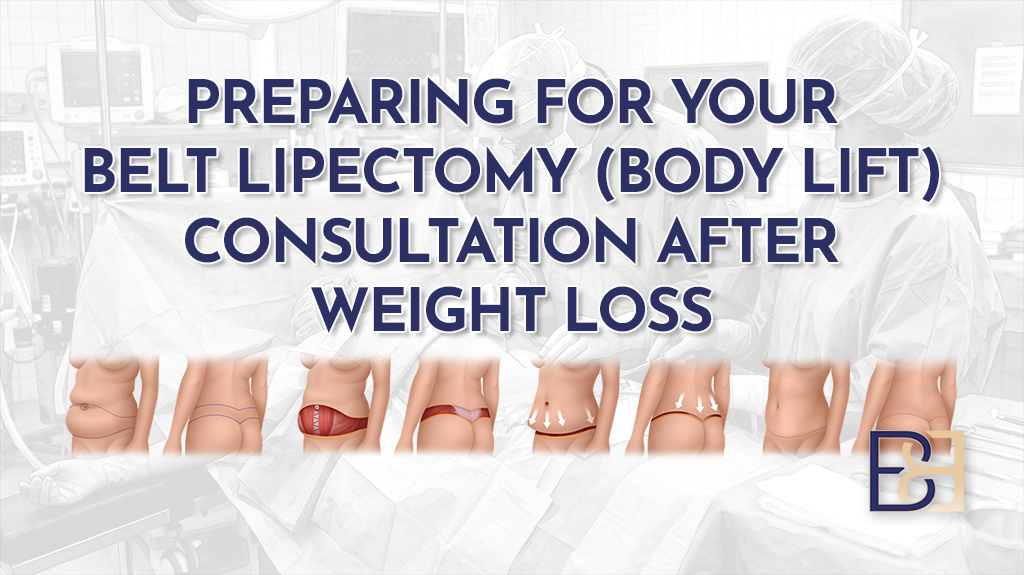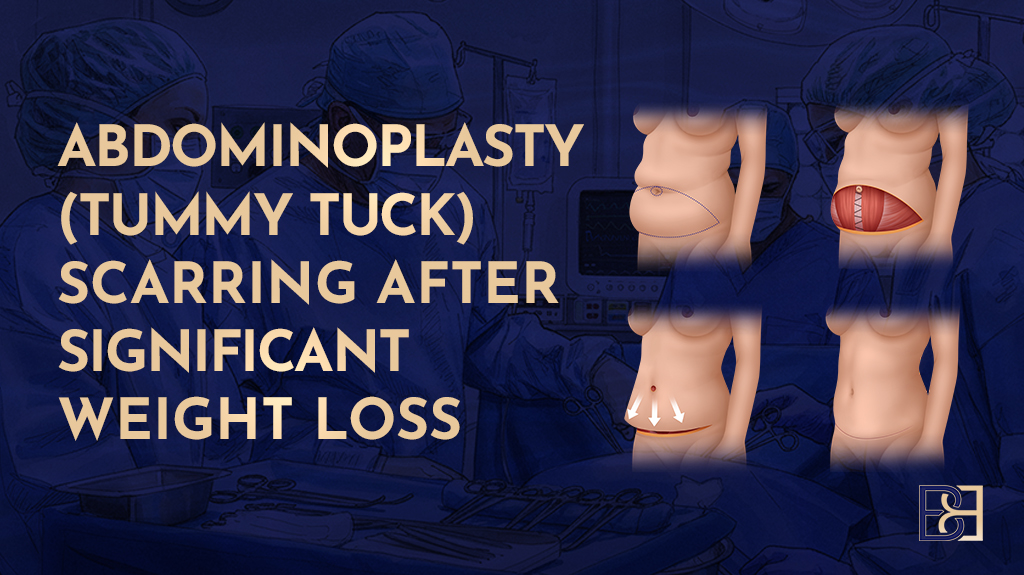
A fleur de lis abdominoplasty is a tummy tuck (abdominoplasty) that removes excess skin in both vertical and horizontal directions. A standard abdominoplasty uses a horizontal incision low across the abdomen to remove skin that hangs downward. The fleur de lis adds a vertical incision up the midline, which allows me to also remove skin that is loose from side to side around the waist. For many patients after significant weight loss, that side to side laxity is the main problem, and it is the one a standard tummy tuck (abdominoplasty) cannot fix.
I perform this operation regularly at Maitland Private Hospital in the Hunter Valley for patients who have experienced significant weight loss through bariatric surgery, medication or lifestyle change. In this guide I will walk you through how the operation works, who it suits, what I do differently from a standard abdominoplasty, what can be combined with it, and what recovery, risks and costs look like. Where I have written detailed separate articles, such as on recovery after fleur de lis abdominoplasty and complications of fleur de lis abdominoplasty, I will point you to them rather than repeat everything here.
The trade-off at the heart of this operation is straightforward. You gain the ability to treat loose skin that no other abdominoplasty pattern can reach. In exchange, you accept a vertical scar up the middle of your abdomen. Whether that trade is worth making depends on your skin pattern, your health and your priorities, and it is a decision we make together at consultation.
What Is a Fleur de Lis Abdominoplasty?
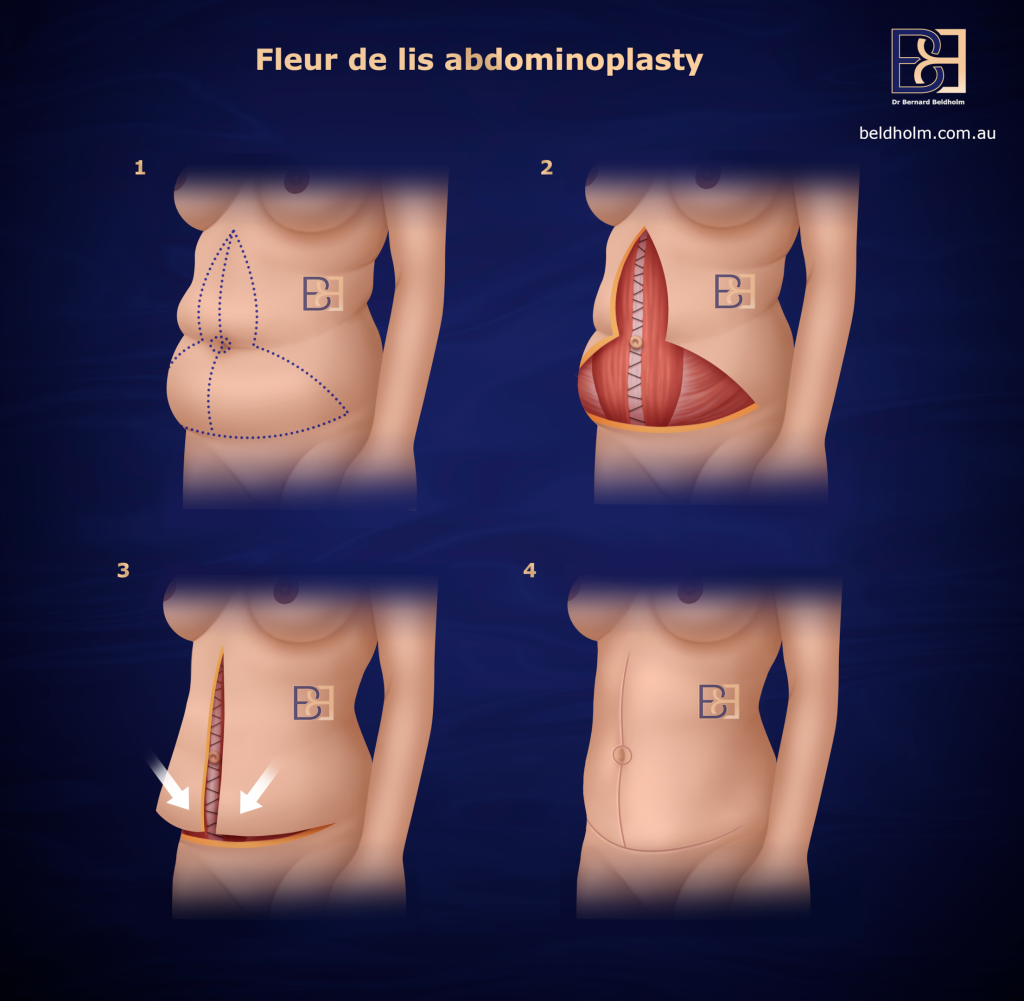
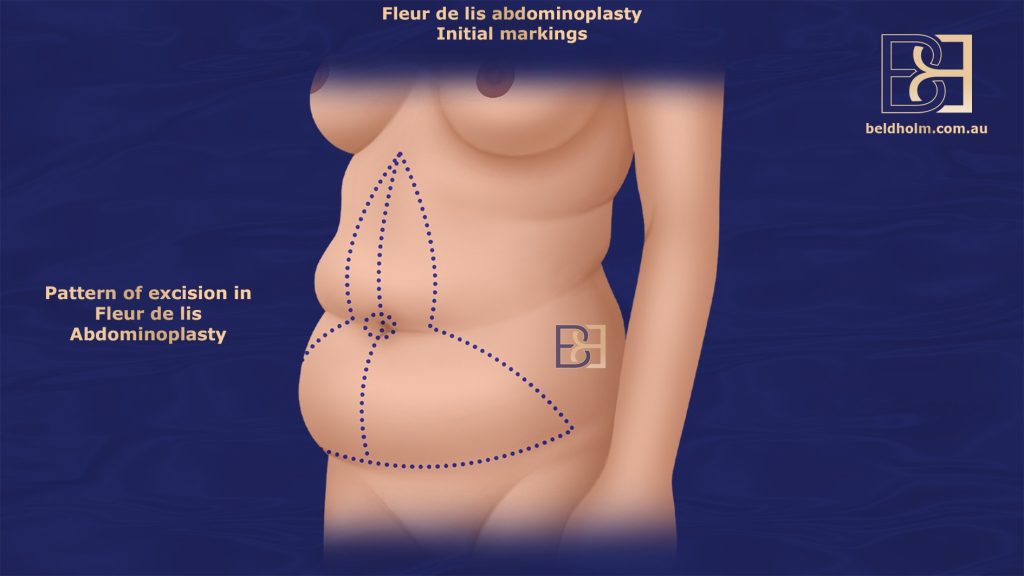
The fleur de lis abdominoplasty, sometimes called a fleur de lis tummy tuck (abdominoplasty) or a vertical abdominoplasty, takes its name from the French heraldic lily. When the incisions for fleur de lis surgery are marked out on the abdomen, the pattern resembles the stylised flower: a horizontal line low across the abdomen and a vertical line running up the midline towards the breastbone. Together they form an inverted T.
Each incision does a different job, and the direction matters:
- The horizontal incision sits low across the abdomen, in the same position as a standard tummy tuck (abdominoplasty) incision. It removes excess abdominal skin that is loose from top to bottom, the apron that hangs downward over the lower abdomen and pubic area.
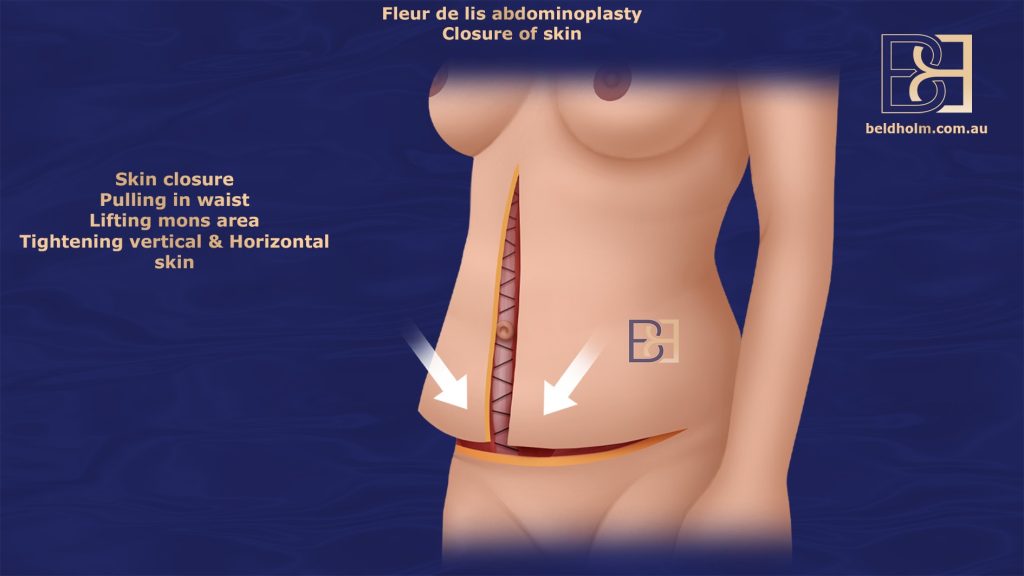
- The vertical incision runs up the midline. It removes skin that is loose from side to side. Bringing the skin edges together in the midline draws the waist inward, which is something no horizontal incision can do.
This is the key point that decides who needs this operation. If your loose skin only hangs downward, a standard or extended abdominoplasty deals with it. But after significant weight loss, many patients are left with skin that is loose in both directions, across both the upper and lower abdomen. The abdomen has deflated all over, not just above the pubic area. Pulling that skin downward alone leaves the side to side looseness behind, and the result is a flatter but still wide and lax abdomen.
The fleur de lis is designed to target excess skin in both directions in the 1 operation. That is its purpose, and it is why the operation has such a strong role in post weight loss body contouring specifically. In my practice, almost every fleur de lis abdominoplasty I perform is for a patient after massive weight loss, whether through bariatric surgery, weight loss medications or diet and exercise.
The cost of that extra capability is the vertical scar, which I discuss openly throughout this guide. The operation only makes sense when the horizontal excess is significant enough to justify the scar.
Fleur de Lis vs Standard Abdominoplasty (Tummy Tuck)
The choice between a fleur de lis and a standard abdominoplasty comes down to 1 question: in which direction is your skin loose?
Direction of skin excess
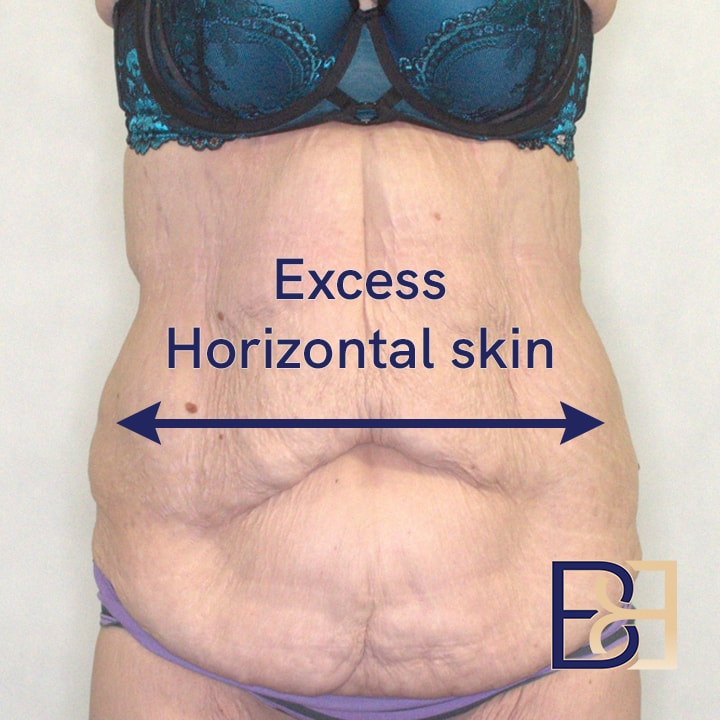
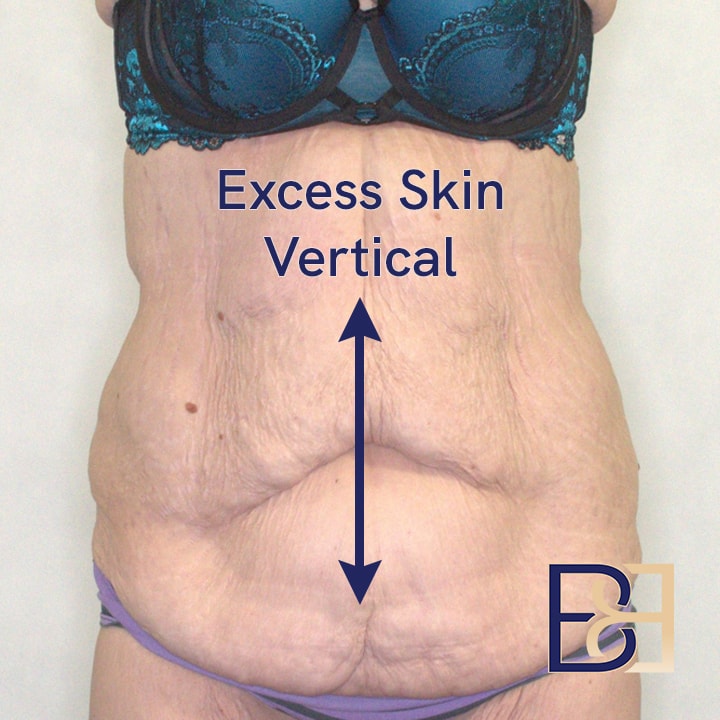
Skin excess after weight loss runs in 2 directions, and each direction needs a different excision to treat it:
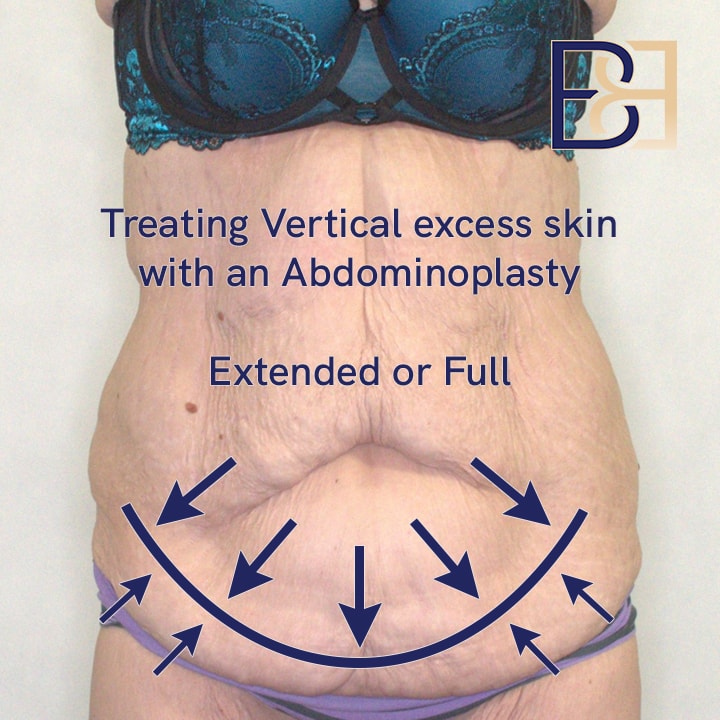
- Vertical excess is looseness running from top to bottom. The skin hangs downward like an apron. A horizontal incision removes it, because the excision line runs across the direction of the excess and the skin above is pulled down to close the gap.
- Horizontal excess is looseness running from side to side. The abdomen is wide and lax around the waist. A vertical midline incision removes it, because closing the midline draws the skin in from both sides and brings the waistline inward.
A standard abdominoplasty, sometimes called a traditional abdominoplasty or traditional tummy tuck (abdominoplasty), only has a horizontal incision, so it can only treat vertical excess. The fleur de lis uses both a horizontal incision and a vertical one. For post pregnancy patients, the standard operation is usually all that is needed. The skin excess after pregnancy sits mainly in the lower abdomen and hangs downward.
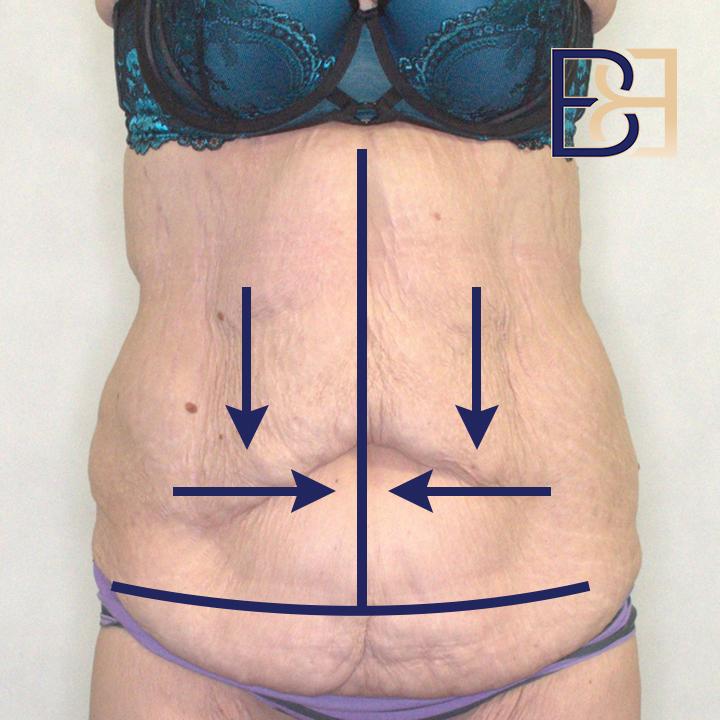
Post weight loss patients are different. When the whole abdomen has deflated after major weight loss, skin is usually loose in both directions. In my practice, I see this pattern constantly: a patient has been assessed elsewhere for a standard tummy tuck (abdominoplasty), but when I examine them and pinch the skin across the upper abdomen, there is a large amount of side to side excess that a horizontal incision alone would leave completely untreated.
What each operation can and cannot do
Standard abdominoplasty | Fleur de lis abdominoplasty | |
|---|---|---|
Incision pattern | Horizontal only | Horizontal plus vertical midline (inverted T) |
Treats vertical (top to bottom) excess | Yes | Yes |
Treats horizontal (side to side) excess | No | Yes |
Draws the waistline inward | No | Yes |
Upper abdominal skin tightening | Limited | Yes |
Scar | Hip to hip, hidden in underwear line | Same, plus vertical midline scar |
Typical patient | Post pregnancy | Post weight loss |
The extended abdominoplasty middle ground
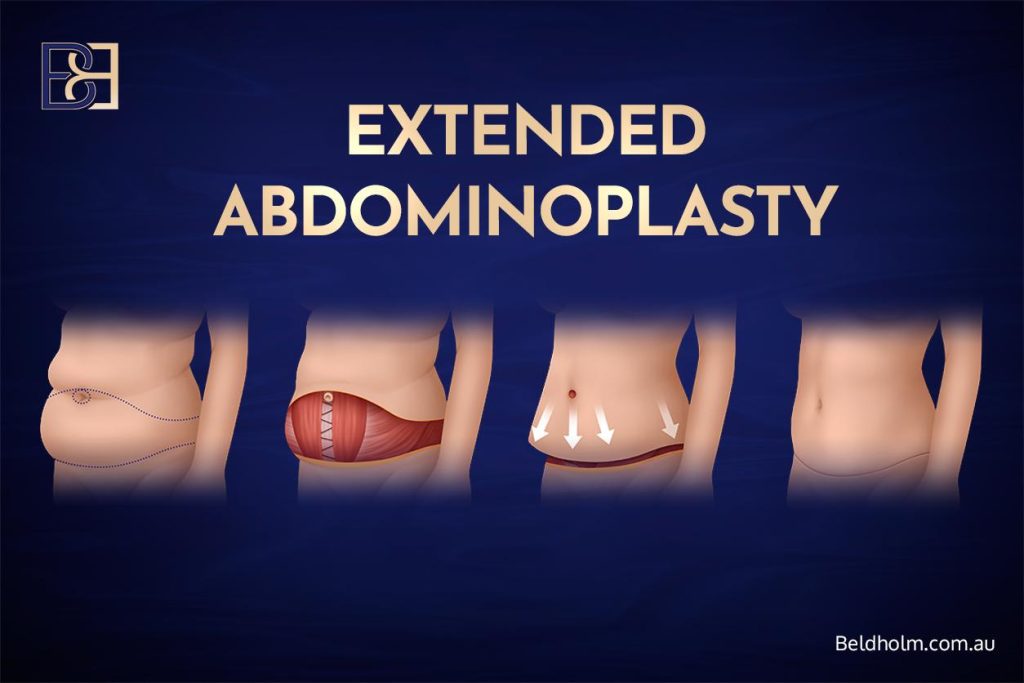
For post weight loss patients whose excess is mainly vertical but extends around the flanks, an extended abdominoplasty lengthens the horizontal incision around the hips without adding a vertical component. This is the standard anterior operation in my post weight loss practice when side to side laxity is not the dominant problem. The fleur de lis is the step beyond it, for patients whose waist and upper abdominal laxity cannot be treated by any horizontal incision, however long.
Related operations in my practice
Two further operations build on the fleur de lis pattern, and I have written about both separately:
- The dual vector abdominoplasty, my technique combining the fleur de lis with excision of upper abdominal skin, for patients with laxity in multiple directions that a fleur de lis alone cannot reach.
- The circumferential hybrid abdominoplasty, which combines a belt lipectomy (body lift) with an anterior vertical incision, for patients whose excess runs the full way around the trunk.
If your loose skin continues around your back and buttocks, the comparison worth reading is between the fleur de lis and these circumferential operations, not between the fleur de lis and a standard tummy tuck (abdominoplasty).
Who Is Suited to a Fleur de Lis Abdominoplasty?
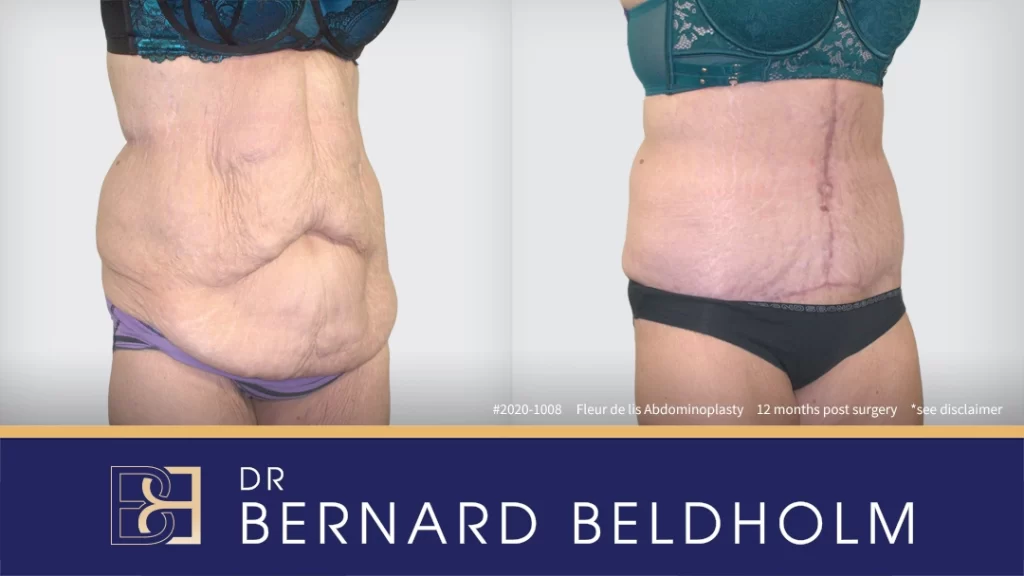
Disclaimer: Results vary, surgery has risks, seek second opinion. Operation performed by Dr Beldholm
There is no single measurement that decides this. When I assess a patient, I am weighing the pattern of their skin excess against their health, their weight history and what they want from the operation.
The skin pattern
The defining feature is significant skin laxity running side to side, usually across the upper abdomen and waist, on top of the downward-hanging excess of the lower abdomen. I assess this by examination: pinching the skin vertically and horizontally at several points tells me how much excess runs in each direction. Patients often recognise the loose abdominal skin themselves as a wide, deflated abdomen with folds that wrap around the waist, rather than a single apron of skin.
If the pinch test shows little side to side excess, I will steer you towards an extended abdominoplasty instead. The vertical scar is only worth carrying if it is removing a genuine problem.
Your weight history
- How the weight was lost does not matter. Bariatric surgery, weight loss medications and diet and exercise all produce the same surgical problem: skin that has not shrunk back after the volume beneath it has gone. Patients who have lost significant weight through medication are now a large part of my practice and are assessed the same way as everyone else.
- Stable weight matters a great deal. I want your weight stable for at least 6 months before surgery, and 12 months is better. This aligns with the Medicare criterion, but the clinical reason is more important: if your weight is still falling, new laxity will develop after surgery, and if it is rising, the result will be strained. Stability also tells me your nutritional intake has settled. A healthy diet and a healthy lifestyle you can sustain long term support healing and give the best foundation for keeping the result.
- Significant weight loss is what creates the 2-directional skin pattern this operation treats. Medicare defines it as at least 5 BMI units for rebate purposes, and most of my fleur de lis patients have lost considerably more than that.
Your general health

A fleur de lis abdominoplasty is a major surgical procedure under general anaesthesia, spanning several hours of operating time. I assess:
- Medical conditions. Diabetes, heart and lung conditions, and clotting disorders all factor into whether this operation, a staged approach, or no surgery is the right call.
- Smoking and nicotine. Nicotine constricts the blood supply to the skin flaps. With an inverted T closure, the junction point where the 3 scar lines meet depends on good blood supply to heal. I require patients to stop all nicotine well before surgery.
- Nutritional status. Post weight loss patients, particularly after bariatric surgery, commonly carry nutritional deficiencies that impair wound healing. I cover this in the preparation section below.
- BMI. I use BMI as a rough guide only, not a cut-off. A higher BMI raises the risk of poor wound healing, but the clinical picture, including how much of that BMI is loose skin itself, counts for more than the number.
What this operation will not do
The fleur de lis removes skin and reshapes the abdominal area and waist. It is not a weight loss operation, it does not remove stretch marks outside the excised skin, and it will not change skin quality elsewhere on your body. Patients whose main concern is loose skin of the back, buttocks or thighs need a different operation, and I cover the alternatives in the section on combined procedures.
Whether this operation suits you is decided at consultation, after examination and a review of your health and weight history.
How I Perform the Operation
Every fleur de lis abdominoplasty I perform takes place at Maitland Private Hospital under general anaesthesia. Operating time is typically 3 to 5 hours. Extensive skin removal takes longer, as does other work planned in the same operation, such as hernia repair.
Marking
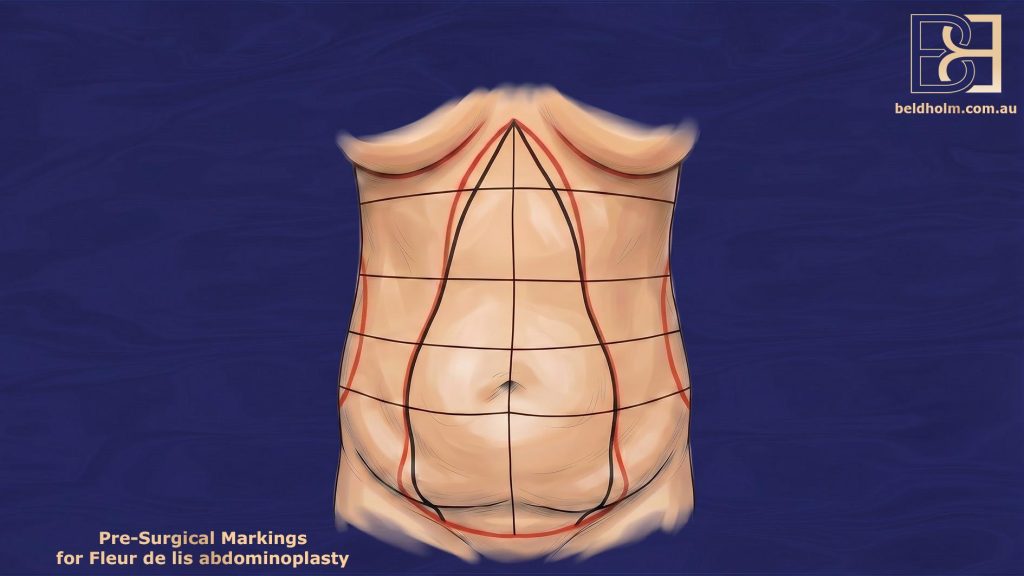
I mark the incision pattern with you standing, before you go to sleep. The markings map both directions of excess across the lower and upper abdomen: the horizontal ellipse and the vertical wedge up the midline. Skin falls differently when you lie flat, and the goal is a scar that sits low and central when you are upright.
The operation, step by step
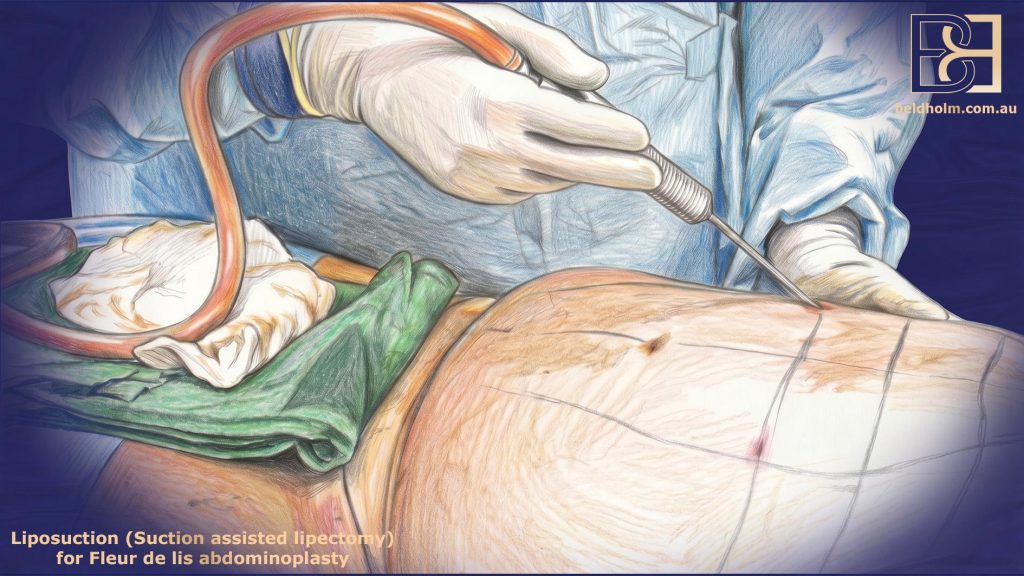
- VASER liposuction (ultrasound assisted lipectomy) is performed first where planned. Thinning the fat layer before excision helps me shape the flanks and upper abdomen and reduces the thickness mismatch where the skin edges meet. I have written a separate walkthrough of a VASER-assisted fleur de lis operation if you want that level of detail.
- I remove excess skin following the marked pattern: the lower horizontal ellipse and the vertical midline wedge, checking the tension repeatedly before committing to the final cut. Taking too little leaves laxity behind; taking too much puts the closure under strain. How much excess tissue to take is the core judgement of the operation.
- Hernias are repaired and muscle separation treated where present. Any umbilical, epigastric or incisional hernia of the abdominal wall found is repaired through the same exposure. Where the abdominal muscles have separated, a condition called muscle separation (diastasis recti), I perform a muscle repair at this stage. Separated or weakened abdominal muscles are more common in patients who have also been pregnant, so this is assessed for each patient, not done as a routine.
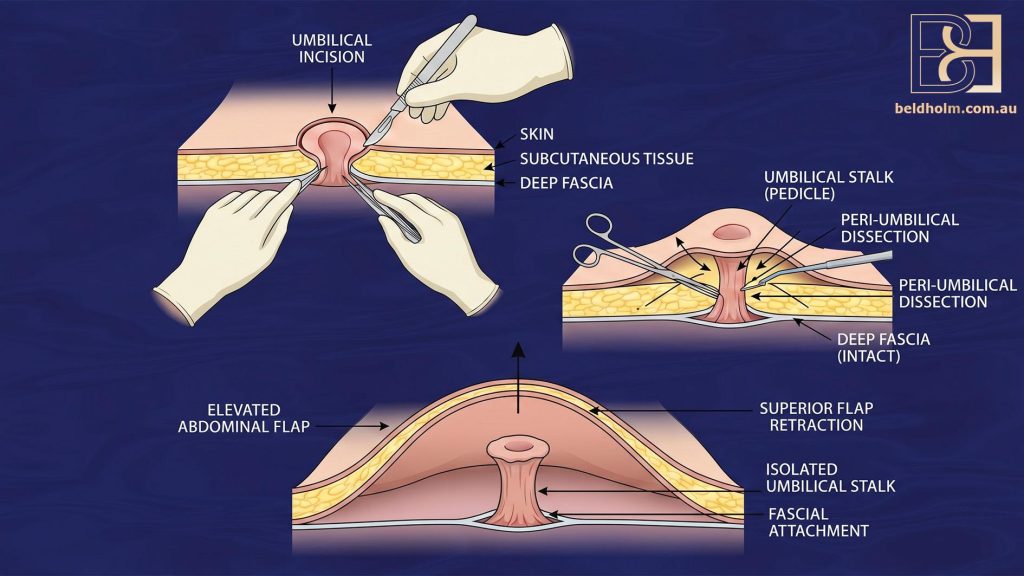
- The belly button (umbilicus) is preserved on its blood supply and brought out through a new opening in the remaining skin. In a fleur de lis, the vertical closure meets the umbilical opening, and I take particular care with the blood supply here.
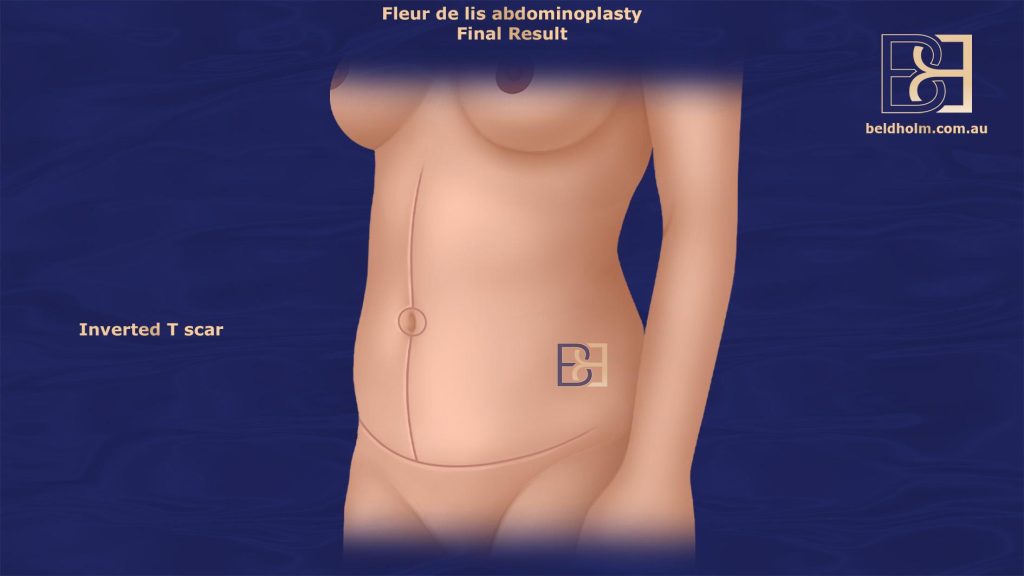
- Closure is in layers, with deep sutures carrying the tension so the skin edges sit together without strain. The 3 scar lines meet just above the pubic area, and this T junction is the part of the wound I watch most closely afterwards, because it has the most demanding blood supply of the whole closure.
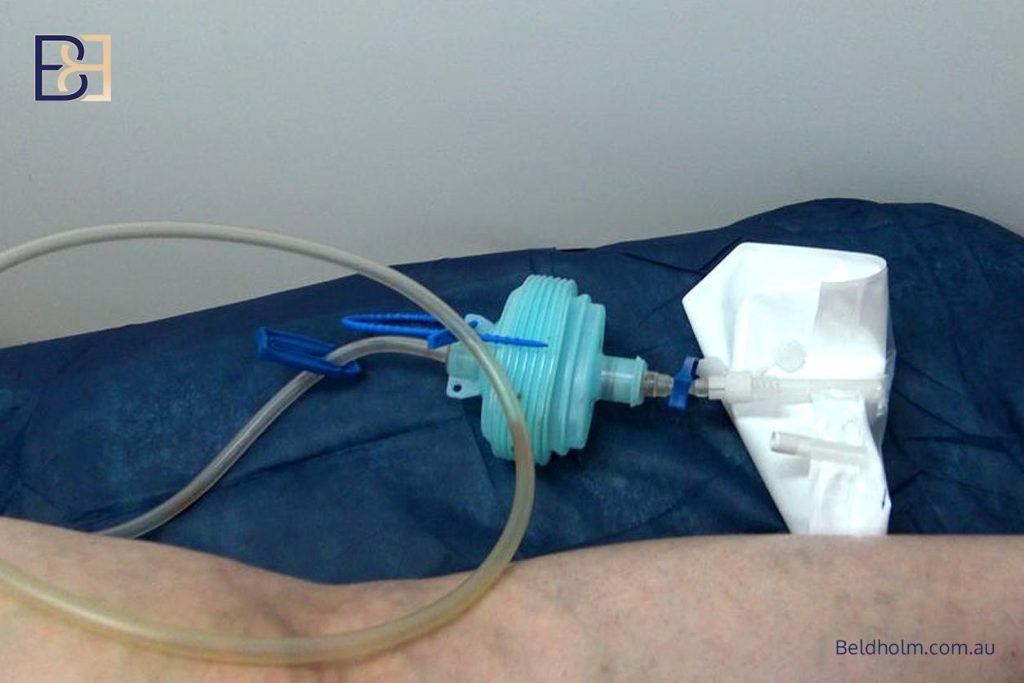
- Drains and dressings are placed at the end of the operation, and you wake in a compression garment.
After the operation
The ward team and I review the wound and drains daily until discharge. From there, the recovery pathway, including garments, dressings, activity and return to work, is covered in my dedicated article on recovery after fleur de lis abdominoplasty.
Combining Procedures, and When Staging Is the Better Path
Most post weight loss patients have loose skin in more than one area. That raises a question I discuss at almost every consultation: should the work be done in 1 larger operation, or spread across 2 or more?
When the trunk pattern needs more than a fleur de lis
If your skin excess continues past the flanks and around your back, a fleur de lis alone will treat the front and leave the back untouched. The operations that deal with the full trunk are:
- Belt lipectomy (body lift), which carries the horizontal excision the whole way around the trunk, lifting the buttocks and outer thighs as well as the abdomen.
- Circumferential hybrid abdominoplasty, my technique combining a belt lipectomy (body lift) with an anterior vertical incision, for patients who have circumferential excess and side to side laxity at the front.
- Dual vector abdominoplasty, which combines the fleur de lis with excision of upper abdominal skin for laxity running in multiple directions.
These are not add-ons to a fleur de lis. They are different operations for different skin patterns, and the examination determines which pattern you have.
My position on single-stage surgery
Where a patient is medically suited to it, my preference is to treat their loose skin in a single comprehensive operation rather than dividing it across several procedures. The reasoning is practical: one operation means one anaesthetic, one hospital admission and one recovery period, rather than repeating each of those 2 or 3 times.
This is a preference, not a rule. A larger single operation is a bigger physiological event than a smaller one. That is the trade-off, and it is why pre-operative preparation carries more weight, not less, when a comprehensive operation is planned.
When staging is the more appropriate path
For some patients, doing everything at once places more demand on the body than is sensible, and staging the work across separate operations is the more appropriate path. Staging is a legitimate clinical choice, not a fallback. I recommend it when:
- Medical factors mean a longer anaesthetic is not appropriate for you
- Nutritional status needs correction that limits how much surgery should be done at once
- The extent of the work cannot be completed well in a single operating time
Whether one operation or staged surgery suits you depends on your medical history, nutritional status and the pattern and extent of your skin laxity. That decision is made with you at consultation, after examination, not before.
Preparing for Surgery
A fleur de lis abdominoplasty asks a lot of your body. Preparation is where you influence the outcome most, and in my practice it starts weeks to months before the operation date.
Nutrition comes first

Most post weight loss patients arrive with nutritional gaps. Reduced intake, restrictive eating patterns and, after bariatric surgery, reduced absorption all leave their mark, and the deficiencies that develop during weight loss are exactly the ones that impair the healing process: protein, iron, vitamin D, zinc and several others. With an inverted T closure to heal, correcting these to support wound healing before surgery is not an optional extra. It is part of what makes the operation an appropriate choice at all.

I have written a full series on this, starting with my article on nutritional deficiencies after weight loss and my vitamins and supplements guide. The short version: I check, I correct what needs correcting, and I use targeted supplementation guided by your blood results rather than guesswork.
The pre-operative blood panel
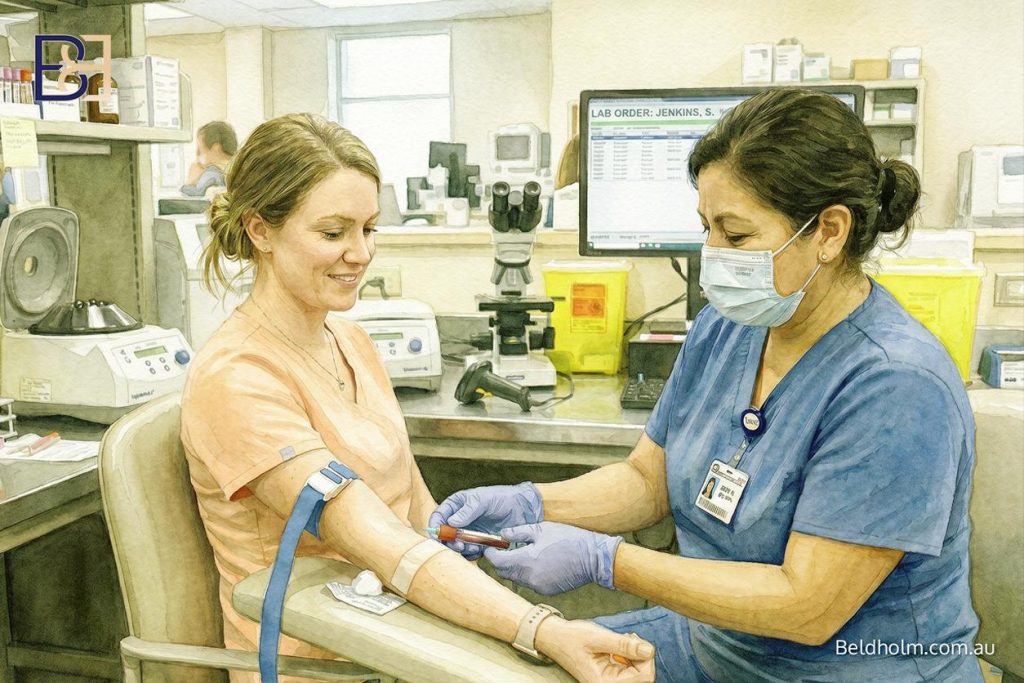
Every post weight loss body contouring patient in my practice has the same panel before surgery: full blood count, coagulation screen, liver function tests, electrolytes, glucose and HbA1c, iron studies, thyroid function, hepatitis B, hepatitis C and HIV screening, pregnancy test where applicable, albumin as the protein marker, and micronutrients including vitamins A, B1, B6, B12, folate, red cell folate, vitamin D, vitamin E, zinc and selenium. Your GP is copied into the results. I explain what each test is for in my article on [pre-operative blood tests].
Medications
- Weight loss medications. Current Australian guidelines do not recommend routinely stopping these before surgery, and I follow that position. If your protein intake is falling short of target during preparation, a temporary dose adjustment is something we may discuss, but that is a decision made with me for your specific situation. Do not adjust or stop these medications on your own.
- Blood thinners and aspirin. I assess your clotting risk and decide the plan for these myself as part of planning your surgery. Most patients stop them 1 week before the operation; some need to continue through surgery, which we plan well in advance. Never stop these yourself.
- Everything else. Bring a complete list, including supplements, to your consultation. Some over-the-counter products affect bleeding and need to stop before surgery.
Nicotine, again
I said it in the suitability section and it bears repeating once: all nicotine must stop well before this operation. The junction point of the closure depends on skin blood supply that nicotine directly constricts.
Book your appointment online now
Recovery: What to Expect

The initial recovery period is measured in weeks, not days, and I will not pretend otherwise. The headline numbers:
- Hospital stay: 2 to 3 nights, walking with assistance from day 1
- Pain management: discomfort is expected in the first weeks and managed with prescribed pain medication
- Compression garments: worn continuously in the early weeks to reduce swelling and promote proper healing, then weaned on my instructions
- Desk-based work: most patients return at 2 to 4 weeks
- Physical work and exercise: graduated return over 6 weeks, with heavy lifting and intense physical exercise held back until the deep repair has healed
- Swelling: settles over months, and the final shape is not the shape you see at week 2

The T junction of the wound needs particular attention during healing, and small areas of delayed healing there are common enough that I prepare every patient for the possibility. Because of this, follow-up is intensive in the first 2 weeks, with close wound review through my rooms, then continues at 4 weeks, 3 months, 6 months and 12 months after surgery. LED light therapy is available at my clinic during the recovery period. Unusual or severe pain, spreading redness or fever between visits are reasons to seek medical advice promptly.
The full week-by-week recovery process, including dressings, garments, showering, driving and the difference between normal healing and something that needs review, is in my dedicated article on recovery after fleur de lis abdominoplasty.
Risks and Complications
All surgery carries risks, and the fleur de lis pattern carries more wound healing risk than a standard abdominoplasty. Published research comparing abdominoplasty types has found the fleur de lis has one of the higher complication rates among the variants, driven mainly by wound problems (1). The reason is the closure: 3 scar lines meeting at a T junction. Research comparing fleur de lis with traditional abdominoplasty in post weight loss patients found broadly comparable complication rates overall, with wound infection the notable exception (2).
The risks I discuss with every patient include:
- Delayed or poor wound healing, most often at the T junction
- Infection
- Seroma (fluid collection) and haematoma (blood collection)
- Blood clots (deep vein thrombosis and pulmonary embolism), for which I assess your risk and set your prevention plan individually
- Compromise of the blood supply to the belly button (umbilicus) or skin edges
- Scars that widen, thicken or heal unevenly
- Changes in skin sensation, which are expected early and usually settle over months
- The possibility of revision surgery
Numbers, context and what I do to reduce and manage each of these are covered properly in my dedicated article on complications of fleur de lis abdominoplasty. It is worth reading before you make a decision about surgery.
Cost and Medicare

I do not publish fixed prices for this operation because the cost depends on what your operation involves: the extent of skin removal, whether hernia repair or VASER liposuction (ultrasound assisted lipectomy) is included, operating time, and your hospital and anaesthetic fees. You receive a written quote after your consultation, with every component itemised.
Medicare support may be available for a fleur de lis abdominoplasty after significant weight loss under MBS item 30176. The criteria in broad terms:
- Weight loss of at least 5 BMI units
- Weight stable for at least 6 months
- Skin excess that causes documented problems, such as recurring rashes or infections beneath the skin folds that have not responded to other treatment, or interference with daily activities
Meeting the criteria matters beyond the rebate itself, because private health fund contribution towards your hospital stay generally depends on a valid Medicare item number applying. I have written a full guide to Medicare coverage for abdominoplasty, including how eligibility is documented and what to bring to your GP.
Item numbers and their criteria are revised from time to time, so my team confirms current requirements with you as part of your quote.
Frequently Asked Questions
What does the fleur de lis scar look like?
An inverted T: a horizontal scar low across the abdomen, largely hidden by underwear, and a vertical scar running up the midline from the pubic area towards the ribs. The vertical scar is visible when the abdomen is uncovered. Scars are red and raised in the early months and generally settle and fade over 12 to 18 months, though scar quality varies between individuals and cannot be guaranteed. My before and after gallery shows healed examples.
Can the vertical scar be avoided?
Not if you need what it does. Side to side skin excess can only be removed by a vertical excision. If your excess is mainly vertical, you do not need a fleur de lis at all, and an extended abdominoplasty with a horizontal-only scar is the better operation. That is exactly what I assess at examination.
Is there a BMI limit for this operation?
I use BMI as a guide, not a cut-off. Higher BMI increases wound complication risk, so there is a point where I will advise further weight loss or a staged approach first, but that judgement is made on your overall health and skin pattern, not a single number.
What happens if I lose more weight after the operation?
Losing a significant amount of weight after surgery can create new skin laxity, which is why I want your weight stable for at least 6 months, and preferably 12, before operating. Modest fluctuations are normal and do not undo the operation.
What about pregnancy after a fleur de lis abdominoplasty?
Pregnancy after this operation is possible, but it stretches the repaired tissues and abdominal muscles and can create new laxity or recurrence of muscle separation. If you are planning further pregnancies, my usual advice is to complete your family first and have this operation once.
Can I have a fleur de lis after a caesarean section?
Yes. A caesarean scar sits within the skin that is removed, so it is excised with the excess. I have written a separate article on fleur de lis abdominoplasty after caesarean section covering the specifics.
Dr Beldholm’s Final Thoughts

The fleur de lis abdominoplasty occupies a specific place in post weight loss surgery. It is the operation that can remove significant excess skin running in 2 directions, and for the right skin pattern it achieves what no horizontal-only excision can. The price is a vertical scar and a more demanding wound to heal, and I put both in front of every patient without softening them.
What I want you to take from this guide is that the decision is anatomical before it is anything else. The pattern of your skin excess, found on examination, determines whether this operation, an extended abdominoplasty, or one of the circumferential procedures fits your situation. Results vary between patients, and the patients who do best are the ones who arrive at surgery with stable weight, corrected nutrition and a clear understanding of the trade-offs they are making.
If you have lost significant weight and are weighing up your options, start with the articles linked through this guide, and bring your questions with you. A GP referral is needed before we meet.
References
- Chaker SC, Hung YC, Saad M, Perdikis G, Grotting JC, Higdon KK. Complications and Risks Associated With the Different Types of Abdominoplasties: An Analysis of 55,956 Patients. Aesthet Surg J. 2024;44(9):965-975.
- Friedman T, O’Brien Coon D, Michaels J, Purnell C, Hur S, Harris DN, et al. Fleur-de-Lis abdominoplasty: a s*fe alternative to traditional abdominoplasty for the massive weight loss patient. Plast Reconstr Surg. 2010;125(5):1525-1535.