


Mini Facelift (Limited Rhytidectomy) in Newcastle NSW
A mini facelift (limited rhytidectomy) is not one operation. It is an umbrella term covering several smaller procedures: skin-only lifts, the S-lift, and short-scar techniques such as the MACS lift, which tightens the SMAS layer through a limited incision. These procedures use shorter incisions and less dissection than a full facelift (rhytidectomy), and they produce a more limited result. For that reason, I refer to this category as limited facelift (rhytidectomy) surgery.
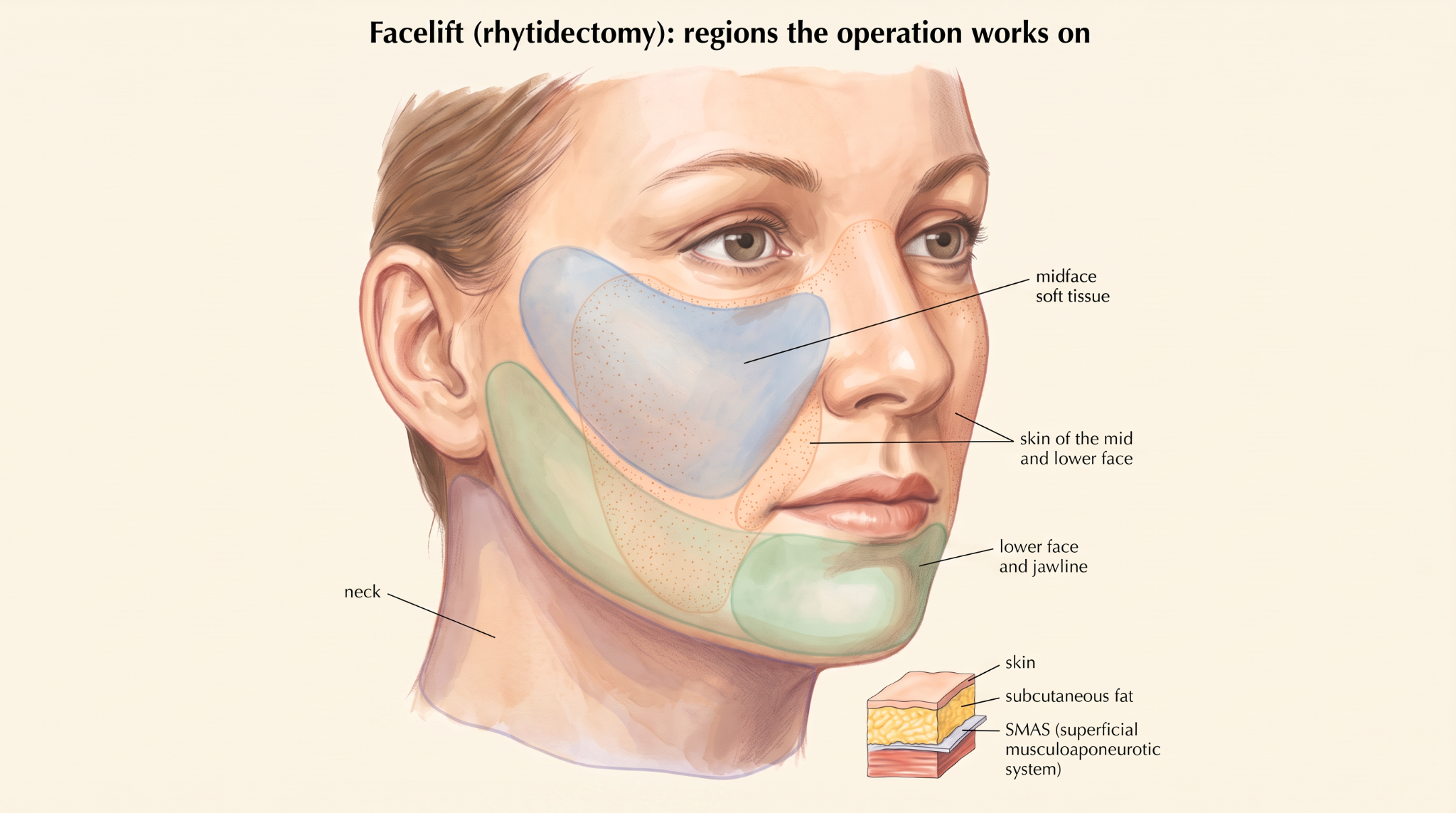
The word “mini” undersells what is involved. A limited facelift (rhytidectomy) is still a significant operation. It involves incisions, anaesthesia, a recovery period, and the same family of risks as any facelift (rhytidectomy).
It also has clear limits. A limited facelift (rhytidectomy) does not replace lost volume, does not change skin texture or fine lines, and does not stop the ageing process. Facial ageing is normal and continues after any surgery, so results are not permanent, and with a limited approach they tend to be more limited and shorter-lived than with a full facelift (rhytidectomy).
If you want more detail on what the different terms in this category actually mean, I cover it fully in my article on the mini facelift (limited rhytidectomy) problem: what the terms actually mean.
Book your appointment online now
What a limited facelift (rhytidectomy) is suited to
Facial ageing has several components: laxity of the skin, descent of the deeper soft tissue, loss of volume, and changes in skin quality. A limited facelift (rhytidectomy) works on a narrow slice of that picture. It is suited to earlier, more limited descent and skin laxity in the mid and lower face, in a patient who understands and accepts a more limited result.
It is not suited to established descent, marked skin excess, or significant changes in the neck. Where those are present, a limited approach will under-deliver, and a full facelift (rhytidectomy), sometimes combined with a neck lift (cervicoplasty), is the honest recommendation. You can read more on the facelift (rhytidectomy) page. Where the changes are very minor, non-surgical measures may be more appropriate, and that is something I discuss at consultation.
I will be direct about my position. A limited facelift (rhytidectomy) is rarely my first recommendation, because the results are limited in extent and tend not to last as long. Some patients specifically want a smaller procedure and accept those trade-offs. I offer it to those patients, after a detailed explanation of what it can and cannot achieve, so the decision is made with clear expectations.
Techniques within the limited facelift (rhytidectomy) category
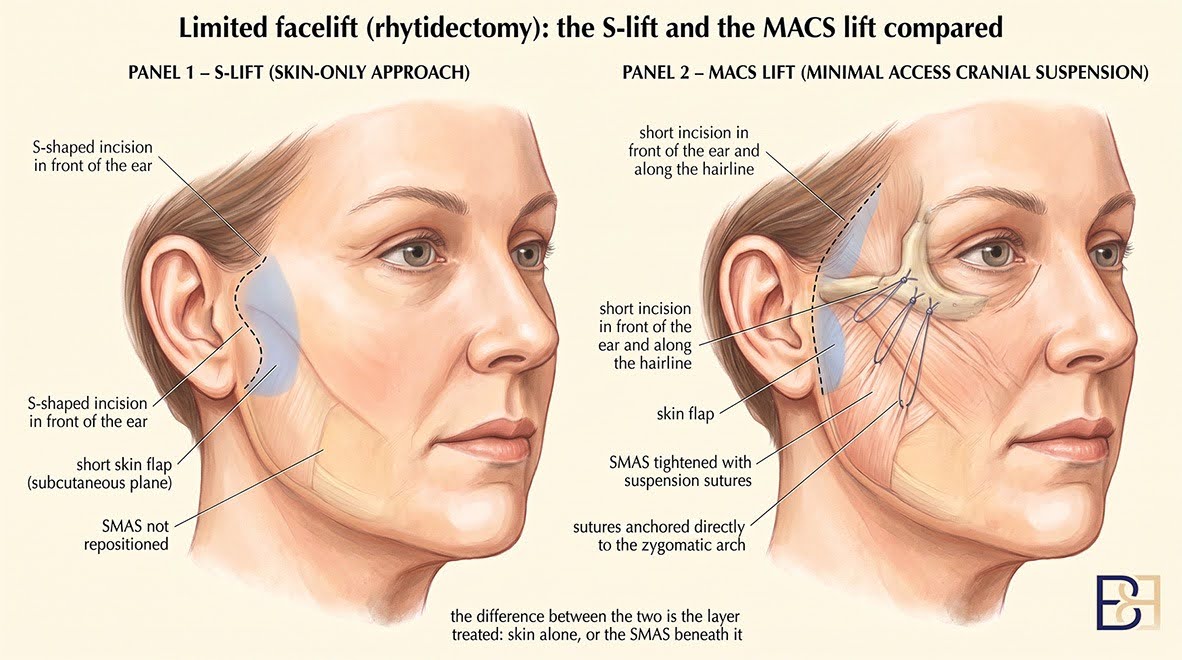
The term covers different operations, and the differences matter, because they determine what the procedure can achieve and how long it lasts.
Skin-only lifts and the S-lift
The S-lift uses an S-shaped incision in front of the ear with a short skin flap. In its original form it is largely a skin-tightening procedure. Skin-only tightening tends to be short-lived, because skin stretches under tension and the descended deeper tissue has not been repositioned. This is the version of a mini facelift (limited rhytidectomy) I rarely recommend.
The MACS lift
The MACS lift (minimal access cranial suspension) is a short-scar technique that works on the deeper layer, not just the skin. Through a shorter incision in front of the ear and along the hairline, the SMAS layer is tightened with suspension sutures. Because it engages the SMAS, it produces a more durable result than a skin-only lift, though still more limited than a full SMAS facelift (rhytidectomy), which involves wider access and more complete repositioning.
Which layer is treated, and how, is the main difference between every facelift (rhytidectomy) technique. I explain how I choose between them in my article on skin-only vs SMAS vs deep plane vs preservation: how I choose.
My approach
I start with assessment, not with a procedure. At consultation I examine skin quality and laxity, descent of the deeper soft tissue, volume, and the neck, supported by standardised clinical photography. That assessment determines whether a limited facelift (rhytidectomy) can deliver a results you are expecting.
Often it shows that a limited approach will under-deliver, and I will tell you that directly rather than operate and disappoint. If a limited procedure is a reasonable fit, or if you have weighed the trade-offs and still prefer a smaller operation, we plan it with clear expectations on both sides.
Preparation matters as much as technique. Blood pressure is reviewed and optimised before surgery, because raised blood pressure contributes to haematoma risk. If you smoke, cessation before surgery is required, because smoking affects skin perfusion and healing.
Book your appointment online now
About Dr Beldholm
I have more than 15 years of experience in surgery of the face and neck. I am a Fellow of the Royal Australasian College of Surgeons (FRACS) and practise as a Specialist Surgeon in the Hunter Valley, NSW.
Facial surgery in my practice sits alongside a broader surgical focus, and every facial procedure I perform starts from the same principle: understand which components of ageing are present before deciding whether surgery, and which operation, is appropriate. Where non-surgical options are better suited to what I find at assessment, I will say so and we can discuss them.
I operate at Maitland Private Hospital, a fully accredited private hospital, with specialist anaesthetists and dedicated nursing staff.
Your pathway
Referral
A GP referral is required before any consultation.
Consultation
Your first consultation runs for about an hour. I take a full history, examine your face and neck, and take standardised clinical photography. We go through what a limited facelift (rhytidectomy) can and cannot achieve for you, the alternatives, the risks, and the recovery. A second consultation is done at no cost.
Quote
You receive a written quote for my surgical fee. The hospital and the anaesthetist provide their own separate quotes, and my patient coordinator organises these for you. A support garment is provided, and all post-operative follow-up with me is included at no extra cost.
Surgery
Surgery is performed under general anaesthesia at Maitland Private Hospital.
Follow-up
Follow-up is intensive for the first two weeks, then continues at four weeks, three months, six months, and twelve months.
Recovery in brief
Recovery after a limited facelift (rhytidectomy) is genuinely shorter than after a full facelift (rhytidectomy), because there is less dissection. That is one of its real advantages.
It is still a surgical recovery. Expect swelling and bruising over the first one to two weeks, some numbness around the incisions that settles over weeks to months, and a staged return to work and exercise. Recovery varies between patients, and I guide the timing at your follow-up visits.
I cover the general timeline in my facelift (rhytidectomy) recovery article, and the differences specific to smaller procedures in my article on mini facelift (limited rhytidectomy) recovery.
Risks
A limited facelift (rhytidectomy) is a smaller operation than a full facelift (rhytidectomy), but it is still a significant operation, and it carries the same family of risks:
- Haematoma (a collection of blood under the skin), with raised blood pressure a contributing factor
- Injury to branches of the facial nerve, which is usually temporary but can be permanent
- Skin flap problems and skin loss, with the risk higher in smokers
- Infection
- Scarring, including hypertrophic scarring, and changes to the hairline near the incisions
- Asymmetry
- Altered sensation around the face and ears, which usually settles over weeks to months
- The possibility of revision surgery
Results vary between patients. I go through the full risk profile with you at consultation, and I cover it in more depth in my article on facelift (rhytidectomy) risks and complications.
Is a limited facelift (rhytidectomy) right for you?
That depends on what is actually present in your face, and on what you want from surgery. A limited facelift (rhytidectomy) suits a narrow group: earlier, more limited changes, in a patient who accepts a more limited and shorter-lived result in exchange for a smaller operation and a shorter recovery. For established changes, a full facelift (rhytidectomy) remains the more reliable operation.
The only way to know which group you fall into is assessment. At consultation I will give you a direct answer about what a limited approach can achieve for you, and what I would recommend instead if it falls short.