


Brow Lift (Browplasty) in Newcastle NSW
A brow lift (browplasty) is an operation that repositions the brow. Over time the brow can descend, particularly at its outer part. When that happens, the soft tissue of the brow sits lower over the bony rim above the eye, and this can create a feeling of heaviness in the upper part of the face. A brow lift (Browplasty) works on the position of the brow itself, lifting it back towards where it sat earlier in life and holding it there.
There are also things a brow lift (Browplasty) does not do. It does not remove excess skin from the upper eyelid. That is a separate operation, an upper blepharoplasty (upper eyelid surgery), and the two are often confused because a low brow and excess upper lid skin can look similar from the outside. Part of my assessment is working out which of the two is actually present, or whether both are. A brow lift (Browplasty) also does not change skin texture, fine lines, or the deeper creases of the forehead in any predictable way.
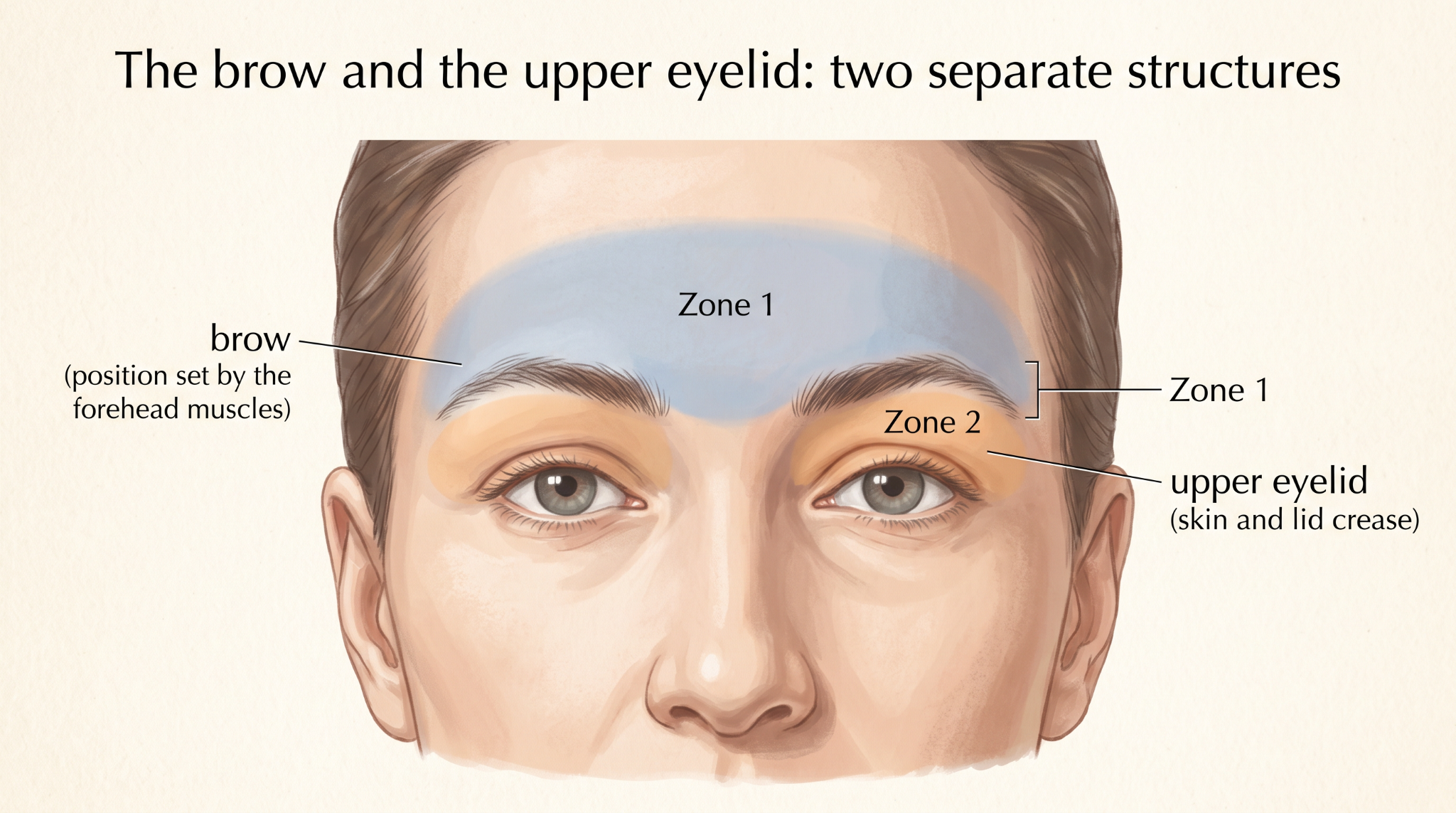
Changes in brow position are part of normal facial ageing. They happen to everyone to some degree, and there is nothing abnormal about a brow that has descended over the years. Surgery is one option for people who want to change it, and whether it is a suitable option is something I can only determine at consultation. A brow lift (Browplasty) also does not stop the ageing process. The face continues to age after surgery, so results are not permanent in that sense.
If you want more detail on how each technique works and how I assess the brow, I cover it fully in my article on brow lift (browplasty) techniques and assessment.
Book your appointment online now
What a brow lift (browplasty) is suited to
A brow lift (Browplasty) is suited to descent of the brow itself. In most people the outer part of the brow descends first and furthest, so the change is often most noticeable towards the tail of the brow. When the brow sits low, it can push soft tissue down towards the upper eyelid and contribute to a sense of heaviness above the eyes.
The important distinction is between a low brow and excess upper eyelid skin. These are two different problems with two different operations. If the brow position is good and the issue is redundant skin on the lid itself, the operation suited to that is an upper blepharoplasty (upper eyelid surgery). If the brow is low and the lid skin is reasonable, a brow lift (Browplasty) is the more logical operation. Some people have both, and in selected patients the two procedures are performed together, but only where both are genuinely indicated, which is decided at consultation. I go through this decision in detail in my article on brow lift (browplasty) versus upper blepharoplasty.
Where the changes are minor, non-surgical measures may be more appropriate than surgery, and that is something I discuss with you at consultation.
Techniques I use
There is no single brow lift (Browplasty) operation. The right technique depends on where the brow has descended, the height and shape of your forehead and hairline, the quality of the skin, and what you are prepared to accept in terms of scars. These are the four techniques I use.
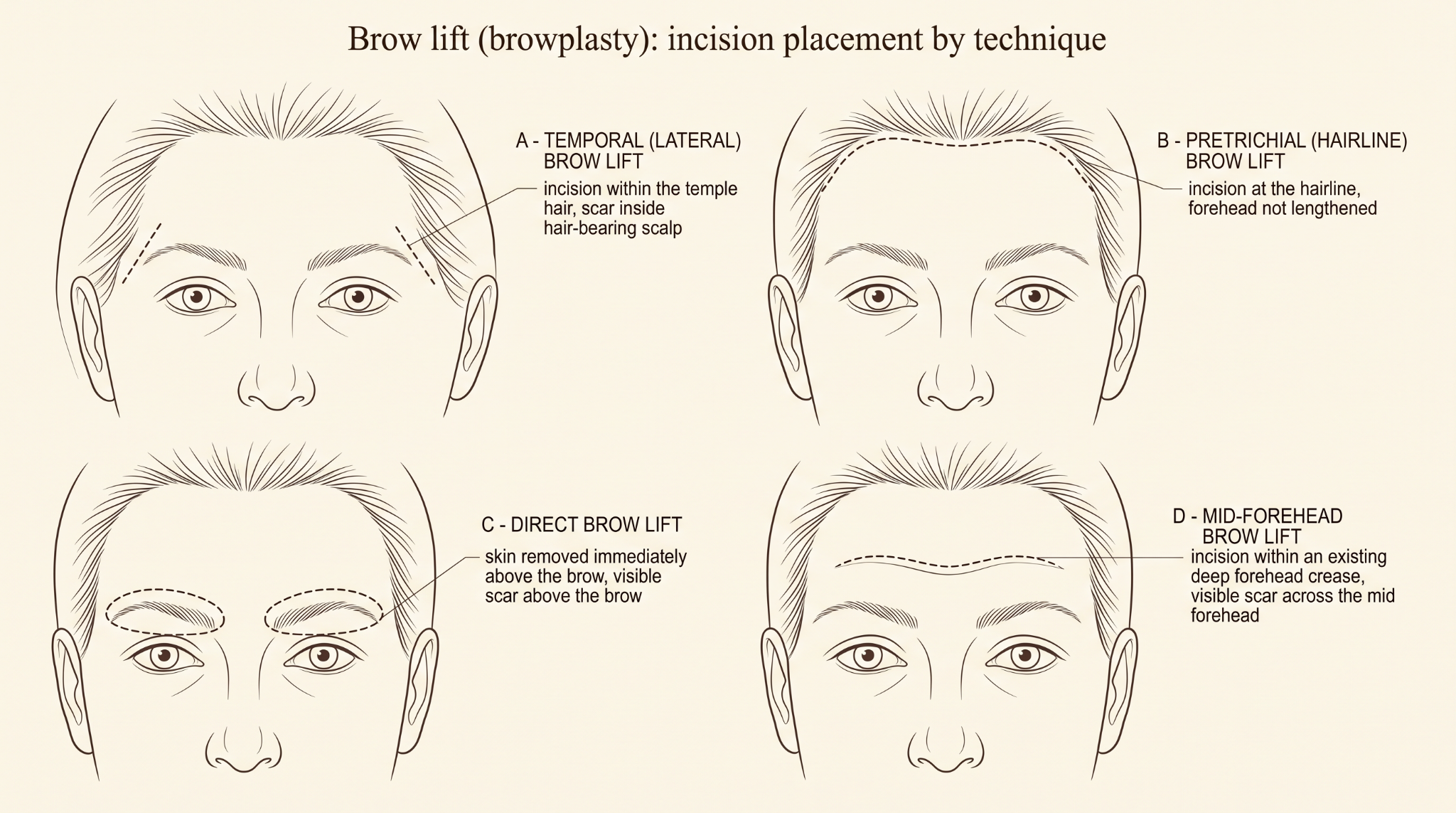
Temporal (lateral) brow lift (Browplasty)
The temporal brow lift (Browplasty) works on the outer part of the brow, which is where descent is usually most pronounced. The incision is placed within the hair of the temple, so the scar sits inside hair-bearing scalp. Through this incision the outer brow is released and repositioned upwards. Because it deals with the outer brow only, it is suited to people whose central brow position is reasonable.
Pretrichial (hairline) brow lift (Browplasty)
The pretrichial brow lift (Browplasty) uses an incision placed at or just in front of the hairline. It allows the whole brow to be repositioned, and because the skin is removed below the hairline rather than behind it, the forehead is not lengthened. This makes it suited to people with a higher forehead, where an incision behind the hairline would raise the hairline further. The scar runs along the hairline, and while it is placed to sit as discreetly as possible, it is still a scar.
Direct brow lift (Browplasty)
The direct brow lift removes a measured strip of skin from immediately above the brow, lifting the brow through direct excision. It is the most precise way to set brow height, but it leaves a visible scar just above the brow, and there is no way around that trade-off. For that reason I reserve it for selected patients, and only after a frank discussion about the scar.
Mid-forehead brow lift (Browplasty)
The mid-forehead brow lift (Browplasty) also lifts the brow through direct excision of skin, but the incision is placed within an existing deep crease across the mid forehead rather than above the brow. It is suited to selected patients with deep forehead creases, most often older men with little or no frontal hair, where an incision at the temple or hairline is not an option. The scar sits across the mid forehead, and although the crease helps to disguise it, it remains a visible scar, which I discuss frankly before surgery. Which technique is suited to you, if any, is determined at consultation after assessment.
My approach
Assessment comes first. Before any operation is proposed, I need to work out what is actually contributing to the heaviness in the upper part of your face. That means examining brow position at rest, the amount and quality of upper eyelid skin, the height of your forehead and hairline, and the depth of any forehead creases. I take standardised clinical photographs as part of this. It is common for people to come in asking about eyelid surgery when the brow is the structure that has descended, and the reverse also happens. The examination sorts that out, and the operation, if any, follows from what is found rather than from what was asked about.
I also assess your general health and fitness for surgery. Blood pressure is reviewed and optimised beforehand, because raised blood pressure contributes to the risk of bleeding and haematoma after facial surgery. If you smoke, cessation before surgery is required for an appropriate period, because smoking affects skin blood supply and healing. Both of these are covered in detail at consultation.
Book your appointment online now
About Dr Beldholm
I have spent more than 15 years performing surgery of the face and neck. My facial practice covers facelift (rhytidectomy), neck lift (cervicoplasty), upper blepharoplasty, and brow lift (browplasty) surgery, and I perform all of these procedures at Maitland Private Hospital in the Hunter Valley.
I am a Fellow of the Royal Australasian College of Surgeons (FRACS) and work as a Specialist Surgeon. Every operation I recommend follows a full assessment, and where surgery is not the right step, I discuss the alternatives with you, including non-surgical options where relevant.
Surgery is performed under general anaesthesia at Maitland Private Hospital, with 24-hour doctor cover, and I review you daily while you are admitted.
Your pathway
A GP referral is required before any consultation. This is a standard requirement, and it also means your GP is involved from the start.
Your initial consultation runs for around an hour. It includes a full health review, examination of your brow, forehead, and upper lids, and standardised clinical photography. We go through the techniques that may suit you, what each involves, where the scars sit, and the risks. A second consultation is required before surgery and is free of charge.
After consultation you receive a written quote for my surgical fee. The hospital and the anaesthetist provide their own separate quotes, and my patient coordinator organises these for you so you have full costs before deciding.
Surgery is performed under general anaesthesia at Maitland Private Hospital. Your anaesthetic consultation is usually done by phone before the day, with a physical examination on the day of surgery.
Follow-up is intensive for the first two weeks, with reviews two to three times a week for wound checks and dressing care. After that I see you at four weeks, three months, six months, and twelve months. All post-operative follow-up is included at no additional cost.
Recovery in brief
Recovery after a brow lift (browplasty) varies with the technique used and between patients. Swelling and bruising around the forehead, temples, and upper lids are expected in the first one to two weeks. Some numbness of the forehead and scalp is common early on and usually settles over weeks to months. Most people take one to two weeks off work depending on the nature of their job, and return to exercise is staged. Scars take months to mature, and sun protection matters during that time.
I cover the full week by week timeline, wound care, and return to activity in my article on brow lift (browplasty) recovery.
Risks
A brow lift (browplasty) is a significant operation, and it carries risks. These include:
- Bleeding and haematoma (a collection of blood that may need to be drained)
- Injury to the temporal branch of the facial nerve, which can cause weakness of the brow. This is usually temporary but can be permanent
- Numbness or altered sensation of the forehead and scalp, which usually settles but can persist
- Visible or thickened (hypertrophic) scarring, particularly relevant to the direct and mid-forehead techniques
- Change in hairline position or hair loss around incisions placed at or within the hairline
- Asymmetry of brow position
- Overcorrection or undercorrection of brow height
- Wound healing problems, higher in smokers
- Infection
- Risks of general anaesthesia
Results vary between patients, and no outcome can be guaranteed. I go through the full risk profile, including how each technique changes it, in my article on brow lift (browplasty) risks and complications.
Is a brow lift (browplasty) right for you?
That depends on what is actually driving the heaviness in the upper part of your face, and it is not something that can be decided from a website. If the brow has descended, a brow lift (Browplasty) may be suited to you, and the right technique depends on what is found at assessment. If the issue is upper lid skin rather than brow position, a different operation is the more logical step, and if the changes are minor, surgery may not be the right step at all.
Brow position changes with age in everyone, and surgery is one option among several, not a requirement. Whether it is appropriate for you is determined at consultation, after examination and a frank discussion about scars, risks, and recovery.