


Face and Neck Surgery in Newcastle NSW
This page brings together the face and neck procedures I perform at Maitland Private Hospital in the Hunter Valley. It is a starting point. Each procedure has its own detailed page, linked below, and the decision about which operation suits you, if any, is only ever made at consultation.
Facial ageing is normal. It has several components: laxity of the skin, descent of the deeper soft tissues, loss of volume, and changes in skin quality. These components age at different rates in different people, and understanding which are present in your face and neck is the first step. No single operation covers all of them.
Surgery repositions descended tissue and removes excess skin. It does not stop the ageing process, it does not change skin texture or fine lines, and results are not permanent in that sense. The face and neck continue to age after any operation.
If you want to understand how I separate these components at assessment, I cover it fully in my article on the components of facial ageing.
Book your appointment online now
Facelift (rhytidectomy) procedures
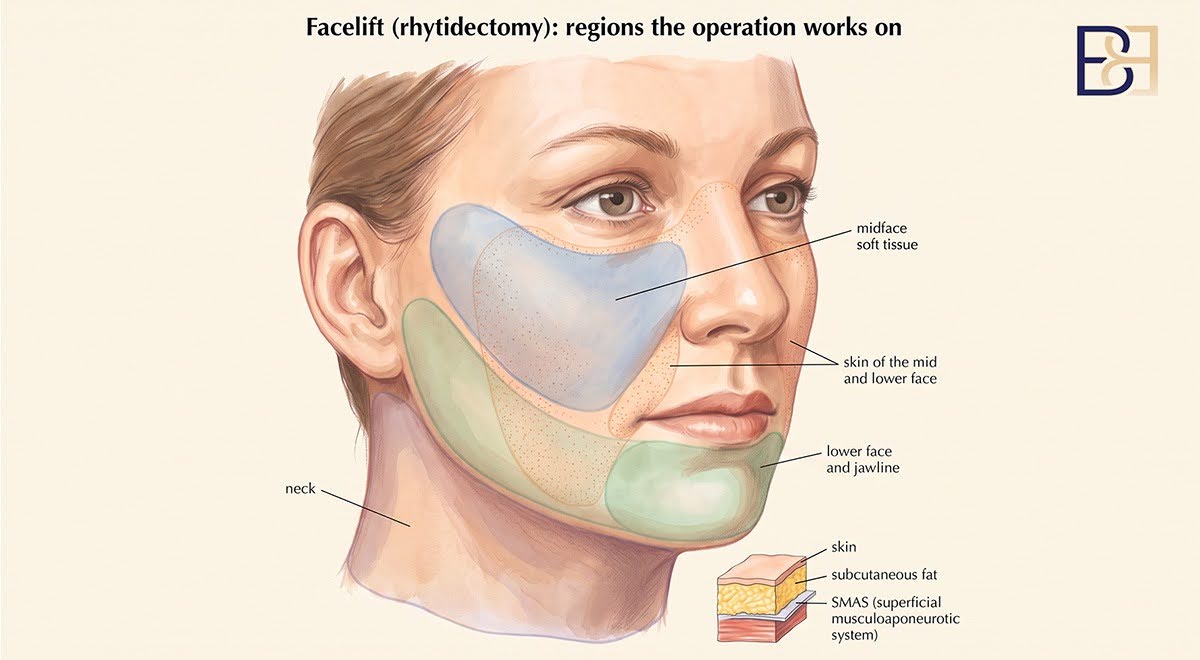
A facelift (rhytidectomy) works on descent of the deeper soft tissues and excess skin of the mid and lower face. I perform several forms of the operation, and the technique is matched to what is found at assessment.
Facelift (rhytidectomy)
The facelift (rhytidectomy) parent page explains what the operation does and does not do, the techniques I use, and how the decision is made.
Deep plane facelift (rhytidectomy)
A deep plane facelift (rhytidectomy) releases and repositions the deeper soft tissue layer as a single unit, with the skin remaining attached to it. The full technique, and who it is suited to, is covered on the deep plane facelift (rhytidectomy) page.
SMAS facelift (rhytidectomy)
A SMAS facelift (rhytidectomy) tightens and repositions the SMAS, the structural layer beneath the skin of the face, with the exact handling decided at assessment. Details are on the SMAS facelift (rhytidectomy) page.
Mini facelift (limited rhytidectomy)
A limited facelift (rhytidectomy) uses shorter incisions and a smaller area of work, suited to earlier and more limited change. It is still a significant operation, which the mini facelift (limited rhytidectomy) page explains.
Neck procedures
The ageing neck has its own set of components: loose skin, laxity or banding of the platysma muscle, and fullness above or below that muscle. The neck procedures I perform each work on a different combination of these.
Neck lift (cervicoplasty)
The neck lift (cervicoplasty) parent page explains what the operation works on, the techniques I use, and how they are combined where needed.
Deep neck lift (cervicoplasty)
A deep neck lift (cervicoplasty) works beneath the platysma muscle on the deeper structures that contribute to neck fullness. What sits in that layer, and what the operation involves, is covered on the deep neck lift (cervicoplasty) page.
Platysmaplasty
Platysmaplasty tightens or repairs the platysma muscle of the neck, most often as a component of a broader neck operation rather than on its own. The platysmaplasty page explains when it is used and what it can and cannot do.
Direct excision of neck skin
Direct excision removes loose neck skin through an incision on the front of the neck, which leaves a visible scar in that position. It is reserved for selected patients, most often those with significant loose neck skin after massive weight loss, and the trade-off is explained frankly on the direct excision of neck skin page.
VASER (ultrasound-assisted liposuction) neck liposuction
VASER (ultrasound-assisted liposuction) removes fat above the platysma muscle in patients with good skin tone. Its indication is narrow, and the VASER neck liposuction (ultrasound-assisted liposuction) page is direct about its limits.
Eyelid and brow procedures
The upper eyelid and the brow are assessed together, because the position of the brow affects how much skin sits over the upper lid. Which structure is driving the change determines which operation is suited.
Upper & lower blepharoplasty
Upper blepharoplasty removes excess skin, and where indicated a strip of muscle and fat, from the upper eyelid. In some patients excess upper lid skin can obstruct the upper part of vision, which is assessed at consultation and covered on the upper blepharoplasty page.
Brow lift
A brow lift repositions the brow where brow descent, rather than the upper lid itself, is the main contributor to what you are seeing. The techniques I use, and how I decide between a brow lift and upper blepharoplasty, are covered on the brow lift page.
My approach
Every procedure on this page starts the same way: with assessment, not with an operation in mind. At consultation I take a history, examine the skin, soft tissues, neck, brow and eyelids, and take standardised clinical photographs. That assessment determines which components of ageing are present and which operation, if any, is suited to them.
Some changes are minor or better suited to non-surgical measures, and I discuss those options at consultation where that is the case. Surgery is one option, not the default.
Where two procedures are needed together, such as a facelift (rhytidectomy) with a neck lift (cervicoplasty), they can be performed in the one operation. That is only done where both are genuinely indicated, decided at consultation.
Preparation matters for every operation on this page. Blood pressure is reviewed and optimised before surgery, and smoking must be ceased for an appropriate period where relevant, because it affects skin healing.
Book your appointment online now
About Dr Beldholm
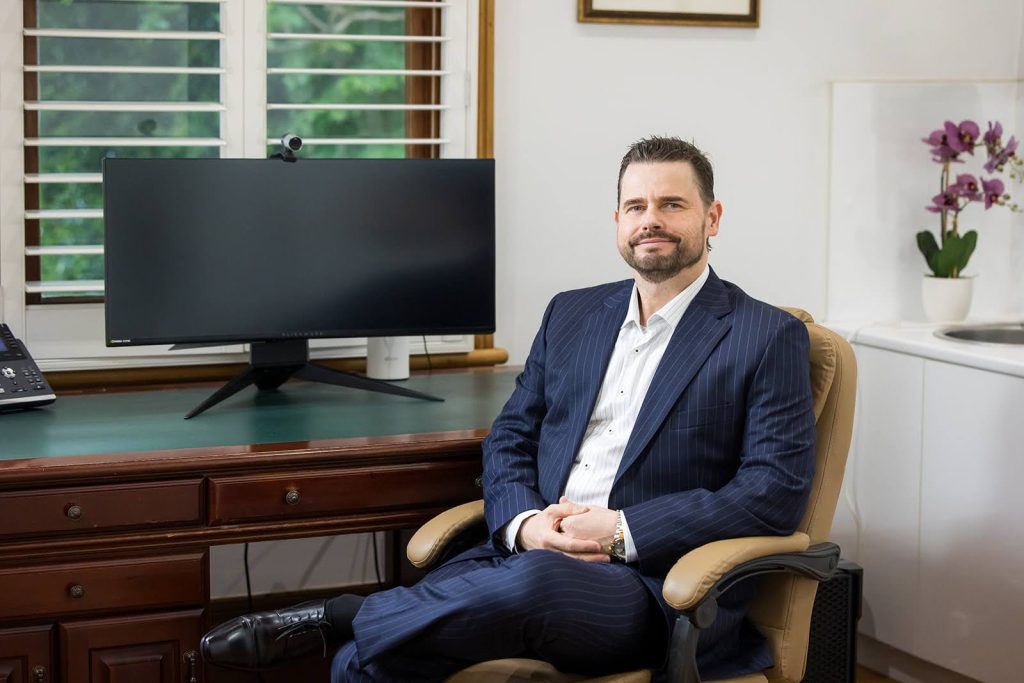
I have performed surgery of the face and neck for more than 15 years. I am a Fellow of the Royal Australasian College of Surgeons (FRACS), and my practice covers facelift (rhytidectomy) surgery, neck lift (cervicoplasty) surgery, upper blepharoplasty and brow lift, alongside body contouring and breast surgery.
I perform every operation myself, and I see my patients personally through preparation, surgery and follow-up. Where a non-surgical measure may suit you better than an operation, I discuss that with you at consultation.
All of my facial surgery is performed under general anaesthesia at Maitland Private Hospital, with 24-hour doctor cover on site.
Your pathway
The pathway is the same for every procedure on this page.
You need a GP referral before any consultation. Your first consultation with me runs for about an hour and includes your medical history, examination, standardised clinical photography, and a frank discussion of what surgery can and cannot do in your case, including the risks. A second consultation is required before surgery and is free of charge.
After consultation you receive my surgical quote, with separate quotes from the hospital and the anaesthetist organised by my patient coordinator, so you know the full cost before you decide.
Surgery is performed under general anaesthesia at Maitland Private Hospital. Where a support garment is needed after your operation, it is provided by my practice. Follow-up is intensive for the first two weeks, then continues at four weeks, three months, six months and twelve months. All follow-up is included at no cost.
Recovery and risks in brief
Every procedure on this page is a significant operation. Swelling, bruising, temporary numbness and scarring are part of recovery for all of them, and time off work and return to exercise are staged. Recovery differs between procedures, and each procedure page above covers its own recovery and risks in detail.
Risks shared across face and neck surgery include:
- Bleeding and haematoma, with raised blood pressure a contributing factor
- Infection
- Nerve injury, including injury affecting facial movement or sensation
- Wound healing problems and skin loss, with the risk higher in smokers
- Visible or thickened scarring
- Asymmetry
- The need for revision surgery
Results vary between patients, and no outcome can be guaranteed.
If you develop sudden, marked, one-sided swelling of the face or neck after surgery, or sudden eye pain or a change in vision after upper blepharoplasty, this needs urgent review. After hours, call Maitland Private Hospital for nurse-led phone advice. Anything needing physical assessment goes to your local emergency department, and for anything life-threatening call 000.
Is face and neck surgery right for you?
That is not a question this page can answer. Facial ageing is normal, and having changes in your face or neck does not mean you need an operation. Surgery is suited to established change in a patient who is medically fit, understands the risks and the recovery, and accepts that results vary and that the face continues to age after surgery.
Whether any of the procedures on this page is appropriate for you, and which one, is determined at consultation after assessment.