


Abdominoplasty (Tummy Tuck), Suction-Assisted Lipectomy (Liposuction) and Breast Surgery After Pregnancy in Newcastle NSW
This page brings together the operations I perform for women after pregnancy and breastfeeding. Each operation has its own page covering what it involves, who it tends to suit, the risks, the recovery and the cost. This page sets out how they fit together.
What this page covers:
- Abdomen: abdominoplasty (tummy tuck), full and limited, and pubic lift (monsplasty)
- Ultrasound-assisted suction lipectomy (VASER liposuction) of the abdomen and flanks on its own
- Breasts: mastopexy (breast lift), breast augmentation (augmentation mammoplasty), and fat grafting to the breast
- Implants from before your children: removal, removal and replacement, and the lift or fat grafting that can go with them

Book your appointment online now
What changes after pregnancy
These changes are normal, and they vary from woman to woman.
- The abdominal skin stretches, and in some women it stays loose
- The 2 vertical abdominal muscles move apart along the midline, which is diastasis recti (abdominal muscle separation)
- Many women I see also have a caesarean scar
- Pregnancy and breastfeeding can change breast volume, shape and the position of the nipple
Some of these changes settle in the months after birth. Some do not. Exercise has a role in recovery, but the evidence that it reliably closes a significant separation is limited, and it does not remove loose skin.
Surgery is an option, and it is not right for everyone. Whether an operation suits you, and which one, is decided at consultation after examination, not from a page.
This page covers surgery after pregnancy. Surgery after significant weight loss is a different set of operations, covered on a separate post weight loss page.
Abdomen after pregnancy
I use 4 operations on the abdomen after pregnancy. Which one fits depends on 3 things I examine at consultation: where the loose skin sits, whether there is diastasis recti and how wide it is, and how well the skin recoils.
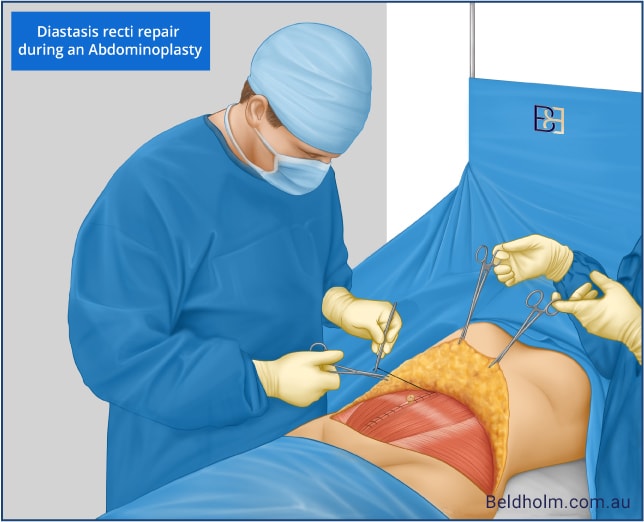
Full abdominoplasty with ultrasound-assisted suction lipectomy (VASER liposuction)
The operation for loose skin across the abdomen with diastasis recti, which is the pattern I see most often after pregnancy.
- Removes excess skin from the lower abdomen, and from the upper abdomen where needed, through a low incision
- Repairs the diastasis recti with sutures along the midline
- Ultrasound-assisted suction lipectomy contours the abdomen and flanks as a routine part of the operation, not an optional extra
- Drainless technique; an existing caesarean scar is removed with the skin, and the new scar sits low across the abdomen
- 1 to 2 nights at Maitland Private Hospital
Read the full abdominoplasty after pregnancy page.
Limited abdominoplasty (tummy tuck)
For loose skin confined to the lower abdomen, below the belly button (umbilicus), with little or no diastasis recti.
- Shorter incision, less skin removed, and the belly button usually stays where it is
- 2 versions: skin removal only, or skin removal with ultrasound-assisted suction lipectomy of the lower abdomen and flanks
- Does not repair diastasis recti above the belly button; where that is present, a full abdominoplasty is usually the operation
- Usually a day procedure, no drains
Read the limited abdominoplasty after pregnancy page.
Ultrasound-assisted suction lipectomy (VASER liposuction) on its own
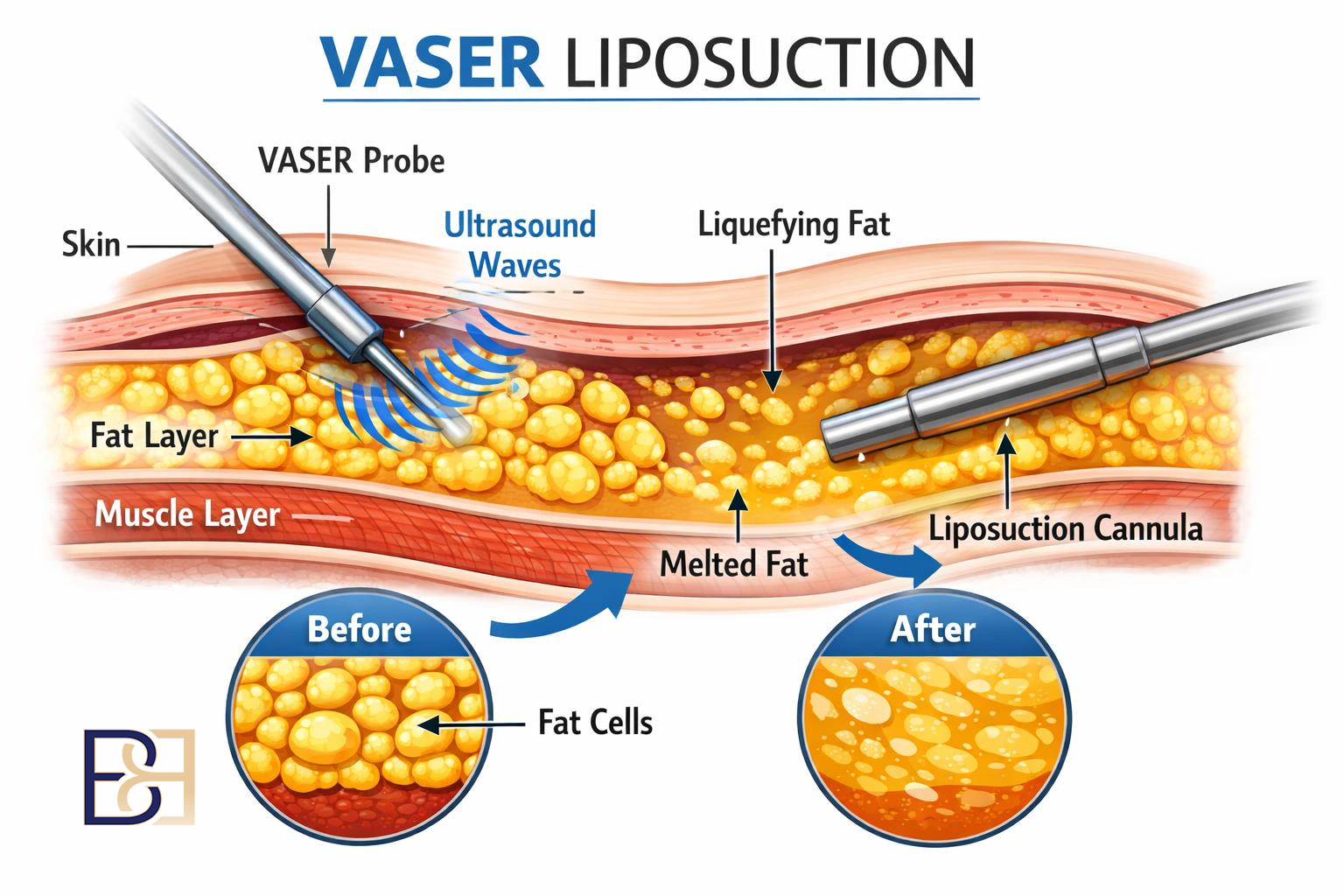
For localised fat on the abdomen and flanks where the skin still recoils well and the muscles have not separated.
- Removes fat only; loose skin and diastasis recti are not treated
- The abdomen and flanks are usually treated as 1 unit so the contour blends
- Day surgery, no drains, compression garment afterwards
- Needs a stable weight; it is not a weight-loss method
Read the ultrasound-assisted suction lipectomy of the abdomen page and the ultrasound-assisted suction lipectomy of the flanks page.
Abdominoplasty (tummy tuck) or suction-assisted lipectomy (liposuction) on its own?
Suction-assisted lipectomy (liposuction) removes fat only. Where the skin has already stretched, taking the fat out from under it can leave the skin looser than before.
Skin after pregnancy usually recoils better than skin after major weight loss, so a small group of women, with localised fat, good skin recoil and no diastasis recti, suit ultrasound-assisted suction lipectomy on its own. Where there is loose skin or diastasis recti, an abdominoplasty (tummy tuck), with ultrasound-assisted suction lipectomy as part of it, is usually the operation.
Pubic lift (monsplasty)
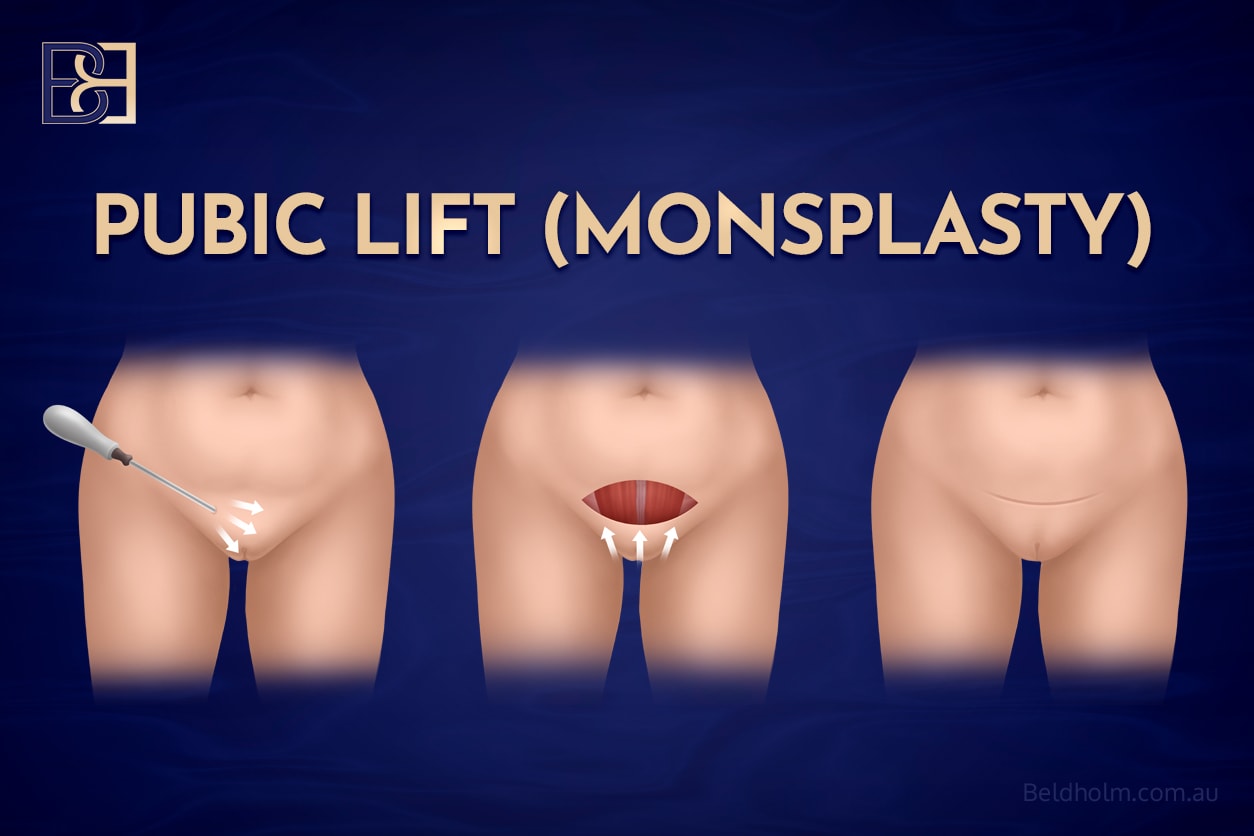
The mons pubis, the fatty pad over the pubic bone, can carry excess fat, loose skin, or both after pregnancy, and is often more noticeable once the lower abdomen has been treated.
- A fat-dominant pattern can be treated with ultrasound-assisted suction lipectomy alone
- A skin-dominant pattern needs skin removal and a lift, through a low incision within the underwear line
- On its own, a day procedure of 1 to 2 hours with no drains; or done within the abdominoplasty incision in the same operation
Read the pubic lift (monsplasty) after pregnancy page.
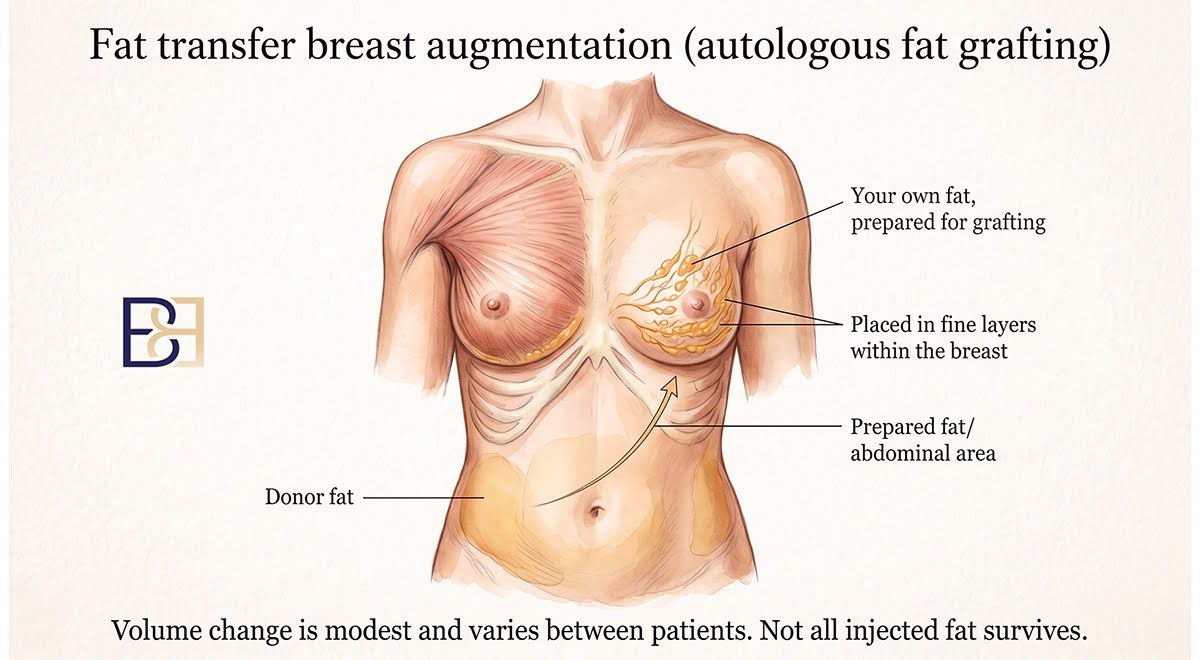
Fat grafting (fat injections) to the breast during abdominoplasty (tummy tuck)
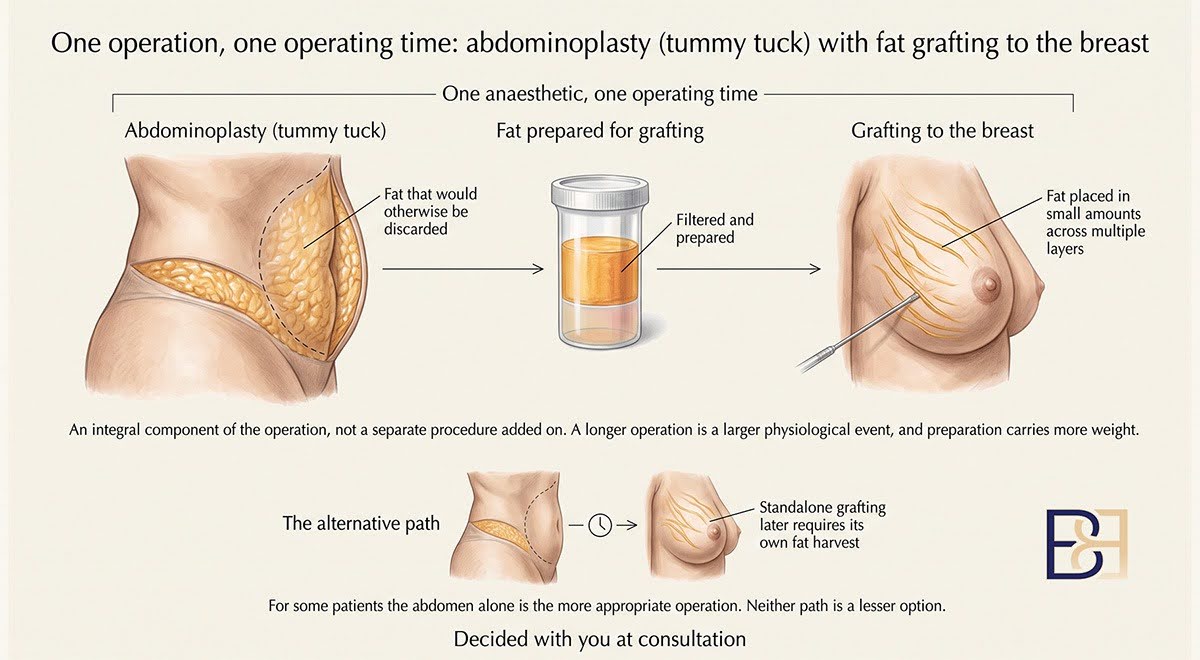
Where an abdominoplasty is already planned, the fat removed by ultrasound-assisted suction lipectomy, which would otherwise be discarded, can be prepared and grafted to the breast in the same operation.
- Harvest, preparation and grafting happen within the same anaesthetic and the same recovery
- The change in breast volume is modest, typically less than 1 cup size, and a proportion of the grafted fat is reabsorbed over the first 3 to 6 months
- Fat grafting does not lift the breast; where a larger or more predictable increase in volume is wanted, implants are a different discussion
- Grafting adds operating time, so the combined operation is a larger physiological event than the abdominoplasty alone
- The decision to have an abdominoplasty and the decision to graft fat to the breast are made separately, each on its own merits, at consultation
Read the fat grafting to the breast during abdominoplasty page.
Breast surgery after pregnancy and breastfeeding
Once breastfeeding has finished and the breasts have settled, these are the operations that come up. Which one, if any, depends on breast position, skin laxity, the breast tissue you have, and the volume you have in mind.
Mastopexy (breast lift)
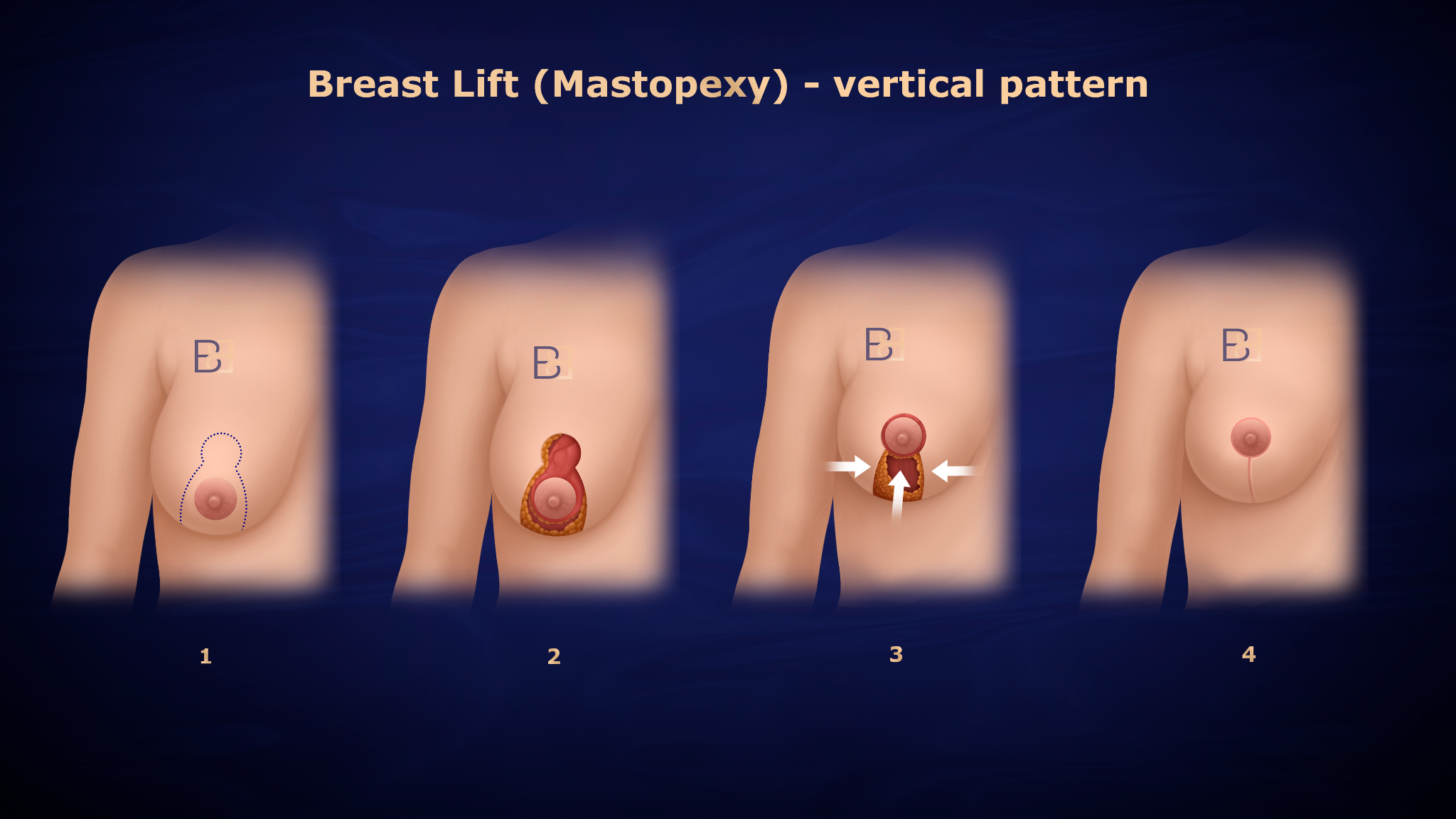
Repositions the nipple and areola, removes excess skin and reshapes the breast tissue. It changes position and shape, not volume.
- One way clinicians describe position is where the nipple sits relative to the breast fold; below the fold is called ptosis, and that is a general guide only
- 3 scar patterns, depending on how far the nipple needs to move: around the areola; around the areola with a vertical line to the fold; or the inverted-T, which adds a line along the fold
- Variants: mastopexy with auto-augmentation, which repositions your own tissue for upper fullness without an implant; a lift with fat grafting for a modest gain in fullness; and suction-assisted lipectomy (liposuction) of the side of the chest where it helps the shape
- Scars are permanent, and a lift can affect the ability to breastfeed later
Read the mastopexy (breast lift) page.
Breast augmentation (augmentation mammoplasty) with implants
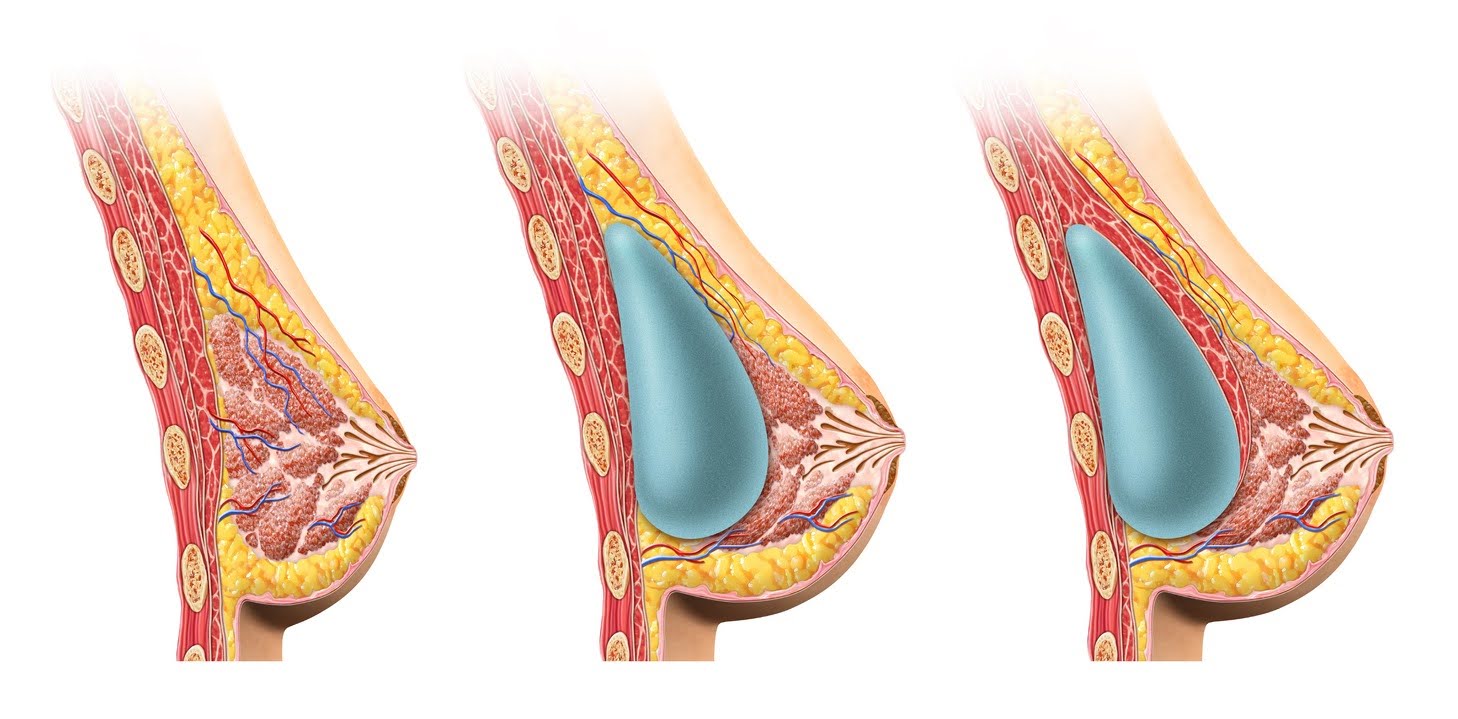
Adds volume with a cohesive silicone gel implant. What the implant does for shape depends on your tissue and on the implant chosen with you.
- Size and shape are worked out with you over more than 1 visit, with try-on sizers
- Fill, shell surface, profile and size are chosen with you; shell surface matters because of BIA-ALCL, a rare condition linked mainly to textured implants
- The implant sits under the breast tissue, under the muscle or in a dual plane, depending on your tissue cover
- Usually a day stay; a later pregnancy can change the result, and an implant can affect the ability to breastfeed
Read the breast augmentation (augmentation mammoplasty) page.
Mastopexy (breast lift) with implants
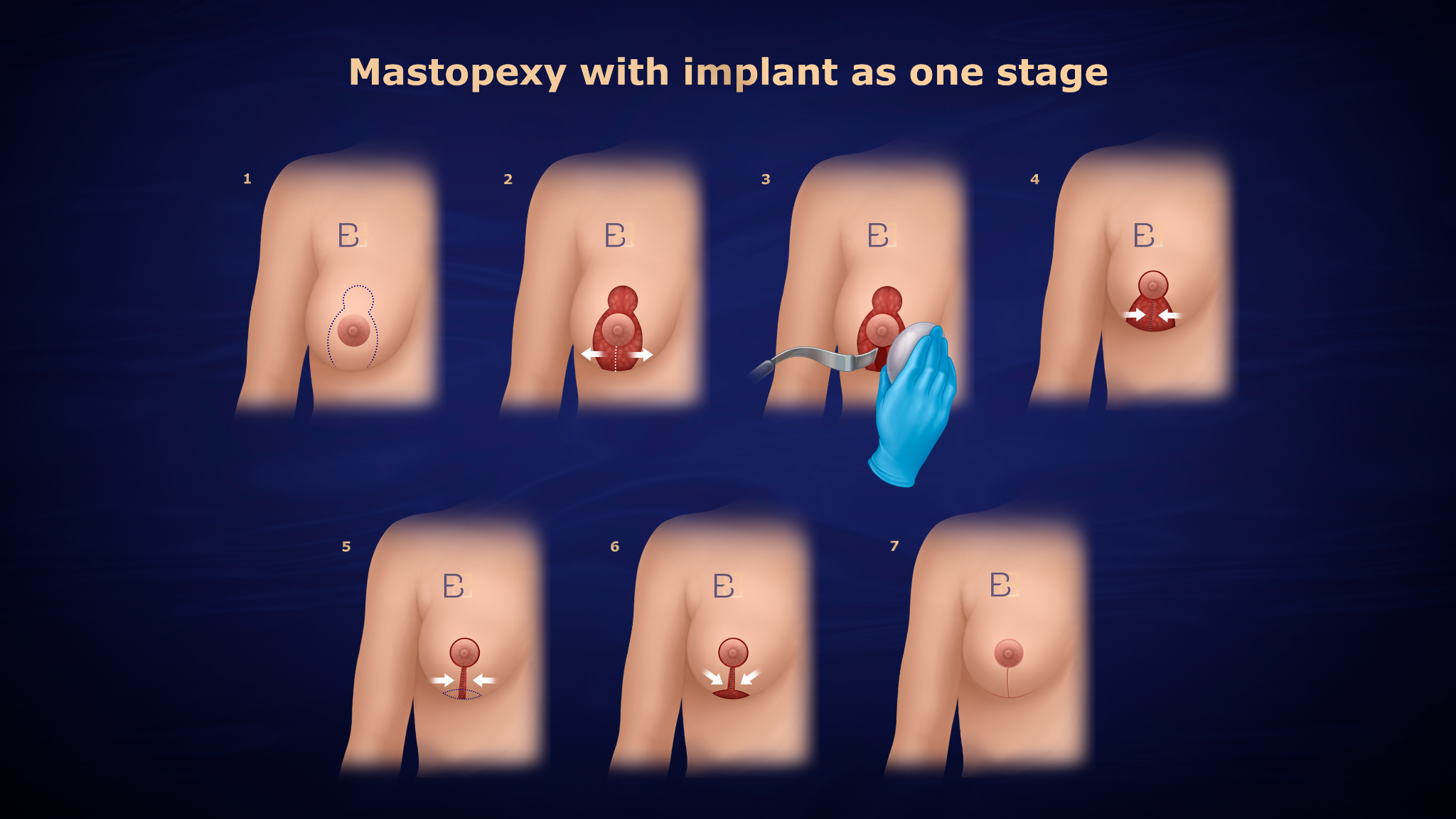
For changes in both position and volume. The lift repositions and reshapes; the implant adds volume. Some women need both; others need only the lift or only the implant.
- A larger and more complex operation than either on its own, with its own risk and recovery profile
- Where you are suited to it, I prefer to do both in 1 operation: 1 anaesthetic and 1 recovery
- Staging the lift and the implant across 2 operations is the appropriate path for some, because a lift and an implant place competing demands on nipple blood supply, skin tension and scar quality; some women find that once the lift has settled they no longer want an implant
Read the mastopexy (breast lift) with implants page.
Fat grafting (fat injections) to the breast
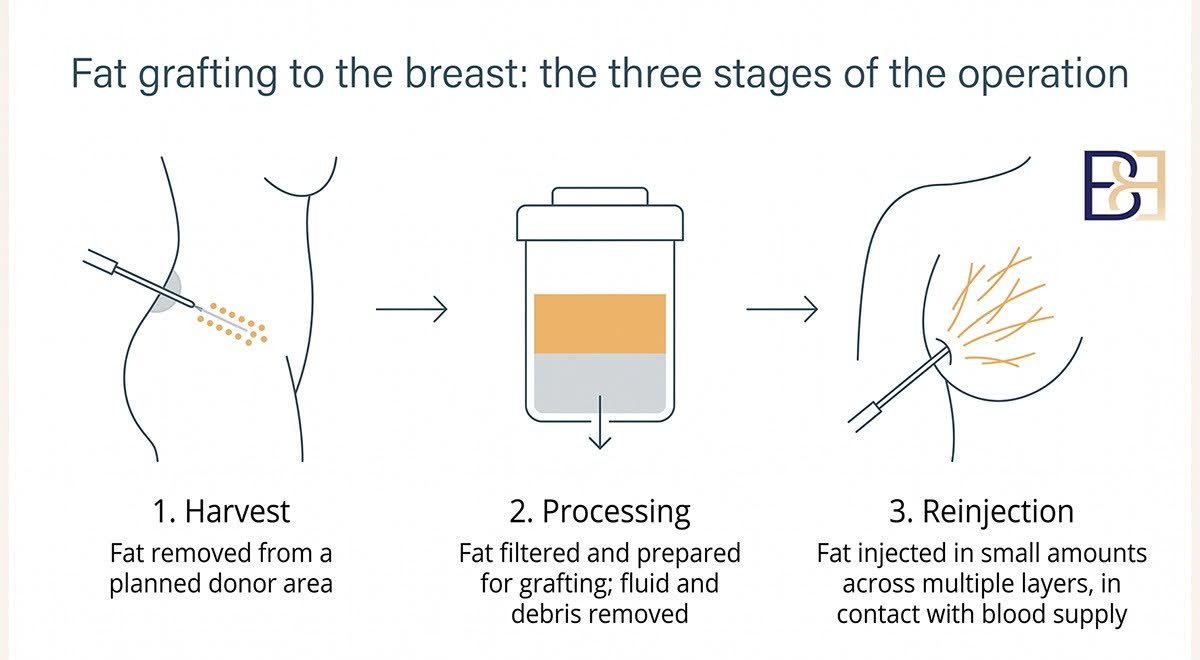
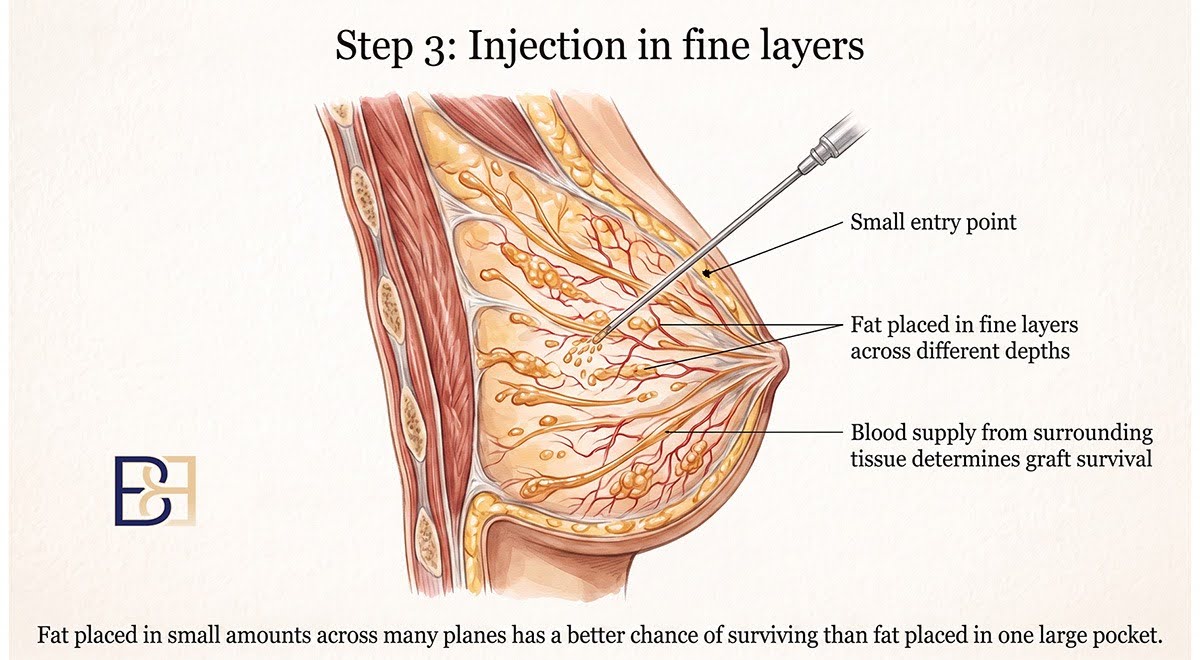
Fat is taken from the abdomen, flanks or thighs by ultrasound-assisted suction lipectomy, prepared, and injected into the breast in fine layers. It adds a modest amount of volume using your own tissue, with no implant.
- Not all grafted fat survives; a proportion is reabsorbed, and the volume at 3 to 6 months is a reasonable guide to the lasting result
- It does not lift the breast, and it cannot produce a large or precisely predictable increase in size; an implant remains the reliable route to that
- You need enough donor fat, and very lean women may not have enough for the volume they have in mind
- On its own it is uncommon in my practice; more often it is 1 part of another planned operation, including the abdominoplasty covered above
Read the fat transfer breast augmentation page. How the fat is harvested and prepared is covered on the suction-assisted lipectomy with fat grafting to the breast page.
Hybrid breast augmentation: implants combined with fat grafting
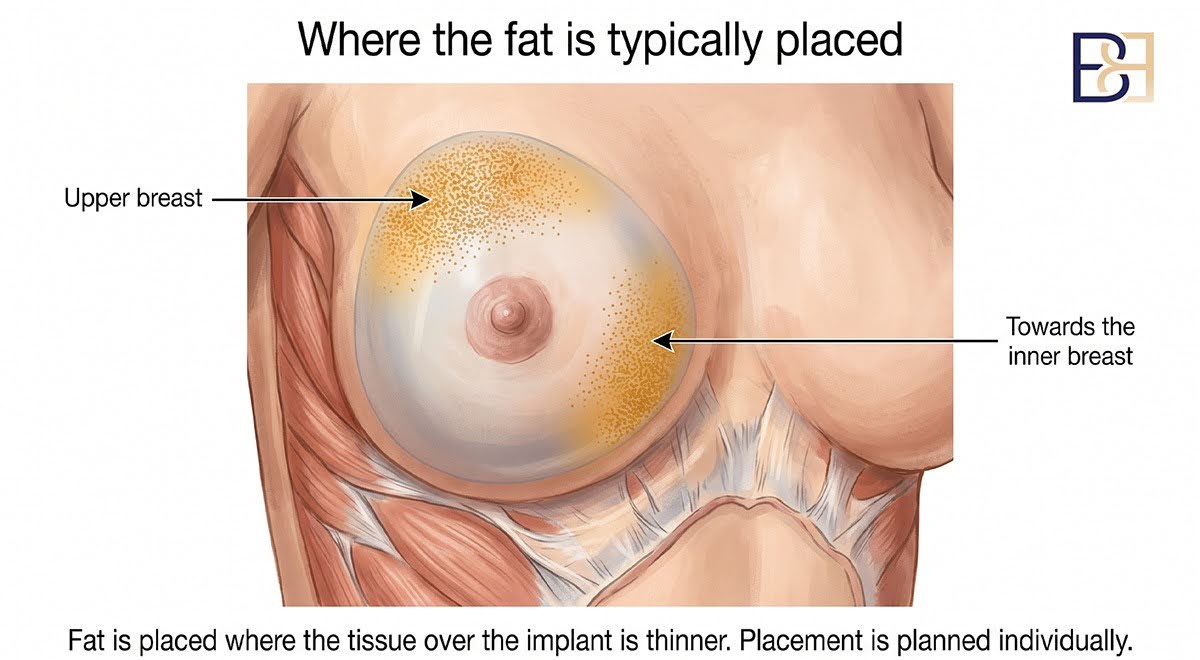
An implant and fat grafting in the same operation. The implant provides the volume and the shape; the fat is grafted over the implant where the tissue cover is thin.
- The implant gives a known, predictable change; the fat adds a smaller, variable amount, so it refines contour and cover rather than building volume
- Fat is harvested by ultrasound-assisted suction lipectomy, usually from the abdomen or flanks, so you need enough donor fat
- Some women who ask about the combination are better served by an implant alone, or by fat alone
Read the hybrid breast augmentation page.
If you had implants before your children
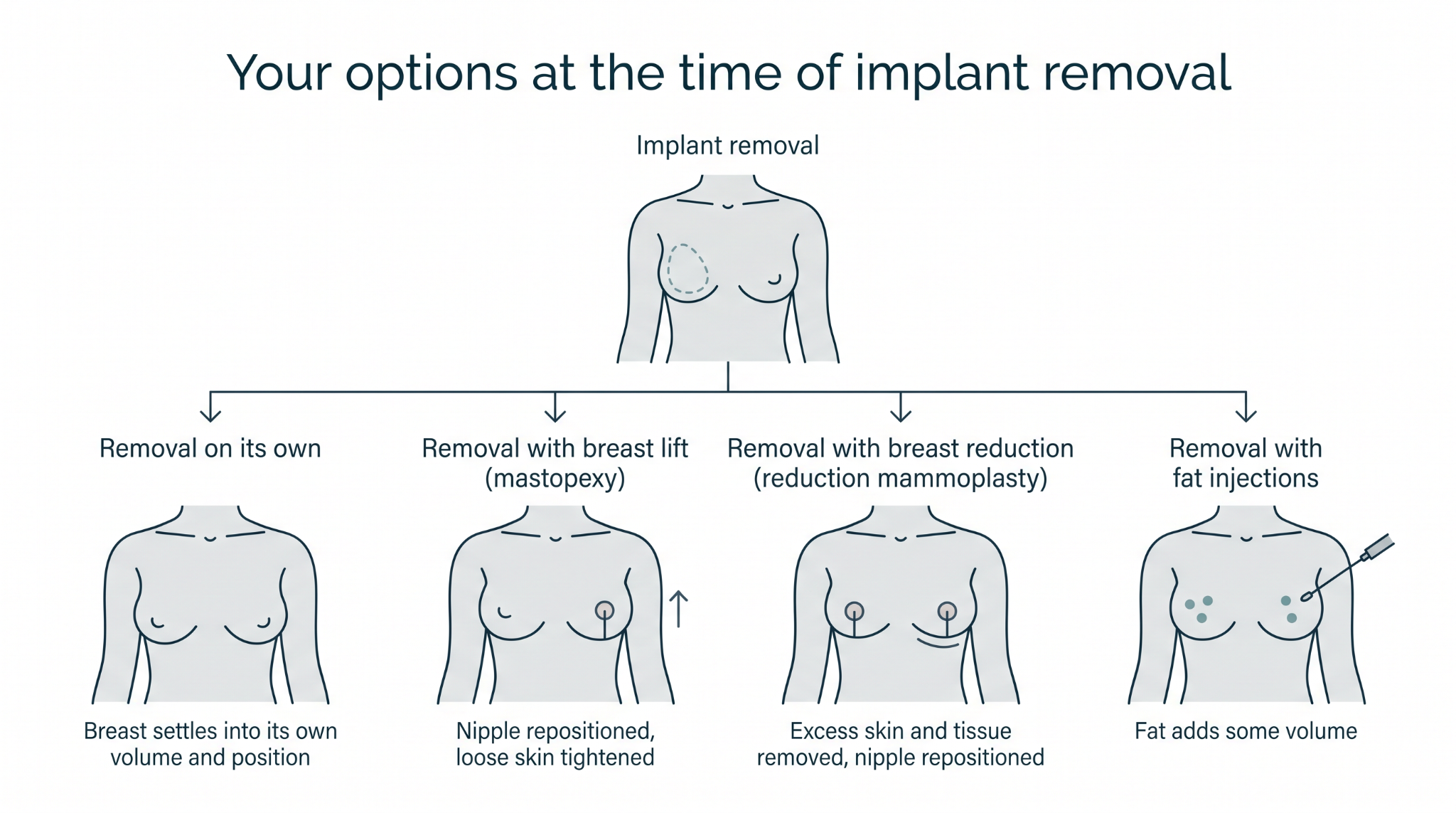
Implants do not need replacing on a set schedule. Pregnancy and breastfeeding can change the breast tissue and skin over an existing implant, and some women reach a point where they want the implants out, or changed. These are the 6 operations that cover that ground.
Removal of breast implants (explant surgery)
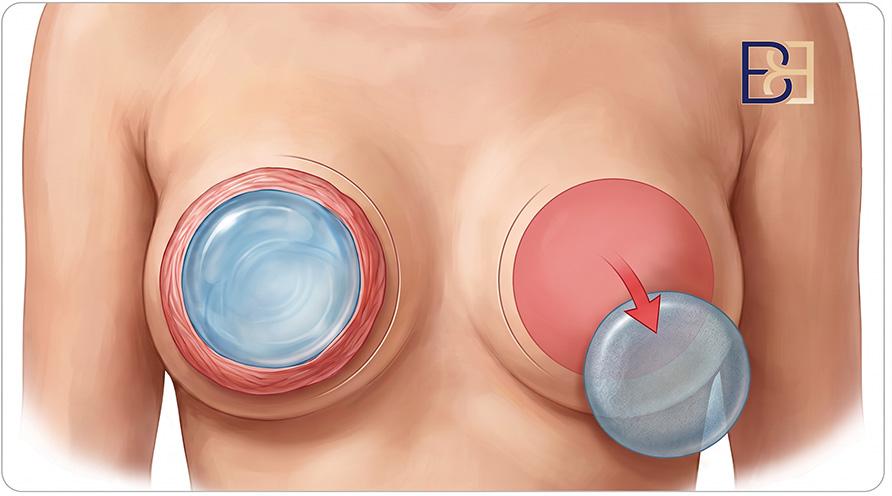
- The implant comes out through the existing scar where possible; the capsule around it is left, partly removed, fully removed, or removed intact with the implant (en bloc), depending on its state and the reason for removal
- Afterwards the breast is smaller, and skin that has been stretched over an implant does not always draw back; how much depends on your tissue, the implant size and how long it was in place
Read the removal of breast implants (explant surgery) page.
Removal with a mastopexy (breast lift)
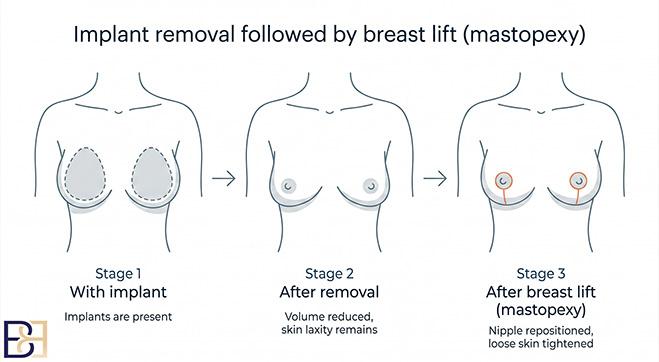
- The lift reshapes the remaining tissue, removes excess skin and repositions the nipple; it does not add volume
- Done in 1 operation for some women, or staged so the lift is planned on a breast that has settled, which can also protect nipple blood supply and scar quality
Read the removal of breast implants with a mastopexy (breast lift) page.
Fat grafting at implant removal
- Adds a modest, variable amount of your own fat at the time the implant volume is lost; it does not replicate implant volume
- Suits women who have decided against implants and accept that trade-off; removal alone is also a reasonable path
- This is not auto-augmentation, which I do not perform at explant because rearranging breast tissue at the same time puts its blood supply at risk
Read the fat grafting at implant removal page.
Removal and replacement of breast implants (implant exchange)
- Common reasons: a different size or profile, capsular contracture, rupture, an older textured implant, or implants that have been in place for many years
- The capsule is managed as found, and a new smooth-surface silicone implant is placed, with any change of size, profile or plane kept within what your tissue can support
- If your implants are intact and causing no symptoms, monitoring with imaging may be the more sensible path
Read the removal and replacement of breast implants page.
Exchange with a mastopexy (breast lift)
- Where the breast now sits lower over the implant, replacing the implant alone may not change where it sits; the lift brings the tissue over the new implant
- 1 operation or staged; a lift and an implant place competing demands on nipple blood supply, skin tension and scar quality
Read the removal and replacement of breast implants with a mastopexy (breast lift) page.
Fat grafting at implant exchange
- Fat is grafted over the new implant where the cover is thin, rippling is visible or the implant edge can be felt; it is not a volume replacement
- 2 separate decisions: whether to exchange at all, and whether grafting adds anything; for many women it does not, and the exchange proceeds without it
Read the fat grafting at implant exchange page.
Removal or replacement for a medical reason, such as rupture, symptomatic capsular contracture or BIA-ALCL, may attract a Medicare item number. Removal or replacement for cosmetic reasons does not.
One operation or staged surgery
Some women have concerns on the abdomen and the breasts at the same time. Where a patient is suited to it, my preference is to treat both in a single comprehensive operation. That is a preference, not a rule.
- For a suitable candidate, 1 operation means 1 anaesthetic, 1 hospital admission and 1 recovery, rather than repeating each of those steps
- A larger single operation is a bigger physiological event and asks more of your body, which is why preparation before surgery matters more, not less
- For some women, staging the work across separate operations is the more appropriate path, and I say so when it is
- Each procedure is decided on its own merits; combining them is never a reason to have more surgery than you need
- Whether 1 operation or staged surgery suits you is decided at consultation, after assessment of your medical history, the pattern of skin laxity and diastasis recti, and what can be done well in a single operating time
Book your appointment online now
Timing, and what I assess

I plan surgery once:
- Your family is complete, because a later pregnancy can stretch the skin and separate the muscles again, and can change the breasts, which affects the result of an earlier operation
- Breastfeeding has finished and the breasts and the abdominal wall have settled after your most recent pregnancy
- Your weight has been stable
There is no set number of months that applies to everyone. Timing is assessed individually. Breast surgery, including a lift and an implant, can affect your ability to breastfeed later, so if more children are a possibility, tell me at consultation.
At consultation I examine the abdomen and the breasts, and go through:
- The abdominal skin, the width of any diastasis recti, and your caesarean scar
- Breast position, skin laxity and the breast tissue you have
- Where you carry fat, if fat grafting is being considered
- Your general health, your medications, and nicotine in any form, which needs to stop for 6 weeks before and after surgery
- Standard pre-operative blood tests, arranged before surgery
For some women the right advice is not to have surgery, or not yet, and I say that when it applies.
Your pathway

GP referral
required before any consultation
First consultation
About 1 hour with me, in person in Lorn or by video if you are travelling; I take your history, examine you, and tell you whether surgery is reasonable for you now and which operation fits
Second consultation and written information
Included at no cost; at least 1 consultation is in person before surgery, and no consent is signed at the first.
Cooling-off period
at least 7 days between consent and booking or paying a deposit
Surgery
At Maitland Private Hospital, which has 24-hour medical cover and an on-site intensive care unit; I see you on daily rounds while you are admitted
Follow-up
2 to 3 times a week for the first 2 weeks, then at 4 weeks, 3, 6 and 12 months, all included in the surgical fee; your GP receives a formal handover at 4 weeks
Travelling from Sydney, the Central Coast or regional NSW
First consultation by video, in person before surgery, and plan to stay locally for 7 to 10 days after surgery
Recovery with young children, and risks
Recovery takes time and should not be underestimated. For most women I see, it happens alongside caring for young children.
- Lifting is restricted after abdominal surgery, and the limit depends on the operation: about 2 weeks after skin-only surgery, about 4 weeks after surgery without muscle repair, and about 6 weeks after diastasis recti repair
- Within that, I use a graduated guide: up to about 5 kg from 2 weeks, up to about 10 kg from 4 weeks, then unrestricted from 6 to 8 weeks, set individually for you
- A toddler is above those limits for the first weeks, so arrange help at home before surgery rather than after
- Time off work ranges from 1 to 2 weeks for day procedures to 2 to 4 weeks for a full abdominoplasty; each procedure page gives its own timeline
All of these are operations under general anaesthetic, and all carry risk. Across them, the risks I discuss include:
- Bleeding, infection, seroma (fluid collecting under the skin), delayed wound healing and altered skin sensation
- Permanent scars, asymmetry, contour irregularity, and the possibility of revision surgery
- Blood clots in the legs or lungs, which I assess and manage for each patient
- With implants: capsular contracture, rupture and BIA-ALCL; with fat grafting: reabsorption, oil cysts, firm lumps of fat necrosis, and changes that can appear on breast imaging
- With any breast surgery: changes in nipple sensation and effects on breastfeeding
Results vary between patients. Each procedure page sets out the risks and recovery for that operation, and the post pregnancy abdominoplasty complications guide covers the abdominal operations in detail.
Cost and Medicare
Every operation has 3 separate fees: my surgical fee, the anaesthetist’s fee, and Maitland Private Hospital’s fee for theatre and your stay. You receive an individual written quote after your consultation, with the Medicare item numbers where they apply. My fee includes your second consultation and all follow-up to 12 months.
- Abdominoplasty with diastasis recti repair may attract MBS item 30175 where the criteria are met; where it applies, Medicare and your health fund contribute towards the cost, there is still an out-of-pocket gap, and no GST applies
- Mastopexy (breast lift) has a conditional item number that applies only in defined circumstances; breast augmentation (augmentation mammoplasty) for cosmetic reasons has none
- Implant removal or exchange for a medical reason may attract an item number, as covered above
- Where no item number applies, the operation is cosmetic: 10% GST applies to the surgical, anaesthetist and hospital fees, and the hospital charges a higher rate for cosmetic theatre time
- Whether an item number applies to you is assessed at consultation against the current MBS criteria
Fees for each operation are on its cost page: post pregnancy abdominoplasty cost page, limited abdominoplasty cost page, mastopexy (breast lift) cost page, breast augmentation (augmentation mammoplasty) cost page, and mastopexy (breast lift) with implants cost page. For the full breakdown, with Medicare criteria and worked examples, read how much a post pregnancy abdominoplasty costs in Australia.