


Fat Grafting to the Breast During Abdominoplasty (Tummy Tuck) in Newcastle NSW
During an abdominoplasty (tummy tuck), fat is removed from the abdomen and flanks with VASER (ultrasound assisted lipectomy). In most operations that fat is discarded. For some patients, it can be prepared and grafted to the breast instead, within the same operation.
This is fat transfer breast augmentation (Augmentation mammoplasty autologous fat grafting) carried out as an integral part of the one procedure. The fat harvest is already happening as part of the abdominoplasty (tummy tuck). No separate harvest and no second operation are involved. The question I work through with you at consultation is whether grafting that fat to the breast is appropriate for you, and what it can realistically achieve.
Most of the patients I see for this are post pregnancy. Pregnancy and breastfeeding can change breast volume, shape and position, and changes in the abdominal wall such as diastasis recti are often what bring these patients to abdominoplasty (tummy tuck) in the first place. Where fat grafting to the breast is appropriate, it makes use of tissue that would otherwise be discarded.
You can read about fat transfer breast augmentation (augmentation mammoplasty) as a standalone service on the main service page.
Book your appointment online now
How Fat Grafting Fits Into the Operation
An abdominoplasty (tummy tuck) in my practice usually includes liposuction of the abdomen and flanks using VASER (ultrasound assisted lipectomy). The VASER (ultrasound assisted lipectomy) component uses ultrasound energy to loosen fat before it is suctioned. This is part of the abdominal contouring, and the fat it removes is normally discarded at the end of the case.
When fat grafting to the breast is planned, that same fat is kept. It is filtered and prepared for grafting, then injected into the breast in small amounts across several tissue planes. Placing the fat in small parcels rather than one large volume gives each parcel the best chance of gaining a blood supply.
There are 3 steps within the one operation: harvest, preparation, and grafting. None of them changes what the abdominoplasty (tummy tuck) itself involves. The abdominal side of the operation, including repair of diastasis recti where present, is covered in detail on the abdominoplasty (tummy tuck) service page.
One Operation, One Operating Time
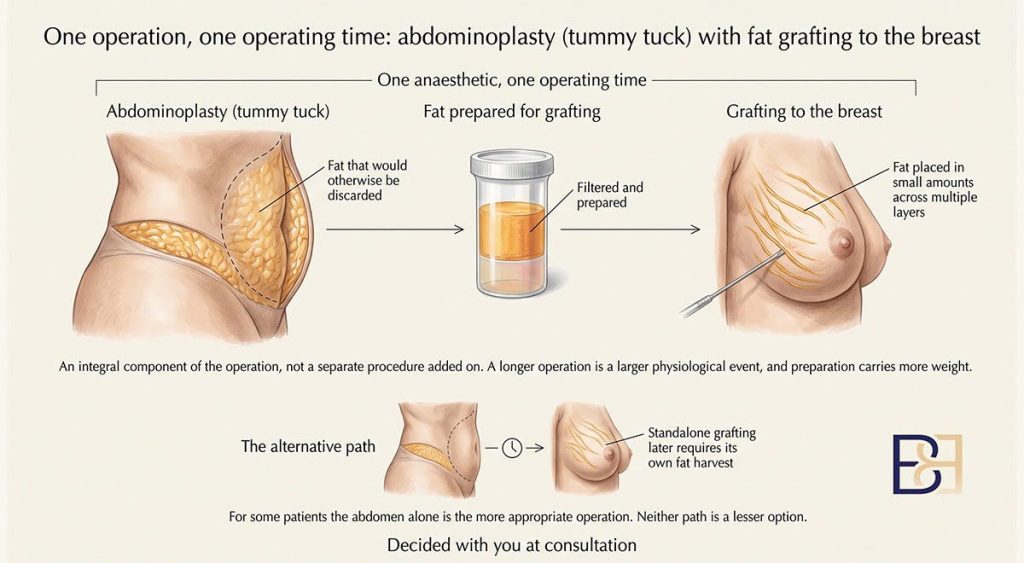
Fat grafting to the breast in this context is an integral component of the abdominoplasty (tummy tuck). For a patient suited to it, this means one anaesthetic, one hospital admission and one recovery period covering both the abdominal surgery and the breast grafting.
Preparing and grafting the fat does add to the operating time. A longer operation is a larger physiological event, and combining abdominal surgery with breast grafting places more demand on the body than the abdominoplasty (tummy tuck) alone. Recovery should not be underestimated. This is also why pre-operative preparation carries more weight when a combined operating time is planned, not less.
For some patients, keeping the operation to the abdomen alone is the more appropriate path. Fat grafting can be considered separately at a later date, although a standalone procedure then requires its own fat harvest. Whether grafting during the abdominoplasty (tummy tuck) is appropriate for you depends on your medical history, your breast tissue, and the total demand of the planned surgery, and it is decided with you at consultation.
Who This Context Suits
Most patients I graft fat to the breast during an abdominoplasty (tummy tuck) are post pregnancy. Pregnancy and breastfeeding can change breast volume, shape and position, and for some patients a small change in breast volume alongside their abdominal surgery is what they are after.
Timing matters. Surgery is planned once:
- Breastfeeding has finished and the breasts have settled after your most recent pregnancy
- Your family is complete, as future pregnancy can affect the result in both the breast and the abdomen
As a general guide this sits around 12 months after pregnancy, but it is not a fixed interval. I assess timing individually at consultation.
This context may not suit you if:
- You are seeking a larger or more predictable increase in breast volume. Fat grafting produces a modest change, and breast implants remain the reliable route to predictable volume
- There is not enough donor fat in the abdomen and flanks to make grafting worthwhile
- Your medical history, breast tissue or the extent of the abdominal surgery makes the combined operating time inappropriate
What Fat Grafting Can and Cannot Do
Fat grafting produces a modest change in breast volume. Not all of the grafted fat survives. A proportion is reabsorbed by the body in the months after surgery, and how much is retained varies from patient to patient. The volume you see in the first weeks is not the final result, and the outcome settles over roughly 3 to 6 months.
What this means in practice:
- Expect an increase of typically less than one cup size from a single session
- Retention varies and cannot be promised in advance
- A repeat grafting session at a later date is possible if more volume is wanted, and it requires its own operation and fat harvest
- If a larger or more predictable increase in volume is what you are after, breast implants remain the reliable route, and that is a different discussion
Part of my job is to be clear about whether the change fat grafting can produce matches the change you have in mind.
Book your appointment online now
Your Pathway
The pathway is the same as for any operation I perform:
1. GP referral
A referral from your GP is required before any consultation
2. Consultation
We meet at my Lorn rooms, or by Zoom if you are travelling from further away. I take a full medical history, examine both the abdomen and the breasts, and go through what the combined operation would involve for you. An in-person consultation is required before surgery
3. Decision
Whether fat grafting during your abdominoplasty (tummy tuck) is appropriate is decided here, with you, after assessment
4. Surgery
The operation takes place at Maitland Private Hospital
Why Patients Choose Me

I am Dr Bernard Beldholm, FRACS, a Specialist Surgeon based in the Hunter Valley. I have performed breast and body surgery for more than 15 years, and post pregnancy surgery is a core part of my practice. Combining VASER (ultrasound assisted lipectomy), abdominoplasty (tummy tuck) and fat grafting in one operation draws on both sides of that work.
Surgery takes place at Maitland Private Hospital, an accredited private hospital with 24-hour medical cover and an on-site ICU. I do daily rounds while you are admitted.
Follow-up is structured and included in your surgical fee. You are reviewed by my nursing team and me 2 to 3 times a week for the first 2 weeks, then at 4 weeks, 3 months, 6 months and 12 months. Your GP receives a formal handover at the 4-week visit. After hours, Maitland Private Hospital provides a nurse-led triage line.
Recovery and Risks
This is invasive surgery under general anaesthetic, and it carries risks. Recovery takes time, is driven largely by the abdominal side of the operation, and varies from patient to patient. The grafted breasts are typically swollen and bruised in the early weeks, and the volume settles over the months that follow.
Specific risks of fat grafting to the breast include fat reabsorption, oil cysts, firm lumps of fat necrosis, and changes that appear on breast imaging. These are covered in detail, alongside how I manage them, in my fat transfer complications article. What recovery looks like week by week is covered in my fat transfer recovery article.