


Fat Transfer Breast Augmentation (Augmentation Mammoplasty Autologous Fat Grafting): Adding Volume With Your Own Fat | Newcastle NSW
Breast augmentation (augmentation mammoplasty) by fat transfer (autologous fat grafting) uses your own fat, taken from another part of your body, to add volume to the breast. In my practice it is most often done as part of an operation already being planned: alongside implants, during an abdominoplasty where the fat would otherwise be discarded, or at implant removal or implant exchange. Fat grafting on its own, without an implant, is offered but is the less common path.
The fat is harvested by VASER ultrasound-assisted liposuction (ultrasound-assisted lipectomy), filtered and prepared, then injected into the breast in fine layers. The volume change is modest and varies between patients, and not all of the injected fat survives. What this technique can and cannot do is set out further down this page, because realistic expectations matter with fat grafting.
Book your appointment online now
What Fat Grafting to the Breast Involves
Fat grafting is a three-step operation performed under general anaesthetic at Maitland Private Hospital. The fat is harvested, processed, then injected.
Harvest
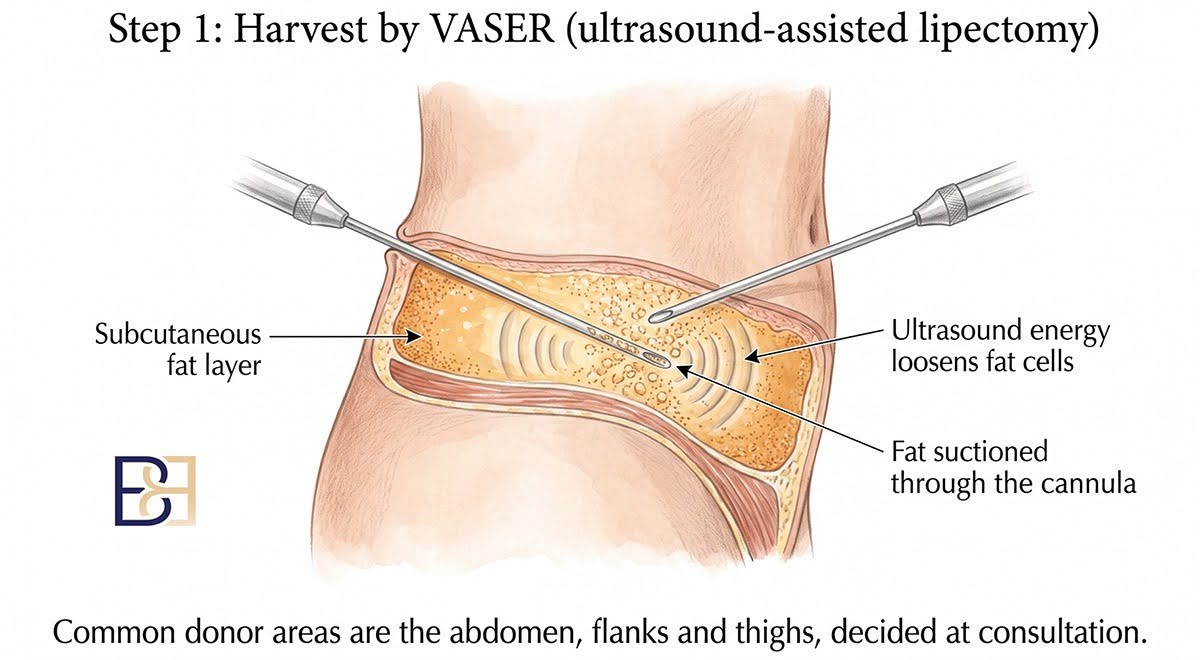
The fat is taken by VASER ultrasound-assisted liposuction (ultrasound-assisted lipectomy), which uses an ultrasound device listed on the Australian Register of Therapeutic Goods to loosen fat cells before they are suctioned out. I use it for the harvest step in fat grafting cases. Common donor areas are the abdomen, flanks and thighs. Which area is used depends on where you carry enough fat and on any other surgery planned at the same time. When fat grafting is done during an abdominoplasty, the fat comes from tissue that would otherwise be discarded as part of that operation.
Processing
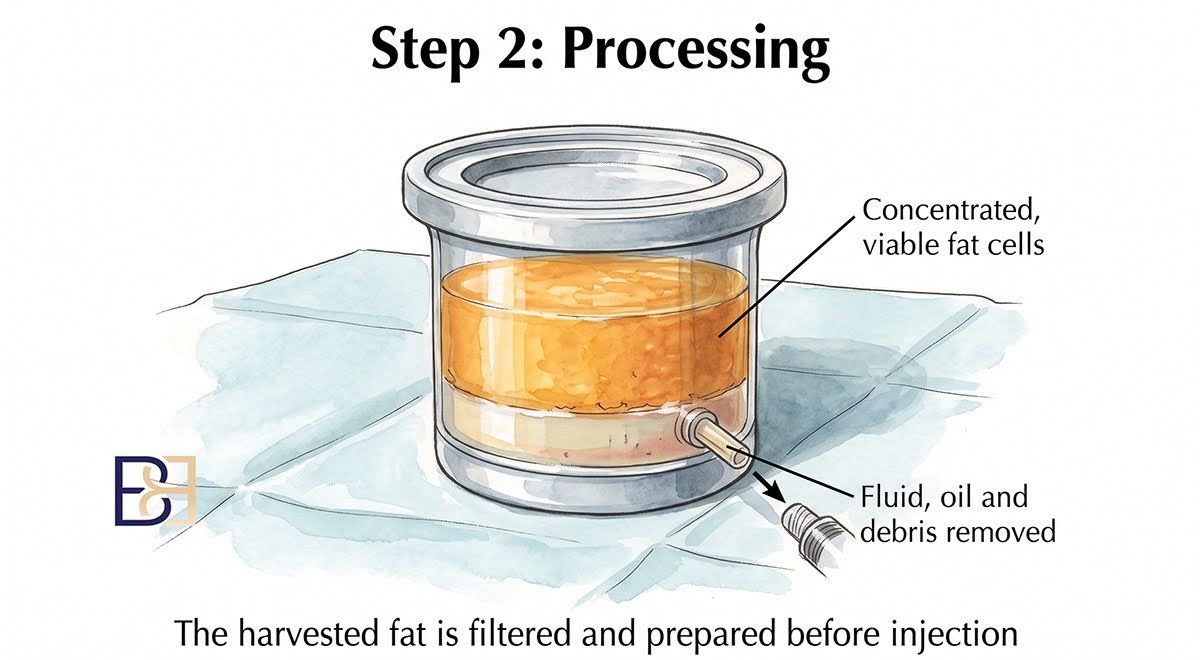
The harvested fat is not injected as it comes out. It is filtered and prepared to separate intact fat cells from fluid, oil and debris. The aim of processing is to inject concentrated, viable fat cells.
Injection
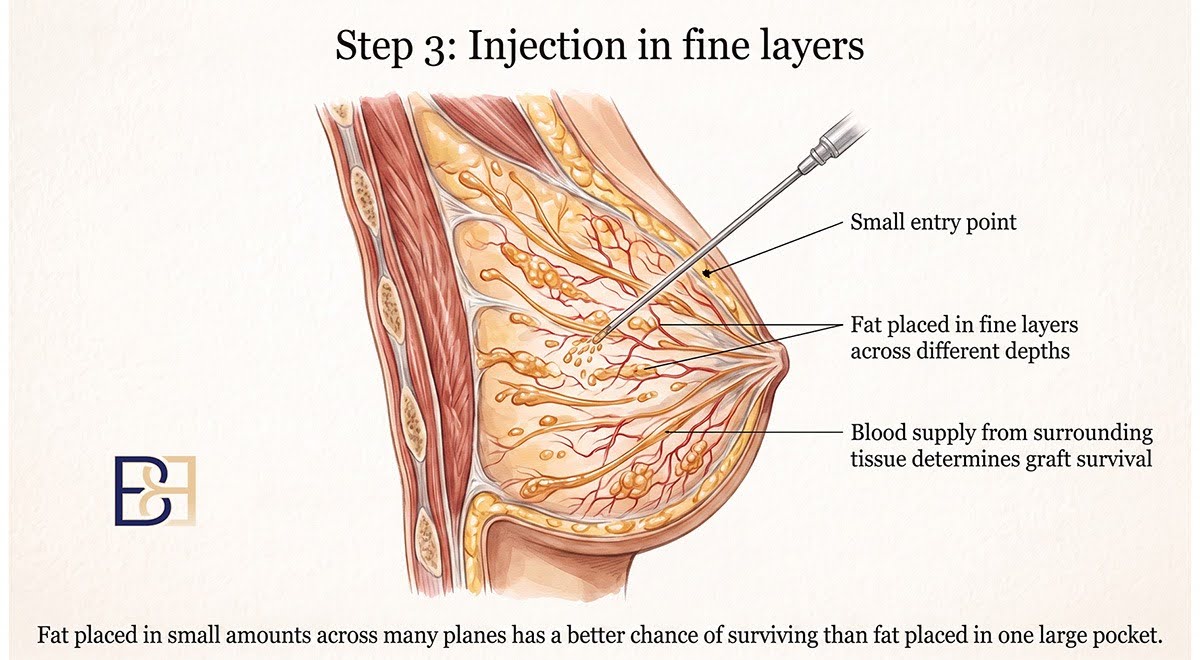
The processed fat is injected into the breast through small entry points, placed in fine layers across different depths of the tissue. Layering matters because grafted fat needs a blood supply from the surrounding tissue to survive. Fat placed in small amounts across many planes has a better chance of taking than fat placed in one large pocket. The entry points are small and heal as short marks, and the donor area carries its own liposuction (suction-assisted lipectomy) incisions and recovery.
Where Fat Grafting Fits
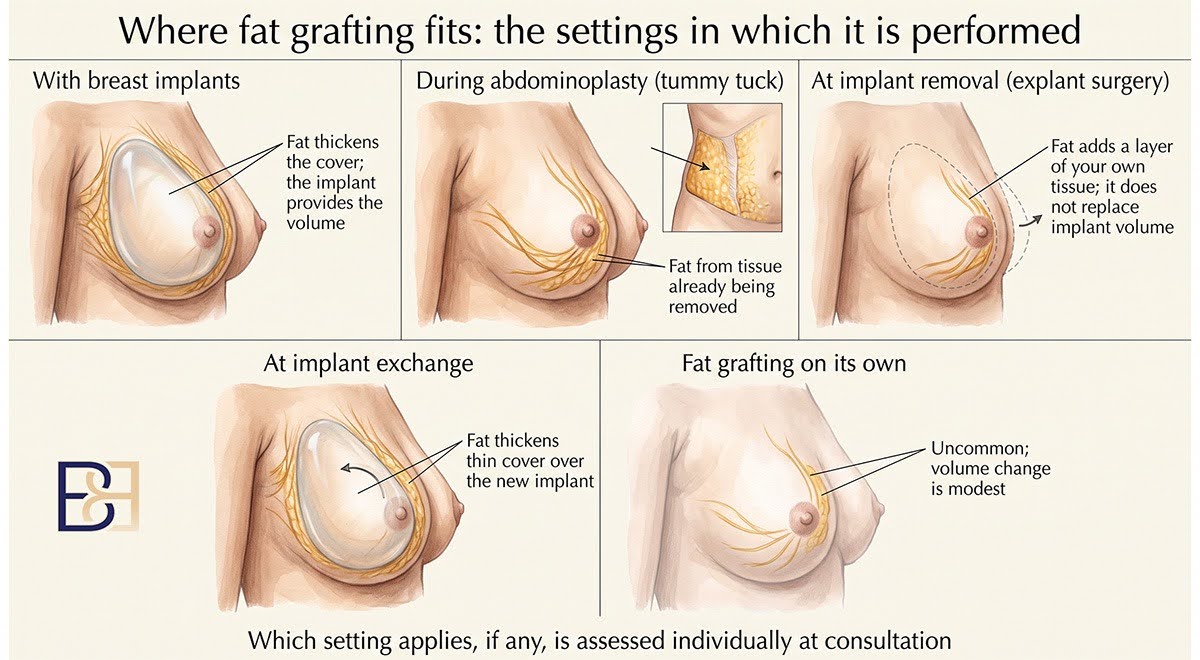
Fat grafting is rarely the whole operation. In my practice it is most often one part of a breast procedure that is already planned, and the context shapes what the fat is doing.
With breast implants
Fat can be grafted at the same operation as breast augmentation (augmentation mammoplasty) with implants. The implant provides the volume. The fat is placed over the implant edges and through the medial cleavage area to thicken the soft tissue cover, which can soften the transition between implant and chest wall in patients with thin tissue. Whether this combination suits you is assessed at consultation, and for some patients an implant alone, or fat alone, is the more appropriate operation.
During an abdominoplasty
When an abdominoplasty is already planned, the tissue removed during that operation contains fat that would otherwise be discarded. Where a patient has separately decided they want breast volume, that fat can be harvested and grafted to the breast during the same anaesthetic. This makes use of tissue already being removed. The decision to have an abdominoplasty and the decision to have fat grafted to the breast are made separately, each on its own merits, at consultation.
At implant removal (explant surgery)
For patients having breast implants removed without replacement, fat grafting can be performed as part of the explant operation. The fat does not replace the implant volume. It adds a layer of the patient’s own tissue at a time when the breast is losing implant volume. What is achievable depends on how much donor fat is available and on the quality of the breast tissue after explant, and this is assessed individually.
At removal and replacement of breast implants (implant exchange)
Fat grafting can also be added when implants are being exchanged, most often to thicken thin tissue cover over the new implant. The same assessment applies.
Fat grafting on its own
Standalone fat transfer breast augmentation (augmentation mammoplasty), with no implant and no other procedure, is offered but is uncommon in my practice. The volume change from fat alone is modest, and patients wanting a clearly larger breast are usually better served by an implant. This is covered in the next section.
What Fat Grafting Can and Cannot Do
This is the section to read carefully, because fat grafting is the breast procedure where expectations most often run ahead of what the technique delivers.
What it can do
- Add a modest amount of volume using your own tissue, with no implant
- Thicken thin soft tissue cover over an implant and soften the implant edge in hybrid cases
- Add some volume at explant or implant exchange
- Change shape in specific areas of the breast, such as the medial cleavage
What it cannot do
- Produce a large or precisely predictable increase in breast size. An implant remains the reliable route to a predictable volume change
- Guarantee how much of the grafted fat survives. A proportion of injected fat is resorbed in every patient, and the proportion varies from person to person
- Change breast position. Fat grafting adds volume where it is placed. It does not lift the breast, and patients with ptosis who want a change in breast position need a mastopexy (breast lift), which is a different operation
Retention and repeat sessions
Not all grafted fat takes. Published figures for retention vary widely, and I do not quote a percentage because the range in the literature is broad and your result cannot be predicted from it. The fat that survives the first few months behaves as living tissue and changes with your weight. Some patients choose a second session to build further volume, and this is a known feature of the technique rather than a failure of the first operation.
Book your appointment online now
Is Fat Grafting Right for Me?
There is no single measurement that decides suitability for fat grafting. The assessment turns on a few practical factors.
Donor fat
You need enough fat to harvest. Fat grafting is a transfer, and the amount available at the donor sites sets a ceiling on what can be moved. Very lean patients sometimes do not have enough donor fat for the volume they have in mind, and I will say so at consultation rather than proceed with an operation that cannot deliver it.
Breast tissue quality
Grafted fat survives on blood supply from the tissue it is placed into. The condition of the breast tissue, including any previous breast surgery, scarring or radiotherapy, affects how well a graft is likely to take. This is part of the examination.
What you want from the operation
Fat grafting suits patients seeking a smaller volume change, or the specific adjunct roles described above. If the goal is a clearly larger breast with a predictable size outcome, an implant is usually the better tool, and I will tell you that directly at consultation. If the goal is a change in breast position, the operation to discuss is a mastopexy (breast lift).
Weight stability
Grafted fat behaves like the fat it came from. Significant weight change after surgery changes the result, so being at a stable weight before surgery matters. Future pregnancy and breastfeeding can also affect the result, which is a timing conversation we have individually if it applies to you.
Planning and Imaging
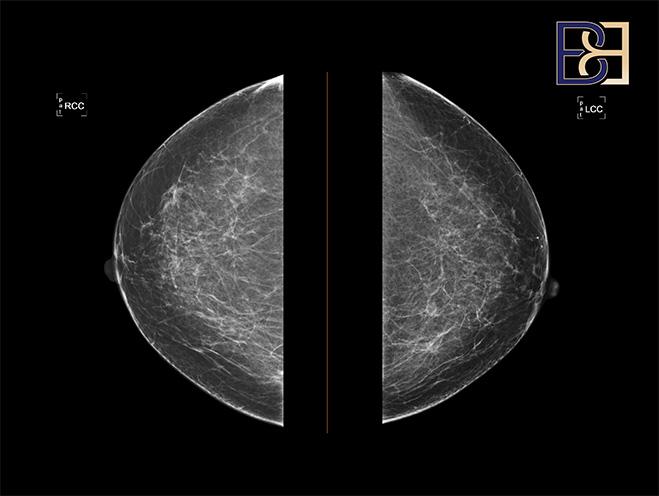
Pre-operative breast imaging
Every patient having fat grafting to the breast has breast imaging before surgery. For younger patients this is usually an ultrasound; for older patients, a mammogram. The imaging serves two purposes. It documents the state of the breast before surgery, and it gives radiologists a baseline, because grafted fat can produce changes such as oil cysts and small calcifications that are visible on later imaging. A documented baseline is important for future comparison.
Planning at consultation
At consultation I examine the breast and the donor areas, review your history including any previous breast surgery, and go through what volume is realistically achievable for your tissue. If fat grafting is planned alongside another procedure, such as implants, an abdominoplasty or explant surgery, the sequence and combined operating time are planned at the same visit. Standard pre-operative blood tests are arranged before surgery.
Your Pathway
Referral and consultation
A GP referral is required before any consultation. At the consultation, at my Lorn clinic or by Zoom, I examine the breast and donor areas, we discuss what fat grafting can achieve for your tissue, and I set out the risks in full. If fat grafting is part of a larger operation, the whole plan is discussed together.
Surgery
Surgery takes place at Maitland Private Hospital under general anaesthetic. The anaesthetist usually consults with you by phone beforehand, with physical assessment on the day of surgery. Operating time depends on whether fat grafting is the whole procedure or one part of a larger operation.
Follow-up
Follow-up is structured and frequent early. My nursing team and I review you two to three times a week for the first two weeks, then at milestone visits at four weeks, three months, six months and twelve months. Your GP receives a formal handover at the four-week visit.
Why Patients Choose Me
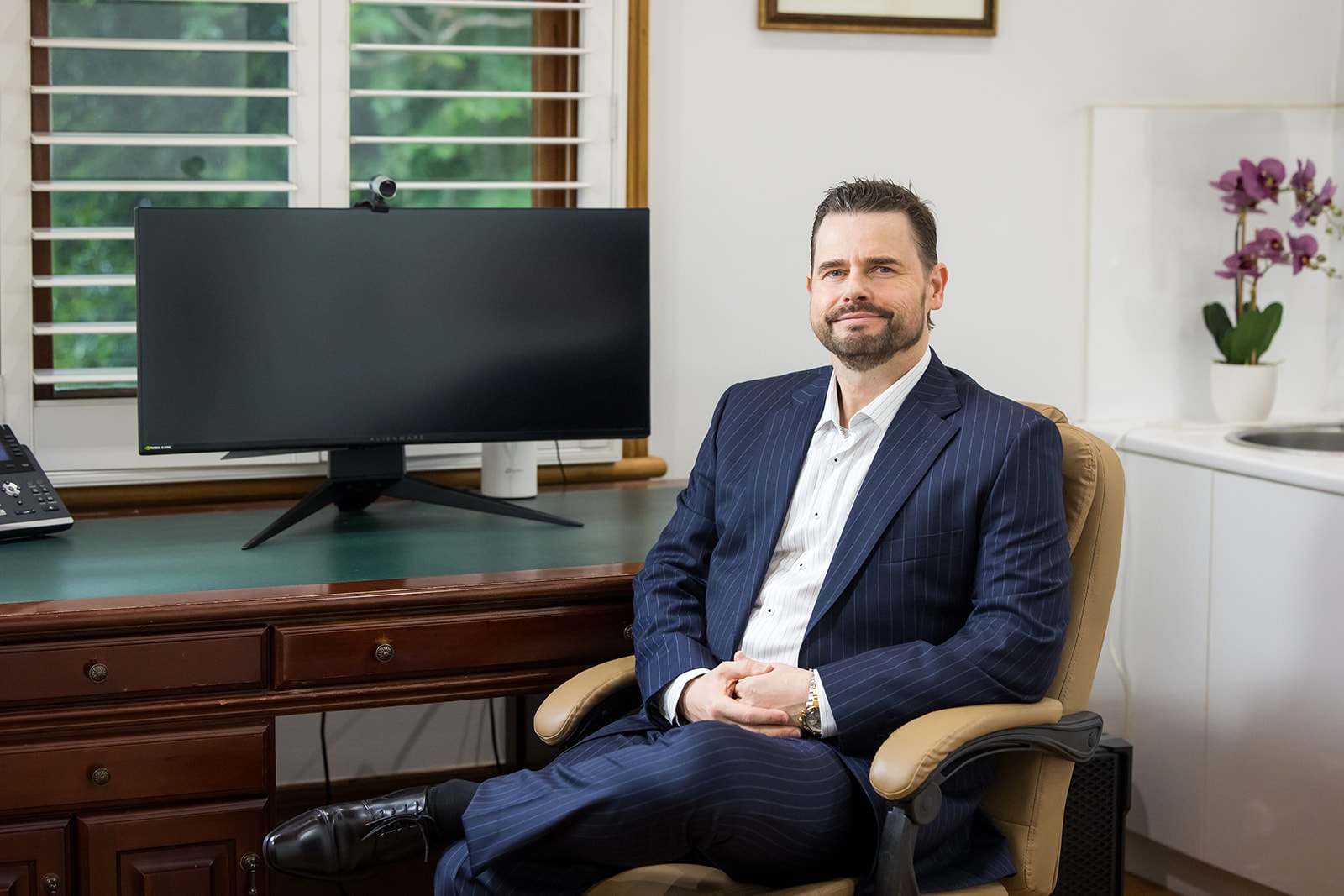
I am Dr Bernard Beldholm, a Specialist Surgeon and Fellow of the Royal Australasian College of Surgeons (FRACS). I have spent more than fifteen years in breast and body surgery, and my breast work spans augmentation, reduction, mastopexy (breast lift), implant removal and implant exchange, which is the context fat grafting sits within.
A few things about how I work:
- All surgery is performed at Maitland Private Hospital, an accredited hospital with overnight facilities, not an office-based procedure room
- I do the assessment and the surgery myself. The consultation where suitability is decided is with me, not a coordinator
- Follow-up is intensive. Two to three reviews a week for the first fortnight, then structured milestone visits out to twelve months
- I will tell you if fat grafting is not the right operation for you. Some patients I assess for fat grafting leave with a recommendation for a different procedure, or for no surgery
Costs
The cost of fat grafting depends on the context. Fat grafting on its own is priced differently from fat grafting added to an implant operation, an abdominoplasty or explant surgery, because the operating time and what is involved differ in each case.
After your consultation you receive a written quote setting out the three components: my surgical fee, the anaesthetist’s fee and the hospital fee. Fat transfer breast augmentation (augmentation mammoplasty) performed for appearance alone does not attract a Medicare rebate.
A full breakdown of how fat grafting is priced in each context is on the fat grafting cost page.
Recovery and Risks
Fat grafting is invasive surgery under general anaesthetic, and it involves two operative areas: the breast and the donor site. Both need to heal, and recovery takes time and varies between patients. Expect swelling and bruising at both sites, and be aware that the breast volume you see early on is not the final result, because swelling settles and a proportion of the grafted fat is resorbed over the first few months.
The risks include the general risks of surgery and anaesthesia, and risks specific to fat grafting: oil cysts, fat necrosis (firm lumps where grafted fat has not survived), calcifications, infection, contour irregularity at the donor site, and changes visible on future breast imaging. These imaging changes are one of the reasons every fat grafting patient has baseline imaging before surgery. Rare but serious complications also exist and are covered in full on the complications page.