


SMAS Facelift (Rhytidectomy) in Newcastle NSW
The SMAS is the superficial musculoaponeurotic system. It is a layer of firm tissue that sits beneath the skin and fat of the face, and it is continuous with the platysma muscle in the neck. A SMAS facelift (rhytidectomy) works on this layer. During the operation, the SMAS is tightened and repositioned, and the excess skin that results is removed. Because the lift is carried by this deeper layer rather than the skin alone, the skin can be closed without tension.
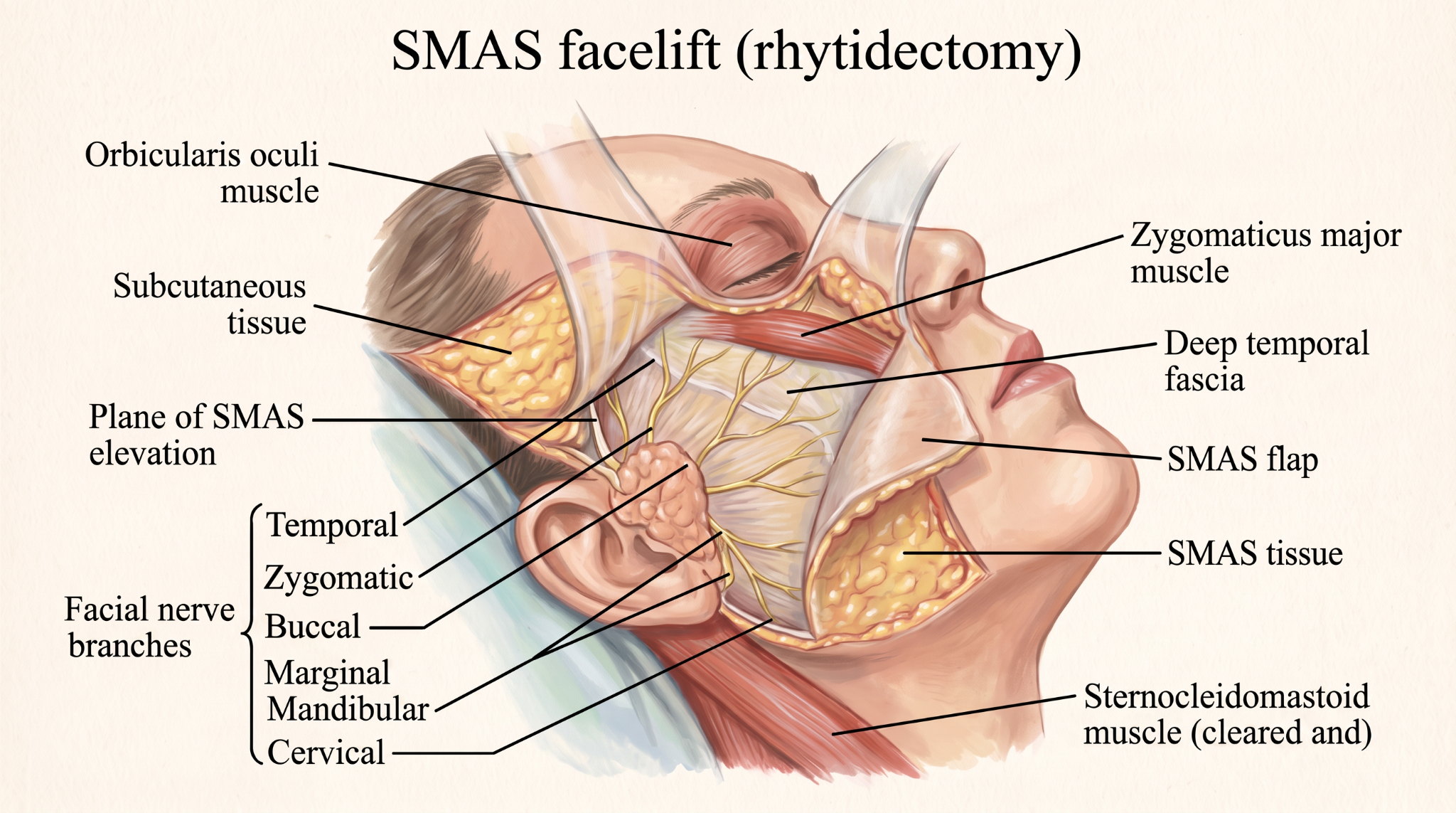
Facial ageing is normal. Over time, the soft tissue of the mid and lower face descends and the skin develops excess. A SMAS facelift (rhytidectomy) repositions that descended tissue and removes the excess skin. It does not replace lost volume, it does not change skin texture, pigment, or fine lines, and it does not stop the ageing process. The face continues to age after surgery, so results are not permanent in that sense.
If you want more detail on this technique, I cover it fully in my article on SMAS facelift (rhytidectomy) techniques.
Book your appointment online now
What a SMAS facelift (rhytidectomy) is suited to
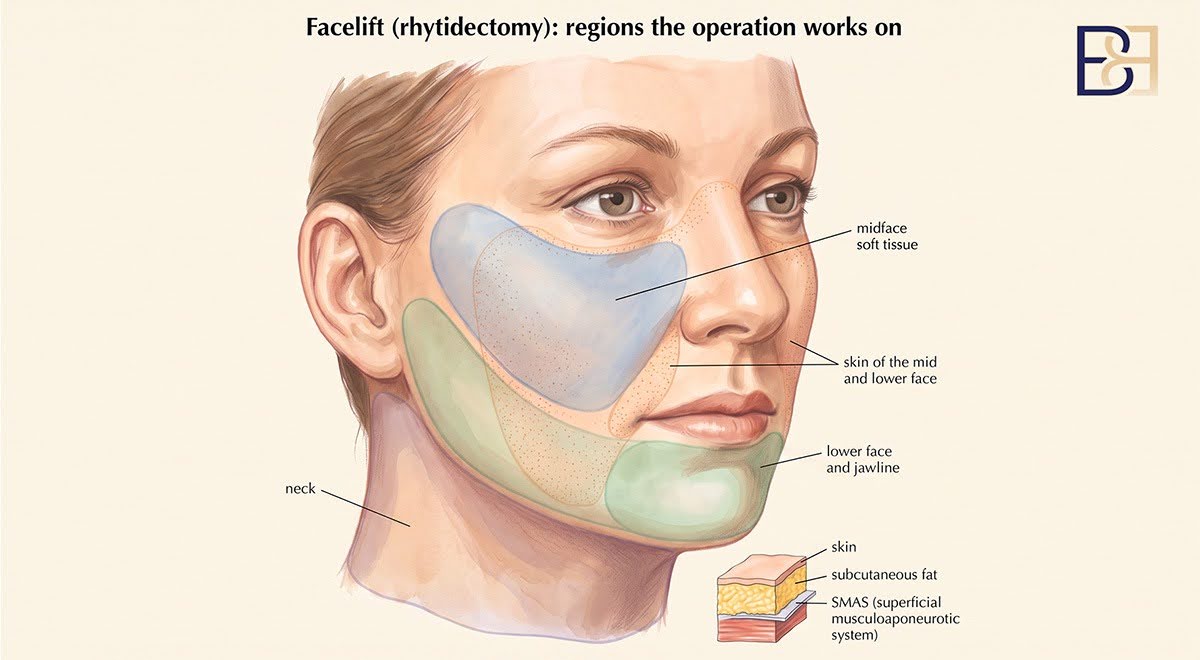
Facial ageing has several components, and they do not all respond to the same treatment:
- Descent of the soft tissue of the mid and lower face
- Excess and laxity of the skin
- Loss of volume
- Changes in skin quality, such as texture, pigment, and fine lines
A SMAS facelift (rhytidectomy) works on the first two. It is suited to established soft-tissue descent and skin excess, rather than minor or early changes. Volume loss and skin quality are separate matters and are not changed by this operation.
Tightening the skin alone tends to be short-lived, because skin stretches and is not the layer that holds the descended tissue. Working at the SMAS layer is what gives the repositioning its durability, although the face continues to age afterwards.
Where changes are minor, non-surgical measures may be more appropriate. Where the neck shows similar changes, a facelift (rhytidectomy) and a neck lift (cervicoplasty) are sometimes performed in the one operation when both are genuinely indicated for that person. You can read more on my neck lift (cervicoplasty) page.
How I perform a SMAS facelift (rhytidectomy)
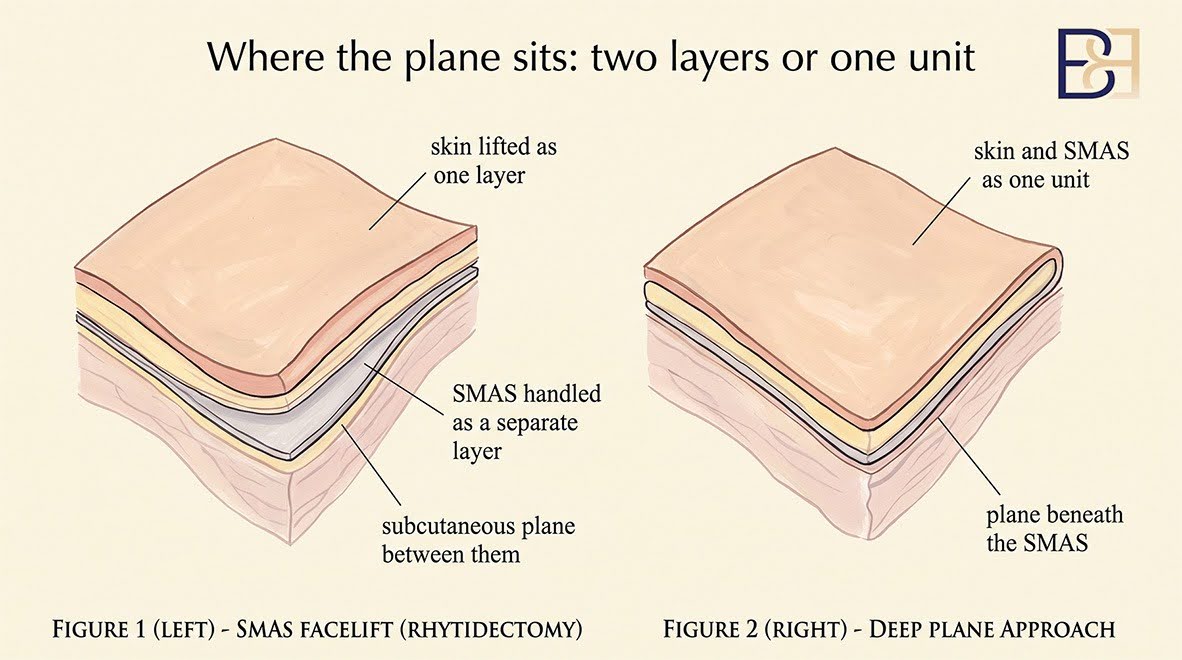
The incision sits in front of the ear, follows its creases, and continues behind the ear. This placement keeps the resulting scar as inconspicuous as the anatomy allows.
Through this incision, the skin is elevated and the SMAS is tightened and repositioned. The exact handling of the layer is decided at assessment, because the degree of descent, the quality of the tissue, and the shape of the individual face all differ. The excess skin is then removed and the skin is closed without tension, since the lift is carried by the SMAS rather than the skin.
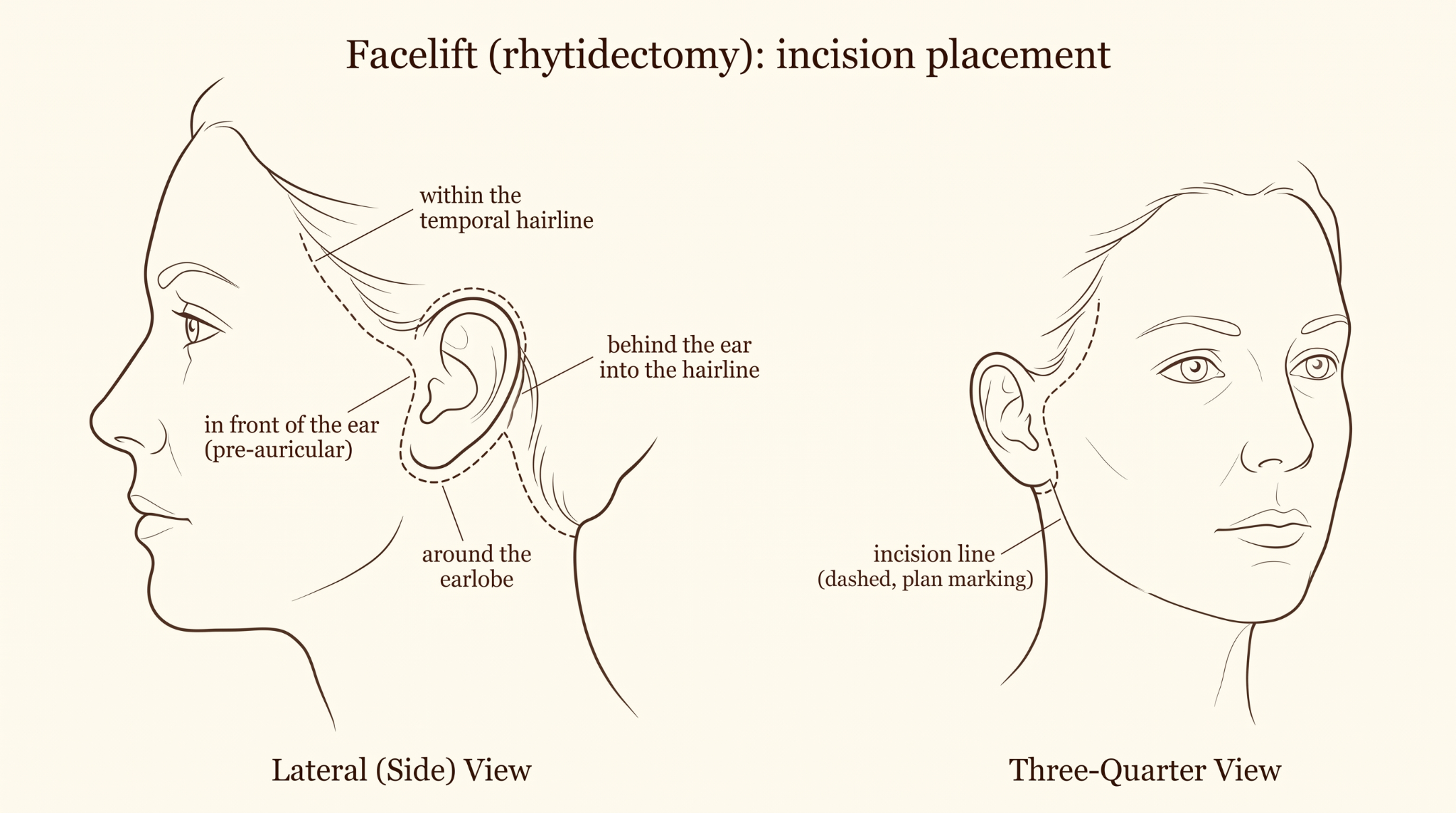
How this compares with other facelift (rhytidectomy) techniques
A SMAS facelift (rhytidectomy) lifts the skin and the SMAS as two separate layers. A deep plane facelift (rhytidectomy) and a preservation deep plane facelift (rhytidectomy) release the skin and the deeper layer together and move them as one unit. A limited facelift (rhytidectomy) uses shorter incisions and is suited to more limited changes. Each approach has a place, and the choice depends on what I find at assessment, not on a standard preference.
I compare these approaches in my article on how I choose a facelift (rhytidectomy) technique. You can also read about each on my deep plane facelift (rhytidectomy), preservation deep plane facelift (rhytidectomy), and limited facelift (rhytidectomy) pages, or start with my main facelift (rhytidectomy) page for an overview.
My approach
I plan this operation from assessment, not from a standard template. At consultation I examine the skin, the soft tissue of the mid and lower face, the neck, and the position of the brow and lids, and I take standardised clinical photographs. That assessment determines whether a SMAS facelift (rhytidectomy) is the right operation for you at all, and how the SMAS should be handled if it is.
Preparation matters as much as technique. Blood pressure is reviewed and optimised before surgery, because raised blood pressure contributes to the risk of haematoma. If you smoke, you will need to stop for an appropriate period before surgery, because smoking reduces skin perfusion and healing. Where the history warrants it, other health factors are worked through with your GP before a surgery date is set.
Book your appointment online now
About Dr Beldholm
I have spent more than 15 years operating on the face and neck. I am a Specialist Surgeon and a Fellow of the Royal Australasian College of Surgeons (FRACS), and facial surgery sits alongside body contouring and breast surgery in my practice.
Surgery is not the answer for everyone. Where changes are minor, or where a different path suits you better, non-surgical options exist, and I discuss them openly at consultation rather than steering every patient toward an operation.
All of my facelift (rhytidectomy) surgery takes place at Maitland Private Hospital in the Hunter Valley.
Your pathway
GP referral
A referral from your GP is required before any consultation.
Consultation
You spend around an hour with me. I take a full history, examine your face and neck, and take standardised clinical photographs. If you need more time to decide, a second consultation is free.
Quote
After the consultation you receive my surgical quote, and my patient coordinator organises the separate hospital and anaesthetist quotes, so you can see the full cost before committing to anything.
Surgery
The operation is performed under general anaesthesia at Maitland Private Hospital. A supportive garment is provided.
Follow-up
I see you intensively over the first 2 weeks, then at 4 weeks, 3 months, 6 months, and 12 months. All follow-up is included at no cost.
Recovery in brief
Swelling and bruising are expected and are most noticeable over the first 2 weeks. Most patients take around 2 weeks off work, depending on the type of work they do. The supportive garment is worn as directed, and sleeping with the head elevated helps in the early days. Return to exercise is staged. Numbness around the ears and cheeks is common early on and usually settles over months. Sun protection matters for how the scars mature.
Recovery varies between patients. I cover the full timeline in my article on facelift (rhytidectomy) recovery week by week.
Risks
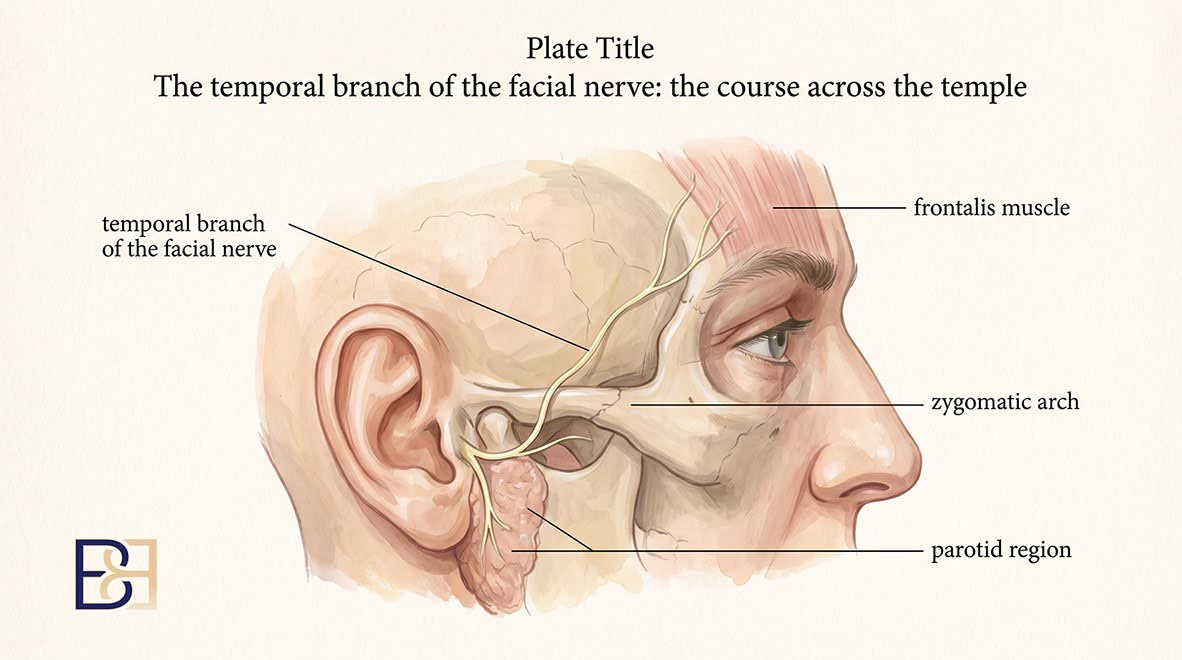
A SMAS facelift (rhytidectomy) is a significant operation, and it carries real risks. The ones I discuss with every patient include:
- Haematoma, a collection of blood under the skin that can need a return to theatre
- Injury to branches of the facial nerve, which can cause weakness of facial movement. This is usually temporary but can rarely be permanent
- Problems with skin healing, including skin loss. This risk is higher in smokers
- Scarring, including thickened or hypertrophic scars
- Changes to the hairline around the incisions
- Asymmetry
- Altered sensation, which is common early and usually settles, but can persist
- Infection and bleeding
- The possibility of revision surgery
Is a SMAS facelift (rhytidectomy) right for you?
Facial ageing is normal, and surgery is one option, not the default. A SMAS facelift (rhytidectomy) may suit you if the soft tissue of your mid and lower face has descended, if your skin has developed established excess, and if you understand the risks, the recovery, and the fact that results vary and are not permanent. It may not be the first step if your changes are minor, if volume loss or skin quality is the main concern, or if your health, blood pressure, or smoking needs work first.
Whether this operation, another technique, or no surgery at all is the right path for you is decided at consultation, after assessment.