


Deep Plane Facelift (Rhytidectomy) in Newcastle NSW
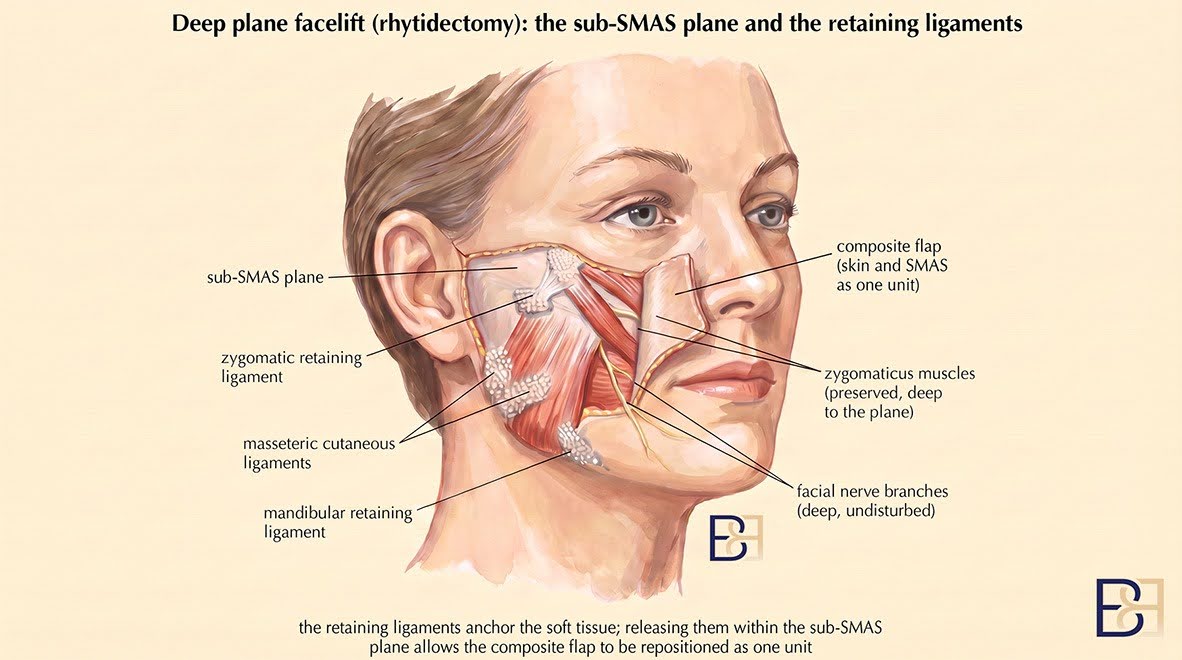
A deep plane facelift (rhytidectomy) is a surgical technique for established descent of the soft tissue of the mid and lower face. The name refers to the plane of dissection. It sits beneath the SMAS, the superficial musculoaponeurotic system, which is the layer of firm connective tissue and muscle under the skin of the face.
In this technique, I release the retaining ligaments that anchor the SMAS to the deeper structures of the face. Once released, the skin and SMAS are repositioned together as one composite unit, rather than the skin being pulled separately over a tightened layer beneath. This is the defining feature of the deep plane approach. You can read about the operation more broadly on my facelift (rhytidectomy) page.
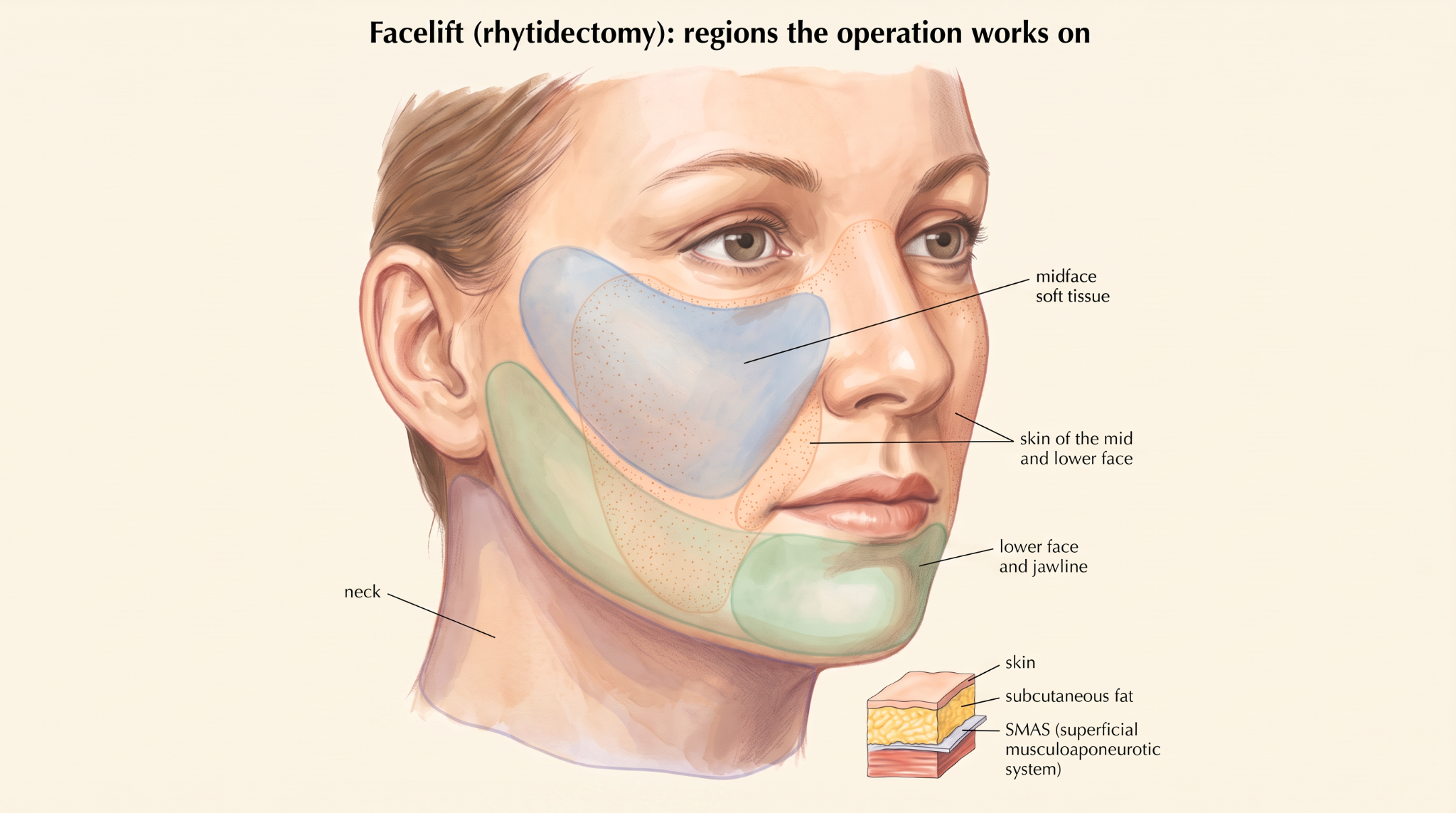
Understand what this operation does not do. It does not replace lost facial volume, and it does not change skin texture, pigment, or fine lines. Those are separate components of facial ageing and are assessed separately. Facial ageing itself is normal, and surgery does not stop it. The face continues to age after any facelift (rhytidectomy), so results are not permanent in that sense.
If you want more detail on this technique, I cover it fully in my article on deep plane facelift (rhytidectomy) explained.
Book your appointment online now
What a deep plane facelift (rhytidectomy) is suited to
Facial ageing has several components: laxity of the skin, descent of the deeper soft tissue, loss of volume, and changes in skin quality. A deep plane facelift (rhytidectomy) works on the descent component. It repositions soft tissue of the mid and lower face that has moved down over time, and removes excess skin.
It is generally suited to people with established descent of the mid and lower face, rather than minor or early changes. Where the changes are minor, or where the main issue is volume or skin quality rather than descent, surgery may not be the right first step. Non-surgical measures may be more suitable for some people, and I discuss those options where relevant at consultation.
Descent of the face and laxity of the neck often occur together. Where both are present and surgery is indicated for both, a deep plane facelift (rhytidectomy) can be performed in the same operation as a neck lift (cervicoplasty).
How it differs from other facelift (rhytidectomy) techniques
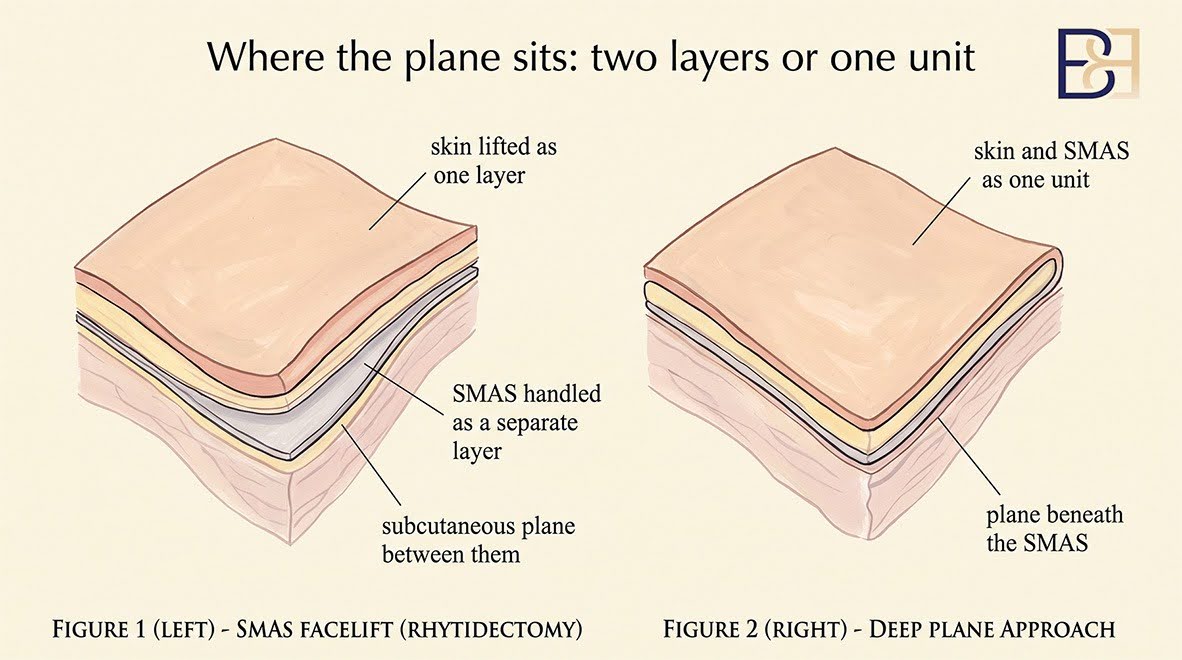
Almost all modern facelift (rhytidectomy) techniques work on the SMAS layer in some way. Skin-only tightening, which leaves the SMAS untouched, tends to give a short-lived result, which is why it has largely been left behind. The differences between current techniques come down to how the SMAS is handled.
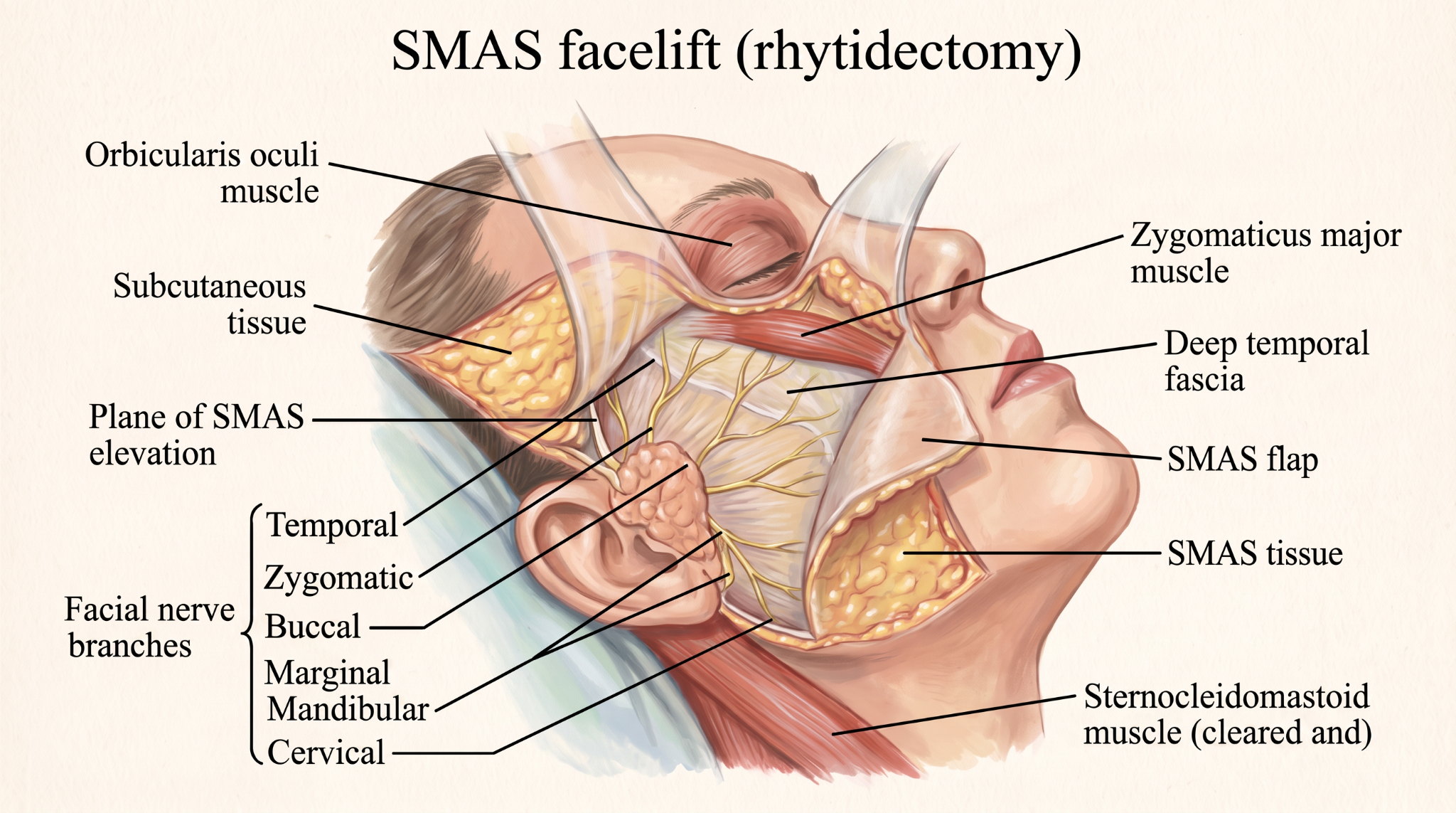
In a SMAS facelift (rhytidectomy), the SMAS is tightened from above, either by folding and suturing it (plication) or by removing a strip and overlapping the edges (imbrication). The skin is lifted as a separate layer over the top.
In a deep plane facelift (rhytidectomy), the dissection goes beneath the SMAS. The retaining ligaments are released and the skin and SMAS move together as one unit. The approach aims to reposition the deeper tissue with less tension on the skin itself.
Neither approach is right for everyone, and no technique produces a guaranteed result. Which technique suits an individual face depends on what assessment finds, including the pattern of descent, skin quality, and the neck. I explain how I choose between skin-only, SMAS, deep plane, and preservation approaches in my article on how I choose a facelift (rhytidectomy) technique.
My approach

At consultation, I examine the skin, the deeper soft tissue, the neck, and the position of the brow and lids, supported by standardised clinical photography. Whether a deep plane facelift (rhytidectomy) is the right operation, or whether a different technique or no surgery at all is the better path, comes out of that assessment.
Preparation matters as much as the operation itself. Blood pressure is reviewed and optimised before surgery, because raised blood pressure contributes to the risk of haematoma, which is bleeding under the skin after the operation. If you smoke, cessation for an appropriate period before and after surgery is required, because smoking affects the blood supply to the skin and how it heals. Both are worked through with you before a surgery date is set.
Book your appointment online now
About Dr Beldholm

I have spent more than 15 years performing surgery of the face and neck. I am a Fellow of the Royal Australasian College of Surgeons (FRACS) and a Specialist Surgeon, and facial surgery sits alongside my body contouring and breast surgery practice.
My facial work covers the range of facelift (rhytidectomy) techniques, neck lift (cervicoplasty) including deep neck work, and upper eyelid surgery. Where a concern is better suited to non-surgical measures, I say so, and we discuss those options at consultation rather than defaulting to an operation.
All of my surgery is performed at Maitland Private Hospital in the Hunter Valley, an accredited private hospital with overnight facilities and nursing support.
Your pathway
The process starts with a referral from your GP. A referral is required before any consultation.
Your consultation with me runs for around an hour. It covers your history, examination, and standardised clinical photography, and we work through what is present in your face, what surgery can and cannot do, and whether a deep plane facelift (rhytidectomy) is an appropriate option for you. If you would like a second consultation to go over things again before deciding, that visit is free.
If you decide to proceed, you receive a written quote for my surgical fee. The hospital and the anaesthetist provide their own separate quotes, and my patient coordinator organises those for you. The anaesthetist usually consults with you by phone before surgery, with the physical assessment on the day.
Surgery is performed under general anaesthesia at Maitland Private Hospital. A support garment is provided by my practice, and all of your post-operative follow-up with me is included at no extra cost. I review you closely for the first two weeks, then at four weeks, three months, six months, and twelve months.
Recovery in brief
Recovery from a deep plane facelift (rhytidectomy) takes time, and it varies between patients. Expect swelling and bruising of the face and neck that is most noticeable in the first one to two weeks and settles gradually over the following weeks. Numbness of areas of the face is common early on and usually resolves over months. Most people take around two weeks off work, though this depends on your job and how you heal. Return to exercise is staged, and I guide you through that at your follow-up visits.
Because the dissection sits in a deeper plane, swelling can take longer to fully settle than many people expect, and the final result is judged over months, not weeks. I cover the week-by-week detail, including dressings, sleeping position, and return to normal activities, in my facelift (rhytidectomy) recovery guide and in my article on deep plane facelift (rhytidectomy) recovery.
Risks of a deep plane facelift (rhytidectomy)
A deep plane facelift (rhytidectomy) is a significant operation, and it carries real risks. These include:
- Haematoma, which is bleeding under the skin. This is one of the notable risks of facelift (rhytidectomy) surgery, and raised blood pressure contributes to it, which is why blood pressure is optimised before surgery
- Facial nerve injury, which can cause weakness of part of the face. This is usually temporary but can be permanent. It is a recognised risk of any facelift (rhytidectomy), and I discuss it with you in detail at consultation
- Problems with skin healing, including skin loss. This risk is higher in smokers
- Numbness or altered sensation of the face and around the ears, which usually resolves over months but can persist
- Scarring, including the possibility of thickened scars, and changes to the hairline around the incisions
- Asymmetry between the two sides of the face
- Infection
- Risks associated with general anaesthesia, which the anaesthetist discusses with you
Results vary between patients, and no outcome can be guaranteed. I go through the full risk profile, including how often problems occur and how they are managed, in my article on facelift (rhytidectomy) risks and complications.
Is a deep plane facelift (rhytidectomy) right for you?
There is no way to answer that from a website. Facial ageing is normal, and surgery is one option among several, suited to some faces and not others. A deep plane facelift (rhytidectomy) may be worth considering if you have established descent of the mid and lower face, you are medically fit, your blood pressure is controlled, you do not smoke or are willing to stop, and you understand the risks, the recovery, and that results vary and are not permanent.
Whether those things apply to you, and whether this technique or a different one suits your face, is worked out at consultation after a proper assessment. That is where the decision belongs, and I would rather tell you surgery is not the right step than operate on someone it does not suit.