


Liposuction (Suction-Assisted Lipectomy) with Fat Grafting to the Breast in Newcastle NSW
Fat transfer breast augmentation (augmentation mammoplasty autologous fat grafting) uses your own tissue in a single operation. I harvest fat by liposuction (suction-assisted lipectomy), process it, and graft it into the breast in the same operating time. There is no second procedure for the harvest and no separate admission.
The volume change fat grafting can achieve is modest and varies between patients, and not all grafted fat survives. Where predictable volume is the goal, implants remain the reliable route. What fat grafting offers is a way to use tissue from one area of your body to add shape or volume to the breast, most often alongside another planned operation. Results vary between patients.
Book your appointment online now
How the Operation Works, Start to Finish
The operation runs in three stages within one operating time, under one anaesthetic at Maitland Private Hospital.
1. Harvest
Fat is removed from a planned donor area by VASER (ultrasound assisted lipectomy). The donor sites are agreed with you at consultation, before the day of surgery.
2. Processing
The harvested fat is filtered and prepared for grafting. This step separates the fat cells from fluid and debris so that what is grafted is concentrated fat tissue.
3. Reinjection
The prepared fat is injected into the breast in small amounts across multiple passes and layers. Placing the fat this way gives each portion of grafted tissue contact with the surrounding blood supply, which is what determines how much of the graft survives.
All three stages happen in sequence in the one operation. When fat grafting is combined with another procedure, such as implant placement or an abdominoplasty, the stages are worked into the same operating time.
Fat Harvest with VASER (Ultrasound Assisted Lipectomy)
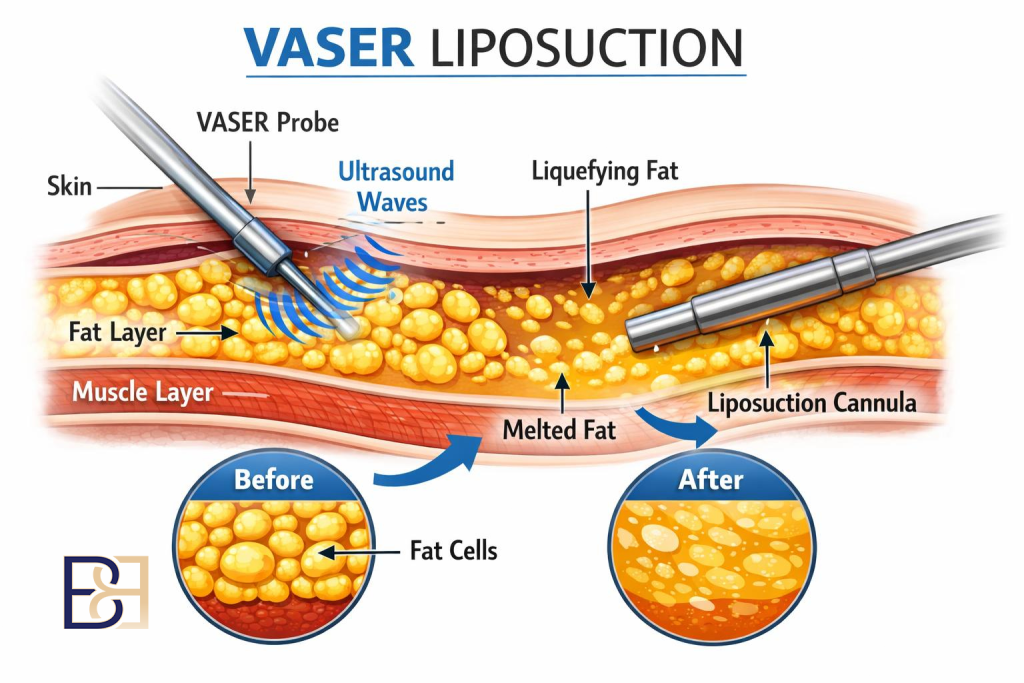
I harvest the fat using VASER (ultrasound assisted lipectomy). This is a form of liposuction (suction-assisted lipectomy) that applies ultrasound energy through a thin probe before the fat is removed.
The ultrasound energy loosens the fat cells from the surrounding tissue. The loosened fat is then removed by suction through small incisions in the donor area, each a few millimetres long.
The reason I use VASER (ultrasound assisted lipectomy) for grafting cases is a practical one. The fat needs to come out in a condition suitable for reinjection, and the harvest needs to leave the donor area with an even contour. Ultrasound assisted harvest lets me work with finer cannulas and remove fat in a controlled, layered way.
VASER (ultrasound assisted lipectomy) is a registered medical device used within the operation. Like every part of this surgery, the harvest carries its own risks, which are covered on the complications page linked below.
Where the Fat Comes From
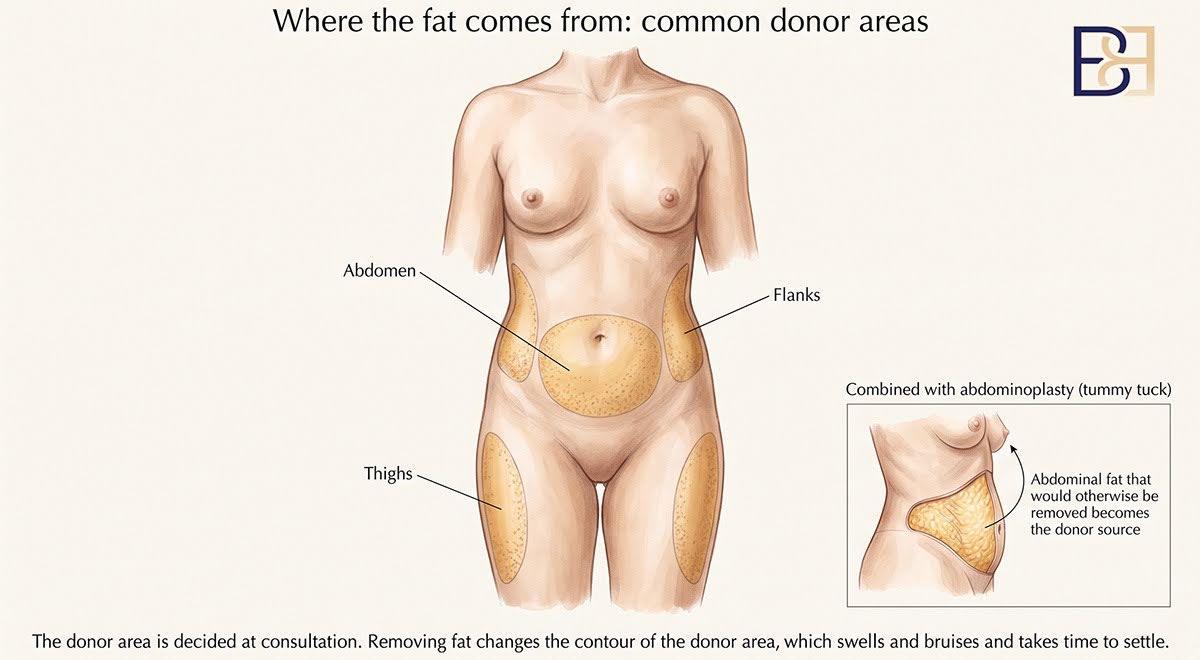
Fat for grafting is commonly taken from the abdomen, flanks, or thighs. These areas tend to hold enough fat to make harvest worthwhile and are practical to reach in the same operating position as the breast work.
Which donor area suits you is decided at consultation. I examine where you carry fat, how much is available, the quality of the overlying skin, and how the donor area sits with any other procedure planned in the same operation. If fat grafting is combined with an abdominoplasty, the abdominal fat that would otherwise be removed and discarded becomes the donor source.
Not everyone has enough donor fat for grafting. Patients with low body fat may not be suited to this operation, and that is part of the assessment.
What happens to the donor area. Removing fat changes the contour of the donor area. That change is a consequence of the harvest, and I plan the harvest so the donor area is left even. The donor area swells and bruises after surgery and takes time to settle, alongside the breast. The donor site is part of the recovery, not separate from it, and the timeline for both is covered on the recovery page linked below.
Processing and Grafting the Fat
Fat straight out of the harvest is not ready to graft. It is mixed with fluid, blood, and broken cells, and grafting that mixture wastes volume and works against graft survival. So between harvest and reinjection, the fat is filtered and prepared in a closed sterile system. Fluid and debris are separated out, leaving concentrated fat tissue for grafting.
The prepared fat is then injected into the breast through small entry points, using a fine cannula. I place the fat in small amounts, in multiple passes, across different depths and directions. Each parcel of grafted fat needs contact with surrounding tissue to pick up a blood supply, and that blood supply determines whether the graft survives.
Not all grafted fat survives. A proportion is reabsorbed by the body in the months after surgery, and how much is retained varies between patients. The volume that remains at around three to six months is a reasonable guide to the lasting result. Where more volume is wanted than one graft can deliver, a repeat session in a later operation is sometimes an option, and that is discussed at consultation.
Book your appointment online now
Where This Operation Fits
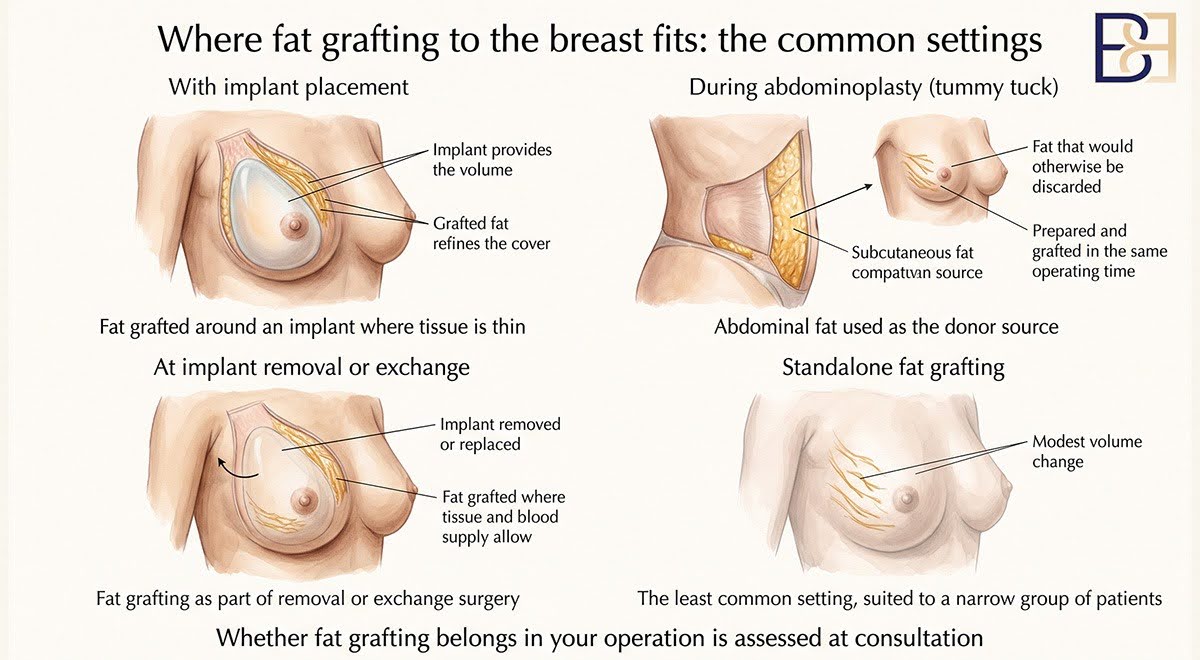
In my practice, fat grafting to the breast is mostly performed alongside another planned operation rather than on its own. The common settings are:
- With implant placement. Fat is grafted around an implant in the same operation to add cover or adjust shape where the tissue is thin. The implant provides the volume; the fat refines the result. More detail is on the main fat transfer breast augmentation (Augmentation mammoplasty autologous fat grafting) page.
- During an abdominoplasty. Where an abdominoplasty is already planned, fat that would otherwise be removed and discarded can be prepared and grafted to the breast in the same operating time.
- At implant removal or implant exchange. Fat grafting can be part of the plan when implants are removed or replaced, where the tissue and blood supply allow it.
Standalone fat grafting, with no other procedure, is the least common setting. The modest volume change it offers suits a narrow group of patients, and whether you are in that group is a consultation question.
Each of these is a clinical decision made for the individual patient, not a set combination. Whether fat grafting belongs in your operation at all is assessed at consultation, based on your anatomy, your donor fat, and what the rest of the operation involves.
Your Pathway
A GP referral is required before any consultation. Your GP is also copied into your pre-operative results and takes over routine follow-up after your four week review.
At consultation I take a full medical history and examine both the breasts and the potential donor areas. The assessment covers how much donor fat is available, the quality of the breast tissue and skin, and how fat grafting would fit with any other procedure being planned. This is where the decision is made on whether fat grafting suits you at all, which donor sites to use, and what the operation as a whole will involve.
Pre-operative breast imaging is arranged before surgery. The type of imaging depends on your age: mammography for older patients and ultrasound for younger patients, arranged individually.
Standard pre-operative blood tests are also completed before surgery. Surgery is performed at Maitland Private Hospital, with consultations at my Lorn clinic and by Zoom for patients travelling from further away. An in-person consultation is required before surgery.
Recovery and Risks
This is invasive surgery under general anaesthetic, and it carries risks at both the breast and the donor area. Recovery takes time, involves swelling and bruising at both sites, and varies between patients, as do results.
Risks specific to this operation include the harvest itself, graft loss, oil cysts, and changes that can appear on breast imaging. These are set out in full on the [fat grafting complications page].
The recovery timeline, including the support garment, activity restrictions, and how the donor area and the breast settle over the weeks after surgery, is covered on the [fat grafting recovery page].
For a full picture of the procedure, including candidacy and how fat grafting compares with implants, see the main fat transfer breast augmentation (augmentation mammoplasty autologous fat grafting) page.