
Gynaecomastia Surgery Complications What Can Happen and How Likely It Is

Gynaecomastia Surgery Complications: What Can Happen and How Likely It Is

Gynaecomastia is enlarged male breast tissue, and surgery to reduce it is also known as male breast reduction surgery. Where the condition is established and surgery is appropriate, an operation can reduce the tissue. Like any operation, it carries risks. This page sets out the potential complications of the surgical


Gynaecomastia Grading Systems A Comprehensive Comparison of the Major Classification Methods

Gynaecomastia Grading Systems: A Comprehensive Comparison of the Major Classification Methods

Gynaecomastia means enlarged male breast tissue. The surgery to remove excess tissue is sometimes called male breast reduction, or male breast reduction surgery. When surgeons talk about it, they usually describe it in grades, from mild through to severe. The grade is a shorthand for how much excess breast tissue

VASER Liposuction (Ultrasound Assisted Lipectomy) for Gynaecomastia: Treating Fat-Predominant (BB Grade 2) Male Breast Tissue Without Excision

VASER Liposuction (Ultrasound Assisted Lipectomy) for Gynaecomastia: Treating Fat-Predominant (BB Grade 2) Male Breast Tissue Without Excision

Gynaecomastia is enlarged male breast tissue. The surgical correction of enlarged breasts in men, also known as male breast reduction surgery, is a surgical procedure I perform regularly. In some men the enlarged male breasts are mostly fatty tissue rather than firm glandular tissue, and the nipple has not dropped.

Historically Significant: Mastectomy for Gynecomastia Through Semicircular Intra-Areolar Incision, Webster (1946)

Historically Significant: Mastectomy for Gynaecomastia Through Semicircular Intra-Areolar Incision, Webster (1946) 

Written in 1946 by Dr. Jerome P. Webster, Mastectomy for Gynaecomastia Through a Semicircular Intra-Areolar Incision describes a forward-thinking surgical technique for treating gynaecomastia using a minimally invasive approach.  First introduced in 1934, the Webster procedure holds particular historical significance as one of the first surgical approaches specifically designed to

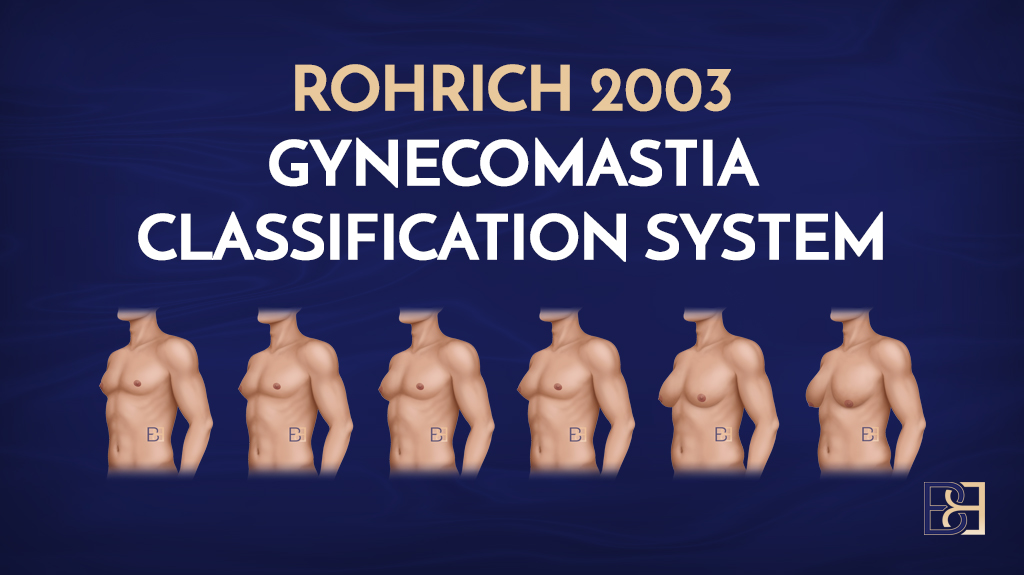
Rohrich Gynaecomastia Classification System (2003)

Rohrich Gynaecomastia Classification System (2003)

According to an article, Classification and Management of Gynecomastia: Defining the Role of Ultrasound-Assisted Liposuction, written by Rod J. Rohrich, M.D., et al., medical management has had limited success for the treatment of gynaecomastia, with excisional surgical techniques becoming the accepted standard. However, with such important physical and psychological impacts and an

Location

30 Belmore Rd
Lorn NSW 2320

Connect