


Breast Surgery: Reducing Breast Size, Lifting the Breast, Adding Volume, and Surgery for Existing Breast Implants
Every breast operation I perform does one or more of three things: it changes breast volume, it changes breast position, or it places, removes or replaces an implant.
- Reducing breast size. Breast reduction (reduction mammoplasty) removes volume and weight and repositions the nipple.
- Lifting the breast. A breast lift (mastopexy) repositions the breast and nipple and reshapes the tissue, without adding volume.
- Adding volume. Breast augmentation (augmentation mammoplasty) adds volume, either with an implant or with your own fat (autologous fat grafting).
- Existing implants. If you already have implants, surgery means removing them, replacing them, or doing either together with a breast lift (mastopexy).
This page is a map. Start with whether you already have breast implants, because that changes the consultation, the operation and the risks. From there, each group below says in a few lines what the operation does and links to the page that covers it in full, with its own recovery, risks and cost information.
Book your appointment online now
If you do not have breast implants
These operations start from a breast that has not had implant surgery. They fall into four groups by what changes.
Reducing breast size
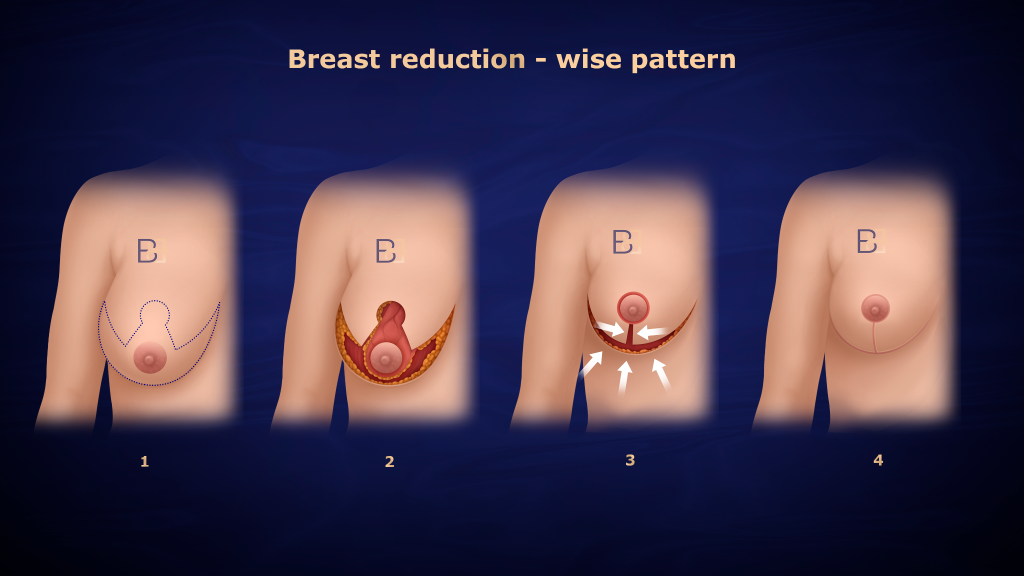
Breast reduction (reduction mammoplasty) removes breast tissue, fat and skin, and moves the nipple to a higher position on the smaller breast. A lift is built into the operation, so there is no separate lift to add. Liposuction (suction-assisted lipectomy) is sometimes used alongside it for fat at the side of the breast and towards the armpit.
Lifting the breast
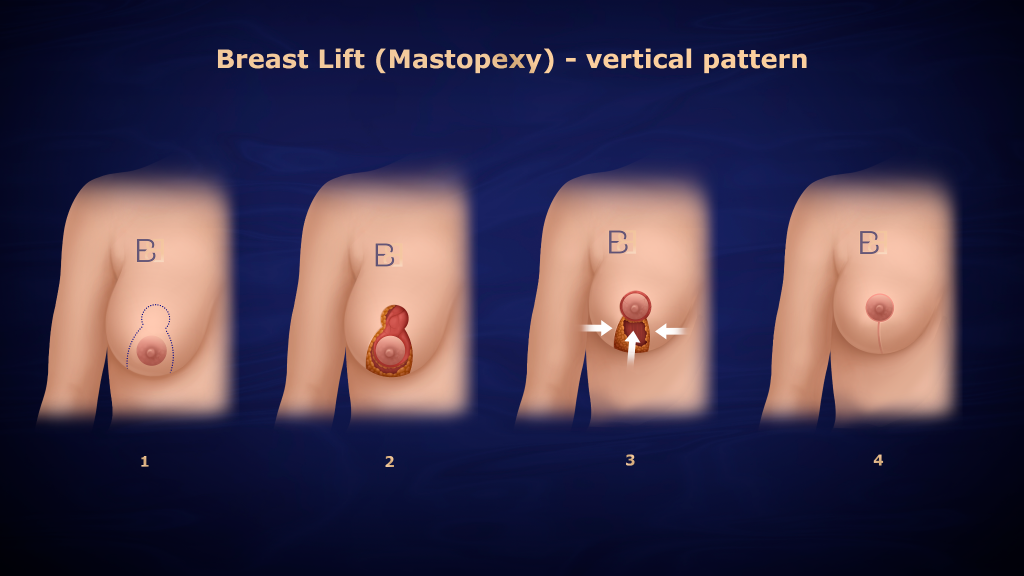
A breast lift (mastopexy) removes excess skin, reshapes the breast tissue and moves the nipple higher. On its own it does not add volume. Where volume is also wanted, there are three ways to add it during the lift.
- Breast lift (mastopexy): the lift on its own.
- Breast lift (mastopexy) with implants: the lift and an implant. This can be done as one operation or in two stages. I cover that decision further down this page.
- Breast lift (mastopexy) with auto-augmentation: during the lift, your own lower breast tissue is repositioned to add volume to the upper breast, without an implant. It suits patients who have enough breast tissue for that.
- Breast lift (mastopexy) with fat grafting: during the lift, fat harvested from elsewhere on your body is grafted into the breast, mostly to the upper breast. How much volume fat grafting adds, and how much of it survives, is covered in the fat grafting group below.
If you already have implants and want a lift, the lift is planned as part of implant removal or exchange. Those pages are in the existing implants group below.
Adding volume with implants
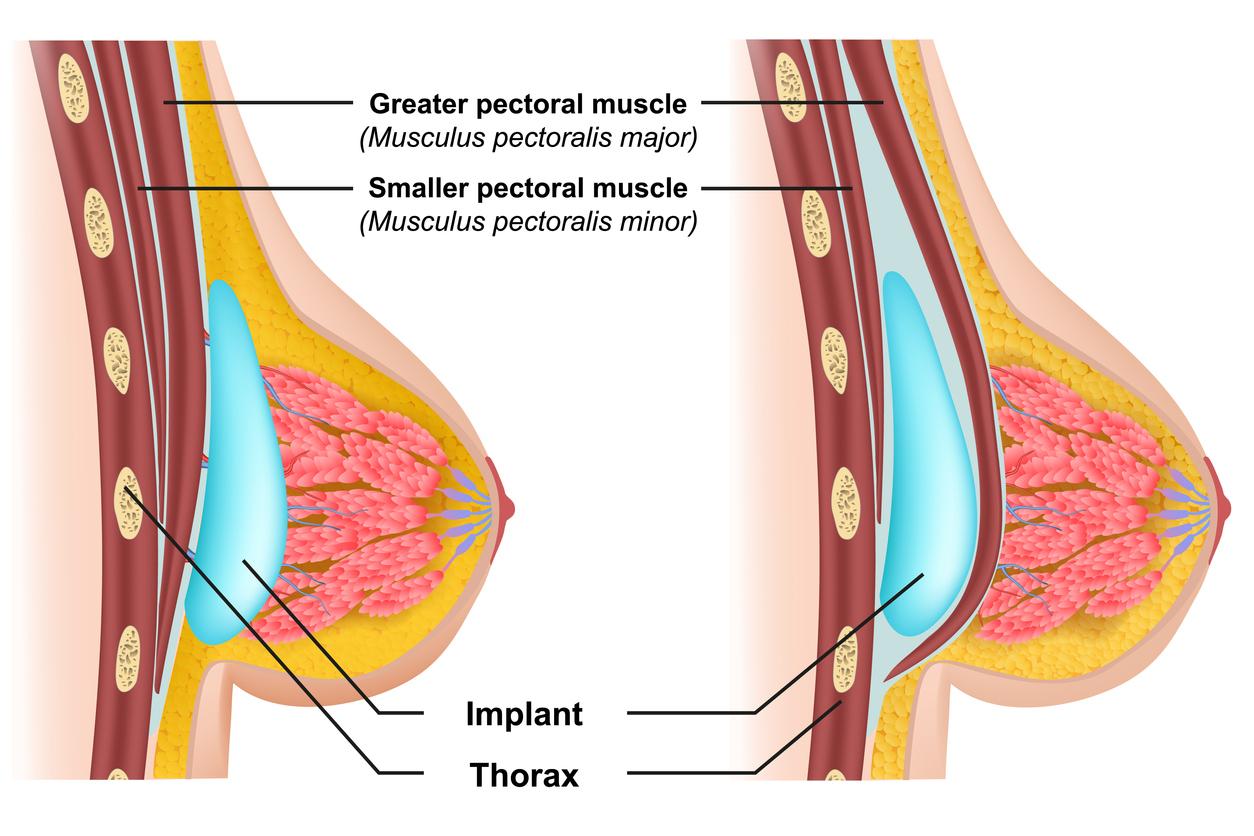
Breast augmentation (augmentation mammoplasty) places an implant behind the breast tissue, either in front of or partly behind the chest muscle, to add volume. Round and anatomical implants are both used. Size, shape and placement are planned at consultation. An implant adds volume but does not lift the breast; where the nipple sits low, the lift with implants option above covers that.
- Breast augmentation (augmentation mammoplasty) with implants: the implant on its own.
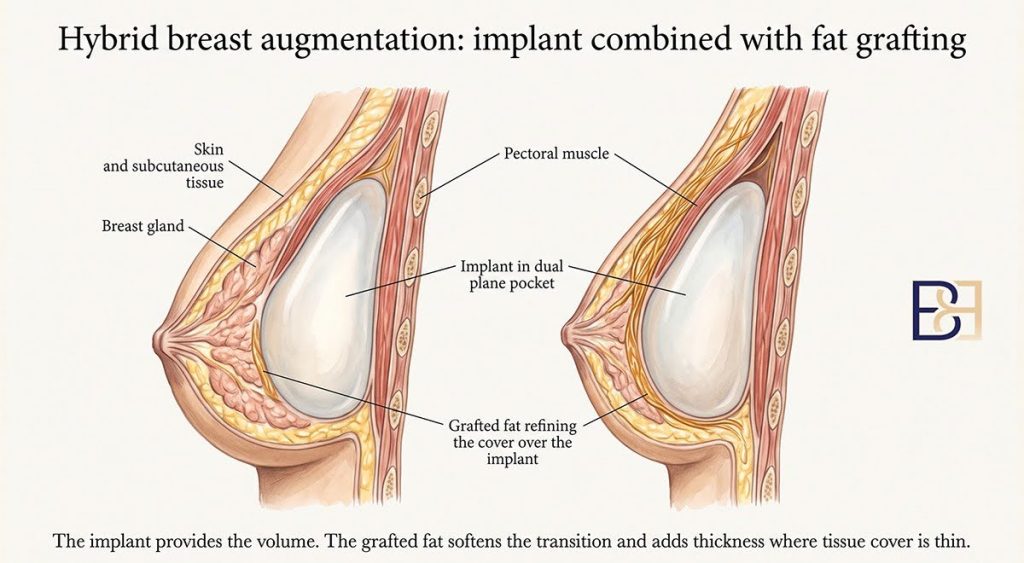
- Hybrid breast augmentation (augmentation mammoplasty): the implant provides most of the volume, and a smaller amount of your own fat is grafted around it in the same operation where the tissue over the implant is thin. Whether the fat grafting component is appropriate is decided case by case.
Adding volume with your own fat
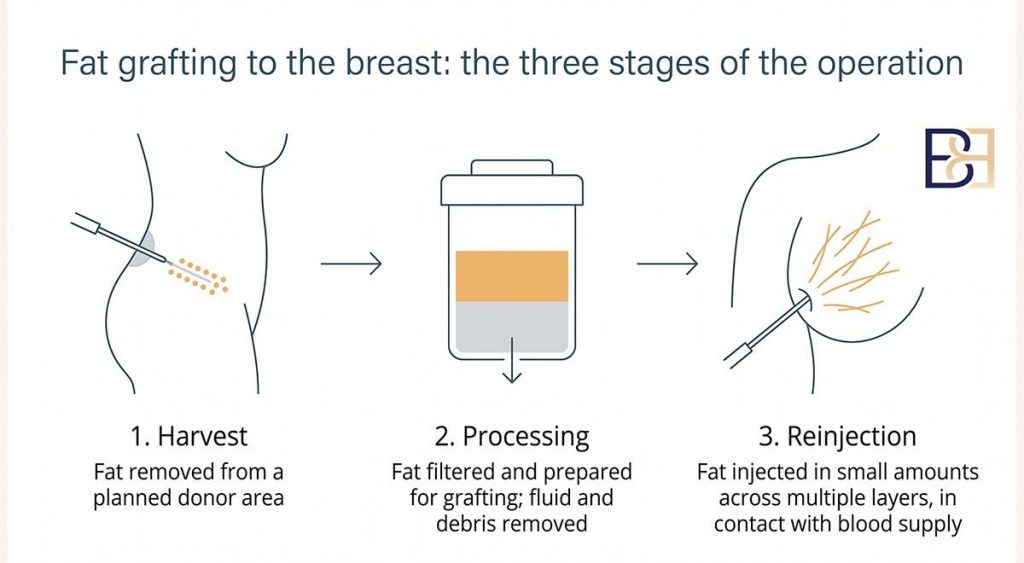
Fat grafting takes fat from one part of your body, prepares it, and grafts it into the breast. The volume change is modest and varies between patients, and not all grafted fat survives. Where predictable volume is the goal, implants remain the reliable route. Fat grafting on its own is uncommon in my practice; I offer it mostly as a component of another planned operation.
- Fat transfer breast augmentation (augmentation mammoplasty with autologous fat grafting): the main page on adding volume with your own fat, including who it suits and what it can and cannot do.
- Liposuction (suction-assisted lipectomy) with fat grafting to the breast: how the fat is harvested by liposuction (suction-assisted lipectomy), prepared and grafted in one operating time, and where it is taken from.
- Fat grafting to the breast during abdominoplasty (tummy tuck): where an abdominoplasty (tummy tuck) is already planned, fat that would otherwise be removed and discarded can be prepared and grafted to the breast in the same operation.
Fat grafting is also used at implant removal and implant exchange. Those pages are in the existing implants group below.
If you already have breast implants
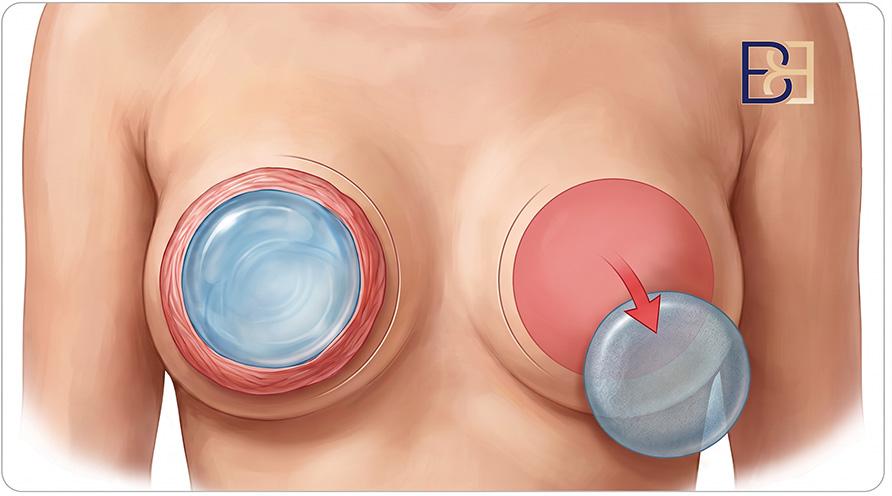
Breast implants are not lifetime devices. Patients come to see me about implants already in place for a range of reasons: a rupture or a suspected rupture, capsular contracture (tightening of the scar tissue around the implant), changes in the breast since the original surgery, a wish for a different size, symptoms they attribute to the implants, or a decision that they no longer want implants at all.
Each of these six operations begins with removing the implants. The capsule of scar tissue around each implant may be left, removed in part, or removed in full, decided case by case. What comes next splits the group in two: either nothing replaces the implant, or a new implant does.
Bring your implant details to consultation if you have them, either the implant card or the operation record. If BIA-ALCL is suspected, assessment and treatment sit with a breast cancer surgeon through your GP, not with me. My BIA-ALCL page explains the condition and that pathway.
Removing implants without replacement
Once the implants are out, the breast settles over the following months. How it settles depends on how much breast tissue you have and how far the skin has been stretched by the implant.
- Removal of breast implants (explant surgery): removing the implants, with or without the capsule, and nothing else.
- Removal of breast implants with a breast lift (mastopexy): where the skin envelope will be larger than the remaining breast tissue, a lift removes excess skin and repositions the nipple. This can be done in the same operation as the removal or as a second stage; that decision is covered further down this page.
- Fat grafting at implant removal: fat harvested from elsewhere on your body is grafted into the breast at the time of removal, to replace some of the volume the implants provided. What was said about fat grafting in the group above applies here too.
I do not combine auto-augmentation with implant removal. The blood supply risk to the breast tissue is too high to justify it.
Removing and replacing implants
- Removal and replacement of breast implants (implant exchange): the existing implants come out and new ones go in during the one operation. Size, shape, surface and placement are reassessed rather than copied from the original surgery.
- Removal and replacement of breast implants with a breast lift (mastopexy): exchange together with a lift, where breast position has changed since the original surgery and a new implant on its own would not change it. As with removal with a lift, this can be one operation or two.
- Fat grafting at implant exchange: a smaller amount of your own fat is grafted around the new implant where the tissue over it is thin, at the time of the exchange.
One operation or two
Several of the operations above combine two things: a lift with an implant, a lift with implant removal or exchange, or fat grafting with another planned operation. Where a patient is suited to it, my preference is to do the work in a single operation. That means one anaesthetic, one hospital admission and one recovery, rather than repeating each of those steps.
It is a preference, not a rule. A combined operation is a larger physiological event than either part on its own, and for some patients staging the work across two operations is the more appropriate path. With a lift and an implant in particular, the trade-offs between blood supply to the nipple, skin tension, implant position and scar quality can favour doing the lift first and the implant later. Staging is not a lesser option. For some patients it is the right one.
Which path suits you depends on your medical history, the quality of your breast tissue and skin, the degree of ptosis (breast position), and what can be done well in one operating time. I decide it with you at consultation, after examination, and not before. Combining operations is never a reason to have more surgery than you came in for.
Is breast surgery right for me
Surgery is not the only option, and it is not the right option for everyone who considers it. Part of my job at consultation is to tell you if I think it is not right for you, or not right yet.
The things I assess apply across every operation on this page:
- General health. Breast surgery is performed under general anaesthetic. Any condition that affects healing or anaesthetic risk is reviewed before a decision is made.
- Weight. A stable weight matters more than a specific number. BMI is a rough guide, not a cut-off. Where weight is still changing, surgery is usually planned once it has settled.
- Smoking and nicotine. Both reduce blood supply to the skin and nipple and raise the risk of wound healing complications. I ask patients to stop well before surgery.
- Pregnancy and breastfeeding. Where relevant, surgery is planned once breastfeeding has finished and the breasts have settled after your most recent pregnancy. Timing is assessed individually. Future pregnancy and breastfeeding can change the result of any breast operation, and augmentation and reduction can affect your ability to breastfeed later. I discuss this with anyone who may have children in future.
- Expectations. Every operation on this page changes volume, position or both within the limits of your own tissue. What that means for you is something I can only discuss after examining you, and results vary between patients.
- Age. I operate on adults only.
You do not need to decide at your first consultation. Take time, ask questions, and get a second opinion if you want one.
Book your appointment online now
Your pathway
The steps are the same whichever operation you are considering.
1. GP referral
A referral from your GP is required before your first consultation. Your GP is copied into your pre-operative results and takes over routine care after your 4 week review.
2. First consultation
At my Lorn clinic, or by video for patients travelling from further away. I take a full history, examine you, and go through which operation fits, what it involves, its risks, and whether one operation or two is the better plan. No consent forms are signed at this visit. You receive written quotes before you decide anything.
3. Second consultation
At least two consultations are required before cosmetic surgery, and at least one of them must be in person with me. Informed consent is given at a consultation, and there is a cooling-off period of at least 7 days after consent before surgery is booked or a deposit paid.
4. Preparation
Standard pre-operative blood tests, and breast imaging where it is indicated for your age and your operation. The anaesthetist assesses you by phone before surgery in most cases, with the physical examination on the day.
5. Surgery
At Maitland Private Hospital. Whether you go home the same day or stay overnight depends on the operation.
6. Follow-up
My nurse and I see you 2 to 3 times a week for the first 2 weeks, including Healite II LED light treatment, then at 4 weeks, 3 months, 6 months and 12 months. During office hours you contact my rooms. After hours you call the Maitland Private Hospital nurse-led triage line, which you are given before you go home.
Why patients choose me

I am a Specialist Surgeon (FRACS) with more than two decades of surgical experience, and breast surgery has been a central part of my practice for more than 15 years. I perform every operation on this page myself, at Maitland Private Hospital, and my nurse and I see you personally at every review from the first week to the 12 month mark.
Patients come to me from Newcastle, Lake Macquarie, Maitland, Port Stephens, the Central Coast and regional NSW.
The consultation is for information, not persuasion. I tell you what an operation can and cannot do for your anatomy, what it costs, what the recovery involves and what the risks are. Then you decide, in your own time.
Read more about Dr Bernard Beldholm, including his qualifications and areas of surgical practice.
Costs and Medicare
Every operation on this page is quoted in writing before you decide. You receive three quotes: a surgical quote from my practice, which covers my fee, your support bra, your second consultation and all post-operative reviews; a hospital quote from Maitland Private Hospital; and an anaesthetist quote. My patient coordinator arranges the hospital and anaesthetist quotes for you. Implants are charged separately. GST applies to cosmetic procedures.
Some operations attract a Medicare item number where specific criteria are met, and health fund cover may follow from that. Breast reduction (reduction mammoplasty) is the most common example. Some breast lifts (mastopexy) and some implant removals, such as for rupture or capsular contracture, can also qualify. Cosmetic breast augmentation (augmentation mammoplasty) does not attract a rebate. Eligibility is assessed individually at consultation. Tell me at your first visit if you intend to pursue a rebate.
Indicative figures for each operation are on its cost page:
- Reducing breast size: breast reduction (reduction mammoplasty) cost
- Lifting the breast: breast lift (mastopexy) cost, breast lift (mastopexy) with implants cost
- Adding volume with implants: breast augmentation (augmentation mammoplasty) cost, hybrid breast augmentation (augmentation mammoplasty) cost
- Adding volume with your own fat: fat transfer breast augmentation (augmentation mammoplasty) cost, liposuction (suction-assisted lipectomy) with fat grafting cost, fat grafting during abdominoplasty (tummy tuck) cost
- Existing implants: implant removal cost, removal with breast lift (mastopexy) cost, implant exchange cost, exchange with breast lift (mastopexy) cost, fat grafting at removal cost, fat grafting at exchange cost
Recovery and risks
Every operation on this page is invasive surgery under general anaesthetic. It carries risks, it leaves permanent scars, and recovery takes weeks, not days. How long it takes, and how you find it, varies between patients and between operations, and individual results vary.
Risks common to all breast surgery include bleeding, infection, delayed wound healing, scars that are wider or more visible than expected, asymmetry, changes in nipple sensation, blood clots (DVT and VTE), the risks of general anaesthesia, and the need for further surgery. Lifts and reductions carry a small risk to the blood supply of the nipple. Implants add capsular contracture, rupture, rippling and implant malposition, BIA-ALCL, the symptoms some patients report as breast implant illness, and effects on mammographic screening. Implants are not lifetime devices, and further surgery at some point is likely. Fat grafting adds fat necrosis, oil cysts and calcifications, some of which show on breast imaging, and variable survival of the grafted fat.
I assess and manage your DVT risk myself, and I go through the risks that apply to your operation in detail at consultation and in writing before you consent.
Recovery in broad terms means a support bra for 4 weeks full time and then 2 weeks during the day, lifting and exercise restrictions that depend on the operation, and time off work that depends on the operation and your job. The detail for each operation is on its recovery page:
- Breast augmentation (augmentation mammoplasty): recovery and complications
- Breast lift (mastopexy): risks and recovery
- Breast reduction (reduction mammoplasty): risks and recovery
- Implant removal: recovery and complications
- Implant exchange: recovery and complications
- Fat grafting: complications and how much grafted fat survives
- BIA-ALCL