


Removal of Breast Implants with a Breast Lift (Mastopexy) in Newcastle NSW
When breast implants are removed, the breast that remains is not the same as the breast before the implants went in. Over the years the skin stretches to hold the implant, the breast tissue changes, and the breast usually sits lower on the chest than it once did. So for many people considering implant removal (explant), the question is not only whether to take the implants out. It is also what the breast will look like afterwards, and whether a breast lift (mastopexy) at the same time is the right choice.
That is the decision I work through with patients here: what removing implants involves, what a lift does, and when it makes sense to do both in one operation rather than staging them across two. There is no single answer that suits everyone. Whether either operation is appropriate for you is assessed individually at consultation, after a GP referral.
Book your appointment online now
What this operation involves
Removing breast implants and doing a breast lift (mastopexy) at the same time is really two pieces of work in one operation, under general anaesthetic in hospital. It helps to understand each piece on its own.
Removing the implants
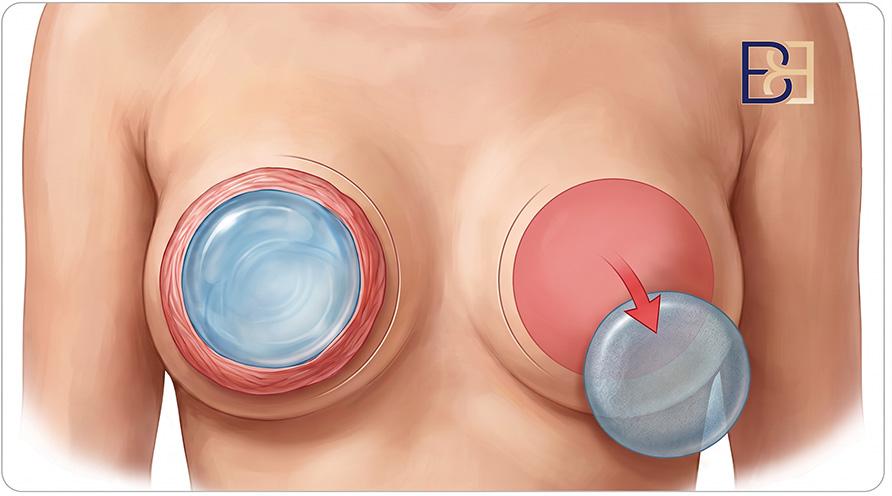
The implant is taken out, usually through the previous scar or through the crease under the breast (the inframammary fold), so a new scar location is avoided where possible. When both implants are being removed, each side is done in turn.
The capsule, and when it is removed
Whenever an implant sits in the body, a layer of scar tissue forms around it. This layer is called the capsule, and it is a normal response, not a complication in itself. What happens to the capsule at the time of removal depends on what I find:
- If the capsule is thin and soft, it can often be left in place to settle on its own.
- If the capsule is thickened, hardened or calcified, as it can be with capsular contracture, removing it (a capsulectomy) is usually part of the operation.
- The capsule can be removed partly or completely. In some cases the implant and the capsule around it are taken out together as one unit, which is sometimes called an en bloc removal.
How much capsule is removed is decided for the individual, based on the findings at examination and imaging, the type of implant, and your history. Removing more capsule means more dissection and a larger operation, so the extent is matched to what is clinically warranted rather than done to a formula. I talk through what I would plan for you, and why, at consultation.
The Breast lift (mastopexy)
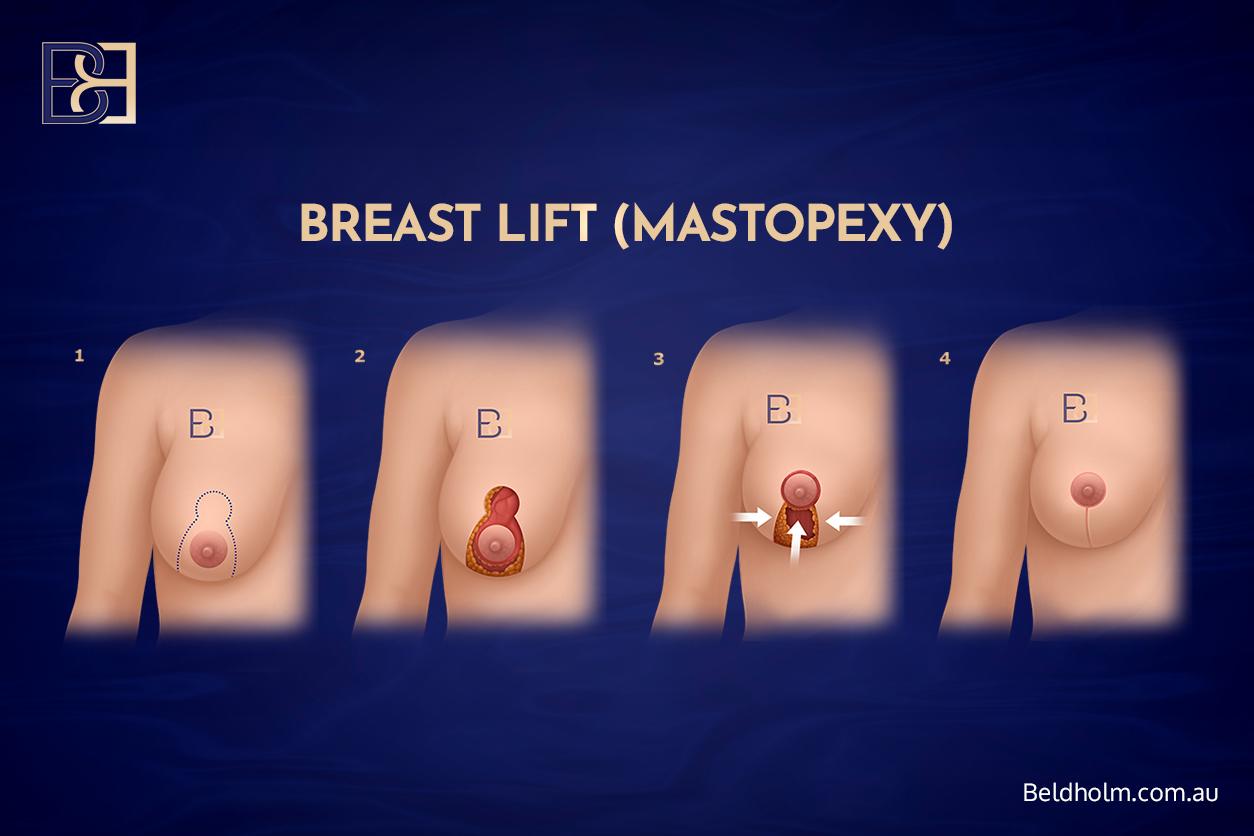
Once the implant is out, the breast has less volume than it did, and the skin that stretched to hold the implant no longer has the same fill behind it. A breast lift (mastopexy) reshapes the remaining breast tissue, removes excess skin, and repositions the nipple and areola higher on the breast. It does not add volume. The result is a smaller breast than you had with implants, reshaped and lifted using your own tissue.
The pattern of the scar depends on how much skin needs to come out and how far the nipple needs to move:
- A periareolar pattern, around the edge of the areola, for a small degree of lift.
- A vertical pattern, around the areola and down to the crease, for a moderate degree.
- An inverted-T pattern, which adds a scar along the crease, where there is more skin to remove.
I go through which pattern suits your breast at consultation, and what that means for scar position and length. Scars are permanent. They mature and fade over many months, but they do not disappear.
Why patients consider implant removal
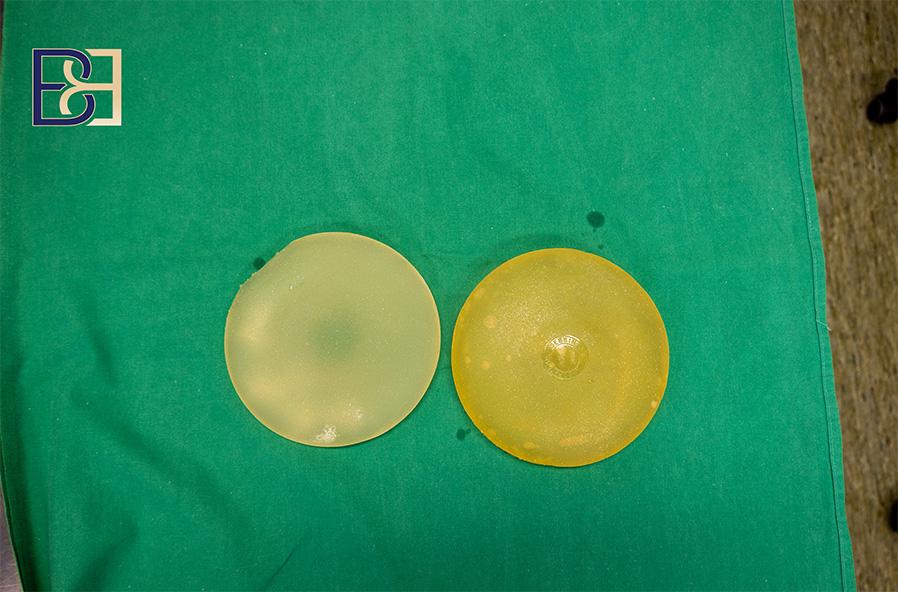
People come to me about removing their implants for a range of reasons. Some are medical, some are personal, and often it is a mix. Here are the ones I see most often. None of them makes removal automatically the right choice for you. That is worked out at consultation, after examination and any imaging.
Capsular contracture
The capsule of scar tissue around an implant can tighten and thicken over time. When it does, the breast can feel firm or hard, change shape, sit differently, or become uncomfortable or painful. This is called capsular contracture. It is one of the more common reasons implants are removed, and where the capsule is involved, removing it (a capsulectomy) is usually part of the operation.
Implant rupture or wear
Breast implants are not lifetime devices. The shell can weaken or fail over the years. A saline implant that ruptures usually deflates noticeably. A silicone implant can rupture without any outward sign, which is why imaging such as ultrasound or MRI is used to check the implant when rupture is suspected. A known or suspected rupture is a common reason to remove or exchange an implant.
BIA-ALCL
Breast implant associated anaplastic large cell lymphoma (BIA-ALCL) is a rare cancer of the immune system, not breast cancer. It has been linked with certain textured implant surfaces. It is uncommon, and it is usually treatable when found early, most often by removing the implant and the capsule. If you have a textured implant, this is something I can talk through factually, including what is and is not known about the risk.
Breast implant illness
Some people with implants report a range of symptoms, such as fatigue, joint aches and brain fog among others, that they connect to their implants. This is often called breast implant illness (BII). It is not a formal medical diagnosis, and the symptoms are wide-ranging and can have many causes, so part of the process is looking into those other causes too. Some people report that their symptoms improve after their implants are removed, though the evidence is still limited and I cannot promise a particular outcome. If this is your reason for considering removal, I will talk it through with you, including what the evidence does and does not support.
A change in what you want
Not every reason is a complication. Some people no longer want implants, or their preferences have changed since the original operation, or their implants are old and they would rather have them out than replaced. That is a legitimate reason to consider removal, and it is your decision to make.
One operation or two
There are two ways to sequence this. The implants can be removed and the breast lifted in the same operation. Or the work can be staged: the implants come out first, the breast is allowed to settle over some months, and the lift (mastopexy) is done as a second, separate operation once the final shape is clearer.
Where a patient is suited to it, my preference is to do the work in one operation. One operation means one anaesthetic and one recovery to work through, rather than repeating those steps twice. That is a preference, not a rule, and it is not the right answer for everyone.
When implants are removed, the breast tissue and skin need time to settle and draw in, and it is not always possible to judge the final shape, or how much skin to remove, straight away. Doing the lift as a second stage lets me plan it on a breast that has settled. Sometimes, once the breast has settled, less of a lift is needed than expected. Staging can also protect the blood supply to the nipple and the quality of the scars, particularly where a lot of skin needs to move. None of that makes staging a fallback. It is the appropriate path for some patients, and I recommend it openly when it is.
Doing both in one operation is a larger operation than either part alone, and a bigger physiological event. Recovery from a combined operation should not be underestimated, which is part of why pre-operative preparation matters.
Which sequence suits you depends on your medical history, the quality and thickness of your breast tissue, how much skin laxity there is, the position of the breast and nipple, and what can be done well in a single operating time.
Book your appointment online now
Is this operation right for me
There is no answer to that question that applies to everyone, and I would be wary of any page that gave you one. Whether removing your implants, with or without a lift (mastopexy), is a reasonable choice for you is something I work out with you at consultation, after examining you and reviewing any imaging.
Some of what I weigh up:
- Your reason for wanting the implants removed, and whether removal is likely to help with it.
- Your general health, and whether you are well enough for an operation of this size.
- The quality and thickness of your breast tissue and skin, and how much skin laxity there is.
- The position of your breast and nipple, which guides whether a lift adds much and which pattern would suit.
- Whether doing everything in one operation is sensible for you, or whether staging is the better path.
It is also fair to say that surgery is not the answer for everyone. Where the reason for removal is something like breast implant illness, part of the consultation is making sure other causes have been looked into.
If you are planning a future pregnancy, that is worth raising, because pregnancy and breastfeeding can change the breast again and affect the result of a lift. When surgery is best timed around that is assessed individually.
Whatever we decide, the aim is a decision you have made with full information, not one made for you. Results vary between patients, and at consultation I will set out what this operation can and cannot do for your particular breast.
Planning and assessment
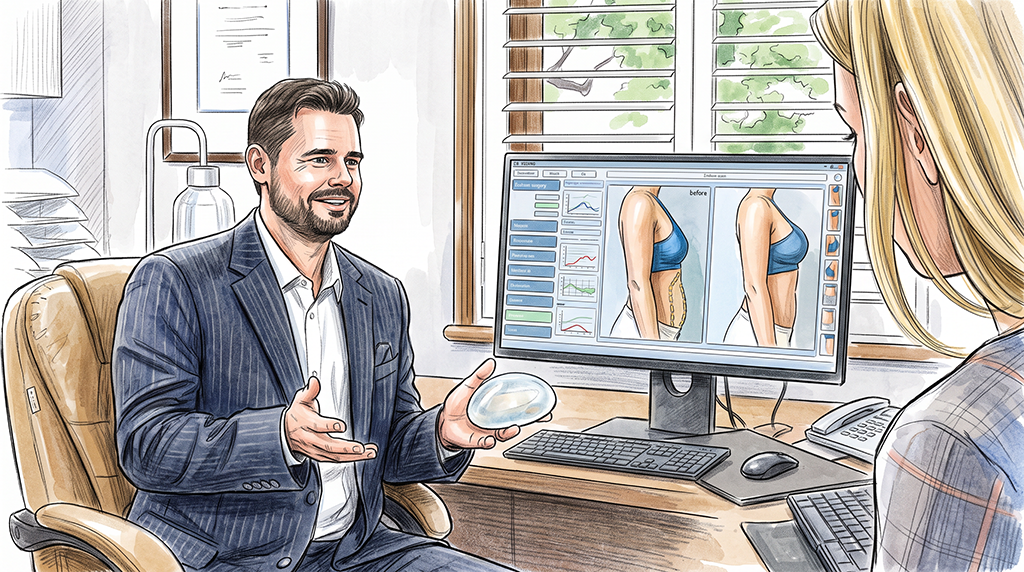
Most of the planning for this operation happens at consultation, before any date is set. Because I am removing implants rather than putting new ones in, there is no implant to size. The planning is about what your breast is likely to look like once the implants are out, and whether a lift (mastopexy) is worth doing at the same time, later, or at all.
At consultation I examine and record:
- The current implants: their type, how long they have been in, and where they sit, from your history and any records you can bring.
- Your breast tissue: how much you have and its quality, which shapes what the breast looks like once the implant is gone.
- Skin laxity: how much the skin has stretched, and how well it is likely to draw in on its own.
- Breast position and nipple position: where the breast and nipple sit, which guides whether a lift adds much and which scar pattern would suit.
- Symmetry: the two sides are rarely identical, and I note the differences so the plan accounts for them.
Imaging is part of this. Where a silicone implant rupture is a question, ultrasound or MRI is used to check the implant, since a silicone rupture can be silent. I also make sure your breast screening is up to date and arrange any imaging that is due, because having implants, or removing them, does not change the need for ongoing breast screening.
I take standardised clinical photographs at consultation, with your consent, for your medical record and planning. These are handled under the usual consent and privacy rules, and any use beyond your record is a separate conversation with its own consent.
From all of that, I set out what I would plan for you: removal on its own, removal with a lift in one operation, or removal now with a lift considered later once the breast has settled. I go through what each would mean for shape, scars and recovery, so the plan is one you have chosen with the full picture. Results vary between patients.
Your pathway, from referral to follow-up
A GP referral first
Every consultation starts with a referral from your GP. This is required before I can see you, and it also means your GP is part of the plan from the beginning. If your reason for removal is a medical one, such as a suspected rupture or capsular contracture, your GP can organise initial imaging before you see me.
The first consultation
The first consultation runs about an hour. I take your history, examine you, review any imaging, and take standardised clinical photographs for your record. We go through why you want the implants out, what removal on its own would look like, whether a lift (mastopexy) is worth doing and when, and the risks and recovery involved. You will not be asked to decide anything on the spot.
I encourage a second consultation, in person or by video, at no extra cost, so you can take the information away, think it over, and come back with questions. For patients who live further from the Hunter, the first consultation can be by telehealth, with an in-person review before surgery.
Preparing for surgery
If you decide to go ahead, there is preparation before the operation:
- A pre-operative blood panel to check your general health and fitness for surgery. Your GP is copied in on the results.
- A review of your medications. Aspirin and blood-thinning medications are usually stopped about a week before surgery, but this is planned with you in advance. Do not stop any medication on your own.
- An anaesthetic consultation, which is usually done by phone. The anaesthetist examines you, including your airway, on the day of surgery.
Typical waiting time for surgery is around one to three months.
Surgery and your hospital stay
The operation is done under general anaesthetic at Maitland Private Hospital, where there is doctor cover around the clock. I see you on daily rounds while you are admitted.
Follow-up
Follow-up is close in the early weeks. Over the first fortnight after surgery you are seen often by me and my nurse, so we can check your wounds and healing and pick up anything early. After that, I review you at four weeks, three months, six months and twelve months. At the four-week visit I hand your ongoing care back to your GP, who manages you long term. Scars take many months to mature, which is why the later reviews matter.
Why patients choose me

With more than two decades of experience as a surgeon, I have seen how differently implant removal plays out from one patient to the next. Some need the implants out and nothing more. Some are better served by a lift (mastopexy) at the same time. Others do better with removal now and a lift later, once the breast has settled. That experience is what lets me judge which path fits you, and plan the capsule removal and any lift as one considered operation.
Here is what working with me looks like:
- I work through the options with you rather than decide for you. Depending on what matters to you, I talk through each path and its likely outcomes, including where the better fit is less surgery, or none at all.
- I do the aftercare myself. You see me and my nurse often in the first fortnight, then at set reviews across the first year, before your care returns to your GP.
- If you live away from the Hunter, your first consultation can be by video, with an in-person review before surgery, so distance does not limit the assessment.
Removing implants, with or without a lift (mastopexy), is an operation I perform regularly, and the plan I put to you is built around your breast and your reasons, not a template.
Costs and Medicare

There is no single price for this operation, because no two patients need exactly the same thing. What it costs depends on whether you are having removal on its own or removal with a lift (mastopexy), whether a capsulectomy is involved, how long the operation takes, and your own medical situation.
After your consultation, our patient coordinator helps you put the full cost together. You receive three separate quotes:
- A surgical quote from my practice, covering my surgeon’s fee, your support bra, and all of your follow-up care.
- A quote from Maitland Private Hospital for your admission and theatre time.
- A quote from your anaesthetist.
Our patient coordinator arranges the hospital and anaesthetist quotes for you, so you have the whole cost in front of you before you decide.
Medicare and private health insurance
Whether Medicare and your health fund contribute depends on why the implants are being removed.
Where removal is medically indicated, for example a ruptured implant, symptomatic capsular contracture, or BIA-ALCL, the operation usually attracts a Medicare (MBS) item number. Where an item number applies, Medicare pays a set rebate, and if you hold appropriate private hospital cover, your health fund may contribute to the hospital costs. There is still an out-of-pocket gap, because the rebate does not cover the full fee.
Where removal is for cosmetic reasons alone, with no medical indication, there is no Medicare item number, no rebate, and private health insurance does not contribute. The same applies to a lift (mastopexy) done for cosmetic reasons.
Whether your situation meets the criteria for an item number is a clinical decision, made case by case. At consultation I tell you which item numbers, if any, apply to you, and give you the codes so you can check your rebate with Medicare and your cover with your health fund before you commit.
Recovery and risks
Removing implants and doing a lift (mastopexy) in the same operation is a larger event than either part on its own, and both the recovery and the risks reflect that. You will need time off work, help at home in the first week or so, and patience while swelling settles and scars mature over many months.
Every operation carries risk. For this one that includes the risks of any surgery and general anaesthetic, such as bleeding, infection and blood clots, alongside risks specific to breast surgery, such as changes in nipple or skin sensation, effects on the blood supply to the nipple, wound healing problems, asymmetry, and scars that may widen or thicken. Where a lift (mastopexy) is done, there is also the chance that revision surgery is needed later. I go through the risks that apply to you, and how likely they are in your case, at consultation, so you can weigh them before deciding.
Because the detail matters, I have set out recovery and risks more fully on their own pages:
- Recovery after implant removal and a lift (mastopexy)
- Risks of implant removal and a lift (mastopexy)
Results vary between patients, and nothing here changes the fact that whether to have this operation is your decision, made with the full picture.