


Upper and Lower Abdominal Lipectomy Post Weight Loss in Newcastle NSW
An upper and lower abdominal lipectomy removes loose skin from 2 separate areas, above and below the belly button (umbilicus), through 2 transverse incisions in a single operation. It suits a small group of post weight loss patients whose central abdominal skin has held its quality while excess skin has settled in the lower abdomen and upper abdomen. For a full explanation of the technique, patient selection and evidence, read my comprehensive guide to upper and lower abdominal lipectomy post weight loss.
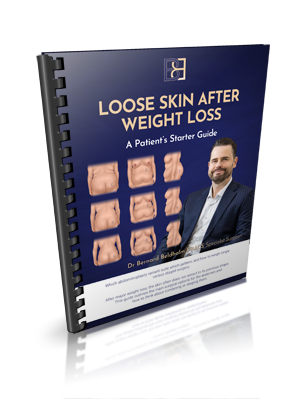
Is This the Right Operation for Your Skin Pattern?
This operation treats an uncommon pattern. It works when loose skin sits in 2 distinct zones: a fold in the lower abdomen and a fold in the upper abdomen, just below the chest, while the skin around the belly button (umbilicus) remains in reasonable condition and the belly button itself sits in a good position.
Most post weight loss patients do not have this pattern. If your loose skin runs through the whole abdomen, an extended abdominoplasty (tummy tuck) treats it more completely. If the laxity continues around your flanks and back, a body lift (belt lipectomy) is the better fit. If you carry marked side to side excess as well as vertical laxity, a Fleur de Lis abdominoplasty deals with both directions.
The advantage of the 2-incision approach, for the right patient, is that it avoids relocating the belly button (umbilicus) and involves less undermining of the abdominal skin. The trade-off is a second scar on the upper abdomen. Whether your skin pattern suits this operation is something I assess at consultation.
Disclaimer: General information only. This is not medical advice. Discuss your result and any health questions with your GP. The calculation happens in your browser. Nothing you enter is stored or sent anywhere.
BMI is a screening measure, not a diagnosis. It does not distinguish muscle from fat. It can be less accurate for people with a very muscular build, some ethnic groups and older adults. The classification shown is the World Health Organization (WHO) classification for adults aged 18 and over. It does not apply during pregnancy.
What the Operation Involves
- 2 separate transverse incisions: 1 in the lower abdomen, placed low so it sits within underwear lines, and 1 in the upper abdomen
- Direct excision of the loose skin folds above and below, with limited undermining of the surrounding skin
- The belly button (umbilicus) stays in its native position and is not relocated
- Muscle repair is not part of this operation. If you have muscle separation (diastasis recti), a different procedure is usually the better choice
- Hernia repair at the same time where present
- VASER liposuction (ultrasound assisted lipectomy) as an adjunct where appropriate
- Operating time is around 1.5 to 2 hours under general anaesthetic
- Performed at Maitland Private Hospital
- Usually 1 night in hospital, though for some patients it can be done as a day procedure
- Usually no drains
Why Come and See Me

I am Dr Bernard Beldholm, a Specialist Surgeon (FRACS). My practice at Maitland Private Hospital in the Hunter Valley focuses on body contouring surgery after significant weight loss and pregnancy, including uncommon skin patterns like the one this operation treats. I developed the circumferential hybrid abdominoplasty and the dual vector abdominoplasty for patterns that standard operations do not deal with well, so assessing which operation actually fits your skin is central to how I work.
Maitland Private Hospital has 24-hour nursing cover and an on-site ICU, and I do my own rounds daily while you are in hospital. Your first consultation runs for around an hour, and a second consultation is always included at no cost, which can be done by telehealth if you are travelling from a regional area. After surgery you have 2 weeks of intense follow-up, then reviews at 4 weeks, 3, 6 and 12 months, all included in the fee.
Risks and Recovery

This is still major surgery, even though it is a smaller operation than an abdominoplasty (tummy tuck) or body lift (belt lipectomy). Risks include bleeding, infection, wound healing problems, fluid collection (seroma), scarring that may thicken or stretch, asymmetry, changes in skin sensation, blood clots (DVT), and the possibility of revision surgery. Because there are 2 incision lines, you will have 2 scars to care for as they mature. Recovery is generally shorter than after an abdominoplasty because there is no muscle repair, and most patients are back to desk-based work within 1 to 2 weeks, though healing time varies between patients. I cover the full timeline in my article on recovery after abdominal lipectomy, and I explain each risk in detail in my article on complications of abdominal lipectomy.
Cost and Medicare

The cost depends on the extent of surgery and whether you meet Medicare criteria for skin excision after significant weight loss. The relevant Medicare item is MBS item 30166, which covers wedge excision of redundant abdominal skin and requires a stable weight after a loss of at least 5 BMI units, along with skin problems that have not responded to conservative treatment. If you qualify, your private health fund contribution is also affected. You will receive a written quote after your consultation, and I break down what goes into the fee in my article on the cost of abdominal lipectomy surgery.
Your Steps to Surgery
1. Get a GP referral
This is required before your consultation and preserves your Medicare rebate.
2. Attend your consultation at my rooms or by telehealth
I assess your skin pattern, medical history and nutritional status, and we work out whether this operation fits. A second consultation is included at no cost.
3. Receive your written quote with all fees itemised
4. Prepare for surgery
This includes your pre-operative blood panel and correcting any nutritional gaps before your operation.
5. Have your surgery at Maitland Private Hospital
usually with 1 overnight stay
6. Recover with structured follow-up
2 weeks of intense follow-up straight after surgery, then reviews at 4 weeks, 3, 6 and 12 months.