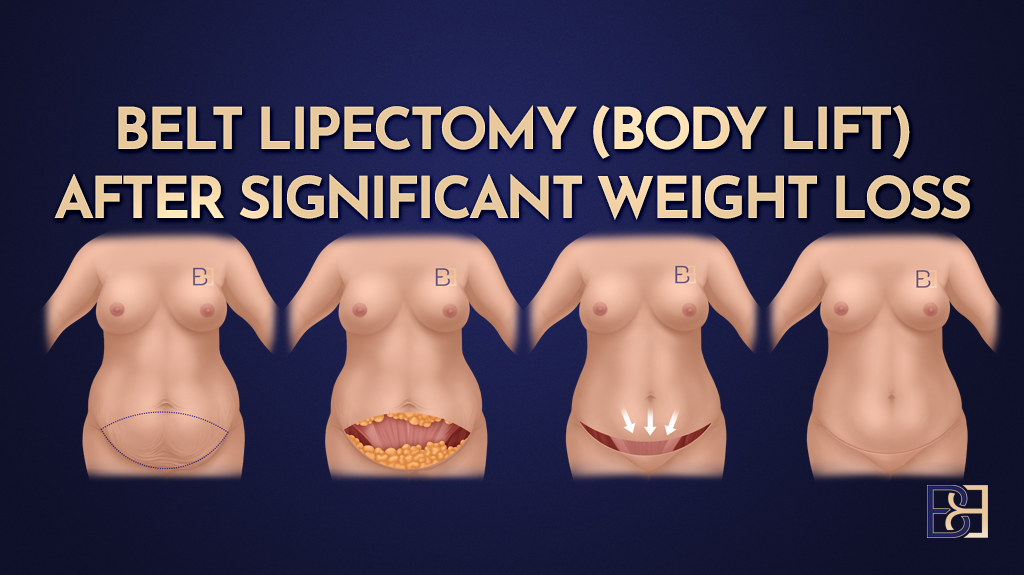
A body lift (belt lipectomy) removes excess skin and fat in a continuous circle around the lower trunk. In a single operation, I treat the abdomen, flanks, lower back, buttocks and outer thighs. The posterior part of the resection lifts the buttocks and outer thighs at the same time. You may also see this operation called a lower body lift, body lift surgery, circumferential body lift, circumferential abdominoplasty, circumferential lipectomy or 360 abdominoplasty (tummy tuck). These names all describe the same operation.

In my practice, this is one of the most common operations I perform for patients who have experienced significant weight loss. Whether weight loss came through bariatric surgery, medication or a healthy lifestyle change, after dramatic weight loss the skin often cannot shrink back. What remains is a circle of loose skin around the waistline that no amount of exercise will change. The only way to remove excess skin of this kind is to excise it surgically.
What is a belt lipectomy (body lift)?

Think of the excess skin as a belt of redundant skin and fat sitting around the lower trunk. The operation removes that belt (1). I make an incision that runs around the entire circumference of the lower body, remove the excess skin and fat between the incision lines, and close the remaining tissue under controlled tension. The scar is planned to sit low, within the line of most underwear or swimwear.
This surgical procedure does 3 things at once:
- Removes the apron of loose skin from the front of the abdomen, similar to an extended abdominoplasty (tummy tuck)
- Removes the rolls of skin from the flanks and lower back
- Lifts the buttocks and outer thighs by removing the excess tissue above them
Patients come to see me about this operation for practical reasons more often than appearance alone. Loose skin around the trunk causes skin irritation, rashes and infections in the skin folds (intertrigo), chafing with movement, hygiene difficulty, trouble finding clothes that fit, and interference with exercise. For many patients, the hanging skin is a daily reminder of a weight problem they have already solved.
A body lift (belt lipectomy) is major surgery. It is a longer operation than a standard abdominoplasty (tummy tuck), it leaves a permanent scar around the trunk, and recovery takes weeks, not days. I cover each of these below, because deciding whether this operation suits you starts with understanding what it involves.
Am I suited to a belt lipectomy?
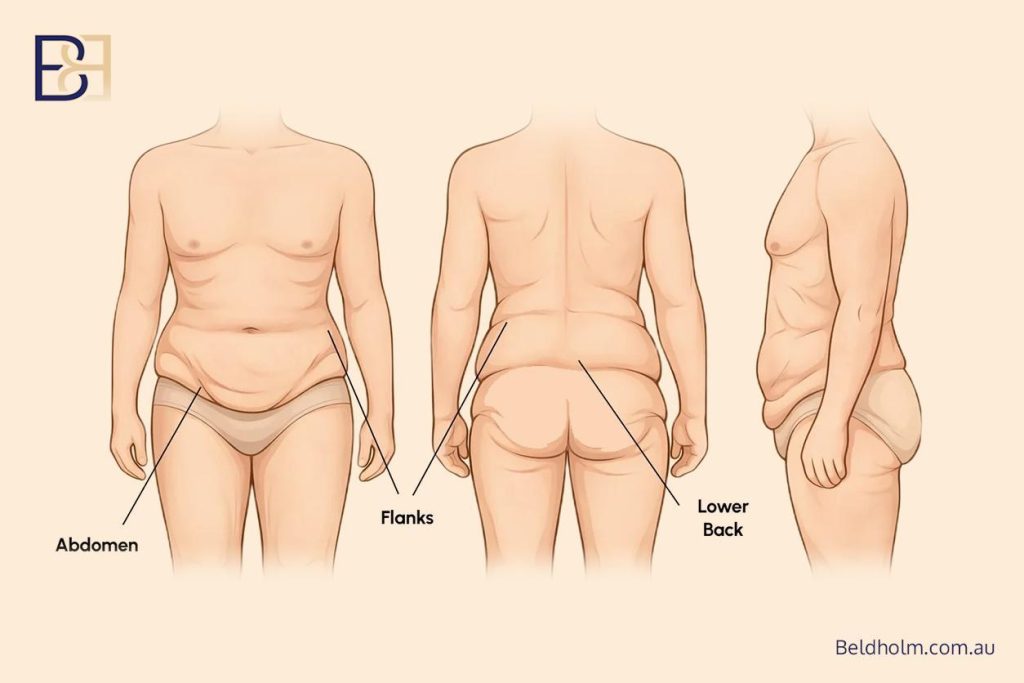
The direction of your loose skin matters most
The first thing I assess at consultation is the direction of your skin excess. This single finding determines which operation suits you, so it is worth understanding before you come in.
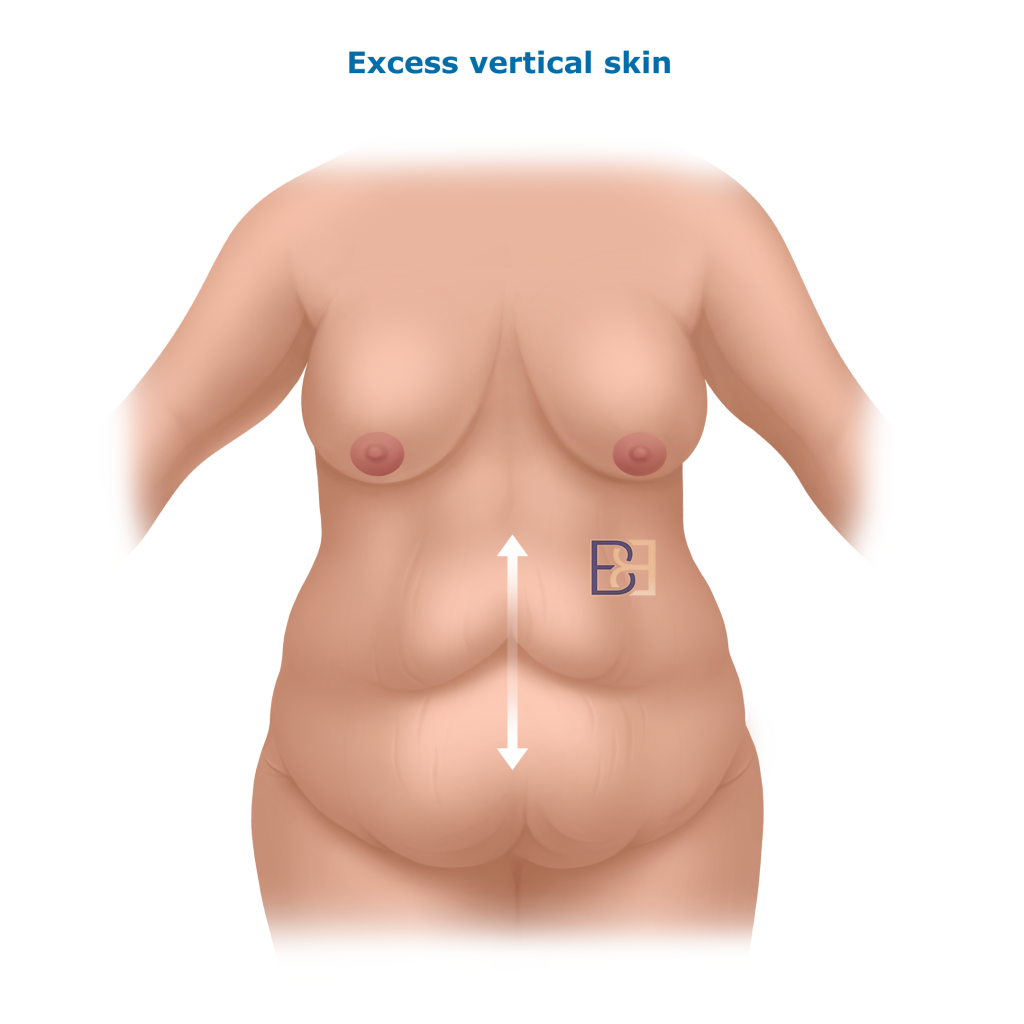
Vertical excess means the laxity runs from top to bottom. This is the classic pattern after major weight loss: an apron of skin over the lower abdomen, rolls at the flanks and lower back, and loose tissue above the buttocks. A body lift (belt lipectomy) treats this pattern. The circumferential incision removes a horizontal band of tissue all the way around, and the vertical laxity is corrected when the upper and lower edges are brought together.
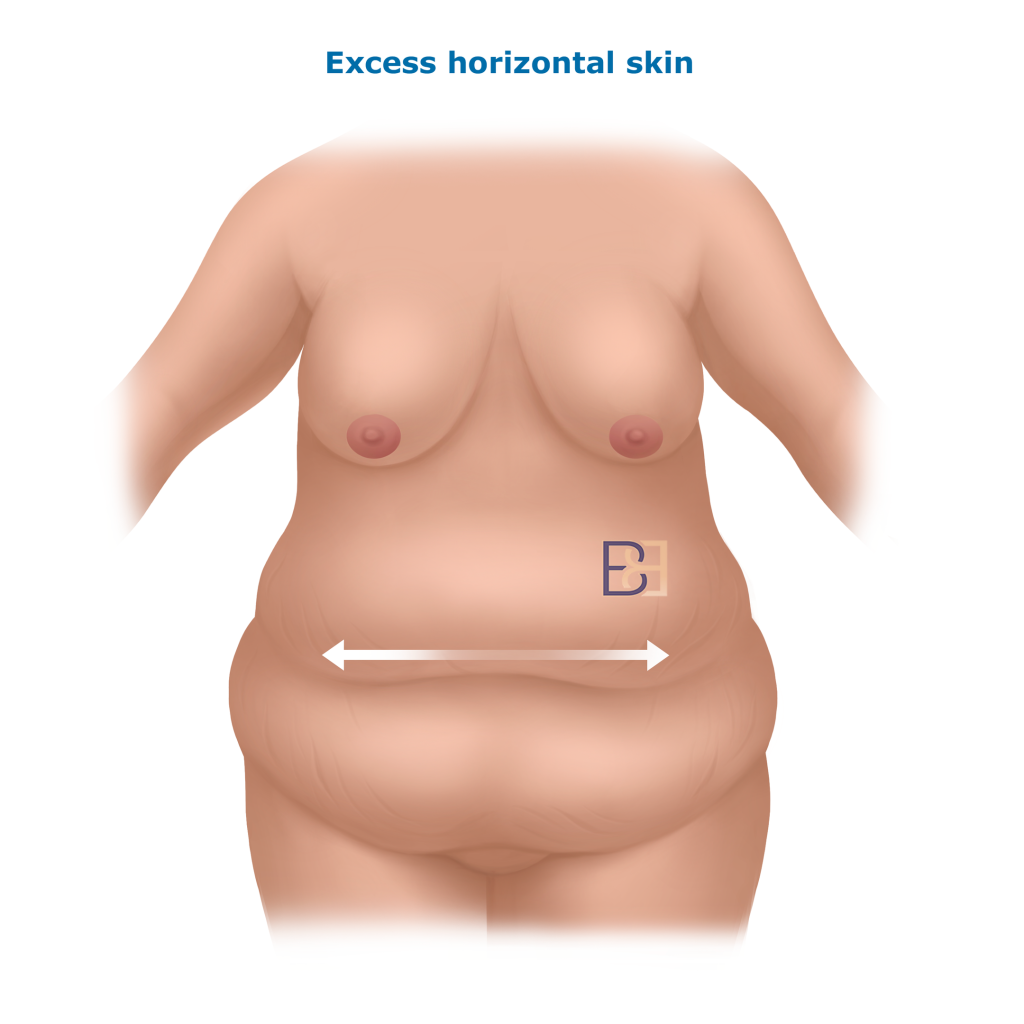
Horizontal excess means the laxity runs from side to side around the waist. When I gather the skin toward the midline of the abdomen, it tightens. A belt lipectomy does not treat this direction of excess. Removing it requires a vertical incision, as in a Fleur de Lis abdominoplasty, a dual vector abdominoplasty or a circumferential hybrid abdominoplasty.
Many post weight loss patients have both directions of excess at the same time. For these patients, I developed the circumferential hybrid abdominoplasty, which combines the circumferential resection with an anterior vertical incision. I cover this in more detail further down.
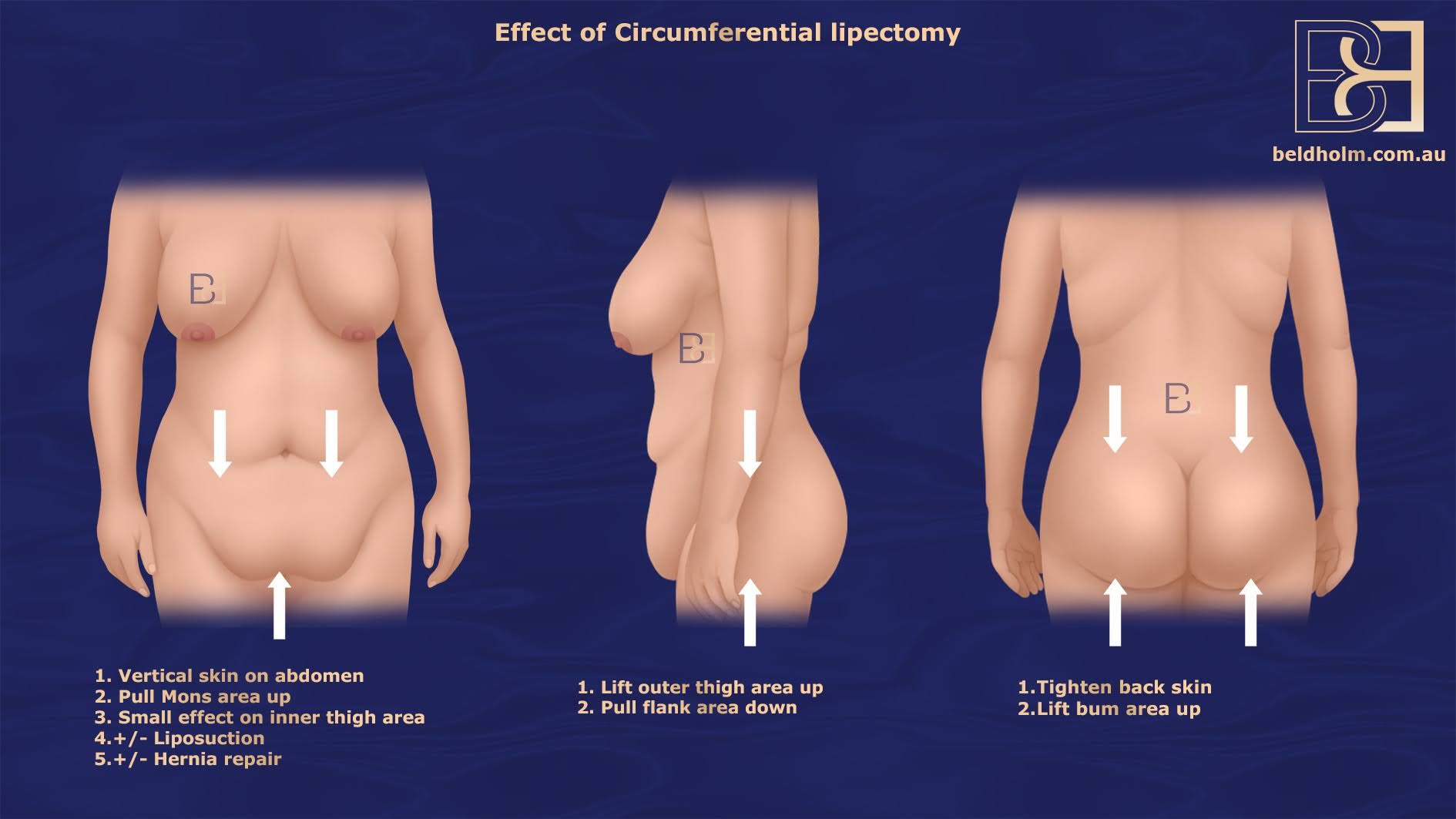
At consultation, I examine the pattern and extent of your laxity directly. Photographs and standard measurements do not replace this examination. The direction of excess is not always obvious to patients themselves, and it is common for someone to come in asking about 1 operation and leave understanding they need a different one.
Stable weight

Your weight needs to have been stable for at least 6 months before surgery, which is also the minimum the Medicare item number requires. My preference is 12 months of stability where possible, because ongoing weight loss after the operation can create new laxity, weight gain stretches the repair, and longer stability gives a more durable result.
General health and fitness

A body lift (belt lipectomy) is a longer operation than a standard abdominoplasty (tummy tuck), and your body needs the reserve to heal a circumferential wound. I review your medical history, medications, smoking status and previous operations. Smoking and nicotine products must stop well before surgery because they impair wound healing and increase surgical risks. Body mass index (BMI) is a rough guide only, not a hard cut-off. I look at your overall health, the distribution of remaining fat, and what can be achieved well in 1 operating time.
Nutritional preparation

Most post weight loss patients have nutritional gaps, whether weight loss came through bariatric surgery, medication or lifestyle changes. Protein, iron, vitamin B12, vitamin D and zinc deficiencies are all common in this group (2), and each one affects wound healing. A circumferential wound is a large area to heal, and uncorrected deficiencies slow that healing.
Every post weight loss patient in my practice completes a comprehensive pre-operative blood panel before surgery, and I correct what it finds before setting an operation date. I have written separately about nutritional deficiencies after weight loss and protein intake before and after surgery, and those articles cover the detail so I will not repeat it here.
Belt lipectomy vs abdominoplasty (tummy tuck): what is the difference?
The short answer: an abdominoplasty (tummy tuck) treats the front of the abdomen, while a body lift (belt lipectomy) continues the resection around the entire trunk.
A standard abdominoplasty removes excess skin from the front of the abdomen through a transverse incision, with the scar running from hip to hip. After massive weight loss, however, the laxity almost never stops at the hips. The skin excess continues around the flanks, and in many patients, around the lower back as well. This is why I rarely perform a hip-to-hip abdominoplasty in this group. At minimum, most post weight loss patients need an extended abdominoplasty, where the incision carries past the hips to treat the flanks.
A body lift (belt lipectomy) takes this to its logical conclusion. You can think of it as an extended abdominoplasty at the front, joined to a resection of the lower back and buttock region at the back, completed as 1 continuous operation. Where the excess runs all the way around, treating only the front leaves the rolls at the back untouched and can make them more noticeable by comparison.
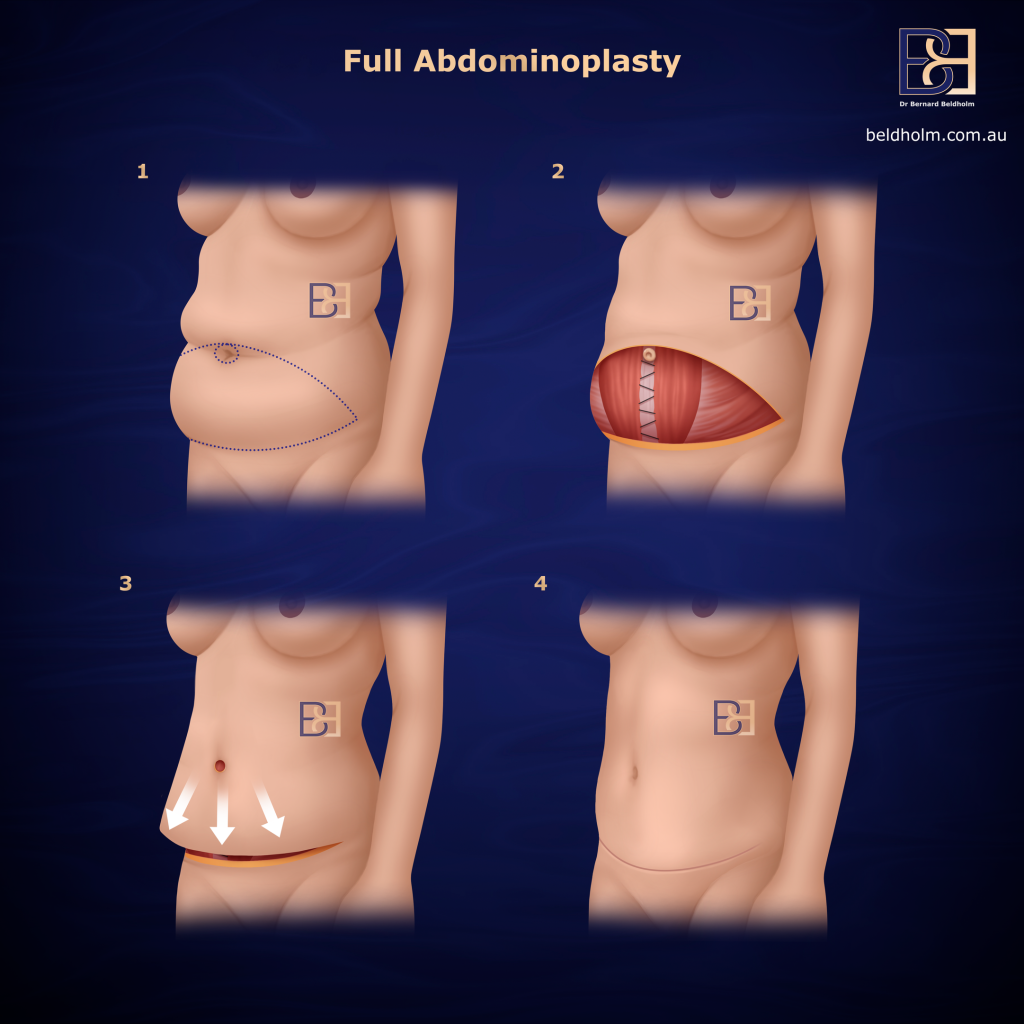
In practical terms:
- Abdominoplasty (tummy tuck): front of the abdomen only. Suits patients whose laxity is limited to the anterior abdomen
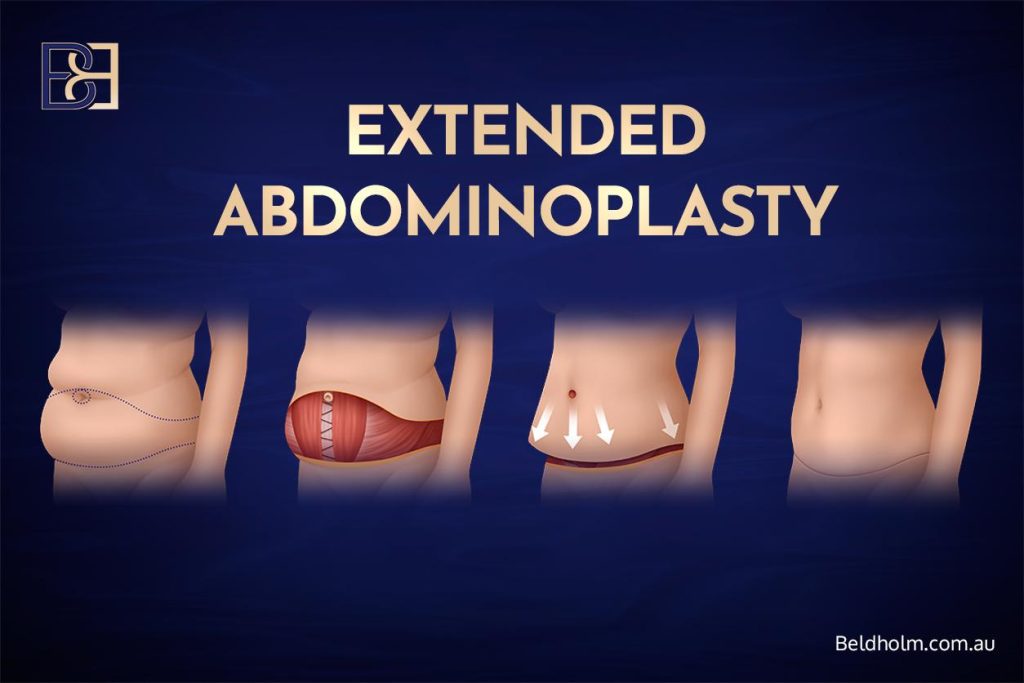
- Extended abdominoplasty: front plus flanks. Suits patients whose laxity carries past the hips but spares the back
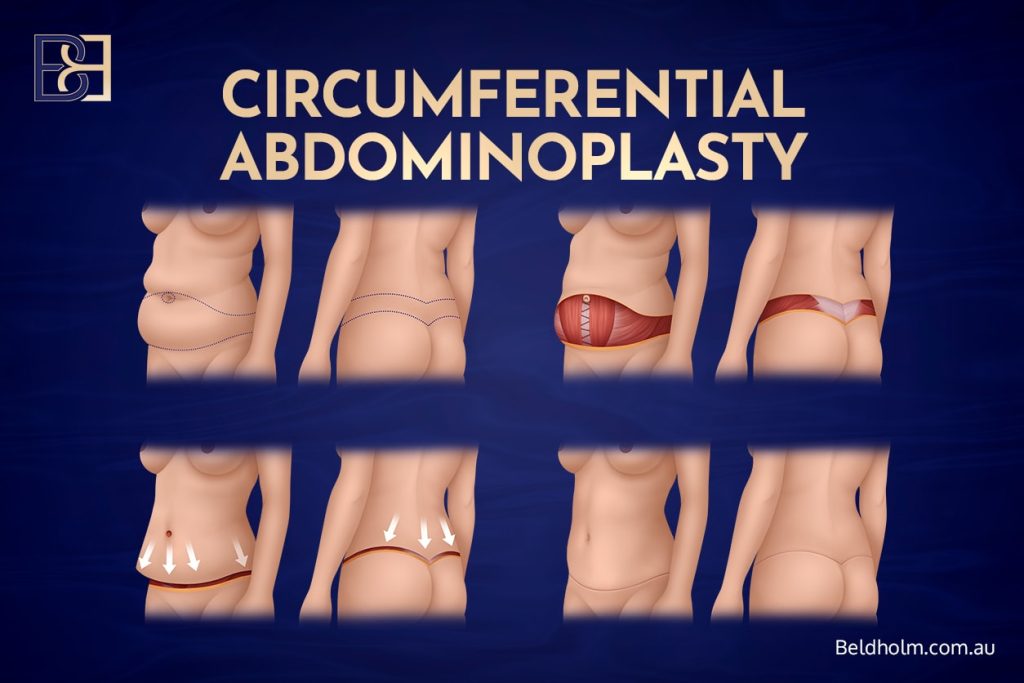
- Body lift (belt lipectomy): the full circumference. Suits patients with loose skin at the front, flanks, lower back and above the buttocks, and it lifts the buttocks and outer thighs as part of the same resection
Both operations treat vertical excess. Neither treats horizontal excess, which needs a vertical incision as I described above. I have written a separate article on abdominoplasty (tummy tuck) after significant weight loss covering the front-only options in detail.
Which operation suits you comes down to where your laxity ends. That is an examination finding, not something to decide from photographs, and it is the central question I answer at your consultation.
Circumferential hybrid abdominoplasty: when both directions need treating
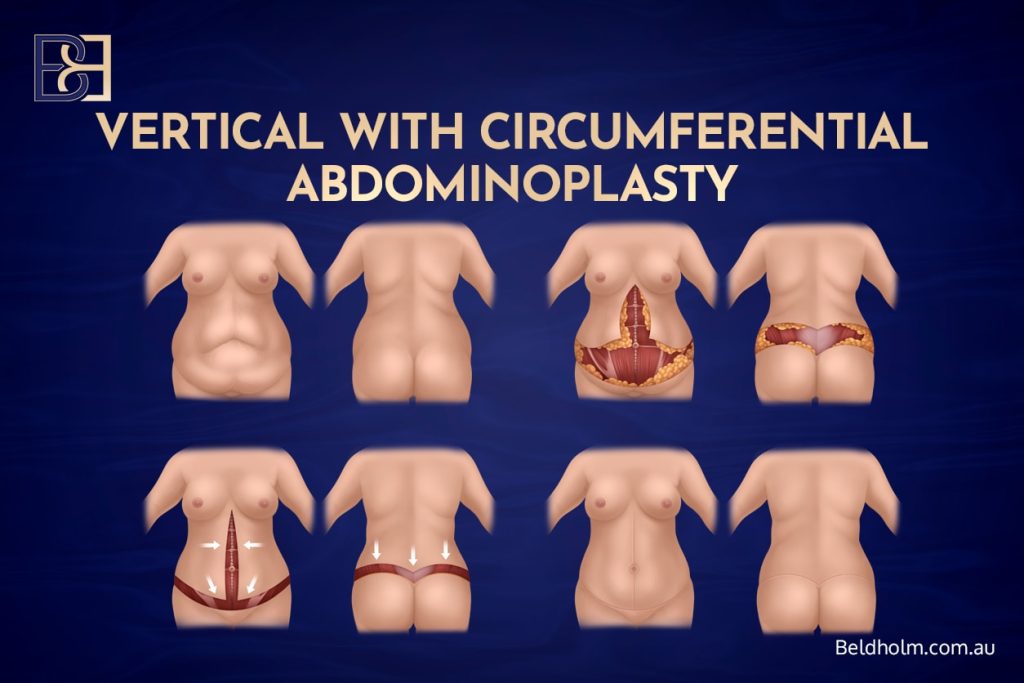
Some patients have vertical excess running all the way around the trunk and horizontal excess at the front of the abdomen at the same time. A standard body lift (belt lipectomy) corrects the first problem but leaves the second untouched. A Fleur de Lis abdominoplasty corrects both directions at the front but does nothing for the flanks, lower back and buttock region.
The circumferential hybrid abdominoplasty is a technique I developed for exactly this pattern. It combines the full circumferential resection of a belt lipectomy with an anterior vertical incision. In 1 operation, it:
- Removes the belt of vertical excess around the entire trunk
- Removes the horizontal excess at the front through the vertical component
- Lifts the buttocks and outer thighs through the posterior resection
The trade-off is an additional vertical scar on the front of the abdomen, running from the horizontal scar line up toward the belly button (umbilicus) or beyond, depending on the extent of the excess. For patients with both directions of laxity, that scar is the price of a properly corrected result. Treating only 1 direction leaves loose skin behind, and I would rather have that conversation before surgery than after.
This is a more extensive procedure than a standard belt lipectomy, so the suitability assessment is stricter. General health, nutritional status and what can be completed well in 1 operating time all carry more weight.
I have written a dedicated article on the circumferential hybrid abdominoplasty covering the technique, incision planning and who it suits.
One operation or staged surgery?
After substantial weight loss, patients often have skin excess in more than 1 region. In the lower body, it is the trunk and thighs; in the upper body, the upper arms and breasts, treated with related procedures such as brachioplasty (arm lift), thighplasty (thigh lift) and mastopexy (breast lift), with or without breast reduction. Patients with severe excess skin across several regions face this question most directly: whether to combine body contouring procedures into 1 operation or stage them across separate operations.
Where a patient is medically suited to it, my preference is a single comprehensive procedure. The reasoning is practical. One operation means 1 anaesthetic, 1 hospital admission and 1 recovery period to work through, rather than repeating each of those steps 2 or 3 times.
This is a preference, not a rule. For some patients, doing everything at once places more demand on the body than is sensible, and staging the work across separate operations is the more appropriate path. Staging is a legitimate clinical choice in its own right, not a fallback, and I recommend it openly when it is the right approach.
A larger single operation is a bigger physiological event than a smaller one. It takes longer under anaesthetic, creates a larger healing task, and asks more of your body in the first weeks of recovery. That is precisely why pre-operative preparation matters more, not less, when a single comprehensive operation is planned. Correcting nutritional gaps and getting your health in order beforehand is part of what makes the larger operation an appropriate choice in the first place.
The decision rests on your medical history, your nutritional status, the extent and pattern of your skin laxity, and what can be done well in a single operating time. It is made at consultation, with you, after examination.
What can be treated during the same operation
The circumferential incision gives me direct access to the abdominal wall, and that access lets me treat several functional problems in the same operating time where they are present.
Hernia repair
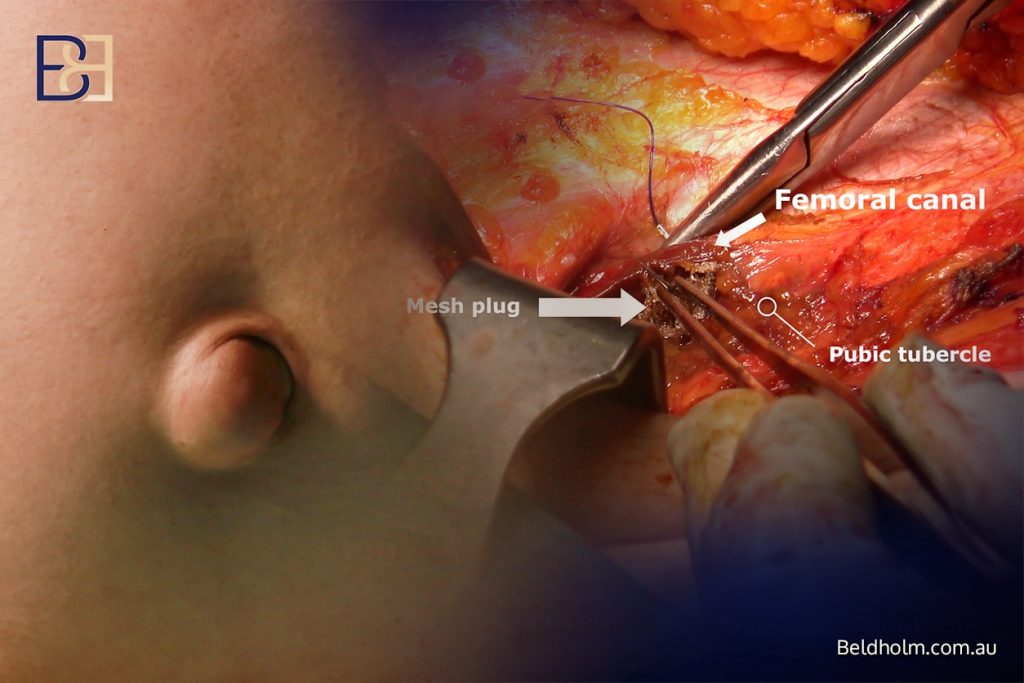
Hernias are common in post weight loss patients, particularly after previous abdominal or bariatric surgery. Where a hernia is present and not an emergency, it almost always makes sense to repair it during the body lift (belt lipectomy) rather than as a separate operation. The large incision provides direct access to ventral, umbilical, inguinal and femoral hernias. A Spigelian hernia requires a laparoscopic approach, but this can still be completed within the same operation. Staged hernia repair is generally reserved for emergency presentations such as strangulation, which need treatment in their own right before any body contouring surgery. I have written a separate article on hernia repair during abdominoplasty.
Muscle repair (diastasis recti repair)
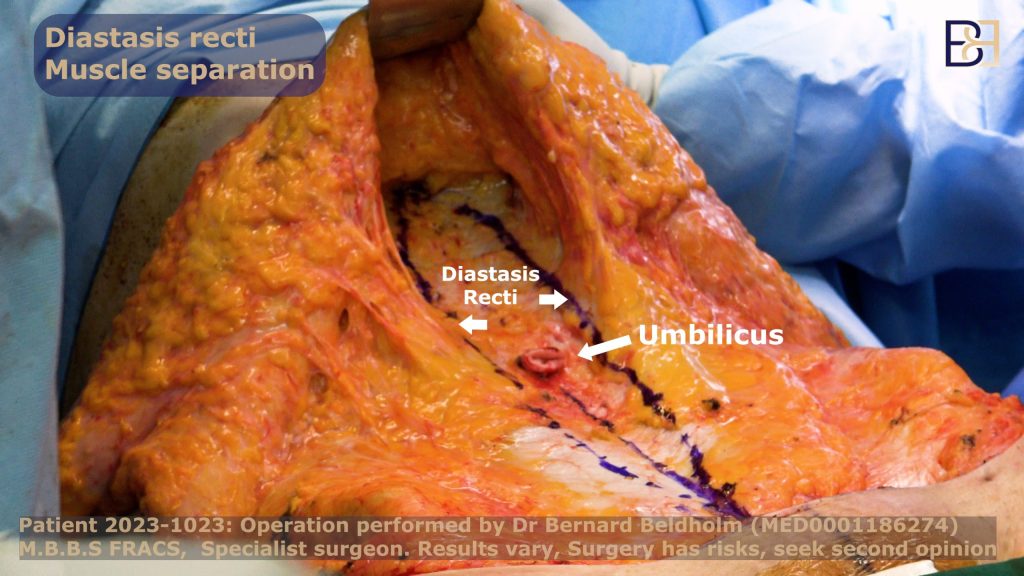
Some patients have muscle separation (diastasis recti), most often those whose skin laxity follows pregnancy as well as weight loss. It is not a default finding in post weight loss patients, so I do not repair muscles routinely. Where separation of the abdominal muscles is present on examination, with the 2 vertical underlying muscles drifted apart, muscle repair can be performed through the same incision, and I assess this individually.
Other procedures through the same access
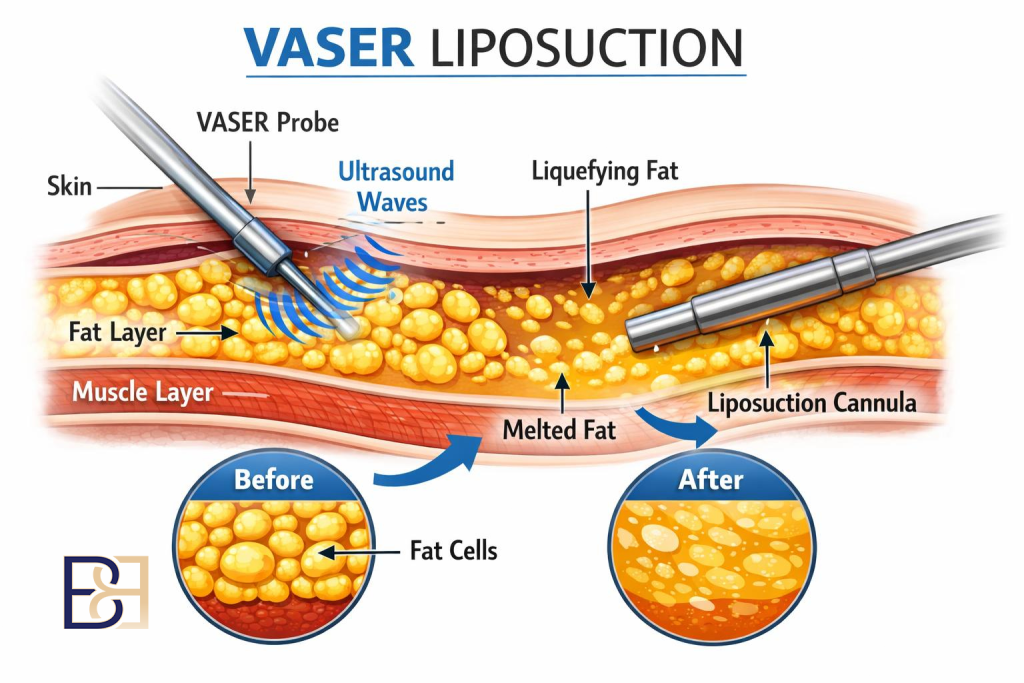
- VASER liposuction (ultrasound assisted lipectomy) to treat areas of remaining fat where this improves the result
- Removal of existing scars, such as appendix and caesarean scars, which typically sit within the tissue being excised
- A lift of the mons, which is carried out as part of the anterior resection rather than as a separate step
Whether any of these apply to you is determined at consultation, after examination.
How I perform the operation
Every operation is planned for the individual, but the sequence below describes my standard approach.
Before surgery
I mark the incision lines with you in the anaesthetic bay before surgery. Marking you awake and standing matters, because the skin excess sits differently when you are lying flat on an operating table. The markings guide the removal of skin and fat and set the final scar position.
Surgery is performed under general anaesthesia at Maitland Private Hospital, which has 24 hour medical cover and an on-site ICU.
The posterior stage comes first
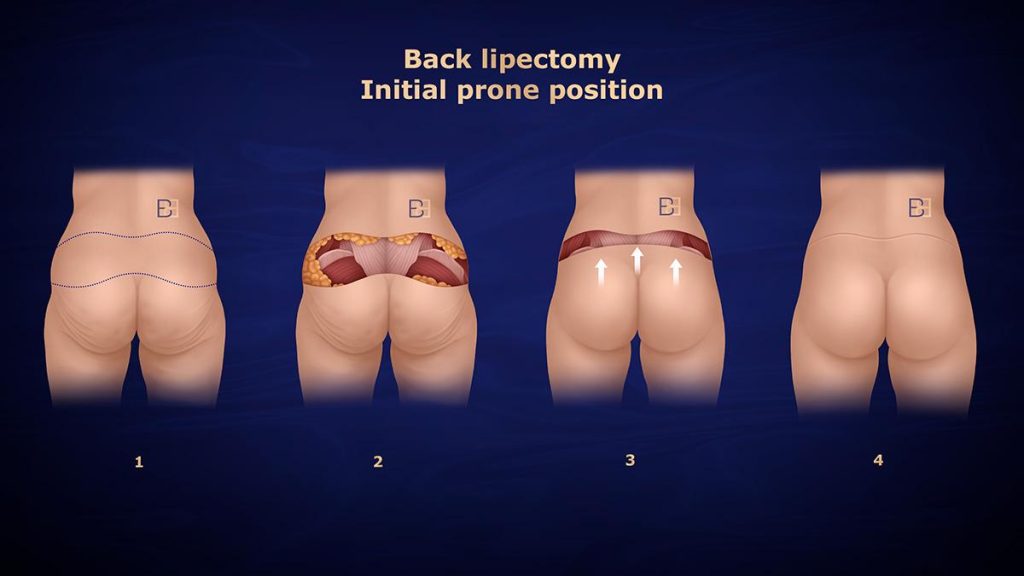
I begin with you positioned prone, lying on your front, and complete the resection across the lower back and flanks first. Removing this posterior tissue is what lifts the buttocks and outer thighs.
The sequence is deliberate. Lying prone means lying flat and straight on your abdomen. If the front of the operation were completed first, that position would place strain directly on the fresh abdominal repair. Doing the back first, then turning you over, protects the anterior work.
The anterior stage
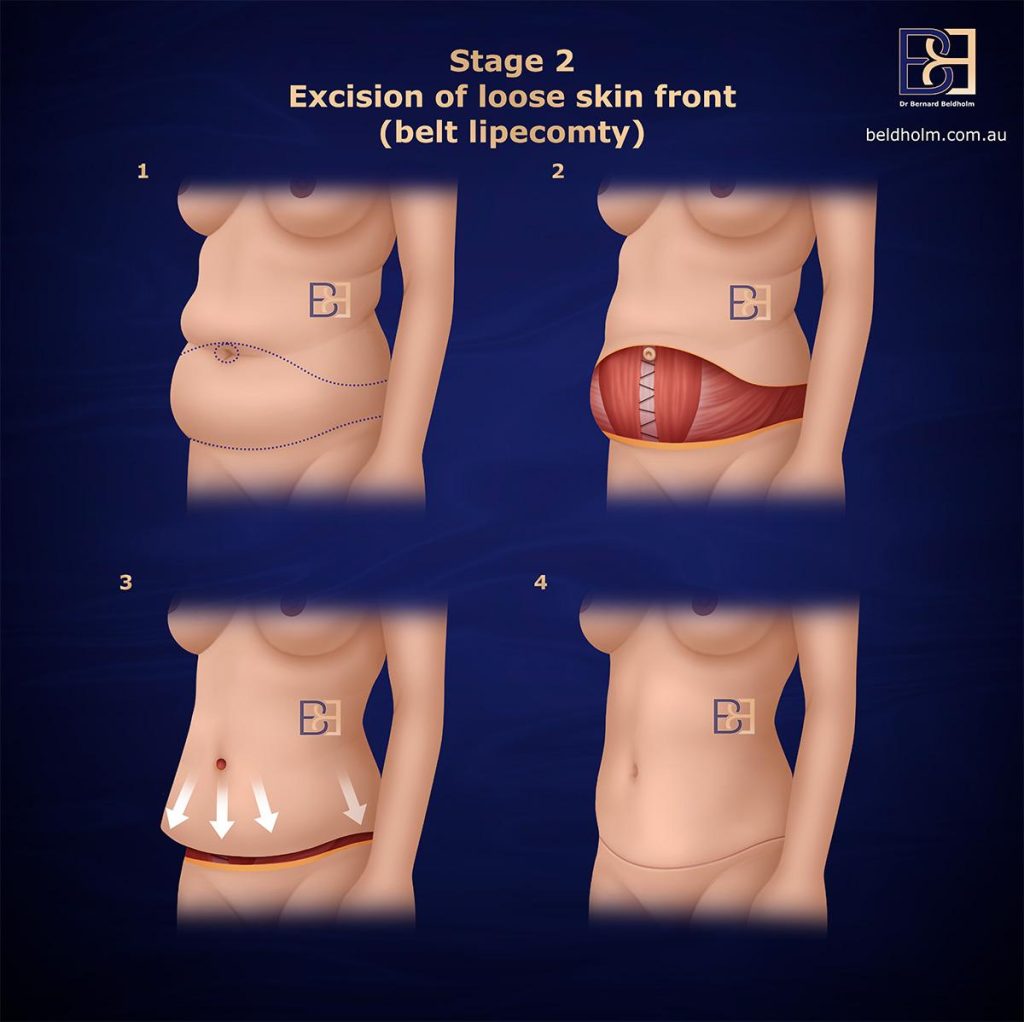
You are then repositioned onto your back and the operation continues at the front, similar to an extended abdominoplasty. I raise the abdominal skin in a plane just deep to Scarpa’s fascia, which preserves the lymphatic channels and blood supply above it. Published research has shown this dissection plane reduces drain output, time to drain removal and fluid collections after abdominoplasty (3,4). The belly button (umbilicus) is freed on its stalk so it can be brought out through the tightened skin later. I stitch a small marker to the stalk during the operation so it can be located precisely through the new skin, a technique of my own that avoids searching for the stalk once the skin is closed over it.
Where a hernia repair or muscle repair is planned, it is performed during this stage, as covered above. The excess skin and fat are then removed, and the belly button (umbilicus) is reconstructed: the stalk is freed, stretched skin is trimmed, and the base is shortened with sutures so it sits well within the new contour.
The circumferential wound is closed in layers, repairing the underlying tissues first, to spread tension away from the skin edge.
Finishing
I place 2 closed suction drains, 1 at each lateral hip, to remove excess fluid from the healing space. Dressings are applied: PICO negative pressure dressings at the front and Comfeel dressings across the back. An abdominal binder goes on before you wake, providing support from the first day.

Recovery: what to expect in brief

I have written a full article on recovering from a belt lipectomy (lower body lift), so this is the short version.
Most patients stay 2 to 3 nights at Maitland Private Hospital. Walking begins on Day 1 after surgery, along with breathing exercises using an incentive spirometer. Moving early is not optional extra credit. It is how we reduce the risk of clots and chest complications after a longer operation.
The 2 drains usually stay in for the first days, and it is common to go home with them still in place. My team teaches you how to manage them before discharge. The abdominal binder is worn full time for the first weeks, transitioning to a fitted compression garment at around 2 to 3 weeks if you prefer it. Compression continues 4 weeks full time, including overnight, then 2 weeks during the day only.
Office-based work is usually manageable within a few weeks. Manual labour takes 6 to 8 weeks. Lifting is limited to 10 kg for the first 6 weeks to protect the repair.
Recovery from a circumferential operation asks more of you than recovery from a front-only abdominoplasty (tummy tuck), and the timeline above is a guide, not a promise. The full recovery article covers the recovery process week by week, including wound care, sleep positions and warning signs.
Risks: the short version

A body lift (belt lipectomy) is major surgery and carries surgical risks. I have written a dedicated article on complications of belt lipectomy after weight loss that covers each one in depth, including how often they occur and how I manage them, so here I will keep to the headline points.
The complications I see and discuss most often include fluid collections (seroma), wound healing problems along a long incision line, infection, bleeding, changes in skin sensation, asymmetry, and scar problems that occasionally need revision. Published research on large series of these operations reports seroma and wound healing problems as the most frequent complications (1,5). Deep vein thrombosis and pulmonary embolism are uncommon but serious risks after longer operations, which is why I stratify every patient’s clot risk and plan prevention before surgery.
The most common issue in the first days is actually blood pressure. Low blood pressure after a circumferential operation can delay getting you up and walking for 1 to 2 days, which is one of the reasons you are in hospital rather than at home.
Deciding on major surgery requires knowing what can go wrong, not only what can go well.
The scar
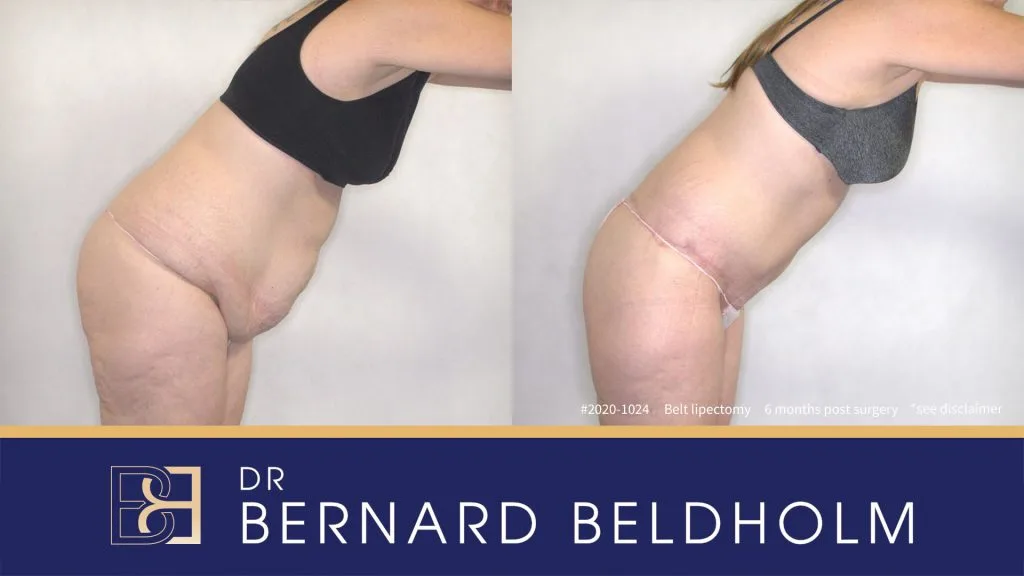
Disclaimer: results vary, surgery has risks, seek 2nd opinion. Operation performed by Dr Beldholm
There is no way around it: a body lift (belt lipectomy) leaves a permanent scar that runs around the entire circumference of the lower trunk. I plan the incision so the final scar sits low, within the line of most underwear and swimwear. Where a circumferential hybrid abdominoplasty is performed, there is an additional vertical scar on the front of the abdomen.
There are also smaller scars beyond the main incision line:
- A scar around the belly button (umbilicus), where it is brought out through the tightened skin
- Small scars at each lateral hip where the drains exit
- Small adit holes where VASER liposuction (ultrasound assisted lipectomy) has been used, each only a few millimetres
These smaller scars generally settle to be far less noticeable than the main scar line.
Scars change substantially over time. In the first months, the scar is typically red, firm and raised. Over 12 to 18 months it matures, softens and fades. How your scar settles depends on your skin type, genetics, nutrition, whether you smoke, and how much tension the closure carries, which is why the wound is closed in layers. Scar quality varies between patients, and I show patients examples at consultation of how scars settle across that range.
After the initial dressings come off, taping supports the scar for the first few weeks, and LED light therapy is available at my clinic as part of scar care. A small number of patients develop thickened or stretched scars that benefit from revision, which I assess from 12 months onward once the scar has matured.
For most post weight loss patients, the decision comes down to a trade: permanent, visible and prominent scarring, planned to sit low, in exchange for removing the extra skin around the trunk. Patients who go ahead have generally decided the loose skin bothers them more than the scar will.
Cost, Medicare and health funds

I do not publish dollar figures, because the cost of a body lift (belt lipectomy) depends on what your operation involves: the extent of the resection, whether a hernia repair or other procedures are included, operating time and length of stay. After your consultation, my rooms prepare a written, itemised quote within about 1 week, covering the surgical fee, hospital fees, anaesthetist fee and the Medicare item numbers that apply to you.
How MBS item numbers work
The Medicare Benefits Schedule (MBS) is the list of medical services the Australian Government subsidises. Each service has an item number, and each item number carries a description and a set of criteria. If your operation matches the description and you meet the criteria, the item number can be applied to your surgery. That unlocks 2 things: a Medicare rebate toward the surgical and anaesthetic fees, and, just as importantly, the ability of your private health fund to contribute toward hospital costs. Without an applicable item number, the operation is classified as entirely self-funded, including the hospital stay.
Whether you meet the criteria is a clinical assessment I make at consultation and document.
MBS item 30179: circumferential lipectomy
The item number for a body lift (belt lipectomy) is MBS item 30179, which covers circumferential lipectomy to correct circumferential excess of redundant skin and fat as a direct consequence of significant weight loss, with or without a radical abdominoplasty (6). The criteria are:
- The circumferential excess of skin and fat is complicated by intertrigo or another skin condition that risks loss of skin integrity, and that skin condition has failed 3 months of conventional (non-surgical) treatment
- The excess skin and fat interferes with your activities of daily living
- Your weight has been stable for at least 6 months following significant weight loss
The MBS explanatory notes define significant weight loss as at least 5 BMI points. Document the skin conditions along the way: photographs from your GP and records of treatments tried, such as creams and antifungal preparations, all help establish eligibility. The MBS wording is revised from time to time, and my rooms confirm the current requirements as part of your quote.
Private health funds and level of cover

Health fund contributions come from hospital cover, not extras. Under the private health insurance tiers, item 30179 sits in the weight loss surgery clinical category, which is included as standard in Gold policies. Some Silver Plus policies include it as an added category, but many Silver, Bronze and Basic policies do not. Check your policy documents for the weight loss surgery category specifically, and be aware that upgrading cover usually triggers a 12 month waiting period for pre-existing conditions before you can claim.
If your policy covers the category and the item number applies, your fund will generally contribute toward the hospital and theatre costs. My rooms can give you the item numbers from your quote so your fund can confirm exactly what they will pay before you book surgery. I have written a separate article on the cost of body contouring surgery after weight loss that covers how the fees fit together.
The patient journey at my practice

From first appointment to final review, this is how the surgical process runs for a body lift (belt lipectomy) with me.
- GP referral. A referral from your GP is required before any consultation. It also keeps your GP in the loop from the start, which becomes important later in the process.
- Consultation. I allow around 1 hour for a first consultation. We cover your weight history, your health, your goals, and I examine the pattern and direction of your skin laxity. If a second consultation is needed to settle questions or finalise planning, it is at no cost. Telehealth consultations are available for regional patients, though the physical examination still needs to happen before surgery is planned.
- Written quote. Within about 1 week of consultation, my rooms provide the itemised quote described above.
- Preparation. You complete the comprehensive pre-operative blood panel, and I correct any deficiencies it finds. Your GP is copied on the results. Most patients have 1 to 3 months between consultation and surgery. Where optimisation takes longer, it delays the operation date, but going into surgery well prepared is part of what makes a larger operation appropriate. Continue your prescribed medications unless I direct otherwise; blood thinning medications in particular need a plan made well in advance, never stopped on your own. Your anaesthetic consultation is usually by phone, with the physical assessment on the day of surgery.
- Surgery. The operation takes place at Maitland Private Hospital, and I do daily rounds while you are admitted.
- Follow-up. intense follow up for 2 weeks post surgery. I then review you at 4 weeks, 3, 6 and 12 months, all included in your surgical fee. At the 4 week visit, I complete a formal handover to your GP, so your long-term care continues with the doctor who knows you best.
Frequently asked questions
Is a belt lipectomy the same as a lower body lift?
Yes. Belt lipectomy, lower body lift, circumferential body lift, circumferential abdominoplasty, circumferential lipectomy, 360 abdominoplasty (tummy tuck) and body lift surgery all describe the same operation: removal of a circumferential band of excess skin and fat from around the lower trunk. Different surgeons and different countries favour different names, which causes understandable confusion.
Does a belt lipectomy lift your buttocks?
Yes. The posterior part of the resection removes the loose tissue above the buttocks, and closing the wound lifts the buttocks and outer thighs. It changes the lower body’s shape by removing and lifting existing tissue rather than adding volume, so it is a different operation from buttock augmentation.
How long does the operation take?
Several hours. The exact time depends on the extent of the resection and whether procedures such as hernia repair, muscle repair or VASER liposuction (ultrasound assisted lipectomy) are included. Your quote and consultation cover the expected operating time for your plan.
Do I need to be at my goal weight first?
You need to be at a stable weight rather than a specific number on the scale: at least 6 months of stability, and preferably 12. Ongoing weight loss after surgery creates new laxity, and weight gain stretches the repair. BMI is a rough guide in my assessment, not a hard cut-off.
Can I have a belt lipectomy if I lost weight with medication?
Yes. What matters is the skin excess, weight stability and your health, not how the weight was lost. Patients who have lost significant weight through medication have the same patterns of circumferential laxity as patients after bariatric surgery, and the same suitability assessment applies. Nutritional preparation is checked in the same way for every post weight loss patient.
What happens if my weight changes after surgery?
Modest fluctuations are normal and the result tolerates them. Significant weight gain stretches the skin and can undo the correction, and if you continue to lose weight after surgery, new laxity can develop. This is why I ask for at least 6 months of stable weight before operating, and prefer 12. A healthy diet and regular activity are the best long-term protection for the result.
Is the recovery painful?
Yes, the first days are the worst, particularly with movement, and this is managed with a structured pain relief plan in hospital and at home. Most patients find the discomfort settles substantially within the first 2 weeks. The recovery article covers pain management week by week.
References
- Aly AS, Cram AE, Chao M, Pang J, McKeon M. Belt lipectomy for circumferential truncal excess: the University of Iowa experience. Plast Reconstr Surg. 2003;111(1):398-413.
- Parrott J, Frank L, Rabena R, Craggs-Dino L, Isom KA, Greiman L. American Society for Metabolic and Bariatric Surgery Integrated Health Nutritional Guidelines for the Surgical Weight Loss Patient 2016 Update: Micronutrients. Surg Obes Relat Dis. 2017;13(5):727-741.
- Costa-Ferreira A, Rebelo M, Vasconez LO, Amarante J. Scarpa fascia preservation during abdominoplasty: a prospective study. Plast Reconstr Surg. 2010;125(4):1232-1239.
- Costa-Ferreira A, Rebelo M, Silva A, Vasconez LO, Amarante J. Scarpa fascia preservation during abdominoplasty: randomized clinical study of efficacy and s*fety. Plast Reconstr Surg. 2013;131(3):644-651.
- Nemerofsky RB, Oliak DA, Capella JF. Body lift: an account of 200 consecutive cases in the massive weight loss patient. Plast Reconstr Surg. 2006;117(2):414-430.
- Australian Government Department of Health and Aged Care. Medicare Benefits Schedule item 30179 [Internet]. Canberra: MBS Online [cited 2026 Aug 6]. Available from: https://www9.health.gov.au/mbs/fullDisplay.cfm?type=item&q=30179&qt=item