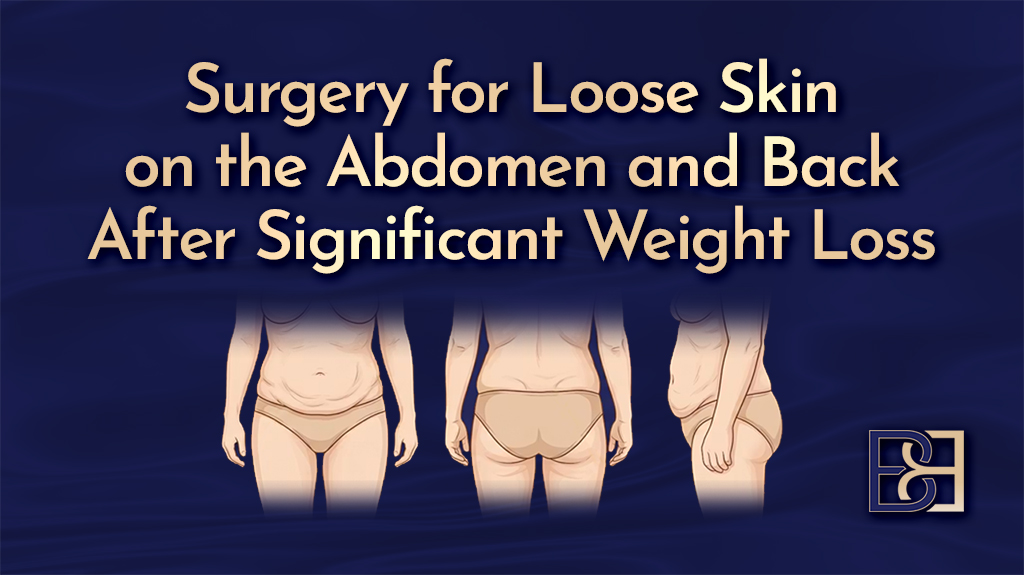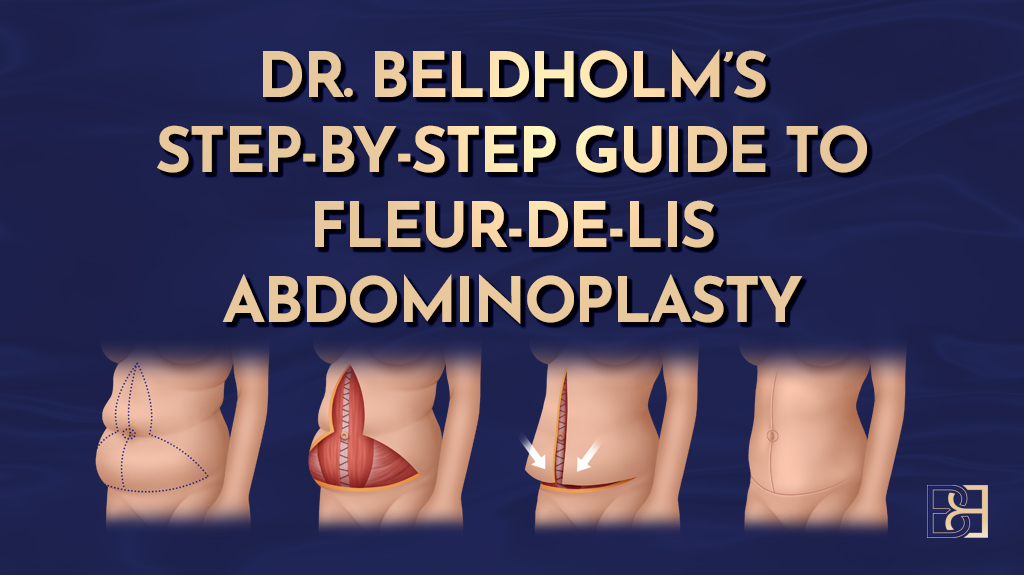
After major weight loss, the chest is often the area men find hardest to live with. The skin stretched over years of carrying extra weight, and once the weight is gone it frequently does not retract. What remains is loose skin, redundant folds, and in many men residual glandular tissue, sitting over a body that has otherwise changed completely. Exercise builds the muscle underneath but does not remove the skin envelope on top.

An upper body lift (torsoplasty) is the operation I use to treat this. It removes excess skin and fat from the chest and, where the laxity extends further, from the sides of the torso and the upper back. In men with marked skin excess, the nipple and areola are repositioned as a free graft so the chest can be made flat. The operation is planned around 2 questions: how much skin needs to come out, and how far around the torso the excess extends.
There is no single version of this surgery that suits every patient. In my practice, each side of the chest is graded separately using my BB grading system, and a 5 point BB elasticity grade tells me how much work the skin can do on its own. Those 2 assessments, made at consultation, determine whether the operation is confined to the front of the chest or extends around the torso, and whether the nipple can be lifted or needs to be grafted.
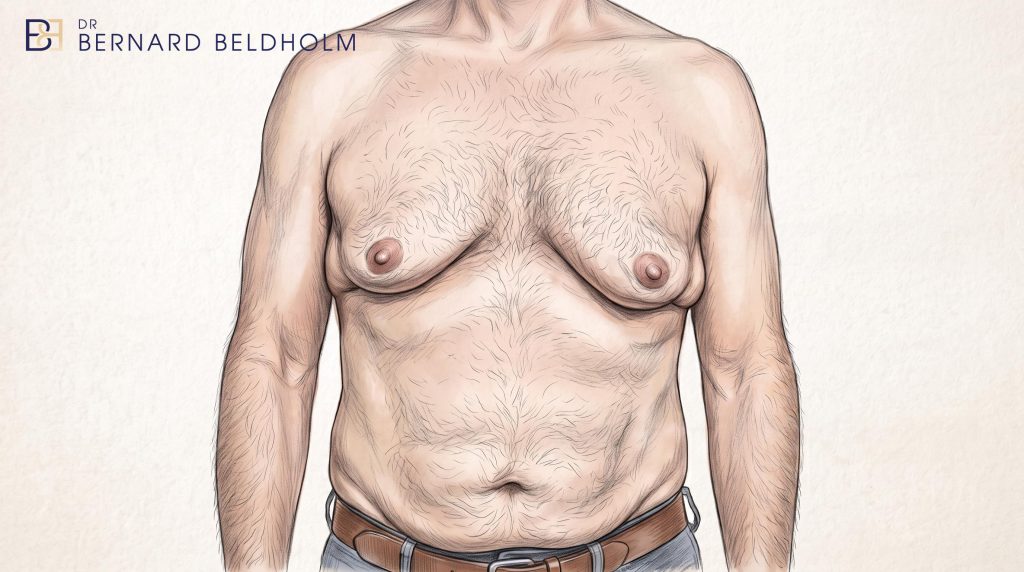
This article covers how I assess the male chest after weight loss, how I choose between the surgical options, what anterior and circumferential torsoplasty involve, how weight stability and nutrition fit into the planning, and where recovery, complications and cost are covered in detail.
Why the Chest Changes After Significant Weight Loss
Skin is elastic, but that elasticity has limits. When excess body weight is carried for years, the chest skin expands to accommodate it, and the collagen and elastin fibres within the dermis are progressively damaged (1,2). Stretch marks are the visible sign of that damage. Once the weight comes off, skin with intact elasticity contracts back. Stretched skin that has passed its capacity to recover does not, regardless of how the weight was lost or how much training follows.
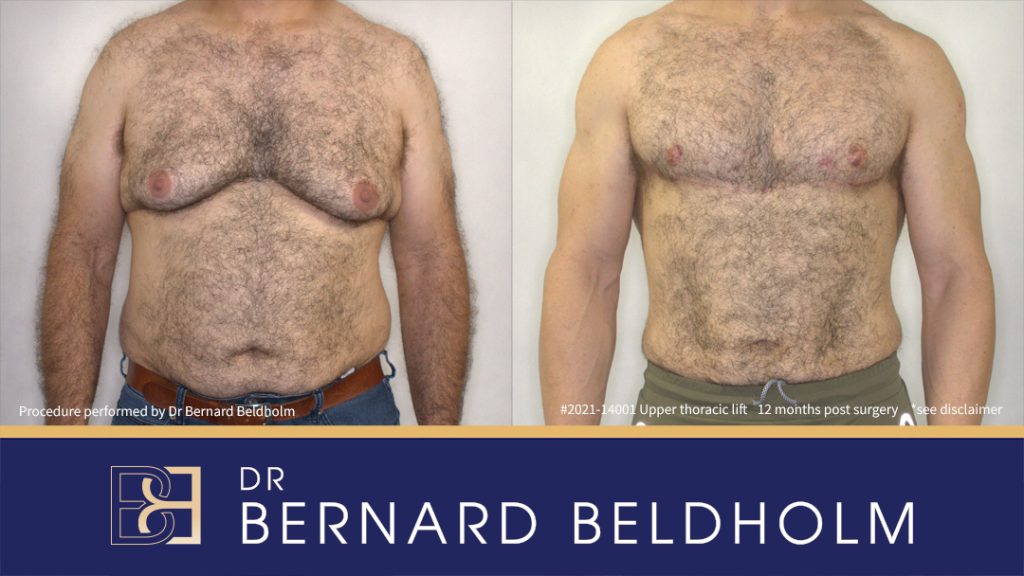
Disclaimer: Results Vary, surgery has risks, seek 2nd opinion. Operation performed by Dr Beldholm.
How much the skin recovers varies between patients. The main factors I see are the amount of weight lost, how long the weight was carried, age at the time of weight loss, repeated cycles of weight gain and loss, genetics, smoking history and sun exposure. A man in his 20s who loses 30 kg will usually retain more skin recoil than a man in his 50s who loses 60 kg after 2 decades of obesity.
3 tissue components, 3 different problems
When I examine the male chest, I am assessing 3 separate components:
- Skin. The envelope itself. After major weight loss this is usually the dominant problem, with visible skin folds of loose chest skin hanging over the lower chest, often extending towards the armpit and around the side.
- Fat. Excess fat that persists despite weight loss. Fat responds to liposuction (suction assisted lipectomy).
- Glandular tissue. True gynaecomastia is enlargement of the breast gland itself. Gland is firm, sits directly behind the nipple, and does not respond to suction assisted lipectomy alone. It needs surgical excision.
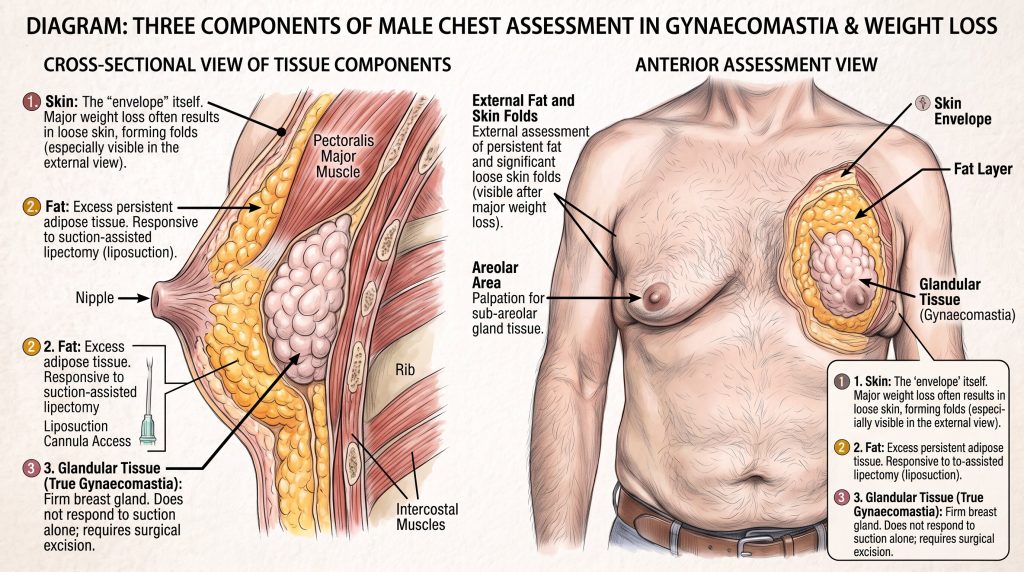
The distinction matters because each component is treated differently, and most men after significant weight loss have a combination. Enlargement that is mostly fat is sometimes called pseudogynaecomastia (3). In the post weight loss chest, however, the picture is usually skin excess first, with variable amounts of residual fat and gland behind it. That is what separates this group from men with gynaecomastia at a stable, normal weight, where gland and fat dominate and the skin often still has useful elasticity.
I cover the causes and patterns of gynaecomastia itself, including hormonal and medication related causes, in my article on what causes gynaecomastia. This article stays with the problem specific to weight loss: a skin envelope that is now too large for the chest wall beneath it.
How I Assess the Male Chest
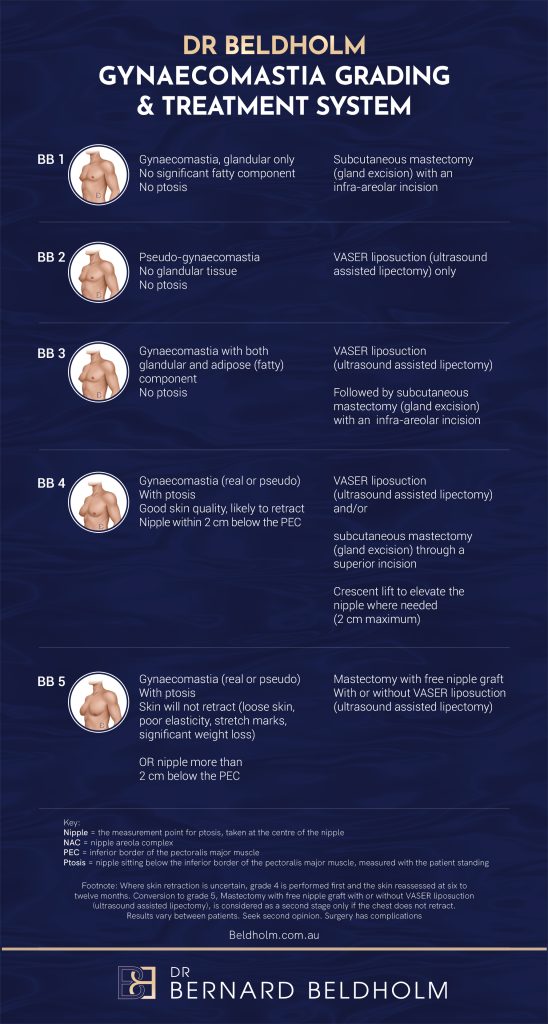
Assessment drives everything in this surgery. Choosing an operation before properly grading the chest is how men end up with liposuction (suction assisted lipectomy) that leaves the skin problem untouched, or a scar pattern that was never going to be enough for the degree of excess.
Each side is graded separately
In my practice I grade each side of the chest on its own, using my BB grading system, which runs from grade 1 through to grade 5. The 2 sides frequently differ. It is common to see a grade 3 on one side and a grade 4 on the other, and the operative plan has to reflect that rather than treating the chest as a single unit. The full system, with photographs of each grade, is set out in my article on the BB grading system for gynaecomastia.
The BB elasticity grade
Alongside the grade of each side, I assess the quality of the skin itself on a 5 point BB elasticity grade. This is the assessment that does the most work in post weight loss patients. 2 chests can look similar in a photograph, but if one has skin that recoils when pinched and the other has thin, inelastic, stretch marked skin, they need different operations. Poor elasticity is the rule after major weight loss, and it is the main reason suction assisted lipectomy alone so often disappoints this group.
The pectoralis major landmark
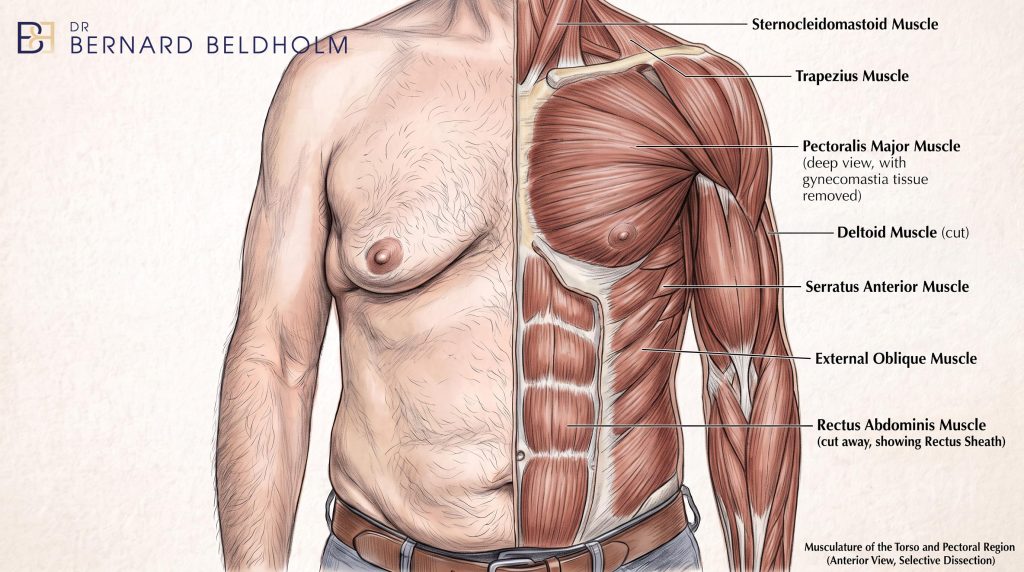
The position of the nipple gives me an objective anchor. I use the inferior border of the pectoralis major muscle as the reference line. If the centre of the nipple sits more than 2 cm below that border, the nipple has descended too far to be lifted and kept on its blood supply, and the chest is graded BB grade 5. At or above that threshold, a lifting procedure that preserves the nipple on its native circulation remains possible. This single measurement, taken with the patient standing, separates the 2 fundamentally different operations described in the next section.
Assessment happens at consultation, with the patient standing and then lying, and includes the pattern of skin laxity across the upper abdomen, sides and upper back, because in the weight loss group the chest excess frequently continues around the torso. How far it continues determines whether the operation stays anterior or becomes circumferential.
Choosing the Operation
Once each side is graded and the elasticity is assessed, the operative options narrow considerably. The decision logic below is the one I apply at consultation.
Why liposuction (suction assisted lipectomy) alone is rarely enough after weight loss
Liposuction (suction assisted lipectomy) removes fat. It relies on the overlying skin contracting down onto the smaller chest once the volume is gone. That contraction only happens when the skin has retained useful elasticity. In post weight loss patients with a low BB elasticity grade, removing more volume from under skin that is already too large makes the excess more obvious, not less (3,4). This is the most common planning error I see in men who come to me after unsatisfactory chest suction assisted lipectomy elsewhere, and it is why the elasticity grade sits at the centre of my decision making.
BB grade 4: skin reduction with the nipple preserved
Where the nipple centre still sits within 2 cm of the inferior border of pectoralis major, the skin excess can be treated while the nipple stays on its own blood supply. This is my BB grade 4 operation: gland and fat are removed, redundant skin is excised, and the nipple and areola are lifted through a crescent pattern. I describe the technique, scars and staging in detail in my article on the BB grade 4 gynaecomastia operation.
BB grade 5: skin excision with free nipple and areola graft (male mastectomy)
Where the nipple has descended more than 2 cm below the pectoral border, lifting it that distance on its blood supply is no longer reliable. I then remove excess skin, gland and fat through a horizontal chest incision, with the nipple and areola removed, trimmed and replaced as a free graft in the correct position on the new chest (5). This is the operation most men need after massive weight loss. The full technique is covered in my article on the BB grade 5 gynaecomastia operation.
The borderline chest
2 situations sit between the grades and both come up regularly at consultation:
- BB elasticity grade 3 skin. Where elasticity is borderline, I often plan the BB grade 4 operation first and reassess at 6 to 12 months, once the skin has settled. Some men need nothing further. Some elect a second stage. Planning it this way, preserving blood supply to the nipple, keeps the scar burden as low as the skin allows.
- Building the chest before grading is finalised. Pectoralis muscle bulk changes the relationship between the nipple and the pectoral border. In some men, a structured period of resistance training shifts a borderline BB grade 5 chest into BB grade 4 territory. I cover this in my article on getting in shape before gynaecomastia surgery.
Anterior Torsoplasty: When the Excess Stays at the Front
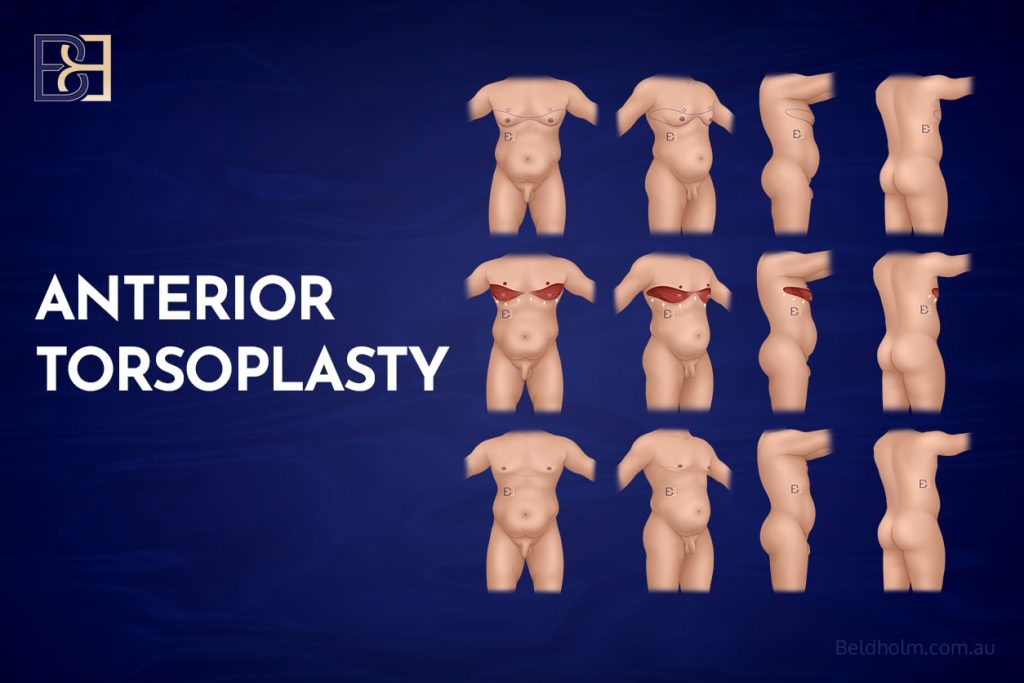
Upper body lift surgery comes in 2 forms in my practice, and the difference is how far around the torso the skin excess travels. Anterior torsoplasty is the option when the loose skin is concentrated over the anterior chest and sides of the torso, without significant rolls continuing across the back (6).
What the operation involves
Anterior torsoplasty builds on the BB grade 5 chest operation described above and extends it sideways:
- Incision. A long horizontal incision placed along the lower border of the chest, following the line of the inferior pectoral fold. Where lateral skin rolls extend towards the armpit and the lateral chest wall, the incision continues laterally to capture them. The intent is a scar that sits where the chest meets the torso, in a line the eye reads as an anatomical boundary.
- What is removed. The redundant skin of the lower chest, residual glandular tissue, and the fatty excess of the front and sides. The remaining skin is brought together and closed in layers, and the amount removed is determined by the pinch assessment at consultation and confirmed on the table.
- The nipple and areola. In most post weight loss patients having this operation, the nipple has descended below the 2 cm threshold and is replaced as a free graft, resized and positioned for the new chest. Where the descent is less, a lifting pattern that preserves the blood supply may still be possible. The surgical technique is decided by the grading, not by preference.
- VASER liposuction (ultrasound assisted lipectomy). I use this as an adjunct in most of these operations. It thins the fatty layer at the borders of the excision so the chest blends into the surrounding torso rather than stepping off at the scar line, and it can remove excess fat in areas that do not need skin removed.
- Anaesthetic. Surgery performed under general anaesthetic at Maitland Private Hospital.
Who this suits
The typical anterior torsoplasty patient has lost a large amount of weight, has BB grade 4 or 5 chests with a low BB elasticity grade, and has lateral rolls that stop short of the back. If the rolls continue around, the operation changes, and that is the subject of the next section.
Circumferential Torsoplasty: When the Excess Continues Around the Torso
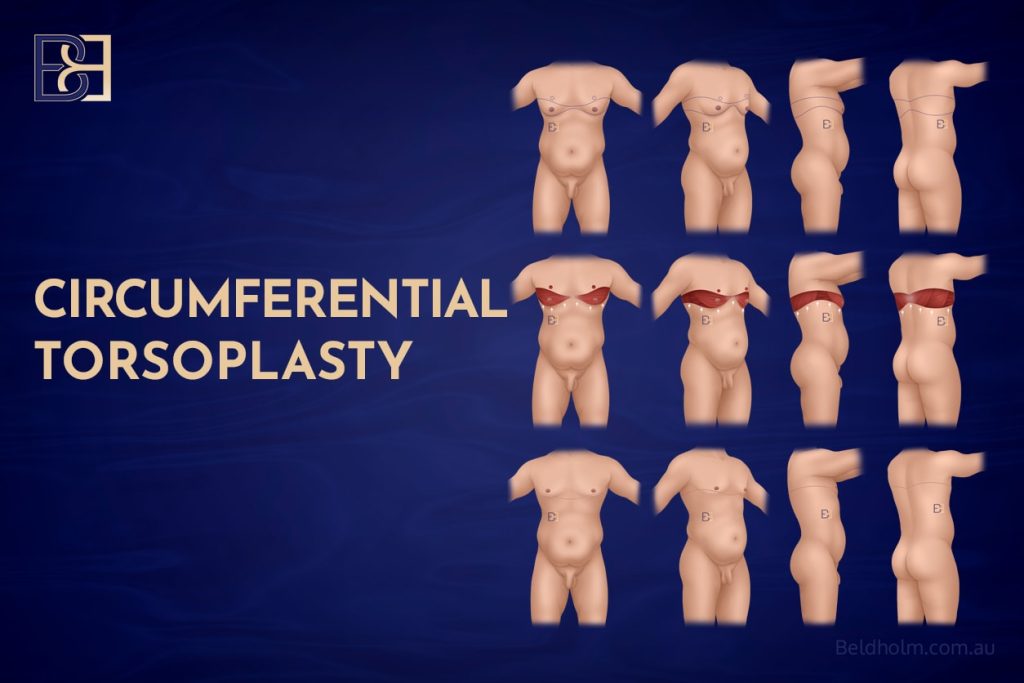
In some men, particularly after very large weight loss, the skin excess does not stop at the sides. Rolls of redundant skin continue across the upper back, and treating the front alone would leave the back untouched and the result unbalanced. Circumferential torsoplasty, a circumferential upper body lift, treats the excess tissue as what it is: a continuous ring of loose skin around the upper torso.
What the operation involves
- The incision continues around. The horizontal chest incision of the anterior operation is carried on around the sides and across the upper back, so the scar forms a continuous line around the torso at the level of the lower chest. On the back, the excision works as an upper back lift, removing the excess back skin and rolls that no amount of training changes, because the problem is skin, not fat or muscle.
- Repositioning during surgery. I begin with the patient prone and complete the back and lateral excision first, then reposition to complete the chest. Doing the posterior work first means the fresh anterior closure is never placed under strain by lying the patient on it, the same sequencing logic I apply in a belt lipectomy (body lift) of the lower torso.
- The chest component. The anterior stage is the operation described in the previous section, including the free nipple and areola graft where the grading calls for it, and VASER liposuction (ultrasound assisted lipectomy) at the excision borders.
- Operating time and hospital stay. This is a longer operation than the anterior version, typically 3 to 6 hours depending on the extent of the excision. Patients stay 1 to 2 nights, with drains in place until output settles.
A larger operation is a larger physiological event
Extending the excision around the torso consolidates the work into one anaesthetic and one recovery, and for suitable patients that is exactly why I plan it this way. The trade-off has to be stated: a circumferential operation is a major surgical procedure and places more demand on the body than an anterior one. That demand is the reason weight stability and nutritional preparation, covered next, carry so much weight in the planning, and it is also why for some patients dividing the work across separate operations is the more appropriate path.
Weight Stability and Preparing for Surgery
Timing matters as much as technique in this surgery. 2 things need to be in order before I will book a torsoplasty: the weight needs to be stable, and the body needs the nutritional reserves to support the healing process along a long incision.
Why stable weight comes first
I want to see weight stable for at least 6 months before operating, and 12 months is better. The reason is practical. If a patient loses another 15 kg after a circumferential torsoplasty, new skin excess appears and part of the work is undone. If weight is regained, the result is stretched in the other direction. Operating on a moving target wastes the operation. Stability also tells me the pattern of excess I am grading at consultation is the pattern I will be treating in theatre.
Nutritional preparation

Most men who have experienced significant weight loss arrive with nutritional gaps, whichever way the weight came off (7). Restricted intake, smaller portions after bariatric surgery, and reduced appetite on weight loss medications all limit protein and micronutrient intake during the losing phase, and healing a torsoplasty incision is a demanding metabolic task. A larger single operation raises those demands further, which is why preparation carries more weight, not less, when a circumferential procedure is planned.
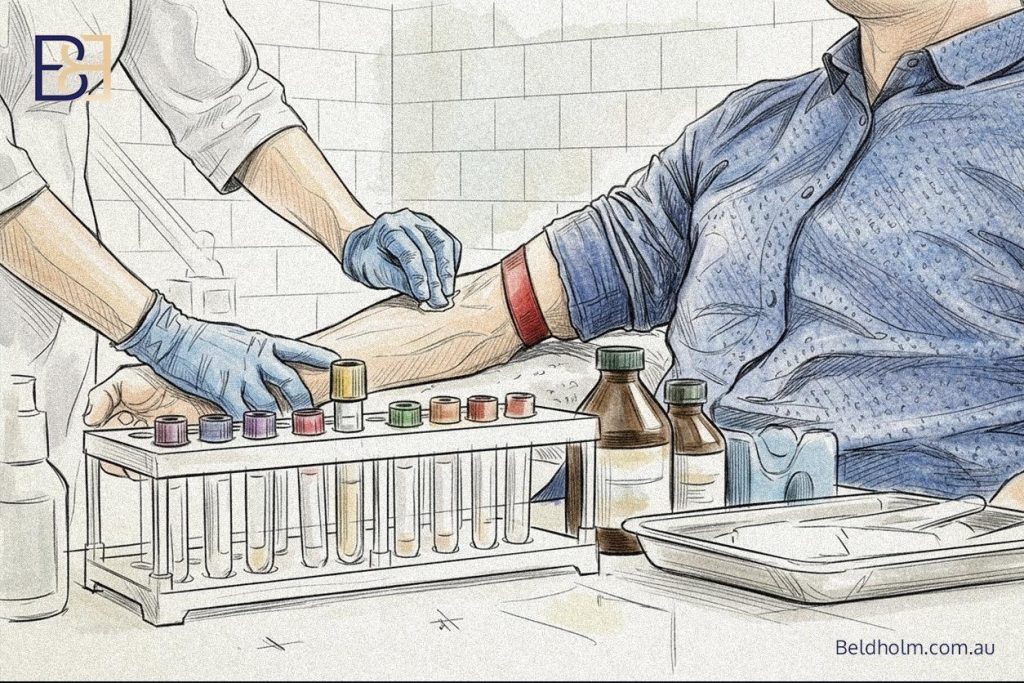
Every post weight loss patient in my practice has a pre-operative blood panel before surgery, covering blood count, iron studies, protein status, glucose control, thyroid function and the vitamins and trace elements that matter for wound healing. Anything the panel picks up is corrected before the operation date is set. I explain the panel in my article on pre-operative blood tests, and the reasoning behind protein targets in my article on protein after weight loss surgery. Where gaps are found, correction is blood-guided rather than a fixed supplement list, and I cover that approach in my article on nutritional deficiencies after weight loss.
If you are on weight loss medications

A growing share of my torsoplasty patients lost a significant amount of weight on weight loss medications. Current Australian guidelines do not recommend routinely stopping these before surgery, and I follow that position. Where protein targets cannot be met because appetite is suppressed, a temporary dose adjustment may be discussed as part of pre-operative planning. That is a decision made with me for the individual patient. Do not adjust or stop these medications on your own before surgery.
One Operation or Staged Surgery
Most men considering a torsoplasty after major weight loss have skin excess in more than one area, and a question comes up at nearly every consultation: should the work be done in one operation or spread across several body contouring procedures?
My preference, where a patient is suited to it
Where a patient is medically suited to it, my preference is to treat the planned area comprehensively in a single operation. One operation means one anaesthetic, one hospital admission and one recovery to work through, rather than repeating each of those steps. Within the chest and upper torso, that is the logic of the circumferential torsoplasty: the front, sides and back are treated in one operating time instead of returning later for the back rolls.
Staging is a legitimate path, not a compromise
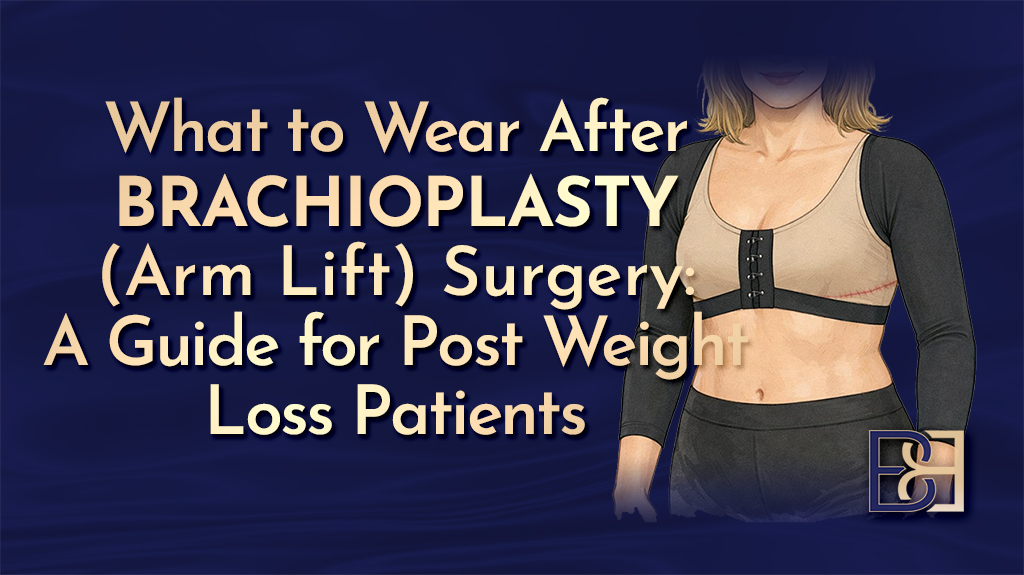
For some patients, doing everything at once places more demand on the body than is appropriate. Medical history, nutritional status, the extent of the excess, and what can be completed well in a single operating time all set limits. Where those limits are reached, staging the work across separate surgical procedures is the more appropriate choice, and I plan it that way without hesitation. An anterior torsoplasty now with posterior work later, chest surgery separated from a lower body lift (belt lipectomy), or a brachioplasty (arm lift) for the upper arms staged at a different time, are all common and sound sequences.
How the decision is made
This is a clinical judgement made for the individual, at consultation, after examination. It follows from your medical history, your blood panel, your BB grading and elasticity assessment, and the pattern of excess across the torso. It is not a decision that can be made from photographs or before we have met, and it is never about doing more surgery than you need. Patients who come to me wanting one area treated get a plan for that area. Where excess in other areas is relevant to sequencing, we discuss it because it changes the planning, not to expand the scope of your surgery.
Recovery: A Snapshot

The recovery period after upper body lift torsoplasty surgery runs to weeks, not days, and a circumferential operation asks more of you than an anterior one. I have written a full torsoplasty recovery guide that walks through the recovery process week by week; what follows is the shape of it.
- Hospital. 1 to 2 nights at Maitland Private Hospital, with surgical drains in place.
- Drains. Removed once the output settles below 20 mL over 24 hours, in most patients within the first days.
- Dressings. A PICO negative pressure dressing covers the incisions and comes off at day 7. Where a free nipple and areola graft has been done, the graft sits under its own pressure dressing until day 10, and it is not to be disturbed before then.
- Compression. Compression garments are fitted and worn over the torso for several weeks to support the underlying tissue and reduce swelling.
- Movement. Walking starts on day 1. Upper body training, lifting and anything that stretches the chest wall waits until I clear it, staged over the following weeks.
- Follow-up. The first 2 weeks involve intense follow-up straight after surgery, then follow-up appointments at 4 weeks, 3 months, 6 months and 12 months, all included in the surgical fee.
Swelling, tightness across the chest and back, and fatigue are all expected in the early weeks, and the graft site looks worse before it looks better. The recovery guide covers wound care, showering, driving, work and training milestones in detail.
Risks: What You Are Weighing Up

Book your appointment online now
Torsoplasty is major surgery and carries the risks of any long operation under general anaesthetic, plus risks specific to the free nipple and areola graft. I have written a separate article on torsoplasty complications that covers each in depth, including how often I see them and what is done when they occur. In brief, the risks fall into 3 groups:
- General surgical risks. Bleeding, infection, seroma (fluid collection under the skin), and poor wound healing. Post weight loss skin heals less reliably than skin that has never been stretched, and small areas of delayed healing along a long incision line are not uncommon.
- Clot risk. A longer operation raises the risk of blood clots: deep vein thrombosis and pulmonary embolism (8). I stratify this risk for every patient before surgery and determine the thromboprophylaxis plan myself, including how blood thinning medications are handled around the operation. Patients on these medications must not stop them without direction.
- Graft and scar risks. A free nipple and areola graft does not always take fully. Partial graft loss and loss of pigment can occur, and where pigment is lost, medical tattooing later is an option. Nipple sensation is reduced or absent after grafting. Scars around the torso take 12 to 18 months to mature and can stretch, thicken or heal unevenly, and asymmetry between the 2 sides can require revision.
Every item on this list is discussed at consultation before any decision is made, and the complications article sets out what each one means in practice, including when to seek medical advice after surgery.
Cost and Medicare

Whether Medicare contributes to a torsoplasty depends on which problem predominates, and that is a clinical determination made at consultation, not something that can be promised in advance.
Where glandular breast tissue is the dominant finding, the operation may fall under the Medicare item numbers for gynaecomastia surgery. Where the dominant problem is redundant skin after significant weight loss, a different item may apply, and its criteria are specific: a loss of at least 5 BMI units, weight stable for at least 6 months, and skin problems such as intertrigo that have failed conservative treatment or interference with daily activities. The 2 pathways are not combined for the same operation. Which one applies, if either, follows from the examination findings and Services Australia criteria current at the time of surgery.
An item number determines the Medicare rebate and affects the private health fund contribution toward the hospital stay. It does not make the surgery free; a gap applies. After consultation you receive a written quote setting out the surgical fee, anaesthetic fee, hospital costs and the expected rebates, so the full position is in front of you before any decision is made.
I have set out the fee structure, health fund considerations and the item number criteria in more detail in my article on torsoplasty cost and Medicare.
References
- Rocha RI, Junior WC, Modolin MLA, Takahashi GG, Caldini ETEG, Gemperli R. Skin Changes Due to Massive Weight Loss: Histological Changes and the Causes of the Limited Results of Contouring Surgeries. Obes Surg. 2021;31(4):1505-1513.
- Sami K, Elshahat A, Moussa M, Abbas A, Mahmoud A. Image analyzer study of the skin in patients with morbid obesity and massive weight loss. Eplasty. 2015;15:e4.
- Gusenoff JA, Coon D, Rubin JP. Pseudogynecomastia after massive weight loss: detectability of technique, patient s*tisfaction, and classification. Plast Reconstr Surg. 2008;122(5):1301-1311.
- Ziegler UE, Lorenz U, Daigeler A, Ziegler SN, Zeplin PH. Modified Treatment Algorithm for Pseudogynecomastia After Massive Weight Loss. Ann Plast Surg. 2018;81(3):290-294.
- Tashkandi M, Al-Qattan MM, Hassanain JM, Hawary MB, Sultan M. The surgical management of high-grade gynecomastia. Ann Plast Surg. 2004;53(1):17-21.
- Hurwitz D. Enh*ncing Masculine Features After Massive Weight Loss. Aesthetic Plast Surg. 2016;40(2):245-255.
- Agha-Mohammadi S, Hurwitz DJ. Nutritional deficiency of post-bariatric surgery body contouring patients: what every plastic surgeon should know. Plast Reconstr Surg. 2008;122(2):604-613.
- Petersen ML, Vázquez FJ, Mayer HF. Mechanical Thromboprophylaxis Alone in Body Contouring Surgery for Post Massive Weight Loss Patients: Is this Good Enough? Aesthetic Plast Surg. 2022;46(1):248-254.