After major weight loss, the abdomen often carries loose skin in two directions. There is vertical skin laxity below the belly button. There is also horizontal skin laxity across the upper abdomen.
This pattern shows up after bariatric surgery, after sustained weight loss on GLP-1 medications, and after long-term lifestyle change.
A standard tummy tuck (abdominoplasty) tightens the skin in one direction. A fleur-de-lis abdominoplasty (FDL) treats both.

This article walks through how I perform the operation at Maitland Private Hospital, from marking through to applying the compression garment.
It is not a candidacy guide, nor a recovery guide. For those who are suitable, the pre-operative blood panel, nutritional optimisation, and recovery timeline are covered in my main Fleur de Lis abdominoplasty article.
Every patient’s anatomy is different. The sequence below is my standard operative approach. Healing and final results vary between patients.
Table of Contents
The Day of Surgery: Arrival and Theatre Prep
Patients arrive at Maitland Private Hospital on the morning of surgery. They are admitted to the day surgery ward.
The anaesthetic consultation has usually been completed by phone in the weeks leading up to it. The anaesthetist meets the patient on the day of the procedure to examine the airway and confirm the plan.
I meet the patient in the pre-operative bay. We go through any last questions. I confirm the operative plan once more.
The patient then walks into the anaesthetic bay. I begin marking before any sedation is given.
Surgical Markings
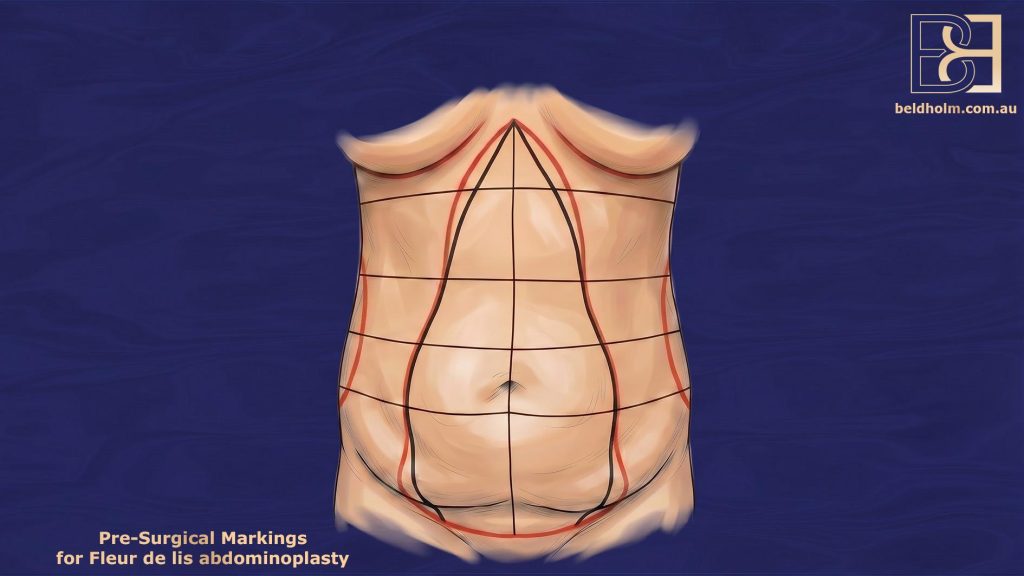
The fleur-de-lis pattern is drawn with the patient standing, then refined when they lie down. I use an indelible marker so the lines remain visible after skin prep.
The Horizontal Line
The horizontal incision runs hip to hip. The aim is to place the scar in the underwear line, so it sits low across the abdomen. This is the same horizontal line used for a standard abdominoplasty.
The Vertical Line
With the patient standing, I work out how much skin can come out from the upper abdomen. I do this by pulling the loose skin from side to side across the midline. This tells me how much skin I can bring together to close at the midline without excessive tension.
I then mark out the extent of the excision. The markings are usually widest beside the umbilicus, where skin redundancy tends to be greatest after major weight loss. From there they taper up to an inverted V at the top.
The vertical incision runs along the midline from the lower end of the sternum down to where it meets the horizontal line in the groin.
Why the Fleur de Lis Pattern
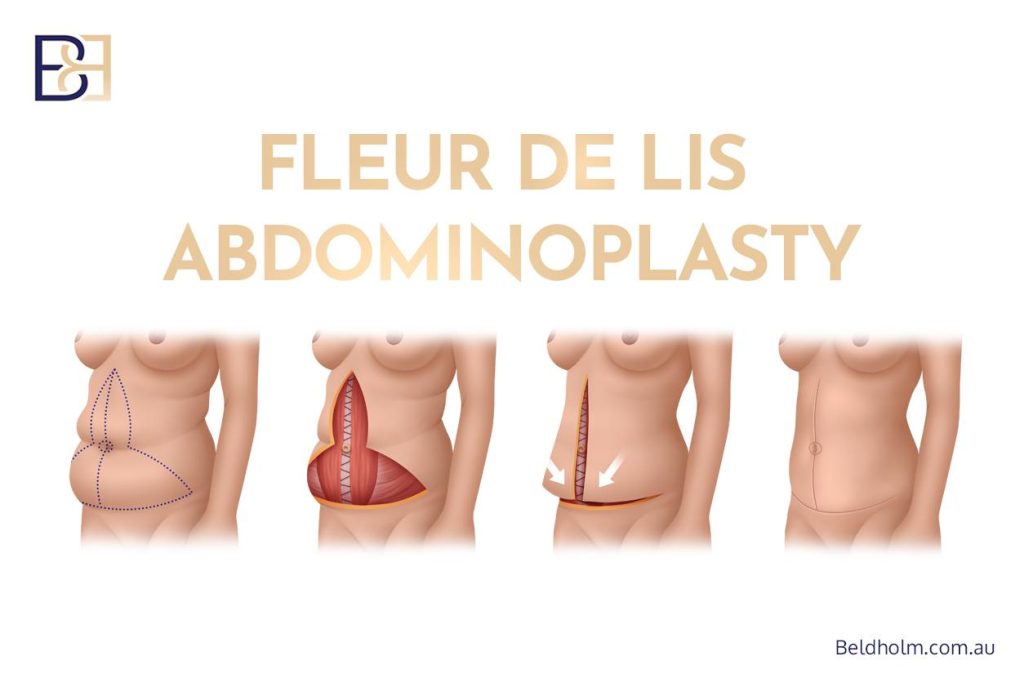
The two lines meet at the lower midline. Together, they form the inverted T-shape that gives the operation its name. The name comes from a French term for the stylised lily flower.
A standard abdominoplasty removes a horizontal ellipse of lower abdominal skin and pulls the upper skin down. It does not tighten the skin horizontally.
For patients with significant upper abdominal skin laxity after major weight loss, horizontal redundancy requires vertical excision. The fleur-de-lis pattern lets me remove skin along both axes in a single operation (1).
Anaesthesia and Positioning
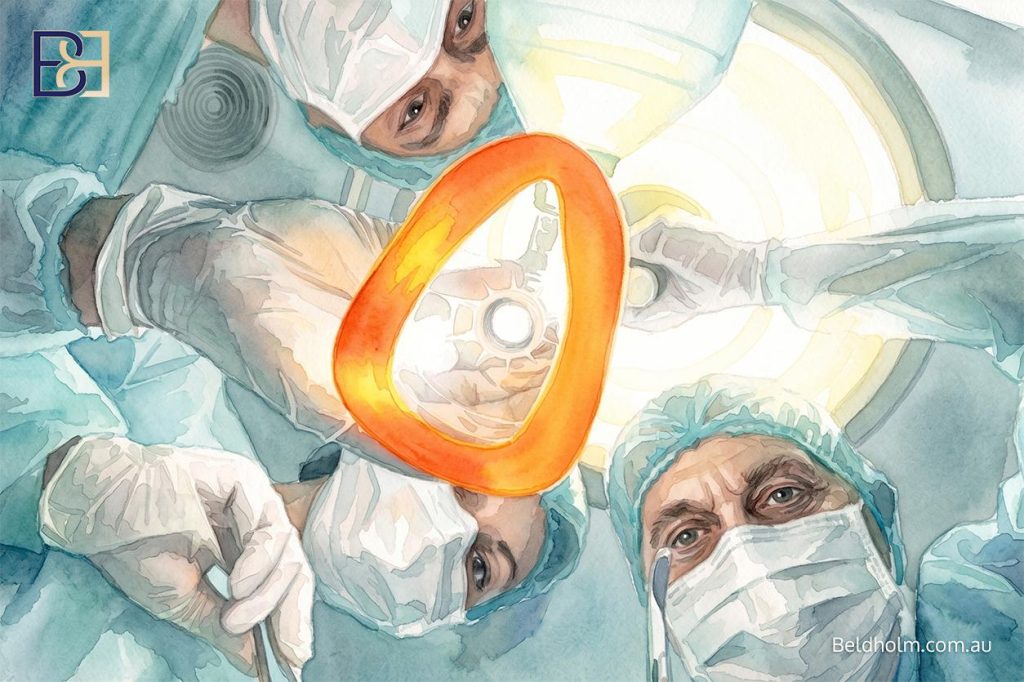
A fleur-de-lis abdominoplasty is performed under general anaesthesia. The anaesthetist intubates the patient and manages the airway and vital signs throughout the operation.
IV access is established. Prophylactic antibiotics are given before incision. Warming starts early.
The patient is positioned supine on the operating table with arms out to the sides on padded arm boards.
Calf compression devices are fitted on both legs. These run continuously through the operation and reduce the risk of deep vein thrombosis. This is one part of the DVT prevention plan. The full plan is decided well before the day of surgery and is patient-specific. I cover this in more detail in my article on DVT prevention after body contouring surgery.
The abdomen and lower chest are prepped with an antiseptic solution. Sterile drapes are applied, exposing the operative field from the lower chest down to the upper thighs.
Suction-Assisted or Ultrasound-Assisted Lipectomy (When Combined)
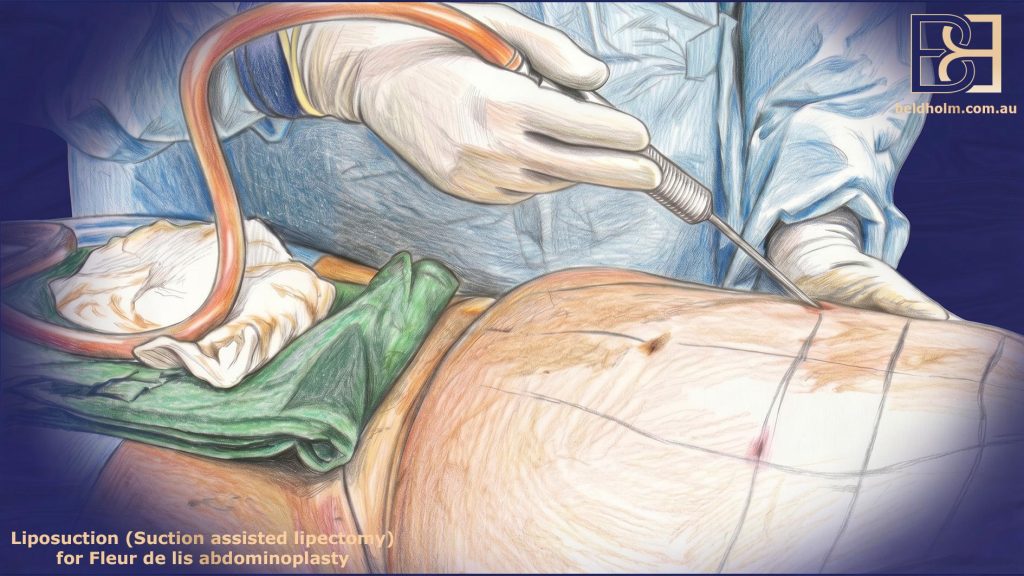
Not every fleur de lis abdominoplasty patient needs liposuction (suction-assisted lipectomy). I decide on a case by case basis.
The two main techniques are suction-assisted lipectomy (traditional liposuction) and ultrasound-assisted lipectomy (VASER). I use VASER when liposuction(suction-assisted lipectomy) is part of the operation.
When residual subcutaneous fat in the flanks, hips, or upper abdomen is not addressed by the planned skin excision, I add VASER at the start of the operation.
I infiltrate tumescent fluid through small access incisions first. The fluid contains lignocaine, adrenaline, sodium bicarbonate, and saline. It firms the tissues, reduces bleeding, and makes fat removal more precise.
The VASER probe is then passed through the same access incisions. It emits ultrasonic energy that breaks down and liquefies the fat. The probe generates heat, so I protect the skin with wet towels over exposed areas, protective ports at the access points, and ongoing tumescent fluid coverage.
Once the fat is emulsified, I aspirate it through a cannula.
Adding VASER extends the operation by approximately one hour.
Belly Button (Umbilicus) Release
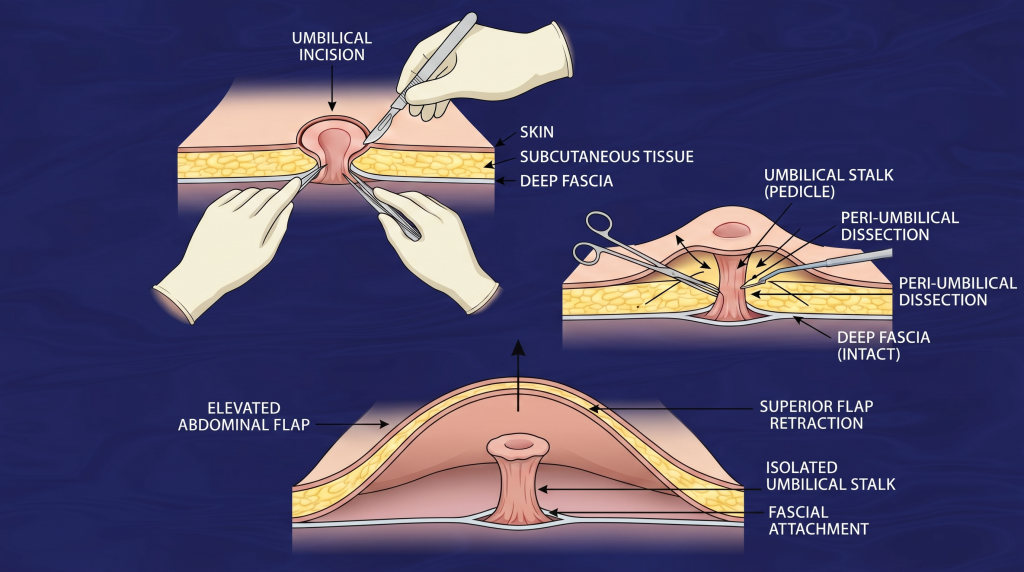
The umbilicus is anchored to the abdominal skin around its rim, and to the abdominal wall below by its stalk. To elevate the abdominal skin, I separate the umbilicus from the surrounding skin with a small circumferential incision.
The stalk is kept intact. The blood supply to the umbilicus runs through this stalk, so leaving it attached preserves the umbilicus’s viability for later repositioning.
My assistant holds the surrounding tissue stable while I make the incision. I then stitch a small piece of plastic, taken from the suction tubing, onto the umbilical stalk. I call this my belly button detection device. It lets me identify the umbilicus at the end of the operation when I need to bring it back through the new opening (2).
Vertical Incision and Excision
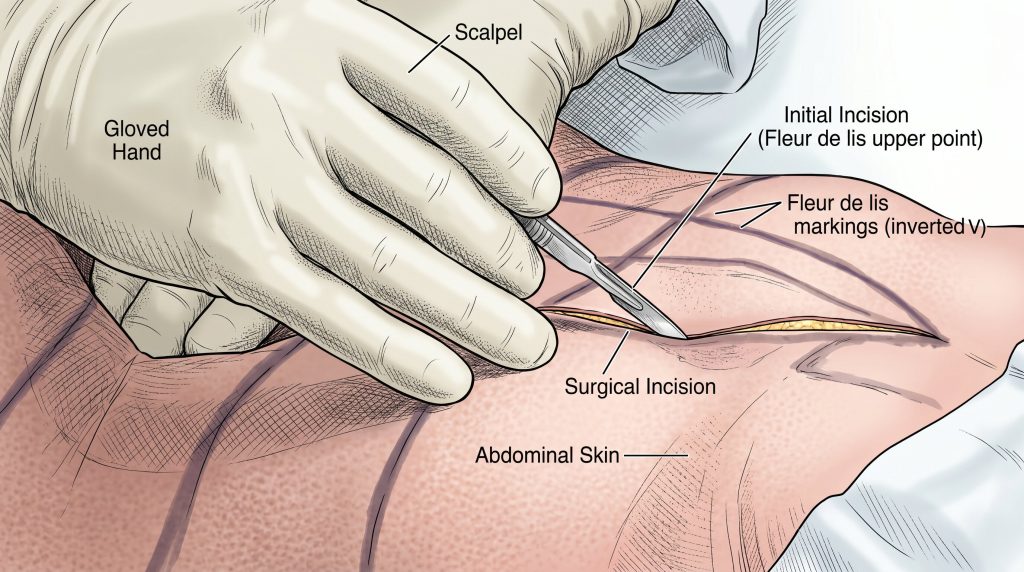
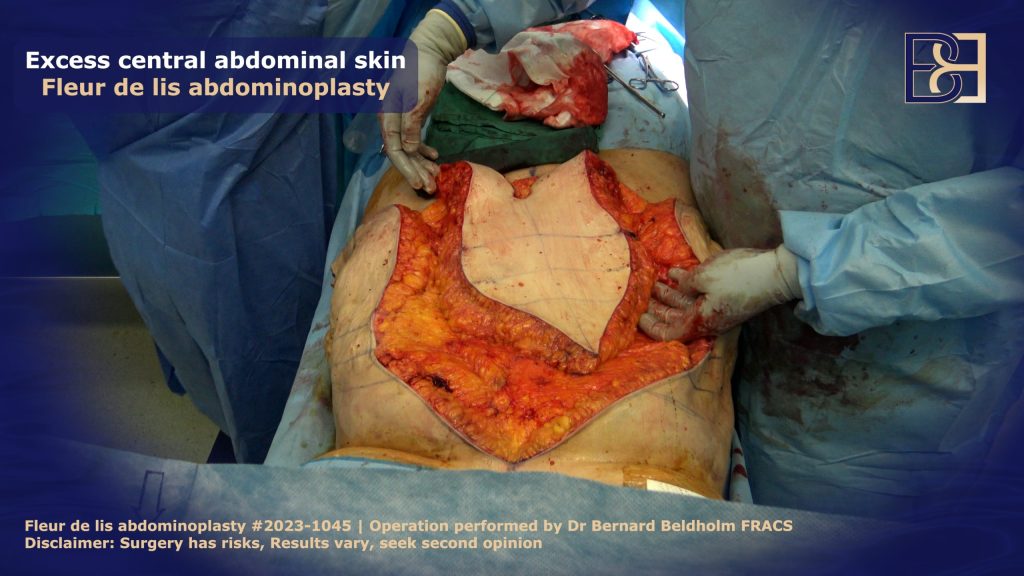
With the umbilicus released, I move to the vertical excision. I follow the markings made earlier, cutting along each side of the inverted V. Diathermy is used as I go to seal blood vessels and keep the field clean.
I then move to the muscle repair before closing the vertical incision.
Abdominal Muscle Repair (Diastasis Recti Repair)
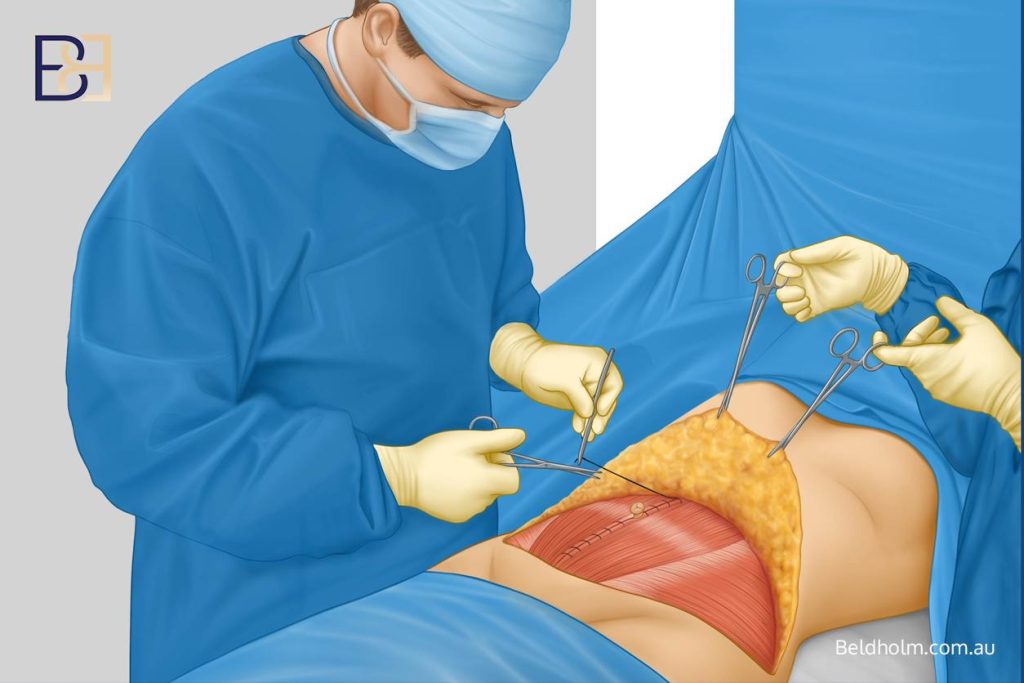
After pregnancy or significant weight gain, the two halves of the rectus abdominis muscle often separate at the midline. This separation is called diastasis recti. Skin removal alone will not treat it. The muscles need to be brought back together at the midline to repair the diastasis.
The vertical excision in a fleur de lis abdominoplasty gives me direct access to the full length of the rectus sheath. I use a V-Loc barbed suture to plicate the diastasis from the xiphoid down to the pubis.
V-Loc is a self-anchoring suture. The barbs along its length grip the tissue as the suture is run, so it does not need a knot at the start or the end. Tension is distributed evenly along the repair rather than concentrated at knot points, operative time is shorter without knot tying, and patients are less likely to feel any suture under the skin once they have healed (3).
The repair is checked along its full length before closure begins.
Closing the Vertical Incision
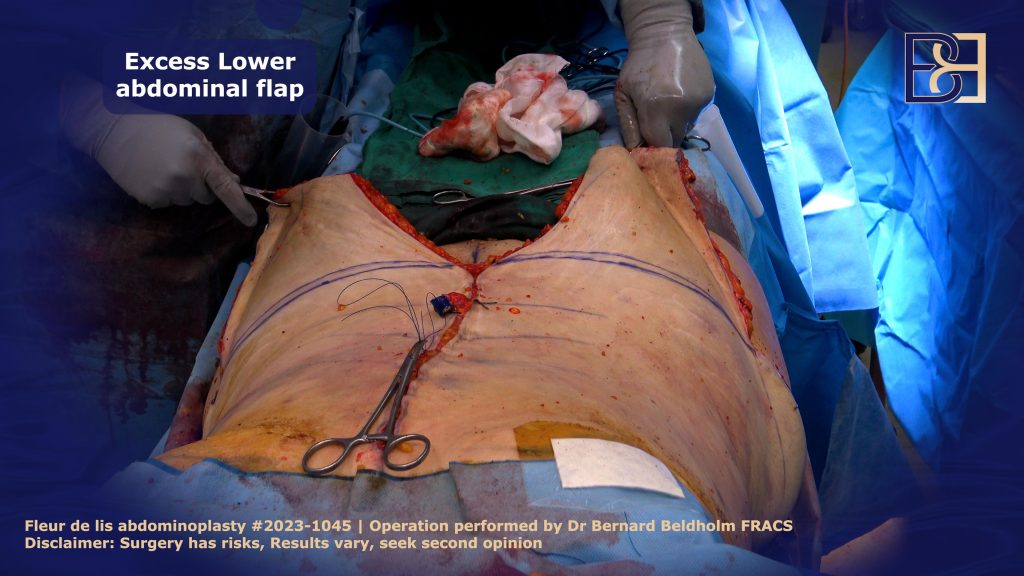
I close the vertical incision in layers. The deeper subcutaneous layers are closed first with absorbable sutures. The skin layer is then closed with subcuticular absorbable sutures, buried beneath the surface, so there are no external stitches to remove.
The midline closure is completed before I move to the horizontal incision, so that midline tension is set before the lower abdominal work begins.
Horizontal Incision and Excision
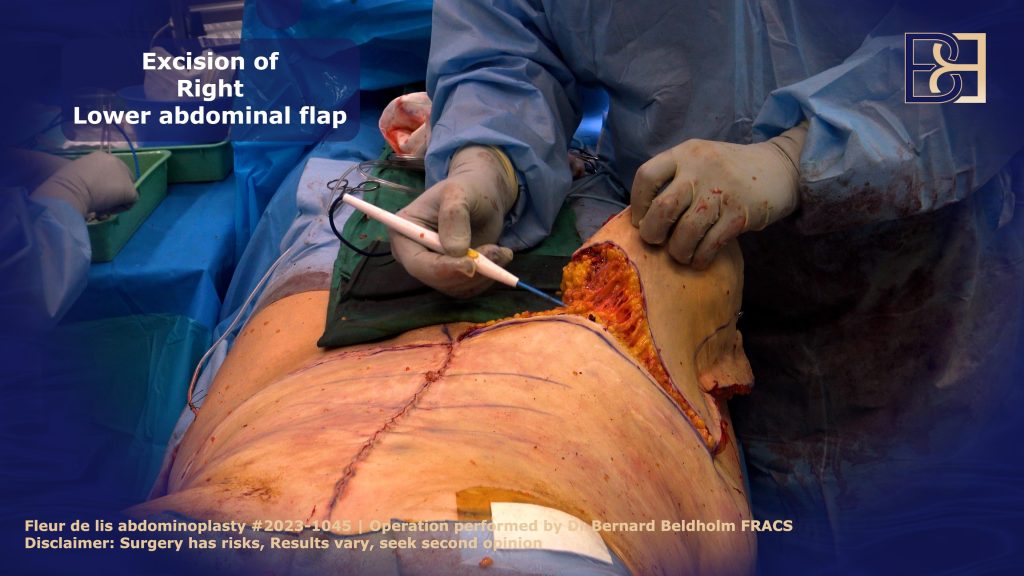
With the vertical excision closed, I move to the horizontal component. This incision runs hip to hip, the same line used in a standard abdominoplasty.
I make the incision through skin and subcutaneous fat. As I work, diathermy seals blood vessels along the way. The dissection is taken just below Scarpa’s fascia, in the plane deep to it.
Scarpa’s fascia is a recognisable white fibrous layer in the lower abdominal fat. Dissecting just below it keeps Scarpa’s fascia intact within the flap. The deeper fat layer between Scarpa’s and the rectus sheath stays attached to the abdominal wall, along with the lymphatic vessels that run through it.
Preserving the deeper fat layer with its lymphatics is one of the techniques shown to reduce post-operative seroma rates after large abdominal skin excisions (4). Keeping Scarpa’s fascia intact also gives me a clean tension-bearing layer for the final closure.
The excess lower abdominal skin and fat above the dissection plane is then lifted as a flap, mobilised up to the level needed for closure, and the surplus tissue removed.
Umbilicus Repositioning
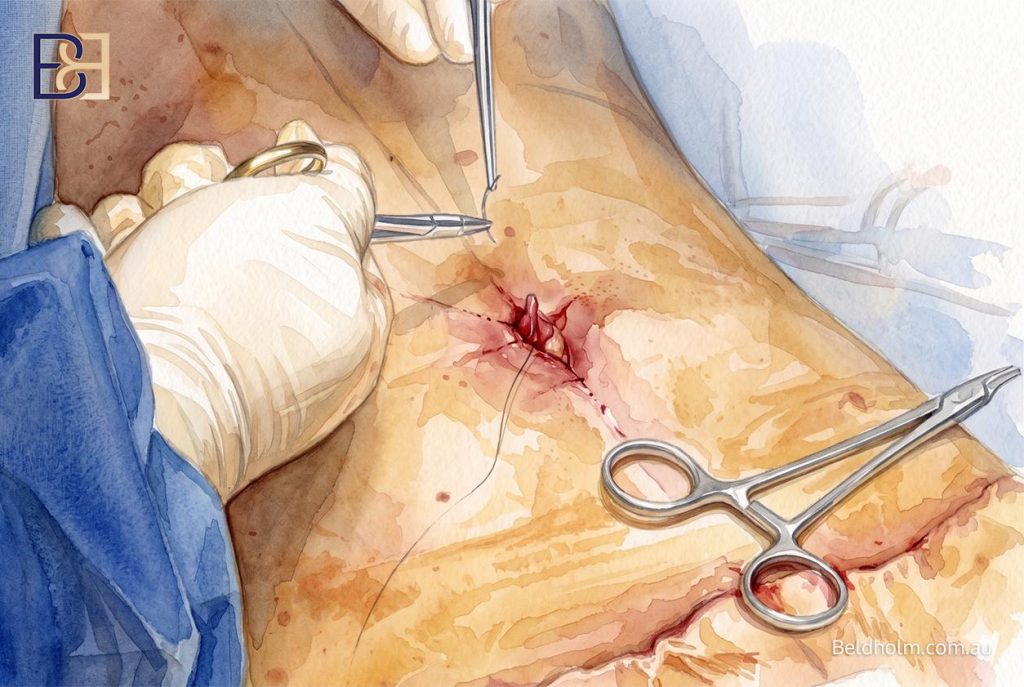
With the flap mobilised and brought down over the abdomen, the umbilicus is still attached to the abdominal wall by its stalk, sitting underneath the flap. I locate it using the belly button detection device I placed earlier.
A new opening is created in the abdominal flap at the level the umbilicus needs to sit. The stalk is brought out through this new opening and sutured into position with fine absorbable sutures, set to match normal anatomical position and sit in line with the vertical incision (2).
The position of the umbilicus is one of the technical details that influences the final appearance of the abdomen.
Book your appointment online now
Drains
I place two closed-suction drains in every fleur-de-lis abdominoplasty. One drain on the right and one on the left, both exiting on the lateral hip area. The drains sit in the subcutaneous space under the closed flap.
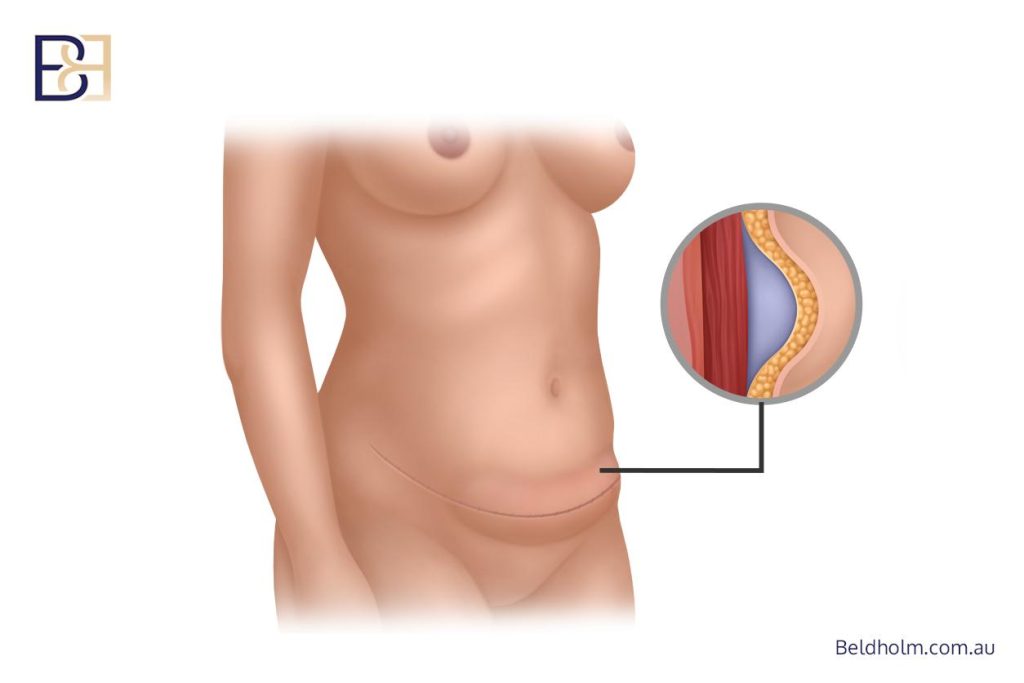
A fleur de lis abdominoplasty creates a large undermined area between the flap and the abdominal wall. As the tissues heal, the space between them produces fluid. Without drainage, the fluid collects as a seroma. A small seroma is common and usually settles on its own. A larger seroma can need repeated needle aspiration or, occasionally, a second small operation to wash out.
Drains reduce that risk. They sit on continuous low-pressure suction and remove the fluid as it forms, which helps the flap settle onto the abdominal wall and heal.
The drains stay in until the daily output drops below a defined threshold over two consecutive days. Most patients have them removed between days two and seven, sometimes before discharge from hospital and sometimes at an outpatient review.
Routine drainage is my current standard for FDL. In this patient group, drains give more reliable seroma control than a tissue glue and drainless technique.
Closing the Horizontal Incision
The horizontal incision is closed in layers, with particular attention to tension across the closure.
The deepest layer is Scarpa’s fascia. This is the tension-bearing layer. I close Scarpa’s fascia with Vicryl, an absorbable suture that holds tension well while the deeper tissues bond together over the following weeks.
The intermediate layers are closed with barbed sutures, which distribute tension along their length and avoid knot bulk in the wound.
The skin layer is closed with subcuticular absorbable sutures buried beneath the surface, so there are no external stitches that need removing.
PICO Negative Pressure Wound Therapy

Once both incisions are closed, I cover them with PICO Negative Pressure Wound Therapy (NPWT) dressings. PICO is a thin, sterile dressing connected to a small battery-powered pump. The pump applies continuous low-level negative pressure across the wound.
The negative pressure draws fluid away from the incision, holds the wound edges together as a mechanical support to the closure, and improves blood flow to the skin edges to assist healing (5).
The PICO dressing stays in place until day seven. The battery is not waterproof, so full showers are not possible during this period. At day seven I remove the PICO dressing and replace it with Hypafix tape, which stays on for several more weeks to support the healing scars.
Compression Garment
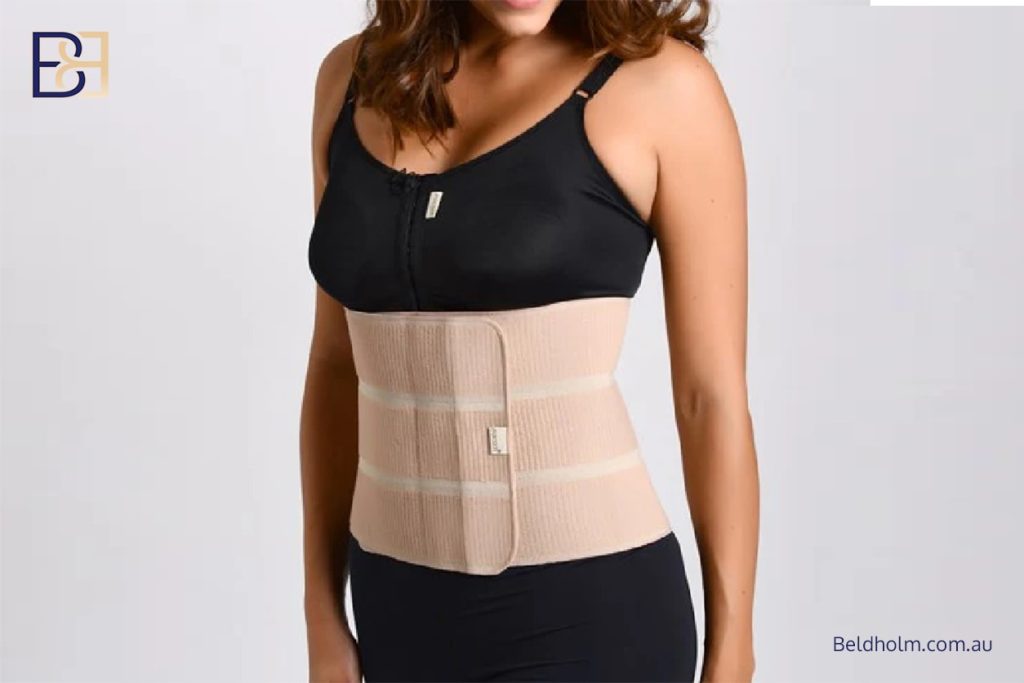
The compression garment goes on in the theatre before the patient wakes up. It is a firm-fitting abdominal binder that runs from the lower chest down past the hips.
The garment supports the closure, reduces swelling, and helps the flap settle onto the abdominal wall.
I recommend that the compression garment be worn full-time for the first four weeks, day and night, including during sleep.
After four weeks, I shift patients to half-time wear for the next two weeks. The daytime hours are when swelling is worst, so my standard advice is to wear the garment during the day and remove it overnight.
In hot weather, or if a patient finds the garment uncomfortable to sleep in, the reverse is also acceptable. The total daily wear time matters more than the specific hours.
Immediate Post-Operative Period

The patient wakes in the recovery room. Pain relief is initially administered through the intravenous line. Most patients transition to oral pain medication during their first day on the ward.
Patients are encouraged to mobilise as soon as possible after surgery. Early walking reduces the risk of deep vein thrombosis and supports the return of bowel function. The first walk is typically with nursing assistance on the same day or the morning after surgery, starting with a short distance and gradually building up.
Most patients stay in the hospital for two to four nights after a fleur de lis abdominoplasty. The actual length depends on pain control, drain output, mobility, and how the wound is settling. I review every admitted patient daily on ward rounds.
Patients who live a long way from Maitland are encouraged to stay locally for seven to ten days after discharge so that any concerns can be treated in person at our clinic before they travel home.
Operation-Specific Risks

Fleur de lis abdominoplasty is a major surgery. Every operation carries risks, and FDL has some that are more common than after a standard abdominoplasty due to the longer incisions and the larger area of tissue dissection.
Bleeding and haematoma. Bleeding under the skin can collect as a haematoma and may need return to theatre for drainage if large.
Seroma. Fluid collection between the flap and the abdominal wall. Drains and the PICO dressing reduce this risk, but a small seroma after drain removal is not uncommon and can usually be managed with needle aspiration in the clinic.
Wound healing at the T-junction. The point where the vertical and horizontal incisions meet is the area most prone to delayed healing or breakdown. The blood supply at this junction is more vulnerable than along either incision alone. Smokers, patients with diabetes, and patients in the higher BMI range have a higher risk here (6).
Skin necrosis. A small area of skin at the T-junction or at the lower edge of the flap can lose its blood supply and die. This may need dressings for weeks to heal, or occasionally a small revision once the wound has settled.
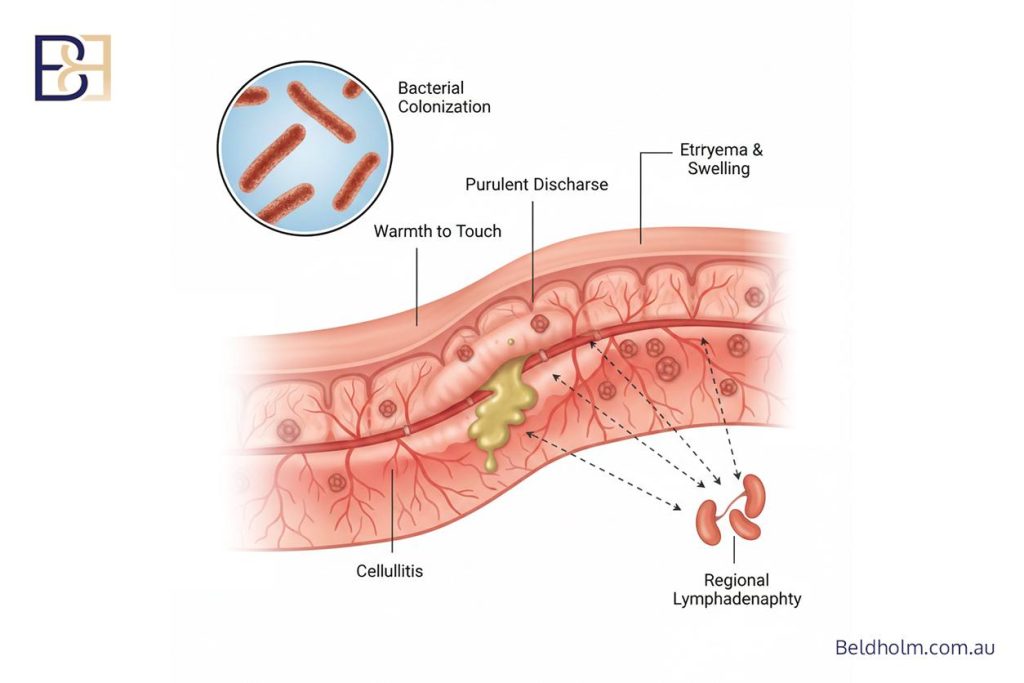
Wound infection. Pre-operative antibiotics, careful technique, and the PICO dressing all reduce this risk, but infection still occurs in a small number of cases.
Deep vein thrombosis and pulmonary embolism. Post-weight-loss patients are an elevated-risk group for VTE. I stratify each patient’s risk and plan thromboprophylaxis before surgery. This is covered in more detail in my article on DVT prevention after body contouring surgery.
Scar widening, hypertrophic scars, and keloid scars. Scars from FDL are long and visible. They typically fade over twelve to twenty-four months. Some patients form thickened scars that may need additional management.
Asymmetry. Even with careful marking, small differences between the two sides can show up after healing.
Altered skin sensation. Areas of the abdomen often feel numb or unusual for months after surgery, and a small area may remain different long term.
Anaesthetic risks. General anaesthesia has its own set of risks, which the anaesthetist discusses separately.
Revision surgery. A proportion of patients have a small revision at a later date, for example, to refine a scar, take out a dog-ear (a small fold of skin at the end of an incision), or treat an asymmetry.
After Discharge

Drains are removed at the clinic once output drops below the threshold, typically between days two and seven after surgery. The PICO dressing is removed at day seven and replaced with Hypafix tape.
Follow-up appointments are scheduled at four weeks, three months, six months, and twelve months post-surgery.
For a full overview of recovery milestones, return to activity, scar care, and what to expect over the first year, see my fleur de lis abdominoplasty recovery article.
Healing and Results Vary

Swelling settles gradually. Most patients see the bulk of it resolve within three to six months, with smaller residual swelling possible for up to twelve months.
Scars are long after FDL, running up the midline and hip to hip. Both are pink and raised in the early months and typically flatten and fade over twelve to twenty-four months. Final scar appearance varies between patients depending on skin type, tension at closure, healing genetics, and post-operative care.
No two patients heal in the same way, and no two patients end up with an identical result. Body habitus, weight stability, age, smoking status, nutritional status, and the amount of skin laxity at the outset all affect what is achievable.
This article describes how the operation runs. It is not a promise about the outcome for any individual patient. That conversation happens at the consultation, after I have examined the patient, reviewed their history, and discussed what is and is not realistic in their case.
References
- Wallach SG. Abdominal contour surgery for the massive weight loss patient: the fleur-de-lis technique. Aesthet Surg J. 2005 Sep-Oct;25(5):454-65.
- Mendes FH, Donnabella A, Fagotti Moreira AR. Fleur-de-lis Abdominoplasty and Neo-umbilicus. Clin Plast Surg. 2019 Jan;46(1):49-60.
- Gutowski KA, Warner JP. Incorporating barbed sutures in abdominoplasty. Aesthet Surg J. 2013 Sep;33(3 Suppl):76S-81S.
- Costa-Ferreira A, Rebelo M, Silva A, Vásconez LO, Amarante J. Scarpa fascia preservation during abdominoplasty: randomized clinical study of efficacy and safety. Plast Reconstr Surg. 2013 Mar;131(3):644-51.
- Normandin S, Safran T, Winocour S, Chu CK, Vorstenbosch J, Murphy AM, Davison PG. Negative Pressure Wound Therapy: Mechanism of Action and Clinical Applications. Semin Plast Surg. 2021 Aug;35(3):164-170.
- Friedman T, O’Brien Coon D, Michaels V J, Purnell C, Hur S, Harris DN, Rubin JP. Fleur-de-Lis abdominoplasty: a safe alternative to traditional abdominoplasty for the massive weight loss patient. Plast Reconstr Surg. 2010 May;125(5):1525-35.