Many women notice that the skin across the lower abdomen stays loose well after their most recent pregnancy, sometimes 2 years on or more. This is a normal variation. Pregnancy stretches the abdominal skin and the wall beneath it across 9 months, and how far things settle afterwards differs a great deal from one woman to the next.
In my practice I see women who have waited, exercised, and given their body time, and whose skin has still not drawn back the way they had expected. I also see women whose abdominal muscles separated during pregnancy and stayed separated. Both are common, and neither means anything has gone wrong.
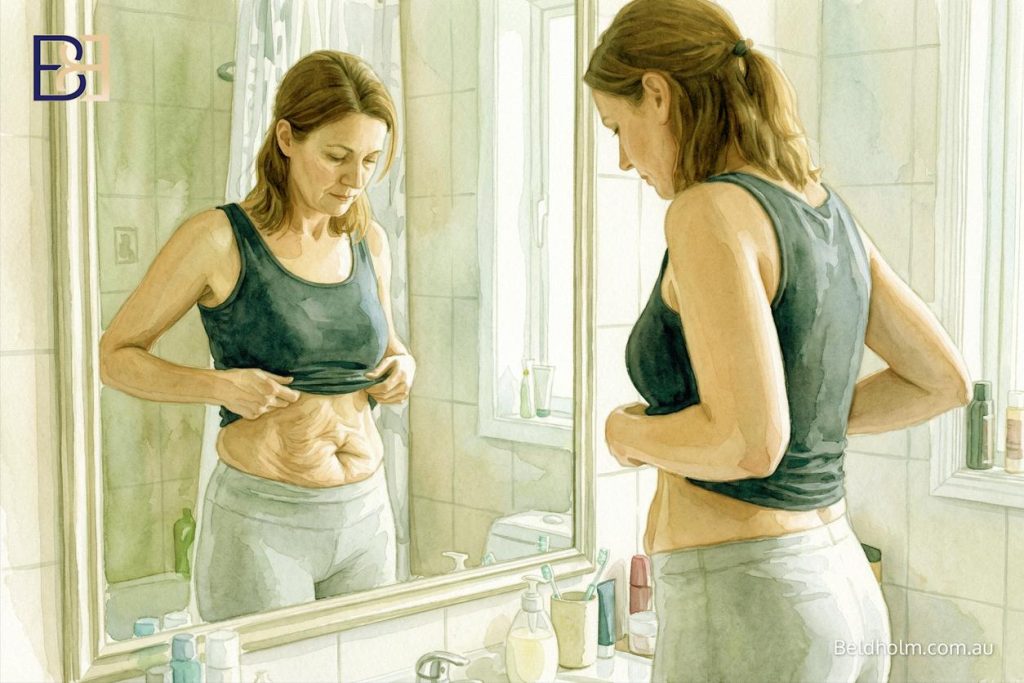
This article explains why loose abdominal skin can persist around the 2 year mark, what influences whether skin retracts, what non surgical measures can and cannot do, and the surgical options I use for post pregnancy patients when they are appropriate.
What changes in the abdomen during and after pregnancy
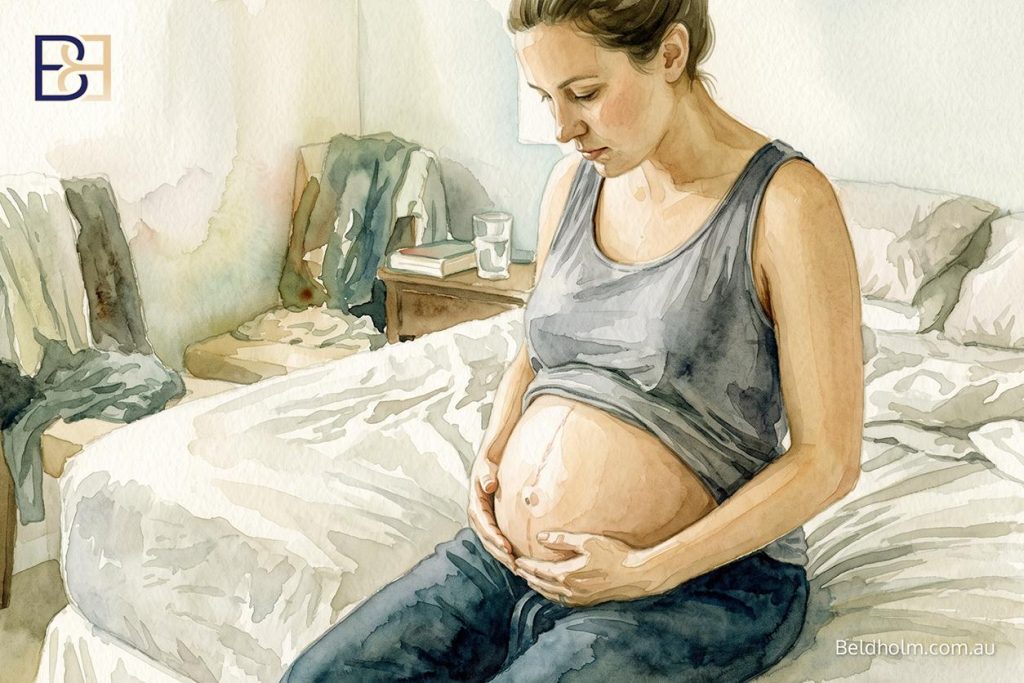
Pregnancy stretches and reshapes several layers of the abdomen over 9 months. When I assess a woman who still has loose skin 2 years on, I look at each of these layers separately, because they respond to pregnancy differently and they are treated differently.
The skin
The skin has to expand a long way to accommodate a growing baby. Its elasticity comes from elastic fibres and collagen in the dermis, which let the skin stretch and draw back. There is a limit to how far they recover once the skin stretches significantly over many months. In some women the skin draws back closely. In others it stays as stretched skin across the lower abdomen. Stretch marks are a sign that the deeper layer of the skin, the dermis, was stretched during pregnancy. They are very common and they do not affect health.
The abdominal muscles (diastasis recti)
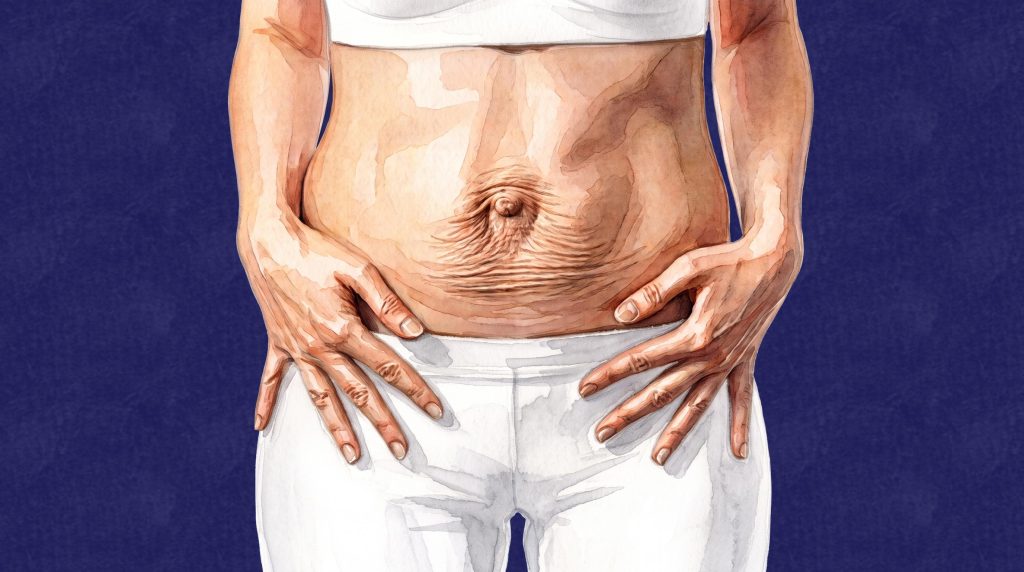
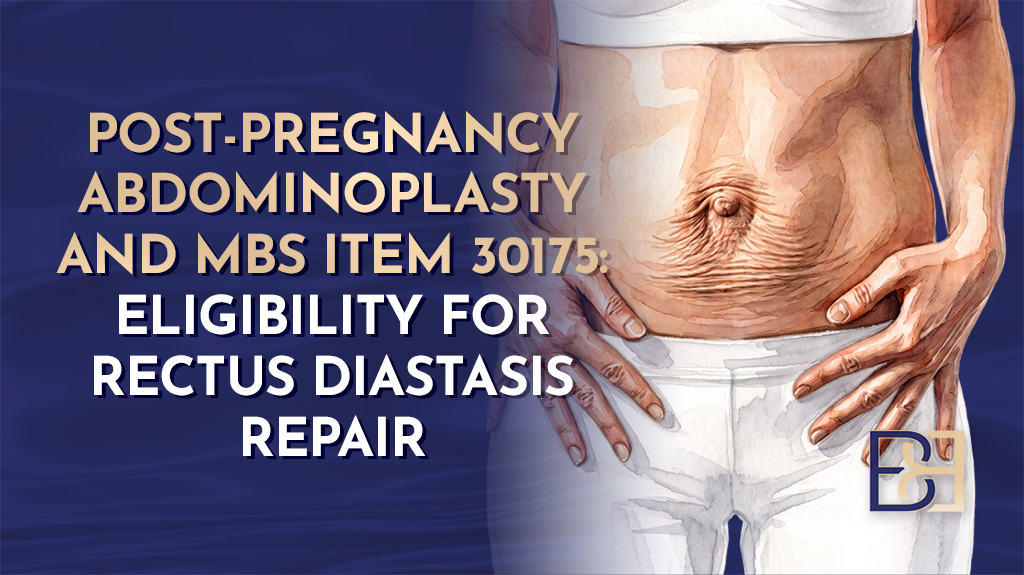
Down the midline of the abdomen, the 2 rectus muscles (the “6-pack” muscles) are joined by a band of connective tissue called the linea alba. During pregnancy this band stretches and widens, so the muscles sit further apart. This widening is called diastasis recti, also known as abdominal muscle separation.
It is worth understanding what this is and is not. The muscles themselves are not torn. The linea alba has stretched and thinned, leaving the abdominal muscles separated in the midline. Even with good muscle tone, separated abdominal muscles do not always come back together on their own. In many women the linea alba narrows again in the months after birth. In others it stays wide, which can give the midline a fuller or more rounded appearance even when weight has returned to its usual level.
Fat
Localised fat is a real and common concern, and for many women it sits alongside loose skin and diastasis recti rather than being a minor issue. These 3 changes often occur together after pregnancy, in varying proportions. Subcutaneous fat over the abdomen and flanks can be stubborn despite diet and exercise. Where it is a factor, it can be treated at the same operation using ultrasound-assisted suction lipectomy (VASER liposuction) alongside the abdominoplasty. This is not part of every abdominoplasty, so combining the two lets me treat loose skin, muscle separation (diastasis recti) and localised fat in a single procedure for suitable patients. I cover how this works under the surgical options below.
The caesarean scar
Many post pregnancy patients have a caesarean scar low on the abdomen. Its position matters when planning any abdominal operation, because the scar and the skin around it are part of what is assessed and, in an abdominoplasty, what is removed. I cover this in more detail further on.
Why skin draws back for some women and not others
Skin retraction after pregnancy varies a lot from one woman to the next. Pregnancy hormones, the degree of stretch, your age and your genetics all play a part, and most of these are outside anyone’s control. Understanding them helps explain why persistent loose skin can still be there 2 years on.
Time since your pregnancy
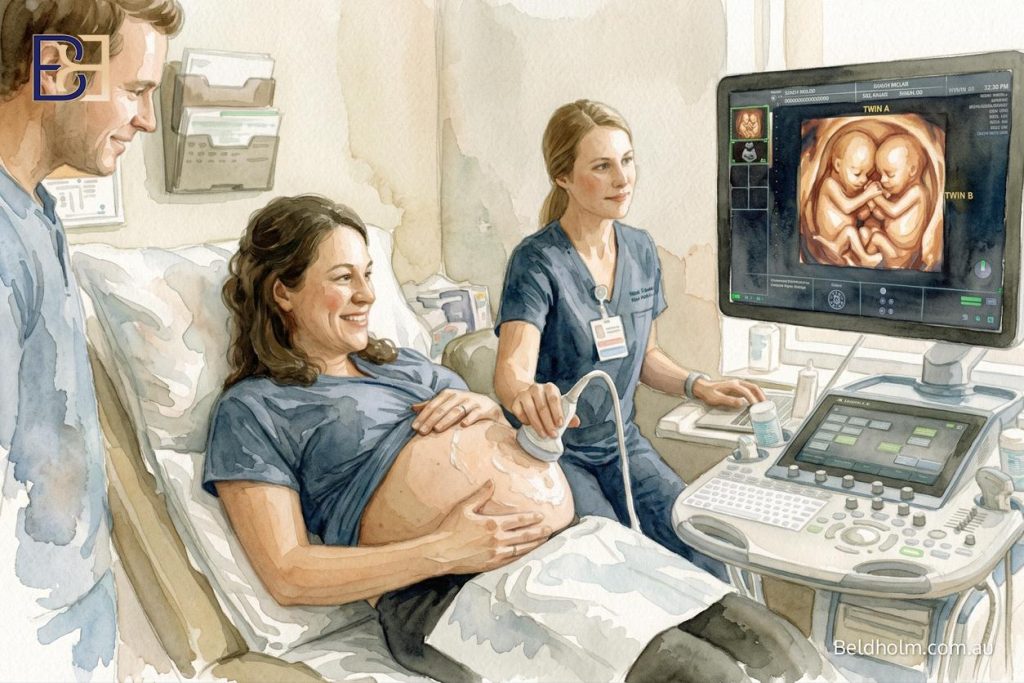
Skin can keep drawing back for roughly 12 to 24 months after birth. By about the 2 year mark, most of the recovery that is going to happen has usually happened. If the skin is still loose at that point, it is unlikely to tighten much further on its own. That is often when women come to see me.
Your age
Skin elasticity depends on elastic fibres and collagen in the dermis, and collagen production declines with age. Younger, more elastic skin tends to draw back more readily and keep more of its firmness. A woman in her 20s and a woman in her 40s can go through the same pregnancy and end up with different amounts of loose skin.
Genetics and skin quality

A large part of skin quality is inherited. Some women have skin with strong elastic recoil and some do not, and this is set mostly by genetics rather than by anything done or not done during pregnancy.
How much the skin was stretched
The more the skin was stretched, and the faster it happened, the less likely it is to draw back fully. A large baby, a twin or higher-order pregnancy, significant pregnancy weight gain, or rapid weight gain all stretch the skin more. Repeated pregnancies add to this over time.
Stretch marks
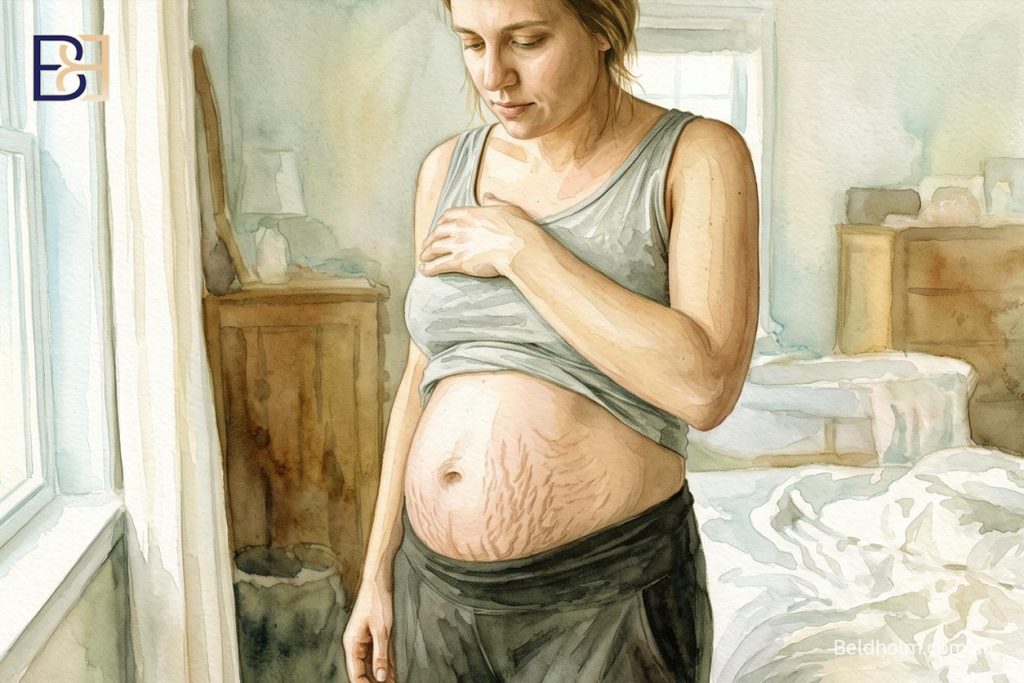
Stretch marks are a sign the dermis was stretched past the point where its elastic fibres fully recover. Skin with a lot of stretch marks below the belly button often stays looser. This is very common and it is not a health problem, but it does tend to predict how the skin will behave.
Smoking

Smoking reduces blood supply to the skin and affects collagen, which tends to leave skin with poorer elastic quality. It also matters a great deal for wound healing if surgery is ever considered.
Can you prevent it?
There is no reliable way to prevent loose skin after pregnancy. Staying at a healthy weight and avoiding rapid weight gain during pregnancy may reduce how far the skin is stretched, but genetics, age and the size of the pregnancy matter more, and none of them are things you can fully control.
These factors together help explain why exercise and skin creams can only do so much once skin is truly loose, which I come to next.
What non surgical measures can and cannot do
Most women who see me about loose skin 2 years on have already tried to improve it on their own. These measures are worth doing for general health, and they can make a real difference to milder changes. Their limits matter just as much, because established loose skin and a wide muscle separation (diastasis recti) behave differently from mild ones.
Exercise and core work
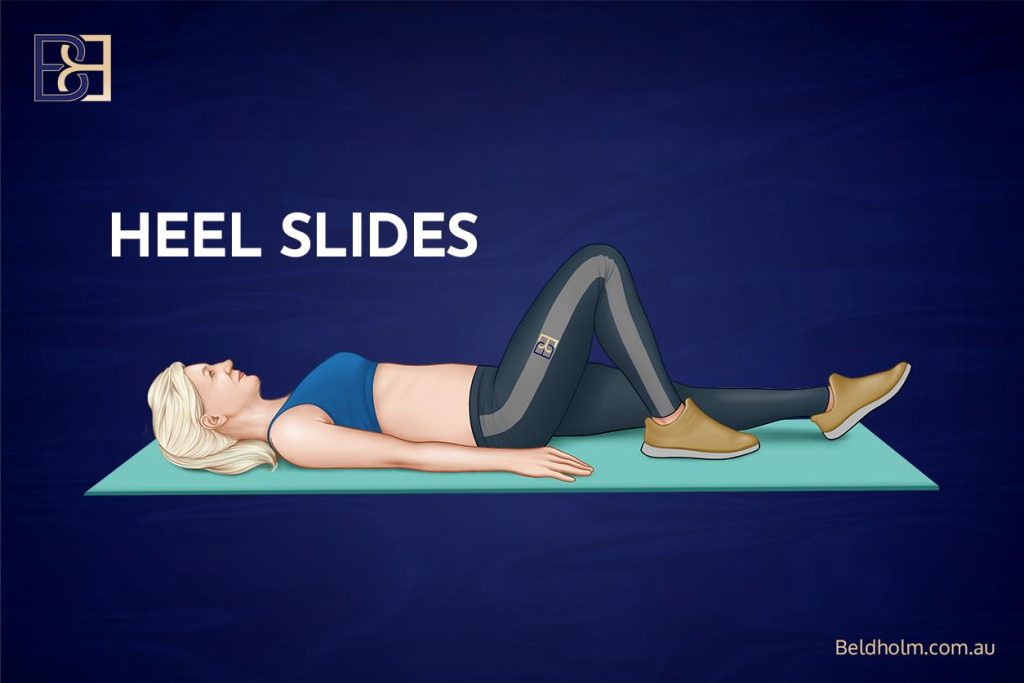
Abdominal and core exercise strengthens the muscles and improves their tone and function. In the early months after birth, targeted core work can help a mild diastasis recti narrow. What exercise cannot do is bring together a linea alba that has stayed significantly stretched, or remove skin that has lost its elastic recovery. By 2 years, if a wide separation or loose skin is still present, exercise builds strength underneath but does not close the gap or tighten the skin over it. I have a separate guide to abdominal exercise after pregnancy that you can work through either way.
Weight and diet
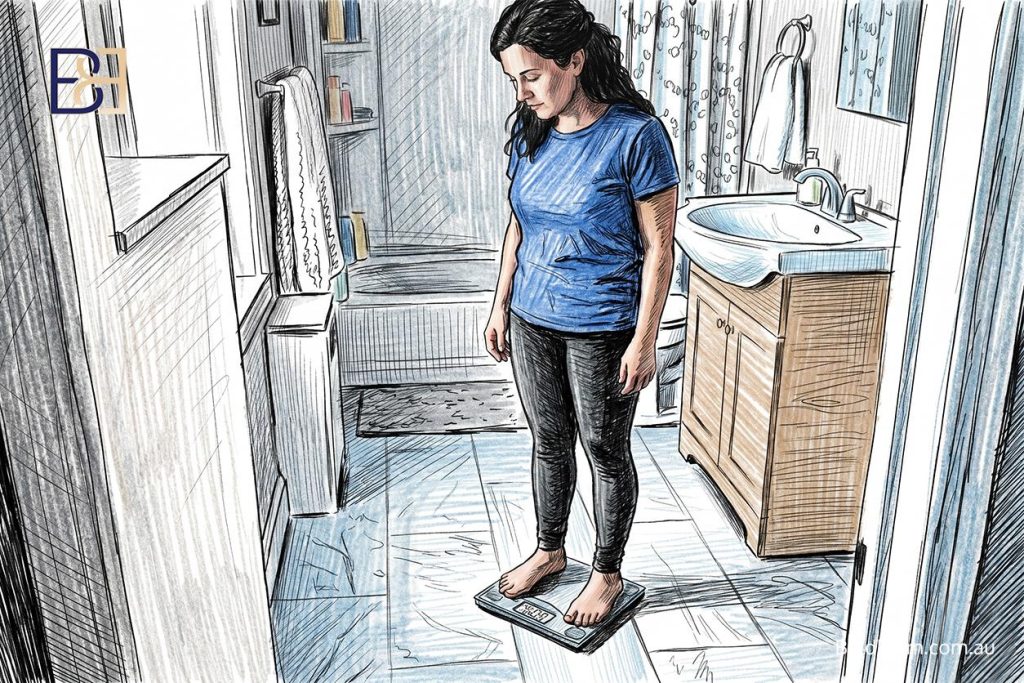
A healthy diet and holding a stable, healthy weight matter for your skin health and general recovery, and reducing excess weight can improve the shape of the lower abdomen. Losing weight does not tighten loose skin, though. In some cases it makes skin look looser, because there is less volume filling it out. Diet and weight management help the fat component, not the skin or the muscle separation (diastasis recti).
Creams, oils and topical products
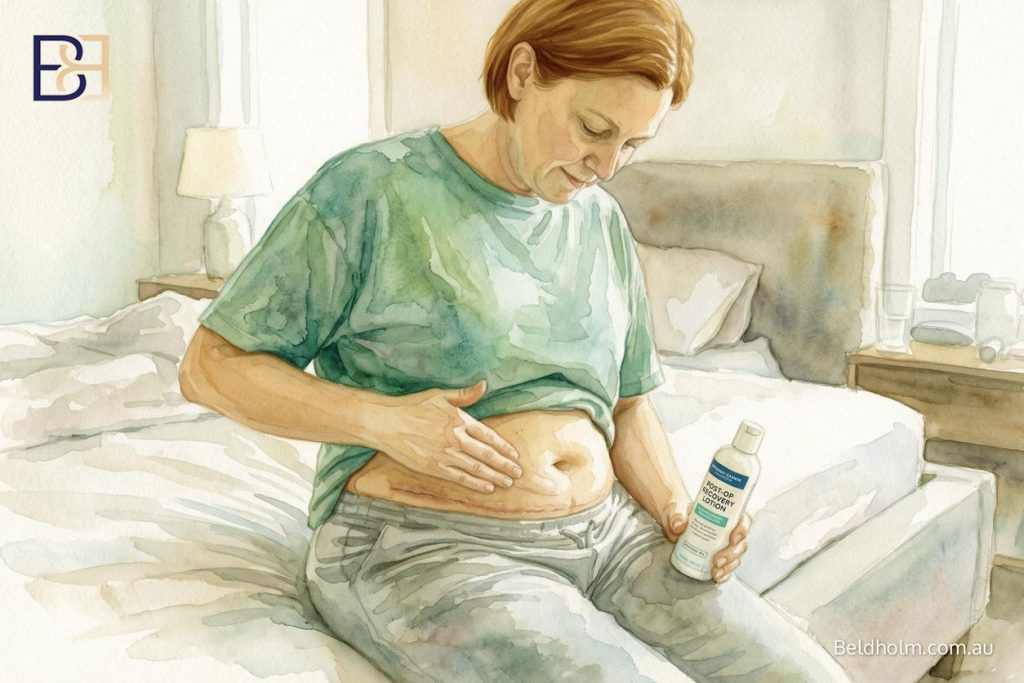
Moisturisers, oils and stretch mark creams can keep the skin comfortable and hydrated, and may improve skin texture and skin appearance a little over time, including softening the appearance of stretch marks. Keeping skin hydrated is good skincare. The evidence that treating stretch marks or improving skin texture with any cream tightens loose abdominal skin or repairs a muscle separation (diastasis recti) is very limited. I would not rely on topical products for either of those.
Non surgical skin tightening treatments
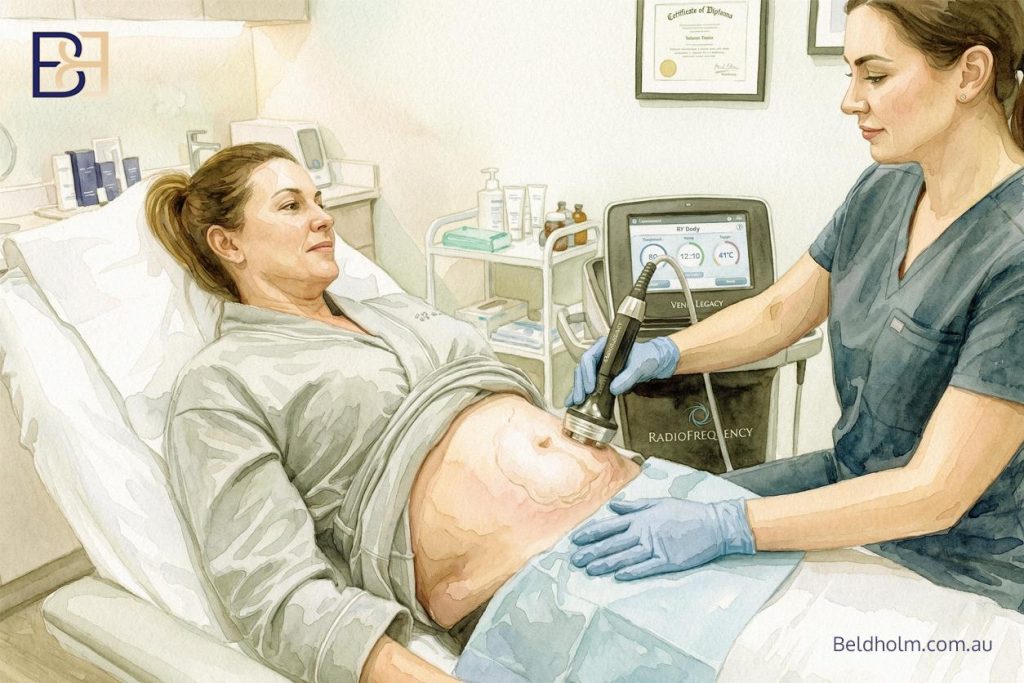
Energy-based skin tightening treatments, such as radiofrequency (RF) skin tightening and laser skin resurfacing, are sometimes offered for skin laxity. For mild laxity these non surgical treatments may firm the surface a little or make the skin feel a little smoother. Laser skin resurfacing is aimed more at skin texture and tone than at loose skin. For the degree of loose skin and muscle separation (diastasis recti) that many women have 2 years after pregnancy, none of these are a substitute for surgery, and it is reasonable to be cautious about how much they can achieve. I would rather be straight about that than have you spend on something unlikely to give you the change you are after.
Time
Time is itself a non surgical measure, and by the 2 year mark it has largely done its work. Waiting longer is unlikely to change loose skin that has already settled.
None of this means these measures are pointless. They support your health, they help milder cases, and staying at a stable weight matters before any operation. What they cannot do is remove true excess skin or bring a widely separated linea alba back together. When those are the issue, surgery is the only reliable way to change them, which is what the rest of this article covers.
When surgery becomes an option
Not everyone with loose skin needs surgery, and it is not right for everyone. When a woman comes to see me, I am assessing whether an operation is appropriate for her, not assuming that it is. Here is what I look at.
What I look for
- Your family is complete. Abdominoplasty tightens the abdominal skin and repairs the muscle separation (diastasis recti). A later pregnancy stretches both again and can undo the repair, so I plan this surgery once you are not planning further pregnancies.
- Breastfeeding has finished and your body has settled. I plan surgery once breastfeeding is over and the abdominal wall has settled after your most recent pregnancy. There is no single number of months that fits everyone. The timing is assessed for you individually.
- Your weight is stable. A stable, healthy weight before surgery gives the most predictable result, and large weight changes afterwards can affect it. I do not use BMI as a hard cut-off, but it is part of the picture.
- You are generally well enough for surgery. Abdominoplasty is major surgery. Your medical history, medications and general health all factor into whether it is appropriate and how it is planned.
A GP referral and consultation
A GP referral is required before your consultation. Your GP knows your history and stays involved in your care afterwards. At the consultation I examine your abdomen, assess the skin and the degree of muscle separation (diastasis recti), talk through what is realistic, and go over the risks. I ask every patient to come back for a second consultation before deciding on surgery, so there is time to weigh everything up without pressure.
Preparing for surgery

Many women come to surgery after pregnancy and breastfeeding with nutritional gaps, commonly in iron, folate, vitamin B12, vitamin D and calcium, since pregnancy and lactation draw heavily on these. Before surgery I arrange a set of blood tests and correct any gaps that show up, because good nutritional status supports healing.
Results vary
Results vary from patient to patient, and it is important to keep that in view throughout. Skin quality, the degree of muscle separation (diastasis recti), body shape, healing and how closely aftercare is followed all differ, so no two results are the same and none can be guaranteed. What I can do is assess you properly and be straight about what surgery can and cannot do for you.
The surgical options I use for post pregnancy patients
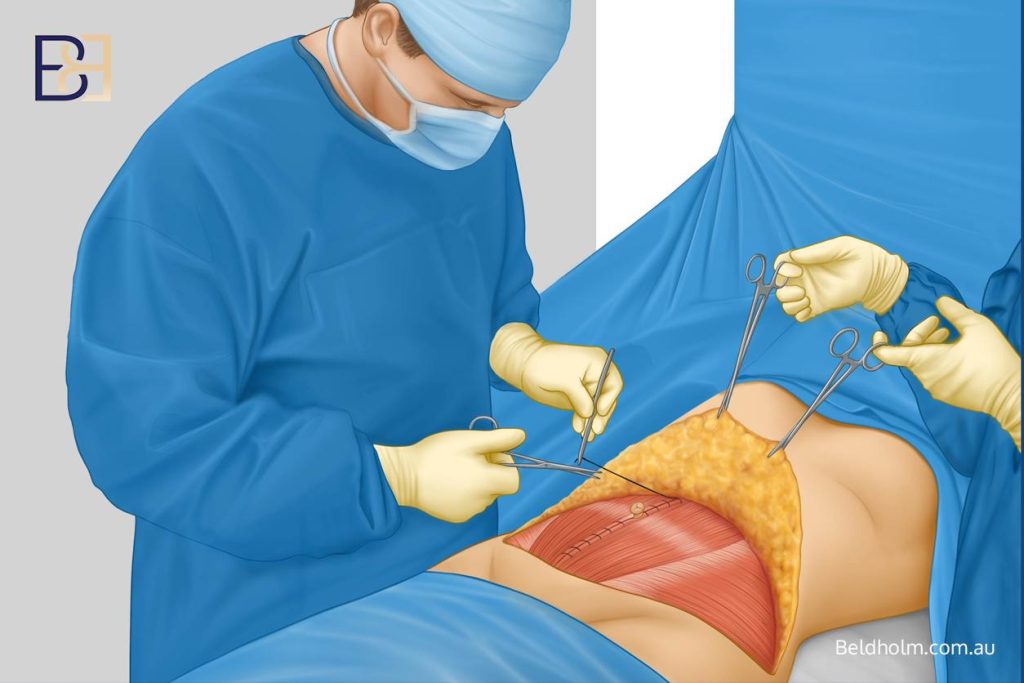
The right operation depends on how much loose skin there is, from moderate skin laxity to significant skin laxity, where it sits, whether there is a muscle separation (diastasis recti), and whether there is localised fat. Abdominoplasty (tummy tuck) is body contouring surgery that removes excess skin from the lower abdomen and repairs the muscle wall beneath it. It is skin removal surgery combined with a muscle repair, and it comes in a few forms. Which one suits you depends on how much loose skin you have and where it sits.
Limited abdominoplasty
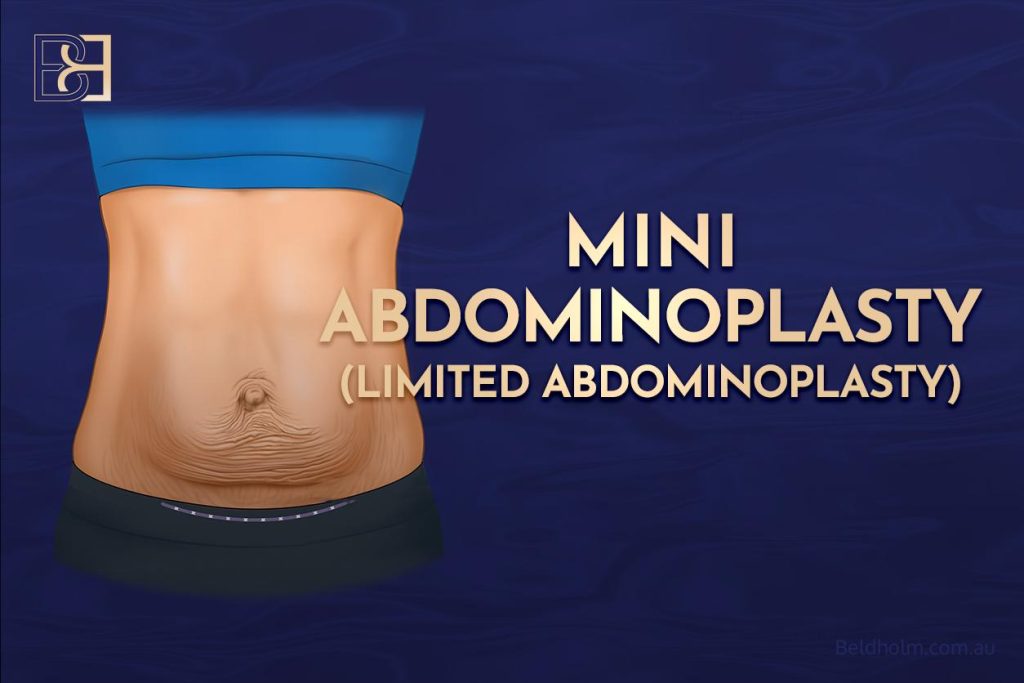
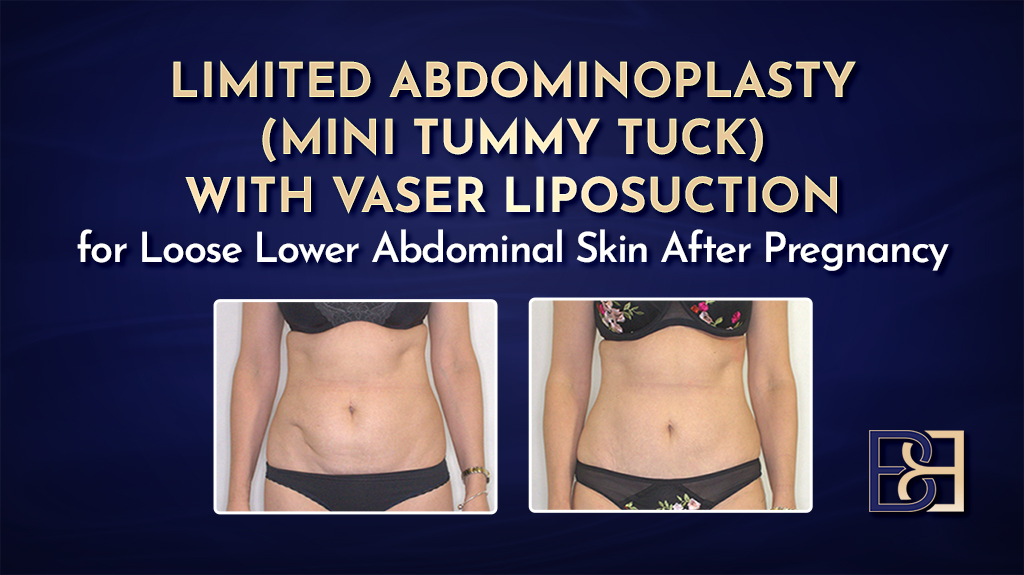
A limited abdominoplasty (mini tummy tuck) suits a smaller group of women whose loose skin and any muscle separation (diastasis recti) sit only below the belly button. It uses a shorter incision low on the abdomen, removes the loose skin below the belly button, and does not usually move the belly button itself. If there is loose skin above the belly button, or the separation extends above it, a limited abdominoplasty will not reach it, and a full abdominoplasty is the better fit.
Full abdominoplasty
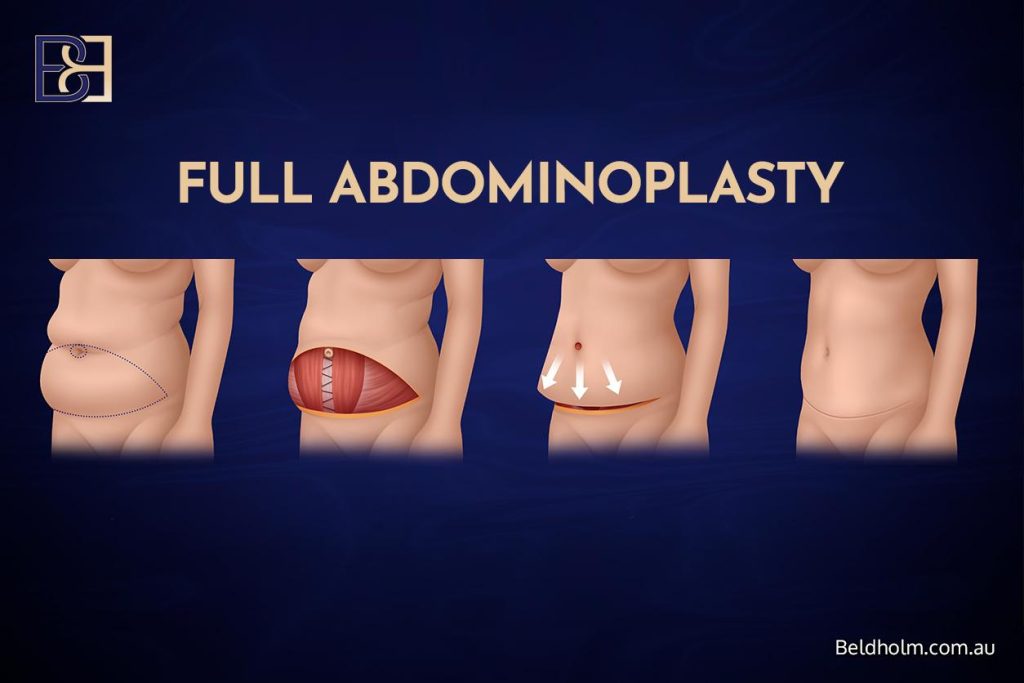
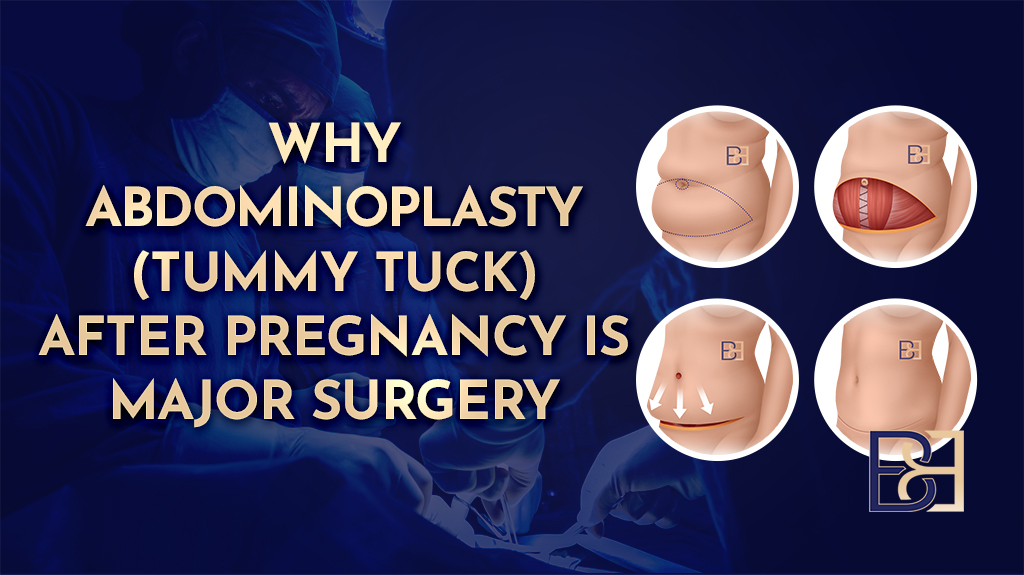
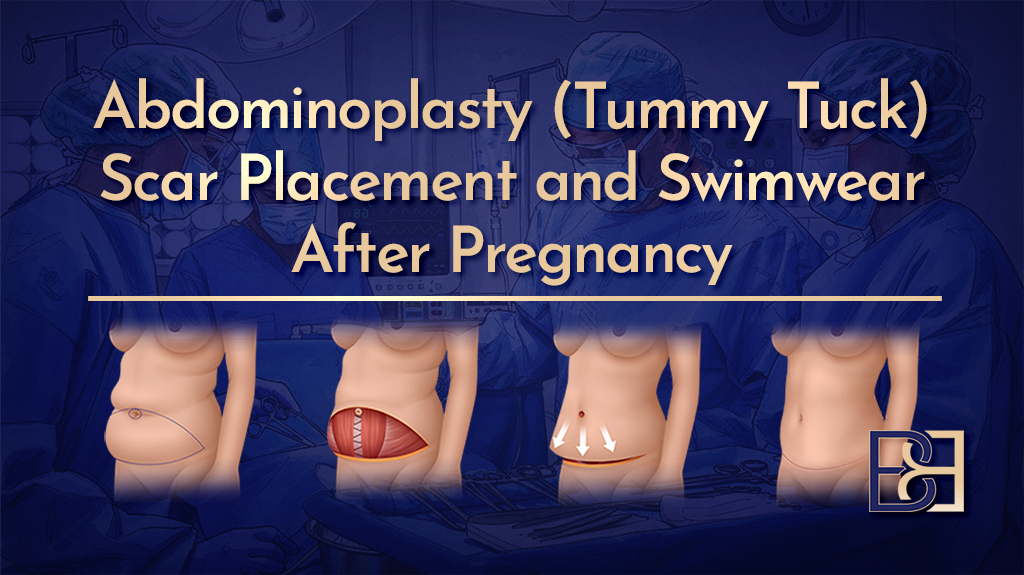
A full abdominoplasty fits most women with significant excess skin and muscle changes both above and below the belly button. The incision runs low across the lower abdomen, from hip to hip, kept where a swimwear or underwear line would sit. I lift the skin, repair the full length of the muscle separation (diastasis recti) up the midline, remove the excess skin, and bring the belly button out through a new opening. Where there is a caesarean scar, it is removed as part of this.
Extended abdominoplasty
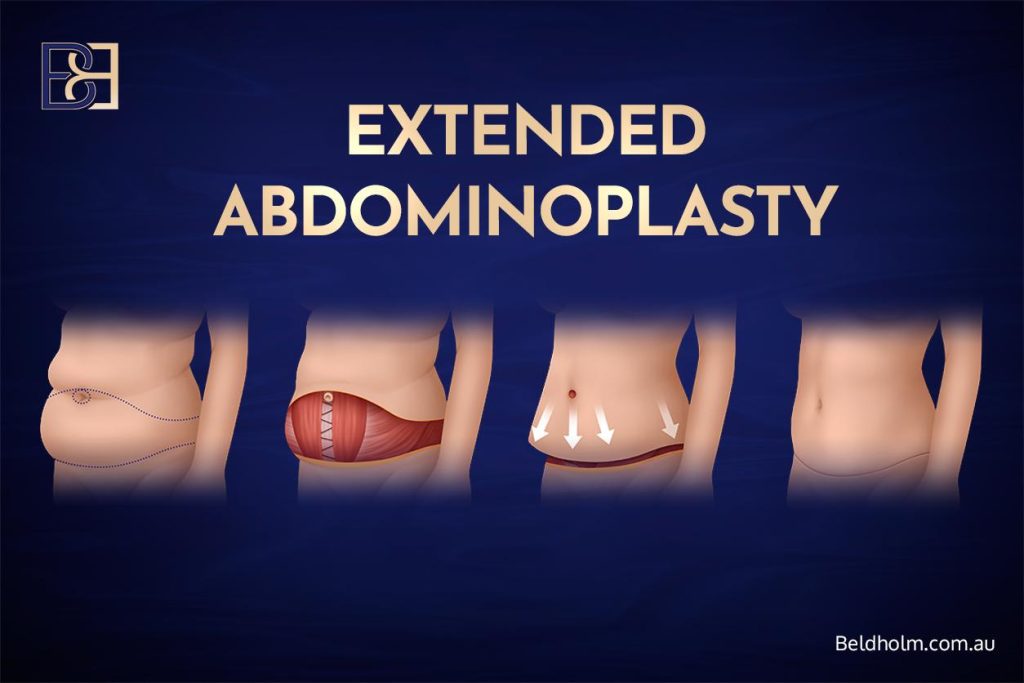
When loose skin carries on around to the hip or flank, the incision is continued a little past the hip bones to remove it. Post pregnancy patients usually have better skin quality and a smaller amount of loose skin than women after major weight loss, but often more muscle separation (diastasis recti). Because the amount of skin and fat removed is smaller, this can often be done without drains. In practice many post pregnancy women have a small extended component to their surgery, and I often just call the whole operation a full abdominoplasty.
Repairing the muscle separation (diastasis recti)
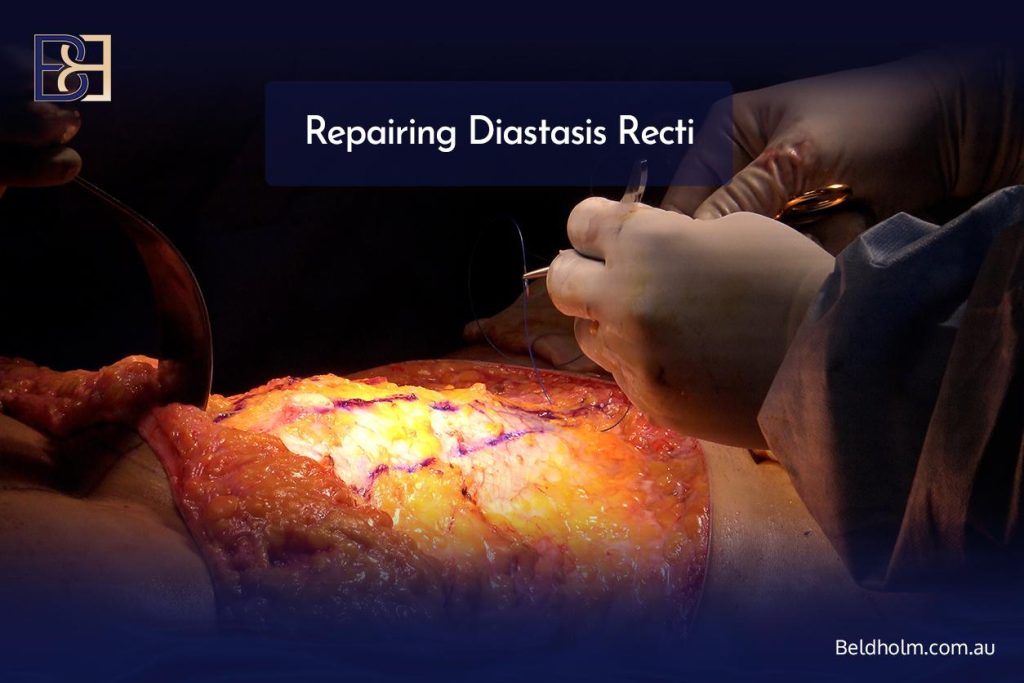
The muscle repair is done as part of a full or extended abdominoplasty, not as a separate operation. I bring the stretched linea alba back to the midline with internal sutures, which narrows the gap and firms the abdominal wall. The muscles themselves are not cut. Alongside the change in shape, research indicates that repairing a significant separation can treat core function and, in some women, symptoms such as lower back pain or stress urinary leakage (1). Whether that applies to you is assessed individually.
Ultrasound-assisted suction lipectomy (VASER liposuction)
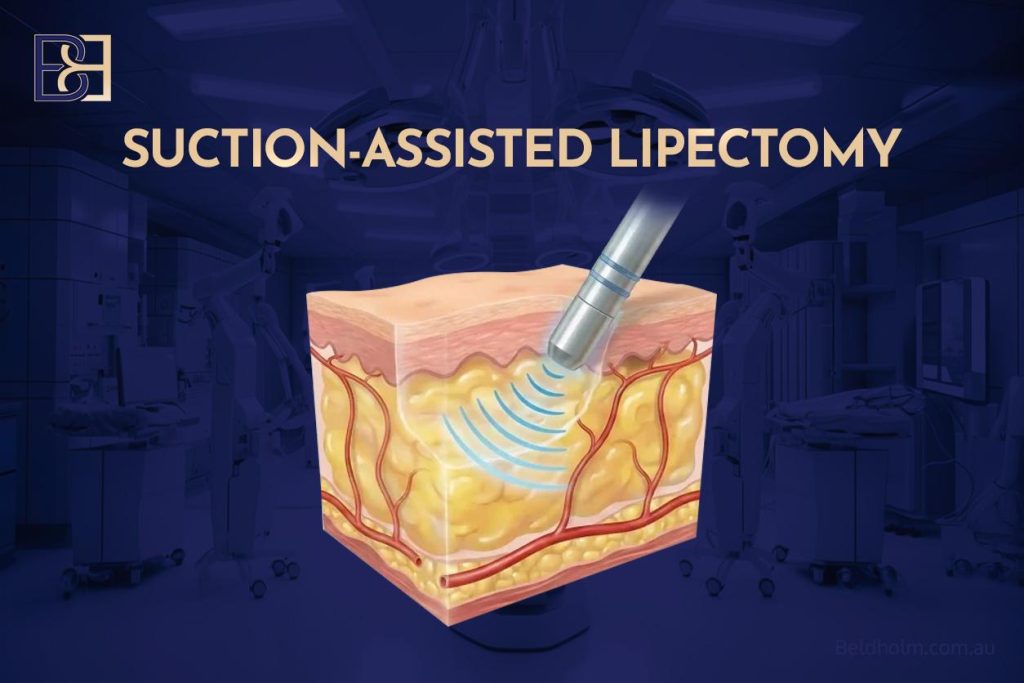
Where there is localised fat over the abdomen or flanks, I can use ultrasound-assisted suction lipectomy (VASER liposuction) at the same operation to treat it, alongside the skin and muscle work. It is not a treatment for loose skin on its own, and it does not replace removing the skin. Used together with the abdominoplasty, it lets me deal with the fat, the loose skin and the muscle separation (diastasis recti) in one procedure.
Which of these, or which combination, suits you is worked out at your consultation after I examine your abdomen.
Timing surgery after pregnancy and breastfeeding
There is no fixed date on the calendar for this. The right time to operate is individual, and I work it out with each woman at consultation. A few principles guide it.
Wait until breastfeeding has finished

I plan surgery once breastfeeding is over. Breastfeeding mainly affects the breasts rather than the abdominal wall, but the body is still adjusting while it continues, so it is better to let things settle first. There is no set number of months that applies to everyone. What matters is that breastfeeding has finished and your body has had time to stabilise afterwards.
Let your weight and body settle
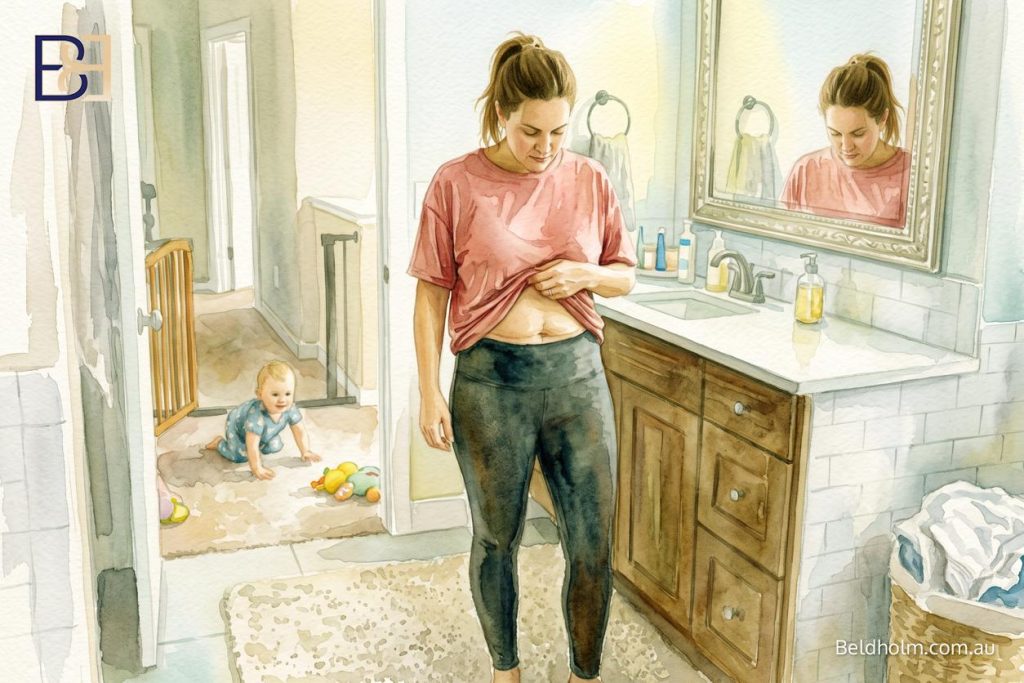
Hormones, weight and body shape shift for a while after pregnancy and breastfeeding. Operating on an abdomen that is still changing makes the result less predictable. I would rather wait until your weight has been stable for a reasonable stretch, so that what I do at surgery is what you keep.
Complete your family first
This is the important one for abdominoplasty. The operation tightens the abdominal skin and repairs the muscle separation (diastasis recti). A pregnancy afterwards can stretch the skin again and separate the repaired muscles, which can undo a good part of the work. For that reason I plan this surgery once you are not planning further pregnancies. It is not that you cannot have a baby after abdominoplasty. It is that another pregnancy can change a result you have recovered from and want to keep.
None of this is a rigid rule with a number attached. It is about operating at a point where your body has settled and the result is more likely to last.
Caesarean scars and where the incision goes
Most women I see for post pregnancy abdominoplasty have had at least 1 caesarean (C-section), so the question of what happens to that scar comes up often.
The caesarean scar is removed, not worked around
The old caesarean scar sits low on the abdomen, in much the same zone as the skin an abdominoplasty removes. Rather than working around it, I take it away. The caesarean scar comes off with the excess lower abdominal skin, and the new abdominoplasty scar takes its place. You are not left with both scars.
Where the new scar sits
The abdominoplasty incision runs low across the lower abdomen, from hip to hip, placed so it sits below the line of underwear or swimwear. In a full abdominoplasty there is also a small scar around the belly button, where it is brought out through the repositioned skin. Scars are permanent, and I go through their placement and how they settle with every patient at consultation.
Abdominoplasty and caesarean are never done together
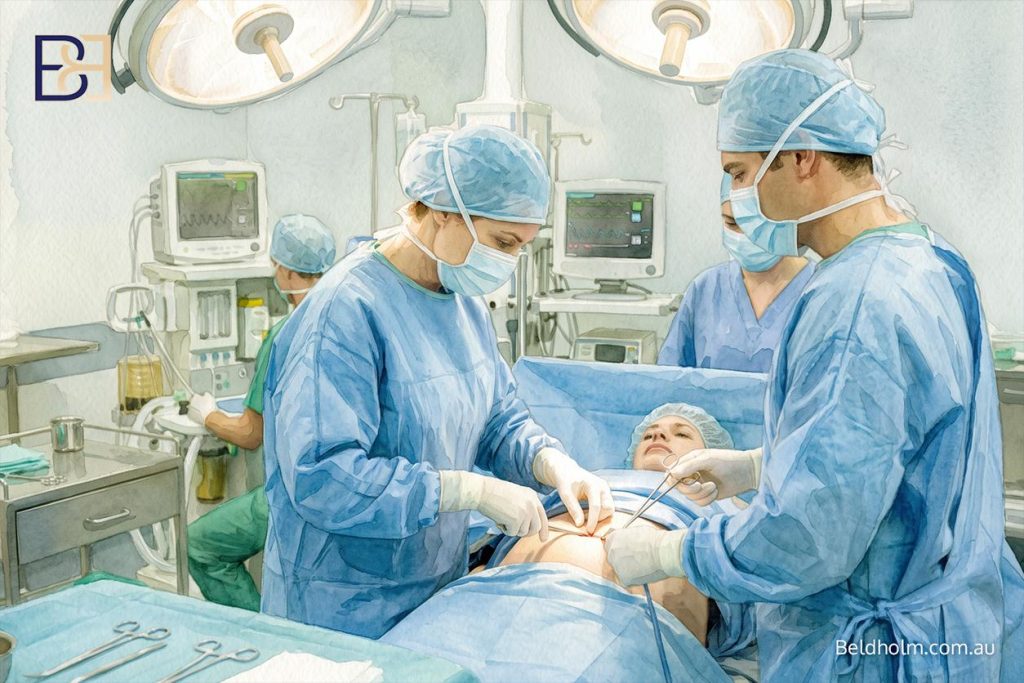
Some women ask whether an abdominoplasty could be done at the same time as a caesarean, to save going through recovery twice. I do not combine the two, and I would advise against any plan that does. They are separate operations, done at separate times. Performing an abdominoplasty during or straight after a caesarean, when the abdomen is swollen, the tissues are still changed by pregnancy, and the body is caring for a newborn, raises the risk of complications and gives an unpredictable result. Abdominoplasty is planned for later, once the body has settled and the family is complete.
The exact incision plan is worked out at consultation, based on your caesarean scar, the amount and position of loose skin, and where you would like the final scar to sit.
Book your appointment online now
When the abdomen and breasts are both a consideration
Pregnancy and breastfeeding can change the breasts as well as the abdomen. Some women who see me about loose abdominal skin also have changes in breast volume or position they would like to look at, and ask about breast surgery at the same time. Where that is the case, there are 2 ways to approach it: a single combined operation, or separate operations staged over time.
One operation versus staged surgery
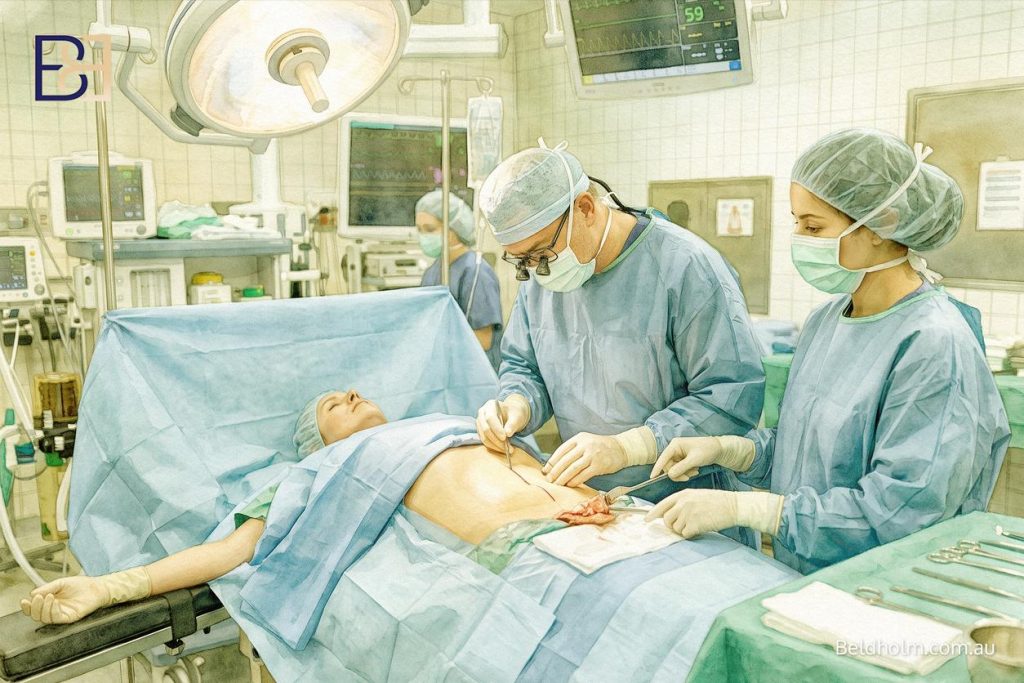
Where a woman is medically suited to it, I prefer to deal with her concerns in a single comprehensive operation rather than dividing the work across several procedures. For a suitable patient, that can mean 1 anaesthetic, 1 hospital admission and 1 recovery to work through, rather than repeating each of those steps. An abdominoplasty and a mastopexy (breast lift), for example, can sometimes be done together.
This is a preference, not a rule, and it does not suit everyone. A larger single operation is a bigger physiological event than a smaller one, and for some women that is more demand than is sensible. In those cases, staging the work across separate operations is the more appropriate path, and it is a legitimate choice, not a lesser one. Which approach fits you depends on your medical history, your nutritional status, and the extent of the skin and muscle changes, and it is decided at consultation after examination.
It is still a bigger operation
A single comprehensive operation is a larger event, and the recovery should not be underestimated, particularly while caring for young children. This is part of why pre-operative preparation matters, and why support at home is worth planning for. I would not combine procedures just to save time if that were not the right thing for you.
Risks and recovery
Abdominoplasty is major surgery, and it deserves to be weighed as such. Here is a frank account of the risks and what recovery actually involves.
The risks
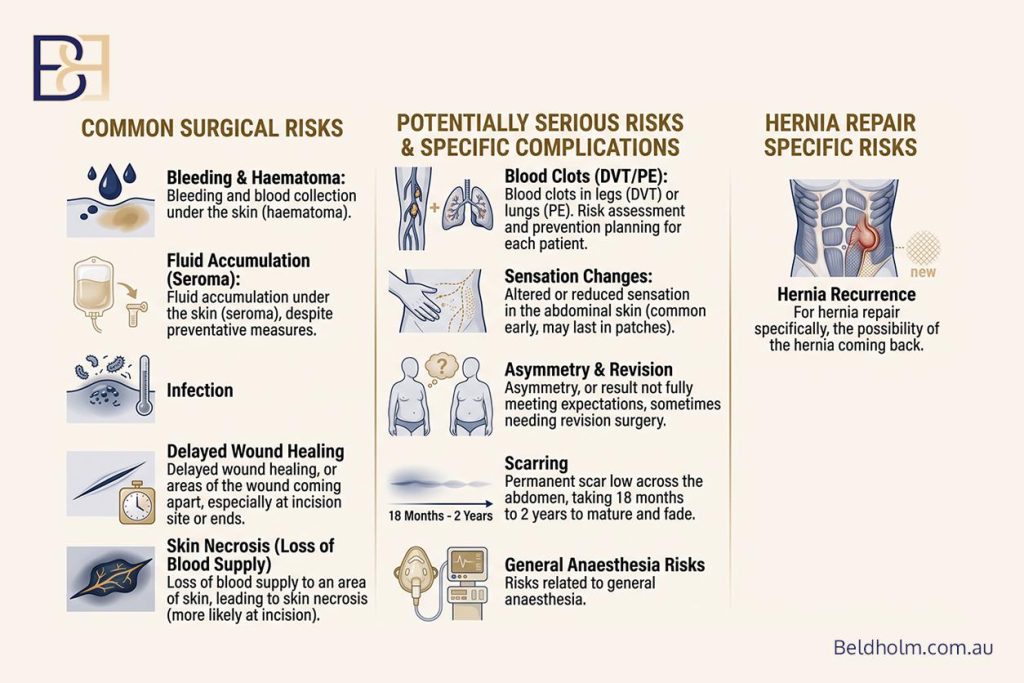
Every operation carries risk, and abdominoplasty is no exception. The ones I go through with every patient include:
- Bleeding and haematoma. A collection of blood under the skin that occasionally needs a return to theatre.
- Infection. Wound infections can happen and may need antibiotics or, less often, further treatment.
- Seroma. A collection of fluid under the skin, which may need draining in the weeks after surgery.
- Wound healing problems. The lower incision is under some tension, and areas can be slow to heal, particularly in women who smoke or have diabetes.
- Blood clots. Clots in the legs (DVT) or lungs (PE) are an uncommon but serious risk of any longer operation. I assess each woman’s clot risk myself and decide on the measures to reduce it, which can include early walking, calf compression and blood-thinning medication where appropriate.
- Altered sensation. Numbness across the lower abdomen is normal after surgery and usually settles over months, though some areas can stay permanently numb.
- Scarring. The scar is permanent. Most settle to a fine line over 12 to 18 months, but scars can widen, thicken or stay red longer in some women.
- Revision. Occasionally a result needs a small revision procedure once everything has settled.
If you already take blood-thinning medication, that is a separate matter from routine clot prevention. We make a plan for it well before surgery. Never stop or change that medication on your own.
What recovery involves
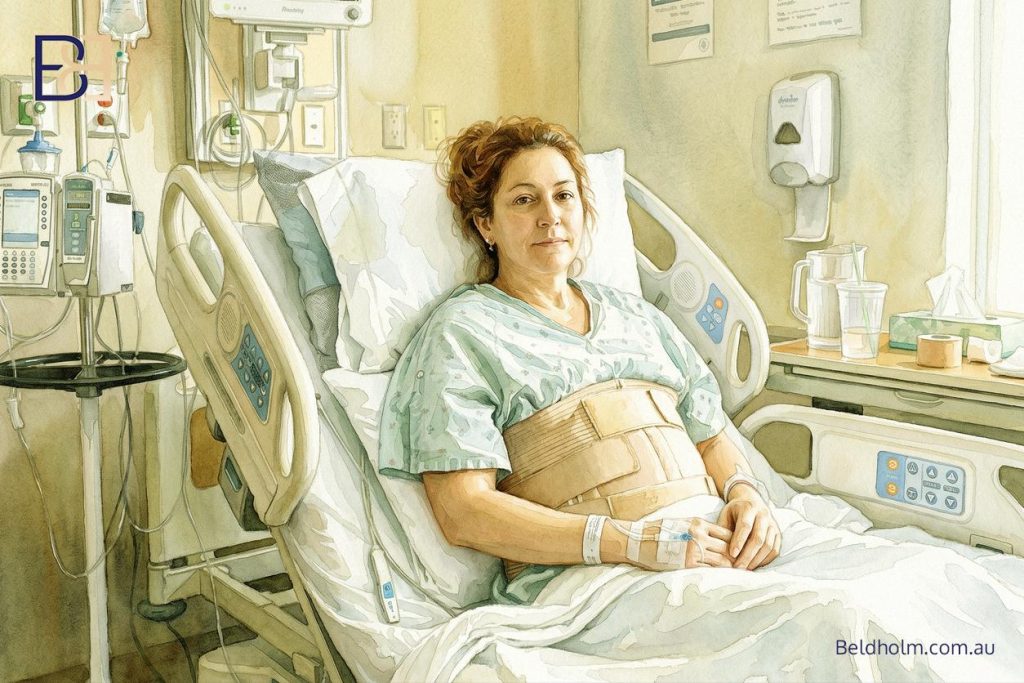
Most women stay in hospital for 1 to 2 nights. You will be up and walking, in a bent-forward posture at first, the day of or the day after surgery, which helps reduce clot risk and gets recovery moving. You go home in a compression garment, worn as I direct in the weeks that follow.
The first 1 to 2 weeks are the demanding part. Moving slowly, sleeping propped up and keeping on top of pain relief are all part of it. Most women take around 2 weeks off desk-based work and longer off physical work. Heavy lifting and core exercise are held off for around 6 weeks, with a graded return to full exercise over the weeks after that.
Recovering while caring for young children

This is the part women most often underestimate. For roughly the first 6 weeks you should not be lifting toddlers or heavy loads, which is a real difficulty when you have small children at home. I will be blunt about it: you will need help. Arranging support with lifting, childcare and the household for the early weeks is not optional, it is part of planning the surgery properly. I would rather you delayed surgery until that help can be arranged than push through without it.
Does Medicare cover any of this?

Some post pregnancy abdominoplasties attract a Medicare rebate, and many do not. It depends on whether the surgery meets specific medical criteria set by Medicare, not on how much loose skin there is or how much it bothers you.
MBS item 30175
Medicare item 30175 covers repair of the muscle separation (diastasis recti) in specific circumstances following pregnancy. The criteria are set by Medicare and are strict. In general terms they look at whether there is a documented muscle separation (diastasis recti), whether your symptoms and examination fit, whether your family is complete, and whether conservative measures such as physiotherapy have been tried first. The exact wording of the item, and what is needed to claim it, is published on MBS Online, and it is what I assess your case against.
If your surgery is purely for loose skin and does not meet these criteria, it is considered cosmetic, and Medicare does not contribute.
What this means for cost and GST
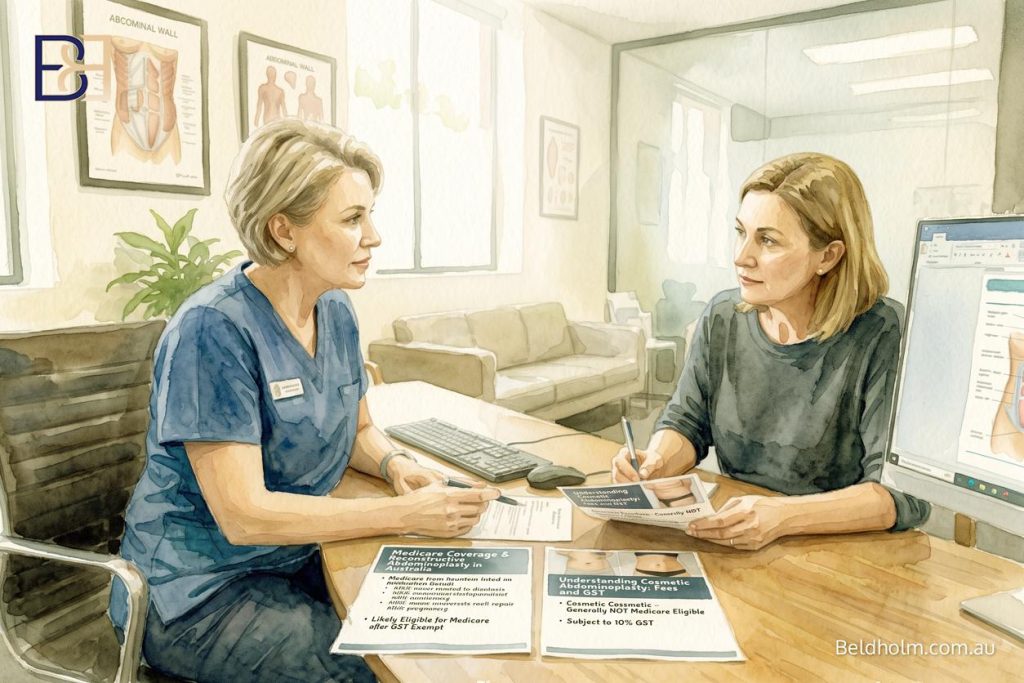
Where item 30175 applies, the procedure is treated as reconstructive, a Medicare rebate applies to the relevant part, and private health insurance may contribute to the hospital side if your policy covers it. A reconstructive procedure of this kind is GST-free. Where surgery is cosmetic and no Medicare benefit applies, 10% GST is added, as it is for any cosmetic procedure.
I do not quote fees in an article like this, because they depend on your individual surgery and change over time. My patient coordinators obtain the hospital and anaesthetist quotes, and you are given written financial consent setting out the costs before you commit to anything. I cover the Medicare side in more detail separately.
Common questions
Can loose skin 2 years after pregnancy still tighten on its own?
By about the 2 year mark, most of the natural retraction that is going to happen has already happened. If the skin is still loose then, it is unlikely to tighten much further on its own, and surgery is the reliable way to remove it.
Can exercise remove loose skin or close a muscle separation (diastasis recti)?
Exercise strengthens the muscles and is worth doing, and early on it can help a mild separation narrow. It cannot remove skin that has lost its elastic recovery, and it cannot bring together a linea alba that has stayed significantly stretched. For established loose skin and a wide separation, exercise builds strength underneath but does not change the skin or close the gap.
How long after having a baby can I have an abdominoplasty?
Once breastfeeding has finished, your weight has settled and your family is complete. There is no single number of months that fits everyone. I work out the timing with you at consultation. A general guildelines is around 12 months.
Will my caesarean scar be removed?
In a full abdominoplasty the old caesarean scar is taken away along with the excess lower abdominal skin, and the new incision sits low in its place. You are not left with both scars.
Is loose skin after pregnancy covered by Medicare?
Only if your surgery meets the criteria for Medicare item 30175, which relate to a documented muscle separation (diastasis recti) and other requirements. Surgery for loose skin alone is considered cosmetic and is not covered. I assess your case against the current criteria on MBS Online.
Can I have an abdominoplasty and a mastopexy (breast lift) at the same time?
Sometimes, if you are medically suited to it. A single operation can mean 1 anaesthetic and 1 recovery rather than 2. For some women, staging the operations separately is the more appropriate path. Which suits you is decided at consultation.
Is abdominoplasty major surgery?
Yes. It involves a general anaesthetic, a hospital stay, a low incision from hip to hip, and a recovery measured in weeks.
References
- Taylor DA, Merten SL, Sandercoe GD, Gahankari D, Ingram SB, Moncrieff NJ, et al. Abdominoplasty improves low back pain and urinary incontinence. Plast Reconstr Surg. 2018;141(3):637-645.