The mons pubis is the soft pad of tissue that sits over the pubic bone, below the lower abdomen and above the genital area. Its job is to cushion the pubic bone. It is a normal part of the anatomy, and it varies a great deal between women.
Pregnancy and birth can change how this area looks and feels. Many patients tell me they have noticed loose skin or a fuller feeling in the pubic area after having children. This is a normal change. Skin that stretched during pregnancy does not always settle back to how it was, and a caesarean scar can leave a fold of skin sitting above it.
In my practice, I see this most often in women who have finished having their family. For some the change is minor and needs no treatment at all. For others it is something they want to talk through.
This article explains what the mons pubis is, why it can change after pregnancy, and what the monsplasty (pubic lift) surgical procedure involves. Monsplasty is one of the body contouring operations I perform for women after pregnancy. I also cover how the area is usually managed in post pregnancy patients, what recovery is realistically like, the risks, and how cost and Medicare work.
Why the mons pubis can change after pregnancy
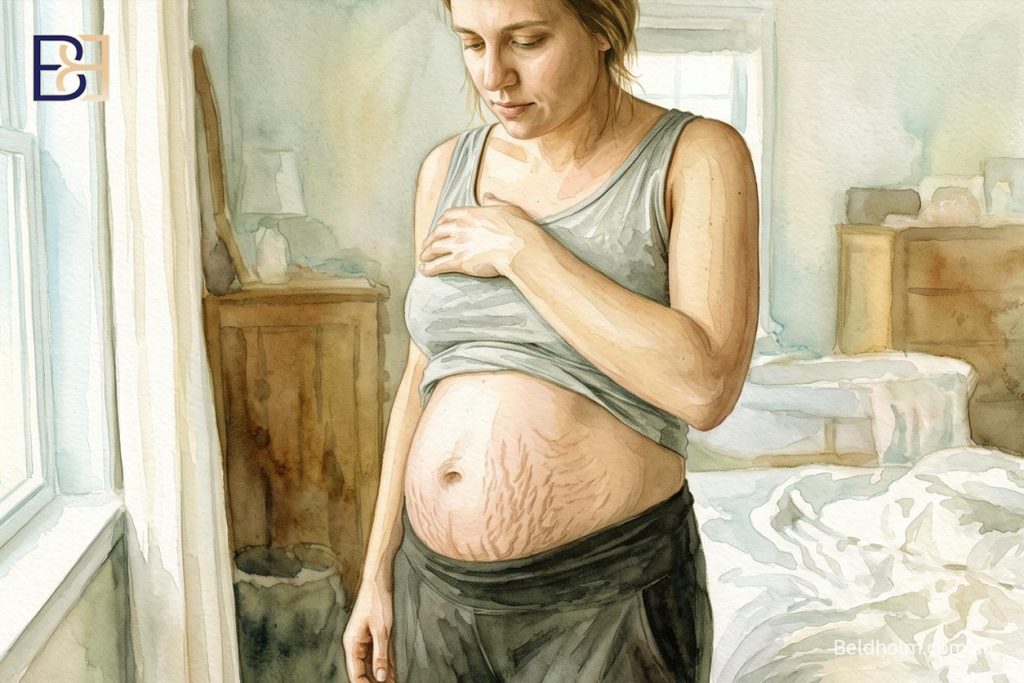
Pregnancy affects this area in a few ways. None of these are abnormal. They are the normal result of carrying a pregnancy and, for many women, having a caesarean.
- Skin stretching. The skin over the lower abdomen and upper pubic area stretches to make room for a growing baby. This stretched skin has collagen and elastic fibres that let it stretch and recoil, but after a full pregnancy it does not always return to its previous tightness. How much it settles back varies between women, and it tends to change with each pregnancy and with age.
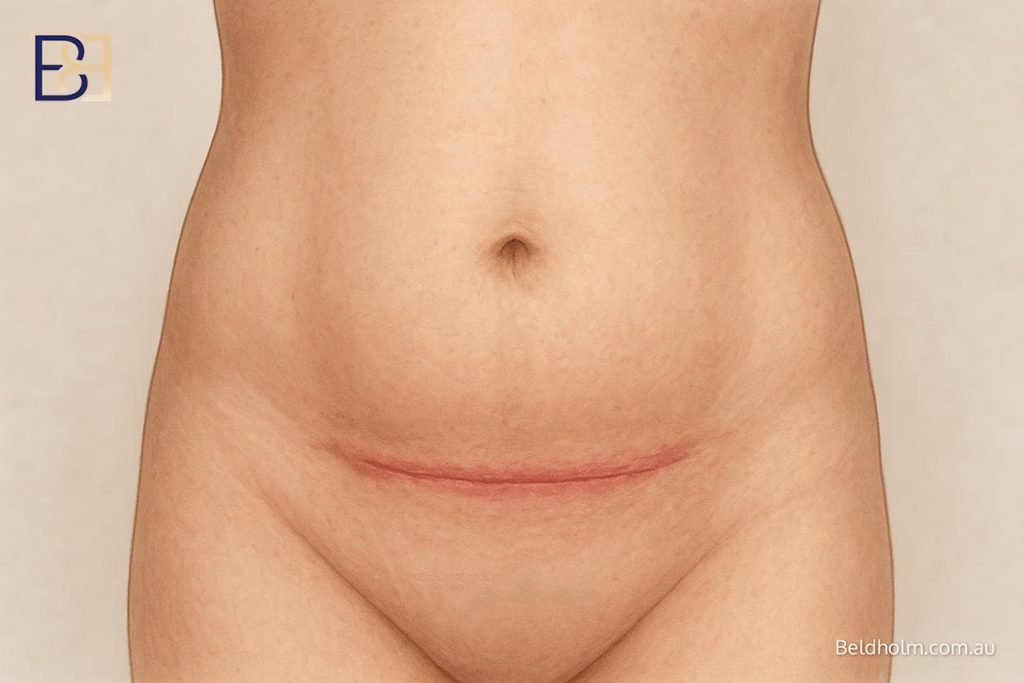
- Caesarean scar. After a caesarean, the skin along the scar heals firmly and stays tight, while the skin below it does not. This can leave a fold of skin sitting above the scar line, over the mons.
- Tissue volume. During pregnancy the body lays down soft tissue across the lower abdomen and pubic area. For some women this settles after birth and breastfeeding. For others, some fullness remains.
- Skin quality. Skin elasticity differs from person to person and reduces with age as the body produces less collagen. 2 women with similar pregnancies can end up with quite different amounts of loose skin.
These changes often sit alongside changes higher up the abdomen, such as loose skin around the navel and separation of the abdominal muscles (rectus diastasis). This is part of why the mons and the surrounding pubic region are usually looked at together with the abdomen rather than on its own.
What is a monsplasty (pubic lift)?
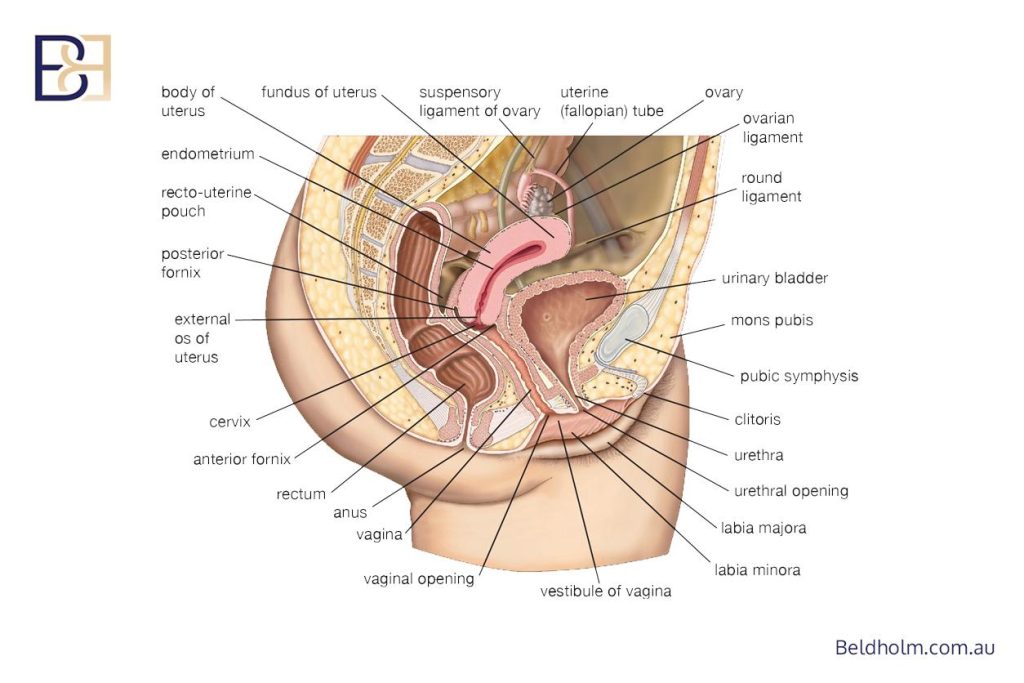
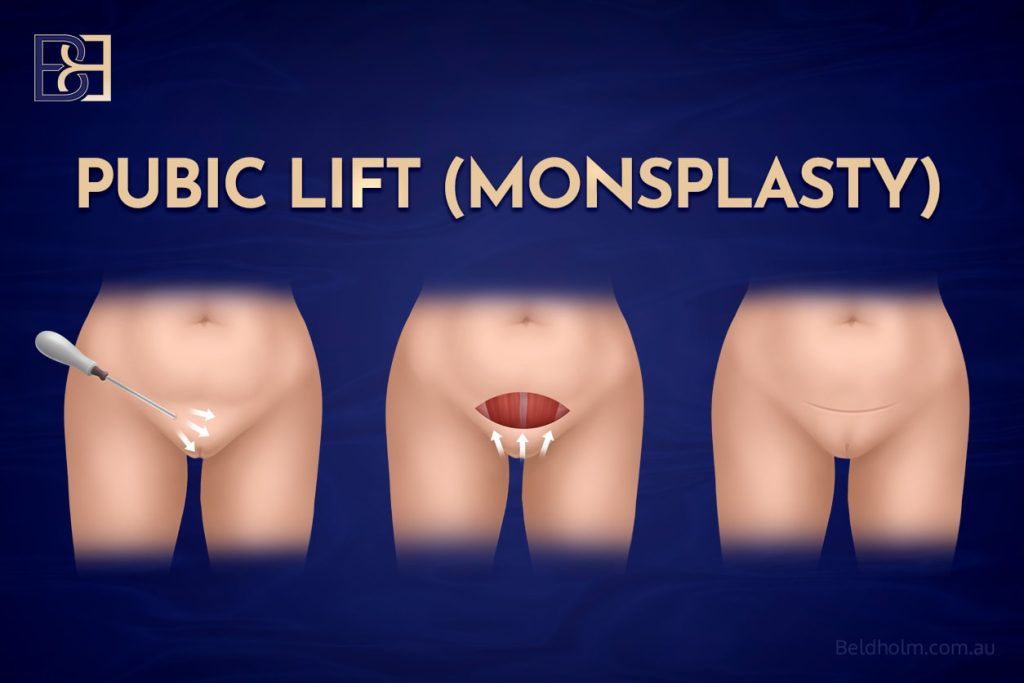
A monsplasty, or pubic lift, is a surgical procedure that lifts and reduces the mons pubis, sometimes called the pubic mound. It does 2 things. It removes excess skin and reduces the excess tissue in the area, and it secures the mons in a higher, flatter position.
The mons does not contain muscle that can be tightened, so the lift is not created by tightening muscle. Instead, the deeper tissue of the mons is anchored to the firm fascia of the lower abdominal wall with sutures. Removing the excess tissue and securing the mons to this deeper layer is what holds the lift in place.
Where there is more fullness than loose skin, I often use ultrasound-assisted suction lipectomy (VASER liposuction) to reduce the volume of the mons before or alongside the lift. This lets me reshape the area with more control and remove less skin. Where loose skin is the main issue, skin removal does most of the work.
The incision sits low, along the same line used for an abdominoplasty. I go through incision placement and scars in more detail below.
How the mons pubis is usually managed after pregnancy
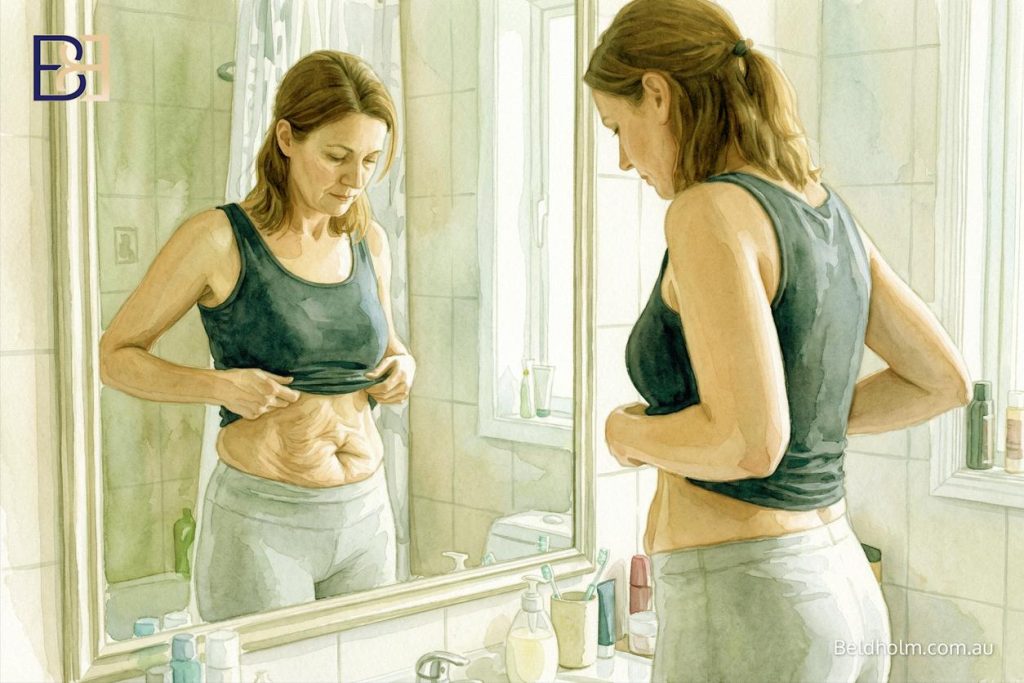
Many patients after pregnancy notice loose skin in the pubic area. This can be treated on its own as a standalone monsplasty, or as part of an abdominoplasty (tummy tuck). In post pregnancy patients the more common approach is to treat it as part of surgery to the abdomen, either a limited abdominoplasty or a full abdominoplasty.
The reason is practical. The loose skin over the mons usually sits on a continuum with loose skin lower on the abdomen, and in many patients with separation of the abdominal muscles (rectus diastasis). When the abdomen is already being operated on, the mons can be lifted and reshaped through the same incision, at the same time. In that setting the mons is not a separate add-on. It is part of managing the lower abdomen as a whole.
A standalone monsplasty is an option for some patients. That might be the case where the abdomen itself does not need surgery and the change is limited to the pubic area. Whether the mons is treated on its own or as part of an abdominoplasty depends on your anatomy, and is decided at your consultation.
Assessment and consultation
Before any surgery in this area you will need a referral from your GP. The initial consultation is where we work out whether an operation is appropriate for you, and if so, which approach suits your anatomy.

At the consultation I assess:
- The amount and quality of loose skin over the mons and lower abdomen
- Whether there is fullness that would be better reduced with ultrasound-assisted suction lipectomy (VASER liposuction), skin removal, or both
- Any caesarean scar and how it sits
- Whether the abdominal muscles are separated (rectus diastasis), which affects whether the mons is best treated on its own or as part of an abdominoplasty
- Your overall health, medical history, current medications, and any previous surgery or reaction to anaesthetic
I also talk through realistic expectations, so you have a clear picture of what surgery can and cannot change.
Timing after pregnancy. I plan this surgery once your family is complete, because a future pregnancy can stretch the skin and tissue again and change the result. I also wait until breastfeeding has finished and things have settled after your most recent pregnancy. When to operate is judged for the individual and is not a set number of months.

A second consultation. I see every patient a second time before booking surgery. This gives you time to think things over, come back with questions, and go through the plan, the recovery and the risks again, without any pressure to decide on the day.
Preparing for surgery
Preparation matters, and it matters more when the mons is treated as part of an abdominoplasty, which is a larger operation than a standalone monsplasty.
Your health and medical history. I review your general health, any medical conditions and your current medications at consultation. This helps me plan the operation and the anaesthetic around you.

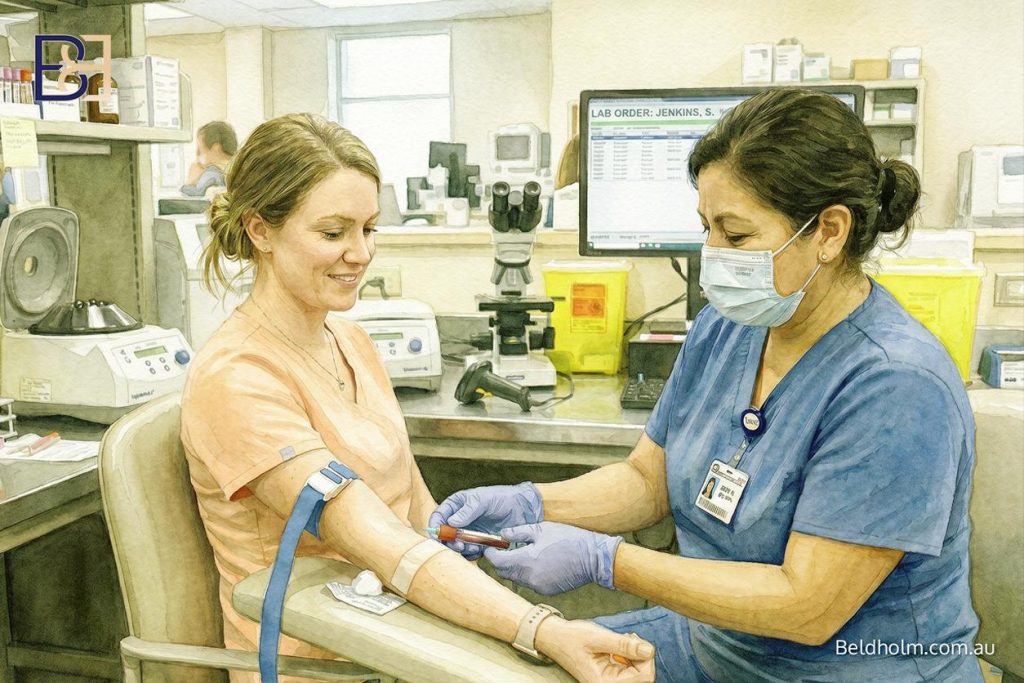
Blood tests. Every patient has a set of pre-operative blood tests before surgery. These check your general health and pick up anything that should be corrected first. After pregnancy and breastfeeding, iron, folate, vitamin B12 and vitamin D are the levels I pay particular attention to, because the demands of pregnancy and lactation can leave these lower than ideal. Correcting a shortfall before surgery supports healing.
Nutrition. Good nutrition supports wound healing.

Smoking. Nicotine narrows blood vessels and reduces the blood supply your healing tissues rely on. I ask patients to stop smoking and vaping for at least 6 weeks before and 6 weeks after surgery, to lower the risk of wound healing problems.

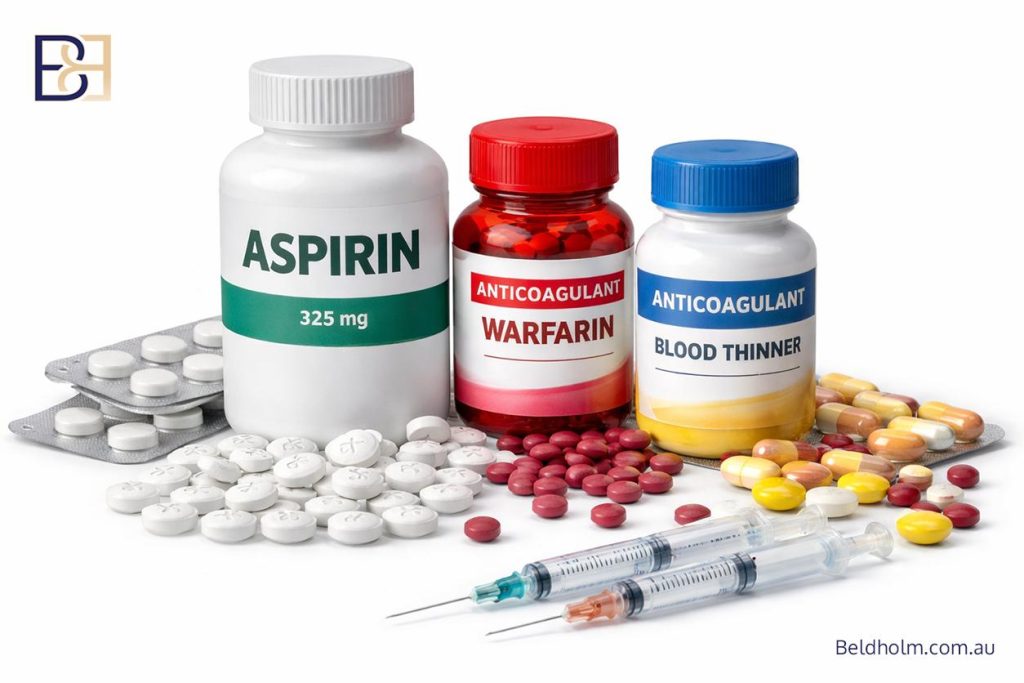
Medications. Some medications, including aspirin and blood-thinning medication (anticoagulants), may need to be adjusted before surgery. I decide this with you and plan it well ahead. Do not stop any prescribed medication on your own. Some patients stay on their medication through surgery, and that decision is made in advance.
Support at home. You will need some help at home in the first 1 to 2 weeks, particularly if you are caring for young children. It is worth arranging this before your surgery date.

What the operation involves
A monsplasty is done under general anaesthetic. What follows is the general approach. The detail is tailored to your anatomy and to whether the mons is treated on its own or with an abdominoplasty.
The incision. The incision is a low horizontal incision across the pubic area, along the same line used for an abdominoplasty, so the scar can be covered by underwear and swimwear. If you have an old caesarean scar (c-section scar) in this line, I remove it and close with a single new scar along the same low line, rather than leaving 2.
Reducing volume. Where there is fullness to reduce, I use ultrasound-assisted suction lipectomy (VASER liposuction) to take down the volume of the mons. This is used in the majority of cases and lets me reshape the area with control.
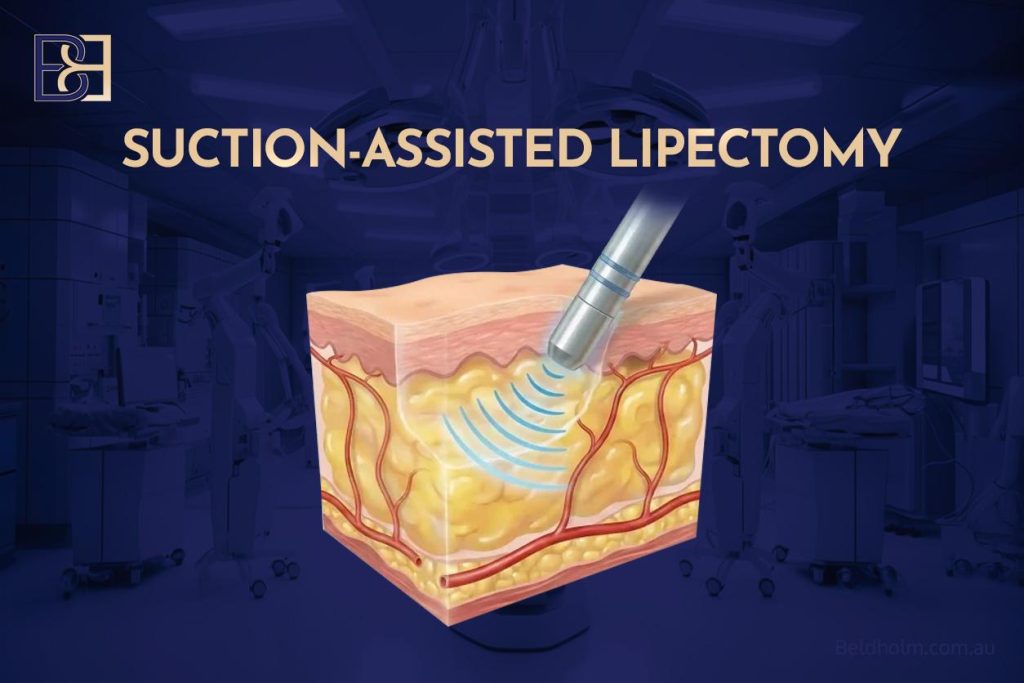
Removing excess skin. I remove the excess skin from the mons and lower abdomen (skin excision). How much is removed depends on how much loose skin there is.
Lifting and anchoring. I lift the mons and anchor the deeper tissue to the firm fascia of the lower abdominal wall with sutures. This is what holds the mons in a higher position. The sutures are absorbable and do not need to be removed.
Drains and garment. Most patients do not need a drain. I fit a compression garment at the end of the operation, which helps reduce swelling and gives support during healing.
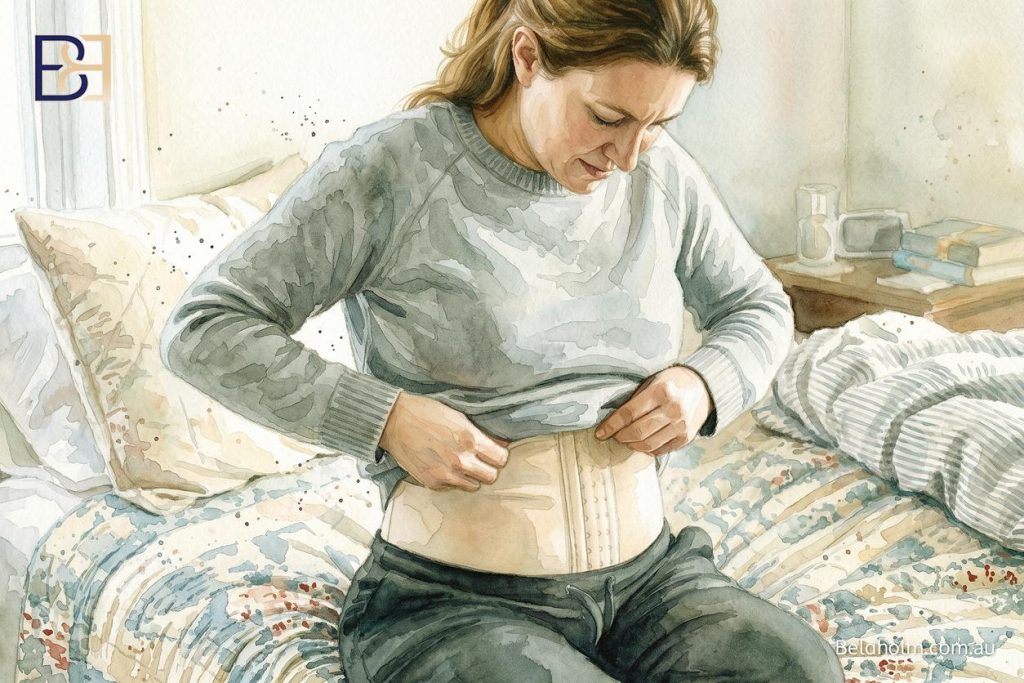
How long it takes. On its own, a monsplasty is a shorter operation than an abdominoplasty. When it is combined with a limited or full abdominoplasty, the operating time is that of the abdominoplasty and depends on the extent of the abdominal work.
Recovery
When the mons is treated as part of an abdominoplasty, this is a larger operation and the recovery is more demanding than for a standalone monsplasty. How you heal, and how long it takes, depends on the extent of surgery, your general health and your body, so the timeframes below are a guide rather than a set schedule.
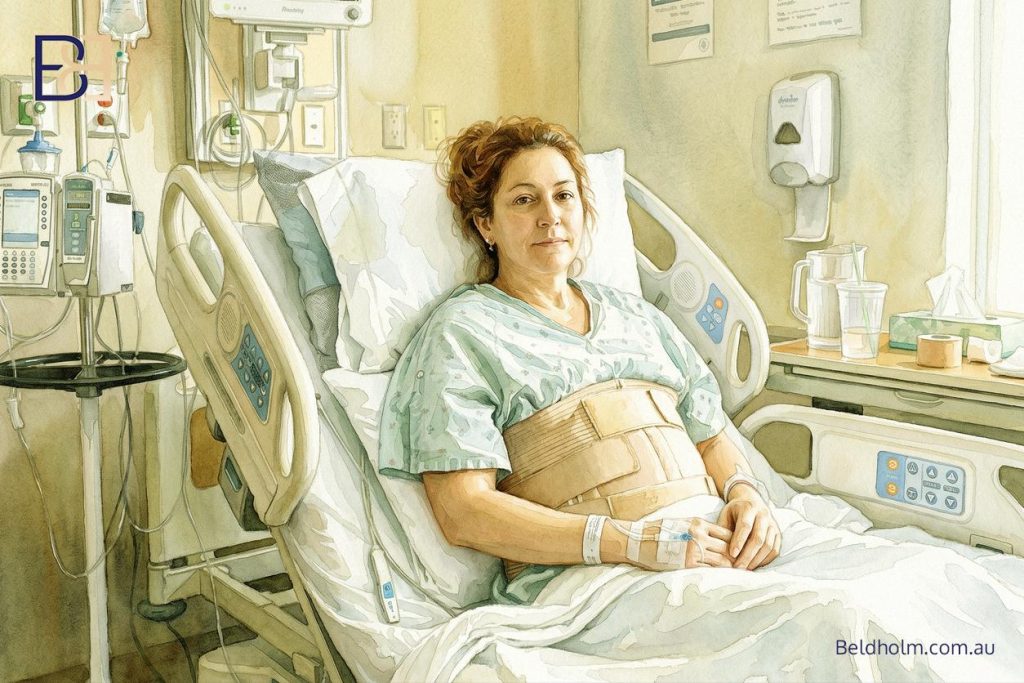
In hospital. Monsplasty is usually a day procedure. You will have some pain, which is managed with prescribed pain medication, and you will be up and walking with help before you go home.
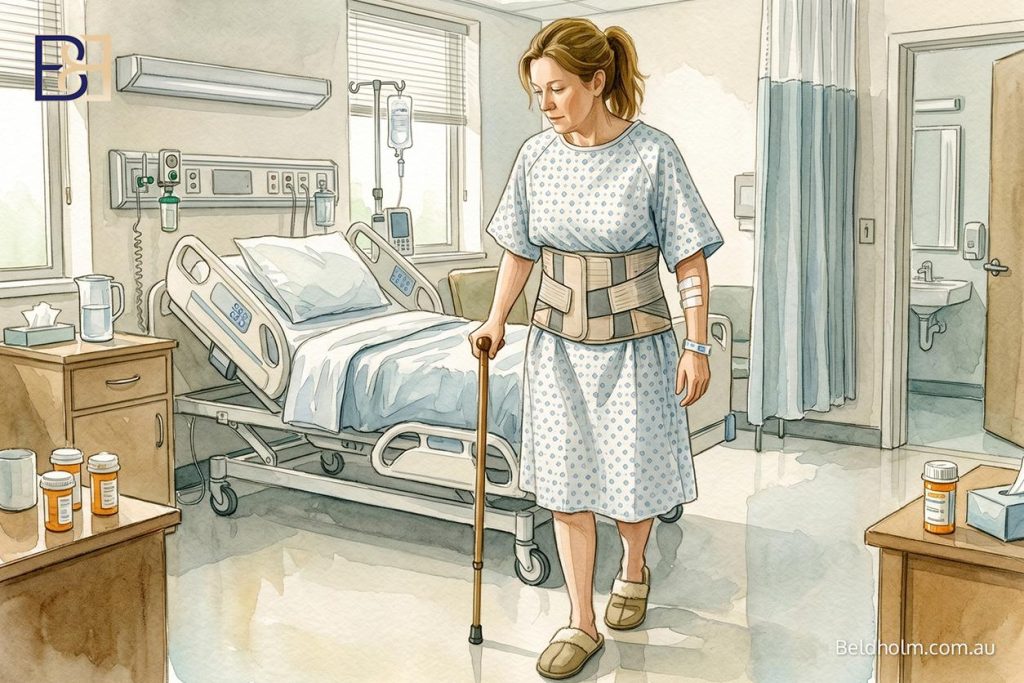
Moving early. I want you up and walking around the house from the first days. Early movement lowers the risk of blood clots in the legs (deep vein thrombosis). It can feel awkward at first, but it is an important part of recovery.
The compression garment. You wear the compression garment for several weeks, as I direct. It supports the area and helps manage swelling.
Time off and lifting. For a standalone monsplasty, most patients take around 3 to 5 days off work. When it is combined with an abdominoplasty, plan for longer. Physical jobs need more time than desk work. Avoid heavy lifting, including lifting small children, for the period I set out for you, and check with me before returning to work if your job is physical.
Caring for children. If you have young children, arrange help for the first couple of weeks. You will not be able to lift toddlers or do heavy household tasks early on, and doing too much too soon can set your healing back.
Swelling and the result. Swelling is expected and settles gradually over weeks to months. The area keeps changing during this time, so the early appearance is not the final result.
Intimacy. Sexual activity puts strain on the healing incision. I generally advise waiting around 4 to 6 weeks, and until you are comfortable, before resuming.
Follow-up. I review you after surgery at set intervals, at 4 weeks, 3 months, 6 months and 12 months, to check your healing.

Scars
Any operation that removes skin leaves a scar. With a monsplasty the scar sits low across the pubic area, in the line that underwear and swimwear cover. Where the mons is treated with an abdominoplasty, it is part of that same low scar rather than a separate one.
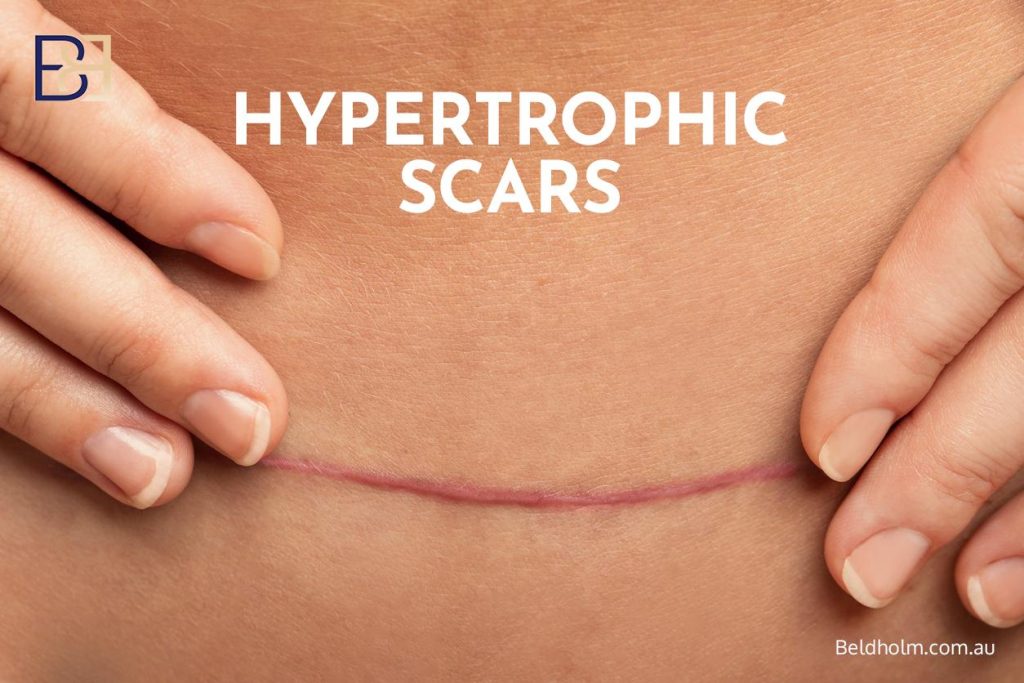
How a scar changes over time. A new scar looks its most obvious in the early months. It then fades and flattens as it matures. This takes time, usually 18 months to 2 years, and the scar keeps settling across that whole period.
What affects how a scar heals. Healing varies from person to person. Your skin type, your genetics, your age, whether you smoke, and how the wound heals all play a part. 2 people can follow the same advice and end up with different scars.
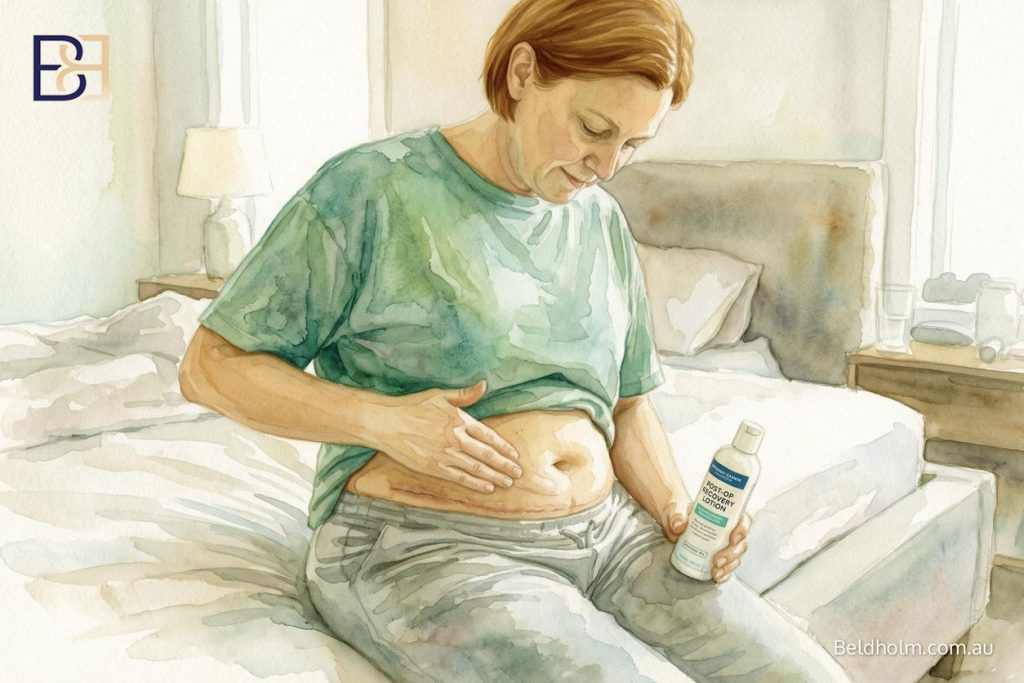
Caring for your scar. Keep the area clean while it is healing and follow the dressing instructions I give you. Protect the scar from the sun, as sun exposure on a new scar can darken it. I will let you know when to start scar management, such as silicone, and how long to keep it up to support scar healing.
Risks and complications
Every operation carries risk, and a monsplasty is no exception. I go through these with you before surgery. The main ones are below.
- Bleeding and haematoma. Some bleeding can collect under the skin as a haematoma. A large one may need to be drained.
- Seroma. Fluid can build up under the wound. Small collections settle on their own. Larger ones may need to be drained.
- Infection. Any wound can become infected and may need antibiotics. The pubic area is a skin fold, which can make wounds here slower to heal.
- Wound healing problems. Part of the wound can be slow to heal or separate at the edges. This can take longer to settle and can affect the scar.
- Altered sensation. Numbness or a change in skin sensation over the mons and nearby skin is common early on. It usually resolves over a few months, but some change can be lasting.
- Fat necrosis. Where suction lipectomy is used to reduce volume, small areas of fat can firm up or break down (fat necrosis). This sometimes needs further treatment.
- Scarring. Scars can widen, thicken or, less often, become raised (hypertrophic or keloid scars). The 2 sides may not be exactly even.
- Changes to nearby structures. Lifting the mons and removing tissue puts tension on the surrounding area. If too much is removed, it can pull on and change the position of nearby structures. I plan the amount carefully to avoid this.
- Blood clots. Clots can form in the legs (deep vein thrombosis) and rarely travel to the lungs. I assess your clot risk and decide on prevention, and early movement after surgery helps lower it.
- Anaesthetic risks. General anaesthetic carries its own risks, which the anaesthetist discusses with you.
- Recurrence. Weight gain or a future pregnancy can loosen the area again over time, so keeping a stable weight helps hold the result.
- Further surgery. Occasionally a revision is needed to settle the result.
Functional considerations
For most women, changes to the mons after pregnancy are a matter of appearance and are not a medical problem. For some, loose skin and a fuller mons can cause practical difficulties. These are worth raising at consultation, because they form part of how I assess whether surgery is reasonable for you.

Reported functional issues include:
- Keeping the area clean. A fold of skin can make the area harder to keep clean and dry.
- Skin-fold inflammation. Moisture trapped in a skin fold can lead to intertrigo, which is inflammation where skin surfaces rub together.
- Comfort in clothing. Some patients find clothing sits uncomfortably over the area.
- Urinary stream. Where the mons sits low, some women notice it affects the direction of their urine stream.
Published studies on monsplasty report that these functional issues can improve after surgery, though results differ between patients (1). Whether any of this applies to you, and whether surgery is a reasonable response, is assessed for the individual.
Future pregnancy
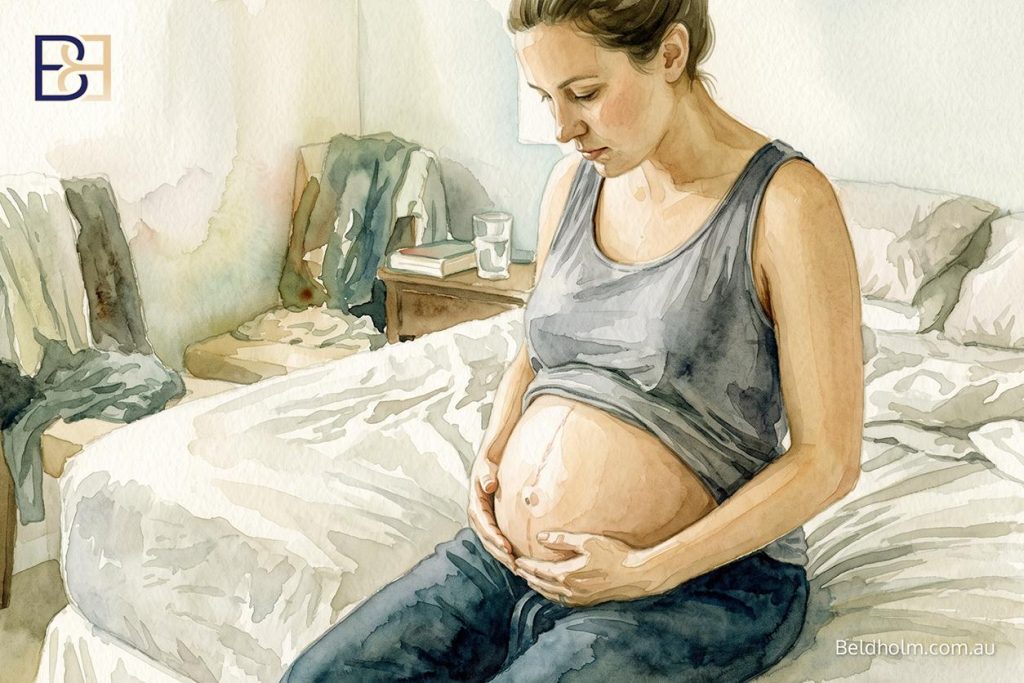
A pregnancy after a monsplasty is not dangerous and does not harm the pregnancy. It can, though, loosen the area again and undo some of the change from surgery. This is why I plan surgery once your family is complete, and why further surgery is something you would only consider once you have finished having children.
Cost and Medicare

Cost depends on what is done, so I cannot give a single figure here. It differs between a standalone monsplasty and a monsplasty combined with an abdominoplasty, and it takes in surgeon, anaesthetist and hospital fees.
Medicare. Like other cosmetic surgery, a standalone monsplasty done for appearance is a cosmetic procedure and does not attract a Medicare benefit. Where the mons is treated as part of an abdominoplasty that meets the Medicare criteria, a benefit may apply to that procedure. Whether you meet the criteria is a clinical question, assessed at consultation. Medicare item numbers and their fees are set by the government and change each year, so for current figures I direct you to the MBS Online website.

GST. A cosmetic procedure with no Medicare benefit attracts GST of 10%. Where a procedure is medically indicated and Medicare-eligible, it is GST-free.

Getting a quote. My patient coordinators arrange written quotes for the hospital and anaesthetist fees, and you receive written financial consent setting out the costs before you commit to surgery.

Frequently asked questions
Is a monsplasty done on its own or with an abdominoplasty? Both are possible. After pregnancy it is more often done as part of a limited or full abdominoplasty, but it can be a standalone operation where the change is limited to the pubic area. Which suits you is worked out at consultation.
Where is the scar? Low across the pubic area, in the line covered by underwear and swimwear. If you have an old caesarean scar there, I remove it and make a single new scar along the same line.
How long is recovery? For a standalone monsplasty, most patients take around 5 to 7 days off work. When it is combined with an abdominoplasty, plan for longer. Avoid heavy lifting, including lifting small children, for the period I set for you. Swelling settles over weeks to months.
Is it painful? You will have some discomfort in the first days, managed with medication. For most patients it settles over the first week or 2.
When can I exercise again? Light walking from the first days. Hold off on strenuous exercise until I clear you, usually around 6 weeks.
Should I wait until I have finished having children? Yes. I plan this surgery once your family is complete and breastfeeding has finished, because a later pregnancy can loosen the area again and change the result.
References
- Hamdi M, Waked K, Deleuze J, et al. The monsplasty: surgical and functional outcomes using an effective and reproducible surgical technique. J Plast Reconstr Aesthet Surg. 2023;84:287-294.