In my practice, stretch marks are one of the things women ask me about often after having children. They are a normal part of pregnancy for many women, and they are nothing to be embarrassed about. What I can do is explain what they are, why they form, what genuinely helps your skin, and where an operation does and does not fit in.
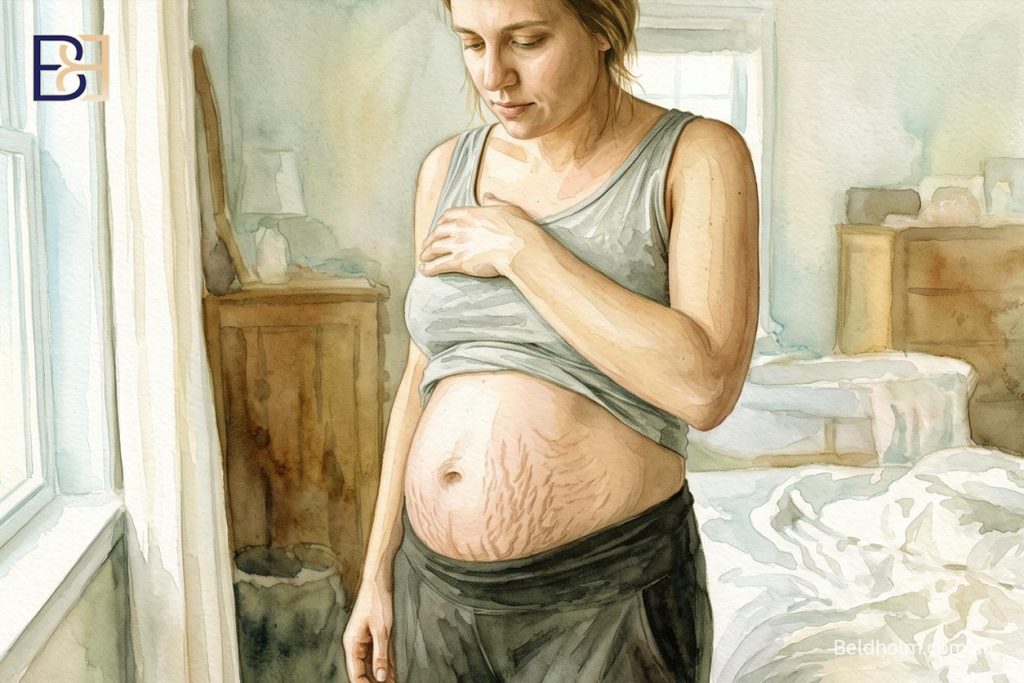
This article is written for women who have had their children and are wondering what their options are now for their post pregnancy body. Some things help your skin during and after pregnancy. Some popular claims do not hold up. And abdominoplasty (tummy tuck), which I perform, is not a treatment for stretch marks. It is an operation for loose lower abdominal skin and separated abdominal muscles, and I will explain how the two relate.
Key points
- Stretch marks (striae) are a common, normal change in pregnancy. Around half of women develop them.
- Genetics strongly influences who gets them. Skin care can support your skin, but no product prevents them with any certainty.
- After pregnancy, marks usually settle from red, pink or purple lines into paler, less noticeable ones over many months.
- Abdominoplasty (tummy tuck) is performed for loose lower abdominal skin and diastasis recti (abdominal muscle separation). Any marks on the skin that is removed are removed with it. The operation is not a treatment for stretch marks themselves.
- Whether surgery is appropriate is decided individually at consultation. A GP referral is required, and results vary from person to person.
What stretch marks are and why they form
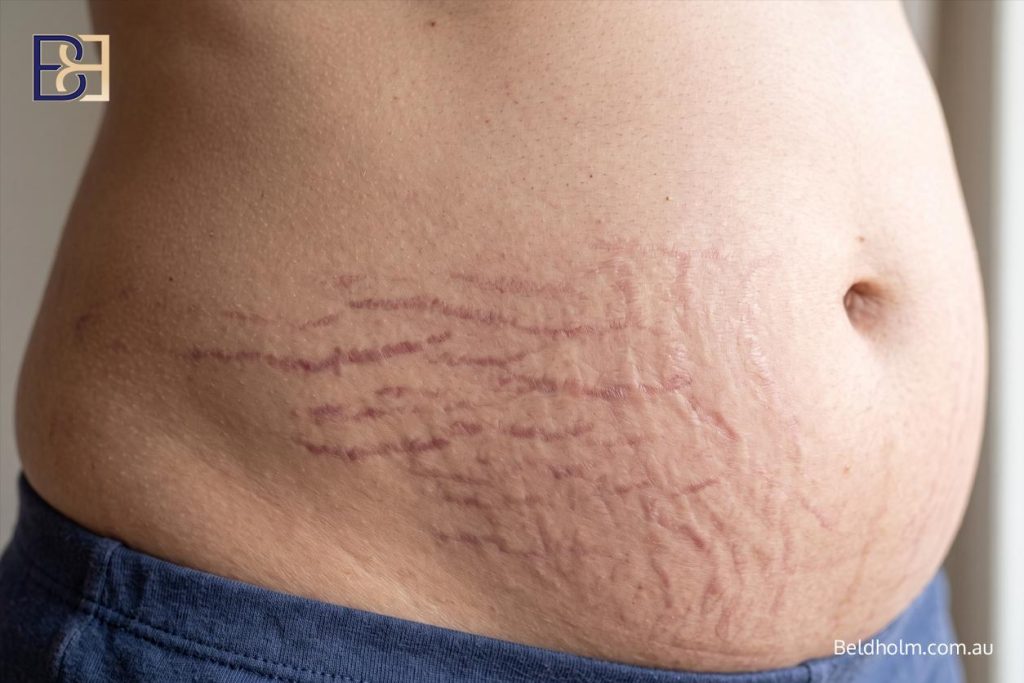
Stretch marks, known medically as striae, are a form of scar that sits in the deeper layer of the skin called the dermis. They show up as fine streaks across the surface. When they first appear, they often look red, pink or purple. This early stage is called striae rubrae, and the colour comes from the small blood vessels sitting underneath. Over time, most marks settle into paler, silvery lines. This later stage is called striae albae.
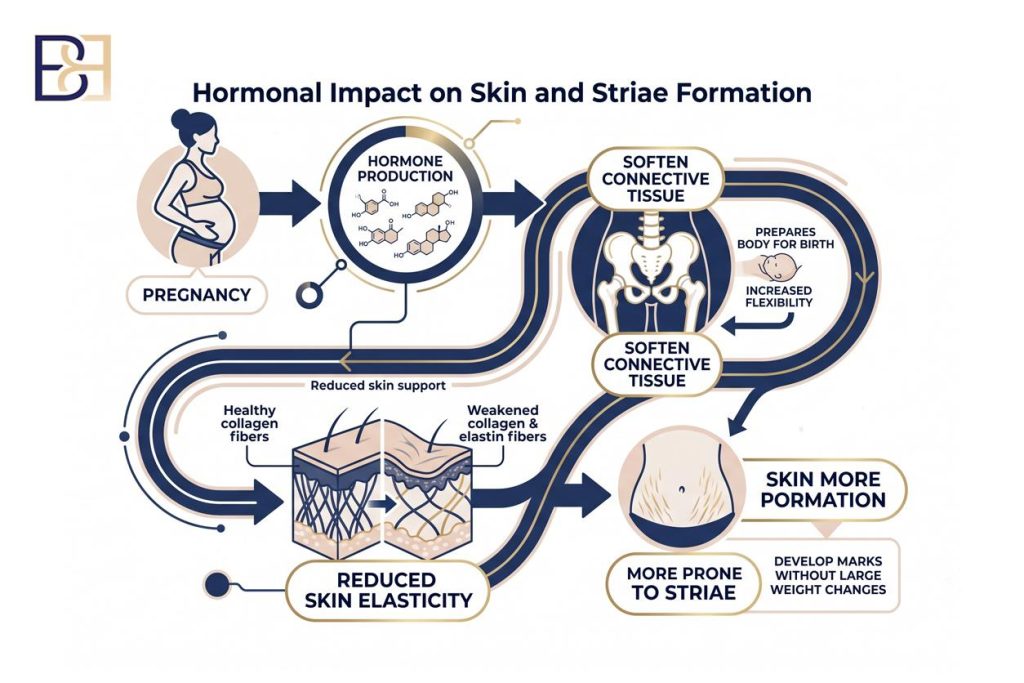
They form because the skin is stretching faster than it can comfortably keep up with. As your baby grows, the skin over your abdomen, and often the breasts, expands quickly. The dermis contains collagen and elastin, which give skin its strength and stretch. When the stretching outpaces these fibres, small areas of the dermis are disrupted, and that is what shows on the surface as a stretch mark (1,2).
Hormones play a part too. During pregnancy, your body produces hormones that soften connective tissue, which is part of how the body prepares for birth. The same softening can make the skin more prone to striae. This is one reason some women develop marks even without large changes in weight.
Genetics is the biggest single factor. If your mother or sisters developed stretch marks in pregnancy, you are more likely to as well. This is largely outside your control, and it is why two women can follow the same skin care routine and have very different results.
A few things are worth knowing:
- Around half of women develop stretch marks in pregnancy. Many do not.
- New marks can feel itchy as the skin stretches. This is common and usually settles.
- The extent and location vary a great deal from one woman to the next.
Stretch marks are a normal sign that your body has done the work of carrying a baby.
When and where they appear
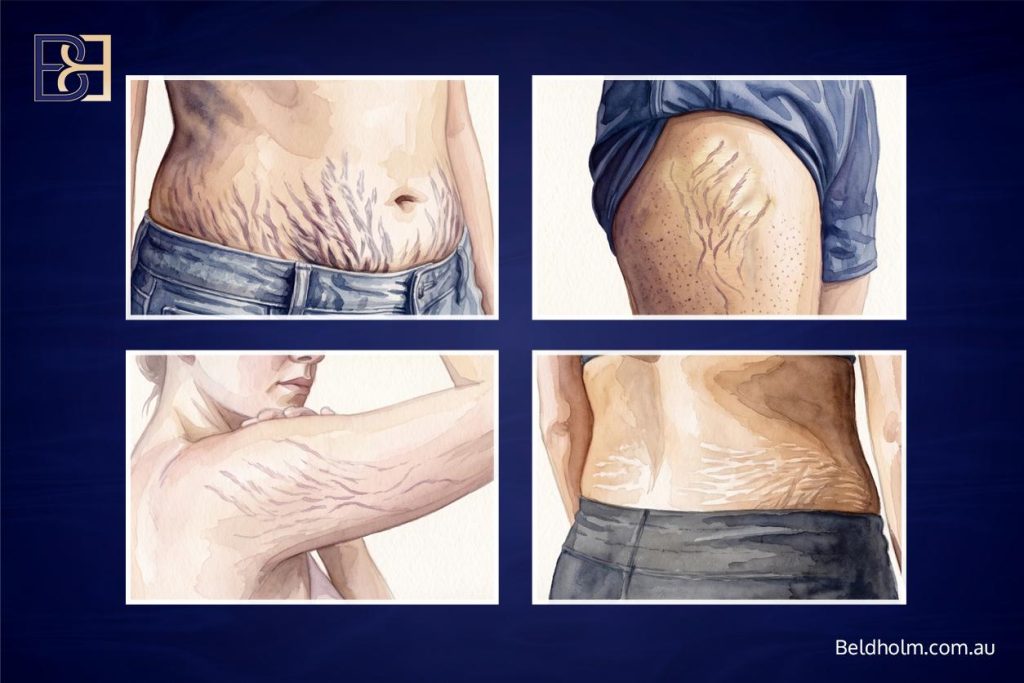
Most women first notice stretch marks in the second half of pregnancy. They often start in the second trimester and become more noticeable through the third trimester, as the skin stretches the most in the later weeks.
They are not limited to the abdomen. The common sites are:
- Abdomen
- Breasts
- Hips
- Thighs
- Buttocks
The abdomen and breasts are the two most common areas, because these are where the skin stretches the most during pregnancy and, for the breasts, again during breastfeeding.
Knowing when and where marks tend to appear is useful for one practical reason. It lets you look after the skin in those areas early, rather than waiting until marks have already formed. It does not mean you can stop them altogether, and I will come to what skin care can and cannot do next.
What helps your skin during and after pregnancy
There is a lot of marketing in this space. Nothing reliably prevents stretch marks. Genetics has more say than any product. What you can do is support your skin so it is in good condition, and a few everyday habits are worth keeping up.
Hydration

Drinking enough water keeps your skin and the rest of your body well hydrated. Well-hydrated skin is more comfortable and copes a little better with stretching. To be clear, water does not prevent stretch marks. It is a sensible habit for your general health during and after pregnancy, and the skin benefits as part of that.
A balanced diet

What you eat supports the quality of your skin. A healthy diet with enough protein, and foods containing vitamins A, C and E, zinc and omega-3 fats, gives your skin the building blocks it uses to repair and stay supple, which supports skin elasticity. Gradual weight gain rather than rapid weight gain in pregnancy also puts less sudden demand on stretched skin. None of this guarantees you will avoid marks, but a healthy lifestyle supports skin quality either way.
Moisturisers
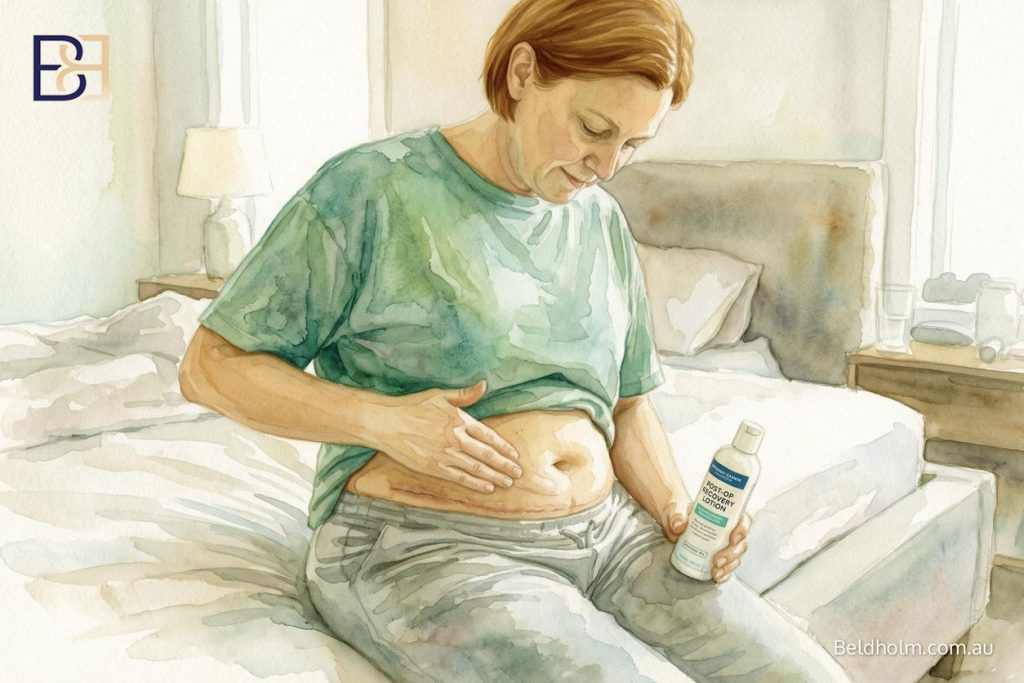
Keeping the skin moisturised can ease the itch that comes with stretching and keeps the skin comfortable. Products with cocoa butter, almond oil or hyaluronic acid are commonly used. The evidence that any cream prevents stretch marks is weak and mixed, so I would not spend a fortune expecting prevention (3,4). If a moisturiser feels good and helps the itch, that is a reasonable enough reason to use it.
Nutrition after pregnancy and breastfeeding

Pregnancy and breastfeeding draw heavily on your body’s stores. By the time many women come to see me, they have gaps in iron, folate, vitamin B12, vitamin D and calcium from the demands of carrying and feeding a baby. These nutrients matter for your skin and for your general recovery, and they matter a great deal if you are later planning surgery, because good nutrition supports healing.
Non-surgical options after pregnancy
First, the reassuring part. Stretch marks usually fade on their own. Over roughly 6 to 12 months the red, pink or purple settles into paler, less noticeable lines. For many women that natural fading is enough, and no treatment is needed.
If you would like to reduce their appearance further, there are non-surgical options. I do not perform these myself. They are offered by dermatologists and other practitioners, and I am describing them here so you know what exists and what to expect.
Topical treatments
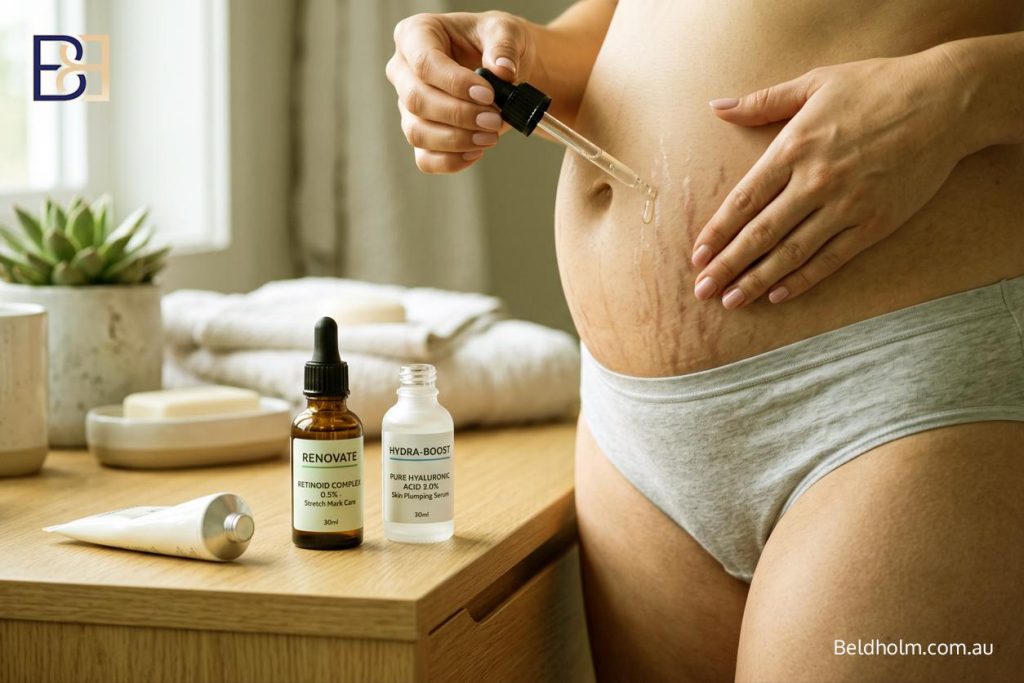
Some creams and serums aim to improve the look of existing stretch marks rather than prevent them. Retinoids can stimulate collagen production and may help the appearance of early, reddish marks (5). One important caution: retinoids are not used during pregnancy or breastfeeding, so this is a post-feeding option only, and it should be discussed with your GP or dermatologist first. Hyaluronic acid products are also used (6). The evidence for these topical treatments is modest, and they tend to help early marks more than older, pale ones (7).
Laser and microneedling
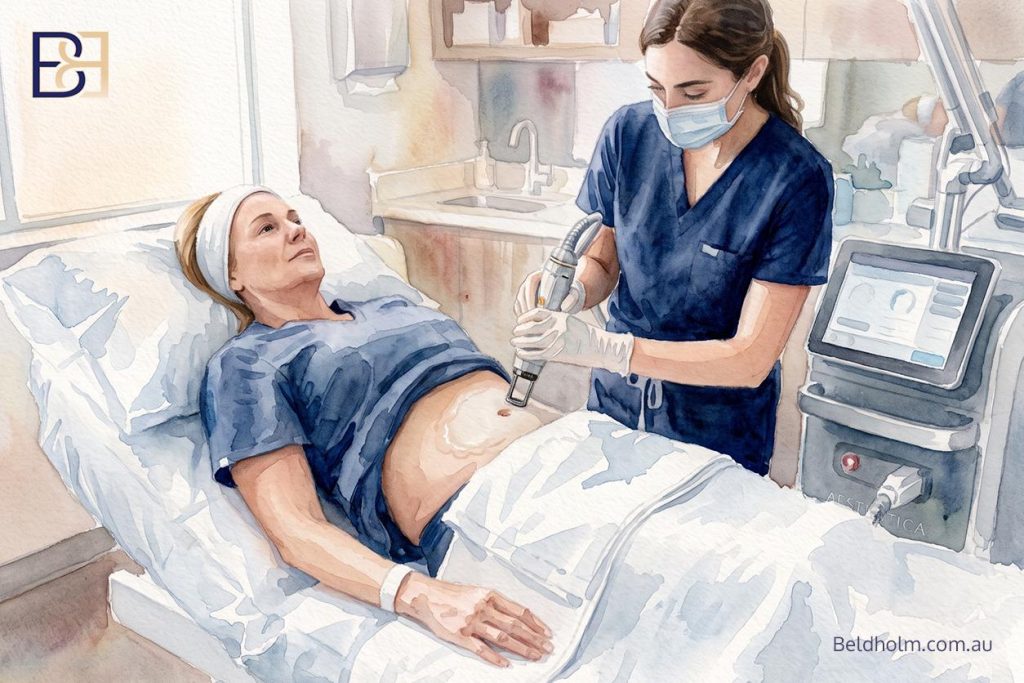
For more established marks, some women consider laser treatments or microneedling, both of which work by stimulating collagen production in the skin. These are done by dermatologists and other practitioners. A few points to keep in mind:
- They usually require several sessions.
- They reduce the appearance of marks for some people. They do not erase them.
- Results vary with your skin type, and there are costs and some downtime involved.
None of these reliably removes stretch marks. They can soften how marks look for some women. If this is something you want to pursue, a dermatologist is the right person to advise you on whether it suits your skin.
Where abdominoplasty (tummy tuck) fits
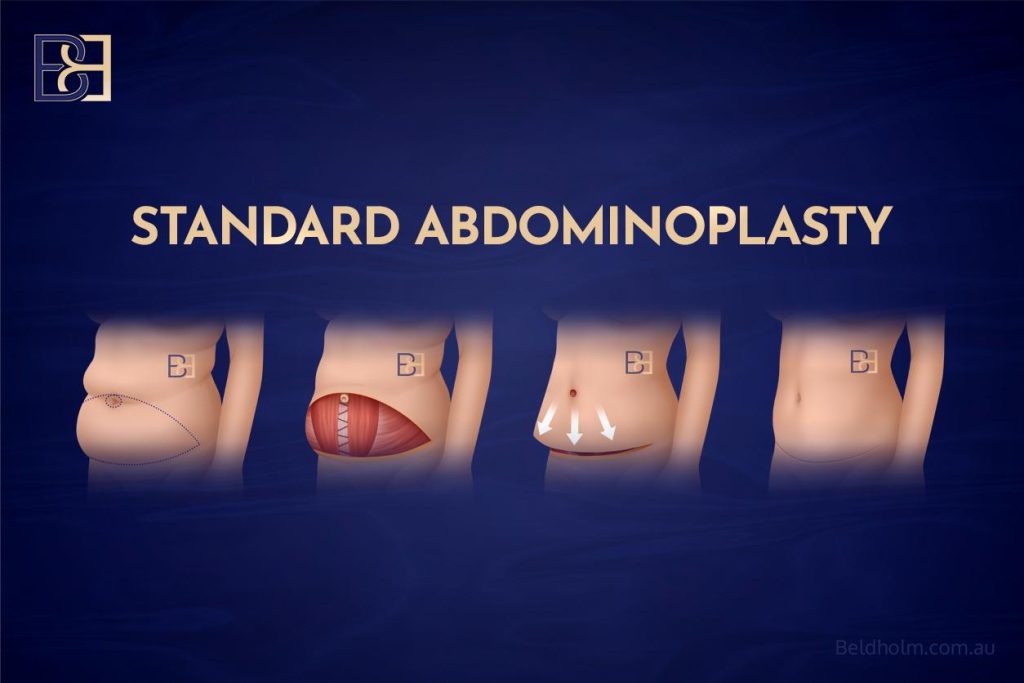
An abdominoplasty (tummy tuck) is not a treatment for stretch marks.
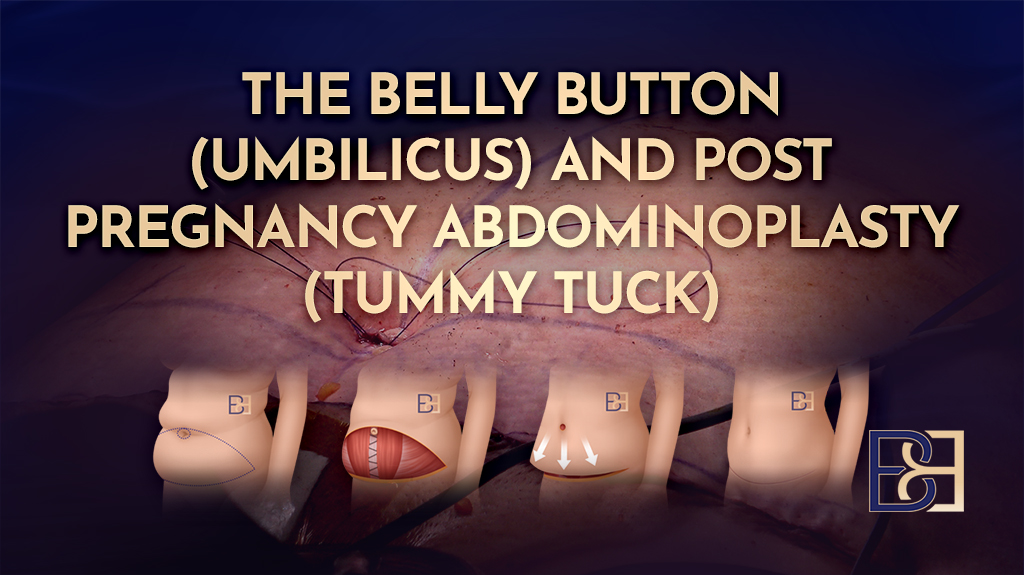
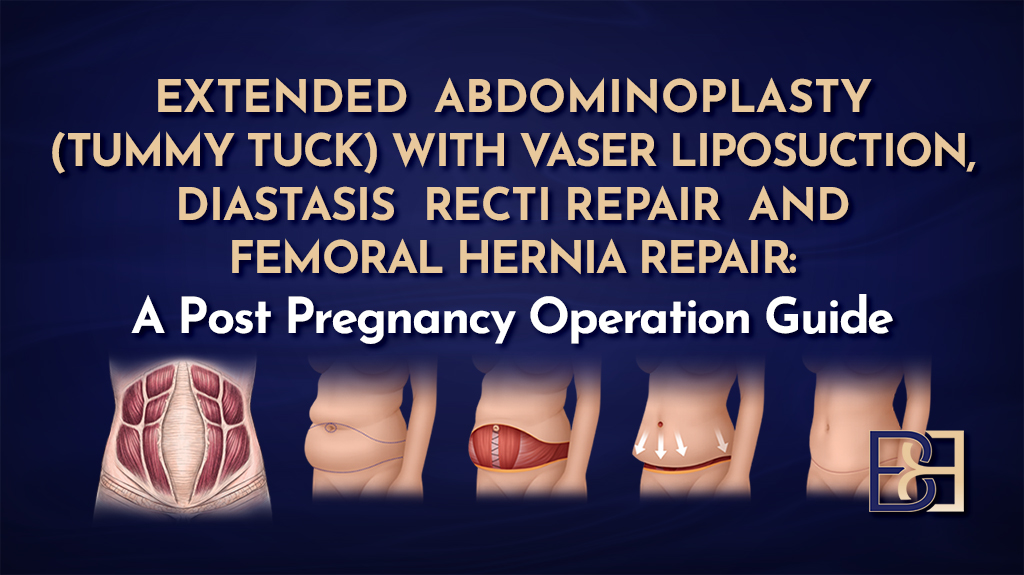
What an abdominoplasty (also called a tummy tuck procedure) does treat is excess skin on the lower abdomen and separation of the abdominal wall muscles, known as diastasis recti (abdominal muscle separation). Both are common after pregnancy. The paired rectus abdominis muscles down the middle of your abdomen can stay stretched apart after carrying a baby, leaving weakened abdominal muscles, and the skin over the lower abdomen can remain loose. An abdominoplasty removes excess abdominal skin, along with some of the excess fat and fatty tissue beneath it, and repairs the abdominal separation by bringing the muscles back together. Removing excess skin in this way reduces the skin laxity across the lower abdomen, and the muscle repair tightens abdominal muscles. In short, the surgical procedure can reduce excess skin and repair the muscle separation in one operation.
Weakened abdominal muscles after pregnancy are not only about appearance. Some women find their core strength is reduced, and a smaller number notice urinary symptoms that relate to the abdominal and pelvic floor working together. If you have urinary incontinence or ongoing core weakness, mention it at consultation, because it can be part of the picture we assess.
How this relates to stretch marks
During the operation, a section of lower abdominal skin is removed. If that particular skin carries stretch marks, those marks come away with it. That is a by-product of removing loose skin, not the purpose of the surgery.
What this means in practice:
- Marks on the lower abdominal skin that is removed will go with that skin.
- Marks above the belly button usually remain, because that skin is repositioned rather than removed.
- Marks on the breasts, hips, thighs or buttocks are not affected by an abdominoplasty at all.
So if your main concern is stretch marks across several areas, an abdominoplasty is unlikely to be the answer.
Who an abdominoplasty suits
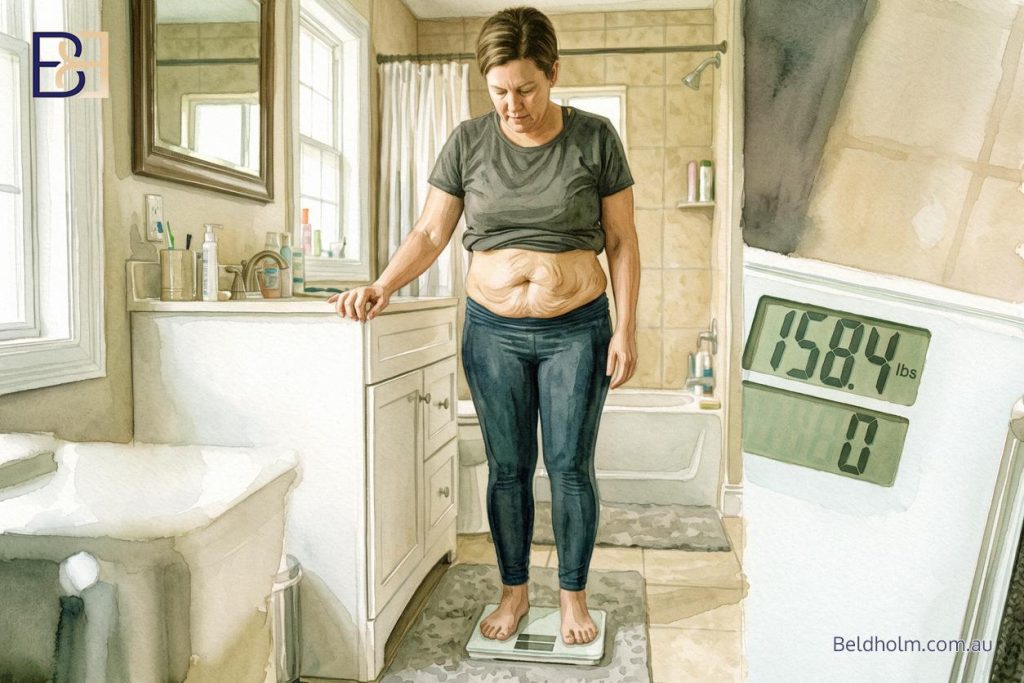
Abdominoplasty is a form of body contouring surgery, and it works best when your weight is settled. Like other cosmetic procedures and body contouring procedures, it suits you best at a stable weight, because significant weight loss, or significant weight fluctuations afterwards, can change the result, as can a future pregnancy. Changes in body shape after pregnancy are normal, and a post pregnancy tummy tuck (abdominoplasty) is one option among several, not something everyone needs. Realistic expectations matter. I will tell you at consultation whether abdominoplasty surgery is likely to suit you and what a reasonable surgical outcome looks like for your body. We then agree a surgical plan together.
What about breast changes
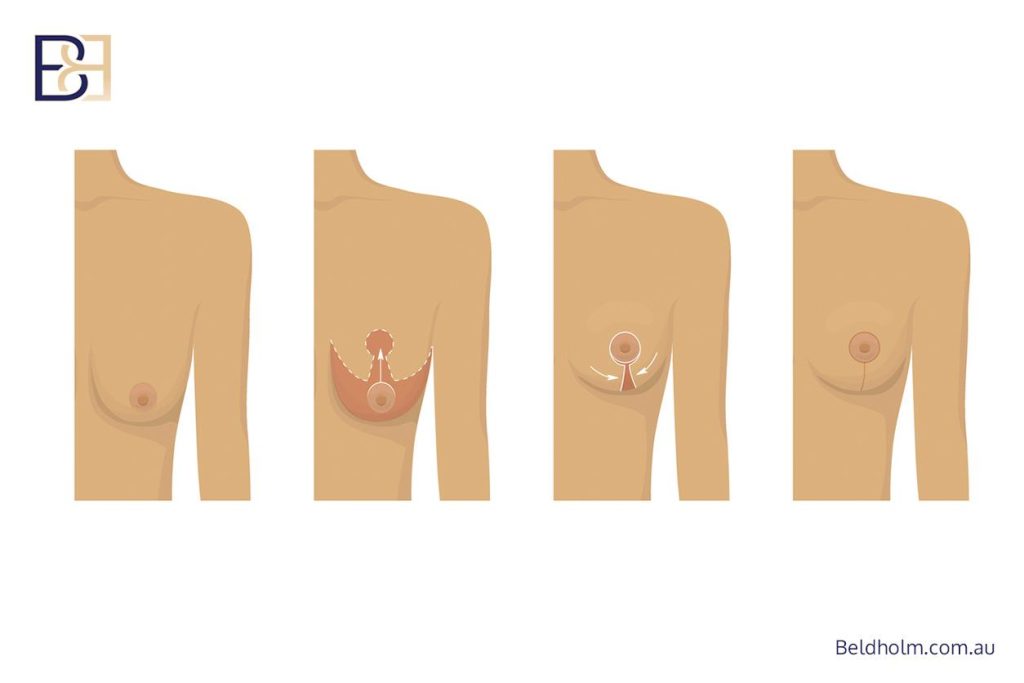
Pregnancy and breastfeeding also change the breasts for many women, and an abdominoplasty does nothing for the breasts. Breast changes are treated by separate operations, such as a breast lift (mastopexy) or breast augmentation (augmentation mammoplasty), and these are considered on their own merits. Whether any breast procedure is appropriate, and whether it would be done at the same time or separately, is a clinical decision made individually at consultation.
The scar
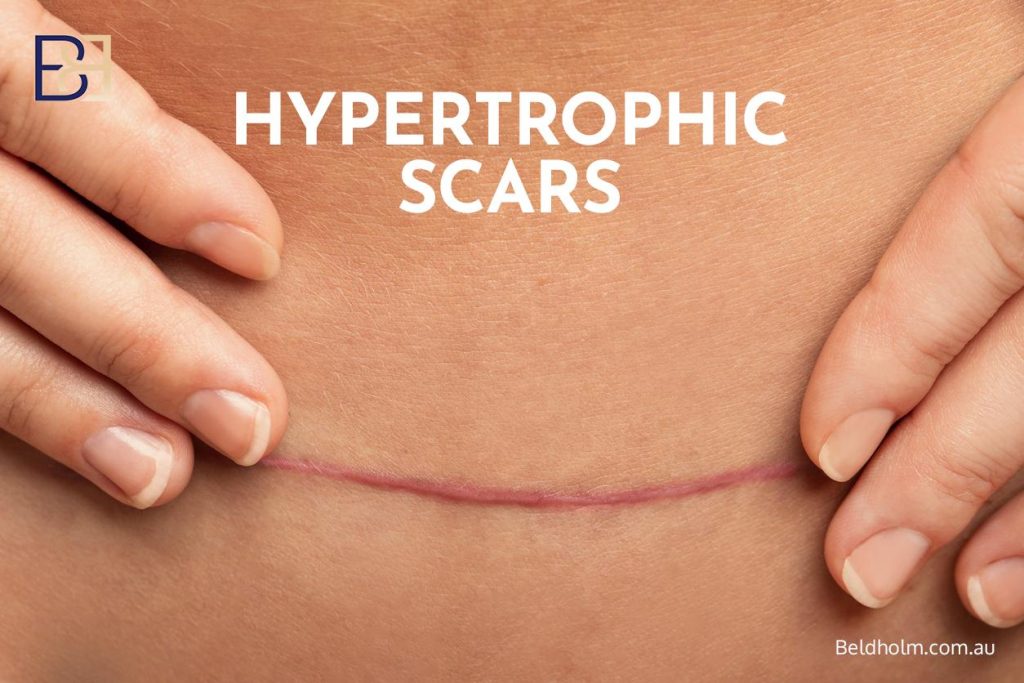
An abdominoplasty leaves a scar low across the lower abdomen, usually from hip to hip, sitting where underwear or swimwear would cover it. There is also a scar around the belly button with a full abdominoplasty. If you have a caesarean scar, I can often plan the incision to incorporate it. The scar is permanent, and the scar tissue matures and softens over many months. How scars settle varies between individuals, and in some cases revision surgery is considered later to improve a scar.
Timing after pregnancy
I plan this surgery once your family is complete and once breastfeeding has finished, and after the abdominal wall and skin have settled following your most recent pregnancy. The reason is straightforward. A future pregnancy can stretch the skin and muscles again and affect the result. The timing is not a fixed number of months.
Risks and recovery
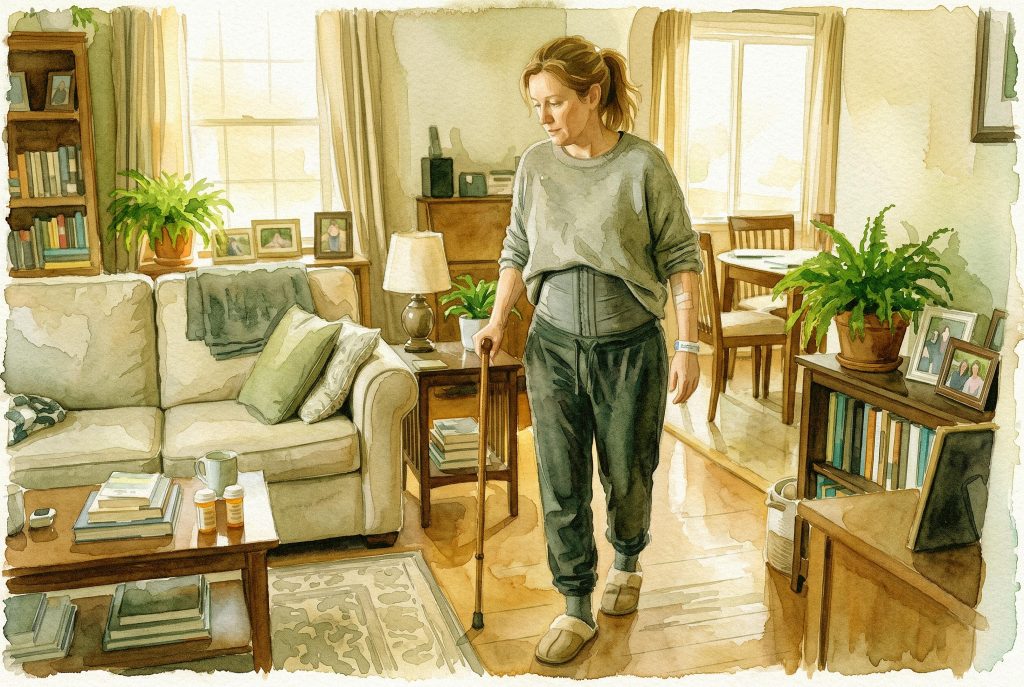
An abdominoplasty is major surgery, and a longer operation places demands on the body. Tummy tuck (abdominoplasty) recovery after this surgery is not something to underestimate, particularly when you are caring for young children. Tummy tuck (abdominoplasty) surgery means you will wear a compression garment, and you will have lifting and activity restrictions, often for around six to eight weeks, though this varies from woman to woman. You will need support at home during that time. I would not plan this around being able to pick up a toddler in the first weeks. Core strength takes time to rebuild, and I will guide you on when to start.
Like any operation, an abdominoplasty carries risks. These include bleeding, infection, fluid collection under the skin (seroma), problems with wound healing, changes in skin sensation, scarring that does not settle as hoped, and blood clots in the legs or lungs. There are also the risks that come with any anaesthetic. I go through these in detail at consultation, and I have written more about them in my guide to abdominoplasty risks.
Common myths

Book your appointment online now
There is plenty of misinformation about stretch marks. A few of the ones I hear most often:
“The right cream will stop me getting them.” No cream reliably prevents stretch marks. Moisturisers can keep the skin comfortable and ease the itch, but genetics has the final say. Spending heavily on a product expecting prevention is likely to disappoint.
“I avoided them last pregnancy, so I will not get them this time.” Each pregnancy is different. Skin elasticity, hormones and how much the skin stretches all vary, so marks can appear in a later pregnancy even if an earlier one left none, and the reverse is also true.
“Only women who gain a lot of weight get them.” Not so. Because hormones and genetics are involved, some women develop stretch marks with very modest weight change, while others gain more and get none.
“They can be erased completely.” They cannot. Marks fade a great deal on their own, and some treatments can soften their appearance, but no approach removes them entirely from the skin that stays.
Frequently asked questions
Can stretch marks be completely prevented in pregnancy?
No. Good skin care and gaining weight gradually support the skin, but they do not prevent stretch marks with any certainty. Genetics has the biggest say, and around half of women develop marks regardless of what they do.
Which moisturisers help?
Products with cocoa butter, almond oil or hyaluronic acid keep the skin comfortable and can ease the itch as it stretches. They are useful for comfort. No moisturiser reliably prevents stretch marks, so I would set expectations accordingly.
How long do stretch marks take to fade after pregnancy?
Most marks settle over about 6 to 12 months, fading from red, pink or purple into paler, less noticeable lines. The pace of fading varies between women.
Do non-surgical treatments work?
Laser treatments and microneedling, which are done by dermatologists rather than by me, can soften the appearance of marks for some women. They usually take several sessions, results vary, and they do not erase marks. A dermatologist is the right person to advise whether they suit your skin.
Does an abdominoplasty remove stretch marks?
An abdominoplasty (tummy tuck) is not a treatment for stretch marks. It removes loose skin from the lower abdomen and repairs diastasis recti (abdominal muscle separation). If the skin that is removed carries stretch marks, those particular marks come away with it. Marks above the belly button, and marks on the breasts, hips or thighs, are not affected. Whether the operation is appropriate for you is decided at consultation.
When can I consider surgery after having children?
I plan this surgery once your family is complete, once breastfeeding has finished, and after the abdominal wall and skin have settled. As a rough guide that is often around 12 months after your most recent pregnancy, though it is not a fixed interval. A future pregnancy can affect the result, which is the reason for waiting. The right timing is assessed individually.
My final thoughts
Stretch marks are a normal part of pregnancy for many women. Looking after your skin with hydration, a balanced diet and moisturiser supports it, but genetics has a large say, and some of this is outside your control. Most marks fade well on their own over time.
If you are considering an abdominoplasty, remember that it is an operation for loose lower abdominal skin and diastasis recti (abdominal muscle separation), not a stretch mark treatment. Any marks on the skin that is removed come away as part of that, while marks elsewhere remain. Whether the operation suits you is decided individually at consultation.
Your body has done the work of carrying and feeding your children. Stretch marks are a normal sign of that, and they are nothing to be ashamed of.
References
- Devillers C, Piérard-Franchimont C, Schreder A, Docquier V, Piérard GE. High resolution skin colorimetry, strain mapping and mechanobiology. Int J Cosmet Sci. 2010;32(4):241-5.
- Gilmore SJ, Vaughan BL Jr, Madzvamuse A, Maini PK. A mechano-chemical model for striae distensae. Math Biosci. 2012;240(2):141-7.
- Bylka W, Znajdek-Awiżeń P, Studzińska-Sroka E, Brzezińska M. Centella asiatica in cosmetology. Postepy Dermatol Alergol. 2013;30(1):46-9.
- Moldovan ML, Lahmar A, Bogdan C, Părăuan S, Tomuță I, Crișan M. Preliminary study on the development of an antistretch marks water-in-oil cream. Clin Cosmet Investig Dermatol. 2016;9:249-55.
- Kang S, Kim KJ, Griffiths CE, et al. Topical tretinoin (retinoic acid) improves early stretch marks. Arch Dermatol. 1996;132(5):519-26.
- Jegasothy SM, Zabolotniaia V, Bielfeldt S. Efficacy of a new topical nano-hyaluronic acid in humans. J Clin Aesthet Dermatol. 2014;7(3):27-9.
- Ud-Din S, McGeorge D, Bayat A. Topical management of striae distensae (stretch marks): prevention and therapy of striae rubrae and albae. J Eur Acad Dermatol Venereol. 2016;30(2):211-22.