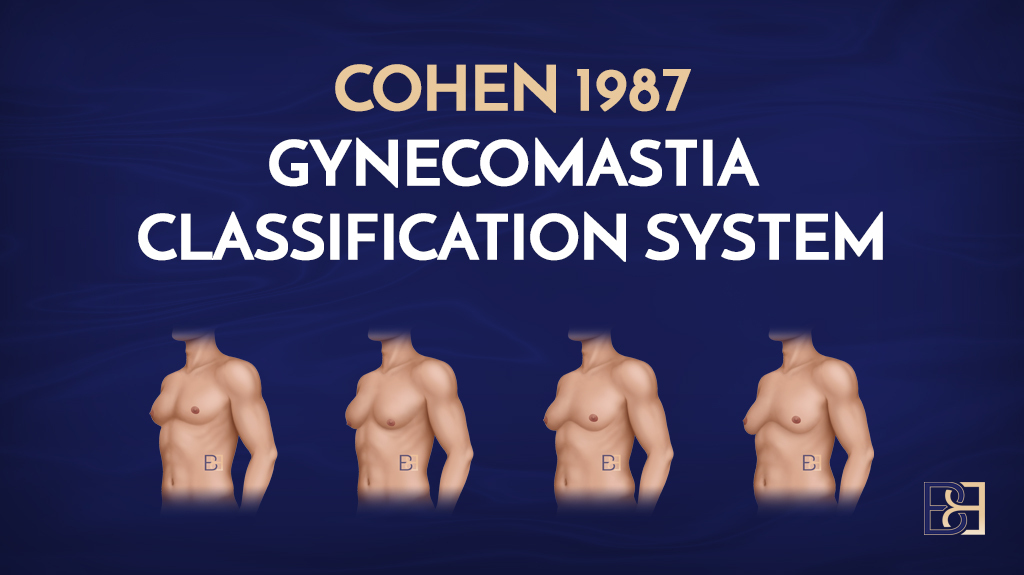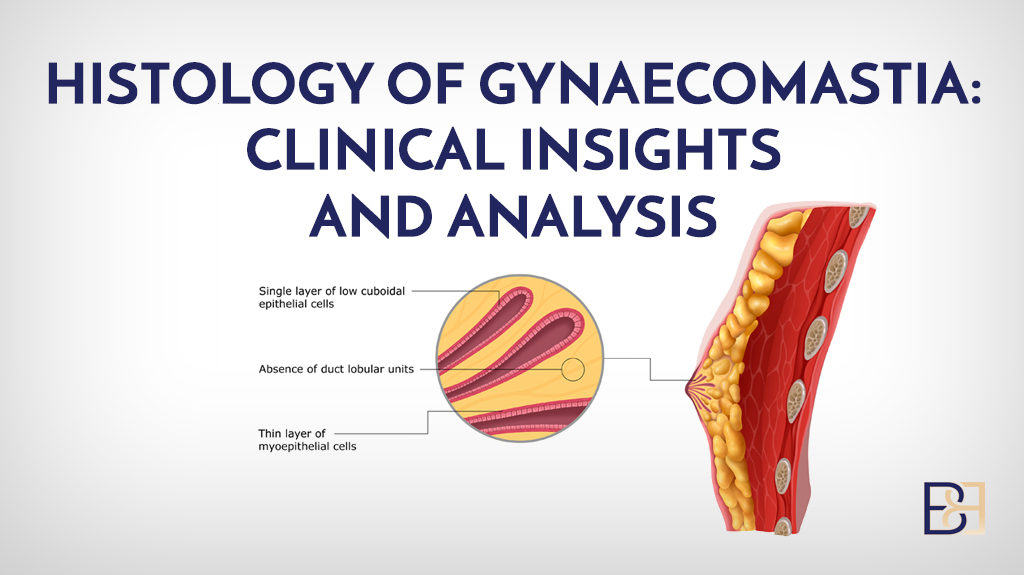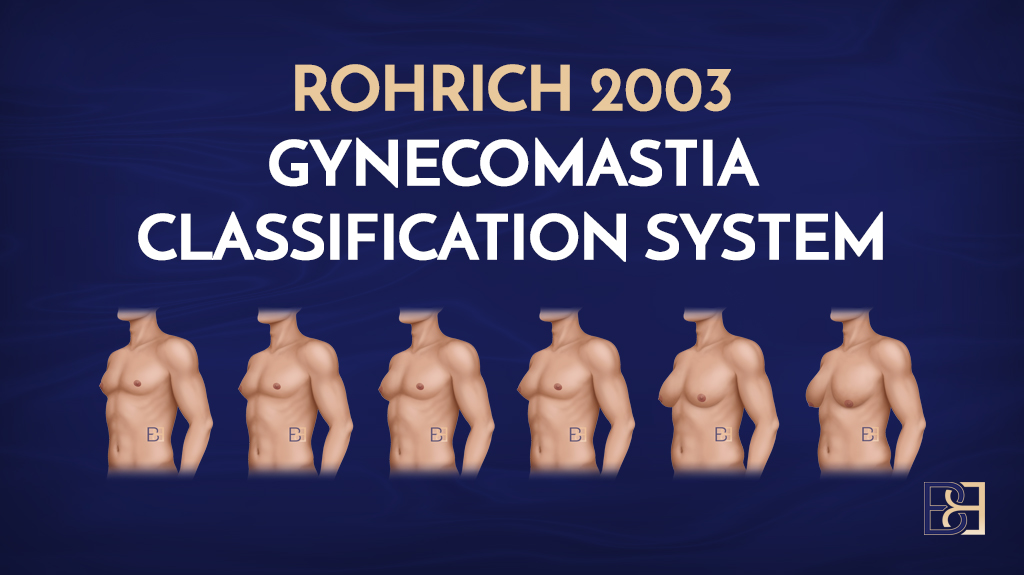
I developed this grading system for gynaecomastia after many years of assessing and operating on men with enlarged male breast tissue. My aim was practical. I wanted the grade to tell me the operation. In this system each grade corresponds directly to one operation, decided by what is in the chest, whether the nipple has dropped, and whether the skin will tighten once the tissue underneath is removed.
Below I set out the five grades and the operation for each. Whether surgery is appropriate for an individual, and which operation suits them, is decided at consultation after examination. A GP referral is required, and results vary between patients.
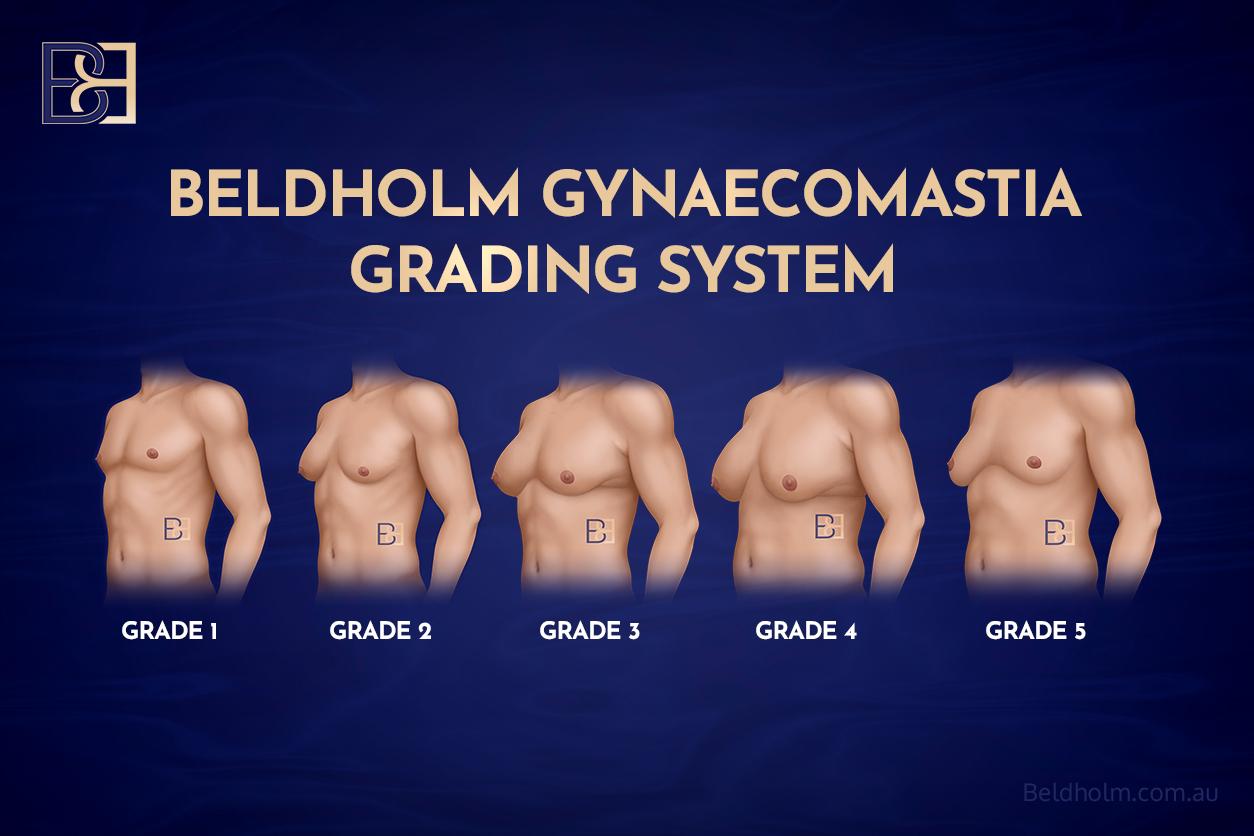

Table of Contents
What gynaecomastia is
Gynaecomastia means enlarged male breast tissue. It is a recognised clinical condition with a range of causes. The surgery to correct it is also known as male breast reduction, which is the term many men use when they search for it. In my practice I see it across a wide spread of men, from lean patients with a firm disc of tissue under the nipple, through to men with a larger, softer chest after significant weight change.
Two patterns matter for surgery.
- True gynaecomastia is enlargement of the glandular breast tissue. It reflects a relative shift between oestrogen and testosterone effects on the breast (1). The tissue feels firm or rubbery and usually sits directly under the nipple and areola.
- Pseudogynaecomastia (also called lipomastia) is enlargement from fat rather than gland. The tissue feels soft and tends to match the fat distribution elsewhere on the body.
Many men have a mix of both.
Why I grade both
From a surgical planning point of view, the amount of gland, the amount of fat, the skin envelope, and the position of the nipple all affect the operation. A chest with a firm glandular disc and a chest made up mainly of fat can look similar from the outside but need different techniques. That is why my system includes both true gynaecomastia and pseudogynaecomastia.
The underlying cause still matters and is assessed before surgery. I cover the causes and the diagnostic workup separately in causes and diagnosis of gynaecomastia.
Telling gland from fat
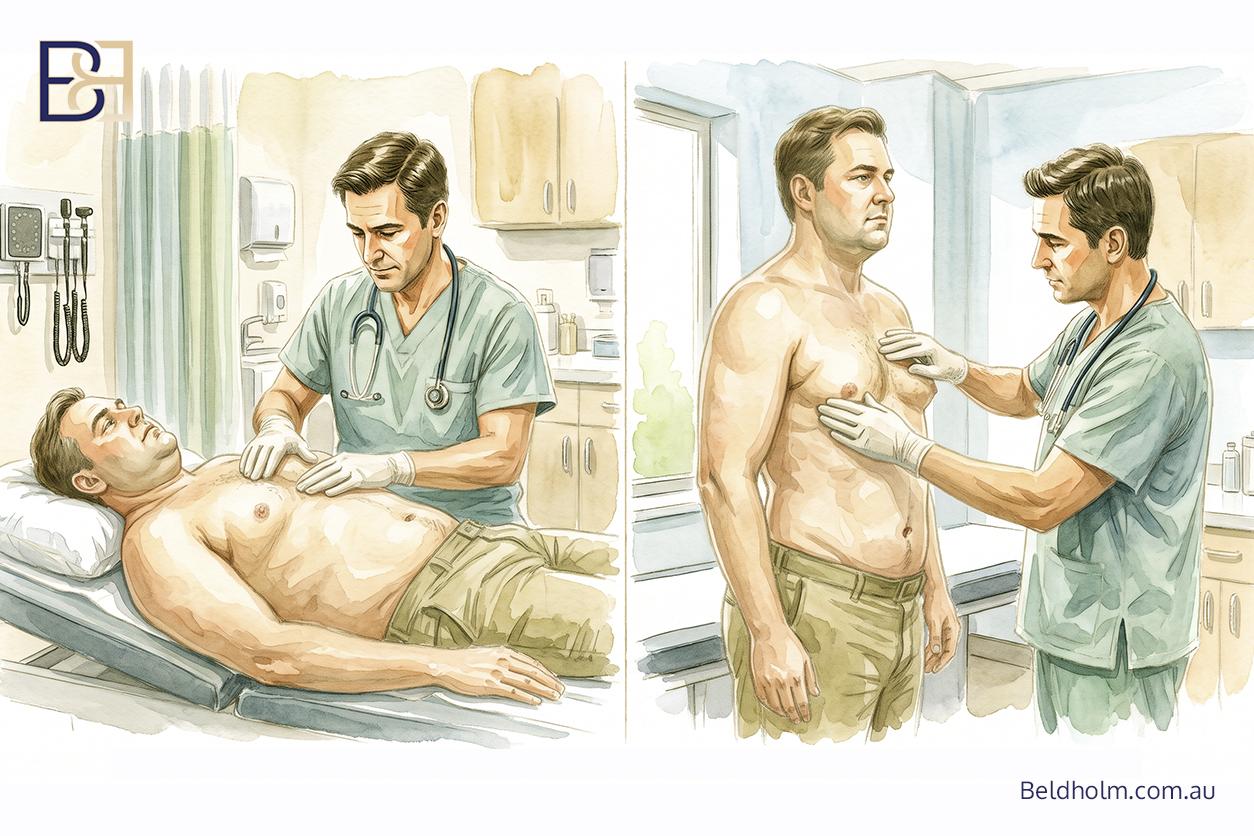
The distinction between gland and fat drives the technique, so I assess it directly.
- Examination. Glandular tissue feels firm or rubbery and is concentrated under the areola. Fatty tissue feels soft and is more spread out.
- Imaging. An ultrasound can help confirm whether the enlargement is glandular, fatty, or mixed, where the examination is not clear cut.
- Blood tests. Where the history or examination points to an underlying hormonal cause, blood tests are arranged as part of the workup. In many men with gynaecomastia these come back normal.
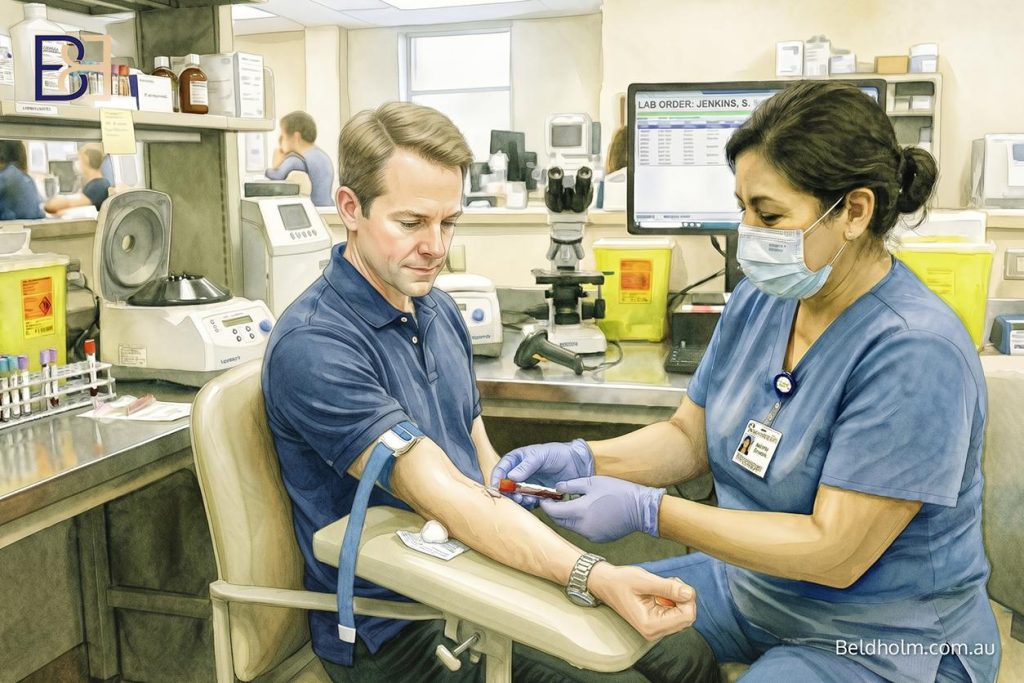
Identifying or excluding a cause matters, because surgery does not change an ongoing driver. I go through this in detail in causes and diagnosis of gynaecomastia.
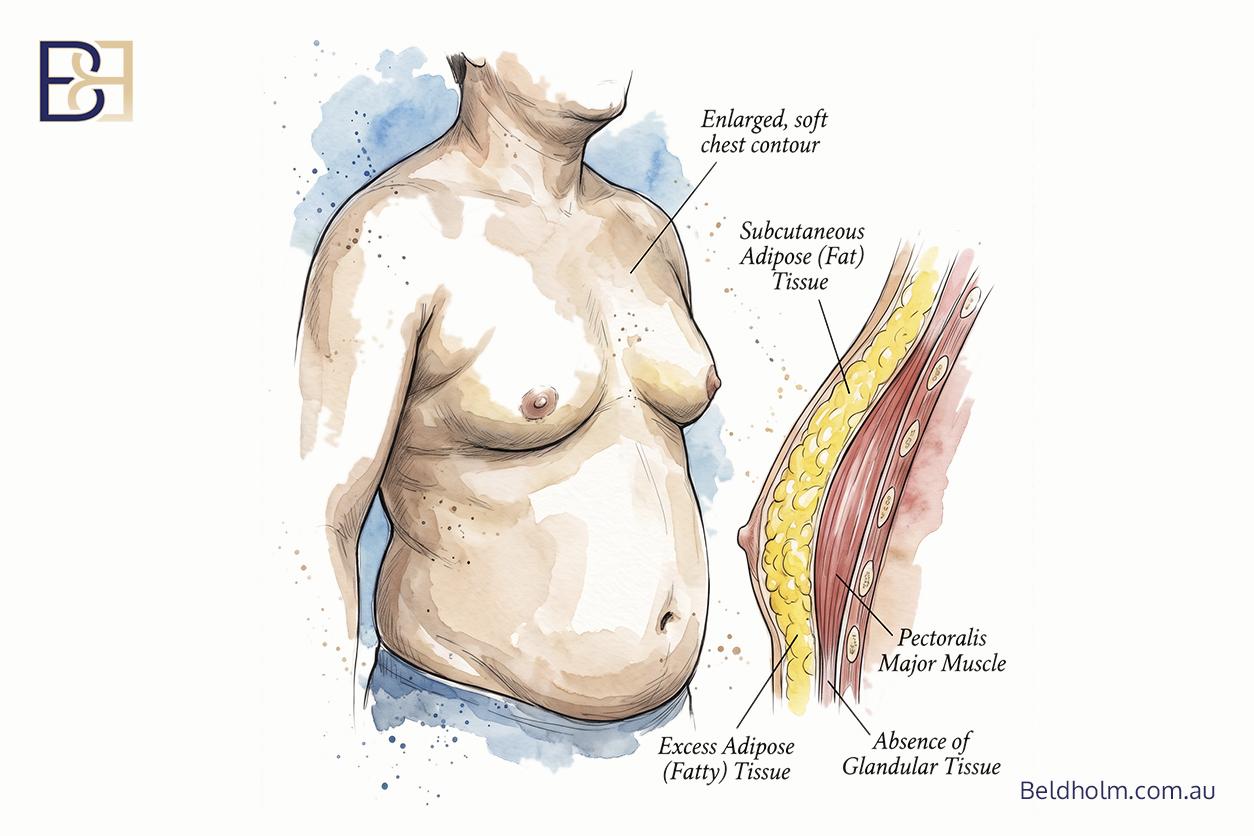
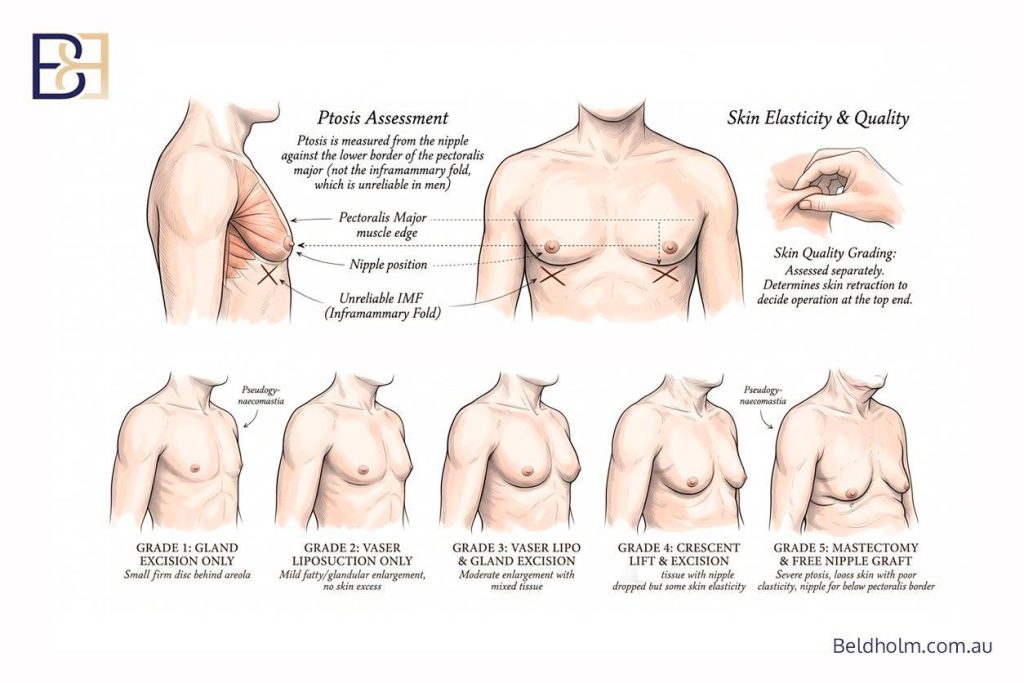
How I assess ptosis: nipple position against the lower border of the pectoralis major
Ptosis means the nipple sitting low on the chest. Which grade a ptotic chest falls into depends on two things: how far the nipple has dropped, and whether the skin will tighten back up once the tissue underneath is removed. This part is about where the nipple sits.
For a long time gynaecomastia has been graded against the inframammary fold, the crease under the breast. In men I have found the fold unreliable. It varies from one man to the next, and in many patients the skin looks loose while the nipple has not actually dropped. That is pseudo-ptosis. The chest looks like it has descended when the nipple has not.
I assess ptosis against the lower border of the pectoralis major muscle instead. The muscle border is a fixed anatomical point that does not move with fat or loose skin. In a lean, muscular man with no excess tissue the nipple sits on this border, positioned slightly more to the side than in a woman. That is the position the surgery works towards, and it is obvious in men who are muscular and carry no loose tissue (2).
I measure to the nipple itself, taken at its centre, with the patient standing.
From there:
- Nipple at or above the lower border of the pectoralis major: no true ptosis. These are the grades without ptosis, BB Grades 1 to 3.
- Nipple below the border: true ptosis. How far below, and how the skin behaves, decides between the two ptotic grades, BB Grades 4 and 5.
The five grades, and the operation for each
Each grade in my system is an operation. The grade describes the chest, and it names the surgery that goes with it. BB Grades 1 to 3 have no ptosis and are sorted by what is in the chest. BB Grades 4 and 5 have ptosis and are sorted by how far the nipple has dropped and whether the skin will retract.
BB Grade 1: Glandular gynaecomastia, no ptosis
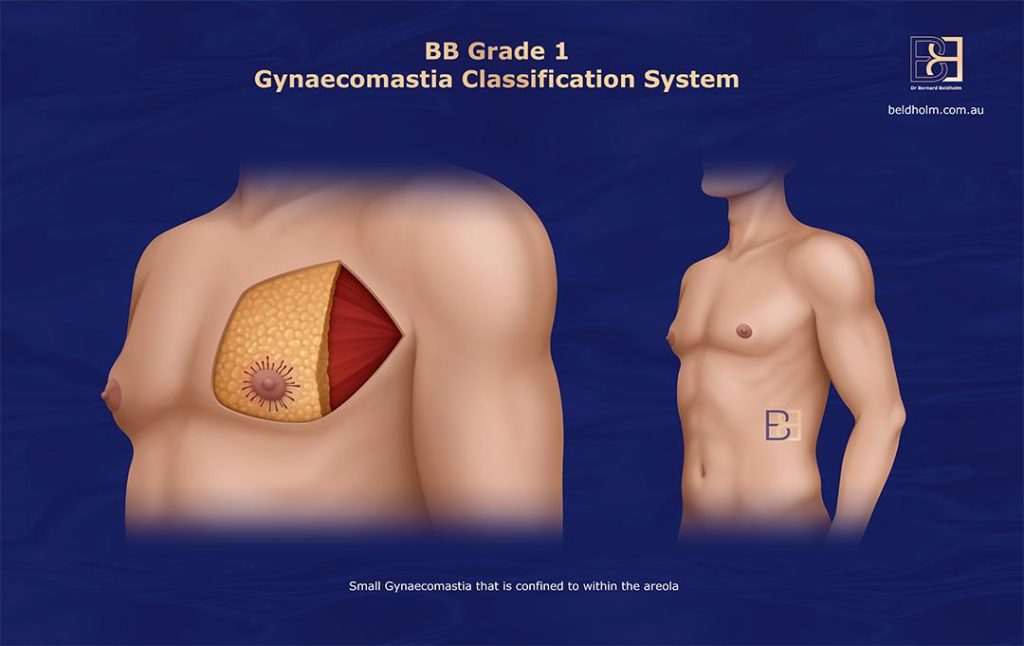
A firm disc of glandular tissue under the nipple, with no meaningful fatty component and the nipple sitting at or above the lower border of the pectoralis major. This includes the “puffy nipple”, where the gland is confined within the areola. Because the enlargement is glandular, liposuction (suction assisted lipectomy) on its own does not deal with it.
Operation: Subcutaneous mastectomy (gland excision) through a small infra-areolar incision, which keeps the scar hidden at the lower edge of the areola. See excision of gland for gynaecomastia.
BB Grade 2: Pseudogynaecomastia, no ptosis
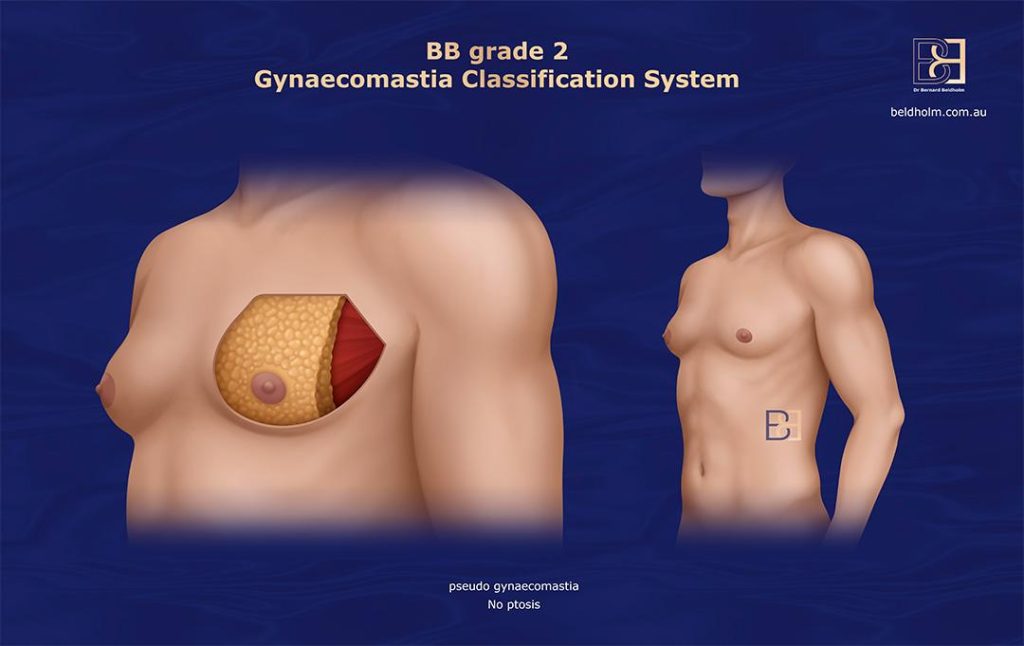
Enlargement from fat rather than gland, with no glandular disc, matching the fat pattern elsewhere on the body. The nipple sits at or above the lower border of the pectoralis major. With no firm gland to remove, this is a liposuction (suction assisted lipectomy) problem.
Operation: VASER liposuction (ultrasound assisted lipectomy) on its own. See VASER liposuction for gynaecomastia.
BB Grade 3: Glandular and fatty gynaecomastia, no ptosis
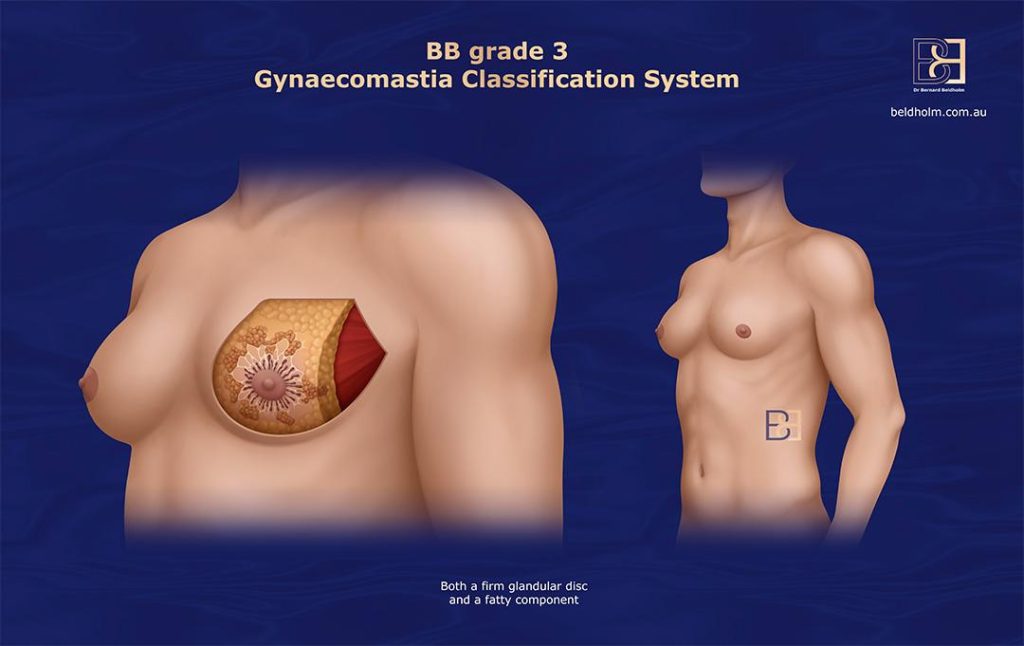
Both a firm glandular disc and a fatty component, with the nipple still at or above the lower border of the pectoralis major. Because both are present, one technique on its own tends to leave the result incomplete.
Operation: VASER liposuction (ultrasound assisted lipectomy) for the fatty component, followed by subcutaneous mastectomy (gland excision) through an infra-areolar incision. See VASER liposuction with gland excision for gynaecomastia.
BB Grade 4: Ptosis, with skin that will retract
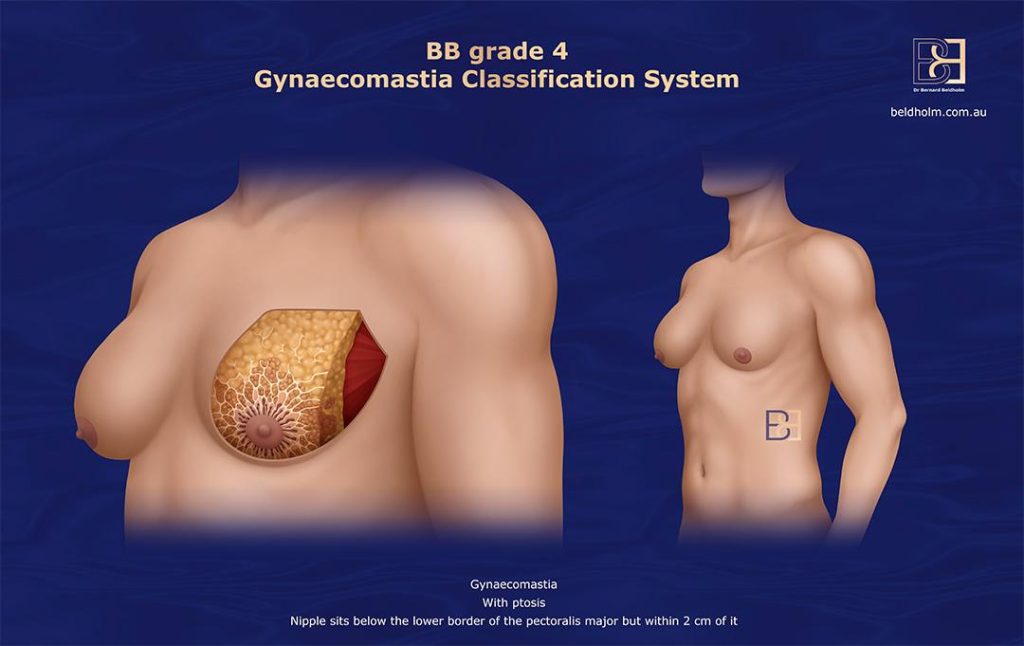
True or pseudogynaecomastia with true ptosis, where the nipple sits below the lower border of the pectoralis major but within 2 cm of it, and the skin quality is good, so the skin is likely to tighten once the volume underneath is removed. Because good skin retracts, the nipple usually settles close to its starting level after the tissue is taken out, so the lift does only as much as the individual needs.
Operation: VASER liposuction (ultrasound assisted lipectomy), gland excision, or both, through a superior incision, according to what is in the chest, with a crescent lift to elevate the nipple where needed, up to a maximum of 2 cm. See crescent lift for gynaecomastia.
BB Grade 5: Ptosis, with skin that will not retract, or a nipple beyond crescent reach
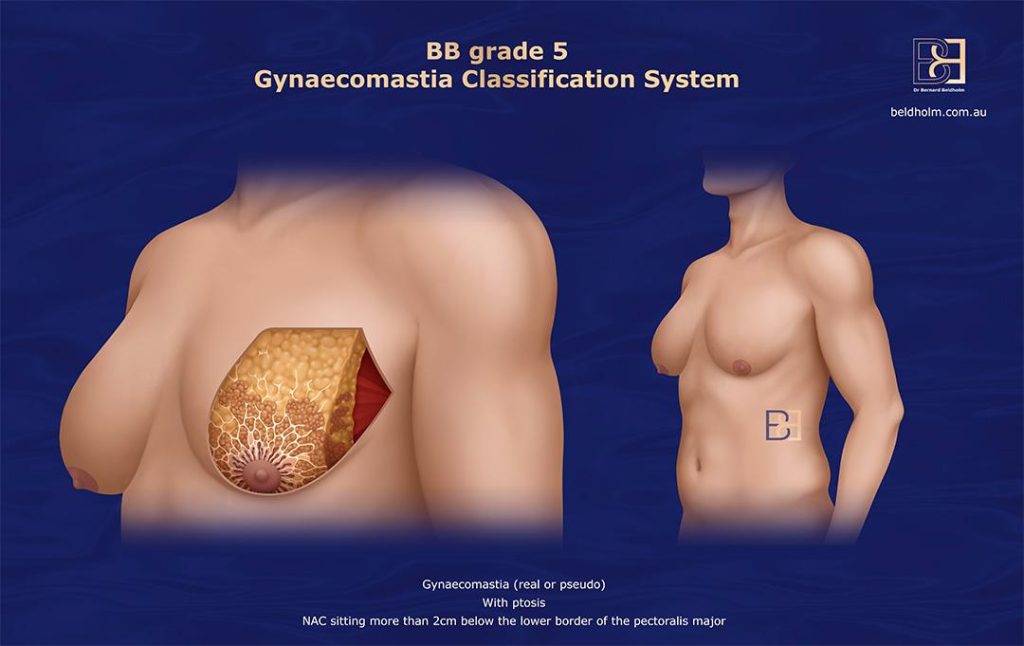
True or pseudogynaecomastia with true ptosis, where either the skin will not retract, because of loose skin, poor elasticity, stretch marks, or a significant weight-loss history, or the nipple sits more than 2 cm below the lower border of the pectoralis major, beyond what a crescent lift can raise.
Operation: Mastectomy with a free nipple graft, with or without VASER liposuction (ultrasound assisted lipectomy). This is an upper thoracic lift, also called a torsoplasty. The loose skin is removed and the nipple is repositioned as a graft. I prefer a free graft here rather than keeping the nipple on a pedicle. In an operation aimed at a flat chest, a pedicle tends to leave bulk that still reads as gynaecomastia, and it carries a risk of losing the nipple. A free graft lets me remove more tissue and skin and set the nipple in the right position. See mastectomy with free nipple graft for gynaecomastia.
How I decide between BB Grade 4 and BB Grade 5
The line between BB Grade 4 and BB Grade 5 comes down to one question.
Will the skin tighten back up once the volume underneath is removed?
To make that call consistent, I grade the skin itself, using a separate scale I developed, the BB skin elasticity grade.
The BB skin elasticity grade

I assess the skin on three things, then judge how it will behave after tissue is removed.
- Stretch marks, and how much of the chest skin they cover.
- Recoil, tested by pinching a fold of skin, releasing it, and watching how quickly it returns.
- Resting looseness, how much loose skin sits on the chest at rest.
That gives a grade from 1 to 5.
- Grade 1. No stretch marks, skin springs back at once, no looseness. The skin will tighten on its own once tissue is removed.
- Grade 2. A few fine stretch marks at most, a slight delay in recoil, little looseness. The skin is still expected to tighten.
- Grade 3. Scattered stretch marks, a clear delay in recoil, moderate looseness. Whether the skin tightens is uncertain. This is the decision point.
- Grade 4. Many stretch marks, sluggish recoil that does not fully return, loose skin. The skin is unlikely to tighten, so skin usually has to be removed.
- Grade 5. Extensive stretch marks, no spring back at all, a loose skin envelope. The skin will not tighten. Skin has to be removed, and at the top of this grade the nipple is repositioned as a free graft.
How the two grades set the operation
Skin elasticity works alongside the gynaecomastia grade, not instead of it. Two men with the same amount of tissue can need different operations purely on skin quality.
- Good elasticity, grades 1 to 2, with the nipple within 2 cm of the pectoralis major border: BB Grade 4. The skin retracts and the nipple settles near where it started.
- Poor elasticity, grades 4 to 5: BB Grade 5. The skin will not retract, so the envelope is removed and the nipple grafted. This holds even when the nipple is within 2 cm of the border, because the problem is the skin, not the nipple height. The post weight loss chest is the common example.
- Nipple more than 2 cm below the border: BB Grade 5, because it is beyond what a crescent lift can raise.
Elasticity grade 3 is the genuine middle. Where I cannot predict how the skin will behave, I do the BB Grade 4 operation first, reassess the skin at six to twelve months, and move to BB Grade 5 only if the skin has not retracted. That avoids putting the longer chest wall scars on a man whose skin would have tightened on its own.
When surgery is and is not the first step

Book your appointment online now
Not every enlarged male chest needs surgery, and surgery is not the first thing I reach for.
- Adolescents. Gynaecomastia during puberty is common and frequently settles on its own. It is not usually a reason for early surgery in a young person. Where it is well established and stable, assessment is reasonable, but observation over time comes first.
- An untreated cause. Where there may be a hormonal cause, a contributing medication, or another agent, that is looked into and treated first. Surgery does not change an ongoing cause, and where a driver is still active the enlargement can return. No one should stop a prescribed medication on their own. That is done with medical guidance.
- Weight not yet stable. In men with a large fatty component and a weight-loss history, I plan surgery once weight is stable.
Risks and recovery
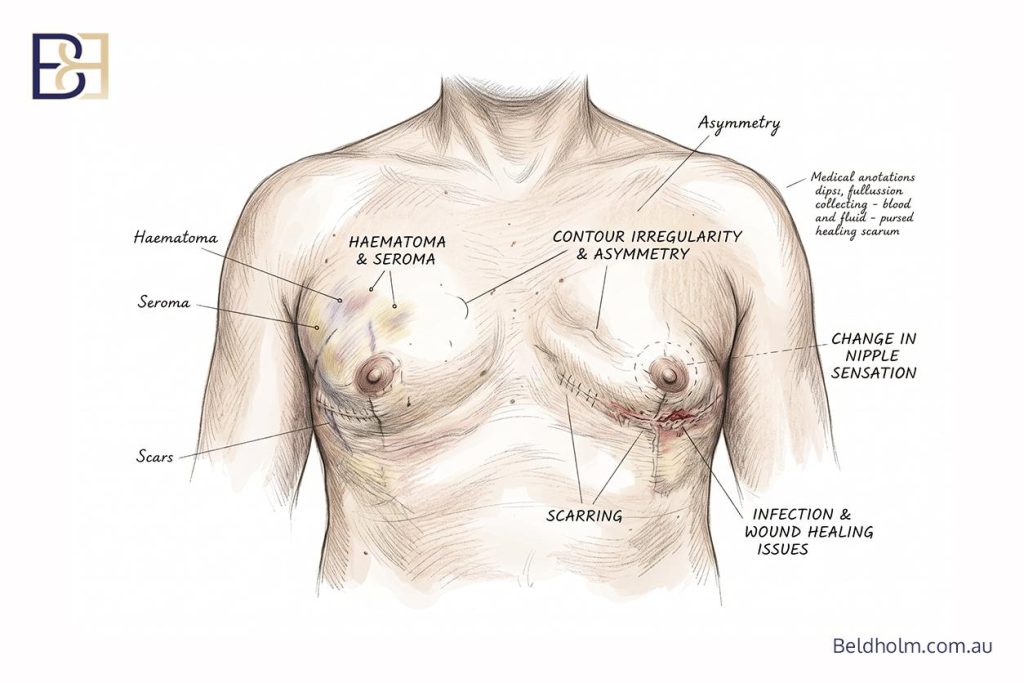
Surgery on the chest carries serious risks. The specifics differ by operation, and each operation page covers its own recovery and complications in detail. The points below apply across the procedure. I go through all of this individually before any decision is made.
- Haematoma, a collection of blood under the skin, is a notable risk in chest surgery of this kind and sometimes needs a return to theatre.
- Seroma (a fluid collection), infection, and wound healing problems can occur.
- Contour irregularity and asymmetry. The two sides may not match exactly, and small dips or areas of fullness can remain.
- Change in nipple sensation, which may be temporary or lasting.
- Scarring. Smaller grades keep the scar around the areola. Higher grades leave longer scars on the chest wall, and where the nipple is repositioned or grafted there are further scars.
- Recurrence. Surgery removes the tissue that is present. It does not change an ongoing cause. Where a hormonal driver, a medication, or another agent is still active, enlargement can come back. This is why the cause is assessed before surgery.
Recovery takes time. A compression garment is usually worn for several weeks. Drains are sometimes used. Return to exercise is staged rather than immediate, and heavier training is brought back gradually. Swelling and firmness settle over months.
Some men need a planned second procedure, particularly where skin retraction was uncertain at the start.
How this differs from earlier systems
Several grading systems for gynaecomastia already exist. Mine differs in a few ways.
- Each grade is an operation. The five grades map one to one onto the five operations I use, so the grade points to the treatment rather than leaving a separate step to work out what to do.
- Ptosis is measured from the nipple against the lower border of the pectoralis major, not the inframammary fold, which is unreliable in men.
- Skin quality is graded separately. Whether the skin will retract decides the operation at the top end, so I assess it with its own skin elasticity grade that modifies the gynaecomastia grade.
- It grades both true gynaecomastia and pseudogynaecomastia.
I have set out a full comparison with the earlier systems in comprehensive summary of gynaecomastia grading systems.
Bringing it together

After examining the chest and going through the history, goals and expectations, I explain the options, the risks, the recovery, and the likely result for that individual. The grade points to the operation. Further detail on the procedure itself is in essential insights on gynaecomastia surgery for men.
References
- Barros ACSD, Sampaio MDCM. Gynaecomastia: physiopathology, evaluation and treatment. Sao Paulo Med J. 2012;130(3):187-97.
- Gusenoff JA, Coon D, Rubin JP. Pseudogynaecomastia after massive weight loss: detectability of technique, patient satisfaction, and classification. Plast Reconstr Surg. 2008;122(5):1301-11.