


Some patients decide to have their breast implants removed and, in the same discussion, ask what happens to the shape of the breast once the implant is gone. For many, removing the implant on its own leaves a skin envelope that is larger than the breast tissue left behind, and the nipple positioned lower on the breast than it was with the implant in place. A breast lift (mastopexy) performed with the removal reshapes the remaining tissue, removes the excess skin, and repositions the nipple and areola.
Doing both in the one operation is a larger undertaking than either part alone. It also carries a different set of risks, and that is what this article covers: what can go wrong when breast implant removal (explant surgery) is combined with a breast lift (mastopexy), why the combination changes the risk picture, and how I work to reduce those risks in my practice.
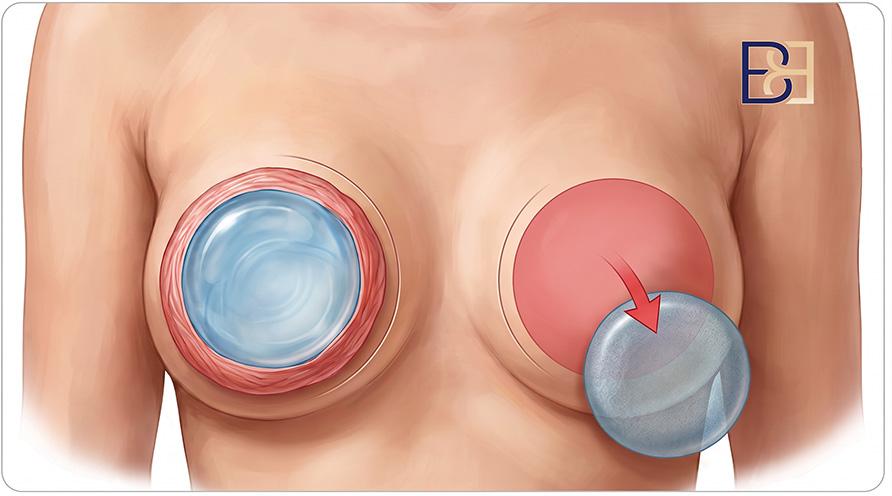
People come to implant removal for different reasons. Some are dealing with implant-related complications such as capsular contracture, a tightening and hardening of the scar tissue around the implant, or an implant rupture. Some are acting on concerns about breast implant illness, a term used for a range of systemic symptoms some people attribute to their implants, or about BIA-ALCL, a rare condition linked to some textured implants. Others no longer want implants. This article is about removing breast implants without replacing them, combined with a breast lift (mastopexy). Removing and replacing implants with new implants (implant exchange, or implant replacement) is a different operation, covered separately.
What the combined operation involves
The operation has two distinct parts.
Breast implant removal (explant surgery). The implant is taken out. This is the breast implant removal procedure. Depending on your circumstances, the capsule (the layer of scar tissue your body forms around any implant) may be left in place, partially removed, or removed in full. Removing the capsule is called a capsulectomy. Capsule removal has its own risks, which I cover later in this article.
Breast lift (mastopexy). Once the implant is out, the breast is reshaped. A lift removes excess skin, tightens the remaining skin envelope, reshapes the breast tissue, and repositions the nipple and areola higher on the breast mound. The pattern of the lift, and therefore the pattern of the scars, depends on how much skin needs to be removed.
Why the two are often done in the same operation
When an implant has been in place for some years, the skin and breast tissue accommodate its volume. Take the implant out and the tissue does not always draw back on its own. The skin may be loose, and the breast may sit lower than it did with the implant in.
Removing the implant deals with the volume. It does not change the skin envelope or the breast position. A breast lift (mastopexy) is what reshapes the breast once the volume is gone. For a patient who wants to remove breast implants and also wants the breast reshaped, combining the two means one anaesthetic and one recovery rather than two.
Whether the two are done together or separated into stages is not a given. I return to that decision later in this article, because it directly affects the risk profile.
A bigger operation than either part alone
Combining implant removal and a lift is a larger physiological event than either part on its own. A longer time under anaesthetic and more surgical work in the same breast place more demand on the body, and on the tissue’s blood supply, than a single, smaller operation does (1). That is the trade-off of consolidating the work, and it is why preparation before surgery and a clear plan for recovery matter.
Why combining the two operations changes the risk picture
The risks of this operation are not just the risks of removing an implant added to the risks of a lift. When the two are done together, in the same breast, at the same time, they interact. A few things drive that.
Two operations in one breast, in one sitting

Removing an implant is one piece of surgical work. Lifting the breast is another. Done together, both happen in tissue that has already been operated on at least once, when the implant was first placed. Each earlier operation leaves scar tissue and changes the local anatomy (1).
Blood supply that has already been altered
This is the central issue, and most of the complications in this article trace back to it.
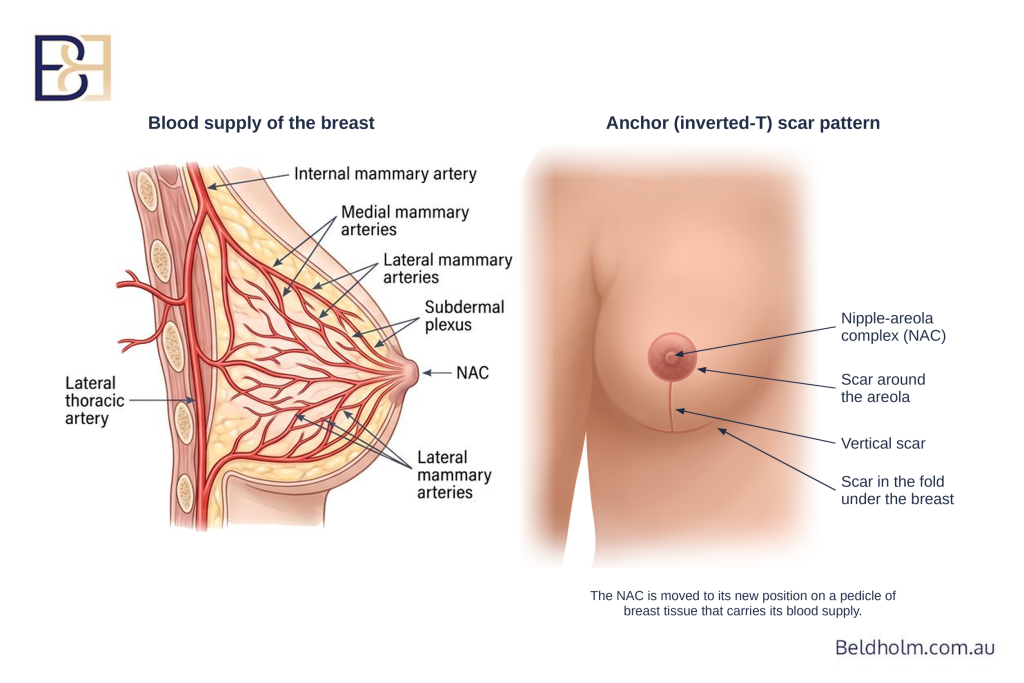
The skin of the breast, and the nipple and areola in particular, stay alive because of their blood supply. A breast lift (mastopexy) works by lifting the nipple and areola on a pedicle, a stalk of tissue that carries the blood supply with it, while excess skin is removed around it. The lift depends on that blood supply reaching the nipple and the skin edges reliably (2).
When an implant has already been placed once, that first operation has already altered the blood supply to the breast tissue and skin. Removing the implant, and the capsule where indicated, alters it further. A lift is then performed on that same tissue, relying on a blood supply that two earlier steps have already reduced. The more the blood supply is drawn on, the higher the risk that skin edges or the nipple do not get enough of it to heal well, or in a small number of cases, to survive (2). This is why blood supply, not scarring or shape, is the risk I weigh most carefully when planning this operation.
Skin tension and where the breast tissue settles
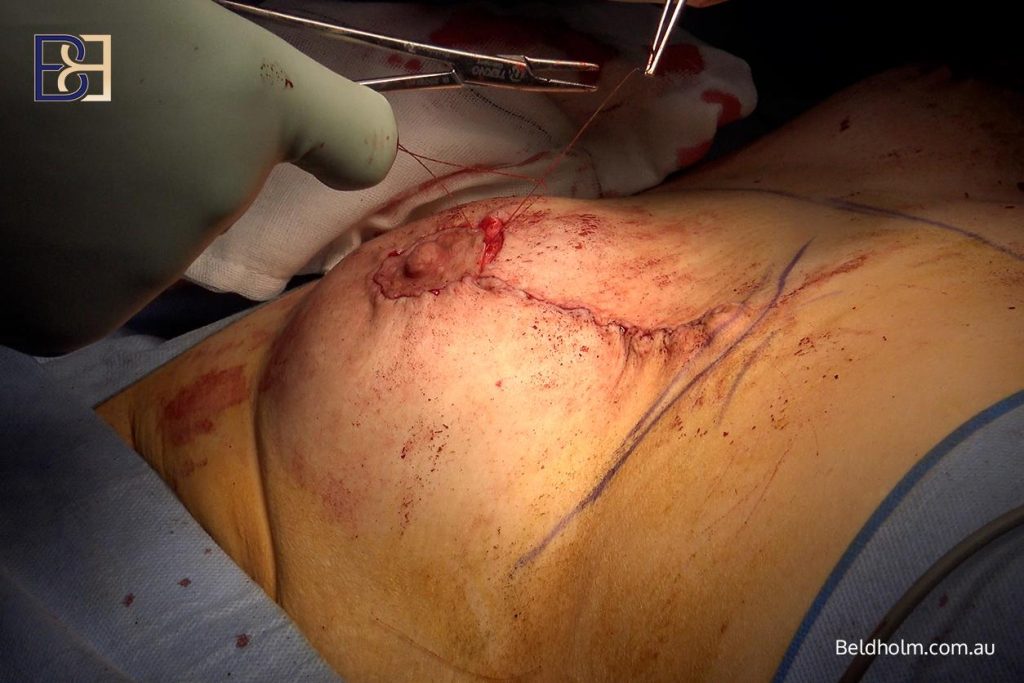
Taking the implant out removes the volume the skin had stretched to hold. A lift then tightens that skin and reshapes the tissue underneath. Getting the balance right, between removing enough skin to reshape the breast and leaving the skin under enough tension to heal without breaking down, is harder when the starting volume has just been removed. Too much tension slows healing and widens scars. Too little leaves the breast lower than planned. Where the tissue finally settles as it heals is not fully predictable, and I cover that on its own further on.
Why this points toward staging for some patients
Because blood supply is the limiting factor, splitting the work into two stages, removing the implant first and performing the lift at a later operation, can be the more appropriate path for some patients. Staging lets the breast recover its blood supply between operations, which can protect the nipple and improve how the scars heal.
The nipple and areola: sensation, blood supply, and viability
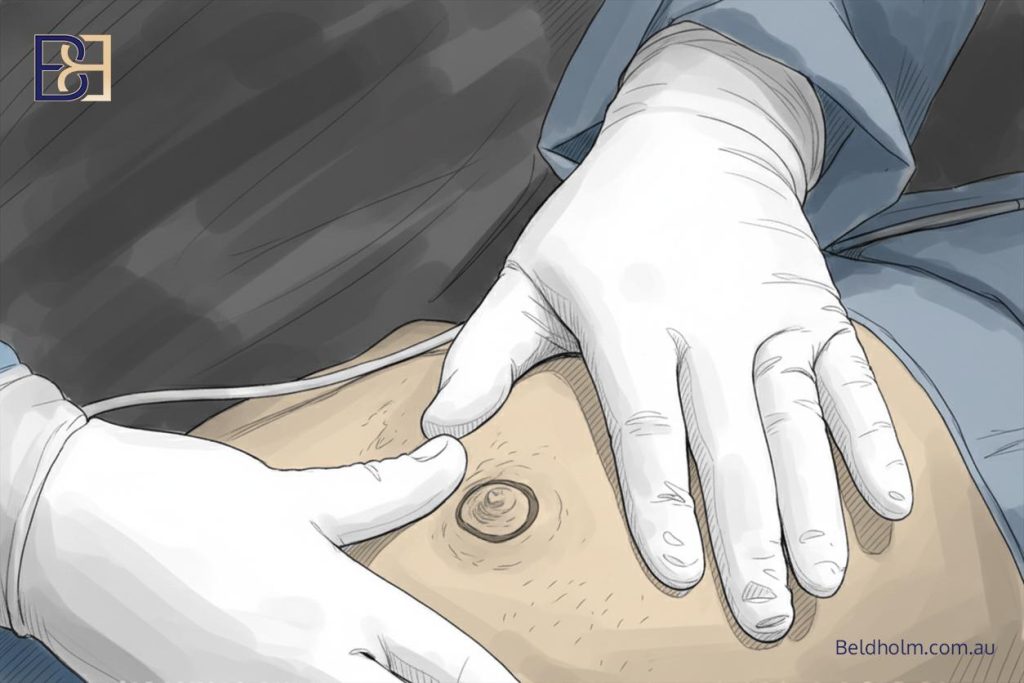
Of all the risks in this operation, the ones affecting the nipple and areola matter most, because they follow directly from the blood supply issue set out above. This section covers what can happen to nipple sensation, and the less common but more serious risk to the nipple’s survival.
How the nipple survives a lift
During a breast lift (mastopexy), the nipple and areola are not removed. They stay attached to the breast on a pedicle, a stalk of tissue that keeps the blood supply and nerves connected while the skin around them is removed and the breast is reshaped (2). Keeping that pedicle intact and well supplied with blood is what keeps the nipple alive and, as far as possible, able to feel.
The nipple and areola draw their blood from a network of small vessels running through the breast tissue. When an implant was first placed, that surgery already passed through some of this tissue. Removing the implant and any capsule passes through it again. The lift then relies on the blood supply that remains. That is the sequence behind the risks below.
Changes to nipple sensation

Altered sensation of the nipple and areola is one of the more common outcomes of a breast lift (mastopexy). The nerve that supplies most nipples runs through the outer part of the breast and can be stretched or divided as the breast is reshaped (2).
Sensation can change in either direction. Some patients notice numbness or reduced feeling. Some notice increased sensitivity that settles over time. For many, sensation recovers over weeks to months as the nerves recover. For some, the change is permanent. I cannot predict in advance whose sensation will return and whose will not.
A change in nipple sensation can also affect the ability to breastfeed in the future. Whether breastfeeding is possible after this operation is assessed individually and cannot be assured either way.
Risk to the nipple’s blood supply and survival
This is the risk that sits behind the whole operation. If the blood supply to the nipple is not enough after the reshaping, the nipple can suffer for it.
At the milder end, the skin of the areola may heal slowly, or lose some pigment, or the edge of the areola may take longer to settle. At the more serious end, part or all of the nipple and areola can lose its blood supply and not survive. Full loss of the nipple is uncommon, but it is a real risk, and it is higher when a lift is combined with implant removal than when a lift is done on its own (1). If part of the nipple is lost, the area heals as a wound and may later need reconstruction or a graft to rebuild the nipple.
The same shortage of blood supply can affect areas of breast skin or fat away from the nipple, which I cover in the wound healing and shape sections further on.
What raises this risk, and what I do about it

Several things make blood supply problems more likely:
- Smoking and vaping. Nicotine narrows the small blood vessels the nipple depends on. This is the single largest modifiable risk to nipple survival, and it is the reason I ask patients to stop well before surgery.
- Previous breast surgery, which has already altered the blood supply, as in this combined operation.
- The size and pattern of the lift, since a larger lift moves the nipple further and relies on a longer pedicle.
- Diabetes and some other medical conditions that affect the small blood vessels.
To reduce the risk, I plan the pedicle to preserve as much blood supply as possible, avoid over-tightening the skin, and for some patients recommend staging the implant removal and the lift into separate operations so the breast can recover its blood supply in between.
Wound healing problems
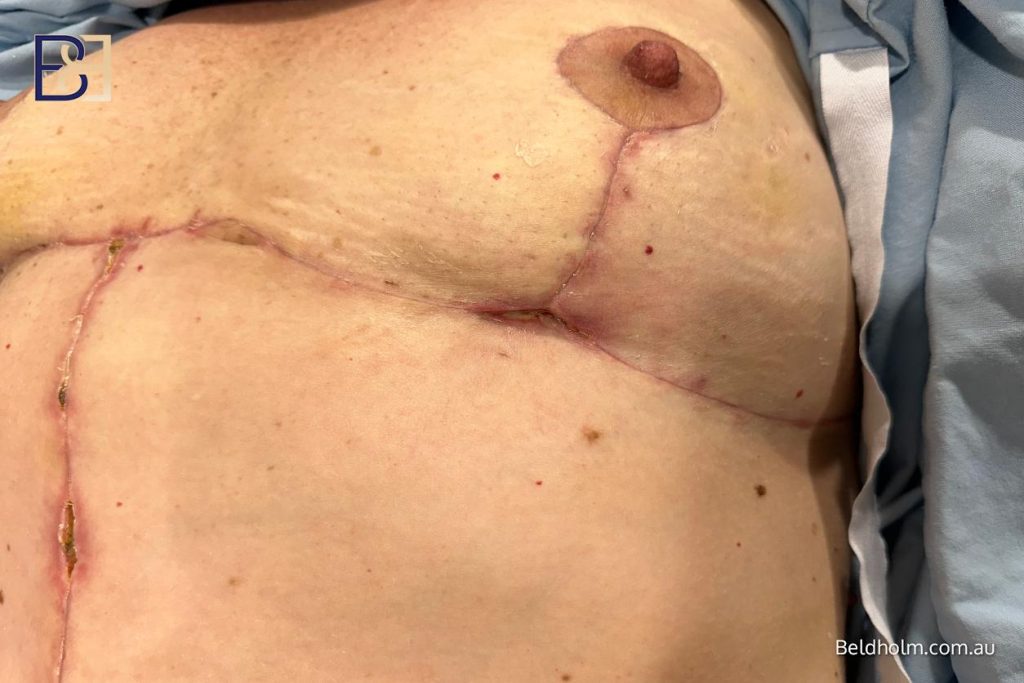
Because this operation relies on a blood supply that earlier surgery has already reduced, wound healing is one of the areas most affected. Most patients heal without a major problem, but delayed healing and wound breakdown are more common here than after a lift on its own, and they are worth understanding before you decide.
Delayed healing and wound breakdown
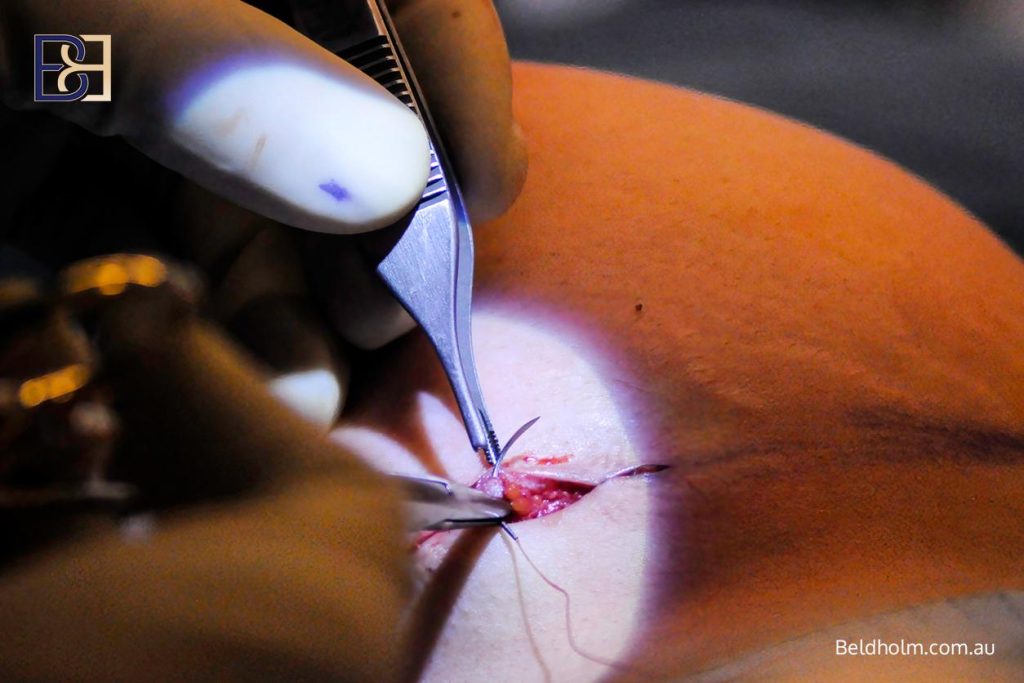
The incisions from a breast lift (mastopexy) are closed under some tension, because the point of the lift is to tighten a skin envelope that has just had its volume removed. Skin closed under tension, on a reduced blood supply, does not always heal in a straight line to time.
Some patients have areas where the skin edges are slow to join, or where a small part of the wound opens after surgery. This is called wound breakdown, or dehiscence. When it happens it is usually at the points under the most tension, and it is managed with dressings and wound care rather than a return to theatre. A wound that heals slowly, or that opens and heals from the base up, tends to leave a wider or firmer scar in that spot.
The T-junction
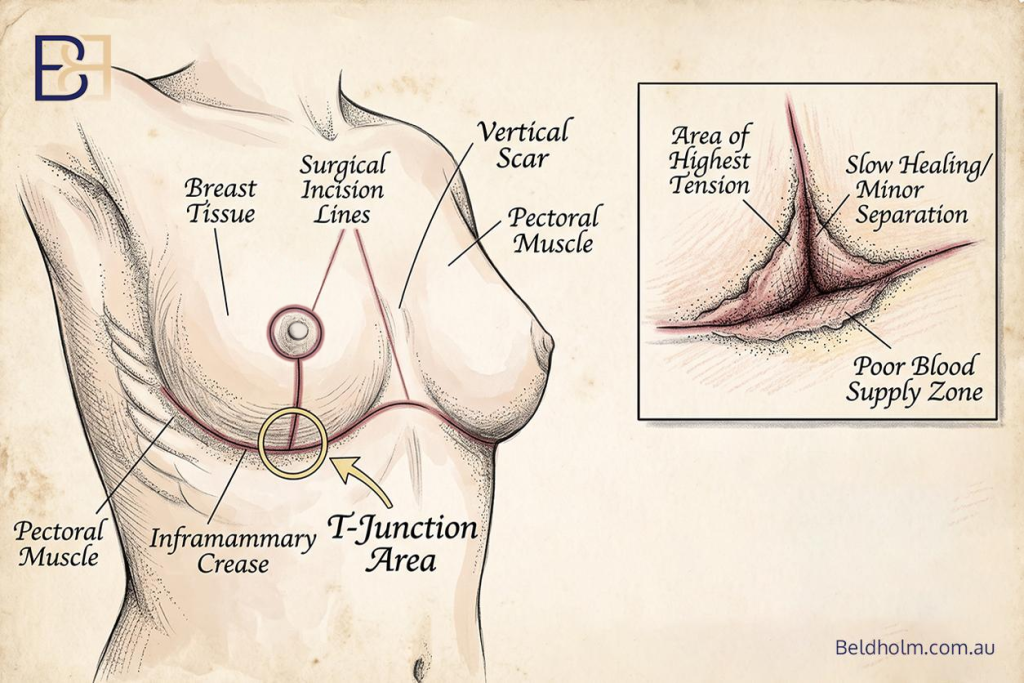
Most lifts that follow implant removal use a vertical or an inverted-T (anchor) pattern. In the inverted-T pattern, the vertical incision meets the horizontal incision in the fold under the breast at a point called the T-junction.
The T-junction is the part of the wound under the most tension and with the least reliable blood supply, so it is the single most common place for delayed healing or a small wound breakdown after this type of lift (1). If it happens, it is managed with dressings and time. It usually settles, though it can leave a small area of firmer or wider scar.
Dog ears
At the outer ends of the incisions, the skin can bunch into a small pucker called a dog ear. Small ones often flatten as the swelling settles over the months after surgery. Ones that remain can be flattened with a minor revision under local anaesthetic once everything has healed.
Fat necrosis
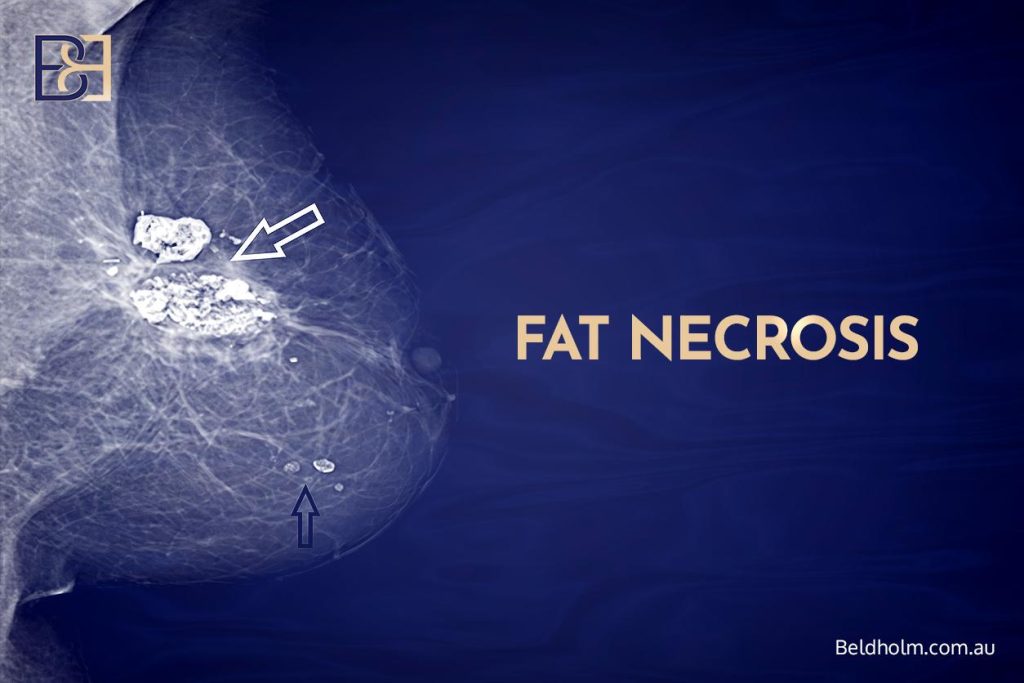
When an area of fatty breast tissue loses too much of its blood supply, it can firm up and form a lump. This is called fat necrosis. It can feel hard, and because it can look and feel like other things on examination or imaging, it sometimes needs an ultrasound, and occasionally a biopsy, to confirm what it is. Small areas often soften over time. Larger firm areas sometimes need to be removed.
Stitches that react or work their way out
The deep stitches used to hold the reshaped breast together dissolve over time. In some patients a stitch works its way to the surface and is pushed out through the skin, which is called a spitting stitch, or forms a small firm reaction around it. These are minor, are dealt with in the rooms, and settle once the stitch has cleared.
What raises the risk, and what I do about it
The things that slow wound healing are much the same as those that threaten the nipple:
- Smoking and vaping, which reduce blood supply to the skin edges. This is the largest modifiable factor.
- Diabetes and some other medical conditions.
- Tension across the closure, which is greater when more skin is removed.
- Previous breast surgery, which has already altered the blood supply, as in this operation.
To reduce the risk, I close the skin with as little tension as the reshaping allows, ask patients to stop smoking and vaping well before surgery, and use Comfeel dressings on the wounds. I review the wounds at my follow-up visits and manage any slow-healing area as it comes up. Where the blood supply is a particular concern, staging the operation is one of the ways that risk is lowered, which I cover further on.
Scarring
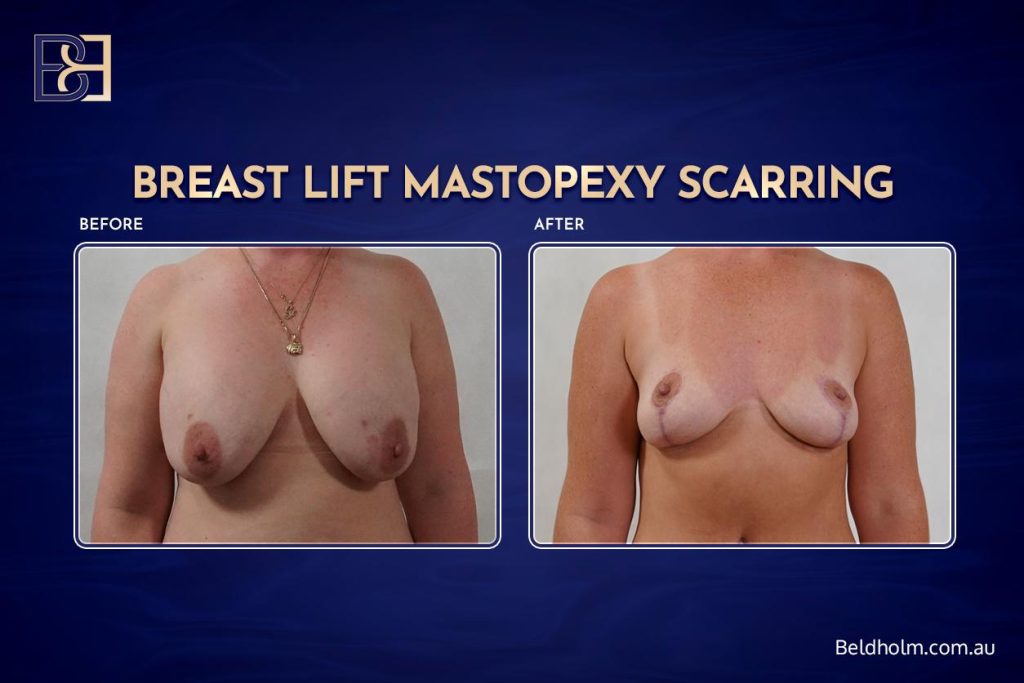
Disclaimer: Results vary, Surgery has risks, Seek 2nd opinion. Operation performed by Dr Beldholm
A breast lift (mastopexy) is a trade. Breast implant removal surgery on its own can often be done through a small incision, sometimes an old scar. Adding a lift means accepting more scarring in exchange for reshaping the breast and repositioning the nipple. If you are not prepared to accept the scars a lift leaves, that changes the conversation, and it is worth thinking through before surgery, not after.
Where the scars are
The pattern of the lift decides the pattern of the scars. There are three common patterns, and which one you need depends on how much skin has to be removed.
- Around the areola (periareolar). A scar runs around the edge of the areola. Used on its own only for smaller lifts.
- Around the areola and vertically down (lollipop). Adds a vertical scar from the bottom of the areola to the fold under the breast. This is a common pattern after implant removal.
- The inverted-T or anchor. Adds a horizontal scar along the fold under the breast to the two above. Used when more skin needs to be removed.
More skin to remove means a larger scar pattern. When a lot of volume has been taken out with the implant, there is often significant excess skin, and a larger pattern is needed to reshape the breast.
Scars are permanent
The scars from a lift are permanent. They fade and flatten over the twelve to eighteen months after surgery, and in many patients they settle to pale, flat lines. They do not disappear. In the early months they are usually pink or red and raised, and this stage can last longer than people expect.
Scar quality varies
How a scar turns out depends heavily on how your skin heals, and that is not something I can fully predict or control. The same operation done the same way can leave a fine scar on one person and a thicker one on another.
Some scars become raised, firm and red, which is called a hypertrophic scar. Some people form keloid scars, which spread beyond the original wound (1). Scars can also widen, darken, or stay raised rather than settling flat. This is more likely in patients who scar this way elsewhere on their body, in areas closed under tension, and where a wound has been slow to heal or has broken down, which is why the wound healing problems covered earlier feed directly into how the scars look.
Revision
If a scar heals poorly, it can sometimes be revised once it has matured, usually after twelve months, often under local anaesthetic. Revision can improve a scar, but it cannot erase it, and it carries the same healing risks again.
What I do about it
I cannot change how your skin forms scar, but several things help:
- I choose the smallest lift pattern that will do the job, so no more scar is created than the reshaping needs.
- I close under as little tension as possible, since tension worsens scars.
- I ask patients to stop smoking and vaping, since poor healing worsens scars.
- Once the wounds have healed, scar management with silicone and sun protection can help the scars settle, and I go through this at follow-up.
Even with all of this, the final look of the scars varies between patients, and I would rather you expect that from the start.
Bleeding, haematoma, seroma and infection
These are the early complications, the ones that show up in the first hours to weeks after surgery. They are common to both parts of the operation, and combining the two means a larger raw surface and a longer operation, which lifts the chance of each (1).
Bleeding and haematoma
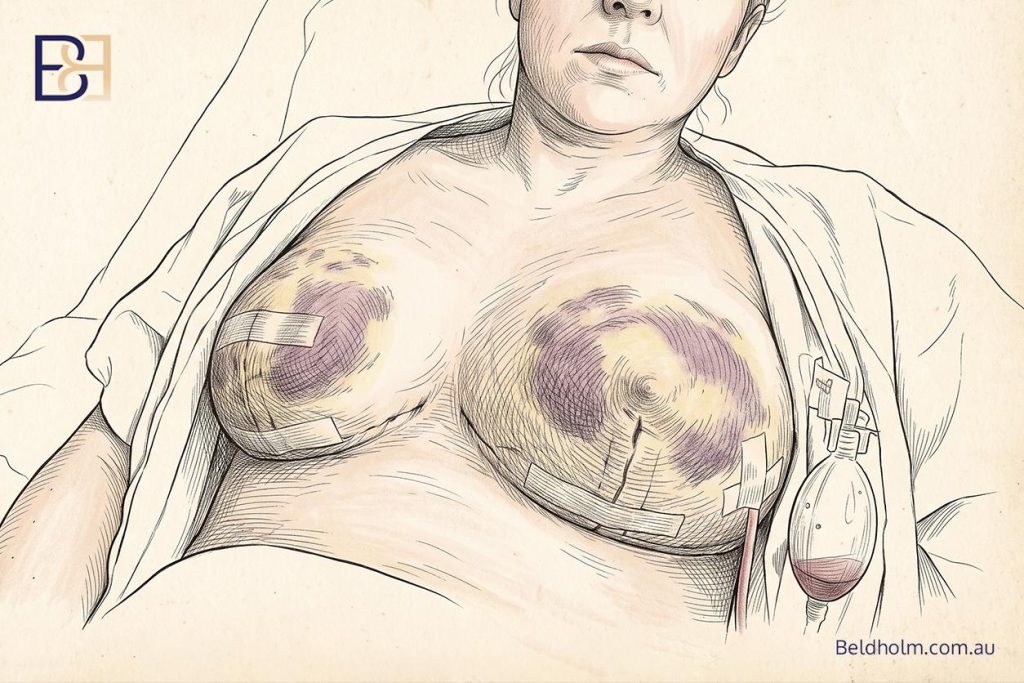
A haematoma is a collection of blood that builds up inside the breast after surgery, usually in the first day or two. A significant one causes sudden swelling, tightness, pain, often bruising, and one breast looking larger or firmer than the other. A haematoma that is more than small usually needs a return to theatre to release the blood and stop the bleeding point. It is one of the more likely reasons a patient goes back to surgery in the early days.
The main things that raise the bleeding risk are blood-thinning medications and supplements. I go through these before surgery and plan when to stop them. Aspirin and anticoagulants are usually stopped about a week before surgery, but this is planned in advance for each patient, and some patients need to continue them through surgery. You should never stop or start these on your own. Stopping the wrong medication, or the right one at the wrong time, carries its own risk.
Seroma
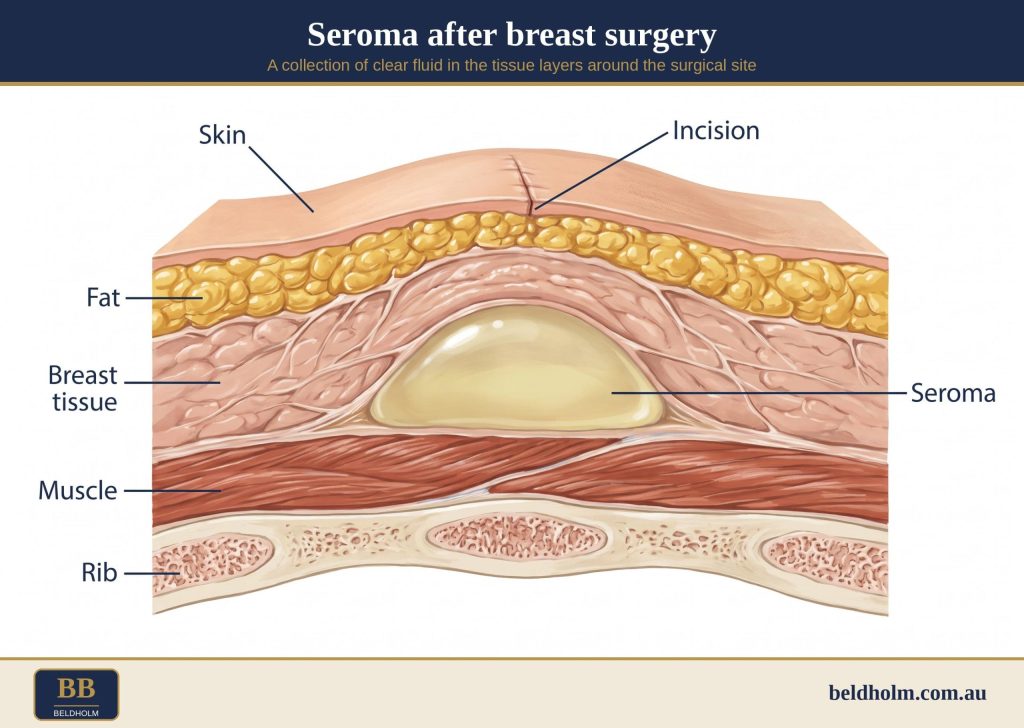
A seroma is a collection of clear fluid, rather than blood, that can gather in the space where the implant was or under the lifted tissue. It tends to appear a little later than a haematoma, over the first weeks. Small ones are often left to reabsorb on their own. Larger ones can be drained with a needle in the rooms, sometimes more than once.
Drains
Because this operation can leave two spaces, the old implant pocket and the area that has been lifted and reshaped, I sometimes place a drain to drain excess fluid and blood while things settle, which can also help reduce swelling. If a drain is used, it stays in until the drainage drops off, usually a few days, and it is removed in the rooms.
Infection
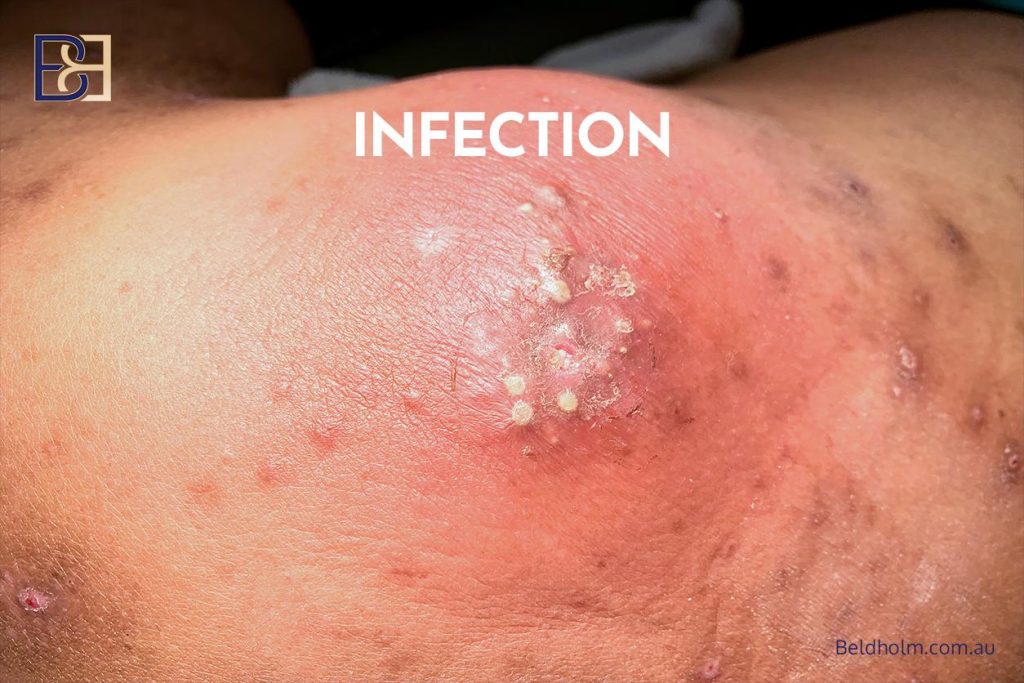
Any operation can become infected. After this one, infection usually shows as a wound that becomes red, hot, swollen, increasingly sore, or starts to discharge, sometimes with a fever, over the first week or two. Most infections are treated with antibiotics. A more serious infection can need a return to theatre to wash out the area, and can worsen the scarring in that spot.
Infection is more likely in patients who smoke or vape, who have diabetes, or where a wound has been slow to heal. The steps that lower it are sterile technique in theatre, antibiotics around the time of surgery, good wound care afterwards, and the same stopping of smoking that helps everything else heal.
Why the combined operation raises these
A longer operation and a larger raw surface give bleeding and fluid more opportunity, and infection more territory. This is part of what makes the combined operation a bigger event than either part alone, and part of what goes into the decision about whether to do it in one sitting or in stages.
Capsule removal and its own risks
When an implant is removed, there is a decision to make about the capsule, the shell of scar tissue the body forms around every implant. This decision matters here because removing the capsule adds surgery, and that surgery has its own risks that stack on top of the lift.
What the capsule is, and the options
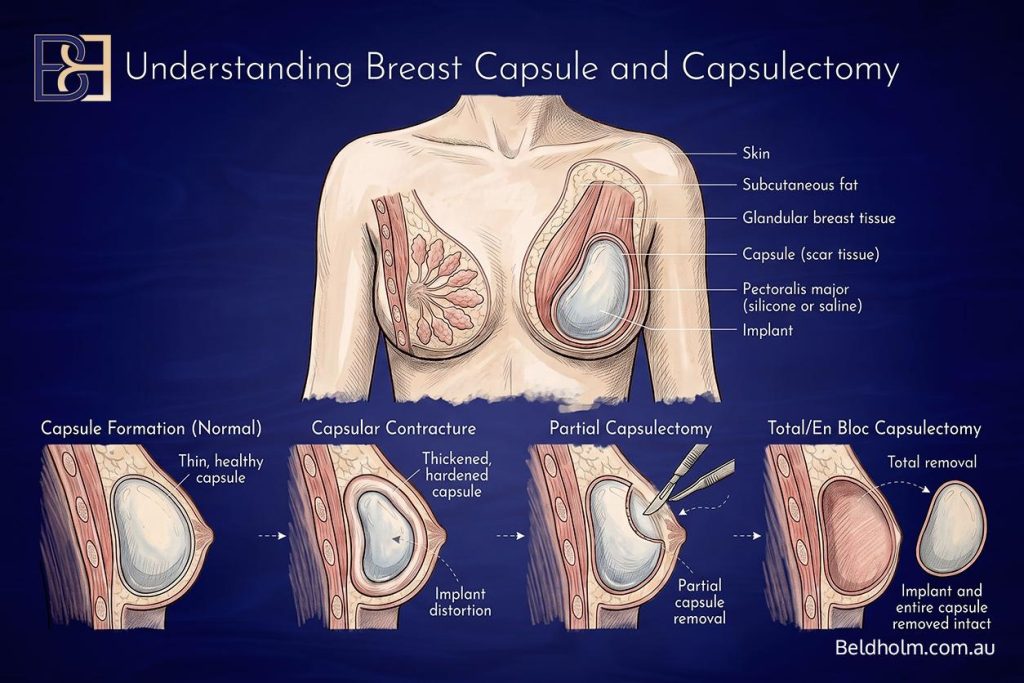
Whether you have silicone or saline implants, your body forms a layer of scar tissue, the capsule, around them. It is a normal response, not a complication in itself. When the implant comes out, the capsule can be:
- Left in place. For a thin, soft capsule, leaving it is often reasonable and avoids the extra surgery of removing it (2).
- Partially removed (partial capsulectomy). The thickened or calcified part is taken out and the rest left.
- Completely removed (total capsulectomy). The entire capsule is removed.
- Removed with the implant as one unit (en bloc). The capsule and implant come out together without opening the capsule. This is a specific approach used when there is a reason to keep the capsule intact, such as findings that need to be examined by a pathologist.
Whether the capsule needs to come out, and how much of it, is a clinical judgement. A thick or calcified capsule, which is what happens with capsular contracture, a capsule affected by an implant rupture, or a capsule where there is a concern that needs pathology are the situations where removal is indicated. Severe capsular contracture, where the capsule has tightened and hardened, is one of the more common reasons to take the capsule out. A thin, soft, healthy capsule can often be left, and removing it in that situation may add risk without adding benefit (2).
Why removing the capsule adds risk
The capsule sits directly on the chest wall, over the ribs and the muscle between them. The further back the capsule is removed, the closer the dissection gets to the lining of the lung.
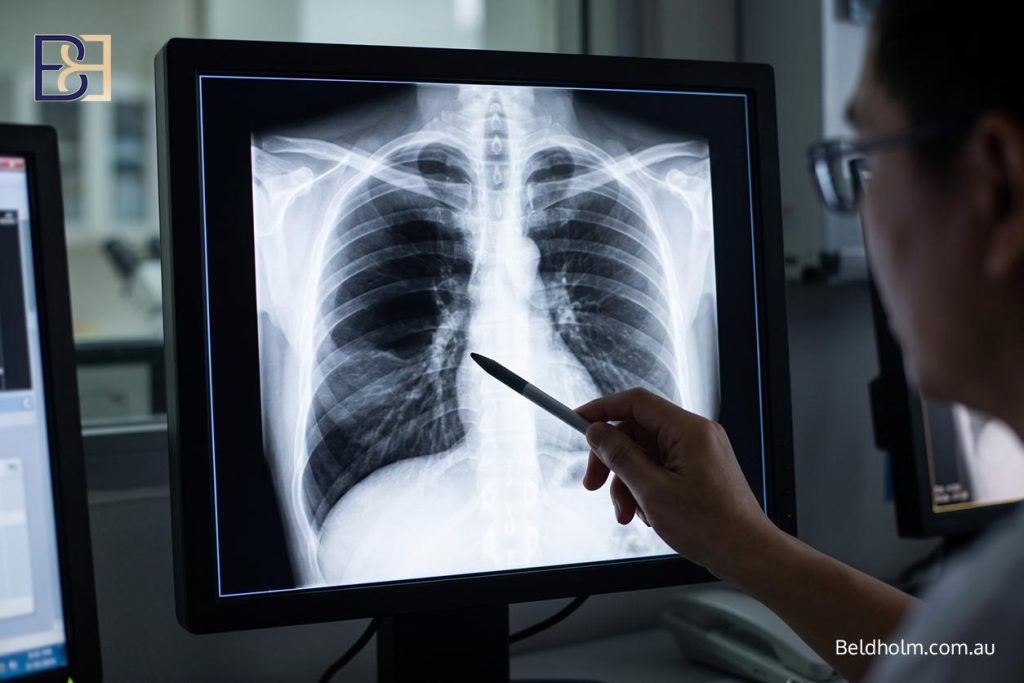
- Pneumothorax. Removing the full capsule, particularly the part against the chest wall, carries a risk of making a small hole in the lining around the lung, which lets air collect around it. This is called a pneumothorax. It is uncommon, but it is a recognised risk of total capsulectomy, and a significant one can need a chest drain to reinflate the lung (2).
- More bleeding. Taking the capsule off the chest wall leaves a larger raw surface, which raises the risk of bleeding and haematoma covered earlier (2).
- A longer operation. A total capsulectomy takes considerably longer than leaving the capsule, which adds to the time under anaesthetic and to the demand of an operation that already has two parts.
- Thinner tissue over the lift. Removing the capsule takes surrounding tissue away from the layer the lift then has to work with, which can affect the blood supply and the shape.
How the capsule decision interacts with the lift
This is the point that matters when the capsule work and a lift are done together. Every one of the effects above draws on the same blood supply and the same tissue the lift depends on. A long capsulectomy on a large raw surface, followed by a lift on what is left, asks a great deal of one breast in one operation. This interaction is one of the reasons some patients are better served by staging the two, which I come to further on.
What I do about it
I decide on the capsule for each patient, based on what the capsule is like and why the implant is being removed. Imaging before surgery is not routine for implant removal, but I use it when the history or examination raises a question that changes the surgical plan, such as a suspected implant rupture. I send the capsule for histopathology in all my cases.
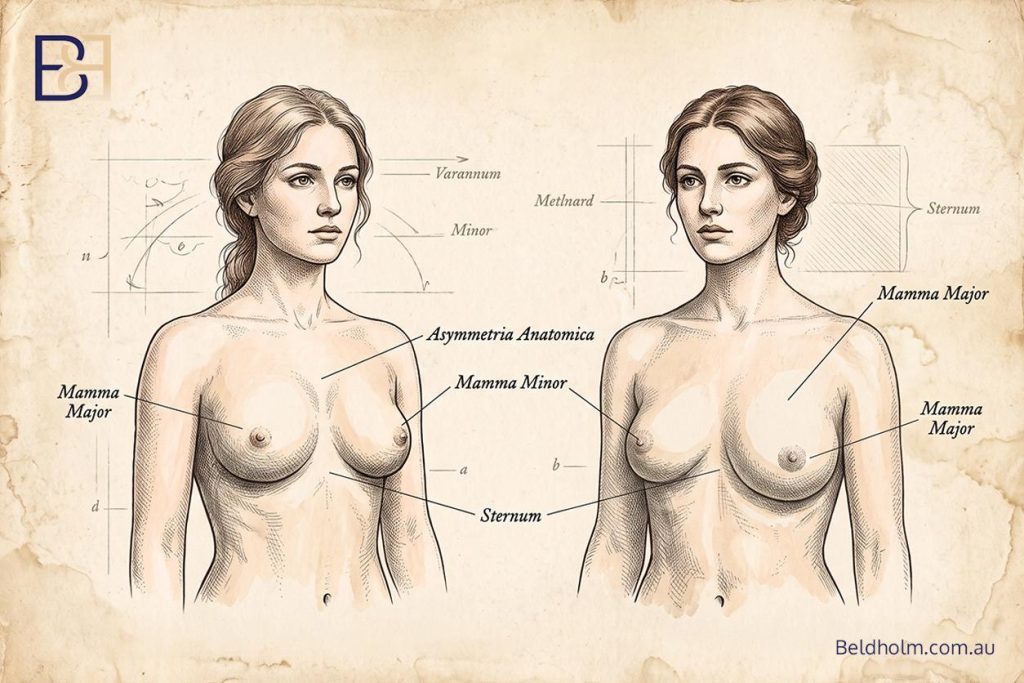
Once the implant is out, the breast is smaller and made up of your own tissue. The lift handles the breast reshaping and repositions the nipple, but it works with the tissue that is there. How the breast appearance settles as it heals depends heavily on the quality of that tissue, and some of that is outside anyone’s control.
Ptosis that persists or returns
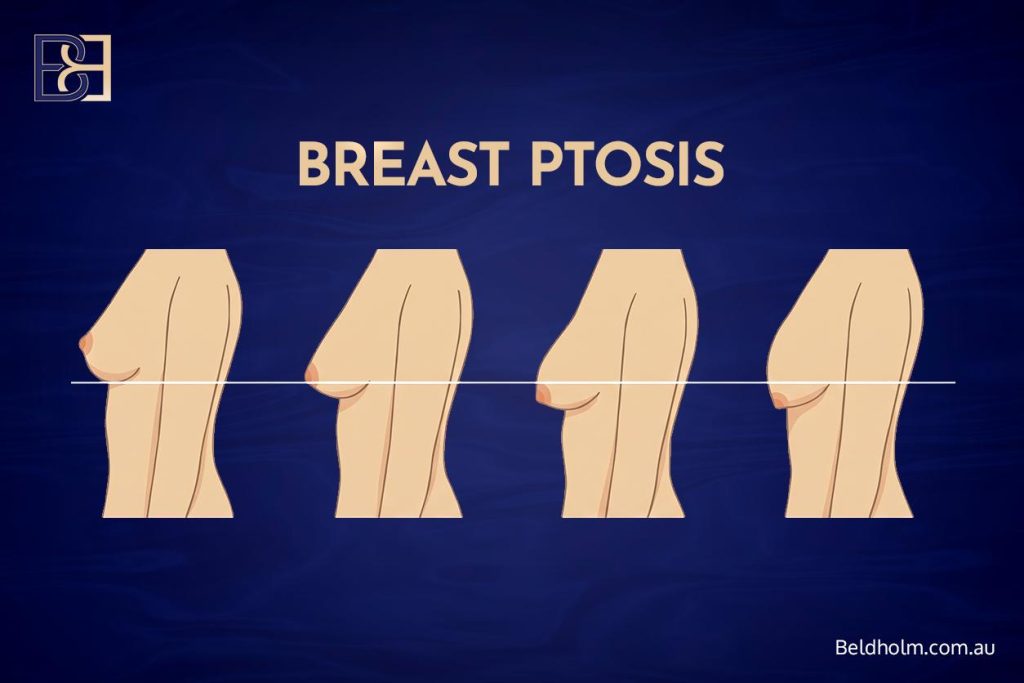
A lift repositions the nipple and the breast tissue higher on the chest. Over the months and years after surgery, tissue can descend again to some degree. A certain amount of settling is expected and normal. Beyond that, the breast can move back towards a lower position, or the tissue can settle below the fold under the breast while the nipple stays put, which is called bottoming out (1). How much of this happens depends on tissue quality, skin laxity, and the effect of gravity over time, none of which stop after surgery.
Asymmetry
No two breasts are identical, before or after any operation. Differences in size, shape, position, and nipple height are normal, and some difference between the two sides is expected after this operation as well. An implant can even out or hide a difference that was there beforehand, so once implants are removed, a pre-existing asymmetry can become more apparent. The lift aims to make the two sides as even as the tissue allows, but it cannot make them identical, and a revision is sometimes considered later for a difference that bothers a patient (1).
Contour and firmness
The breast can heal with areas that are firmer, or with small dips or irregularities in its contour, particularly where fat necrosis has formed a firm patch or where the old implant pocket has left a space. Some of this softens and settles over time. Some remains.
Volume
The size of the breast after this operation is whatever your own tissue provides. For many patients that is smaller than it was with the implant in, and it may differ from how the breast was before the implant was ever placed, because pregnancy, weight change, and time alter breast tissue along the way. This is worth understanding before surgery, because the volume is set by your tissue, not chosen.
What I do about it
I cannot promise a particular shape, size, or symmetry between the two sides, and I would be wary of anyone who did. What I can do is assess your skin laxity, ptosis, and tissue quality at consultation, choose the lift pattern that suits what is there, and be clear with you about what the tissue can and cannot do. Where the skin and blood supply would be under too much demand to get a lasting result in one operation, staging the work is one of the options, decided with you at consultation.
Revision and reoperation
A second operation is a real possibility with this surgery. Some patients need or choose one, and it is better to plan for that possibility from the start than to be surprised by it. I cannot tell you in advance whether you will be one of them.
Two kinds of second operation
It helps to separate two different things.
An unplanned early return to theatre. This is when something in the first days needs surgery to manage, most often a haematoma that needs to be drained, or occasionally a serious infection that needs washing out. This is uncommon, but it does happen, and it is dealt with as it arises.
A later, planned revision. This is an elective operation, usually more than twelve months after the first, once the tissues have settled and any scar has matured. It fine-tunes something the healing did not deliver.
What a later revision might involve
The things that lead patients to consider a revision or additional procedures are the same complications set out earlier in this article:
- Revising a scar that has healed thickened, widened, or raised.
- Flattening a dog ear that has not settled on its own.
- Removing a firm area of fat necrosis.
- Reshaping for recurrent ptosis or bottoming out, where the tissue has descended over time.
- Evening up an asymmetry between the two sides that bothers you.
- Managing an area of contour irregularity.
None of these are guaranteed, and many patients never need any of them. But across a group of patients having this combined operation, a proportion will need further surgery of some kind, and the published revision rates for lift procedures vary (1).
Planned staging is not the same as revision
If your operation is staged, the second stage is a planned part of the treatment from the outset, not a revision. Removing the implant first and lifting at a later operation is two planned steps, decided together at the start. That is different from an unplanned revision to manage a complication, and I keep the distinction clear so you know which one we are talking about.
What I do about it

My aim is to get as much right as possible in the planned operation, so a revision is not needed. I set expectations before surgery about what the tissue can do, review you through the follow-up visits to catch anything early, and if a revision is worth considering, I wait until the tissues have matured before deciding, usually at least twelve months.
DVT, anaesthetic and general surgical risk
Beyond the breast itself, this operation carries the general risks of any surgery of its size under a general anaesthetic. These are less specific to the combined procedure, but they are real, and the longer operating time of doing two things at once feeds into some of them.
DVT and blood clots
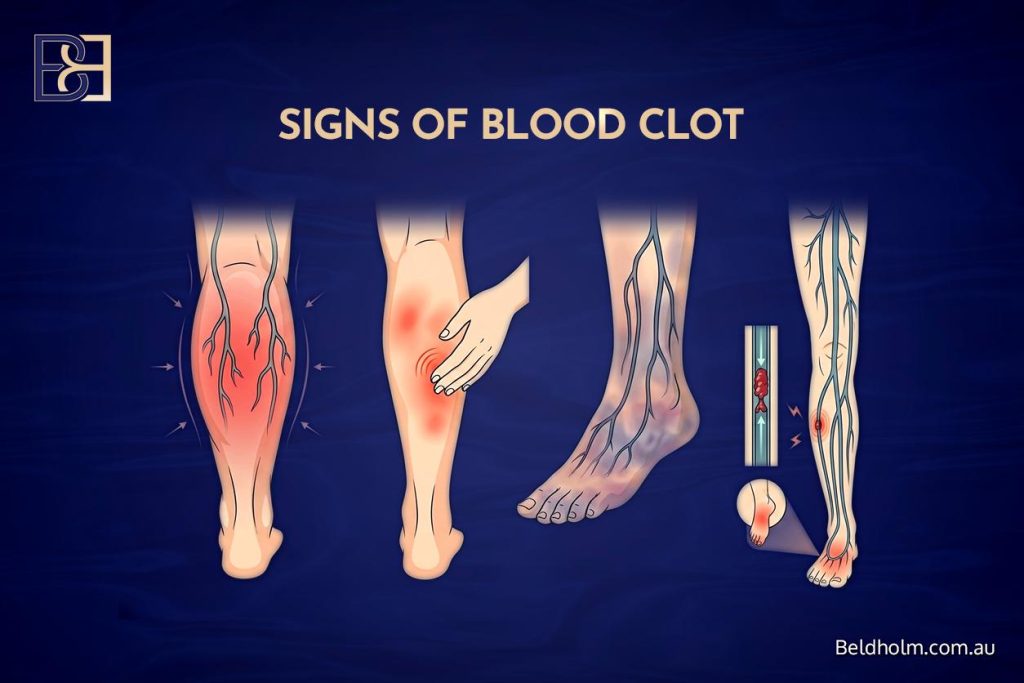
A deep vein thrombosis (DVT) is a blood clot that forms in the deep veins, usually of the leg. If part of it breaks off and travels to the lungs, it becomes a pulmonary embolism, which is a medical emergency. Any operation under general anaesthetic carries some risk of this.
Breast surgery generally carries a lower risk of clots than abdominal operations, but the risk is not zero, and a combined implant removal and lift is a longer operation than either part alone, which adds to it. I assess each patient’s clot risk myself and decide what prevention is needed, rather than leaving it to the anaesthetist. Depending on your risk, that can include calf compression during surgery, getting you up and moving early afterwards, staying well hydrated, and in some cases blood-thinning medication. As covered earlier, any decision to stop or continue blood-thinning medication is planned in advance, and you should never adjust it yourself.
I go through clot prevention in more detail in my separate article on DVT and blood clots after breast surgery.
Anaesthetic risk

This operation is done under a general anaesthetic. Modern anaesthesia is well established, but it carries its own potential risks, from common and minor effects such as nausea, a sore throat, or grogginess, through to rare but serious reactions. Your overall health affects this, which is why your history is reviewed before surgery. For most patients the anaesthetic assessment is done by phone beforehand, with the airway examination done on the day of surgery.
A longer operation means longer under anaesthetic, which is one more part of why a combined operation asks more of the body than a single-part one.
Other general risks
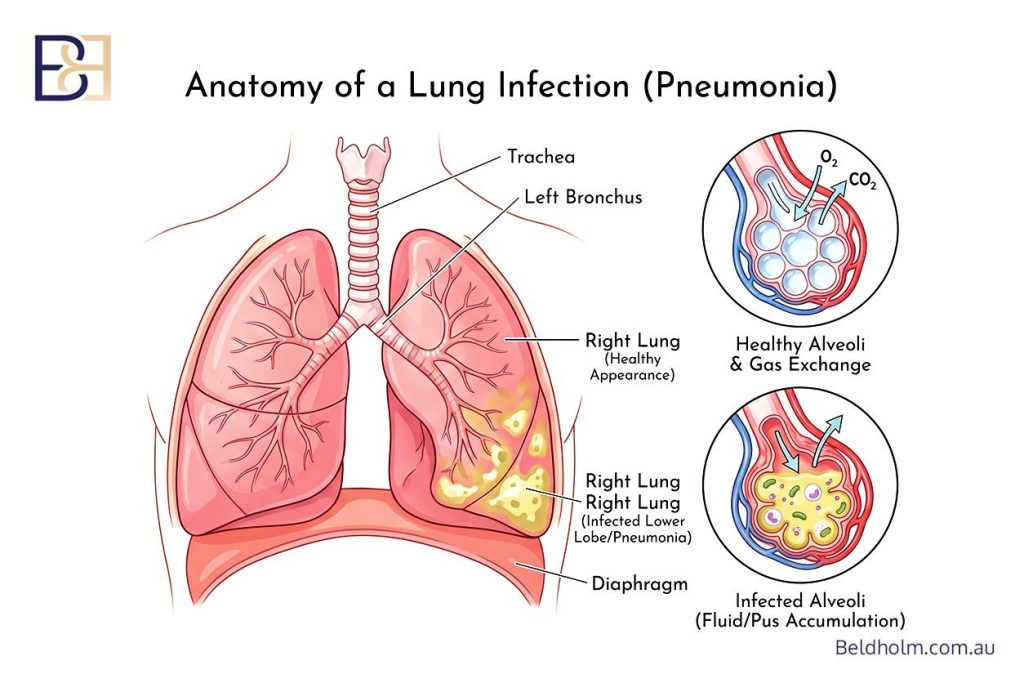
As with any operation of this size, less common general risks include a chest infection after the anaesthetic, difficulty passing urine, pressure areas from lying still during a longer operation, and allergic reactions to medications or dressings. These are managed as they arise.
One operation or two: how staging changes the risk picture
Everything above leads to a key decision: whether to remove the implant and lift the breast in one operation or to stage them separately. This choice affects the risk profile significantly.
The case for one operation
Where a patient is suited to it, doing both in a single operation has practical advantages. It means one anaesthetic, one hospital admission, and one recovery to work through, rather than going through each of those twice. For a patient whose health, tissue quality, and the extent of the work all support it, consolidating the work can make sense, and where that is the case it is my preference.
The case for staging
For many patients having an implant removed and a lift, staging is the more appropriate path, and the reason runs straight through this article.
The blood supply to the nipple and skin has already been reduced once by the original implant surgery. Removing the implant, and often the capsule, reduces it again. Performing a lift in the same operation then relies on that twice-reduced blood supply to keep the nipple and the skin edges alive under the tension of a fresh reshaping. For some patients that is a reasonable ask. For others it is asking too much of one breast in one sitting, and that is where the serious risks in this article, nipple loss and wound breakdown, become more likely (1).
What decides it
Whether one operation or two suits you is a clinical judgement made for you as an individual, not a preference decided in advance. It depends on:
- Your medical history and general health.
- How much the blood supply has already been affected by previous surgery.
- The quality of your breast tissue and skin.
- The extent and pattern of skin laxity and ptosis, and therefore how big the lift needs to be.
- How much can be done well in a single operating time.
The more the blood supply is a concern, and the larger the lift required, the more staging comes into consideration.
Book your appointment online now
How I work to reduce these risks
Assessment and patient selection
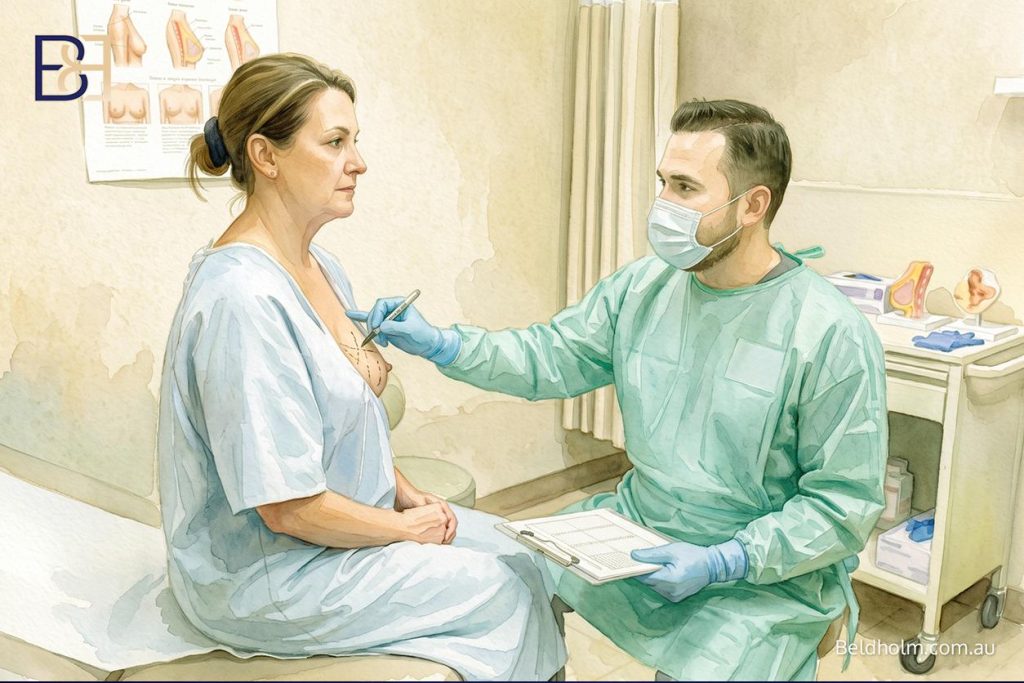
Most of the risk is managed before the operation, at consultation. I assess your medical history, the quality of your breast tissue and skin, how much the blood supply has already been affected by your previous surgery, and the extent of the skin laxity and ptosis. That assessment is what tells me whether one operation suits you, or whether staging the implant removal and the lift is the more appropriate path for you. Getting that decision right is the single biggest thing that reduces the serious risks.
Stopping smoking and vaping
If you smoke or vape, stopping well before surgery is the most important thing you can do to protect the nipple, the skin, and the healing of the wounds. Nicotine narrows the small blood vessels this operation depends on, and this operation depends on them more than most. I ask patients to stop, and for good reason.
Preparing your health for surgery
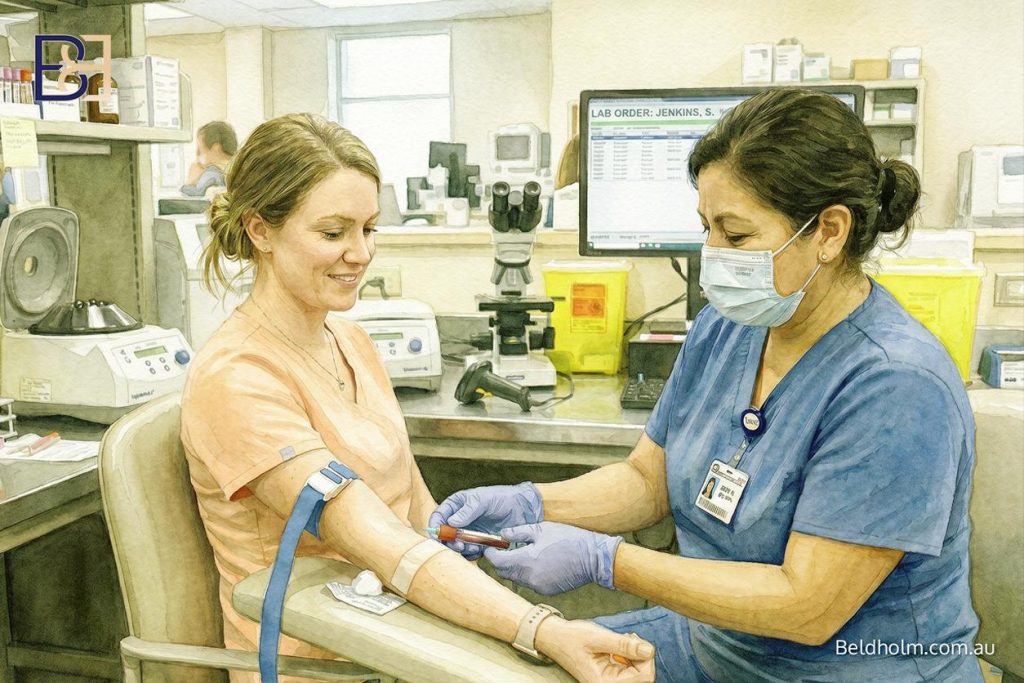
Before this surgical procedure, I arrange the standard pre-operative blood tests and review your general health, so that anything that would affect the healing process is picked up and managed beforehand. Your GP is kept informed throughout.
Technique
In the operation itself, the choices that matter most are the ones that protect blood supply. I plan the pedicle to keep the nipple’s blood supply as intact as possible, close the skin under as little tension as the reshaping allows, and make the capsule decision based on what your capsule actually needs rather than removing it as a routine. I choose the smallest lift pattern that will do the job, so no more scar or tension is created than necessary.
Dressings and recovery
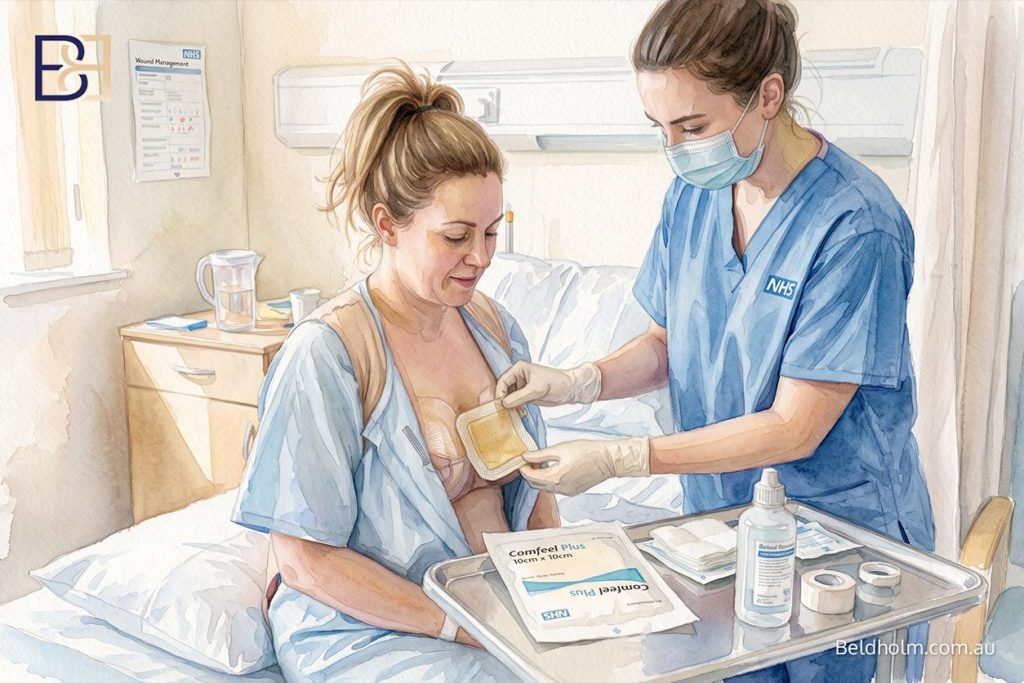
Breast implant removal recovery, with a lift done at the same time, takes several weeks. I use Comfeel dressings, which are water-resistant, so you can shower the day after surgery. The stitches are absorbable and sit under the skin, with nothing to be removed. You wear a surgical bra, a supportive bra worn full-time for the first four weeks, then during the day for a further two weeks, after which an underwire is allowed. I ask patients to avoid heavy lifting and strenuous activity in the first few weeks while the tissue heals. These are not fussy details. Support and rest through the recovery period give the healing tissues the conditions they need. You are given detailed post-operative instructions covering your day-to-day post-operative care.
Follow-up
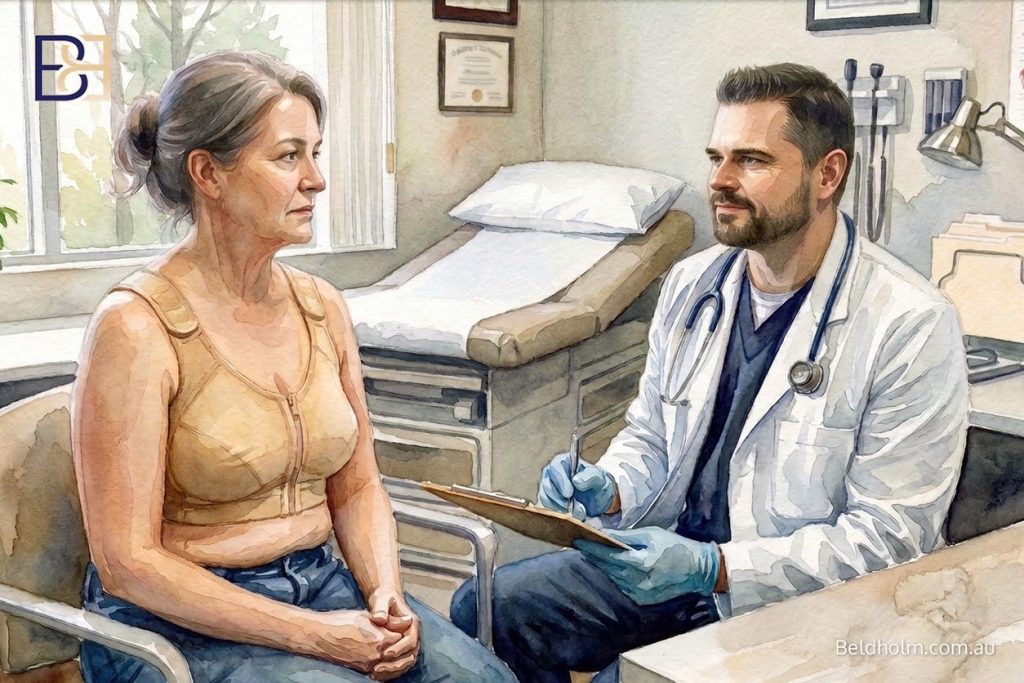
I review patients closely in the first two weeks after surgery, with nurse and surgeon follow-up appointments, which is when most early problems show themselves and can be dealt with promptly. After that I see you at four weeks, three months, six months, and twelve months, and I keep your GP informed for your longer-term care, with a formal handover at the four-week visit. If something needs watching, this schedule is how it gets caught.
If something goes wrong after hours
If you have a concern after hours, you call Maitland Private Hospital, where nurse-led phone triage will guide you. For a physical problem that needs examining, your local emergency department is the right place. For anything life-threatening, call 000. Maitland Private is not an emergency department, so knowing where to go in advance saves time when it matters.
Making the decision

Whether to have this surgery at all, and if so whether to do it in one operation or in stages, is a decision made with you at consultation, after I have assessed you, and after a GP referral. Surgery is not the only path for someone considering having implants removed, and part of the consultation is working out whether an operation is the right choice for you in the first place, and if it is, which approach fits your anatomy and your circumstances.
As with any Body contouring surgery, results vary between patients. I cannot promise a particular result, and combining implant removal with a lift carries the risks set out across this article. What I can do is assess you individually, plan the operation around your tissue and your blood supply, be clear with you about the trade-offs, and support you through recovery. The consultation is where those trade-offs are worked through for your situation.
References
- Ramanadham SR, Johnson AR. Breast Lift with and without Implant: A Synopsis and Primer for the Plastic Surgeon. Plast Reconstr Surg Glob Open. 2020;8(10):e3057.
- Swanson E. Evidence-Based Cosmetic Breast Surgery. Cham: Springer; 2017.