


In my practice, some patients who already have breast implants decide to have those implants exchanged for new ones and, at the same time, want the position of the breast and nipple lifted. Doing both in the one operation means removing the existing implants, placing new implants, and performing a breast lift (mastopexy) during the same procedure. This is often described as removal and replacement of breast implants (implant exchange) combined with a mastopexy, and it is a form of breast implant replacement carried out together with a lift. Patients choose breast implant removal surgery with replacement for different reasons: a problem with the current implants, a wish to change breast size or breast shape, or a change in breast appearance over time, alongside wanting the breast lifted. Where implants are removed without new ones being placed, that is explant surgery, which I cover separately. The decision to remove breast implants and replace them, and to lift the breast at the same time, is made individually at consultation.
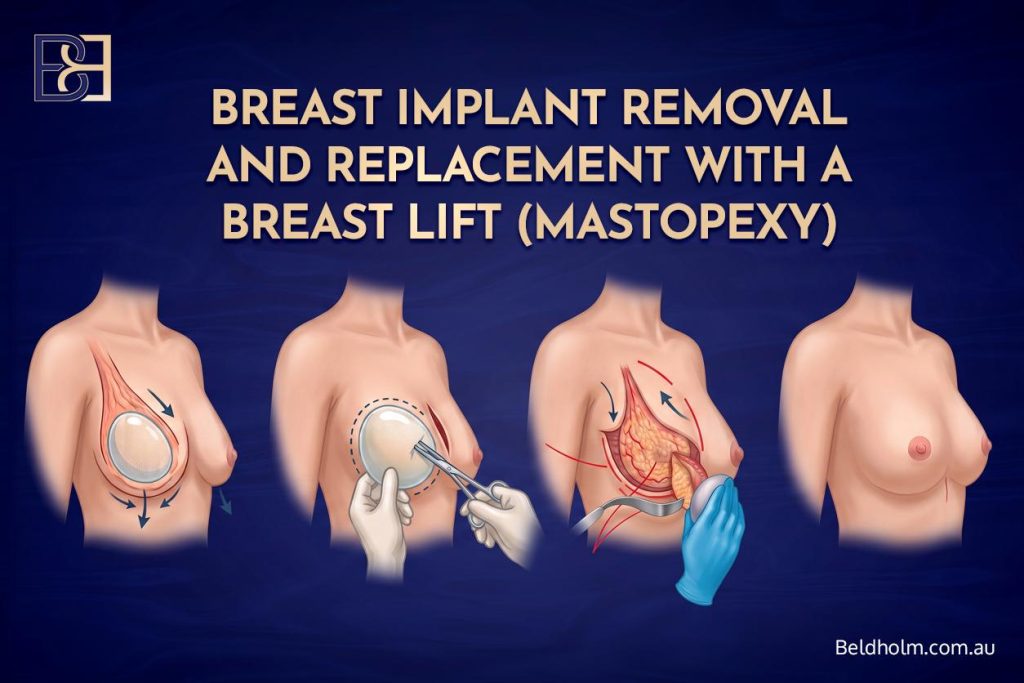
Combining these steps is a larger operation than an implant exchange on its own, and larger than a breast lift (mastopexy) on its own. It also carries a wider set of complications than either procedure performed separately. That is the reason I have written this article as a detailed account of the risks, rather than a general overview of the surgery.
Why the risks combine in this operation
The two parts of this operation work against each other in a mechanical sense, and that is what shapes the complication profile.
- The new implant adds volume and projection, which pushes the skin envelope outward and puts the lower pole under load.
- The mastopexy tightens that same skin envelope and repositions the nipple and areola on their blood supply.
Placing an implant while tightening the skin and moving the nipple means the surgery is working in two directions at once. Several of the complications below come from the way these two actions interact, rather than from either one on its own.
What this article covers
Below I work through the general surgical risks, the wound healing and scar-related risks, the nipple and areola risks, the implant-related risks, and the shape and position risks that can follow this combined operation. I also cover revision and reoperation, and the steps I take to lower these risks.
Recovery has its own article, so I keep recovery detail here to a minimum and link out to it. For the operation itself and how it is planned, see the main procedure page.
Assessment is individual
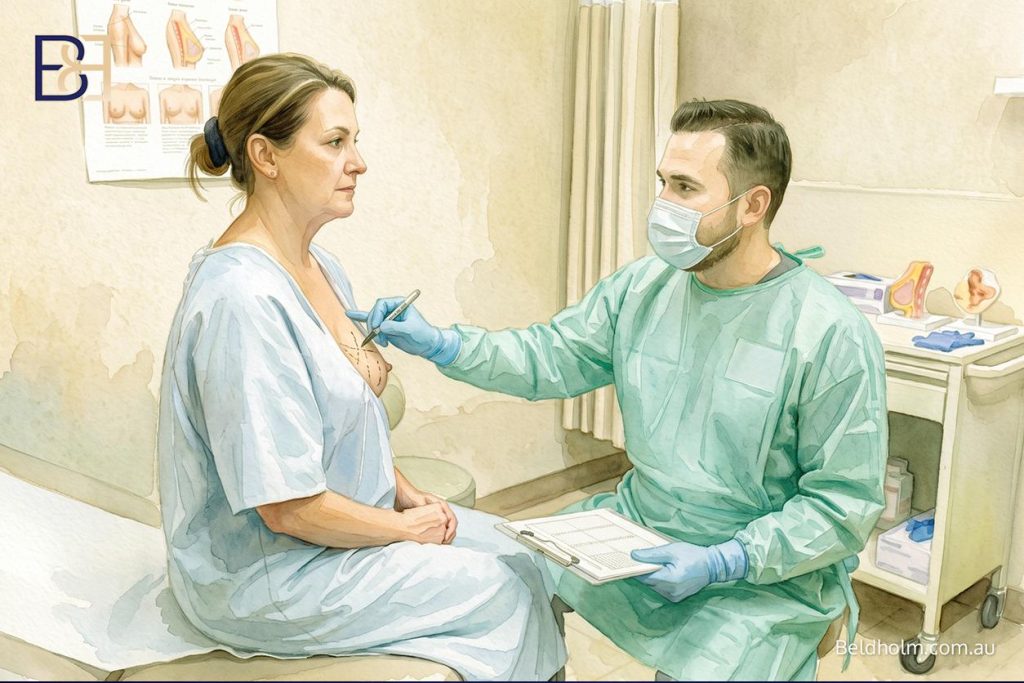
Whether this combined operation suits you, and whether it is better done in one operation or staged across two, is a clinical decision made for you as an individual at consultation. It depends on your medical history, the quality of your breast tissue, the extent and pattern of your skin laxity and breast position, and what can be done well in one operating time. A GP referral is required before any consultation.
Results vary between patients, and the risks described here apply differently depending on your anatomy and history.
One operation or staged surgery

When a patient wants their implants exchanged and a breast lift (mastopexy) at the same time, one of the first things I work through is whether both should be done together in a single operation, or separated into two stages.
Where a patient is suited to it, my preference is a single comprehensive operation. Doing the exchange and the lift in one operating time means one anaesthetic, one hospital admission, and one recovery to work through, rather than repeating each of those steps twice.
This is a preference, not a rule. It is decided for each patient individually, after assessment. For some patients, doing everything at once places more demand on the body or the tissue than is sensible, and separating the work into two operations is the more appropriate path.
Why staging is sometimes the better path
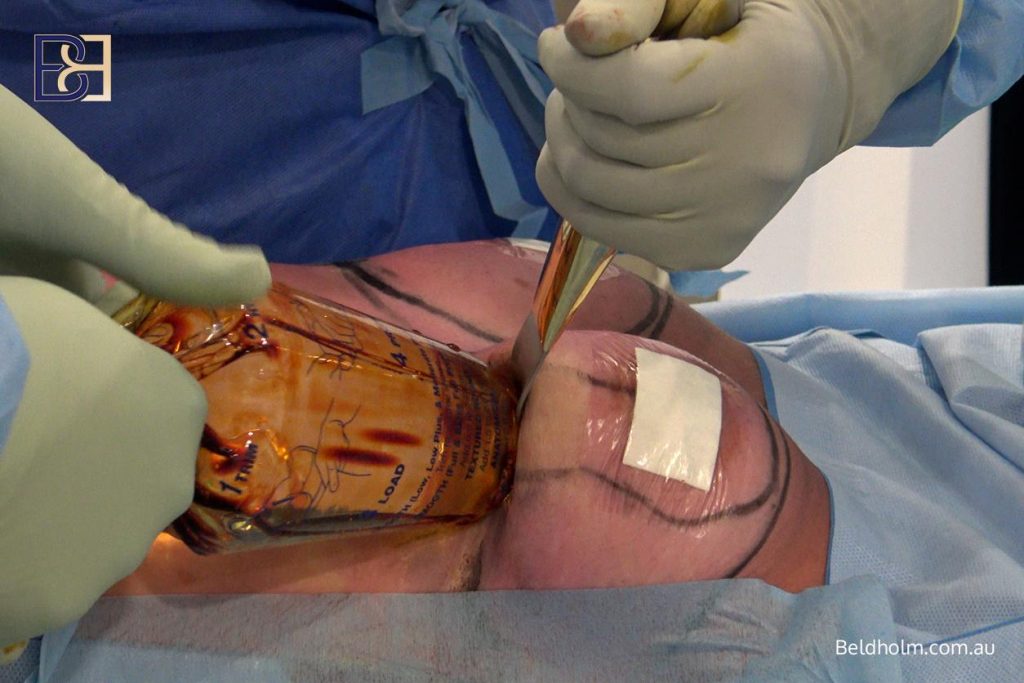
The reason the one-operation-or-staged question carries more weight here than in some other breast operations comes back to the competing tensions in this surgery. When a new implant is placed at the same time as a lift, four things have to hold together at once:
- the blood supply to the nipple and areola, which the lift moves on a pedicle
- the tension in the skin as it is tightened around a larger volume
- the position the new implant settles into within a revised pocket
- the quality of the scars along the lift incisions
A larger implant increases the load on the skin and the blood supply at the same moment the lift is relying on both. In some patients, separating the work across two operations protects nipple blood supply and scar quality by not asking the tissue to do everything at once. When that is the case, staging is the more appropriate choice, and I recommend it openly. Staging is a legitimate clinical decision, not a lesser option or a fallback.
A larger operation is a bigger event
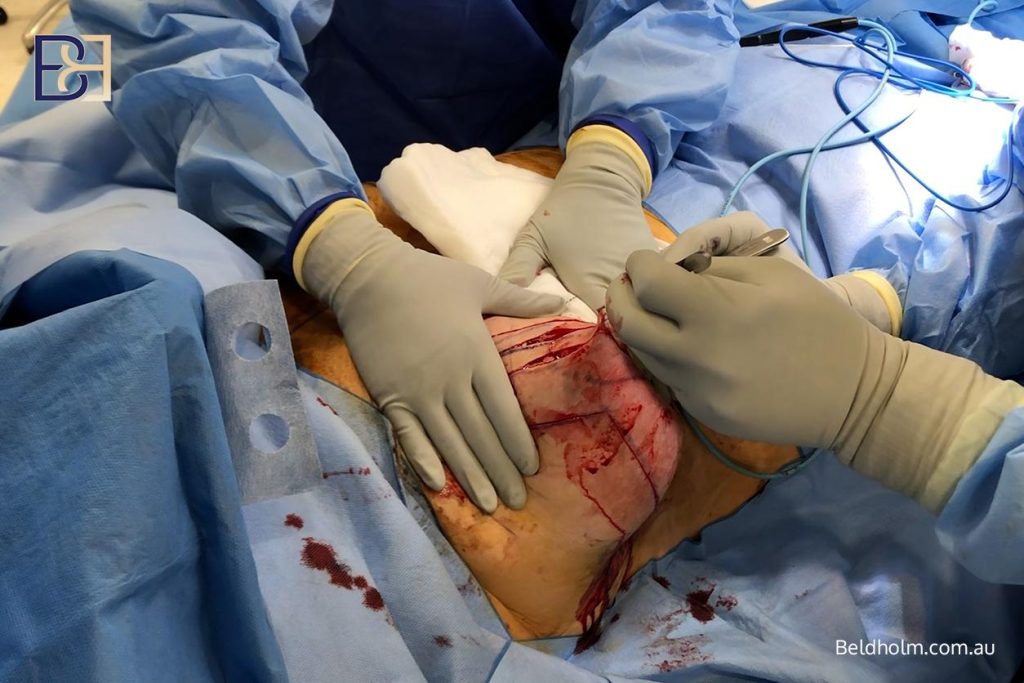
Combining an implant exchange with a lift in one operation is a larger physiological event than either operation performed alone. A longer operation places more demand on the body, and that demand is part of the assessment rather than a detail. It is also the reason pre-operative preparation carries more weight when the whole operation is planned for one operating time.
How the decision is made

Whether this is done in one operation or in two is a clinical judgement made for you as an individual, based on the same factors that decide whether the combined operation suits you at all. It is discussed and decided with you at consultation, not set in advance.
General surgical risks
Like any surgical or invasive procedure, this operation carries a baseline set of risks. Every invasive procedure carries risks alongside its benefits, and a proportion of patients develop complications. The general risks below, including infection, bleeding, and blood clots, can follow any breast operation, and this combined operation is no exception. Because removing and replacing implants alongside a lift takes longer than either operation on its own, several of these risks are weighted differently, and that weighting is part of how I assess each patient.
Bleeding and haematoma
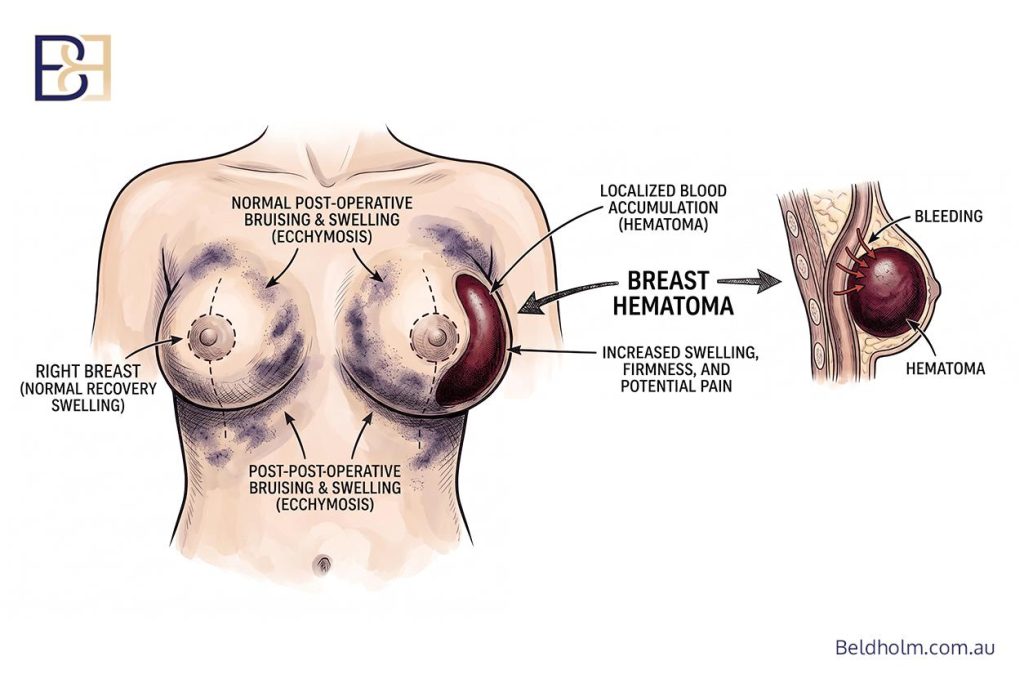
Some bleeding is expected in any breast operation. A haematoma is a collection of blood that gathers in the breast or in the implant pocket, usually in the first day or two. In device studies, fluid collections and bruising or bleeding are reported in around 3 in 100 patients (1).
A small haematoma may settle on its own. A larger one can cause swelling, pain, and pressure on the healing tissue and the new implant, and may need a return to theatre to drain the blood and stop the bleeding. To lower this risk, I stratify each patient’s bleeding risk before surgery and plan when aspirin or anticoagulant medication is stopped, usually about a week beforehand. Patients must never stop these medications on their own, as some need to continue them through surgery under a plan made in advance.
Infection
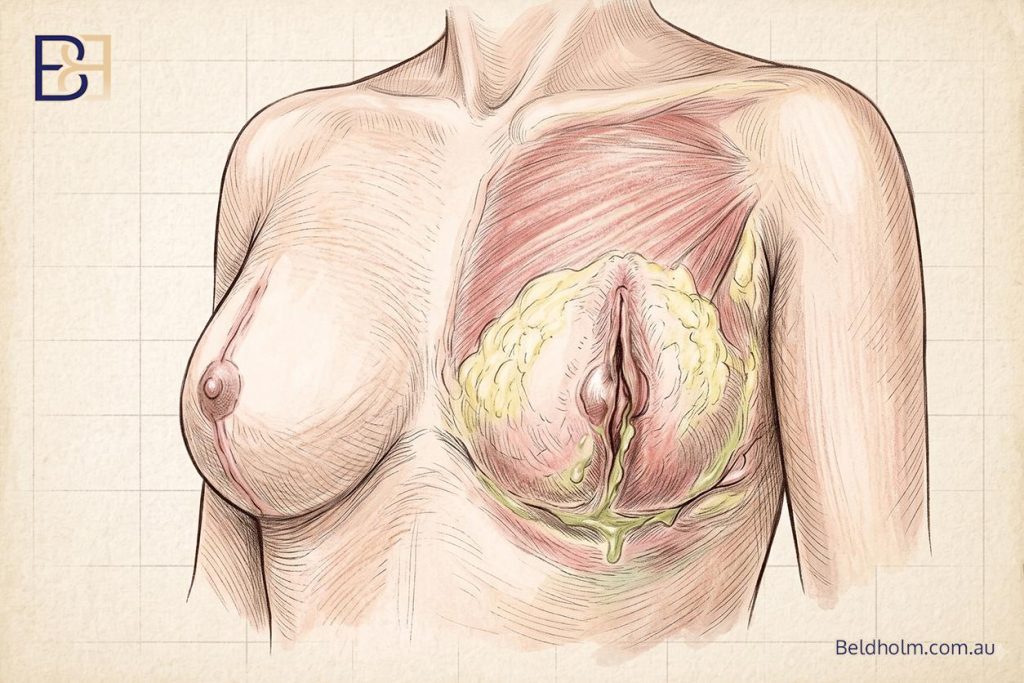
Infection can range from a superficial wound infection or cellulitis, which occurs in roughly 4 in 100 patients, to a deeper infection involving the implant pocket, reported in around 1 in 100 (1,2).
A deep infection around a newly placed implant is uncommon but serious. Depending on severity, it may be managed with antibiotics, with drainage, or in some cases by removing the implant and allowing the tissue to settle before considering a further operation. At the time of placing the new implant I use measures to reduce contamination of the device, and pre-operative preparation of the skin and wider health lowers the overall risk.
Seroma
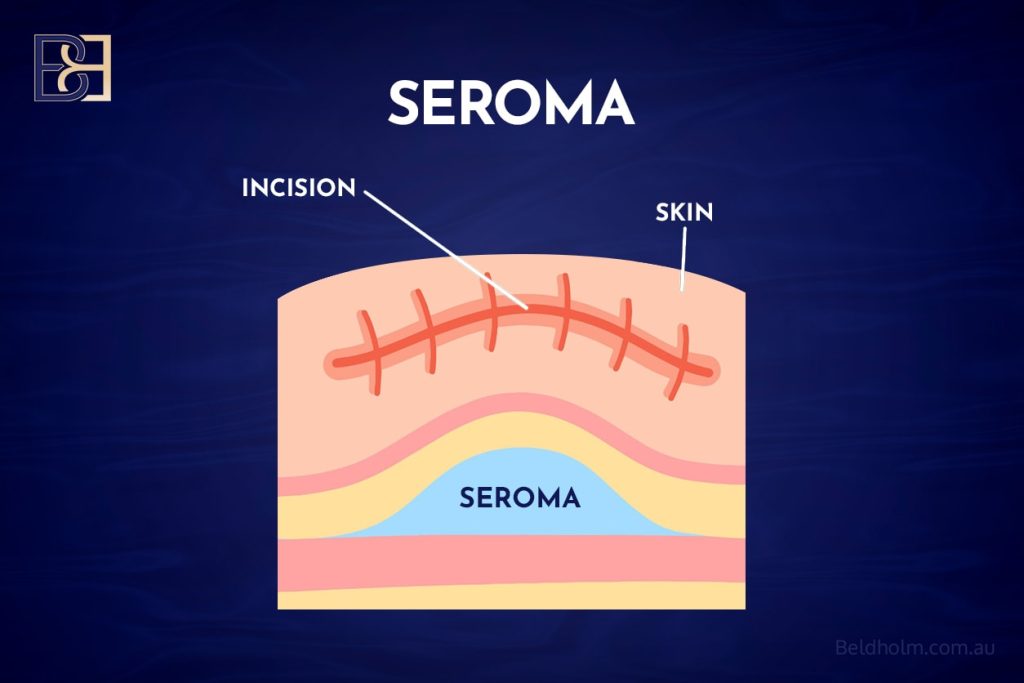
A seroma is a collection of clear fluid around the implant or within the surgical pocket. Most settle on their own or are drained with a needle in the rooms if they are causing discomfort, and occasionally a return to theatre is needed.
A fluid collection that appears long after the breast has healed is treated differently from an early one. A late seroma needs assessment rather than observation alone, because it is one of the changes that warrants investigation of the implant itself.
Blood clots (DVT and VTE)
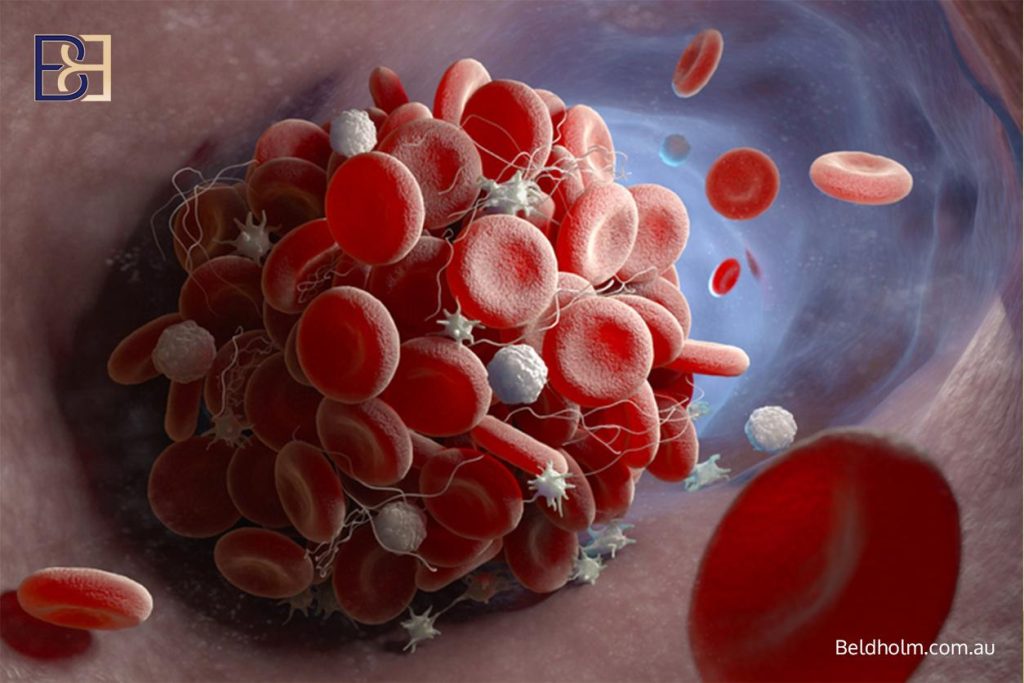
A deep vein thrombosis (DVT) is a blood clot in a deep vein, usually in the leg, and venous thromboembolism (VTE) is the broader term that includes a clot travelling to the lungs. Breast surgery generally carries a lower clot risk than abdominal contouring, but a longer combined operation raises the risk relative to a shorter one, which is one more reason the length of the operation matters.
Each patient’s clot risk is stratified before surgery, and thromboprophylaxis is planned to match it. Measures can include getting patients moving early after surgery, calf compression during the operation, and blood-thinning medication for patients whose risk warrants it. In a published series of combined lift and implant surgery, DVT occurred in under 1 in 100 patients (2). I cover clot prevention in more detail separately.
Anaesthetic risks

This surgical procedure is done under general anaesthesia, which carries its own risks. These are usually minor, such as nausea or a sore throat, but rarely can be more serious. For most patients the anaesthetic assessment is done by phone, with the airway and physical examination completed on the day of surgery. Being fit for a longer anaesthetic is part of the assessment for a combined operation, and the anaesthetist reviews this with you.
Wound healing and scars
A breast lift (mastopexy) creates longer incisions than an implant exchange on its own, and placing a new implant beneath skin that has just been tightened puts the wound edges under more tension. That combination is the reason wound healing and scarring need particular attention in this operation.
Delayed wound healing
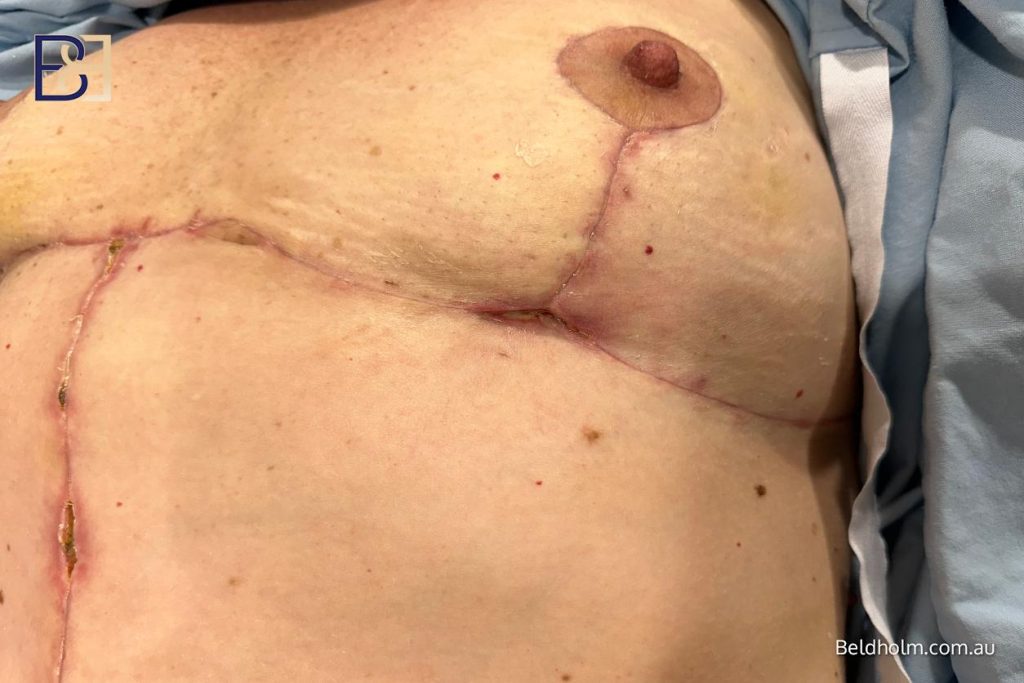
Some wounds heal more slowly than others, most often at the points under the greatest tension. In published series of combined lift and implant surgery, delayed wound healing is reported in around 7 in 100 patients (2).
The biggest factor a patient can control is smoking. Nicotine narrows the small blood vessels that feed healing skin and the nipple, and this operation depends on that blood supply more than most. I ask patients to stop smoking and vaping for six weeks before surgery and six weeks after, because the wound healing and nipple blood supply both rely on it.
The T-junction
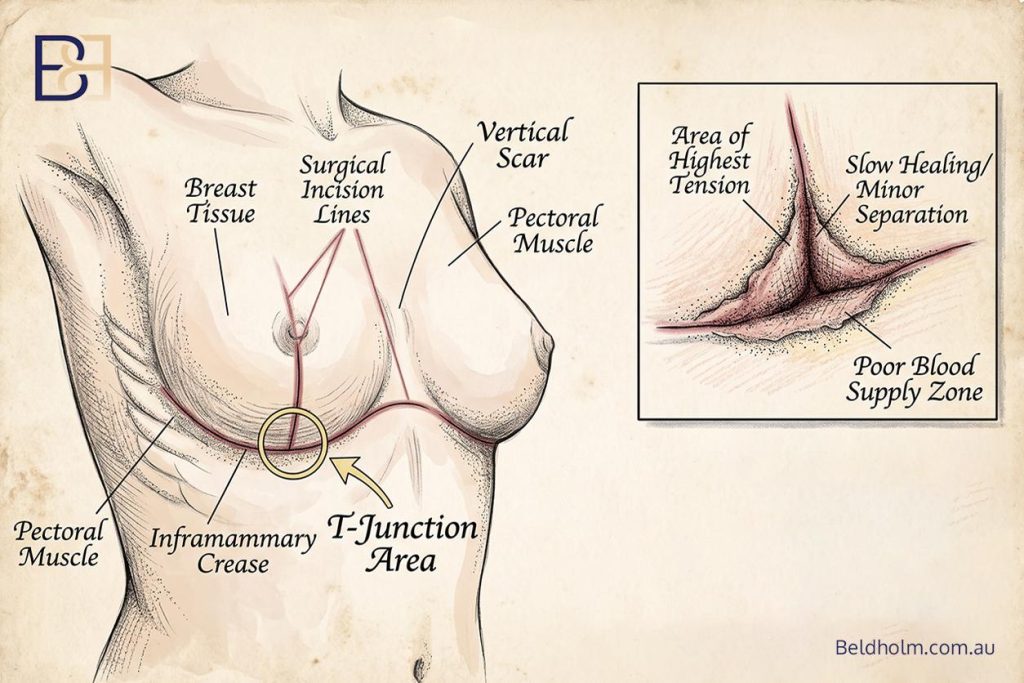
The lift incisions usually meet at a T-shaped junction, where a vertical scar meets the crease beneath the breast. This point sits under the most tension and has the least robust blood supply, so it is the commonest place to see a small area of slow healing or a minor wound separation. In most patients this settles with dressings and time over a few weeks. I use Comfeel dressings to support healing at these wounds.
Wound breakdown
A wound breakdown, or dehiscence, is a partial separation of a healing wound edge, again most often at the T-junction. Small separations are managed with wound care and heal over time. A larger separation is uncommon and only occasionally needs a return to theatre.
Scars
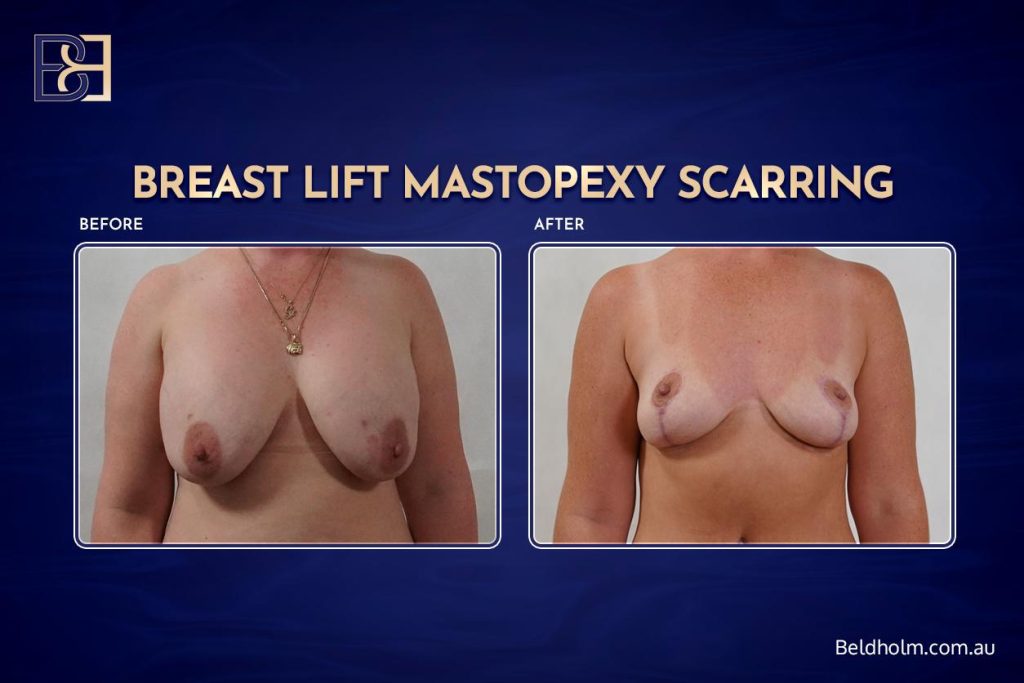
Disclaimer: Results vary, surgery has risks, seek second opinion. Operation performed by Dr Beldholm.
This operation leaves permanent scars that follow the lift pattern: around the areola, in a vertical line below it, and often in the crease beneath the breast, depending on the technique used. Scars are the trade-off for lifting and reshaping the breast, and they do not disappear.
Scars change over time. They are often raised, firm, or pink in the early months and then fade and flatten as they mature, usually over 12 to 18 months. Some patients form thicker, raised, or widened scars. This is more likely in certain skin types and at the points of highest tension, and it is one of the reasons scar management and follow-up matter after this surgery. Detailed scar care sits in the recovery article.
Nipple and areola complications
The lift moves the nipple and areola on a pedicle, a bridge of tissue that carries their blood supply and nerves. Because this happens in the same operation as a new implant being placed beneath, the nipple and areola carry the most s pecific risks of this surgery.
This matters more in a revision setting than in a first-time lift. Patients having implants removed and replaced already have implants in place, and sometimes scars from earlier breast surgery. Both can affect how reliable the nipple’s blood supply is, which is why this area is assessed carefully before and during the operation.
Changes to nipple sensation
A change in nipple sensation is one of the more common outcomes of a lift, because the small nerves supplying the nipple can be stretched or divided as the tissue is moved. Sensation may be reduced, heightened, or lost, in part or completely. For many patients this recovers over the months after surgery, but in some it is permanent. More extensive lifts, which move the nipple a greater distance, carry more of this risk.
Nipple and areola blood supply
The nipple and areola survive on the blood flowing through their pedicle. If that blood supply is reduced, the skin can struggle to heal, and in the most serious cases part or all of the nipple can be lost, which is called necrosis. This is uncommon, but it is the most serious complication involving the nipple.
The risk is higher when a lift moves the nipple a long distance, when a larger implant increases the tension the tissue is under, in patients who smoke, and where previous breast surgery may already have altered the blood supply. Since these patients already have implants and sometimes prior scars, the reliability of the blood supply is one of the main things weighed up, and it is one of the situations where staging the operation across two stages can be the safer path. If the blood supply to the nipple looks at risk during surgery, the plan is adjusted at that point, which can mean changing the lift or not placing the intended implant.
Nipple and areola position and asymmetry
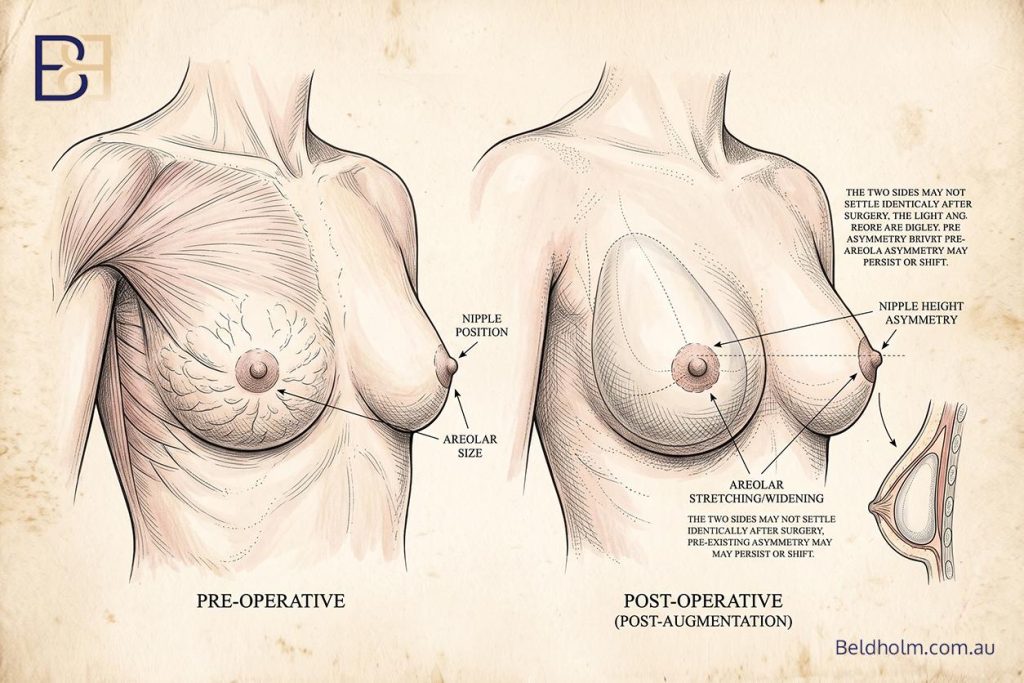
Lifting the breast and placing an implant repositions the nipple and areola, and the two sides do not always settle identically. The nipples can end up at slightly different heights, and the areolae can differ in size or shape. Some asymmetry is present in most people before any surgery, and it may persist or shift afterwards. Size or position asymmetry noticeable enough to matter is reported in around 6 in 100 patients (2).
The areola can also stretch or widen over time, particularly under the load of an implant sitting beneath it. Where asymmetry or a change in nipple position is significant, a further operation may be considered to improve it.
Implant-related complications
Replacing the implants means the new devices bring their own set of implant complications going forward, separate from the lift. Breast implants are not lifetime devices, and the complications below can develop over the years after surgery, which is part of why implants are sometimes removed and replaced in the first place.
Capsular contracture
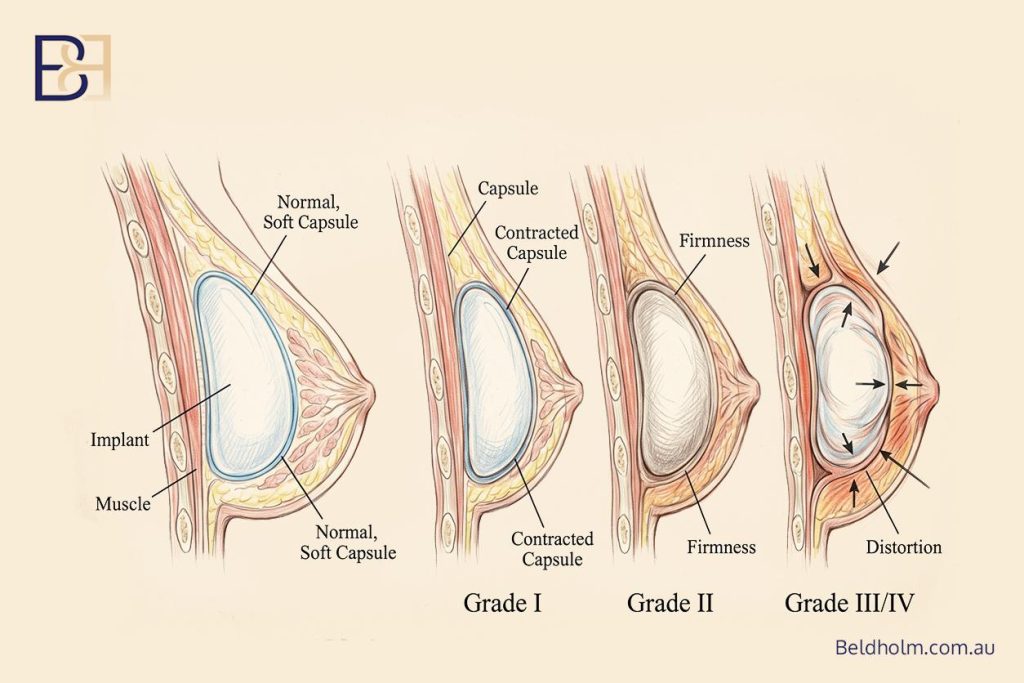
The body forms a layer of scar tissue, called a capsule, in the surrounding tissue around any implant. This is normal and usually causes no trouble. In some patients this scar tissue hardens and tightens around the implant, which is capsular contracture. It can make the breast feel firm, change its shape, and in higher grades cause discomfort or pain.
Published single-surgeon series report capsular contracture in around 6 in 100 patients over roughly ten years, while larger manufacturer studies report higher figures, in the range of 8 to 19 in 100 (2,3). It is more common after revision surgery than after a first-time augmentation, which is relevant here because this is revision surgery (3). Capsular contracture is also one of the common reasons the original implants are replaced, and it can occur again around a new implant.
Higher-grade contracture is managed surgically, by releasing or removing the capsule and exchanging the implant. When an implant and its capsule sit beneath the chest muscle, removing the capsule entirely carries a small risk of injury to the chest wall and the structures beneath it. This risk relates to implants placed under the chest muscles, not to those placed above them. To lower the risk of contracture in the first place, I use a no-touch insertion technique with a Keller Funnel and careful handling of the pocket (4).
Rupture of the new implant
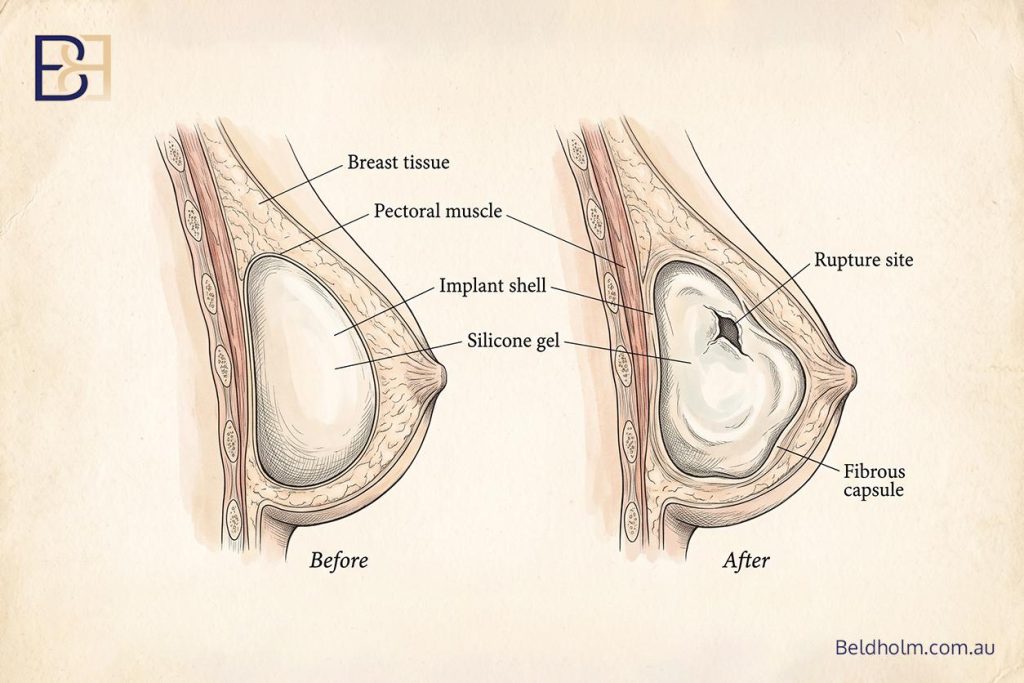
Over time the shell of an implant can develop a tear or hole, which is a rupture. Modern implants are filled with a cohesive silicone gel that largely holds its shape, while some implants are filled with saline instead. In a silicone gel implant a rupture often causes no symptoms and is described as silent, because the gel stays in place. Saline implants behave differently, since a rupture lets the salt water drain and the breast changes shape more obviously. Because of this, a rupture may not be obvious, and imaging is used to detect it. Ultrasound and MRI are both used, with MRI the most sensitive (5).
Over the full life of a set of implants, rupture is reported in around 1 in 5 patients (1). It is more common in revision augmentation than in first-time surgery (6). A ruptured implant will necessitate removal, and where appropriate replacement. Because rupture can be silent, ongoing imaging surveillance to check the implant condition is recommended. Rupture is one reason implant longevity is limited, and implants are eventually removed and replaced with new implants.
Rippling and palpability
Rippling is folding of the implant shell that can be seen or felt through the skin, and palpability is being able to feel the edge of the implant. Both are more likely where there is less natural breast tissue and soft tissue covering the implant, and larger implants make rippling more likely because they need more cover. After implants are removed and a lift is performed, the tissue over the implant can be thinner than before, which can make rippling or a palpable edge more noticeable, particularly in the upper or inner breast.
Breast implant illness
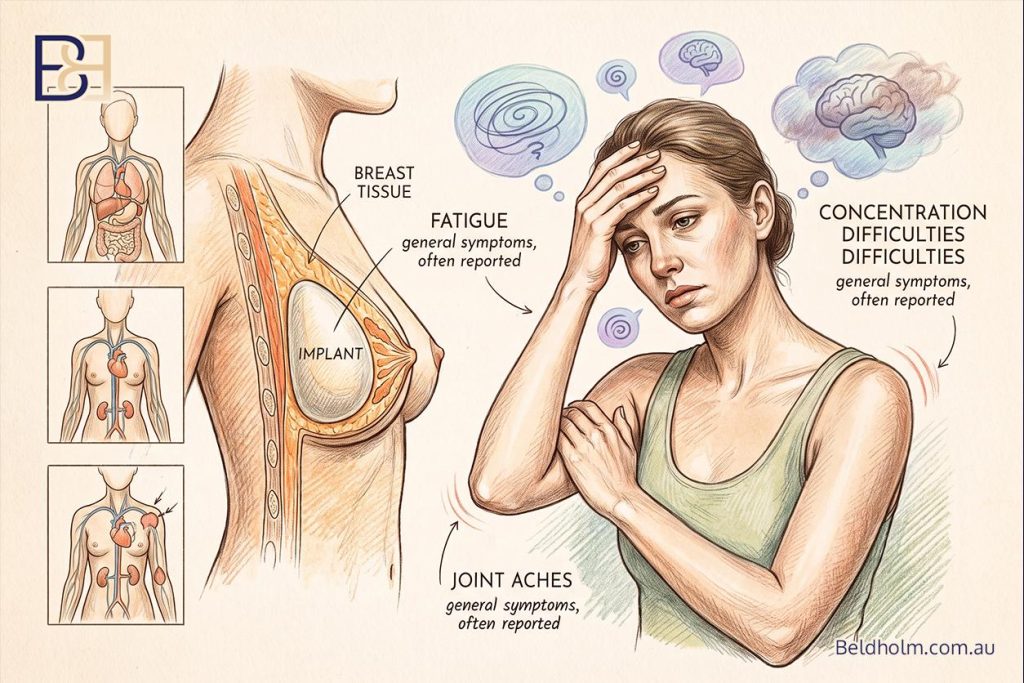
Some patients with breast implants report a range of general symptoms, such as fatigue, joint aches, and difficulty concentrating, that they connect to their implants. This is described as breast implant illness. At present there is no specific diagnostic test for it and no confirmed mechanism, and research is ongoing (7). Some patients report that their symptoms improve after their implants are removed, with or without removal of the capsule. I take these symptoms seriously and discuss them factually, without overstating or dismissing what is currently known.
BIA-ALCL
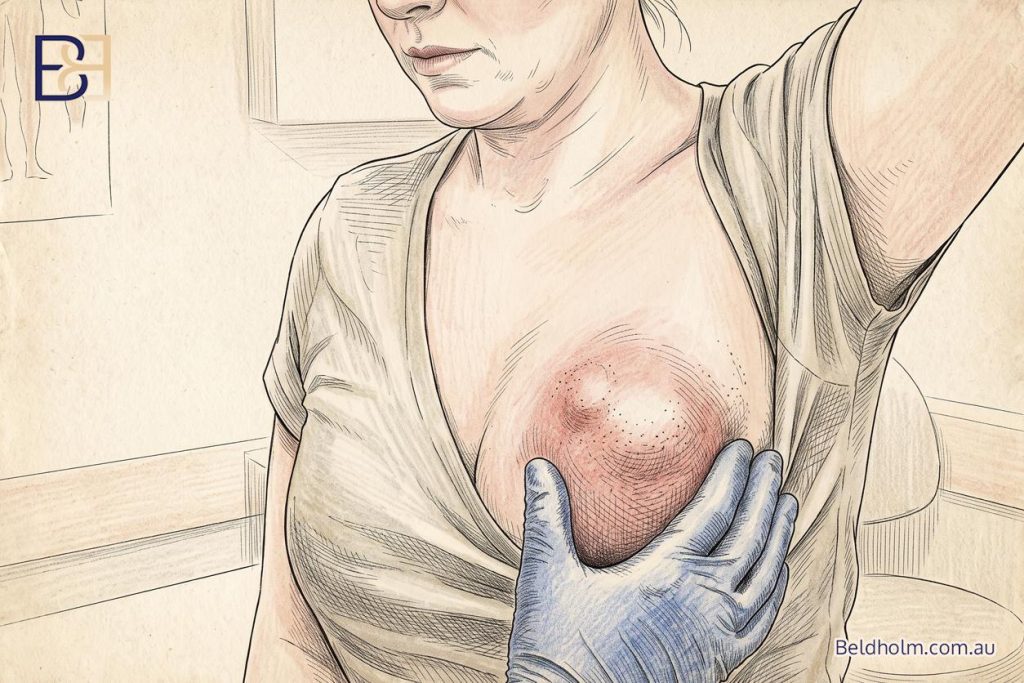
Breast implant associated anaplastic large cell lymphoma (BIA-ALCL) is a rare cancer of the immune system. It is not breast cancer. It has been linked to breast implants, and specifically to textured-surface implants (8). It usually shows up as a fluid collection around the implant years after surgery, sometimes as a lump, which is one reason a late seroma is always investigated rather than watched.
The association is with textured implants. There are no confirmed cases in patients who have only ever had smooth-surface implants (8,9). The implants I use are smooth-surface, which carries the lowest risk profile for this condition. If BIA-ALCL were ever suspected or confirmed, it is diagnosed and treated by a specialist team with particular expertise in it. This sits outside the scope of my surgery, and I would refer a patient to the appropriate specialist for its management.
Implants and breast cancer screening
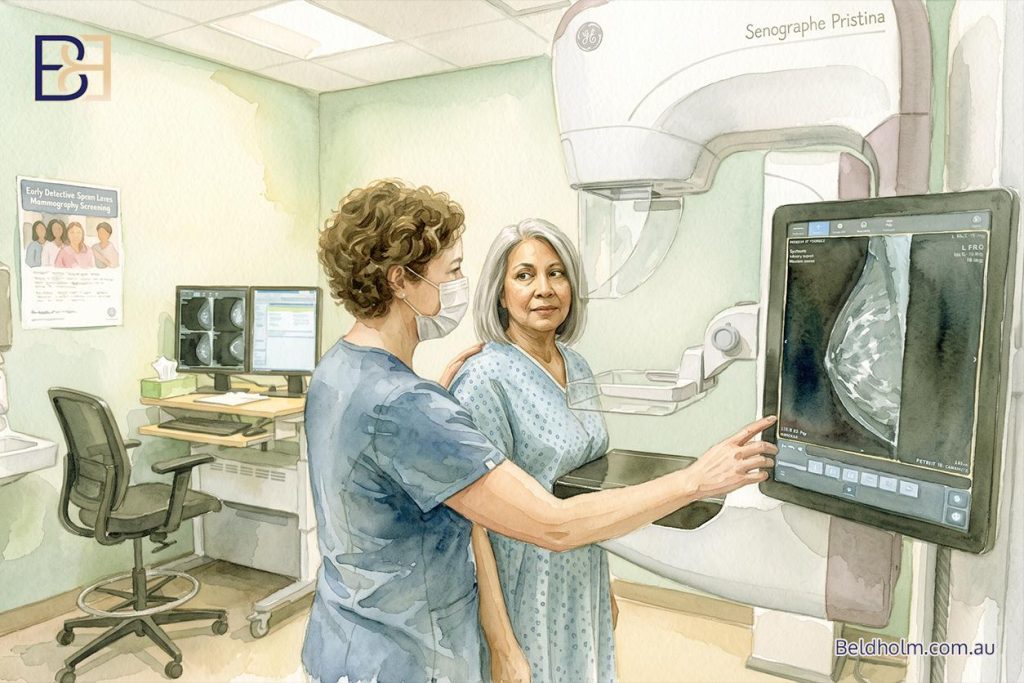
Breast implants can make mammograms harder to interpret, because an implant can obscure part of the breast tissue. This affects breast cancer detection rather than breast cancer risk, since implants are not linked to a higher rate of breast cancer. Additional mammographic views, and sometimes ultrasound or MRI, are used so that screening stays effective, and routine breast cancer screening should continue after this surgery on the schedule appropriate for your age.
Shape and position complications
A breast lift (mastopexy) removes excess skin, reshapes and repositions the breast, while an implant adds volume and weight. This breast reshaping and the added volume interact over time. The final shape depends on how the tissue holds that implant over time, and several complications come from the implant or the breast settling into a position other than the one planned. In a combined operation the lift is working to hold the lower pole up while the implant is loading it, and that tension is behind most of the problems below.
Implant malposition
An implant can settle in the wrong position: too high, too low, too far to the side, or too far towards the middle. When implants sit too close together in the centre of the chest, and the tissue between them lifts off the breastbone, this is called symmastia. Malposition that affects the shape or is uncomfortable may need a further operation to adjust the pocket and the final position the implant sits in.
Bottoming out
Bottoming out is when the implant and the lower part of the breast gradually drop below the original crease beneath the breast. As this happens, the nipple can end up pointing slightly upwards and the lower pole of the breast stretches and lengthens.
It is more likely with larger and heavier implants, with weaker or thinner tissue, and where the crease beneath the breast has been lowered during surgery (10). Because the lift is trying to tighten the lower pole at the same time the implant is weighing it down, this is one of the shape changes the combined operation has to balance carefully. Where it develops, revision can reinforce the fold and support the lower pole.
Double bubble
A double bubble is a second crease that shows across the lower breast, where the original fold appears as a visible line below or across the implant. It can happen when the implant sits below the breast fold, when that fold is not fully released, or when a tight fold bands across the implant (10). Some cases settle as the tissue relaxes, and others need a revision to release the fold or adjust the implant position.
Recurrent ptosis and lower-pole stretch
A lift repositions the breast, but it does not stop the tissue ageing or stretching afterwards. Over time the breast can descend again, which is recurrent breast ptosis, and the skin of the lower pole can stretch under the ongoing weight of an implant, depending on skin elasticity and tissue quality. In published series, persistent or recurrent ptosis is reported in around 9 in 100 patients, and heavier implants tend to accelerate the stretch (2,11). This does not mean the lift has failed. It reflects tissue quality, the weight of the implant, and time, and it is part of why implant weight is considered carefully when a lift and implant are combined.
Shape asymmetry
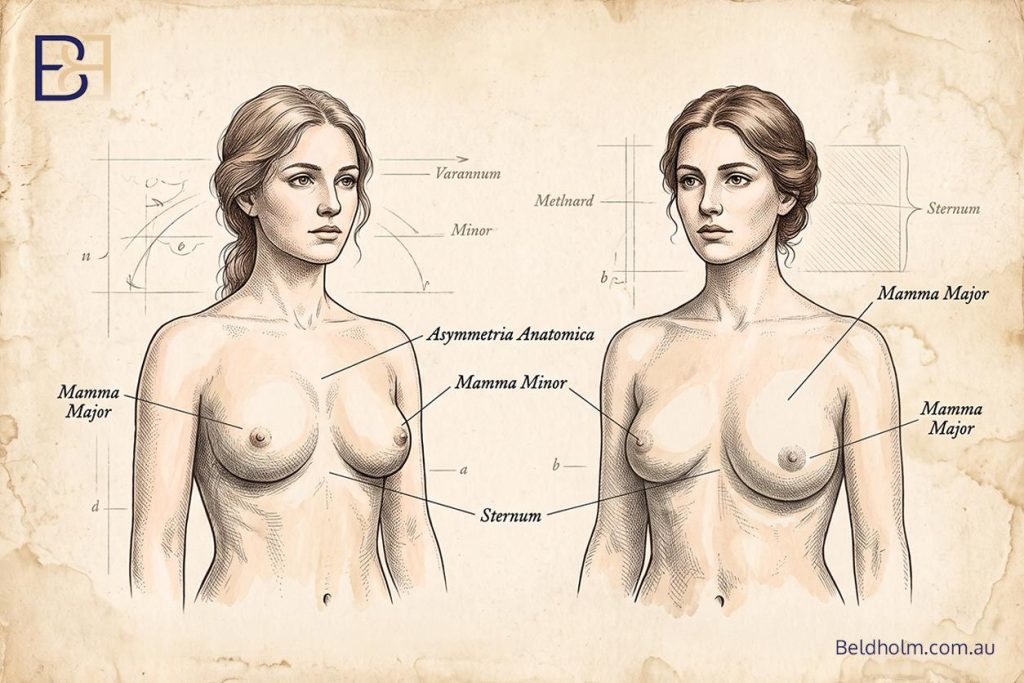
Even when the two sides are matched as closely as possible during surgery, they can heal and settle differently, so the breasts may end up differing in shape, size, or position. Some asymmetry that was present beforehand also persists, since no two breasts are identical to begin with. Where the difference is significant, a further operation may be considered.
Revision and reoperation
It is realistic to think of this operation as something that may need further surgery at some point, rather than a one-time event. Implants are not lifetime devices, the breast keeps changing with time, and several of the complications already described are managed with another operation. Planning for that possibility from the start is part of making an informed decision.
Why a further operation may be needed
A further operation after a combined implant exchange and lift can be needed for any of the following:
- capsular contracture that has reached a grade worth treating
- rupture of an implant
- malposition, bottoming out, or a double bubble
- recurrent ptosis or lower-pole stretch over time
- asymmetry in shape, size, or position
- scar revision where a scar has healed poorly
- a wound healing problem that needs more than dressings
- a later decision to remove the implants, or breast implant replacement with new implants
Planned and unplanned reoperation
Some further surgery is expected rather than a setback. Because implants do not last indefinitely, a future exchange or removal may be part of the long-term picture from the outset, and some patients have their breast implants removed and replaced more than once over a lifetime. Other reoperations are unplanned, done to manage one of the complications above. Both are worth understanding before the first operation, not after.
Revision surgery carries more risk than first-time surgery
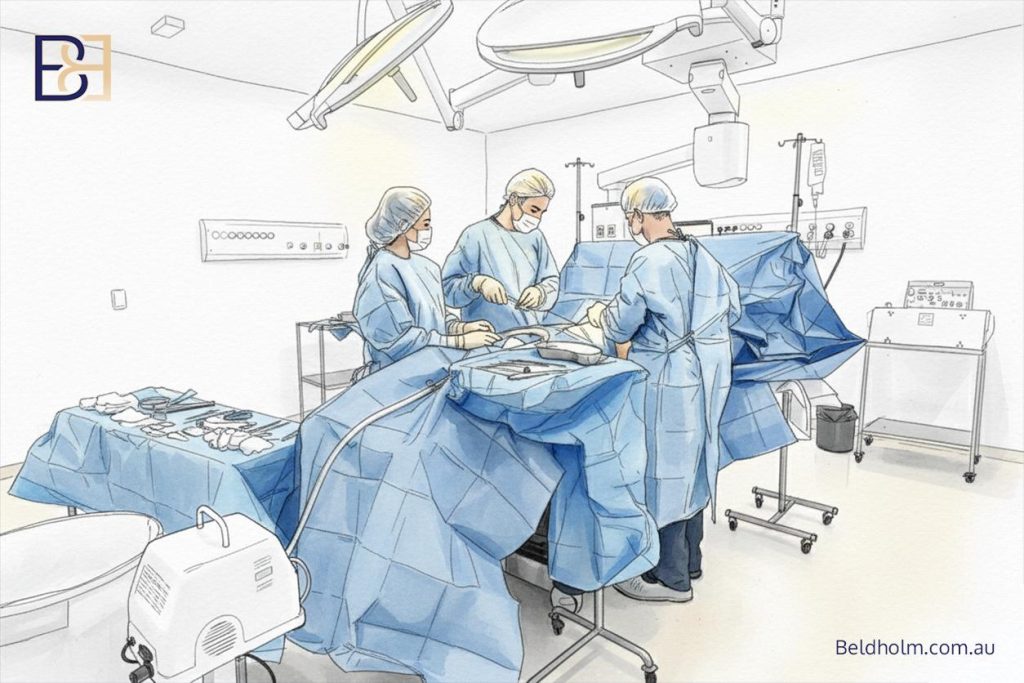
Revision breast surgery generally has higher complication rates than first-time surgery, and further surgeries carry their own risks. Capsular contracture and rupture are both reported more often after revision augmentation than after a primary procedure (3,6). This operation is itself revision surgery, since the implants are being removed and replaced, so any further operation down the track would be another revision again, and the risk profile tends to compound with each one. This is one of the reasons the decision to operate, and the choice of implant, are weighed carefully at the outset.
How often a further operation happens
Long-term studies of breast implant patients report that a substantial proportion undergo at least one further operation within about ten years, and the rate is higher after revision surgery than after a first-time procedure (12,13). The figure depends heavily on which complication is being tracked and on the individual, so it is best understood as a realistic possibility to plan for rather than a fixed number.
A revision is its own operation
Any revision is a fresh operation with its own anaesthetic, its own risks, its own recovery, and its own cost. It is assessed and planned the same way as the first operation, and none of this means anything went wrong with the original surgery. It reflects that implants are not permanent and that the breast continues to change over the years that follow.
Reducing the risk
The risks described in this article are managed at every stage: choosing the right patients and the right approach, preparing well before surgery, the technique used during the operation, and close follow-up afterwards. None of these removes risk, but together they lower it.
Choosing the right approach for each patient
Not every patient is suited to having the exchange and the lift done together in one operation. Assessing tissue quality, the extent and pattern of skin laxity and breast position, implant weight, and medical history is what determines both whether the combined operation is appropriate and whether it is better staged across two operations. For some patients, choosing to stage the work is itself one of the most effective ways of lowering the risks that come from doing everything in one operation.
Part of this assessment is also whether surgery is the right choice at all. Surgery is not the only response to a change in breast shape or position, and it is not something I encourage where it is not warranted.
Preparing for surgery
Because this is a bigger operation than either procedure alone, preparation carries more weight, not less. Getting into good general health before surgery supports healing and lowers the risk of complications.
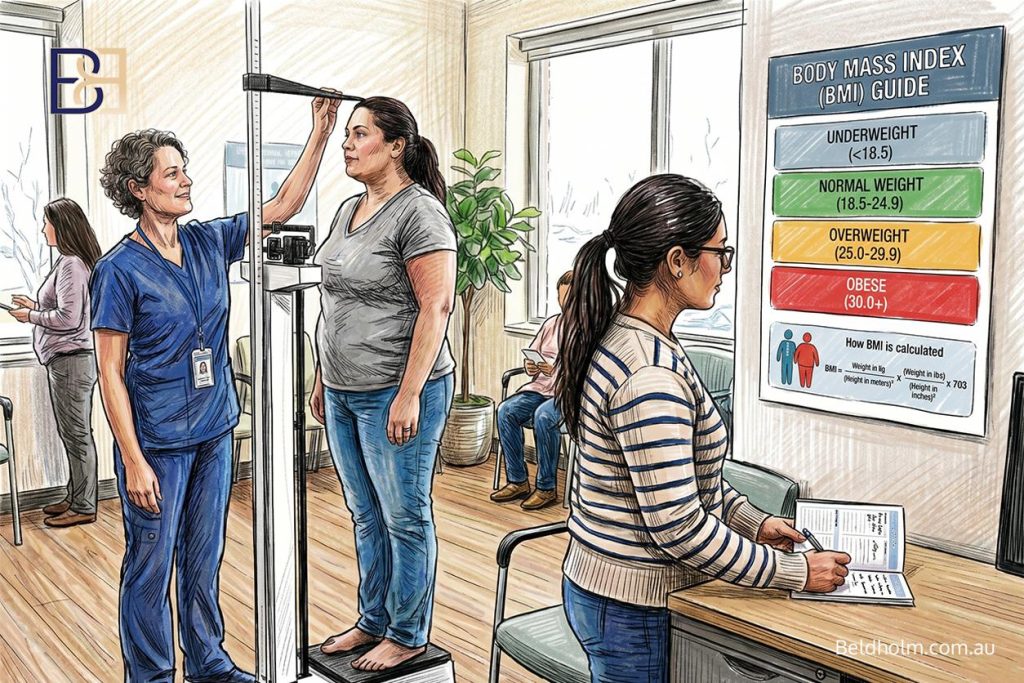
- Stopping smoking and vaping for six weeks before and six weeks after surgery, which protects wound healing and nipple blood supply.
- Pre-operative blood tests to check fitness for surgery and pick up anything worth correcting beforehand.
- Correcting any issues found in those tests before the operation, so the body is in the best position for tissue repair and the healing process.
- Reaching a stable weight, since weight change after surgery can alter the result.
Surgical technique
Several parts of the surgical technique, and how the incision sites and implant placement are planned, are aimed directly at the risks in this article:
- A no-touch insertion technique with a Keller Funnel, to reduce contamination of the implant and lower the risk of capsular contracture.
- Careful handling of the pedicle that carries the nipple’s blood supply, to protect nipple viability.
- Choosing the implant placement to suit the anatomy, including a dual-plane approach where it fits.
- Internal soft-tissue support, sometimes called an internal bra, where it is needed to support the lower pole and reduce the risk of stretch and bottoming out.
- Choosing implant size to balance the result against the load placed on skin that has just been tightened, since heavier implants drive stretch and descent over time.
Follow-up

Book your appointment online now
Close follow-up in the early weeks lets problems be picked up and managed before they grow. In the first two weeks I see patients in clinic two to three times a week, along with the nursing team, and this includes Healite II LED light therapy to support healing. After that, reviews follow at four weeks, three months, six months, and twelve months, with the GP kept informed for long-term care.
Recovery has its own article. The recovery period, including wearing support garments, restrictions on heavy lifting, how to reduce swelling, post-operative care in the first few weeks, and how healing progresses over time, is covered there in detail.
Warning signs and when to seek help
Most patients heal without a serious problem, but knowing what to watch for means anything that does develop is dealt with early. Contact us promptly if you notice any of the signs below.
Signs that need prompt attention

- One breast becoming rapidly larger, tense, or more painful, or heavy bleeding coming through the dressing, which can point to a haematoma.
- A fever, or spreading redness, warmth, and increasing pain around a wound, or discharge from a wound, which can point to an infection.
- A wound edge opening or separating, particularly where the incisions meet low on the breast.
- The nipple or areola turning dusky, dark, pale, or white. A change in the colour of the nipple can signal a problem with its blood supply and needs urgent attention.
- A new swelling or fluid collection appearing in a breast well after it has healed, which needs assessment rather than waiting to see if it settles.
Signs that need emergency care

Some symptoms need emergency help straight away rather than a phone call:
- Chest pain, difficulty breathing, or coughing up blood.
- Pain, swelling, redness, or warmth in the calf or leg.
These can be signs of a blood clot that has travelled to the lungs, which is a medical emergency. Call 000.
How to reach the right help

- During clinic hours, call the rooms. The team will guide you and arrange to see you if needed.
- After hours, call Maitland Private Hospital, where a nurse-led phone triage service can advise you.
- If a problem needs to be looked at in person and cannot wait, go to your local emergency department.
- For anything life-threatening, such as severe chest pain, trouble breathing, or heavy bleeding, call 000.
Maitland Private Hospital is not an emergency department, so any problem that needs an in-person assessment out of hours is best seen at your local emergency department.
Deciding on the procedure
Combining removal and replacement of breast implants (implant exchange) with a breast lift (mastopexy) is a larger operation than either procedure alone, and this article has set out the wider set of complications that come with it. Understanding these risks is the point, because it lets you make an informed decision rather than being either discouraged from surgery or pushed towards it.
Weighing it up
The decision is an individual one. Your medical history, the quality of your breast tissue, the extent and pattern of your skin laxity and breast position, the weight of the implants, and what can be done well in a single operating time all shape whether this combined operation suits you, and whether it is better done in one operation or staged across two.
Surgery is also not the only response to a change in breast shape or position, and whether to operate at all is part of the assessment, not a given. The risks described here are worth weighing properly against what the operation involves for you.
Future pregnancy and breastfeeding

Where it applies to you, a future pregnancy and breastfeeding can change the breast and alter the result of this surgery over time. For that reason, timing is assessed individually, and this is something worth raising at consultation if it is relevant to your plans.
The consultation
Whether this operation is appropriate for you, and whether it is done in one stage or two, is determined at consultation after a full assessment. A GP referral is required before any consultation. Results vary between patients, and the complications described in this article apply differently depending on your anatomy, your history, and the decisions made in your individual case.
References
- NSW Health. Breast implants: information for consumers. Sydney: NSW Health; 2020.
- Swanson E. Evidence-Based Cosmetic Breast Surgery. Cham: Springer; 2017.
- Headon H, Kasem A, Mokbel K. Capsular contracture after breast augmentation: an update for clinical practice. Arch Plast Surg. 2015;42(5):532-543. doi:10.5999/aps.2015.42.5.532.
- Davison SP. Effect of Keller Funnel on the rate of capsular contracture in periareolar breast augmentation. Plast Reconstr Surg Glob Open. 2018;6(6):e1834. doi:10.1097/GOX.0000000000001834.
- Norena-Rengifo BD, Sanin-Ramirez MP, Adrada BE, Luengas AB, Martinez de Vega V, Guirguis MS, et al. MRI for evaluation of complications of breast augmentation. RadioGraphics. 2022;42(4):929-946. doi:10.1148/rg.210096.
- Handel N, Garcia ME, Wixtrom R. Breast implant rupture: causes, incidence, clinical impact, and management. Plast Reconstr Surg. 2013;132(5):1128-1141. doi:10.1097/PRS.0b013e3182a4c243.
- Cohen Tervaert JW, Mohazab N, Redmond D, van Eeden C, Osman M. Breast implant illness: scientific evidence of its existence. Expert Rev Clin Immunol. 2022;18(1):15-29. doi:10.1080/1744666X.2022.2010546.
- Swanson E. BIA-ALCL: comparing the risk profiles of smooth and textured breast implants. Aesthetic Plast Surg. 2023. doi:10.1007/s00266-023-03329-8.
- Sharma K, Gilmour A, Jones G, O’Donoghue JM, Clemens MW. A systematic review of outcomes following breast implant-associated anaplastic large cell lymphoma (BIA-ALCL). JPRAS Open. 2022;34:178-188. doi:10.1016/j.jpra.2022.08.008.
- Salgarello M, Visconti G. Staying out of double-bubble and bottoming-out deformities in dual-plane breast augmentation: anatomical and clinical study. Aesthetic Plast Surg. 2017;41(5):999-1006. doi:10.1007/s00266-017-0918-8.
- Weniger FG. Factors affecting lower-pole stretch after breast augmentation. Plast Reconstr Surg Glob Open. 2021;9(9):e3865. doi:10.1097/GOX.0000000000003865.
- Coroneos CJ, Selber JC, Offodile AC 2nd, Butler CE, Clemens MW. US FDA breast implant postapproval studies: long-term outcomes in 99,993 patients. Ann Surg. 2019;269(1):30-36. doi:10.1097/SLA.0000000000002990.
- Handel N, Cordray T, Gutierrez J, Jensen JA. A long-term study of outcomes, complications, and patient s*tisfaction with breast implants. Plast Reconstr Surg. 2006;117(3):757-767. doi:10.1097/01.prs.0000201457.00772.1d.