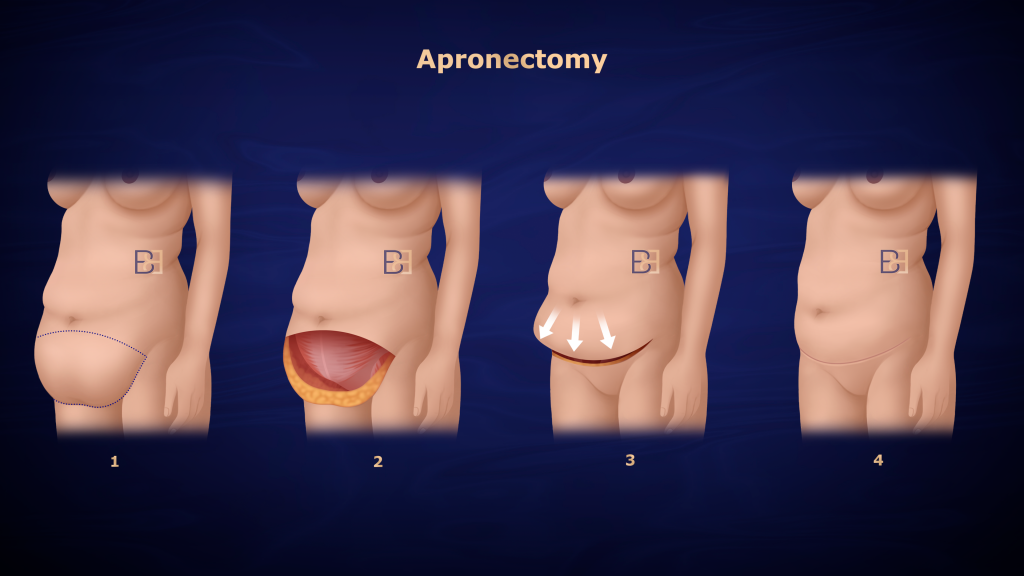
Apronectomy, also called panniculectomy, is a surgical procedure that removes excess skin and fat hanging over the lower abdomen, the fold patients call the apron. The medical name for this apron is the pannus. The operation is a wedge excision of the lower abdominal overhang, performed with minimal undermining of the surrounding tissue. It does not include muscle repair, it does not reposition the belly button (umbilicus), and it does not treat loose skin in the upper abdomen or around the flanks.
My position from the start: in my practice, apronectomy is rarely the operation I recommend as the definitive treatment for loose skin after significant weight loss. For most patients, an extended abdominoplasty or a Fleur de Lis abdominoplasty treats the full pattern of skin excess and gives a more complete result. Those operations remove more skin, allow muscle repair where it is needed, and deal with the whole abdomen rather than the lower portion alone.
So why write a comprehensive guide about it? Because apronectomy has a genuine place, and for the right patient it is the correct operation. I use it in 2 main situations. The first is as a staging procedure for patients who are still losing weight but have a large, symptomatic apron causing rashes, skin breakdown, or real difficulty with movement and hygiene. The second is for patients with significant medical conditions where a longer, larger operation would place more demand on the body than is appropriate. In both cases, removing the apron deals with the functional problem now, and a more comprehensive operation can follow later if the patient wants one and is suited to it.
I am a Specialist Surgeon (FRACS) whose practice focuses on body contouring surgery after significant weight loss, and whether apronectomy or a different operation is right for you is assessed individually at consultation. This guide covers what the operation involves, how it differs from abdominoplasty (tummy tuck), who it suits, what recovery looks like, and how Medicare treats it.
The Abdominal Apron (Pannus) Explained
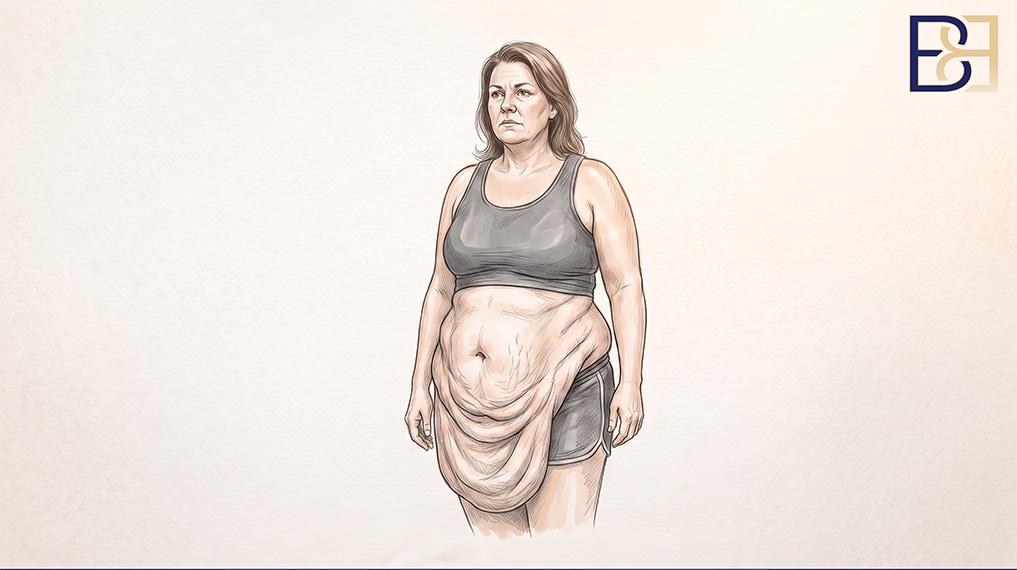
The pannus, or abdominal panniculus, is the fold of redundant skin and subcutaneous fat that hangs from the lower abdomen. Patients usually call it the apron, the overhang, or just hanging skin. It develops when the abdominal skin has been stretched over a long period, most often by significant weight gain, and then loses the volume that was filling it. Skin has some capacity to retract, but that capacity is limited. It depends on age, genetics, how long the skin was stretched, how much weight was lost, and the condition of the elastic fibres within the skin itself. Once a patient has achieved significant weight loss, whether through bariatric surgery, medication assisted weight loss, or diet and exercise, the skin frequently cannot shrink back (1). What remains is significant excess skin: an empty envelope that folds over the pubic area.
How I grade the pannus
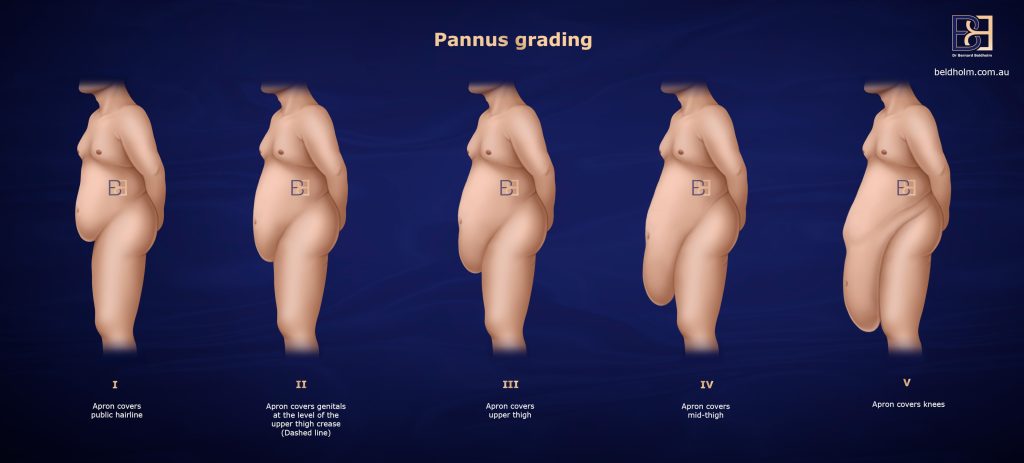
I grade the apron by how far it descends. This grading matters because it tells me how large the problem is, what operation is likely to be needed, and how demanding that operation will be.
- Grade 1: the apron covers the pubic hairline but not the whole mons pubis
- Grade 2: the apron covers the entire mons pubis but does not reach the genitals
- Grade 3: the apron reaches the upper thigh
- Grade 4: the apron reaches the mid thigh
- Grade 5: the apron reaches the knees or beyond
Most patients I see for apronectomy have a Grade 3 apron or larger. Smaller grades are usually better treated as part of a comprehensive abdominoplasty, because the apron is only one part of their skin excess.
The problems an apron causes
The apron is not just a cosmetic concern. A large pannus creates real, daily, physical problems:
- Intertrigo. The skin fold traps moisture, heat, and friction. The result is skin irritation and a recurring rash in the crease that can progress to fungal or bacterial infection. For many patients this cycles constantly through summer despite creams, powders, and careful drying.
- Skin breakdown. In severe cases the skin within the fold ulcerates and weeps, and healing is slow because the environment inside the fold never dries out.
- Hygiene difficulty. Keeping the area under a Grade 3 or larger apron clean and dry is a genuine daily task, and for some patients it is physically hard to reach.
- Interference with movement. A heavy apron shifts weight forward, alters posture and gait, gets in the way of bending, and makes exercise uncomfortable. This is a particular frustration for patients who are actively trying to keep losing weight.
- Clothing and daily function. Fitting clothes over the apron, discomfort with seatbelts, and skin pulling with activity are constant low grade problems that patients live with every day.
These functional problems are the reason apronectomy exists as an operation, and they are also central to how Medicare assesses it, which I cover later in this guide.
Apronectomy vs Abdominoplasty (Tummy Tuck): The Real Differences
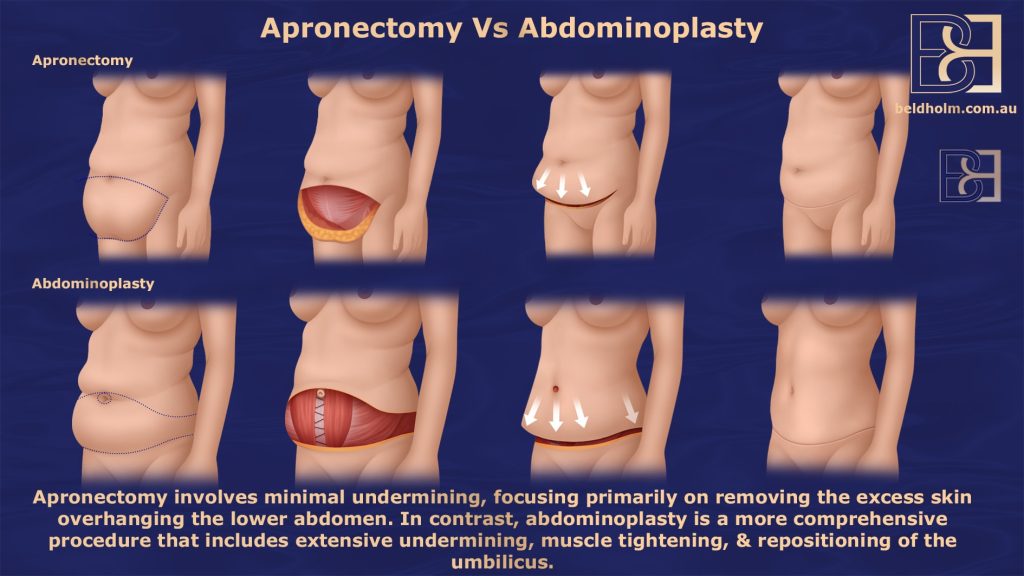
Patients often arrive at consultation using these terms interchangeably. They are different operations with different scopes, and the differences matter when deciding which one suits you.
An apronectomy is a wedge excision. I remove the excess lower abdominal skin and fat through a transverse incision, with minimal undermining of the tissue above it. Because I am not lifting the abdominal skin off the muscle layer, I cannot repair muscle separation (diastasis recti), I cannot treat loose skin in the upper abdomen, and the belly button (umbilicus) stays where it is. The operation deals with the overhang and nothing else.
An abdominoplasty (tummy tuck) involves raising the abdominal skin off the muscle layer up to the ribs. That undermining is what allows me to remove skin from the whole abdomen, perform muscle repair where it is needed, repair a hernia if one is present, and reposition the belly button (umbilicus) to sit correctly on the new abdominal wall. In patients undergoing abdominoplasty after significant weight loss, this is usually an extended abdominoplasty, where the incision continues around the hips to deal with skin excess extending toward the flanks, or a Fleur de Lis abdominoplasty, which adds a vertical excision to treat horizontal skin excess.
Side by side
Apronectomy (panniculectomy) | Abdominoplasty (tummy tuck) | |
|---|---|---|
What is removed | Lower abdominal apron only | Skin excess across the whole abdomen |
Undermining | Minimal | Extensive, up to the ribs |
Muscle repair | No | Yes, where needed |
Hernia repair | No | Can be performed at the same time |
Belly button (umbilicus) | Not repositioned | Repositioned |
Upper abdominal skin | Not treated | Treated |
Operating time | 2 to 3 hours | Longer, depending on the operation |
Physiological demand | Lower | Higher |
Result | Removes the overhang | Reshapes the abdomen as a whole |
What this means in practice
The comparison is not about one operation being better than the other. It is about scope. If the only problem is a symptomatic apron, or if a larger operation is not appropriate for you right now, apronectomy solves the problem it is designed to solve. If your skin excess involves the upper abdomen, the flanks, or muscle separation (diastasis recti), an apronectomy will leave those problems untreated, and you should know that before choosing it.
That is why the decision is made at consultation, after I have examined your skin pattern, your abdominal wall, and your general health. The pattern of excess determines the operation, not the other way around.
Where Apronectomy Fits in My Practice
My general preference, where a patient is medically suited to it, is to treat loose skin in a single comprehensive operation rather than dividing the work across several procedures. 1 operation means 1 anaesthetic, 1 hospital admission, and 1 recovery. For most post weight loss patients, that operation is an extended abdominoplasty or a Fleur de Lis abdominoplasty, because those procedures deal with the full pattern of skin excess in one operating time. Published research on combined body contouring in massive weight loss patients supports this approach in properly selected candidates (2).
A larger single operation is also a bigger physiological event, and it is not the right choice for everyone. That is where apronectomy earns its place. I use it in 2 specific situations.
1. As a staging procedure during ongoing weight loss
Some patients are still losing weight, whether through a weight loss procedure such as bariatric surgery, medication assisted weight loss, or diet and exercise, but have a large apron causing problems that cannot wait. Recurring intertrigo, skin breakdown, and an apron that physically interferes with the exercise they need to keep losing weight are all reasons not to delay treatment until the final weight is reached.
For these patients, apronectomy removes the symptomatic apron now, with a shorter operation and a more contained recovery. Once weight has stabilised, a definitive procedure can follow later if the patient wants one and is suited to it. Operating definitively before weight has stabilised tends to produce a result that deteriorates as further weight comes off, which is why I stage the work in this situation rather than doing everything at once.
2. For patients where a longer operation is not appropriate
Some patients have medical conditions that make a 4 to 6 hour operation with extensive undermining an unreasonable demand on their body. Cardiac disease, respiratory disease, diabetes with complications, and clotting disorders all factor into this judgement. For these patients, a 2 to 3 hour wedge excision with minimal undermining treats the functional problem while keeping the operative demand within what their health can support. Research has shown that panniculectomy can be performed in high risk, medically complex patients with acceptable outcomes when planning is thorough (3).
This is staging as a deliberate clinical choice, not a compromise. For these patients, the more limited operation is the appropriate operation.
How the decision is made
Whether you are suited to a single comprehensive operation, a staged approach starting with apronectomy, or no surgery at all is a clinical judgement I make with you at consultation. It rests on your medical history, your nutritional status, your weight trajectory, and the pattern and extent of your skin excess. A GP referral is required before any consultation, and results vary between patients.
What I will not do is recommend a larger operation than you need, or a smaller one than will solve your problem. The examination determines the advice.
Who Is Suited to Apronectomy?
Patient selection for apronectomy is different from patient selection for abdominoplasty. For a definitive abdominoplasty I want weight fully stabilised and the best possible operating conditions. For apronectomy, the question is different: is there a functional problem that needs treating now, and is this the right sized operation for this patient right now?
The patients I consider for apronectomy
- A symptomatic apron. Recurring intertrigo or skin infections in the fold, skin breakdown, hygiene difficulty, or an apron that interferes with walking, exercise, or daily activities. The functional problem is the indication for this operation.
- Patients still losing weight. If you are partway through a large weight loss and the apron is holding you back, apronectomy can be appropriate before you reach your final weight. This is the staging situation I described above.
- Patients with significant medical concerns. Where health limits what operation can reasonably be performed, the shorter operating time and limited dissection of apronectomy reduce the demand on the body.
- A Grade 3 or larger apron. Smaller aprons are usually better treated as part of a comprehensive abdominoplasty, because the overhang is only one component of the skin excess.
What I assess at consultation

- Your medical history. Diabetes, cardiac and respiratory disease, clotting history, smoking, and current medications all affect both suitability and how I shape the surgical plan. Smoking in particular impairs wound healing, and I ask patients to stop well before surgery.
- Your weight history and trajectory. Actively losing, stable, or regaining. This shapes whether apronectomy or a definitive procedure is the better plan, and it affects Medicare eligibility, which requires weight stability.
- Your nutritional status. Significant weight loss commonly leaves protein and micronutrient gaps that impair healing. I check these with blood tests before surgery and correct what needs correcting. I cover this in the preparation section below.
- The pattern of your skin excess. Where the laxity is, how far the apron descends, and whether the excess is confined to the lower abdomen or extends beyond it.
- Your abdominal wall. Muscle separation (diastasis recti) and hernias. Apronectomy treats neither, so if these are present and symptomatic, that changes the recommendation.
BMI

I treat body mass index (BMI) as a rough guide, not a hard cut off. A higher BMI increases wound complications after any abdominal contouring procedure, and I discuss that risk with each patient. But apronectomy is precisely the operation that is sometimes performed at a higher BMI, for functional reasons, in patients who are still on the way down. Clinical context determines candidacy, not a number on its own.
Who Is Better Served by a Different Operation?
Apronectomy solves one problem. If your skin excess goes beyond the lower abdominal apron, choosing apronectomy as your definitive operation means accepting that the rest stays untreated. For most patients at a stable weight, one of the following is the better plan.
Skin excess across the whole abdomen
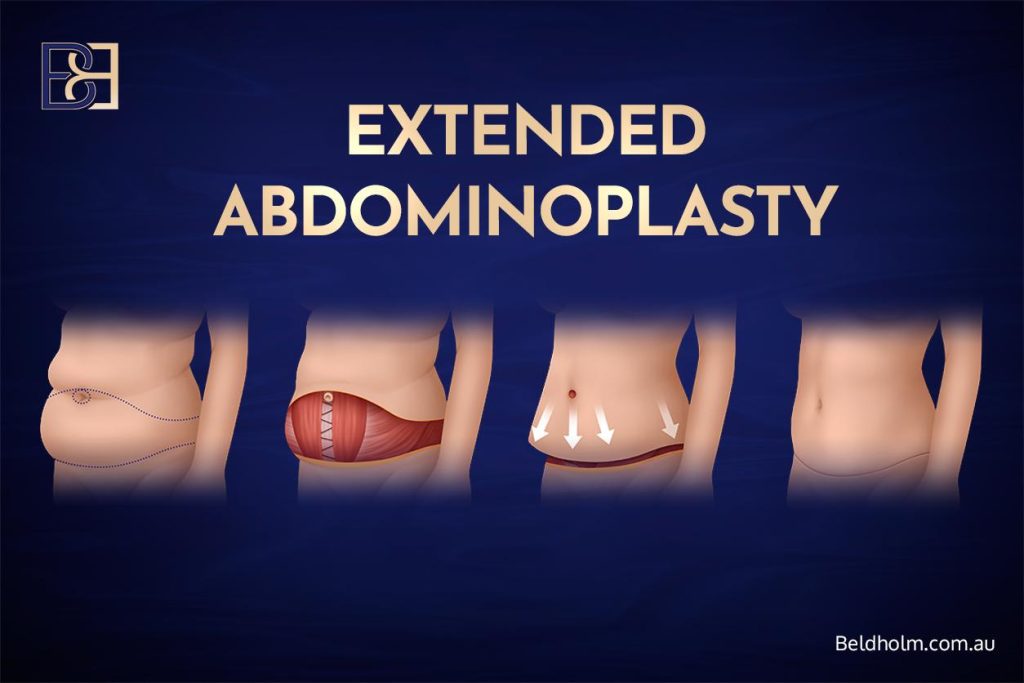
If the laxity involves the upper abdomen as well as the lower, and extends toward the hips, an extended abdominoplasty removes the full apron and the surrounding excess in one operation, with muscle repair where it is needed. This is the standard definitive operation for most of my post weight loss patients.
Horizontal as well as vertical excess

Some patients have skin laxity running side to side as well as top to bottom. You can see it as looseness that gathers toward the midline when you stand. Horizontal excess is treated with a vertical excision, which is the defining feature of the Fleur de Lis abdominoplasty. Where there is also loose skin in the upper abdomen above what the Fleur de Lis pattern reaches, my dual vector abdominoplasty combines the Fleur de Lis with an upper abdominal skin excision to treat multi directional laxity.
Excess extending around the trunk

If the loose skin continues around the flanks and lower back, the operation that treats the full circumference is a body lift (belt lipectomy). For patients with both circumferential excess and horizontal excess at the front, my circumferential hybrid abdominoplasty combines the belt lipectomy with an anterior vertical excision.
Muscle separation (diastasis recti) or hernia
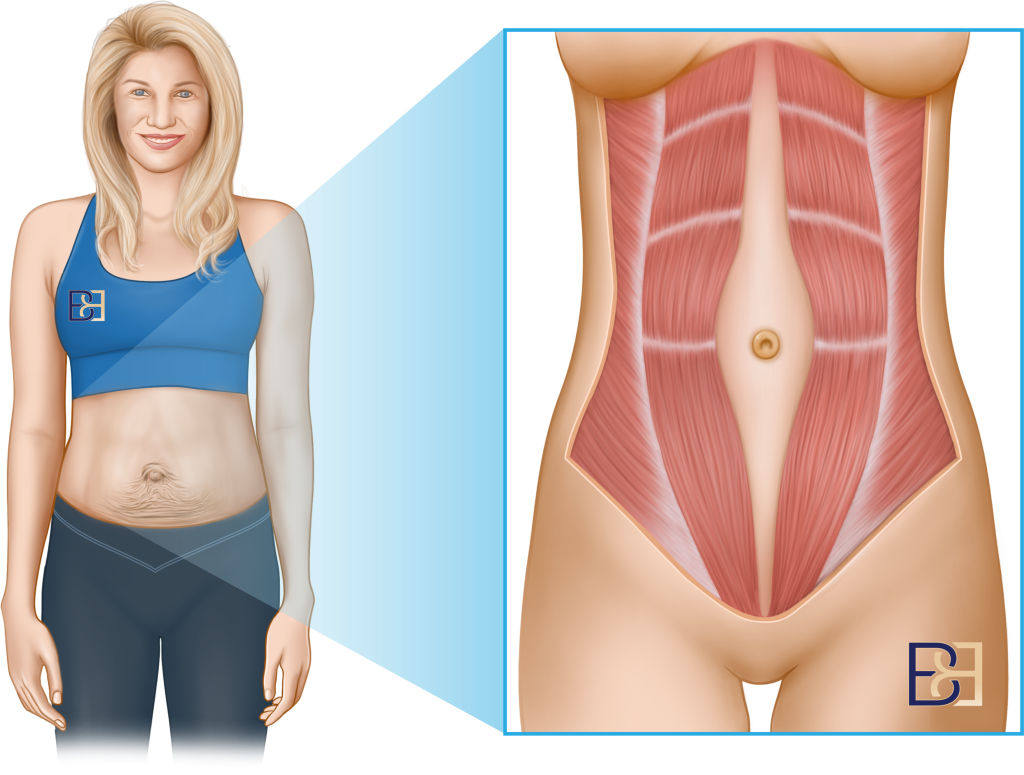
Apronectomy involves no undermining of the abdominal wall, so it cannot include muscle repair or hernia repair. If you have symptomatic muscle separation (diastasis recti), or a hernia that needs fixing, the operation needs to be one that raises the abdominal flap and exposes the abdominal muscles. In post weight loss patients, muscle separation is not routine and is assessed individually, but where it is present and contributing to symptoms, it changes the recommendation away from apronectomy.
The common thread
Each of these operations exists because excess skin after major weight loss follows patterns, and the excision has to match the pattern. At consultation I map where your laxity is and recommend the operation that treats it. If that operation is larger than an apronectomy, I will tell you so and explain why. If your health or weight trajectory makes the larger operation inappropriate right now, apronectomy comes back into the conversation as the staged first step.
How I Perform the Operation
Apronectomy is performed under general anaesthesia at Maitland Private Hospital. The operation takes 2 to 3 hours depending on the size of the apron.
Markings
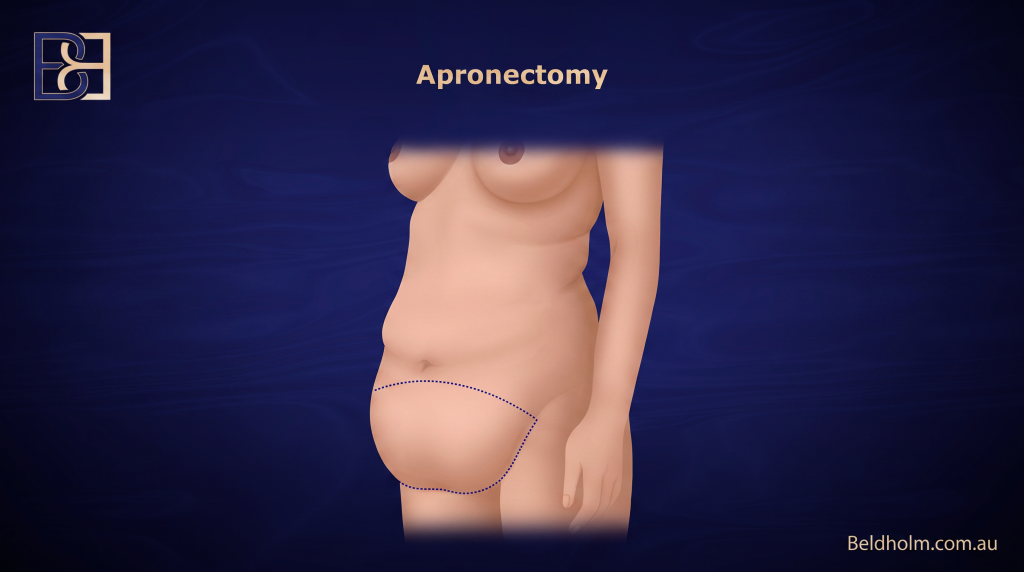
I mark you standing, before surgery, because the apron only shows its true extent when you are upright. The markings define the wedge of tissue to be removed: a transverse ellipse across the lower abdomen, taking the full apron while keeping enough skin above the incision to close without tension. Closure tension is the enemy of wound healing in this operation, and the markings are where that problem is prevented.
The excision
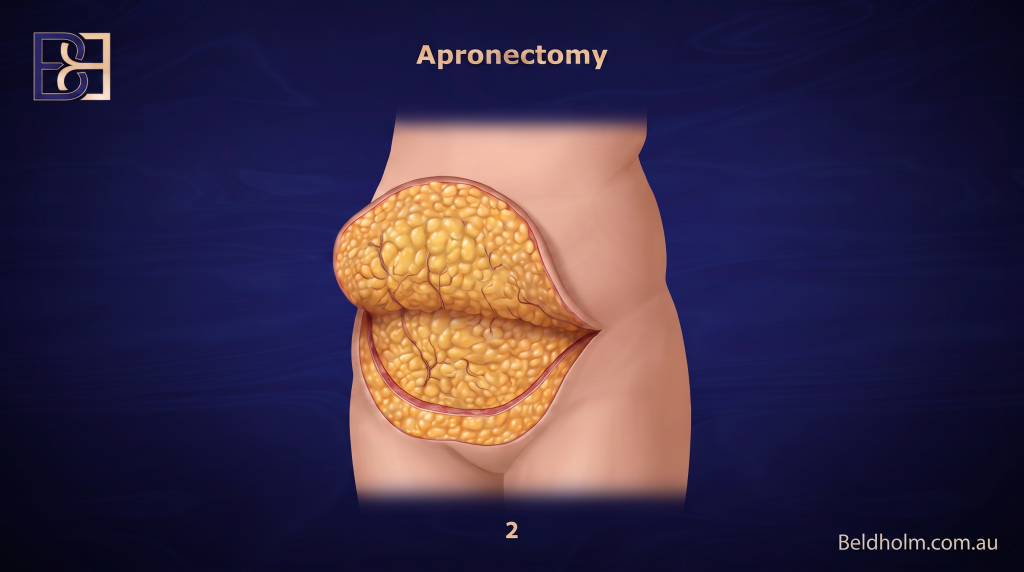
With you asleep, I excise the marked wedge of excess skin and fat. The defining feature of the operation is what I do not do: there is minimal undermining of the tissue above the incision. I am not lifting the abdominal skin off the muscle layer, which keeps the blood supply to the remaining skin intact, keeps the operation shorter, and keeps the physiological demand contained. The belly button (umbilicus) is not repositioned. In patients with a very large apron, the weight of excess tissue removed can be substantial, sometimes several kilograms.
Closure and drains
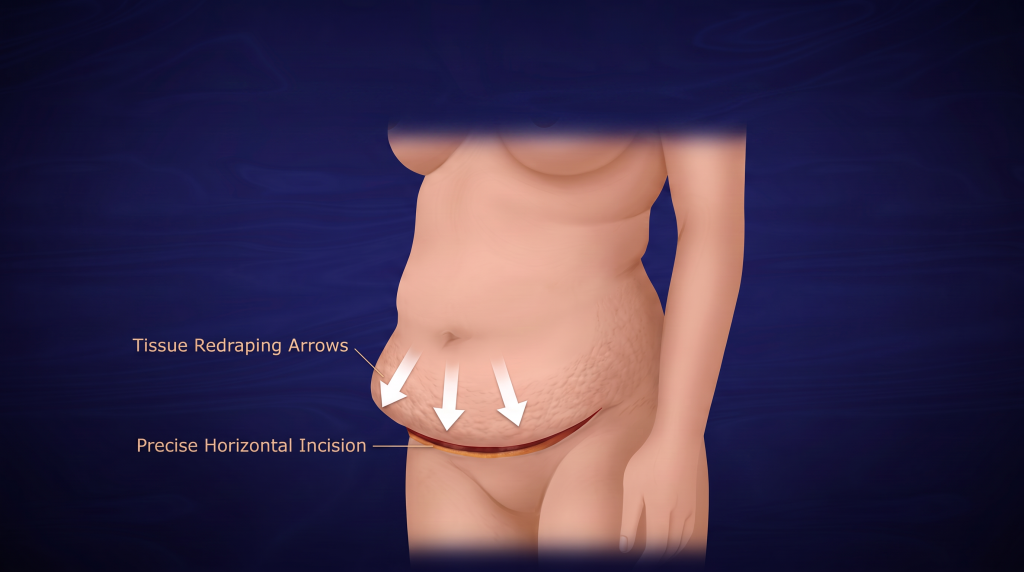
The wound is closed in layers through the soft tissue with dissolving sutures, progressively taking tension off the skin edge. I place 2 closed suction drains before closure. A large apron leaves a raw surface where fluid collects after surgery, and drains reduce the chance of a seroma developing in that space. They usually stay in for the first days after surgery and are removed once the output settles.
Dressings
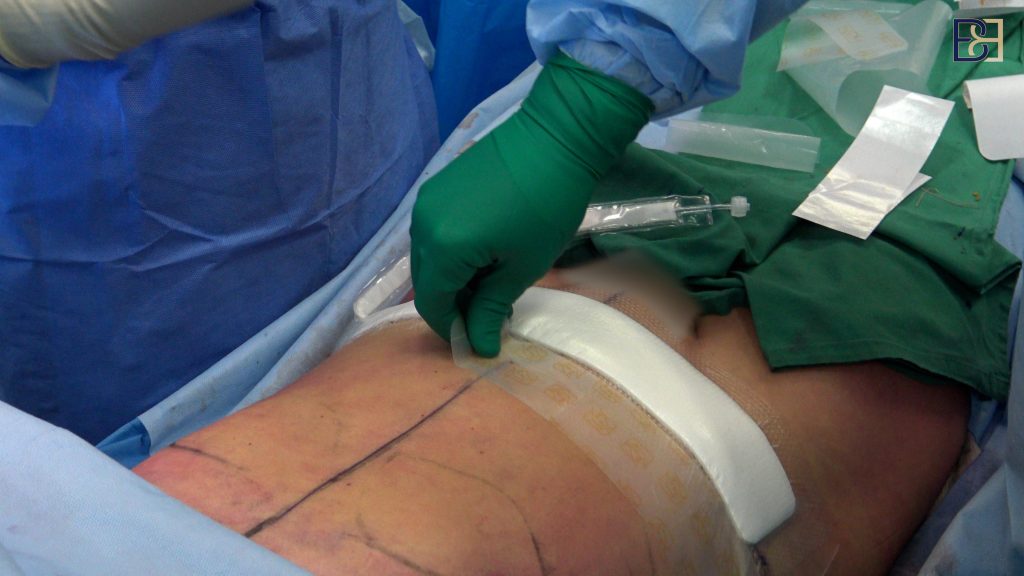
I apply PICO negative pressure dressings at the end of the operation. These stay on for the first 7 days and are then changed. Beyond that, the wound is supported with Hypafix tape, which stays on as the scar matures and I renew at follow up visits.
After the operation
You wake in recovery and are transferred to the ward. Most patients stay 1 night. Patients with significant medical conditions may stay longer, and that is planned in advance rather than decided on the day. Maitland Private has 24 hour medical cover and an on site ICU, which matters for exactly the patient group in whom I most often perform this operation. I see you on the ward each day you are admitted.
Preparing for Surgery
Preparation matters in this operation because the patients who need an apronectomy are often the patients whose healing needs the most support: still losing weight, carrying nutritional gaps, or managing medical conditions. Getting the groundwork right before surgery is how a shorter operation stays a contained one.
Nutritional optimisation

Significant weight loss commonly leaves gaps in protein and micronutrients, whether the weight came off through weight loss surgery such as gastric sleeve or gastric bypass, medication, or diet. Those gaps directly affect wound healing (4,5). Protein is the raw material for repair, and deficiencies in vitamins and trace elements such as vitamin C, vitamin D, zinc, and iron each impair a specific part of the healing process.

Every post weight loss patient in my practice has a full pre operative blood panel before surgery. It covers a full blood count, coagulation screen, liver function, electrolytes, glucose and HbA1c, iron studies, thyroid function, and a vitamin and micronutrient screen including vitamins A, B1, B6, B12, folate, vitamin D, vitamin E, zinc, and selenium, with albumin as the protein marker. Results go to you and your GP, and anything that needs correcting is corrected before we operate. I explain the reasoning behind this in detail in my article on nutritional deficiencies after weight loss, and my pre operative blood tests guide covers each test and why it is there.
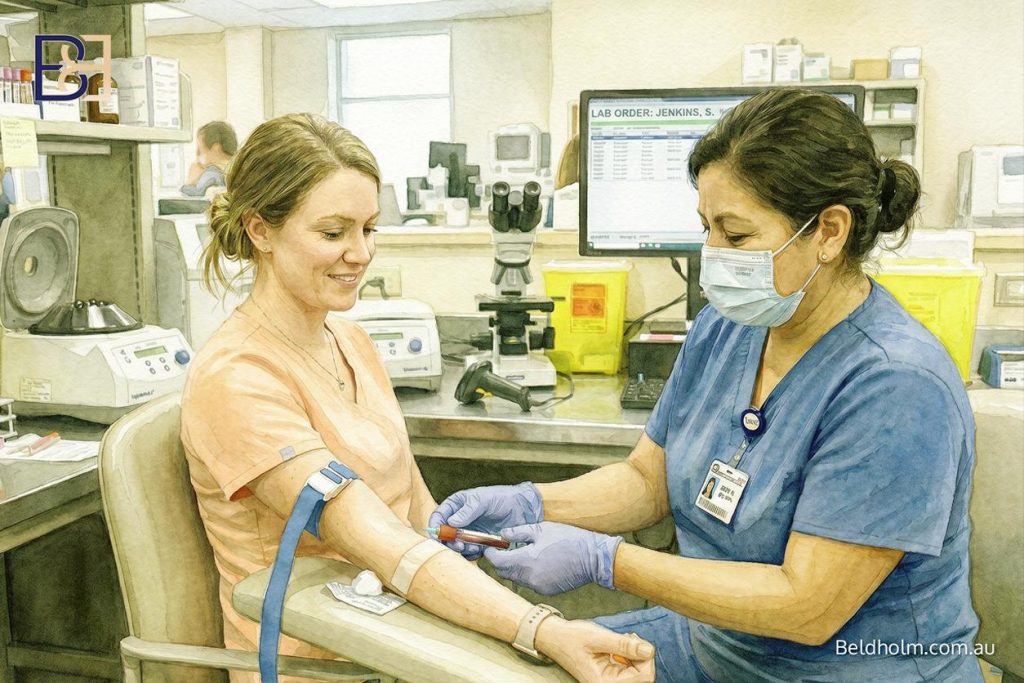
I will give you a specific supplement plan based on your results rather than a generic list. If you are still actively losing weight before a staged apronectomy, protein intake is the single area I watch most closely, because rapid weight loss and healing compete for the same resources.
Medications
Bring a complete list of everything you take to your consultation. Aspirin and anticoagulants are typically stopped 1 week before surgery, but only on my instruction, and some patients continue through surgery with a plan made well in advance. Do not stop these yourself. If your weight loss has come through medication, do not adjust or stop it on your own either. Whether any change is needed around surgery is decided individually as part of perioperative planning.
Smoking
Smoking constricts the blood vessels that the healing wound depends on. I ask patients to stop completely before surgery, and this is not negotiable for an operation whose main risks are wound related.
The anaesthetic consultation
For most patients the anaesthetist consultation happens by phone before surgery, with the physical examination, including your airway assessment, done on the day. If your medical history is complex, the anaesthetist may arrange more than this, and for the medically complex patients who make up part of the apronectomy group, that planning is part of what makes the operation appropriate.
Practical preparation
Arrange 2 weeks of reduced commitments after surgery, help at home for the first days, and loose clothing that does not press on a lower abdominal wound. If you are travelling from outside the region, plan to stay locally for the first 2 weeks if you can, and 1 week at minimum. I cover the full recovery arrangements in the apronectomy recovery guide.
Recovery: A Snapshot

Recovery after apronectomy surgery is more contained than after a full abdominoplasty, but the recovery process is still that of major surgery and should be treated that way. Here is the shape of it. The full detail, week by week, is in my apronectomy recovery guide.
- Hospital: usually 1 night. Longer stays are planned in advance for patients with significant medical conditions.
- Drains: removed in the first days once output settles.
- Dressings: PICO negative pressure dressings for the first 7 days, then Hypafix tape as the wound matures.
- The first 2 weeks: the intense follow up period. You are seen regularly by me and my nurse, and LED light therapy is part of the wound care during these visits. Walking starts on day 1 and is your main activity. Rest, hydration, and protein intake carry the healing.
- Weeks 2 to 4: gradually increasing activity. Patients with desk based work typically return around the 2 week mark. Physical jobs need longer.
- From 4 weeks: light exercise resumes, building gradually. Heavy lifting and high impact exercise wait longer, and I guide the timing at your 4 week review.
- Follow up schedule: after the first 2 weeks of intense follow up, I review you at 4 weeks, 3 months, 6 months, and 12 months. All follow up is included in the surgical fee.
If you are a travelling patient, stay locally for the first 2 weeks if possible, 1 week at minimum. I work with your GP for ongoing care and can run follow up consultations by telehealth where distance makes visits impractical.
Risks and Complications: A Snapshot
Apronectomy is major surgery, and all surgery carries risks. The shorter operating time and more limited dissection reduce some of them compared with a full abdominoplasty, but this operation is often performed in higher risk patients, so the 2 largely offset. This is a summary of the potential complications; the detail on each, including how it is managed if it occurs, is in my apronectomy complications guide.
The main risks are wound related. Seroma, a collection of fluid under the wound, is the most common, which is why I use drains. Wound healing problems, including areas of delayed healing, wound breakdown, or partial skin loss, occur more often in patients with diabetes, higher BMI, or nutritional deficiencies, particularly those carrying more than one of these factors, which is exactly why the pre operative workup exists (6). Infection, bleeding and haematoma, and scarring problems including thickened or stretched scars are all possible. Numbness above the scar line is common and usually resolves over months, though some permanent change in sensation can remain. Deep vein thrombosis and pulmonary embolism are the serious general risks of any abdominal surgery, and I assess your individual clotting risk and set your prevention plan before the operation, including early walking, calf compression during surgery, and blood thinning injections where indicated (7,8). Anaesthetic risks are assessed and discussed by your anaesthetist.
Results vary between patients, and a small number of patients need revision surgery for wound or scar problems. If you notice increasing redness, swelling, discharge, fever, calf pain, or breathlessness after surgery, contact us. After hours, call Maitland Private Hospital, where nurse led phone triage will direct you. For anything life threatening, call 000.
Scars and What the Result Looks Like
The scar
Apronectomy leaves a transverse scar low across the abdomen, sitting where the apron used to fold. It runs longer than a caesarean scar, and with a large apron it can extend toward the hips, because the incision has to be long enough to remove the full width of the overhang without leaving bunched skin at the ends. The scar sits low enough to be covered by underwear in most patients.
Scars are permanent. They fade and flatten over 12 to 18 months, and how well yours matures depends partly on genetics and partly on care: taping, sun protection, and the wound support built into my follow up schedule. Some patients develop thickened or stretched scars, and if that happens we manage it during your reviews.
What changes
The result of an apronectomy is the removal of the overhang. The apron is gone, and the removed skin takes with it the fold, the rash, the moisture, the hygiene difficulty, and the physical interference the apron caused. For patients who had a Grade 3 or larger apron, that is a substantial change in daily comfort and function.
What does not change
This is where expectations need to be accurate before you choose this operation:
- Loose skin in the upper abdomen remains
- Muscle separation (diastasis recti), if present, remains
- The belly button (umbilicus) is unchanged
- The waist and flanks are unchanged
- The overall abdominal contour is improved only to the extent that the overhang was the problem
Patients who choose apronectomy as a staged first step generally understand this well: the goal was function, and the definitive reshaping comes later. Patients considering apronectomy as their only operation need to weigh it carefully, because the contour result is more limited than an abdominoplasty. The starting point, particularly the size of the apron and the condition of the remaining skin, shapes what the end point looks like.
Medicare and Cost

The Medicare item number
Apronectomy after significant weight loss is covered by MBS item 30166, which describes a wedge excision of redundant abdominal skin and fat. To qualify, the criteria set out in the Medicare Benefits Schedule must be met:
- You have lost at least 5 BMI units of weight
- Your weight has been stable for at least 6 months before surgery
- Either the skin fold has caused intertrigo or another skin condition that risks skin integrity and has failed 3 months of conservative medical treatment, or the redundant skin and fat interferes with your activities of daily living
These criteria frame the operation as a matter of medical necessity rather than a cosmetic procedure. If you meet them, Medicare contributes a rebate toward the surgical, anaesthetic, and hospital fees, and private health insurance at the appropriate level of cover contributes toward the hospital costs. If you do not meet them, the operation is self funded.
A note on weight stability and staging
The 6 month weight stability requirement sits awkwardly against the staging use of apronectomy in patients who are still losing weight. This is a genuine tension, and it means some patients having apronectomy as a staged procedure will not qualify for a Medicare rebate at the time of their surgery. Whether you meet the criteria is assessed on your individual circumstances, and I go through this with you at consultation so the funding position is known before any decision is made.
What the costs involve
The total cost of an apronectomy includes the surgical fee, the anaesthetist fee, the hospital fees for theatre and admission, and the surgical garments and dressings. After your consultation you receive a written quote itemising all of this, with the Medicare and health fund contributions identified, so there are no surprises. The second consultation and all routine follow up visits, including the intense 2 week post operative period and the reviews out to 12 months, are included in the surgical fee.
For current figures and a full breakdown of how the fees are structured, see my apronectomy cost guide.
Moving to a Definitive Procedure Later
For patients who had apronectomy as a staged first step, the second stage is planned once weight has stabilised. Here is how I approach it.
Timing
2 things need to be in place before the definitive operation. First, weight stability: your weight should be stable for at least 6 months, and I prefer 12, because operating on a still changing body produces a result that changes with it. Second, full recovery from the apronectomy: the scar should be mature and the tissues settled, which generally means waiting at least 6 to 12 months between operations. In practice, for patients still losing weight at the time of their apronectomy, the gap is usually longer, dictated by how long the remaining weight takes to come off and stabilise.
What the second operation involves
By the time of the second stage, the apron is gone but the skin envelope has usually loosened further with the additional weight loss. The definitive operation is chosen by the pattern of excess that remains: most commonly an extended abdominoplasty or Fleur de Lis abdominoplasty, and where the laxity extends around the trunk, a body lift (belt lipectomy). Muscle repair and hernia repair, which the apronectomy could not include, are performed at this stage where they are needed. Where loose skin involves other regions, procedures such as mastopexy (breast lift), brachioplasty (arm lift), or thighplasty (thigh lift) are planned as separate stages in their own right.
The existing apronectomy scar is usually excised as part of the new incision, so you are not left with 2 separate scar lines across the lower abdomen. The previous surgery does mean the tissue planes contain scar tissue from the first operation, which I take into account in planning, but a prior apronectomy does not prevent any of the definitive operations from being performed well.
Not everyone goes on to a second stage
Some patients find the apronectomy dealt with the problem that mattered to them, and they choose to stop there. That is a legitimate end point. The staged pathway is an option, not an obligation, and whether a second operation is worthwhile is your decision, made with full information about what it would and would not add.
My Final Advice

Apronectomy is a targeted operation with a specific job: removing the symptomatic apron from the lower abdomen. It is not the operation I recommend most often, because most patients at a stable weight are better served by a procedure that treats their full pattern of skin excess. But for the patient still on the way down with an apron causing daily problems, and for the patient whose health makes a longer operation inappropriate, it is exactly the right tool.
If you are weighing it up, the questions to bring to consultation are these. Is my weight stable, or am I still losing? Is my main problem the overhang itself, or the shape of my abdomen as a whole? Do I have muscle separation (diastasis recti) or a hernia that needs treating? The answers, together with the examination, determine whether apronectomy, a definitive abdominoplasty, or a staged combination of both is the right plan for you. A GP referral is needed before we meet, and your GP is also the right first conversation about whether your skin symptoms have been documented and treated, because that history matters for Medicare eligibility.
Frequently Asked Questions
Is apronectomy the same as a panniculectomy?
Yes. Apronectomy and panniculectomy are 2 names for the same procedure: excision of the pannus, the apron of redundant skin and fat hanging over the lower abdomen, without muscle repair or repositioning of the belly button (umbilicus). Apronectomy is the term more commonly used in Australia and the UK. In the United States, panniculectomy surgery is the standard term.
Is apronectomy the same as a limited abdominoplasty (mini tummy tuck)?
No. A limited abdominoplasty (mini tummy tuck) is a contouring operation for a small amount of loose skin below the belly button (umbilicus) in patients near their ideal weight, most often after pregnancy. Apronectomy is the opposite end of the spectrum: a functional operation removing a large, heavy apron, usually after significant weight loss. The incision is longer, the tissue removed is far greater, and the purpose is different.
How long do I stay in hospital?
The usual stay is 1 night at Maitland Private Hospital. Patients with significant medical conditions may stay longer, and where that is likely, it is planned before surgery rather than decided afterwards.
Can I have an apronectomy before I reach my goal weight?
Yes, and this is one of the main reasons I perform the operation. If a large apron is causing rashes, skin breakdown, or interfering with the exercise you need to keep losing weight, removing it before you reach your final weight can be the right call. The trade off is that the Medicare criteria require 6 months of weight stability, so a staged apronectomy during active weight loss may not attract a rebate. Both the clinical and funding sides are worked through at consultation.
Does Medicare cover apronectomy?
Medicare covers apronectomy under item 30166 when the criteria are met: at least 5 BMI units of weight lost, weight stable for at least 6 months, and either a skin condition such as intertrigo that has failed 3 months of conservative treatment or redundant skin that interferes with daily living. If the criteria are not met, the operation is self funded. Details are in the Medicare and cost section above and in my apronectomy cost guide.
Will I need another operation afterwards?
Not necessarily. Some patients have apronectomy as a staged first step and move to a definitive abdominoplasty once their weight has stabilised. Others find the apronectomy solved the problem that mattered and stop there. Both are reasonable outcomes, and the choice remains yours at every stage.
References
- Chandawarkar RY. Body contouring following massive weight loss resulting from bariatric surgery. Adv Psychosom Med. 2006;27:61-72.
- Patanè L, Marruzzo G, Fioramonti P, Guerra M, Lorenzetti P, Ribuffo D. S*fety and Efficacy of Combining Multiple Body-Contouring Procedures in Massive-Weight-Loss Patients: A Retrospective Multicenter Study. Aesthetic Plast Surg. 2026;50(10):3690-3699.
- Vancon A, Alhammadi F, Donadieu A, Gueroult P, Kianmanesh R, Delecroix Q, Renard Y. Simultaneous Abdominal Wall Reconstruction and Panniculectomy in High-Risk Complex Patients: A Retrospective Cohort Study. J Abdom Wall Surg. 2025;4:15456.
- Makarawung DJS, Al Nawas M, Smelt HJM, Monpellier VM, Wehmeijer LM, van den Berg WB, Hoogbergen MM, Mink van der Molen AB. Complications in post-bariatric body contouring surgery using a practical treatment regime to optimise the nutritional state. JPRAS Open. 2022;34:91-102.
- Toninello P, Montanari A, Bassetto F, Vindigni V, Paoli A. Nutritional Support for Bariatric Surgery Patients: The Skin beyond the Fat. Nutrients. 2021;13(5):1565.
- Bruno A, Foti R. Predictors of Complications in Abdominoplasty: A Multivariate Analysis of 150 Consecutive Cases. Aesthetic Plast Surg. 2026;50(13):5189-5205.
- Asiry A, Sayegh A, Gangloff D, Mortada H, Gandolfi S, Lupon E. Utility of the Caprini risk assessment model in guiding venous thromboembolism prophylaxis after abdominoplasty. JPRAS Open. 2025;46:305-315.
- Barrameda B, Clarke M, Wang J, Davé DR. Pulmonary Embolism Risk in Geriatric Panniculectomy: An NSQIP Analysis. Ann Plast Surg. 2026;96(3):218-222.