


Combining two operations changes recovery. When I remove breast implants (explant surgery) and perform a breast lift (mastopexy) in the same operation, you are recovering from more than either procedure would ask of you on its own. This article sets out what that recovery involves, week by week, so you can plan for it.
Patients have their breast implants removed for many reasons. Some have capsular contracture, where the scar tissue capsule around the implant tightens and firms. Others have an implant rupture, other implant complications, a change in breast shape over time, or health concerns such as breast implant illness. Whatever the reason, when there is also loose skin once the implants are removed, a breast lift (mastopexy) at the same time reshapes the breast tissue that remains.
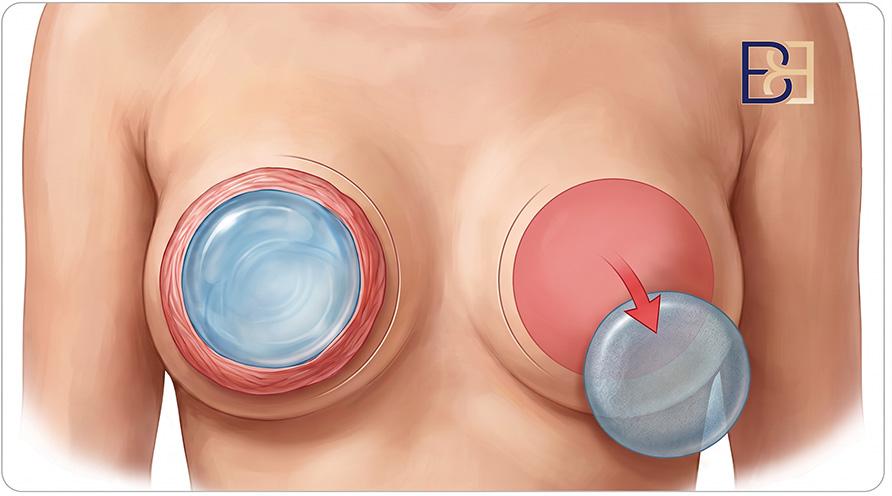
What the combined operation asks of your body
Removing the implants empties the breast implant pocket they once filled. The breast lift (mastopexy) then removes excess skin, reshapes the remaining breast tissue, and repositions the nipple and areola higher on the breast. Done together, this is a single operation with two distinct parts. It is a larger physiological event than a breast implant removal (explant surgery) alone or a breast lift (mastopexy) alone.
As with any cosmetic surgery, a longer operation places more demand on the body. Recovery takes longer to work through than a single smaller procedure, and it should not be underestimated. The sections that follow set out what to expect at each stage.
One operation or two
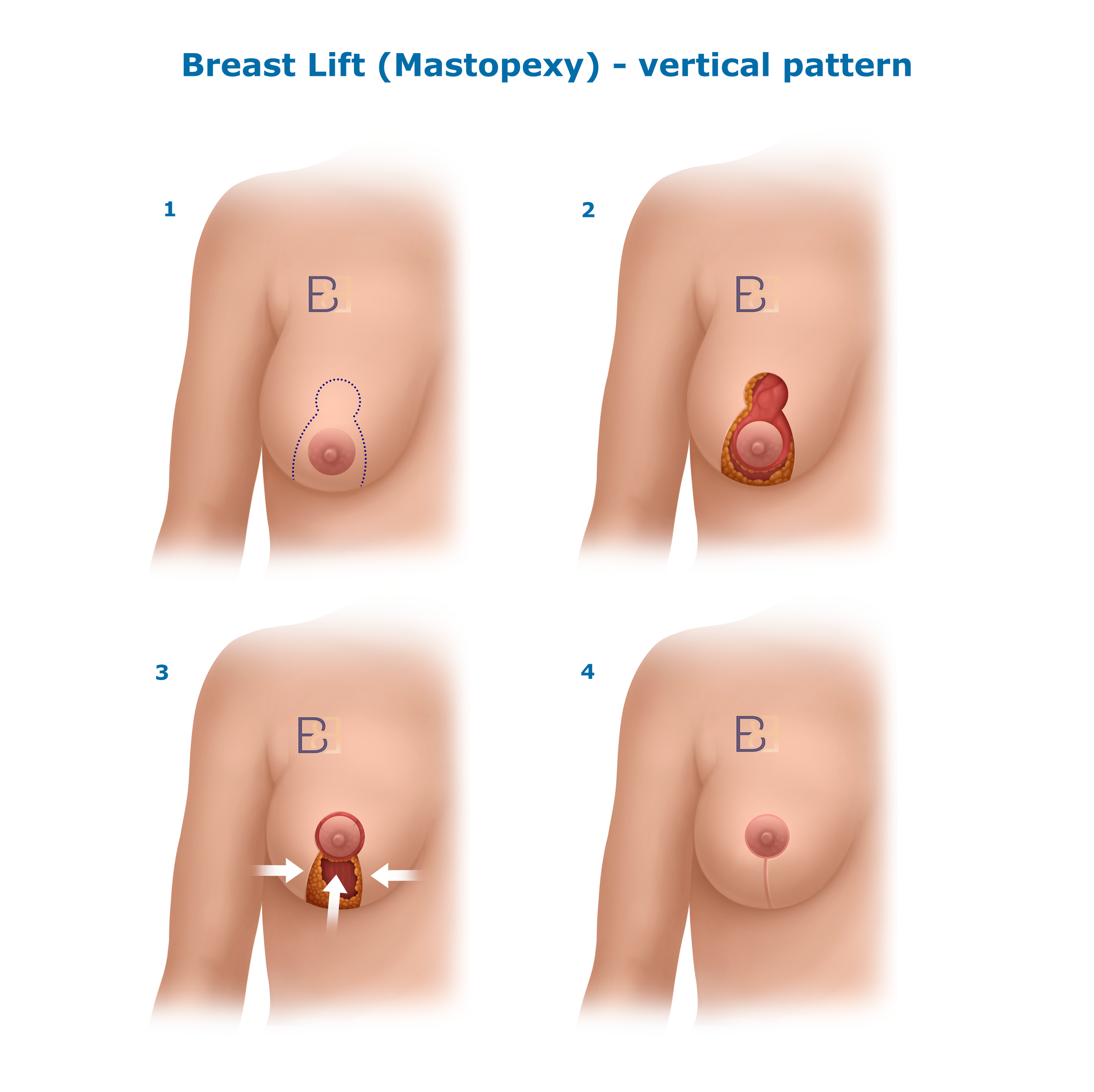
Some patients have the removal and the lift done together in one operation. For others, the more appropriate path is to stage the work across separate operations. That decision depends on your tissue quality, the pattern and extent of skin laxity and breast position, your medical history, and what can be done well in a single operating time. With a breast lift (mastopexy) in particular, staging can protect the blood supply to the nipple and the quality of the scars.
For some patients, staging is the right clinical choice, not a lesser one. Whether one operation or staged surgery suits you is assessed for you individually at consultation.
The first 24 hours
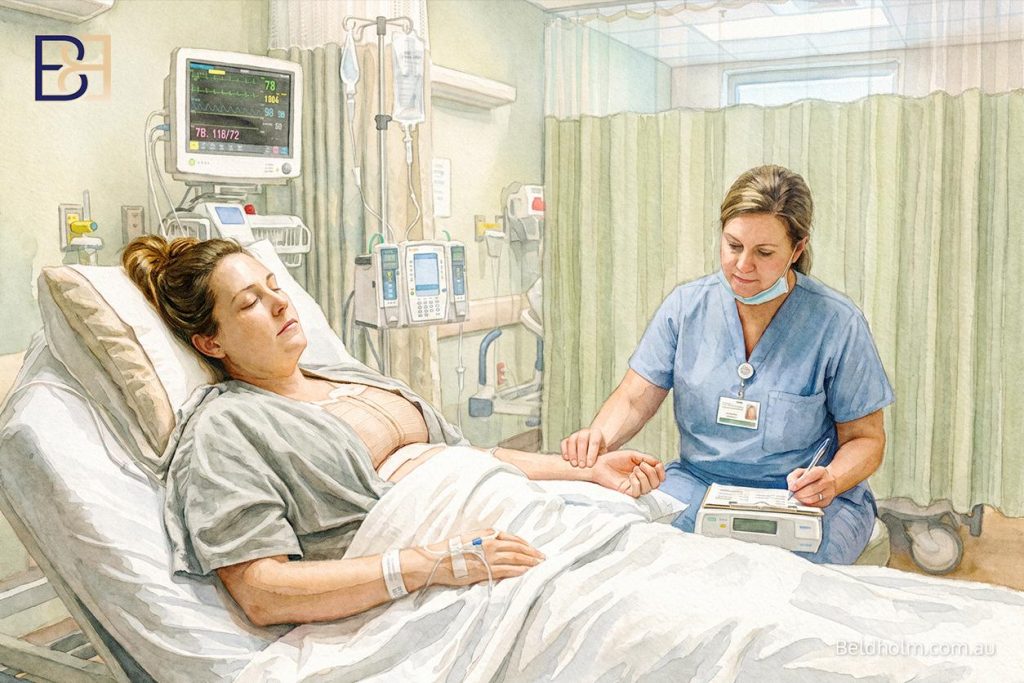
This is a day-stay operation. You come in on the day of surgery and go home the same day, once you have recovered from the anaesthetic.
Waking up
You wake in the recovery ward with a support bra on and dressings over the incisions. Staff monitor your observations while the general anaesthetic wears off. It is common to feel drowsy, and some patients feel nauseated for a few hours. Your breasts and chest will feel tight and sore. If drains have been used, they will be in place, and I cover those further on.
Going home

Because you have had a general anaesthetic, you cannot drive yourself home, and you should not travel alone. Arrange for someone to collect you and to stay with you for the first night. You are given pain relief before you leave and a prescription to take home.
Before discharge you receive written instructions. These cover your medication, how to manage your dressings, your activity restrictions, the signs that need attention, who to contact and when, and the dates of your follow-up. Keep them somewhere you can find them.
The first night
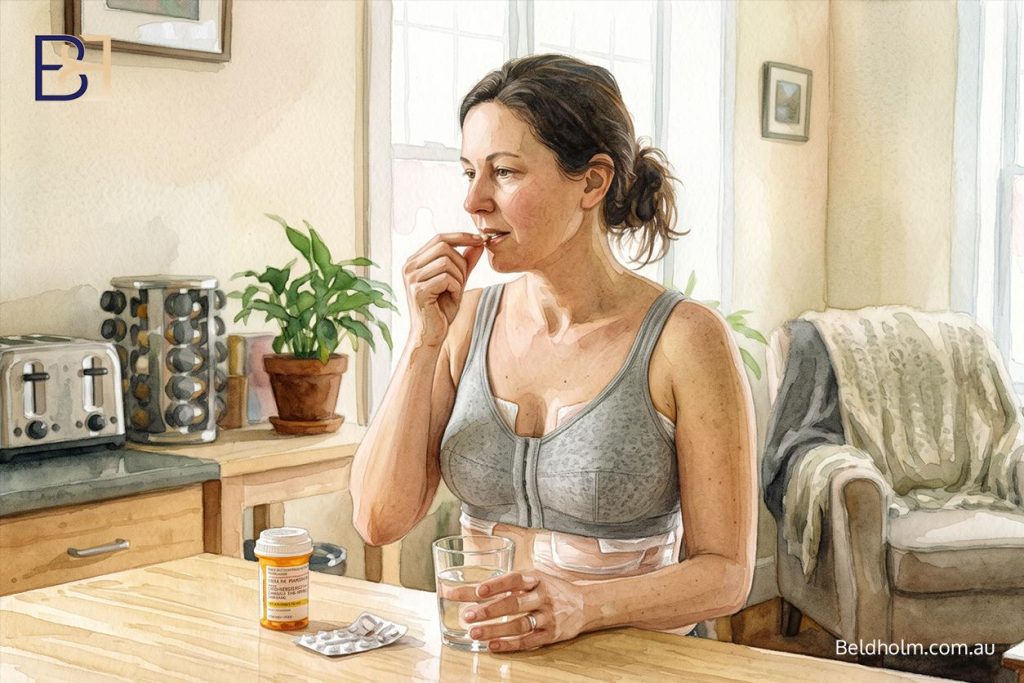
Expect to feel tired from the anaesthetic and sore across the chest. Tightness is normal at this stage. Rest, take your pain relief as directed, and keep your arm movements small. Eat and drink lightly until any nausea settles. Having someone with you means you are not managing on your own if you feel unsteady on your feet.
Managing pain and discomfort
Discomfort is part of the recovery process. The first few days are usually the most uncomfortable, and it eases over the first week as the tissues settle. Good pain management in these early days helps you rest and move about.
What it feels like

Expect soreness and a tight, aching feeling across the chest. The breast lift (mastopexy) involves removing skin and reshaping tissue, so there is tension across the incisions, and the fresh scars are tender. If your implants sat under the muscle, the muscle settles back into place over the first weeks and can ache as it does. Pain is more noticeable when you move your arms and shoulders, which is why arm movement is kept small in the early days.
Your pain relief
You go home with a prescription for pain relief. In my practice, most patients need the stronger pain medications for the first few days, then step down to milder pain relief such as paracetamol over the rest of the first week.
A few points that help:
- Take your pain relief on schedule in the first days rather than waiting for pain to build. Staying ahead of it works better than chasing it.
- Stronger pain medications can cause constipation. Keep up your fluids and fibre, and use a laxative if you need one.
- Reduce the medication as the soreness settles. Most patients are off the stronger tablets within several days.
When pain is not settling
Pain should ease a little each day. Pain that climbs instead of settling, or that is worse on one side with swelling or redness, is not what I expect, and it is a reason to make contact. I set out who to call and when further on.
Drains, dressings and your support bra
Drains
Drains are not always needed. When the implants come out, fluid can accumulate in the space they leave behind, and a drain carries that excess fluid away while the tissues settle. Scar tissue forms around any breast implant, creating a capsule. In some cases I also remove this surrounding scar tissue when the implant comes out. That is a larger dissection, and it makes a drain more likely. If you have a drain, it sits under the skin and exits to the side, connected to a small collection bulb.
You may go home with a drain in place. If so, you are shown how to empty it and record the amount. The drain comes out once the fluid draining over 24 hours drops below 20 mL, which is usually within the first several days.
Dressings and sutures
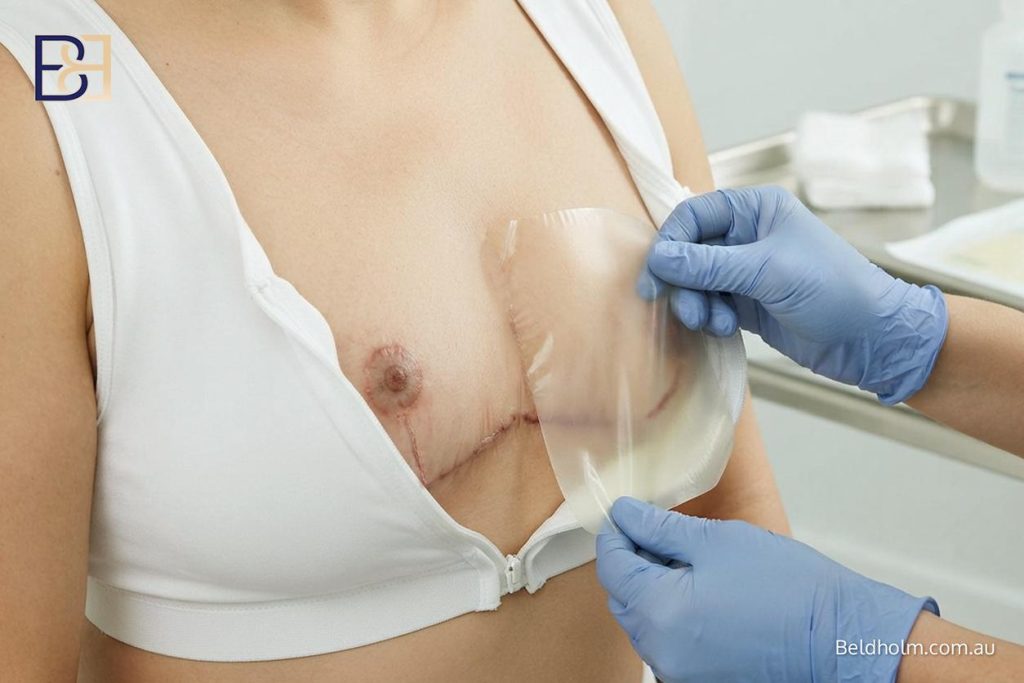
Your incisions are closed with absorbable sutures placed under the skin, with nothing to remove later. Over the top I use Comfeel dressings, which are water-resistant. You can shower the day after surgery with the dressings on, then pat them dry.
Leave the dressings alone. Do not pick at the edges or peel them back to look. They stay in place until the nurse or I change or remove them at your review.
Your support bra
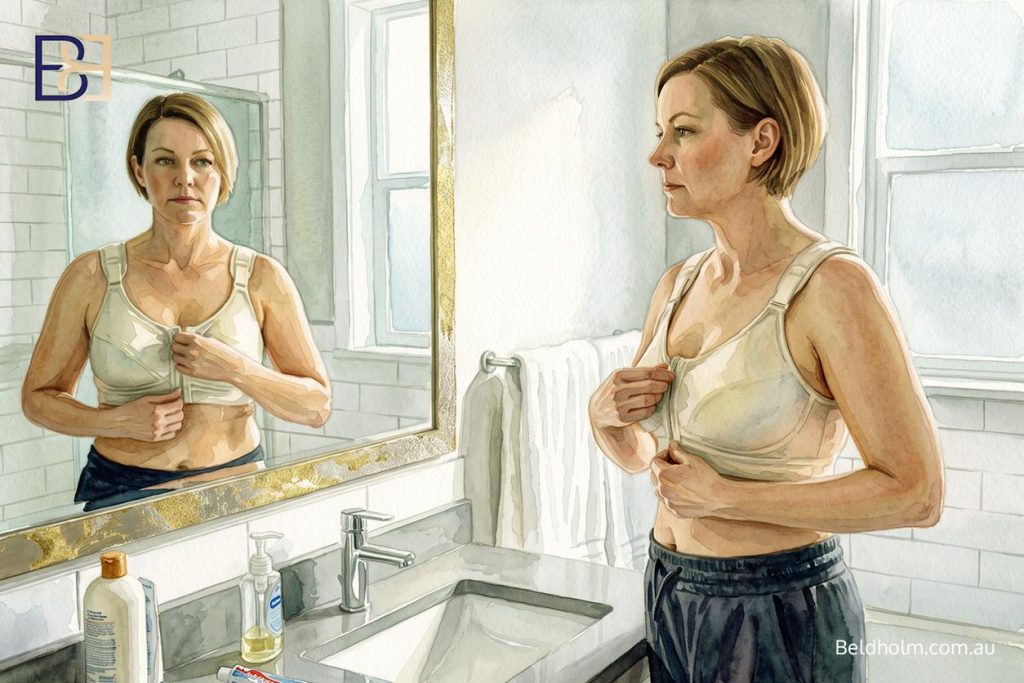
You wear a support bra continuously, day and night, for the first four weeks. It holds the breast tissue steady while it heals and limits movement that pulls on the incisions. After four weeks, you move to wearing it during the day only for a further two weeks. From six weeks, you can wear an underwire bra again.
Choose a bra that fits without digging in. Front-fastening styles are better to manage while your arm movement is limited. Beyond that, the style is a matter of personal preference.
Showering, sleeping and everyday movement in the early weeks
Showering and keeping the wounds dry`
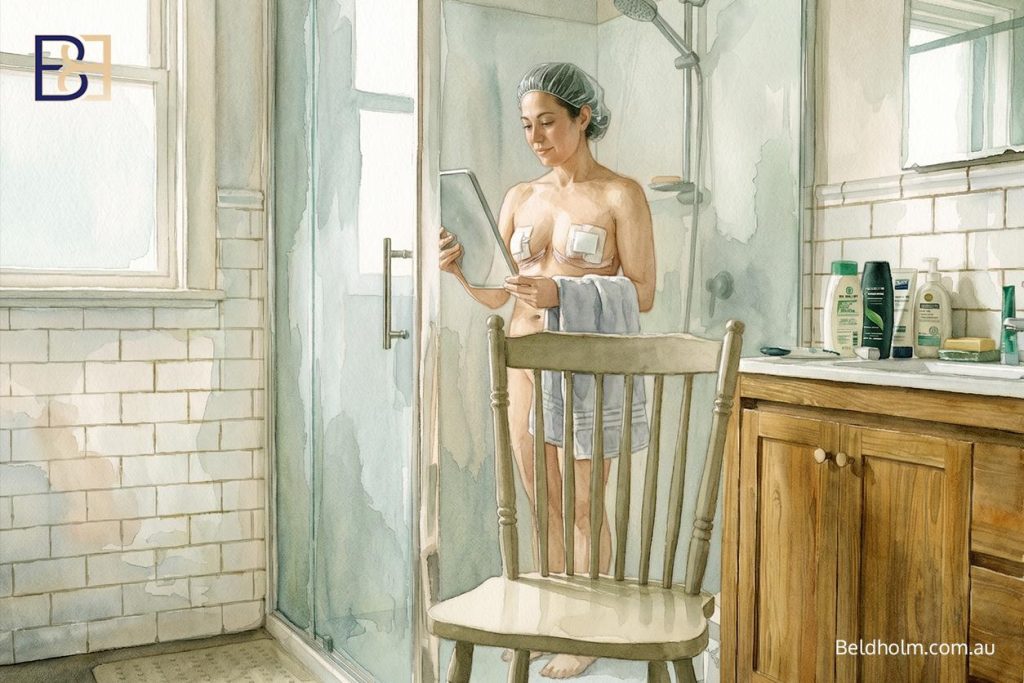
When you shower, do not scrub the incisions or aim the water straight at them, and pat the dressings dry afterwards.
No baths, spas, swimming pools or soaking of any kind until I clear you. Submerging healing incisions raises the risk of infection. A shower is fine; sitting in water is not.
Sleeping
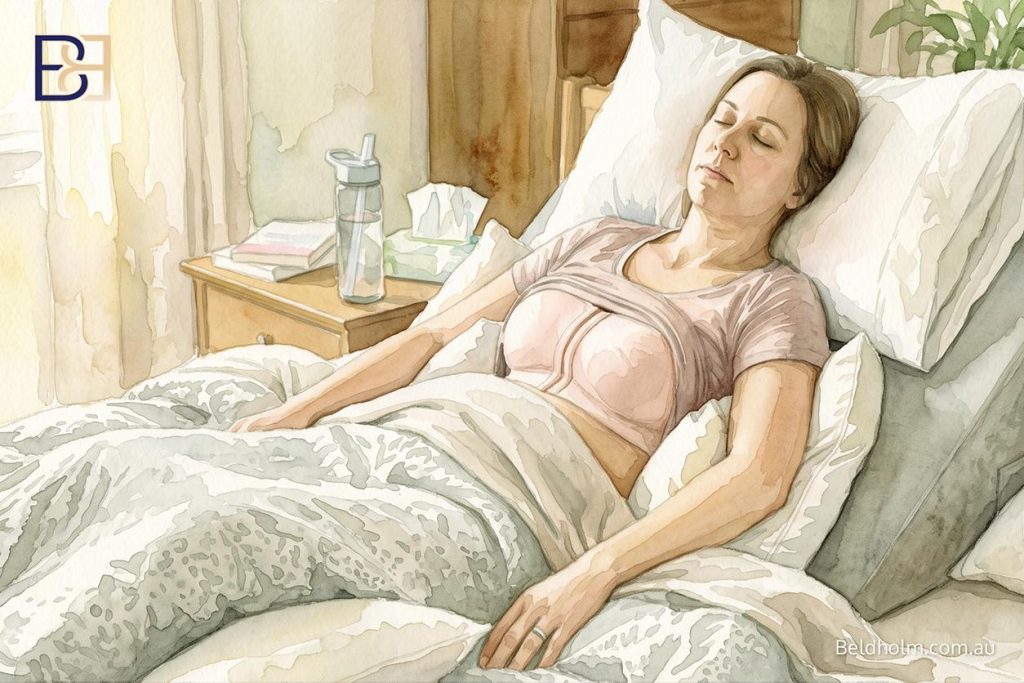
Sleep on your back for the first few weeks, propped up on a couple of pillows or a wedge. This keeps pressure off the breasts and reduces pull on the incisions. Avoid sleeping on your front or your side while everything is healing.
Keep the supportive bra on overnight. Some patients find the first week or two more comfortable in a recliner than flat in bed.
Everyday movement

Keep your arms close to your body and your movements small. In the early weeks, avoid reaching overhead, lifting, and pushing or pulling. These actions pull directly on the incisions.
A few practical points:
- Set the things you use each day at waist height, so you are not stretching up or bending down for them.
- Take short walks around the house from the first day. Moving about helps your circulation and lowers the risk of blood clots. Build the walks up as you feel able.
- Leave heavier housework until I have cleared you for it.
Recovery week by week
As with most breast procedures, these timelines are a guide drawn from what I typically see. A combined operation takes longer to work through than either operation on its own, and everyone heals at their own pace.
The first week
Rest is the priority. Most of the soreness sits in the first few days and eases through the week. If you had a drain, it usually comes out during this first week. Take short walks around the house and keep to the movement limits set out earlier.
You are not driving yet.
Driving, around one week
Most patients can drive again around one week, once they are off the stronger pain medication. Before you drive, you need to be able to brace, turn the wheel and perform an emergency stop without your chest holding you back, and wear a seatbelt without it pressing painfully. Do not drive while taking strong pain medication, and check where your car insurer stands on driving after surgery.
Returning to work, around one week for desk work

If your work is at a desk, most patients return around one week, once off the stronger pain medication. If your work involves lifting, reaching or physical effort, you need longer, and we plan your return around what the job demands. Ease back in. Feeling tired through the first fortnight is common.
Weeks two to three
Swelling begins to settle. You are still in the support bra full-time and still avoiding lifting and reaching overhead. Day-to-day tasks around the house are fine, but stop short of anything that strains the chest.
Weeks four to six
Your support bra steps down as described earlier, and most everyday activity is back to normal by this point, built up gradually rather than all at once.
Beyond six weeks
The breasts keep settling and the scars keep maturing over the following months. I set out how that looks further on.
Getting back to exercise and lifting follows its own timeline, which is next.
Returning to exercise and lifting
Exercise comes back in stages, not all at once. Going too hard too early pulls on the healing tissue and can set your recovery back.
Lifting

For the first weeks, avoid lifting anything heavier than a light everyday item. That means no lifting children, no heavy shopping bags, and no weights. Carrying load through your arms pulls on the chest and the incisions. Heavy lifting comes back gradually from around six weeks, once I have cleared you.
Exercise, stage by stage

- First two weeks: short walks only. Keep the intensity low and stop if it pulls on your chest.
- From about two weeks: you can add low-impact activity that does not involve your arms, chest or bouncing, such as walking at a steady pace or a stationary bike.
- From about four to six weeks: build up further, still leaving out heavy upper-body work and high-impact activity.
- From around six weeks, with clearance: return to fuller exercise, including upper-body work and running, built up gradually rather than straight back to your old routine.
Leave these until you are cleared
- High-impact activity: running, jumping, and anything that jars the breasts.
- Upper-body and chest work: push-ups, chest press, rows, overhead work, swimming and boxing.
- When you do return to impact activity, a firm, supportive sports bra helps.
Most patients are back to their normal activities within about six weeks, then build their physical activities up from there. These are typical timeframes. Your return is guided by how you are healing and confirmed at your reviews. If an activity pulls or hurts, that is your body telling you to ease off.
Swelling, scars and how your breasts settle
Swelling and bruising
Swelling is expected and is at its most noticeable in the first weeks. It settles gradually over the following weeks and months. Bruising is common and usually fades within the first few weeks. Your surgical bra helps reduce swelling.
How the breasts settle
What you see early on is not the final result. In the first weeks the breasts often sit higher and feel firm. As the swelling resolves and the tissues relax, the breasts settle over about three to six months. How your skin quality and elasticity respond shapes the final result. Some difference between the two sides is normal at any stage, since no two breasts are identical.
Your scars
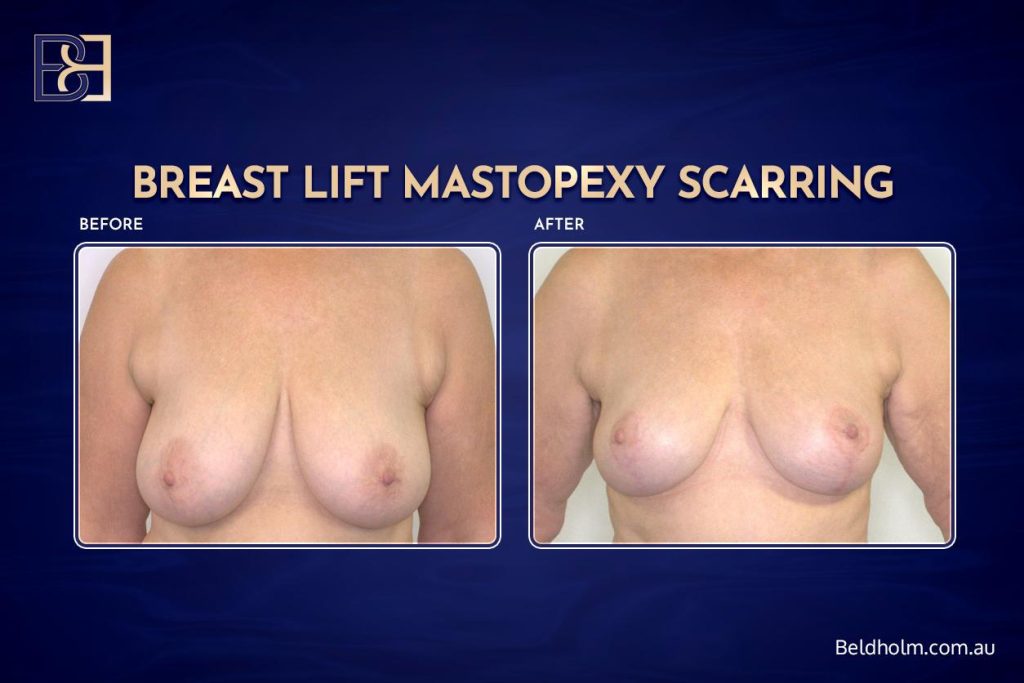
Disclaimer: Results vary, surgery has risks, seek second opinion. Operation performed by Dr Beldholm.
A breast lift (mastopexy) leaves permanent scars. The pattern depends on the surgical technique used. It commonly runs around the areola and vertically down the breast, and sometimes includes a line in the breast fold, also called the breast crease, beneath the breast.
Scars start out firm, raised and pink or red. They fade and flatten over about twelve months, sometimes longer. How a scar matures varies from one person to the next. Keep your scars out of the sun while they are healing, and I will guide you on scar care, including when to start silicone or massage.
Changes in sensation
Changes in nipple sensation, and in skin sensation, are common after this surgical procedure. For most patients, sensation settles over the following months. Some change can be permanent. This is a genuine risk of the operation, and I discuss it with you before surgery.
Results vary
Every patient starts from a different anatomy and heals differently. How your breasts settle, how your scars mature, and how your sensation recovers are individual to you. Occasionally a patient needs further surgery to adjust how things have settled. Results vary between patients.
Warning signs and who to contact
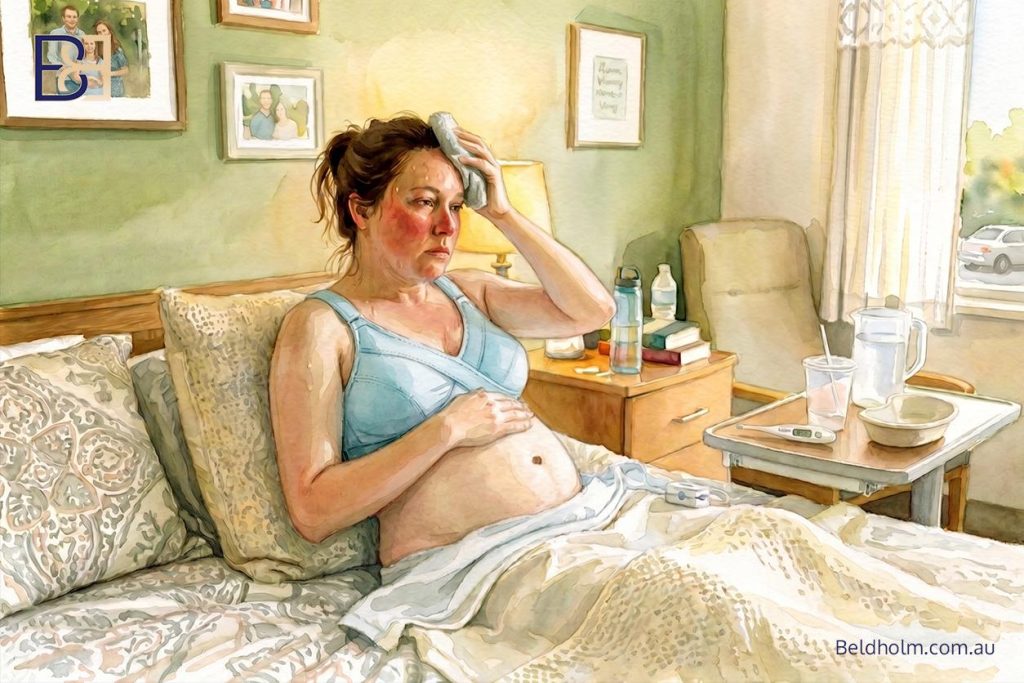
Most recoveries run to plan. Knowing what is normal and what is not means you act early if something changes. Keep your discharge instructions where you can find them, since they list your contact numbers.
Signs that need attention
- A temperature or feeling unwell, which can point to infection.
- Redness that is spreading, or skin that is hot to touch around the surgical site.
- Pain that is climbing rather than settling, particularly on one side.
- A sudden increase in swelling or firmness on one side, which can point to bleeding.
- Wound edges opening, or discharge or fluid leaking from an incision.
- A change in the colour of a nipple or the breast skin, such as it looking dusky or dark.
- If you have a drain: it stops draining, falls out, or the site becomes red and painful.
- Nausea or vomiting that stops you keeping down fluids or medication.
Signs of a blood clot, act immediately

Pain, swelling, warmth or redness in a calf or leg can be a sign of a clot in the deep veins. Chest pain, breathlessness, or coughing that comes on suddenly can be a sign of a clot that has travelled to the lungs, and that is an emergency. Call 000 for chest pain or trouble breathing.
Who to contact and when
- During office hours: call the rooms.
- After hours: call Maitland Private Hospital. The nursing staff provide phone triage and will guide you on what to do next.
- If you need to be physically examined: go to your local emergency department. Maitland Private Hospital is not an emergency department.
- For anything life-threatening, including chest pain or difficulty breathing: call 000.
If something does not feel right, make contact. I would rather hear from you and check than have you wait it out at home.
Follow-up appointments
Book your appointment online now
You are seen closely in the early weeks, then at set points across the first year. These reviews let me check your healing and pick up anything that needs attention early.
The first two weeks
The first two weeks are an intensive period. You are seen several times a week by the nurse and by me. At these visits we check your wounds, change or remove dressings, and take out the drain if you have one. You also have Healite II LED light therapy as part of your early wound care.
Scheduled reviews across the first year
After the early visits, I review you at:
- 4 weeks
- 3 months
- 6 months
- 12 months
At these appointments I check how your breast appearance is settling, how the scars are maturing, and how you are recovering overall.
Your GP
Your GP is kept informed and takes over your longer-term follow-up care. I formally hand back to your GP at the 4-week visit, and your GP was copied in on your pre-operative results.
If something comes up between appointments, do not wait for the next scheduled review. Use the contact steps set out earlier.
Preparing well supports your recovery
A combined operation is a larger physiological event, so the preparation you do beforehand pays off during your recovery period. Getting your overall health into good shape for surgery gives your body a better footing to heal.
Before surgery
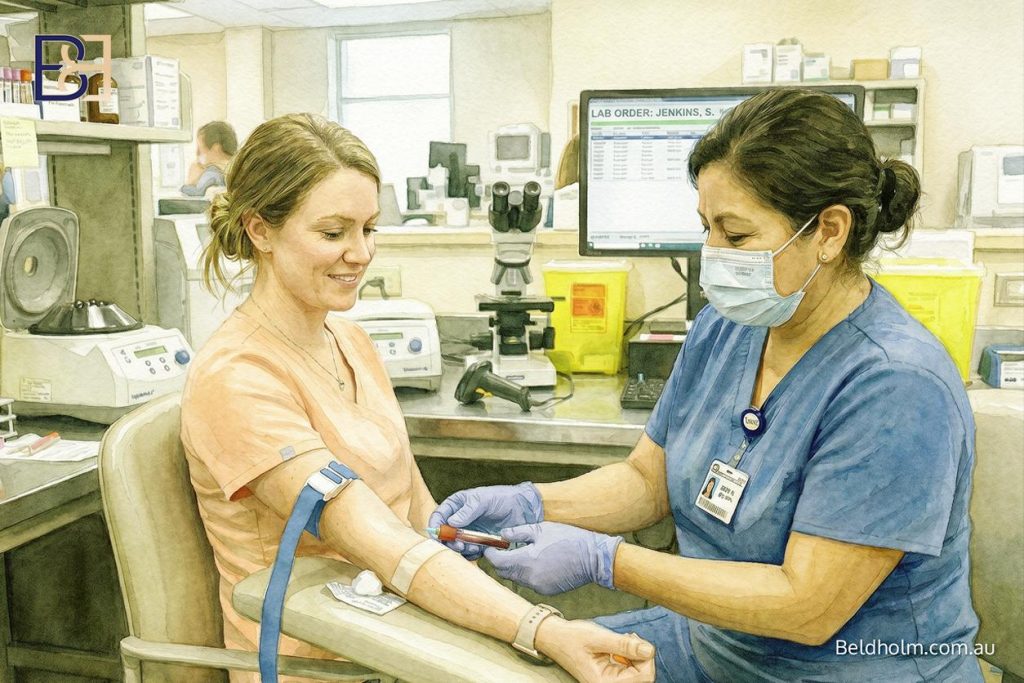
- You have a set of standard pre-operative blood tests before your operation.
- If you smoke, stopping before surgery matters. Smoking can delay wound healing and the healing process, and it raises the risk of wound problems. I talk with you about timing at consultation.
- Eating well and staying hydrated in the lead-up supports healing.
- Bring a full list of your medications and supplements. Some, including blood thinners such as aspirin, are usually stopped about a week before surgery. I tell you what to stop and when, and I decide this with you well in advance. Do not stop any medication on your own.
Set up support at home

- Arrange for someone to drive you home and stay with you the first night.
- Line up help for the first week or so, especially if you have young children or a physical job, since lifting and reaching are limited.
- Prepare a recovery space: pillows or a wedge for sleeping propped up, loose front-fastening tops, your support bra ready, and daily items at waist height.
- Cook meals ahead, or arrange help with cooking and shopping.
- Fill your prescriptions before the day so your pain relief is ready at home.
Preparation matters more for a larger operation
Because a combined operation asks more of the body, preparation matters more, not less. Getting your health in order beforehand and organising help at home is part of recovering well from a larger operation.