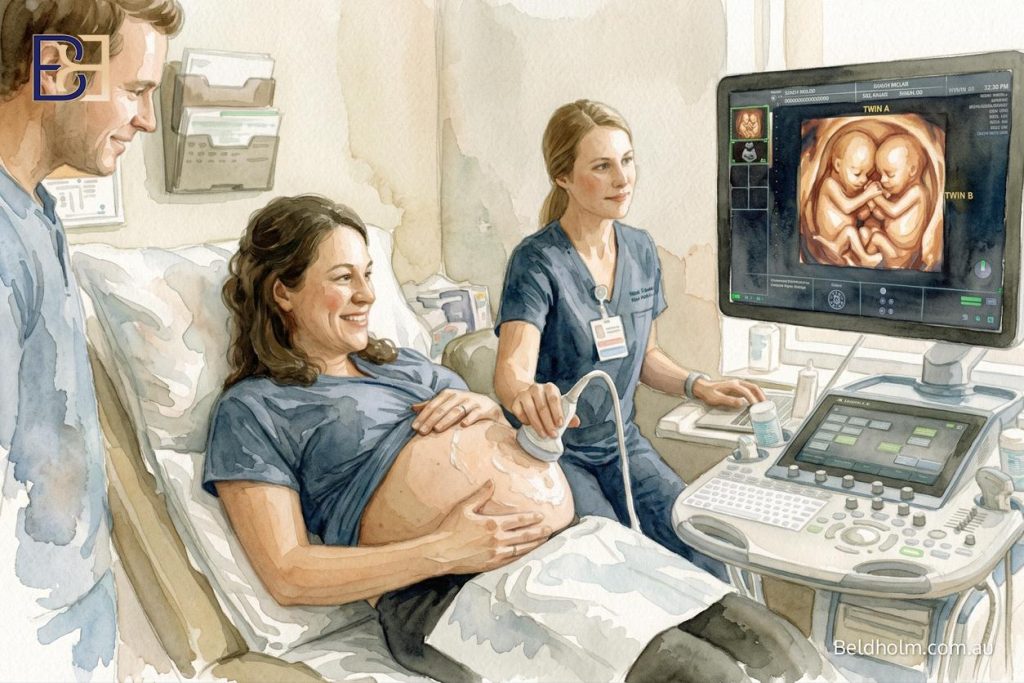
In Australia, about 1.5% of women who give birth have a multiple pregnancy, and almost all of these are twins (1). Carrying more than one baby stretches the abdominal wall further than a single pregnancy, so separation of the abdominal muscles (diastasis recti) tends to be both more common and greater in degree. This is a normal change after pregnancy, not a flaw, and in many women it settles a long way on its own.
I look after a lot of women in the Hunter Valley who have carried twins or higher order multiples, and one of the most common things they ask me about is how their abdomen has changed since giving birth. In this article I explain what a multiple pregnancy does to the abdominal wall, why the muscle separation can be more pronounced than after a single pregnancy, and what the options are if it does not settle on its own.
A multiple pregnancy is considered higher risk during the pregnancy itself, but most result in healthy mothers and babies (1). The changes I describe here are the ordinary consequence of the abdomen stretching to make room for more than one baby. Describing them is not the same as calling them a problem, and most women need no surgery at all.
Timing matters as well. In the first year after birth, the abdominal muscles and skin are still recovering, and in many women they retract considerably without any intervention. I generally suggest giving your body time before considering a procedure. Any decision about surgery is made individually at a consultation, once your family is complete and breastfeeding has finished. I come back to timing later in the article.
How a twin or multiple pregnancy stretches the abdominal wall
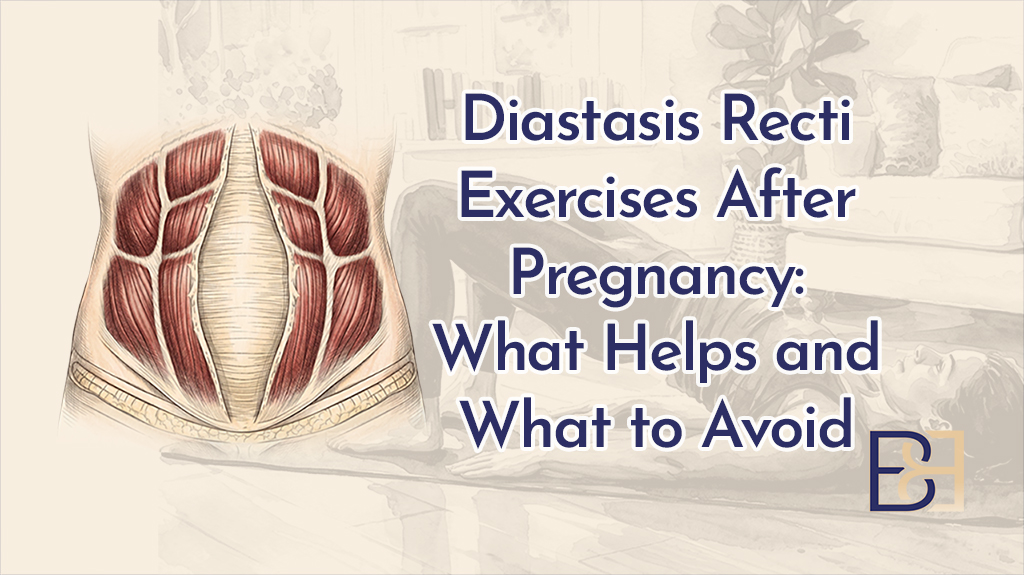
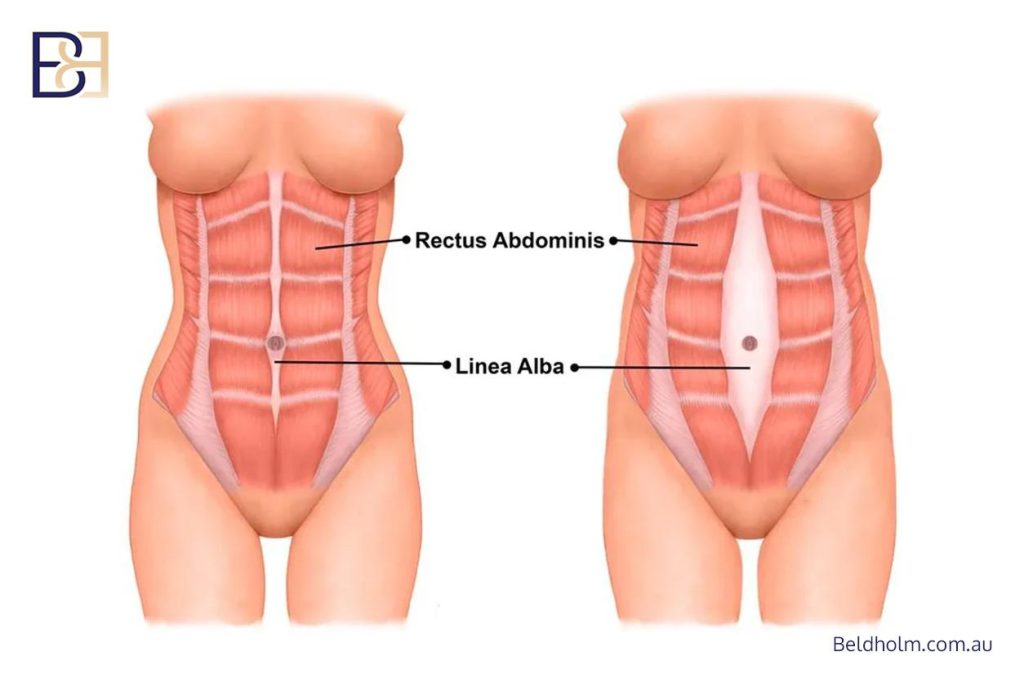
Your abdominal wall is built around 2 vertical bands of muscle, the rectus abdominis, that run vertically from the lower ribs and rib cage down to the pubic bone. Down the middle, joining the 2 bands, is a strip of connective tissue called the linea alba. In everyday movement these muscles and the linea alba hold the abdominal contents in and assist with posture, breathing and lifting.
During pregnancy two things happen at once. The uterus expands upward and outward to make room for the growing baby, and pregnancy hormones soften the connective tissue so it can stretch. The linea alba widens, and the 2 muscle bands are gradually pushed apart. This separation is called diastasis recti abdominis (muscle separation), often shortened to diastasis recti. Some degree of it occurs in most pregnant women, particularly through the second and third trimesters (2).
In a twin pregnancy, or any multiple pregnancy, the uterus has to accommodate more than one baby, so it expands further and the abdominal wall is placed under greater and more prolonged stretch. As a result:
- the linea alba tends to widen more, so the gap between the muscle bands is often larger
- the skin and fascia over the abdomen stretch further, which can leave more laxity afterwards
- the stretch is sustained for longer, particularly with rapid growth in the third trimester
None of this is abnormal. It is what the abdominal wall is built to do under load. What differs after a multiple pregnancy is the degree of stretch, and that is what can make the separation more noticeable and slower to retract.
What makes the separation more pronounced or slower to retract

After birth the linea alba is elastic and begins to draw the muscle bands back toward the midline. In most women the gap narrows considerably over the first few months, and it can keep improving across the first year. A proportion of women are left with separation that does not close on its own.
How much abdominal separation remains, and how quickly it retracts, varies from woman to woman. Several risk factors tend to make the most difference:
- The number of babies and how far the uterus distended. Carrying twins, triplets or higher order multiples stretches the wall further than a single pregnancy, so the starting point after birth is often a wider gap.
- The combined size of the babies and the pregnancy. A larger overall bump places more sustained load on the linea alba.
- Repeated or closely spaced pregnancies. Each pregnancy stretches the wall again before it has fully recovered from the one before.
- Maternal age and connective tissue. Tissue elasticity differs between women and tends to change with age. Multiple pregnancies are more common in women having children later, where assisted reproduction is more often involved.
- Individual healing. 2 women with a similar pregnancy can retract differently. This is normal variation.
As a general rule, the wider the separation immediately after birth, the less likely it is to close completely without help (2). That does not mean intervention is needed. It means the degree of separation is worth assessing properly rather than assuming it will either resolve or persist.
Rather than labelling the separation, I assess it by measuring the width of the gap, the integrity of the linea alba, and whether it is causing any functional symptoms. I describe how I do that in the next section.
What you may notice afterwards
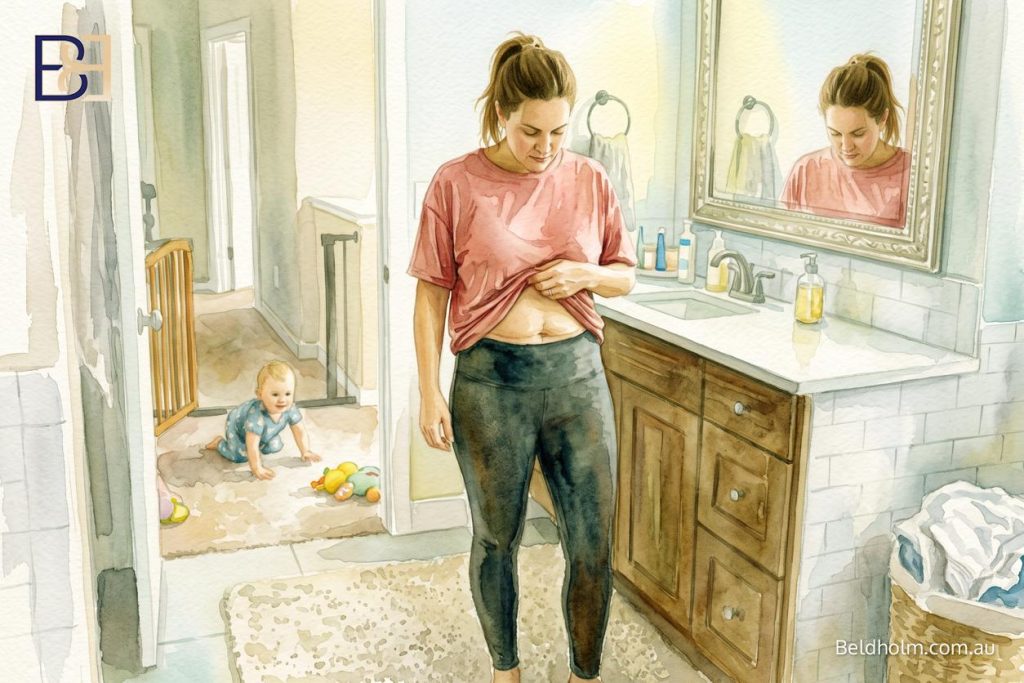
Once you are past the early weeks, there are a few changes women commonly notice after a twin or multiple pregnancy. These are described here as anatomy, not as faults. Many settle over the first year, and plenty of women are never bothered by them at all.
A softer, fuller lower abdomen The lower abdomen, or stomach, can feel softer and look fuller than before, and this can persist even once you are back to your usual weight and activity. When the cause is muscle separation rather than fat, exercise alone often will not flatten it, because the support across the midline has been stretched.
Doming along the midline When the muscles are separated, the tissue between them is thinner. Sitting up from lying down, or straining, raises the intra abdominal pressure and can produce a visible ridge or doming down the centre of the abdomen. This is one of the more reliable signs of diastasis recti, and it is worth showing your GP or me at assessment.
Skin laxity After the skin has been stretched by a multiple pregnancy, it does not always draw back fully. Some women are left with loose skin over the lower abdomen, often most noticeable below the belly button. How much the skin recovers depends on its starting quality and how far it was stretched.
Changes to the belly button During pregnancy the umbilicus is stretched flat or pushed outward. Afterwards it usually settles, but it may not return exactly to its previous shape. A small, soft lump at the navel can sometimes be an umbilical hernia, where tissue pushes through a gap in the muscle. If you notice this, have it assessed, as it is a separate issue from the muscle separation itself.
Fullness low on the abdomen Some women notice fullness low down, over the pubic area. This is common after pregnancy and is usually a combination of skin, soft tissue and the way the lower abdomen has stretched. It is assessed as part of the overall picture, not on its own.
None of these changes means something has gone wrong. They are the ordinary result of carrying more than one baby. Whether any of them warrants treatment is an individual question, and I come to that later.
Diastasis recti abdominis after a multiple pregnancy
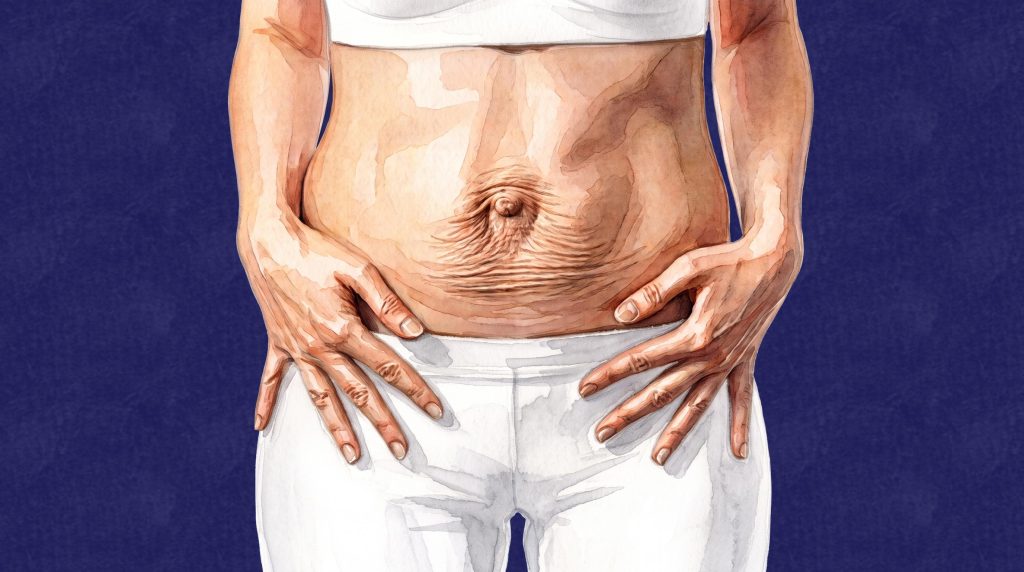
Some separation of the abdominal muscles is normal in pregnancy. What matters is how much remains once your body has had time to recover, and whether it is affecting how your abdomen works.
How common it is
Diastasis recti abdominis is very common in the later stages of pregnancy and in the early weeks after birth. Research following women through pregnancy and the first year afterwards found separation in around 60% of women at 6 weeks after delivery, falling to about a third by 12 months (2). After a twin pregnancy or other multiple pregnancy the separation is more likely to be present and is often wider, because the abdominal wall has been stretched further.
That 12 month figure is the encouraging part. For many women the gap keeps narrowing well into the first year without any treatment, which is one reason I am cautious about assessing anyone too early.
How I assess it
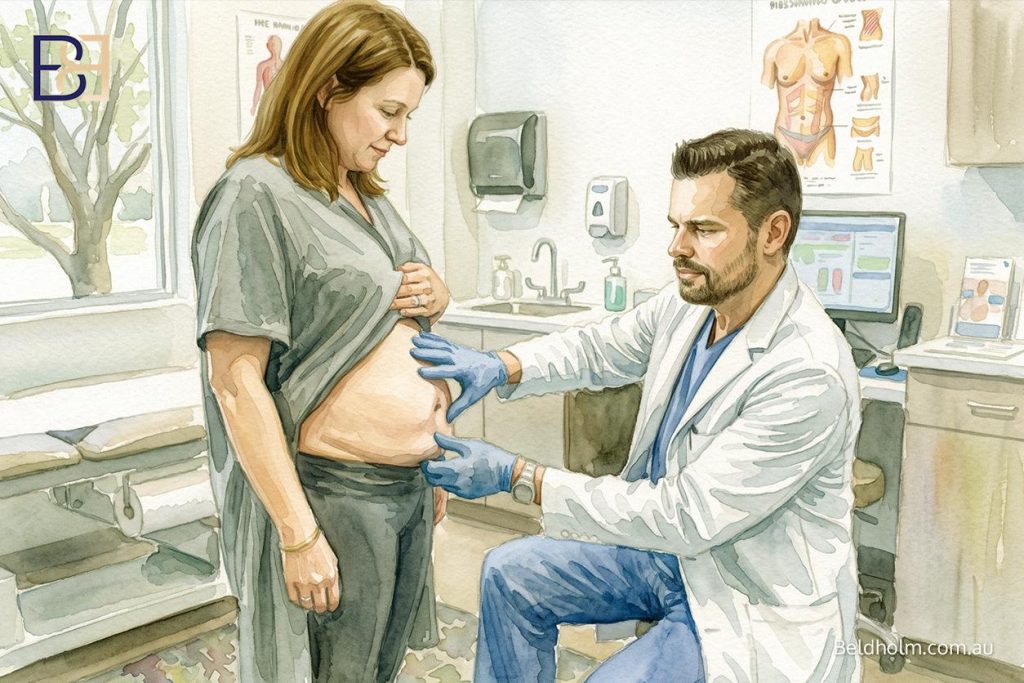
At a consultation I check the separation in a few ways:
- I measure the gap between the muscle bands above, at and below the belly button, usually with you lying down and again as you lift your head and shoulders.
- I feel the linea alba to judge how much tension and integrity it still has.
- I look for doming along the midline when you engage the abdomen, which shows how the wall behaves under load.
- I check for any umbilical hernia, which is assessed and managed separately from the muscle separation.
- Where it helps, ultrasound can measure the gap more precisely.
I describe the abdominal separation by its width and by how it is functioning, rather than putting a label on it. That is more useful for deciding whether anything needs to be done.
Symptoms it can cause
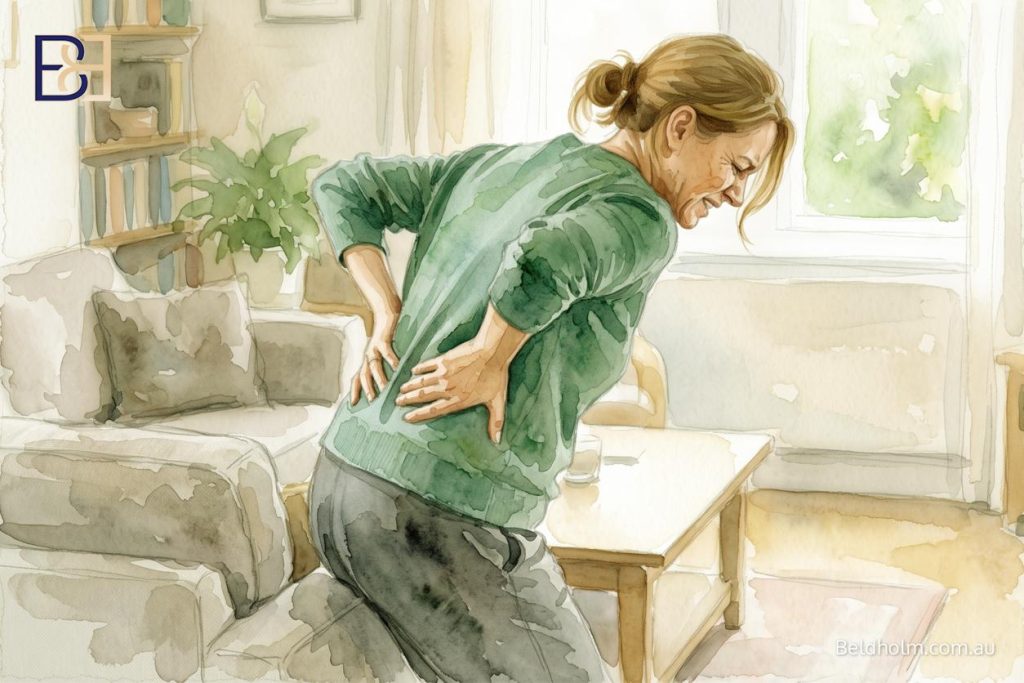
Many women with diastasis recti have no symptoms at all and notice the appearance of the abdomen. Others find the separation affects function. Reported symptoms include:
- low back pain and lumbopelvic pain (pelvic girdle pain)
- core weakness, a feeling of instability, or difficulty with tasks like lifting or getting up from lying down
- pelvic floor symptoms, including stress urinary incontinence
These symptoms are common in the year after birth generally. Research in postpartum women has reported pelvic girdle pain in around a quarter of women at 3 months, and stress urinary incontinence in around a third (3). They are not caused by diastasis recti alone, but a stretched, separated abdominal wall contributes to the loss of support from the core muscles that sits behind several of them.
Where the separation is wide and symptomatic, research in women having abdominoplasty (tummy tuck) after pregnancy has reported improvement in back pain and urinary incontinence following repair of the muscle separation (4). As with any operation, the degree of benefit varies between individuals, and surgery is only one part of the picture.
Caesarean or vaginal birth: does it change the separation?
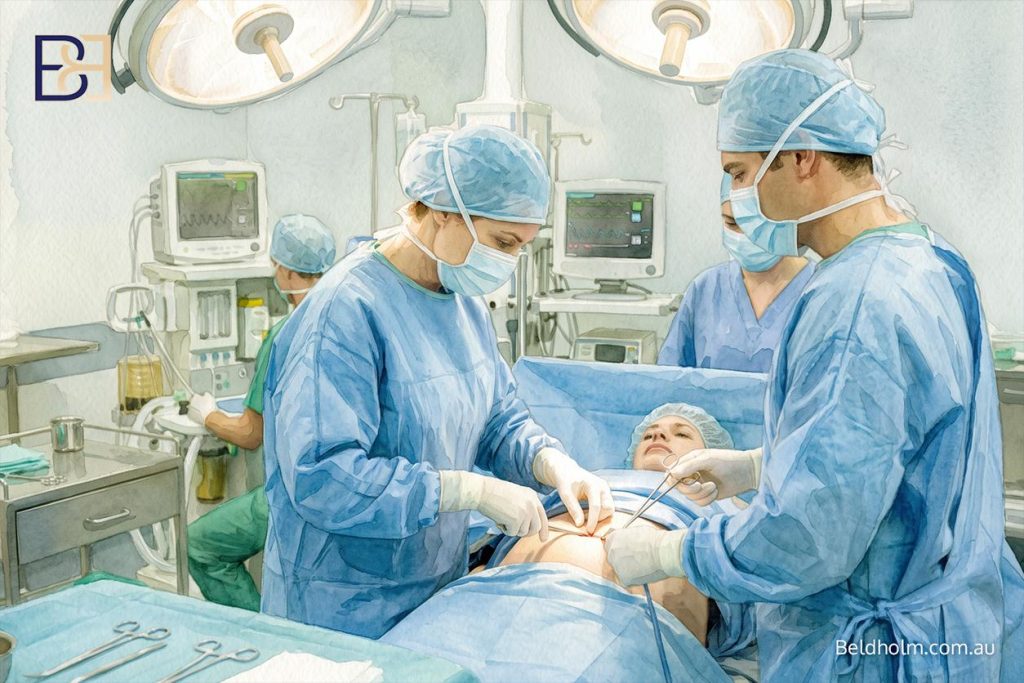
A common belief is that having a caesarean causes more muscle separation. The evidence does not really support that. Studies looking at what predicts diastasis recti have not found the method of delivery to be a clear factor (2). What drives the separation is how far the abdominal wall was stretched and how the connective tissue recovers, not whether the babies were born vaginally or by caesarean.
Delivery method still matters for other reasons after a multiple pregnancy:
- Caesarean is more common with multiples. Twins and higher order multiples are more often delivered by caesarean, so many of the women I see already have a low abdominal scar. That scar becomes part of the planning if abdominoplasty (tummy tuck) is ever considered, and I explain how it is handled in the surgery section below.
- Vaginal delivery and the pelvic floor. Research in postpartum women has associated vaginal deliveries with higher rates of stress urinary incontinence (4). This is one reason pelvic floor symptoms are assessed alongside the abdominal wall, rather than on their own.
The practical message is that your delivery method does not decide how much separation you have. It is one part of your history that I take into account, along with the number of pregnancies, how far the wall was stretched, and how your tissues have recovered.
Non-surgical management
For most women after a multiple pregnancy, the first approach is not surgery. In the first year the abdominal wall is still recovering, and guided exercise and time do a lot of the work. I only consider surgery once conservative management has been given a fair go and the family is complete.
Women’s health physiotherapy
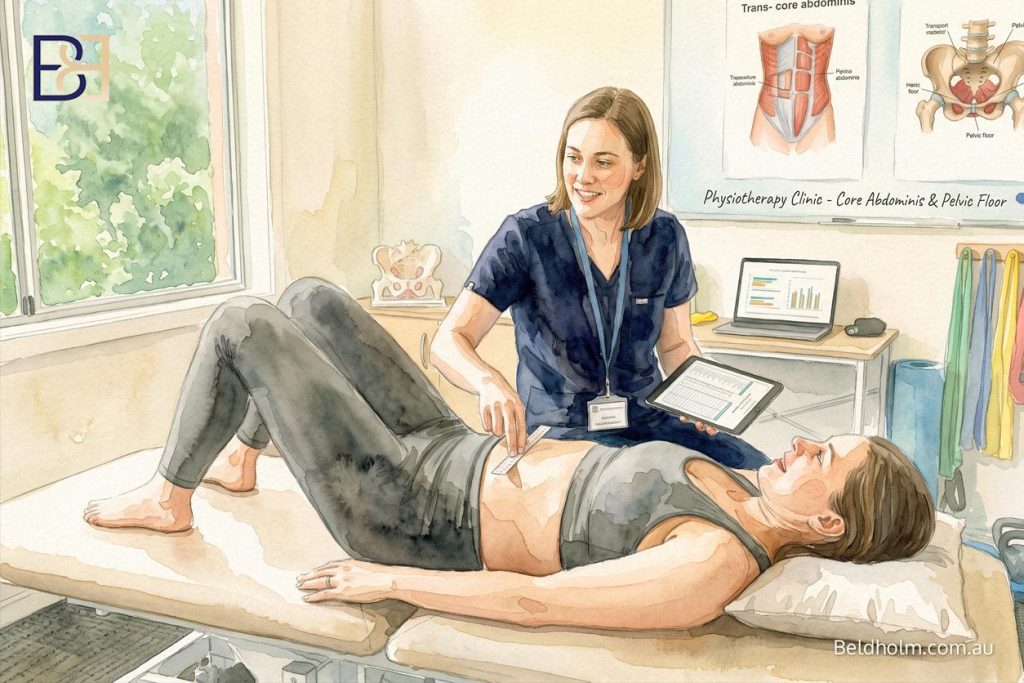
The most useful first step is an assessment with a women’s health physiotherapist. They can measure the separation, check how your deep abdominal muscles and pelvic floor are working, and set a program suited to where you are in your recovery. A tailored, progressive program is far more useful than any generic routine, because what helps one woman can aggravate another.
What these programs generally focus on:
- retraining the deep core muscles, particularly the transversus abdominis (transverse abdominis), to rebuild tension across the midline
- pelvic floor work, since the abdominal wall and pelvic floor function together
- progressing load gradually, so the linea alba is not overstrained before it is ready
- breathing techniques and good posture, which affect how intra abdominal pressure is managed inside the abdomen
There is reasonable evidence that supervised exercise can reduce the width of the separation in some women (5). How much it helps varies, and a wide separation with a stretched, thin linea alba may not narrow with exercise alone. That is a realistic thing to know early, not a reason to skip the conservative stage.
General health and recovery

Alongside physiotherapy, the ordinary things matter: a balanced diet with adequate protein, staying well hydrated, and being realistic about how much energy you have while caring for young children. I do not put post pregnancy patients on any special supplement regimen for this. If your GP has identified something specific from your pregnancy, such as low iron, that is managed in the usual way.
When conservative care has run its course
If you have given guided exercise a genuine trial, your family is complete, and a wide or symptomatic separation remains, that is the point where it is reasonable to talk about treatment options, including surgery. I cover those next.
Timing: when to consider surgery
There is no fixed date that suits everyone. What I look for is a combination of things being right, rather than a particular number of months on the calendar.
Give your body time to recover
In the first year after birth the abdominal muscles and skin are still retracting, and in many women the separation keeps improving during this time. As a general guide I suggest waiting until around 12 months after your most recent pregnancy before assessing whether anything surgical is worth considering. This is a guide, not a rule. The right timing is decided individually once I have assessed you.
Your family should be complete

Surgery is planned once you have finished having children. A later pregnancy stretches the abdominal wall again and can undo a muscle repair, so operating before your family is complete puts the result at risk. This is not a judgement about your plans. It is that the repair holds up only if the abdomen is not going to be stretched by another pregnancy.
Breastfeeding should be finished
I plan surgery once breastfeeding has finished. This matters most for the breasts, which change in size and shape during and after breastfeeding and need time to settle before any assessment. For abdominal surgery, finishing breastfeeding also means your body has moved past the recovery demands of that period. The timing here is individual and is never a fixed number of months.
A referral and assessment come first

Before any consultation you need a referral from your GP. At the consultation I assess the separation, the skin, your general health and your history, and we discuss whether surgery is appropriate for you and, if so, which approach. I see patients more than once before proceeding, so there is time to weigh everything up without pressure and to have your questions answered.
Surgical options
When a wide or symptomatic separation and loose skin remain after the conservative stage, an abdominoplasty (tummy tuck) is the operation that removes the excess lower abdominal skin and repairs the muscle separation (diastasis recti) in the one procedure. For post pregnancy patients I mainly perform a full or extended abdominoplasty. Which one suits you, and whether surgery is appropriate at all, is decided at assessment.
What the operation involves
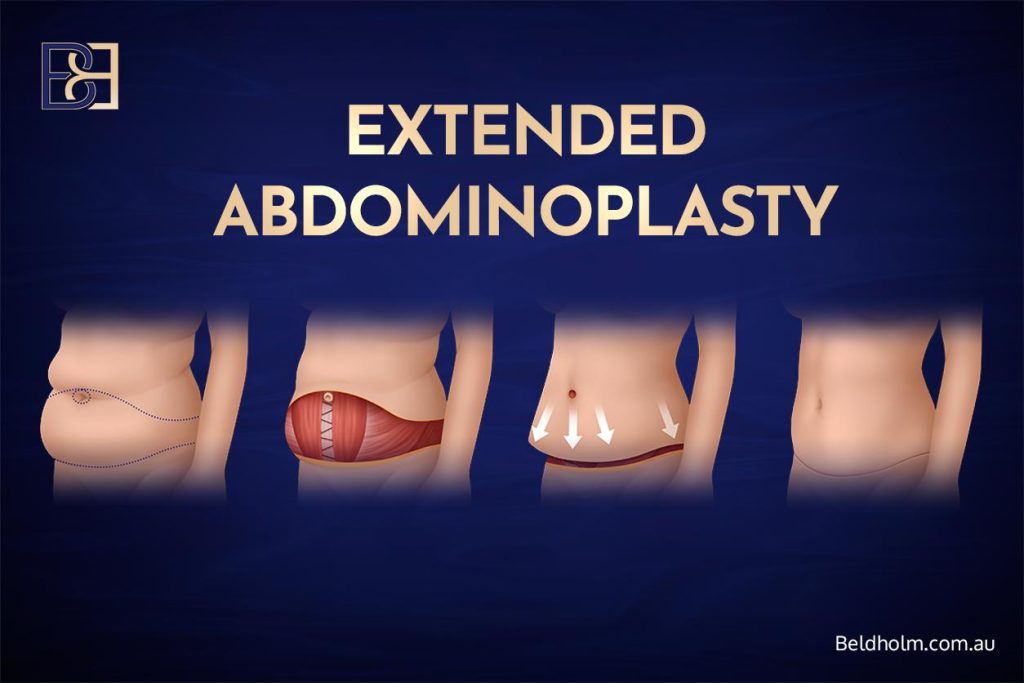
The core steps are the same for a full and an extended abdominoplasty:
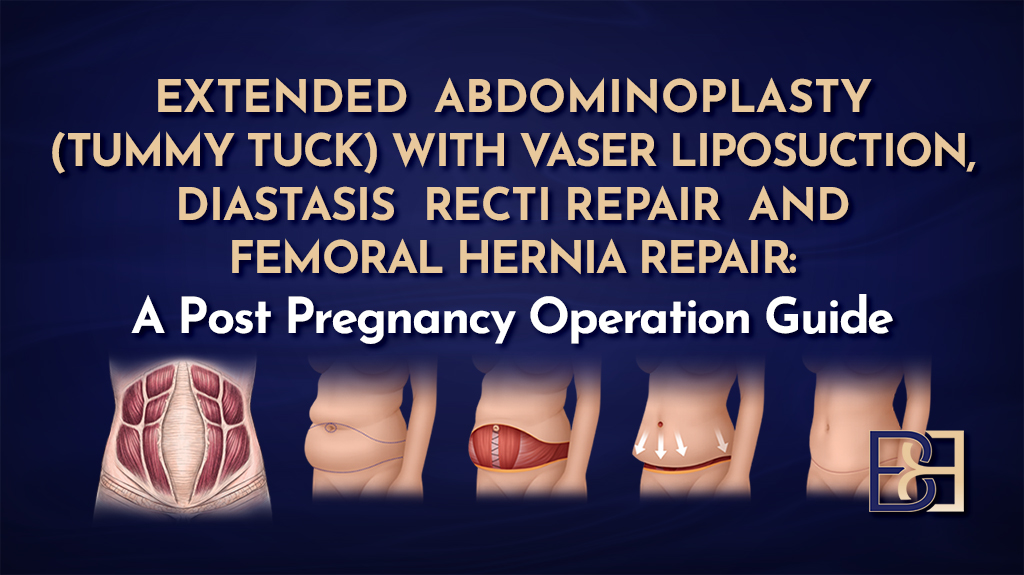
- Skin removal. The excess skin across the lower abdomen, below the belly button, is removed and the upper skin is redraped.
- Muscle repair. The diastasis recti is repaired by stitching the linea alba to bring the muscle bands back toward the midline. Most, though not all, post pregnancy abdominoplasty patients need this repair.
- Belly button. The umbilicus stays attached to its stalk and is brought out through a new opening in the redraped skin.
- Contouring. Ultrasound-assisted suction lipectomy (VASER liposuction) is used in the majority of cases to refine the contour where firmer fat remains.
- Caesarean scar. If you have a caesarean scar, it is fully removed. The new abdominoplasty scar sits low along the same line. I do not leave the old scar in place or work around it.
Full abdominoplasty
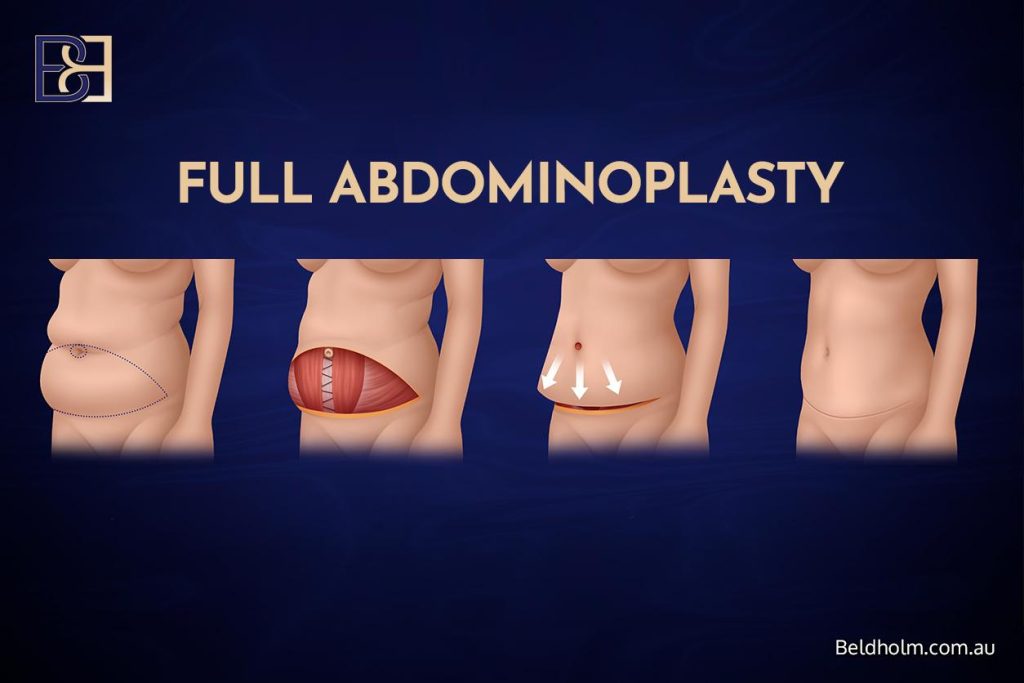
The incision runs low across the abdomen, roughly hip to hip, between the anterior superior iliac spines (the bony points at the front of the pelvis). A full abdominoplasty suits women whose loose skin sits mainly across the front of the lower abdomen.
Extended abdominoplasty
Here the incision continues a little further, past the hip bones toward the lateral hip, to remove loose skin that reaches around the sides.
In practice, many post pregnancy women have some skin laxity extending to the lateral hip, so technically have an extended abdominoplasty, although the amount is modest compared with post weight loss patients. For that reason I often still describe it as a full abdominoplasty. Because the amount of tissue is smaller than after major weight loss, an extended abdominoplasty after pregnancy can often be done without drains.
If the laxity is minimal
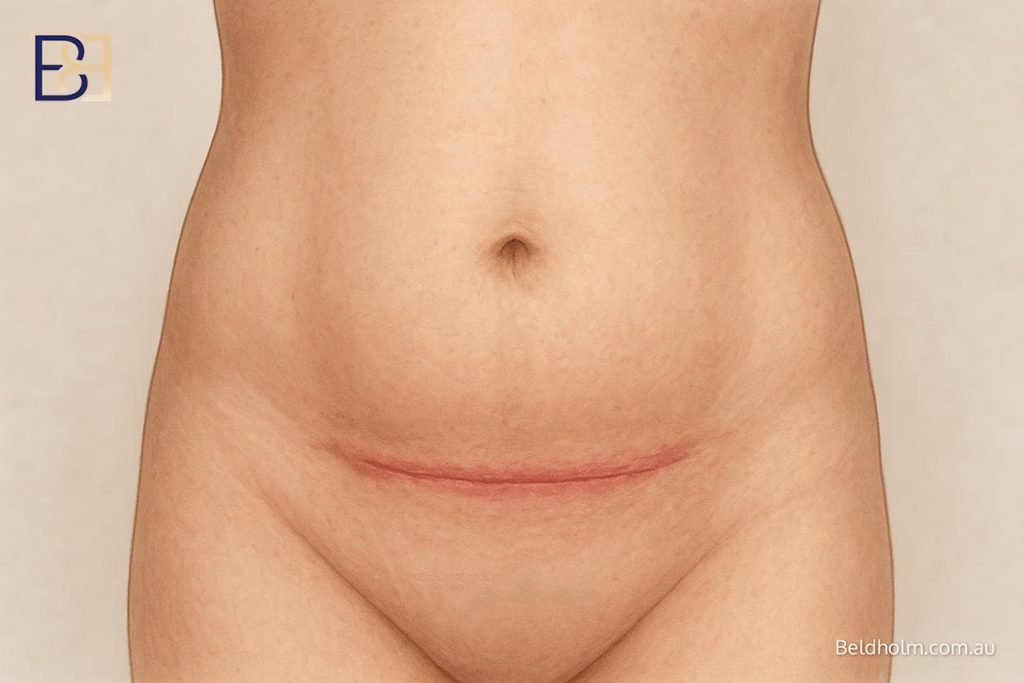
Where the loose skin is minor and limited to the area just above a caesarean scar, a limited abdominoplasty (mini tummy tuck) may be enough. I cover that option in detail on my limited abdominoplasty page.
How this differs from post weight loss surgery
Post pregnancy patients generally have better skin quality and a smaller amount of loose skin than post weight loss patients, but more muscle separation (diastasis recti). The main change after pregnancy is the stretch and separation across the midline, rather than the large volume of excess skin left after major weight loss. That is why the approach and the recovery are not the same, and why many post pregnancy abdominoplasties can be done as a drainless procedure with a shorter hospital stay, usually 1 to 2 days. It is also why I do not use techniques such as fleur-de-lis or dual vector abdominoplasty for a straightforward post pregnancy case. Those are designed for the much larger tissue excess seen after major weight loss.
Book your appointment online now
One operation or staged surgery
Some women after a multiple pregnancy have changes to both the abdomen and the breasts, and ask whether these can be dealt with together. This is a clinical decision made for the individual, not a package.
The case for a single operation
Where a woman is suited to it, combining the abdominal and breast procedures in one operation means one anaesthetic and one recovery, rather than going through those steps twice. For the right patient, that can reduce the overall disruption. My preference, where it is appropriate, is to consolidate the work in this way.
The case for staging
For other women, doing everything at once asks more of the body than is sensible, and staging the procedures across separate operations is the more appropriate path. Whether one operation or staged surgery suits you depends on your medical history, general health, and the extent of the work involved.
The trade-off
A single, larger operation is a bigger physiological event than a smaller one. A longer time under anaesthesia and a more demanding recovery are the trade-off for consolidating the work, which is exactly why careful assessment and preparation beforehand matter. A combined operation is a significant procedure with a substantial recovery.
Risks, recovery and results
An abdominoplasty is major surgery, and it carries real risks. This is not a decision to take lightly, and part of my job at consultation is to make sure you understand what can go wrong, not only what the operation involves.
Risks
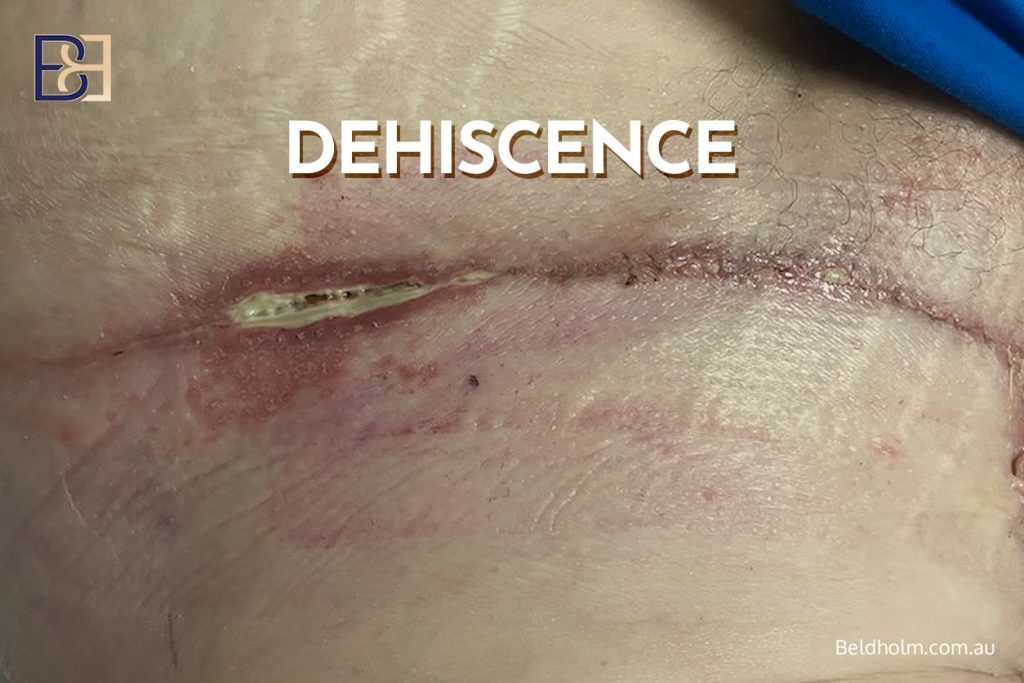
The more common risks of this operation include:
- bleeding and collection of blood under the skin (haematoma)
- infection
- a collection of fluid under the skin (seroma)
- delayed wound healing, or areas of the wound separating, which is more likely along a longer incision
- altered sensation or numbness of the lower abdominal skin, which can be long lasting
- a permanent scar, discussed below
Less common but more serious risks include blood clots in the legs (deep vein thrombosis) that can travel to the lungs (pulmonary embolism), and the general risks of anaesthesia. I assess your individual clot risk myself and decide on the measures to reduce it, rather than leaving that to others. If you take aspirin or a blood thinner, we plan any changes to it well ahead of surgery, and you should never stop these on your own.
There is also the chance that the result is not symmetrical, or that a further procedure is needed later. I go through the risks relevant to you, and to the specific operation planned, at your consultation.
Recovery
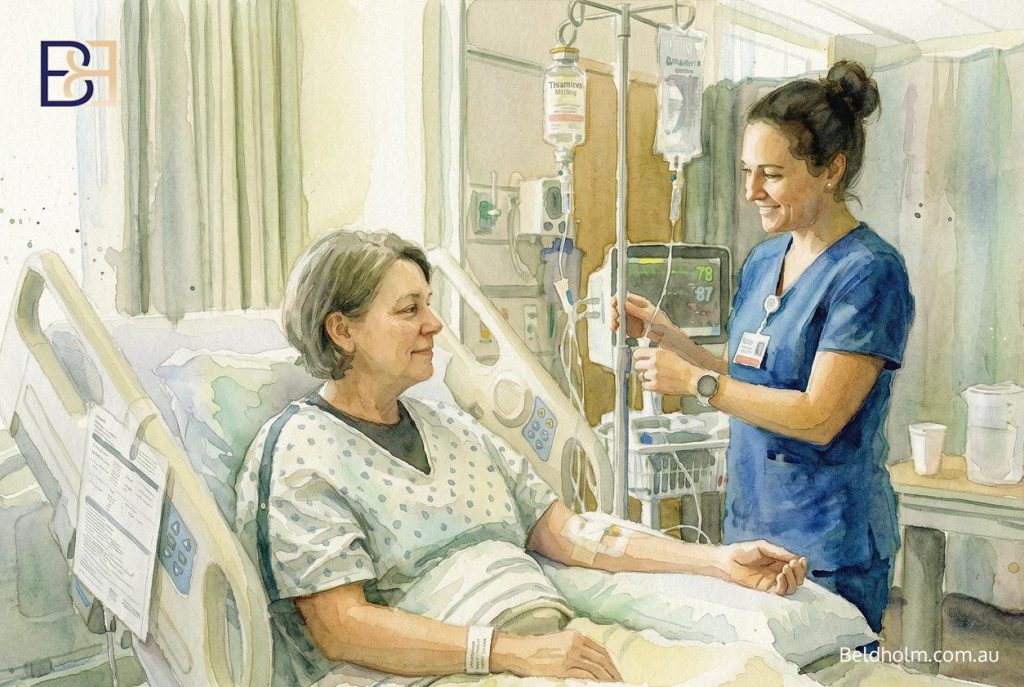
Recovery after a full or extended abdominoplasty usually means:
- a hospital stay of 1 to 2 days
- a support garment worn as directed
- limited activity for the first 1 to 2 weeks, with short walks encouraged early to reduce clot risk
- no heavy lifting or strenuous activity for around 6 weeks, then a graded return to core exercise
The part that catches many post pregnancy patients out is lifting. For several weeks you should not lift anything heavy, and that includes toddlers. If you have young children, and particularly if you have twins, you will need real help at home during recovery. I ask patients to organise this before surgery, not to work it out afterwards. It is one of the reasons timing and preparation matter.
Scars and results
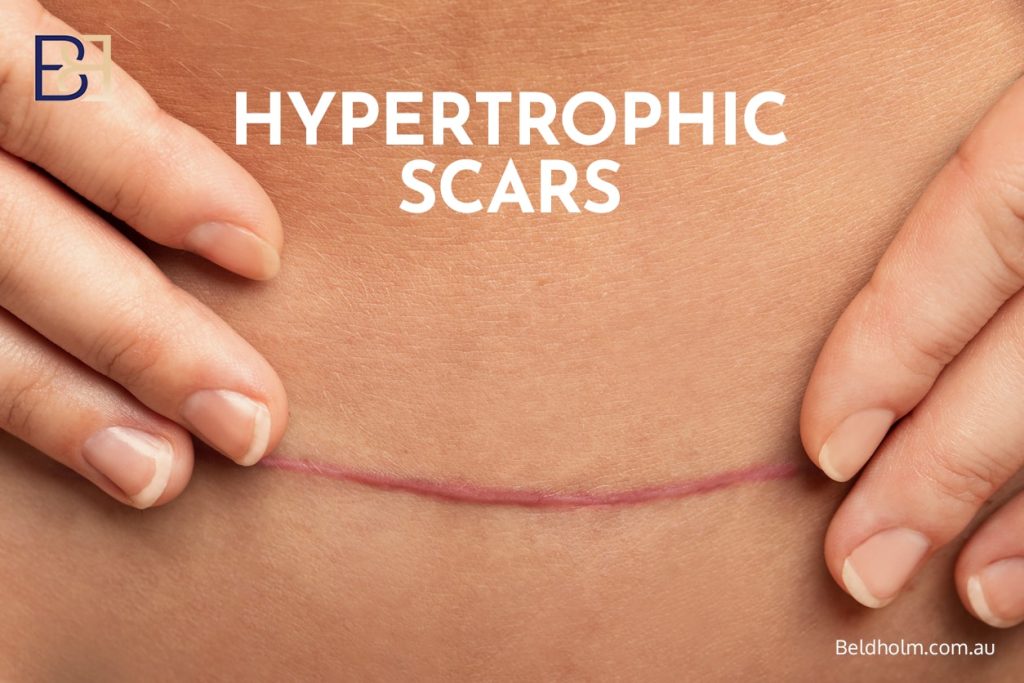
The scar is permanent. It sits low, usually below your underwear or swimwear line, and it fades over time, but it does not disappear. A scar takes 18 months to 2 years to mature and settle into its final appearance.
Results vary between patients. An abdominoplasty removes excess skin and repairs the muscle separation. It is not a weight loss operation, and it does not prevent the abdomen changing again with a future pregnancy, which is why surgery is planned once your family is complete. What the operation can do in your case is something I assess and discuss with you individually.
Dr Beldholm’s final conclusion

Carrying twins or more stretches the abdominal wall further than a single pregnancy, so muscle separation (diastasis recti) and skin laxity are more common and can be more pronounced afterwards. These are normal changes, not faults, and in many women they settle a long way over the first year with time and guided exercise.
Where a wide or symptomatic separation remains once a woman’s family is complete, a full or extended abdominoplasty can remove the excess skin and repair the muscle separation. It is major surgery with real risks and a genuine recovery, and whether it is appropriate is decided individually, after a GP referral and assessment.
For most women after a multiple pregnancy, the first steps are time, a women’s health physiotherapist, and a check with their GP. Surgery is one option among several, considered only when it genuinely suits the person in front of me.
References
- Australian Institute of Health and Welfare. Australia’s mothers and babies. Canberra: AIHW; 2024. Available from: https://www.aihw.gov.au/reports/mothers-babies/australias-mothers-babies
- Sperstad JB, Tennfjord MK, Hilde G, Ellstrom-Engh M, Bo K. Diastasis recti abdominis during pregnancy and 12 months after childbirth: prevalence, risk factors and report of lumbopelvic pain. Br J Sports Med. 2016;50(17):1092-1096.
- Vesting S, Gutke A, Fagevik Olsen M, Rembeck G, Larsson MEH. The impact of exercising on pelvic symptom severity, pelvic floor muscle strength, and diastasis recti abdominis after pregnancy: a longitudinal prospective cohort study. Phys Ther. 2024;104(4):pzad171.
- Taylor DA, Merten SL, Sandercoe GD, Gahankari D, Ingram SB, Moncrieff NJ, et al. Abdominoplasty improves low back pain and urinary incontinence. Plast Reconstr Surg. 2018;141(3):637-645.
- Soto-Gonzalez M, Da Cuna-Carrera I, Lantaron-Caeiro EM, Pascoal AG. Effect of hypopressive and conventional abdominal exercises on postpartum diastasis recti: a randomized controlled trial. PLoS One. 2024;19(12):e0314274.