BB grade 4 is a step in my own grading system for gynaecomastia. It is the point where the enlarged tissue has been dealt with, but the nipple still sits a little low and needs lifting. The crescent lift is the operation I use to raise it.

In this article I explain what the crescent lift is, who it suits, the scar it leaves, and the one risk that is specific to it, which is distortion of the areola. I also cover how I decide between a crescent lift and the larger operation above it, and why I sometimes plan the work in two stages.
Table of Contents
Where the crescent lift sits in my system
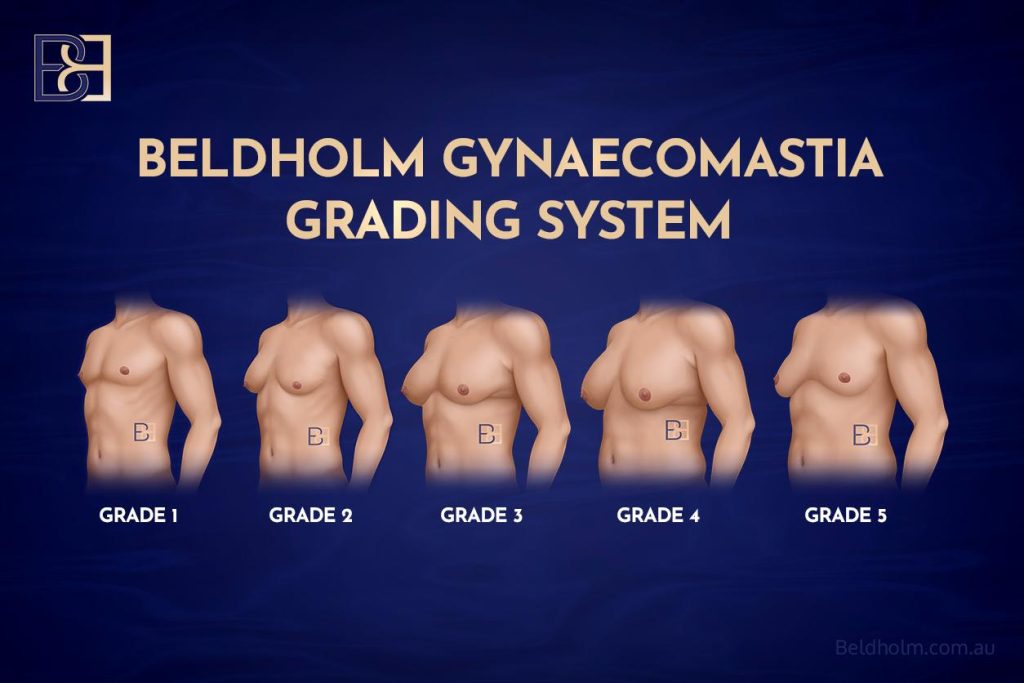
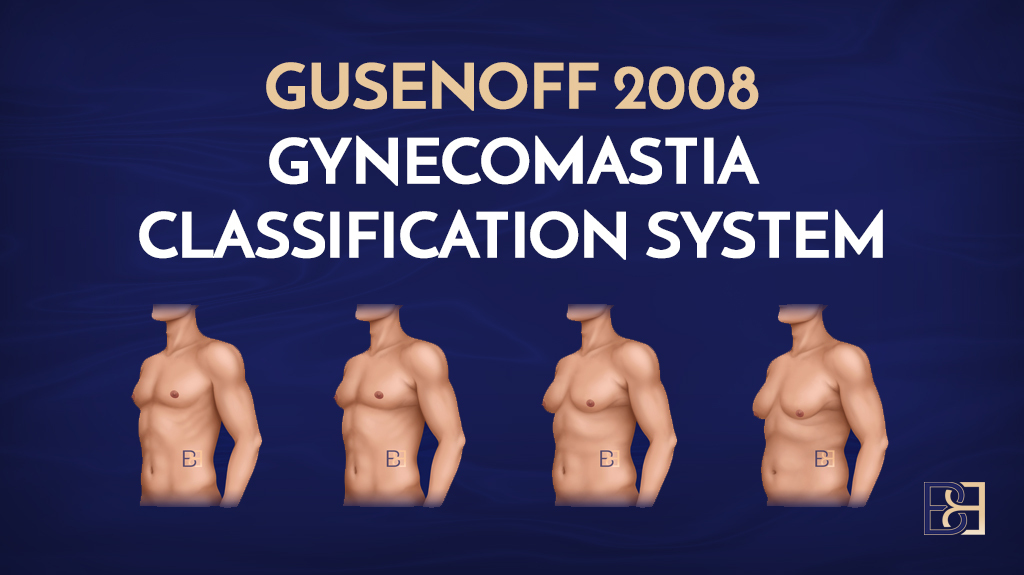
In my gynaecomastia grading system the grade tells me the operation. The crescent lift is BB grade 4, and it sits between two other grades.
- BB grade 3 deals with the gland and the fat. The nipple is in a reasonable position, so no lift is needed.
- BB grade 4 adds a lift of the nipple, for when it sits below the lower border of the pectoralis major muscle but the skin excess is modest.
- BB grade 5 is for a large, heavy skin envelope. It uses a mastectomy with free nipple graft for gynaecomastia, which is a different approach again.
I measure the nipple position at its centre, with you standing, against the lower border of the pectoralis major muscle. That muscle border is a more reliable landmark on the male chest than the old inframammary fold.
What the crescent lift is
The crescent lift is not a skin-only operation. Underneath it I still remove the firm glandular disc and use VASER liposuction (ultrasound assisted lipectomy) for the fatty component, the same as I would at BB grade 3. The crescent lift is the part added on top: a crescent-shaped strip of skin is removed above the areola, and the nipple and areola are lifted into a higher position.
What it will and will not do
The crescent lift raises the nipple a modest amount and reduces the tissue that is present.
How the crescent lift is done
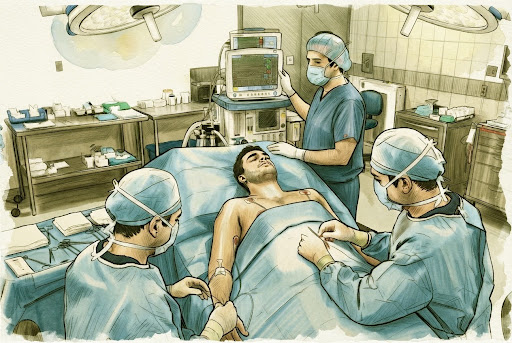
The operation is done under a general anaesthetic. It has two parts: the work underneath, then the lift.
The crescent lift is never done on its own. By itself it achieves very little, because it only moves skin and does nothing about the firm glandular disc or the fat that is causing the enlargement. It is always done together with removal of the gland. The lift is the finishing step, not the operation.
The tissue underneath
I start with the same work I would do at gland excision and VASER liposuction for gynaecomastia, my BB grade 3 operation.
- VASER liposuction (ultrasound assisted lipectomy) reduces the fatty component and helps the skin redrape.
- The firm glandular disc behind the nipple is removed through a small incision at the edge of the areola. Liposuction (suction assisted lipectomy) on its own does not clear this disc, which is why it is taken out directly.
Getting this part right matters for the lift, because the nipple only sits well once the bulk behind it has gone.
The lift
Once the tissue is reduced, I turn to the nipple position. I mark the skin while you are standing, since the nipple sits differently upright than lying down. There are two versions of the crescent lift I use. The choice comes down to how far the nipple needs to move against how much scar is acceptable.
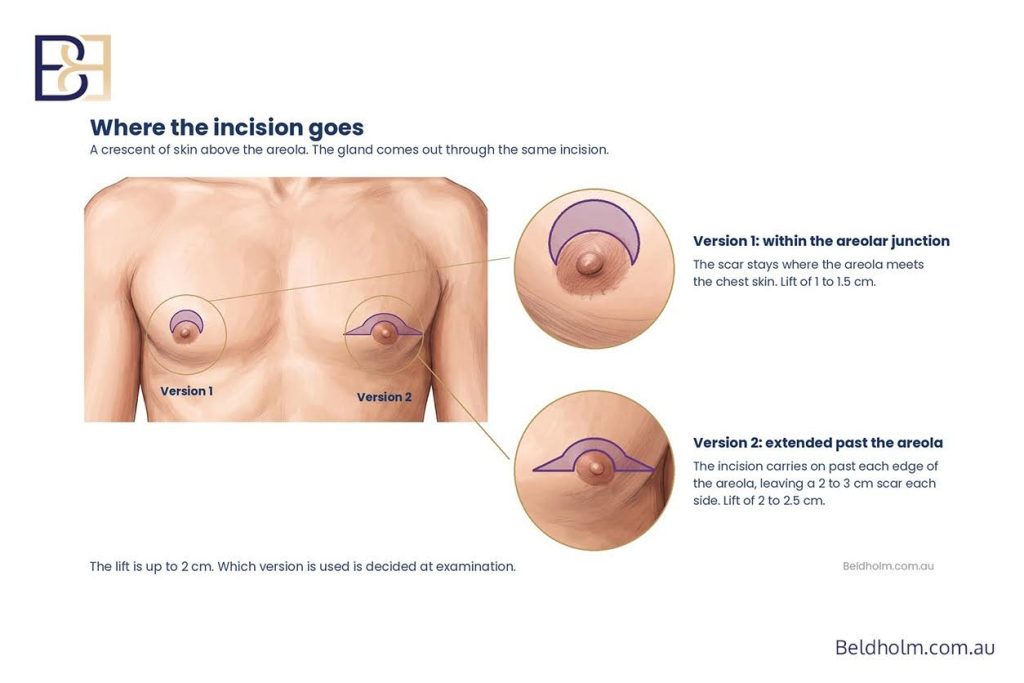
Version one, incision kept within the areolar junction. The crescent of skin sits within the upper edge of the areola, and the scar stays at the junction between the areola and the surrounding skin. This keeps the scar well hidden, but the lift it gives is limited, about 1 to 1.5 cm. It suits a nipple that needs only a small amount of elevation.
Version two, incision extended past the areola. Here I carry the incision past the edge of the areola, horizontally. That lets me take more skin and lift the nipple and areola higher, around 2 to 2.5 cm. The trade-off is more scarring. The scar runs along the top junction of the areola and then extends a further 2 to 3 cm horizontally past it.
Which version I use depends on how far the nipple needs to move. If a small lift will do, version one keeps the scar hidden. If more elevation is needed, version two buys it, and the extra scar is the price.
In either version, the crescent is either removed fully, or its outer surface is taken off while the layer beneath is kept to protect the blood supply to the nipple. Closing the gap draws the nipple and areola upward.
Even version two has a ceiling of around 2.5 cm. If the nipple needs to travel further than that, or there is a lot of loose skin, the crescent lift is the wrong operation, and I would be looking at BB grade 5 instead. I cover that decision further down.
Drains and dressing

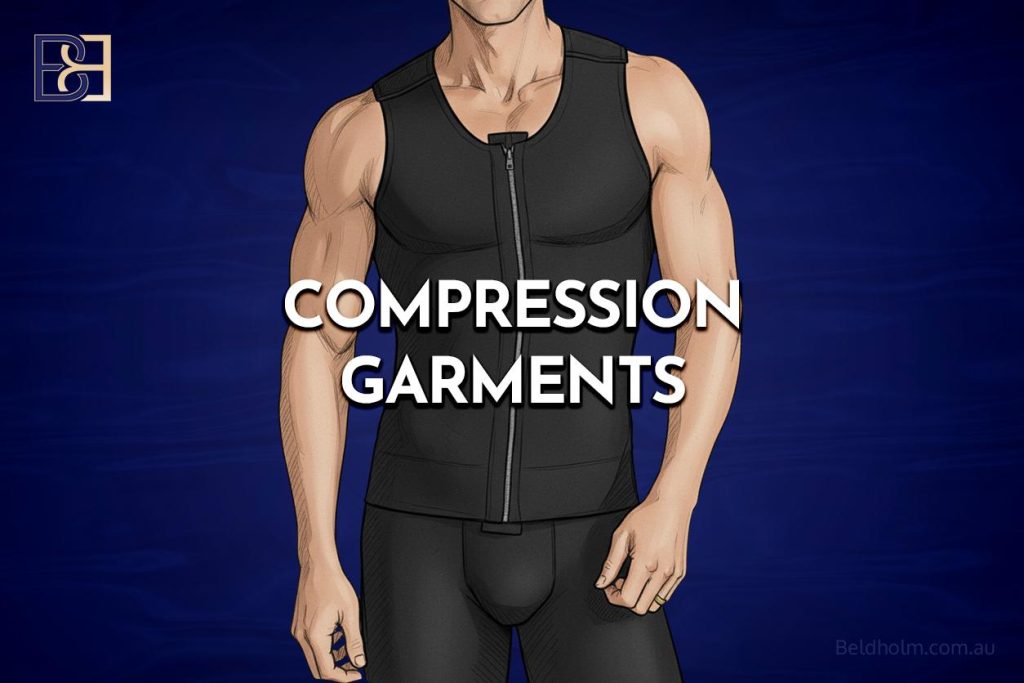
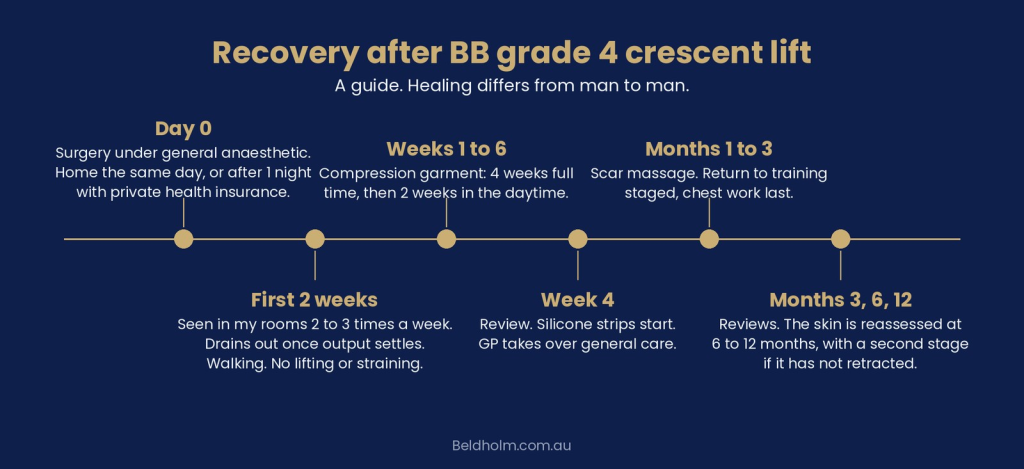
A small drain is often used for a day or two to reduce the chance of blood collecting under the skin. A compression garment goes on at the end of the operation. How long the garment stays on, and when exercise restarts, is set out on the recovery page.
Who the crescent lift suits
The crescent lift is a specific answer to a specific problem. The tissue can be reduced, but the nipple sits a little low and needs a small lift. It suits some men and not others.
It tends to suit you if
- Your nipple sits modestly below the lower border of the pectoralis major muscle, rather than well down the chest.
- The amount of loose skin is modest, so the skin is expected to redrape once the tissue underneath is reduced.
- Your skin quality is reasonable, without heavy stretch marks or a lot of thinned, stretched skin.
- Your weight is stable. Where you have lost a large amount of weight, I want that weight settled before planning the lift.
- Any underlying cause has been looked into and treated, so we are not operating around something that is still driving the changes.
It tends not to suit you if
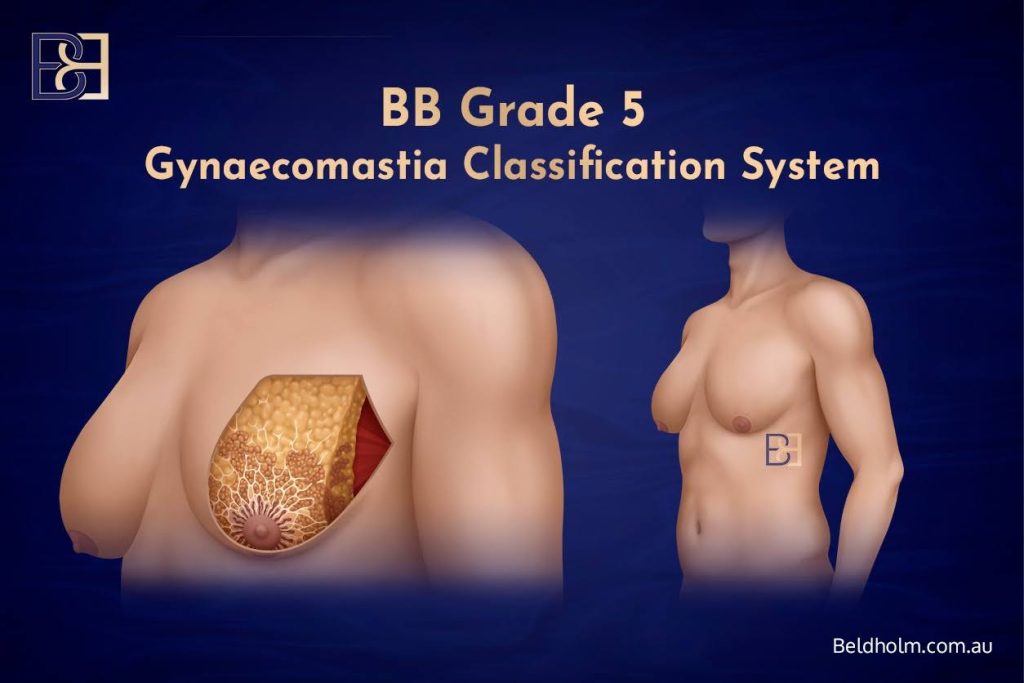
- There is a large, heavy skin envelope, or the nipple sits well down the chest. That is BB grade 5 territory, and a mastectomy with free nipple graft is the better fit.
- The nipple is already sitting well and only the tissue needs reducing. That is BB grade 3, and no lift is needed.
- Your skin is very stretched or damaged, so it will not redrape or hold a scar well.
The limits of the technique
A crescent lift buys a small amount of lift. It is not a way to move a low nipple a long distance. Pushing it past what it can do tends to widen the scar and distort the areola, which I cover further down. Part of the assessment is working out whether a crescent lift will do enough, or whether a different grade serves you better.
Choosing between a crescent lift and the next grade up
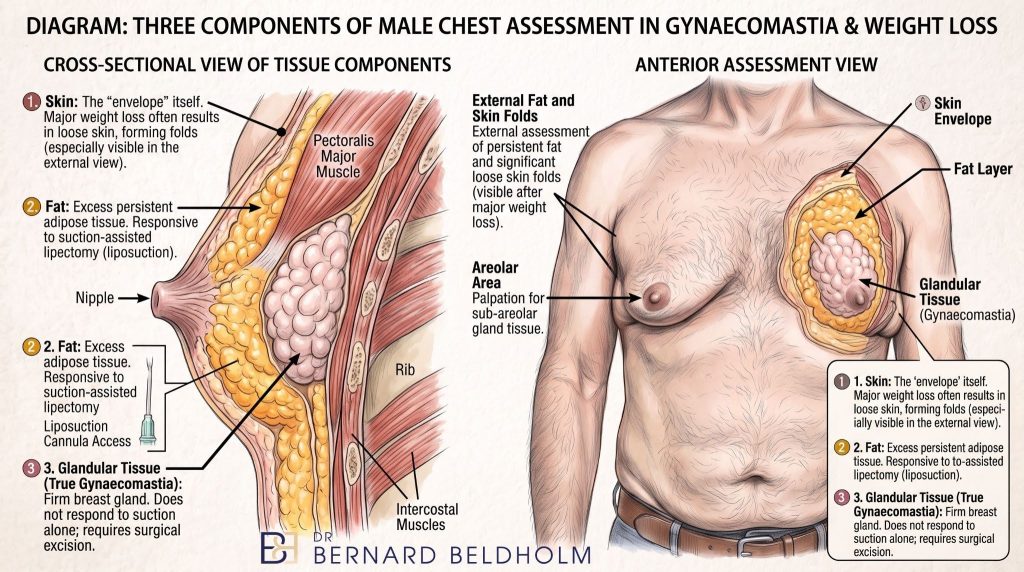
The harder call in this operation is not the crescent lift itself. It is deciding whether a crescent lift is the right choice, or whether you are better served by BB grade 5, a mastectomy with free nipple graft. Two things drive that decision: how far the nipple needs to move, and whether your skin will tighten after the tissue is removed.
How far the nipple needs to move
The crescent lift has a ceiling of around 2.5 cm, and that is with the extended version that leaves the longer scar. If your nipple sits further than that below the lower border of the pectoralis major muscle, a crescent lift cannot raise it far enough. That puts you in BB grade 5.
Whether the skin will tighten
This is the part that is harder to judge, and it is where I spend most of the assessment. After the gland and fat are removed, the skin needs to shrink back onto the flatter chest. Some skin does this well. Some does not.
I read this from a few things:
- How the skin springs back when I pinch it and let go. A brisk springback is a good sign. A slow, sluggish return is not.
- Stretch marks. A few fine marks are usually fine. Heavy, widespread stretch marks tell me the skin has lost its stretch.
- How loose the skin sits at rest.
- Whether you have lost a large amount of weight, which tends to leave a looser, more stretched envelope.
I grade skin quality on its own scale, separately from the gynaecomastia grade, and use it to guide the decision.
- Where the skin is good and springs back well, a crescent lift is likely to hold.
- Where the skin is clearly stretched and will not tighten, the skin needs to be removed directly, which is BB grade 5.
- In between sits the group where I cannot be sure the skin will retract. That is the group I stage.
Staging: a decision we make together
Where the skin quality is borderline, there are two ways to go, and the choice is not mine alone. I set out both at consultation and we decide together.
The staged approach. I do the crescent lift first and give the skin time to retract. If it retracts well, that is the end of it. If it does not retract enough, a mastectomy with free nipple graft can be done as a second stage. The advantage is that you are not committed to the longer scar and the free nipple graft unless the skin proves it is needed. The cost is uncertainty. There may be a second operation, with its own recovery, its own risks, and a further period of time off.
Going to the larger operation first. Some men would rather accept the longer scar and the free nipple graft from the outset than risk needing two operations. For a man whose skin is borderline and who has reason to want this settled in one go, that is a reasonable position.
Several things feed into the choice.
- How the skin reads at assessment, and how likely I think it is to retract.
- How much weight you have lost, and how stretched the envelope is.
- How you weigh a longer scar against the chance of a second operation.
- Your tolerance for an uncertain outcome after the first stage.
- Practical factors such as work, travel, and time available for recovery.
There is no standard answer. One man with borderline skin will choose to stage and another will choose the bigger operation, and both can be the right call. Where we stage, the reassessment happens some months after the first operation. The timing of that review, and what a second stage involves, is set out on the recovery page.
The scar
A crescent lift leaves a scar above the nipple. That is the trade-off you accept in exchange for moving the nipple higher, and you should understand it before you agree to the operation.
Where the scar sits
The scar depends on which version of the lift is used.
Version one. The scar sits at the junction between the top of the areola and the surrounding skin. It follows the curve of the areola, so it falls along a border where the skin changes colour. This is the better hidden of the two.
Version two. The scar follows that same junction along the top of the areola, then carries on horizontally past the edge of the areola for a further 2 to 3 cm. That horizontal portion sits on open chest skin, not on a border, which is why it is more visible than version one.
How visible the scar is
A scar at the areolar junction has the colour change of the areola working in its favour, and it often settles to a fine line that is difficult to pick unless you are looking for it.
The horizontal extension in version two does not have that advantage. It sits on flat chest skin, and it will be visible. In most men it fades to a pale line over time, but it does not disappear. If you are someone for whom a visible chest scar is unacceptable, that needs to be said at consultation, because it changes which version I would use, and it may change whether a crescent lift is the right operation for you at all.
How the scar matures
Scars take time to settle.
- Early on, the scar is firm, raised, and pink or red.
- Over the following months it softens and flattens.
- The colour fades gradually, and the final appearance is usually not clear until around twelve months, sometimes longer.
Judging a scar at six weeks is judging it at its worst.
What affects how a scar turns out
Some of this is under your control and some is not.
- Skin type matters. Darker skin types have a greater tendency to thickened or keloid scarring.
- A history of poor scarring elsewhere on your body is a warning sign, and I want to know about it before surgery.
- Tension on the wound works against a fine scar. This is one reason I do not push a crescent lift beyond what it can do, since forcing more lift than the technique allows puts the closure under tension.
- Smoking impairs wound healing and worsens scarring.
- Sun exposure on a fresh scar darkens it. Keeping a new scar out of the sun is worth the effort.
Scarring varies between men, and I cannot promise any individual how their scar will look.
Scar revision
Where a scar settles poorly, revision is sometimes possible. Revising a scar replaces one scar with another. I would not consider it until the scar has had a full twelve months to mature.
Areolar distortion
Every operation has a risk that belongs to it more than to the others. For the crescent lift, that risk is distortion of the areola.
Why it happens
The crescent lift works by removing skin above the areola and closing the gap. Closing that gap pulls upward on the top edge of the areola. The areola is not rigid, so it moves with the pull, and it can be dragged out of its round shape.
The more skin taken, and the further the nipple is asked to travel, the stronger that upward pull becomes. This is the reason a crescent lift has a ceiling, and the reason I do not force more lift out of it than the technique allows.
What it looks like
Distortion shows up in a few ways.
- Ovalisation. The areola stretches from round into an oval, taller than it is wide.
- A teardrop or egg shape. The upper part of the areola is pulled to a point where the skin is drawn up into the scar.
- Flattening of the upper border. The top edge of the areola loses its curve and reads as a flat line.
- Widening of the areola. The pull stretches the areola so it ends up larger than it was.
- Asymmetry. One side distorts more than the other, so the two areolae no longer match in shape or size.
Some of these are subtle and only apparent to you. Some are noticeable.
How I work to limit it
- I keep the amount of skin removed within what the technique can take, rather than pushing for extra lift and accepting the distortion that comes with it.
- Where a higher lift is needed, I use the extended version with the horizontal incision. Taking that extra skin sideways spreads the tension, rather than loading it all onto the top of the areola.
- I mark with you standing, so the amount of skin removed is judged against how the nipple actually sits.
- The closure is done in layers, so the deeper tissue takes the tension rather than the skin and the areolar edge.
None of this removes the risk. It reduces it.
If it happens
Some early distortion settles as swelling goes down and the tissues relax, so I do not judge the shape of an areola in the first few months.
Where distortion persists, revision is sometimes possible. Reducing or reshaping the areola can be done as a separate procedure once things have fully settled, usually not before twelve months. As with scar revision, it is a further operation with its own risks, not an undo.
The trade-off
If your nipple sits low and you want it higher, the skin above it has to come out, and that pull has to go somewhere. A crescent lift trades a degree of risk to the shape of the areola for a higher nipple position. Whether that trade is worth making for you is part of what we discuss at consultation, and it is a legitimate reason for some men to decide against the lift.
Book your appointment online now
Risks and complications
This is surgery on the chest and it carries risk. Areolar distortion is covered above, because it is the risk that belongs to this operation in particular. The others are set out briefly here, and in full detail in a separate article.
Haematoma is the one I watch most closely
A haematoma is a collection of blood under the skin. It matters most in this operation because of the gland excision. Removing the glandular disc leaves a raw surface behind, and that surface can bleed. Published research on gynaecomastia surgery reports haematoma as one of the more common complications (1, 2).
It usually shows in the first day or two, as one side becoming swollen, tight, firm and painful. Treatment means going back to theatre to remove the blood and stop the bleeding.
The other risks in short
- Seroma. A collection of clear fluid, appearing later than a haematoma. Sometimes needs draining with a needle.
- Changed nipple sensation. Common, usually numbness. It mostly recovers over months, but some change can be permanent.
- Risk to the nipple blood supply. Any operation that moves the nipple carries some risk to its blood supply. It is uncommon with a crescent lift because the lift is small, and smoking increases it substantially.
- Contour irregularity and asymmetry. A dip, a ridge, or a difference between the two sides in shape, nipple height or areolar size.
- Skin that does not retract. Where the skin does not tighten as hoped, loose skin remains, which may mean a second stage.
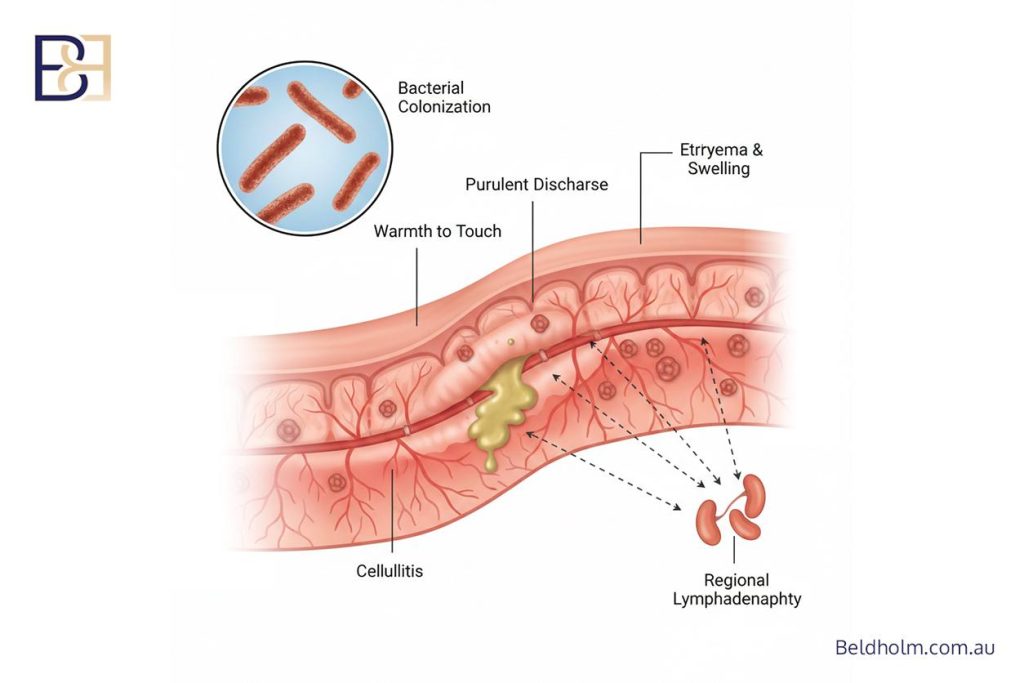
- Infection and wound healing problems.
- Clots in the legs or lungs, lower risk than with larger body contouring surgery, but not nil.
- Recurrence, where an active cause such as an ongoing anabolic androgenic steroid has not been dealt with.
- The need for a further procedure, whether for a scar, a distorted areola, a contour problem, or a planned second stage.
Each of these, including how they are recognised, avoided and treated, is covered in complications of crescent lift surgery for gynaecomastia.
Recovery in brief
Recovery from this operation is covered fully in a separate article. The short version is below, so you know what you are agreeing to.
- The operation is a day procedure or a single overnight stay, depending on the individual.
- A drain is often used for a day or two.
- A compression garment is worn for several weeks. It is not optional. It limits swelling and helps the skin settle onto the flatter chest.
- Bruising and swelling are expected, and the swelling takes months to fully settle. The chest you see at two weeks is not the result.
- Time off work is usually one to two weeks for a desk job, longer for physical work.
- Return to exercise is staged. Walking early, then gradual progression. Chest and upper body training comes last, and it waits.
- Lifting and straining in the early weeks raise the chance of bleeding under the skin.
Two points specific to the crescent lift are worth carrying with you.
The scar takes about twelve months to mature. It looks its worst in the early months. Judging it before then is judging it at its worst.
Where the skin was borderline, the result is reviewed some months out. If the skin has retracted, nothing further is needed. If it has not, a second stage can be planned. This review, and the timing of it, is set out in recovery after crescent lift surgery for gynaecomastia.
Preparing for surgery
Preparation affects how you heal and how the scar turns out. How much preparation you need depends a great deal on how you arrived at this point.
Two different starting points

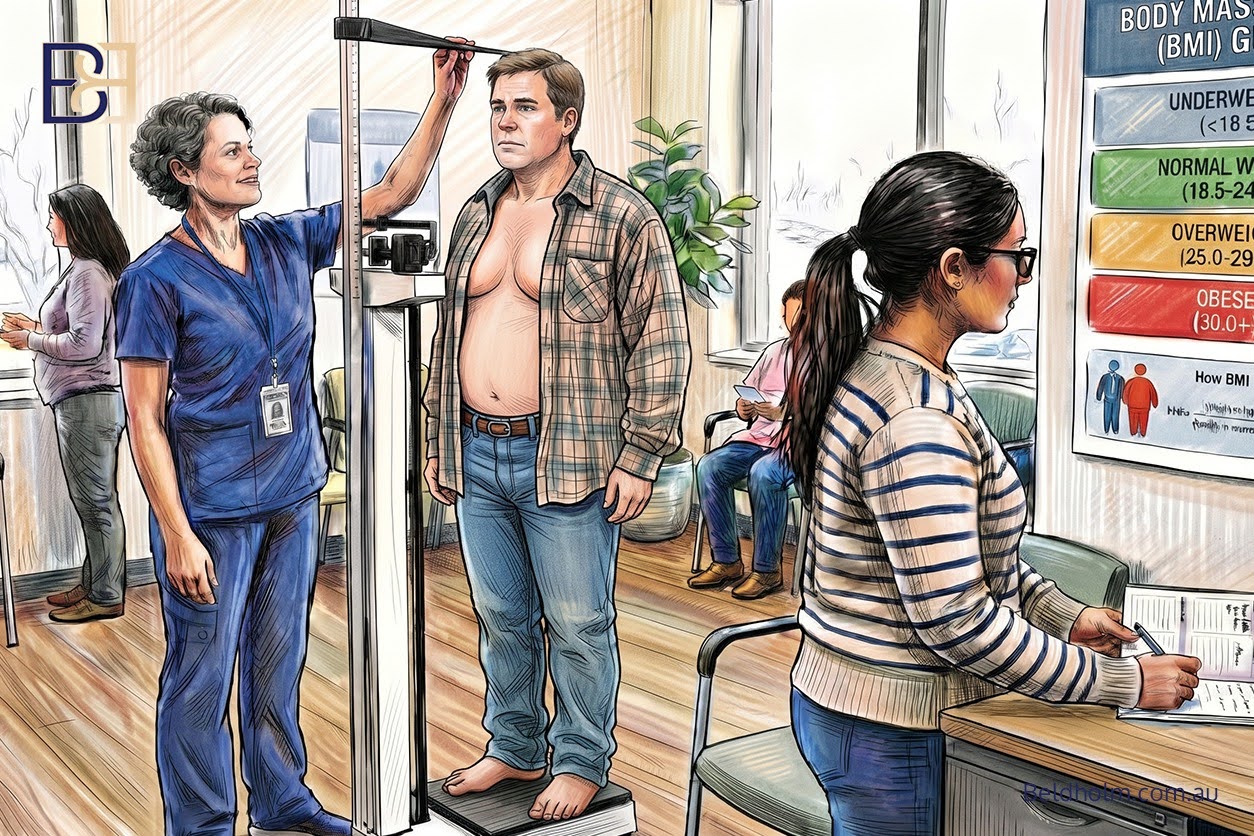
Some men come to a crescent lift after losing a significant amount of weight, whether through diet, training, or a weight loss medications. Others have not lost weight and are otherwise well. These two men do not need the same workup.
Where there is no weight-loss history and you are otherwise healthy, preparation is straightforward: the standard checks that you are fit for a general anaesthetic, and the modifiable risks below. I do not routinely run a full nutritional screen on a well man with no reason to suspect a deficiency.
Where there is a weight-loss history
Significant weight loss changes the picture in two ways.
First, your weight needs to be stable before I plan the lift. Operating on a chest that is still changing does not serve you, and weight stability matters more than any particular number.
Second, weight loss of that size can leave nutritional gaps that work against healing. Where that is your history, a set of blood tests beforehand makes sense, to pick up things like low iron, low vitamin D, or a B12 deficiency, so they can be corrected before surgery rather than after. Your GP is copied in on anything that turns up.
- The role of protein in wound healing is covered in protein.
- Where a specific deficiency shows up, it is corrected first. The common ones are covered in the nutrition articles.
- Any supplements are guided by what the blood tests show, not handed out as a routine stack. The general approach is set out in vitamins and supplements.
Things that work against healing, for everyone

- Smoking. This is the big one. It impairs wound healing, worsens scarring, and increases the risk to the blood supply of the nipple. I want you off cigarettes well before surgery.
- Blood thinning medication and aspirin, which are managed in advance. Never stop these on your own.
- Poorly controlled diabetes.
- Unstable weight.
References
- Steele SR, Martin MJ, Place RJ. Gynecomastia: complications of the subcutaneous mastectomy. Am Surg. 2002;68(2):210-213.
- Zavlin D, Jubbal KT, Friedman JD, Echo A. Complications and outcomes after gynecomastia surgery: analysis of 204 pediatric and 1583 adult cases from a national multi-center database. Aesthetic Plast Surg. 2017;41(4):761-767.
- Vojvodic M, Xu FZ, Cai R, Roy M, Fielding JC. Anabolic-androgenic steroid use among gynecomastia patients: prevalence and relevance to surgical management. Ann Plast Surg. 2019;83(3):258-263.
- Beniwal M, Singh K, Singh P, Sharma A, Beniwal S. The burden of anabolic androgenic steroid-induced gynecomastia. Indian J Plast Surg. 2023;56(4):338-343.