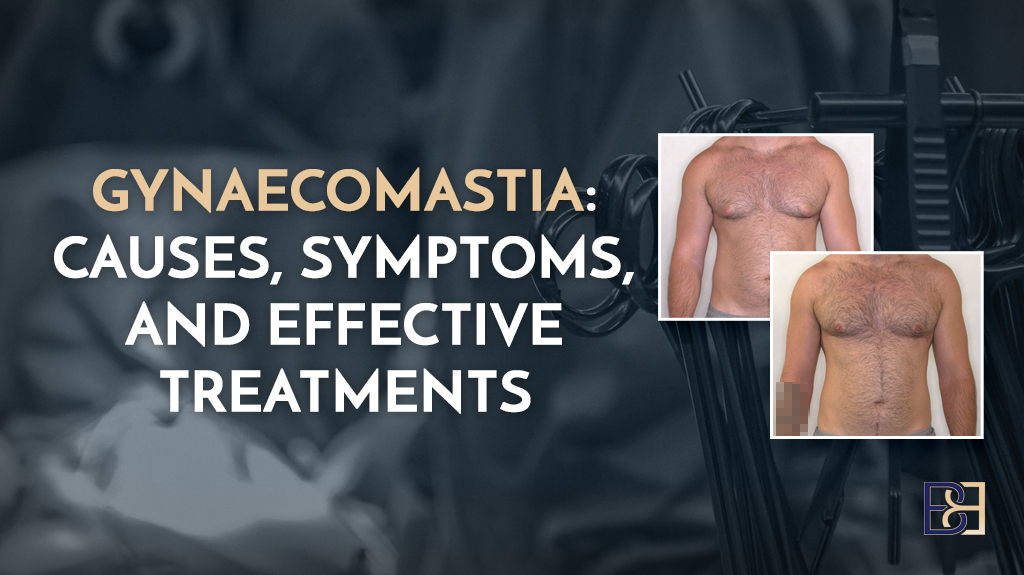
BB grade 1 gynaecomastia is the mildest presentation in my grading system. The enlarged tissue is glandular, it sits within the boundary of the areola, and there is little or no excess fat and no significant skin excess. In practice this is often the man who notices a firm, button-like disc directly under the nipple, sometimes described as a puffy or protuberant nipple areola that will not flatten with training or weight loss.
Gynaecomastia surgery is also known as male breast reduction, or male breast reduction surgery. This page covers one specific operation within that: glandular excision on its own, also called subcutaneous mastectomy. No liposuction (suction assisted lipectomy), no skin removal. It is the operation I use for isolated BB grade 1 disease. If you have a fatty component as well, or skin excess, a different operation applies, and I have linked those pages below so you can find the one that matches your presentation.
Key points
- BB grade 1 gynaecomastia is glandular tissue confined within the areola, with minimal fat and no skin excess.
- The firm disc under the nipple is gland, not fat. Liposuction (suction assisted lipectomy) removes fat, so it does not reliably remove the disc. Excision does.
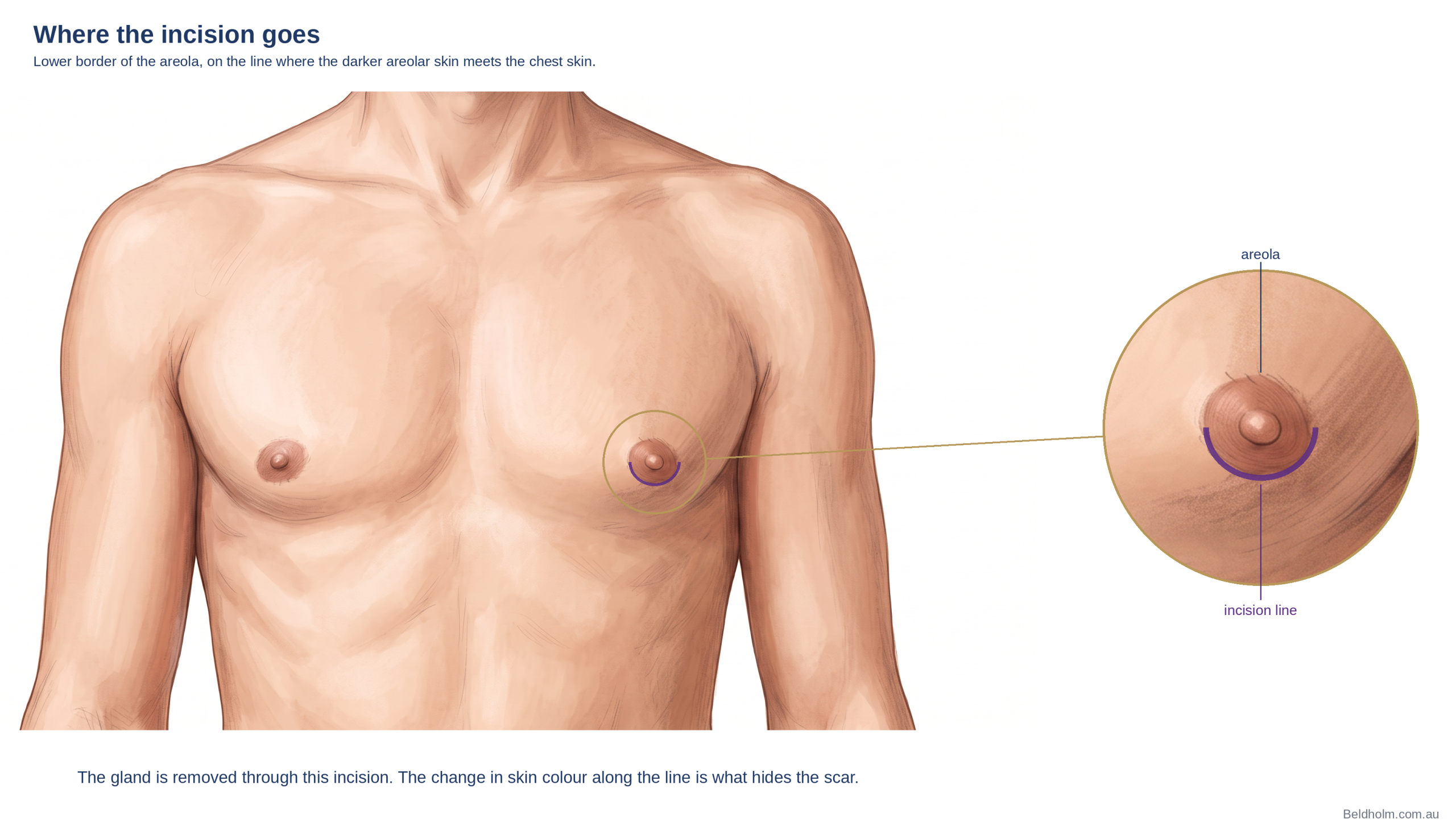
- The gland is removed through a small incision at the lower border of the areola, so the scar sits at the edge of the areola where it tends to settle well.
- This is surgery and it carries risk. The main early risk is a haematoma.
- A compression bandage is applied overnight and removed the next day, followed by a compression garment for two weeks full time and two weeks half time. Return to exercise is staged.
- Surgery removes the tissue that is there now. It does not change an underlying cause, so where a driver is still active the changes can come back.
- Whether surgery is appropriate for you, and which operation, is decided at consultation after examination. A GP referral is required, and results vary between patients.
What BB grade 1 gynaecomastia is
Gynaecomastia is enlarged male breast tissue. It is a recognised clinical condition with several possible causes, and it is common across the lifespan, with recognised peaks in the newborn period, in puberty, and again in older age.
In a BB grade 1 presentation:
- The enlarged tissue is glandular. It feels firm or rubbery, and it is centred under the nipple and areola.
- The tissue sits within the footprint of the areola. It does not spread out across the chest.
- There is little or no excess fat contributing to the shape.
- The skin is not stretched, so there is no loose skin to remove.
This is the presentation many men describe as a firm lump behind the nipple, or a nipple that looks puffy or stands out. It is often present on both sides, though one side can be more prominent than the other.
Where BB grade 1 sits in my grading system
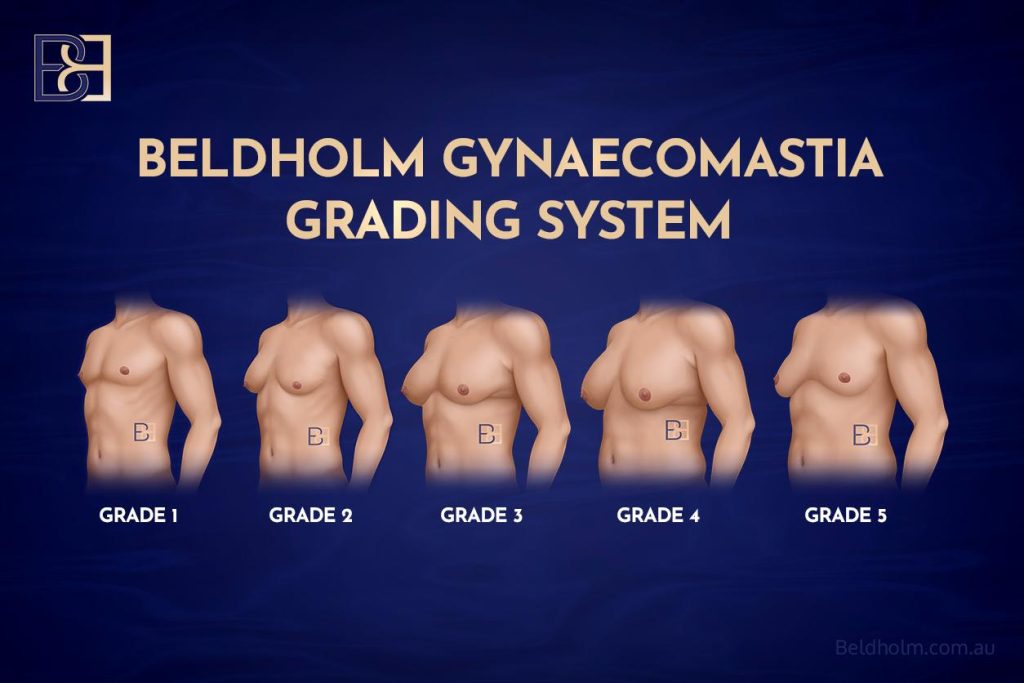
I grade gynaecomastia so that the surgical technique is matched to what is actually present in the chest, rather than applying one operation to everyone. The surgical techniques used across the grades differ substantially, and so does the recovery that follows them. BB grade 1 is glandular tissue, contained within the areola, without a meaningful fatty or skin component.
Because the tissue is glandular and contained, BB grade 1 is the one presentation where I use glandular excision on its own. The other grades call for a different operation:
- BB grade 1. Gland excision only, which is the operation covered on this page.
- BB grade 2. VASER liposuction (ultrasound assisted lipectomy) only. This is the fat-predominant chest, or pseudogynaecomastia, where there is no firm glandular disc to excise.
- BB grade 3. VASER liposuction (ultrasound assisted lipectomy) combined with gland excision, where there is both a glandular disc and a significant fatty component, and the skin has not been stretched enough to need lifting.
- BB grade 4. A crescent lift with VASER liposuction (ultrasound assisted lipectomy) and gland excision, where the nipple has dropped but skin elasticity is still good. A limited skin excision lifts the nipple areola complex back into position.
- BB grade 5. Mastectomy with free nipple areolar graft, also described as free nipple grafting, where there is poor skin elasticity or the nipple sits beyond the reach of a crescent lift. Here the skin excess is the dominant problem, and skin excision is a major part of the operation.
Why the gland, not the fat, decides the operation
The most useful thing to understand about gynaecomastia surgery is that gland and fat behave differently, and they call for different techniques.
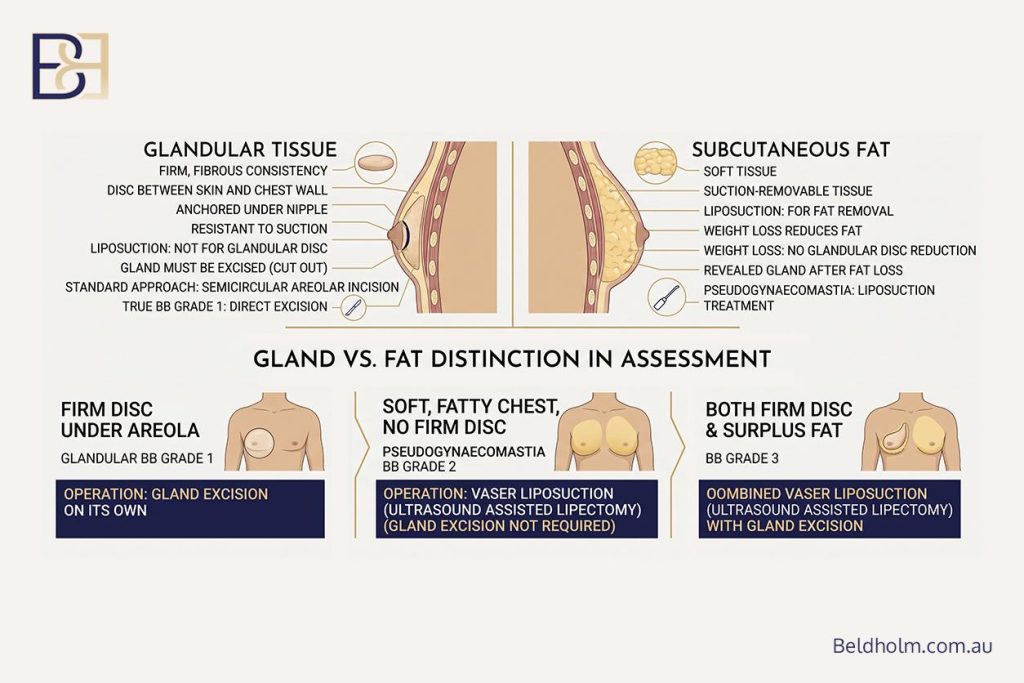
Subcutaneous fat is soft and can be removed by suction. Glandular breast tissue is different. The breast disc is firm and fibrous, it sits between the skin and the chest wall, and it is anchored under the nipple. Where the breast volume is made up of gland, suction has little to work with. Liposuction (suction assisted lipectomy) is designed to remove fat, so it does not reliably remove a firm glandular disc. Published research describes the semicircular incision at the areola as the standard approach for excising glandular gynaecomastia, precisely because the disc has to be cut out rather than suctioned (1). This is why, in a true BB grade 1 presentation, direct excision is the operation.
This distinction also explains why the puffy or protuberant nipple areola does not settle with diet, training, or fat loss. Losing weight reduces fat. It does not remove a glandular disc. Many men only notice the firm disc more clearly once they lose fat around it, because the fat that was disguising it is gone.
Who glandular excision suits
Gland excision on its own suits a specific presentation. In my practice, the man who is a candidate for this operation usually has:
- A firm glandular disc confined within the areola, without a significant fatty component.
- No significant skin excess, and skin that still has good elasticity.
- Enlargement that is established and stable, rather than a recent change that may still settle on its own.
- An underlying cause that has been considered and, where one is found, managed.
- A clear understanding of the risks and the recovery.
If there is a meaningful fatty component, or loose skin, gland excision on its own is not the right operation, and the grade that matches your chest calls for a different one.
The operation: glandular excision through an infra-areolar incision
Gland excision for BB grade 1 gynaecomastia is a focused operation, and among the surgical procedures used across the grades it is the most contained. Surgical correction here means removing one structure, the glandular disc, and leaving everything else alone. The glandular disc is removed through a small, well-placed incision, while keeping the contour of the chest even.
The incision and the scar
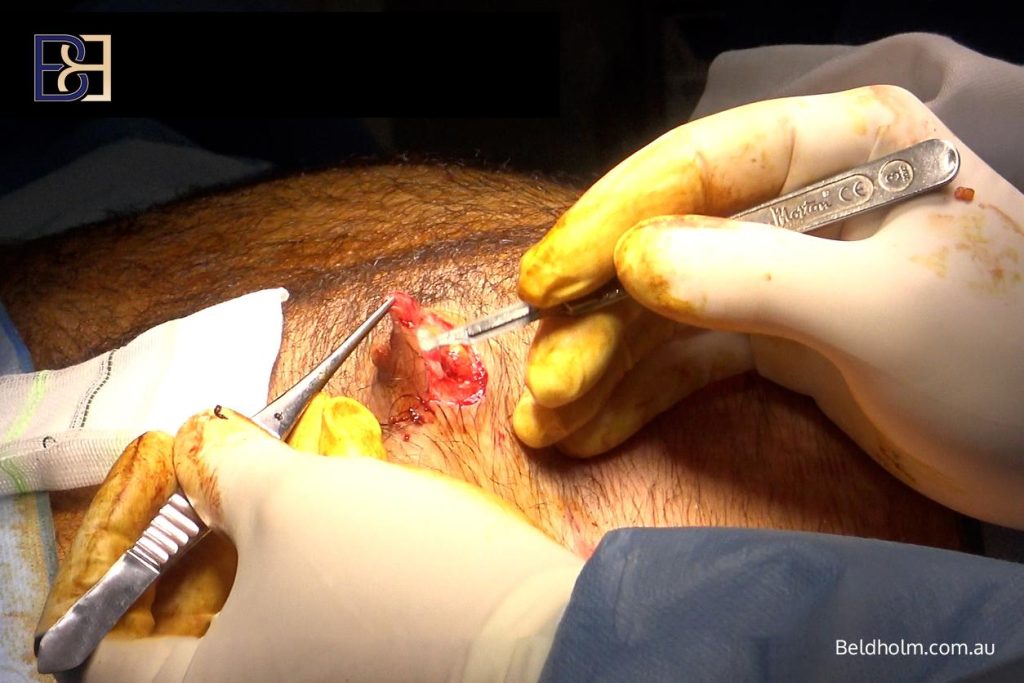
Disclaimer: Results Vary, Surgery has risks, seek 2nd opinion. Operation performed by Dr Beldholm
I use an incision at the lower border of the areola, along the junction where the darker areolar skin meets the surrounding chest skin. This is the semicircular infra-areolar approach first described in the surgical literature in 1946, and it became the standard incision for excising glandular gynaecomastia because it gives access to the disc while keeping the scar at the areolar border, where the colour change in the skin helps make the scar less noticeable (1).
The scar is permanent, as with any surgery. It is positioned to be discreet, but how an individual scar matures varies from person to person.
Removing the gland
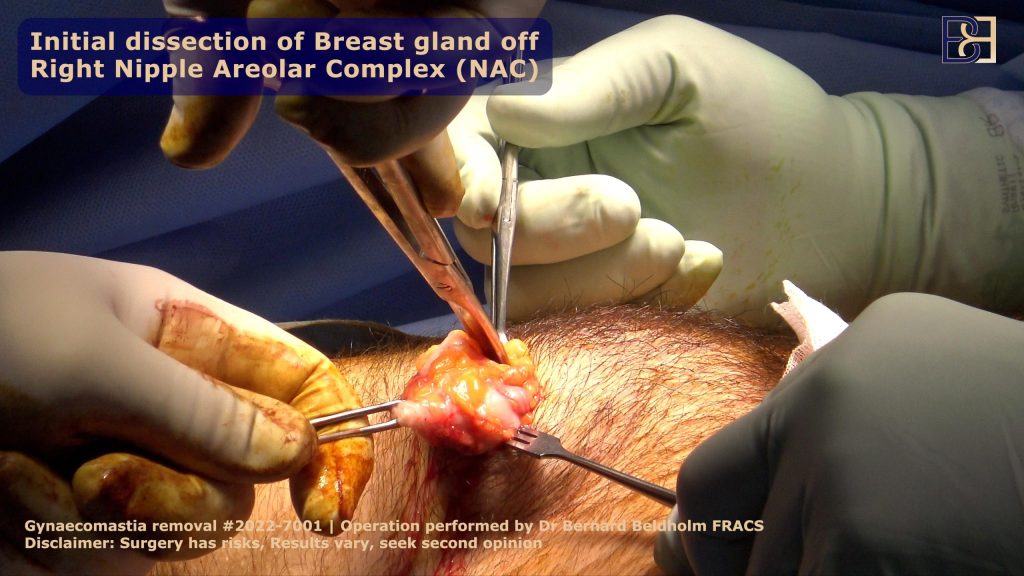
Through that incision the firm glandular disc is removed, along with any excess glandular tissue running out from it.
The disc is not always a tidy button. It commonly sends lateral and medial extensions out beyond the edge of the areola, and these have to be followed and taken as well. Residual tissue left at the margins is one of the ways a chest can still feel lumpy once the swelling has gone, so completeness at this stage matters more than speed.
One technical point determines the shape of the result.
A thin layer of tissue is deliberately left directly beneath the nipple areola complex, which is the nipple together with the pigmented skin around it. If every scrap of tissue immediately under the nipple is taken, the nipple can sink inwards and leave a dished or saucer-shaped depression, which is a recognised failing of over-resection (1). Leaving a measured amount of tissue there keeps the contour even.
The trade-off of a small incision is that it is a narrow window to work through, and controlling bleeding through that window is technically demanding (1). That point connects directly to the main risk of this operation, which I cover further down.
Other operative techniques exist for taking out the gland, including the pull through technique, where glandular tissue is drawn out through a small opening. My preference for BB grade 1 is direct excision under vision through the infra-areolar incision, because it lets me see the margins of the disc and control any bleeding points as I go.
Everything removed is sent for histopathology.
Anaesthetic and hospital stay
I perform this operation under general anaesthetic. For most patients it is a day procedure, meaning you come in and go home the same day. Your own arrangements are confirmed with you beforehand.
Most anaesthetic consultations are done by phone. The physical assessment, including your airway, is done on the day of surgery. It is uncommon to need a separate in-person anaesthetic appointment before the day.
Drains
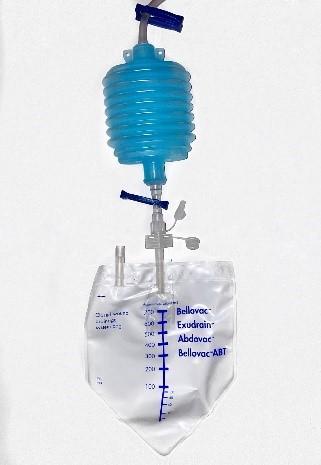
Patients often ask whether they will wake up with a drain. For BB grade 1, usually not. This is a localised excision, the cavity left behind is small, and in my practice a drain is not routinely needed for this operation. Published experience is consistent with that: drains tend to be reserved for the larger resections (4).
Recovery after gland excision
Recovery from a gland-only operation is generally shorter than recovery from the higher grades, where liposuction (suction assisted lipectomy) or skin removal disturbs a much wider area of the chest. BB grade 1 surgery is localised, so there is less tissue trauma to recover from.
Compression
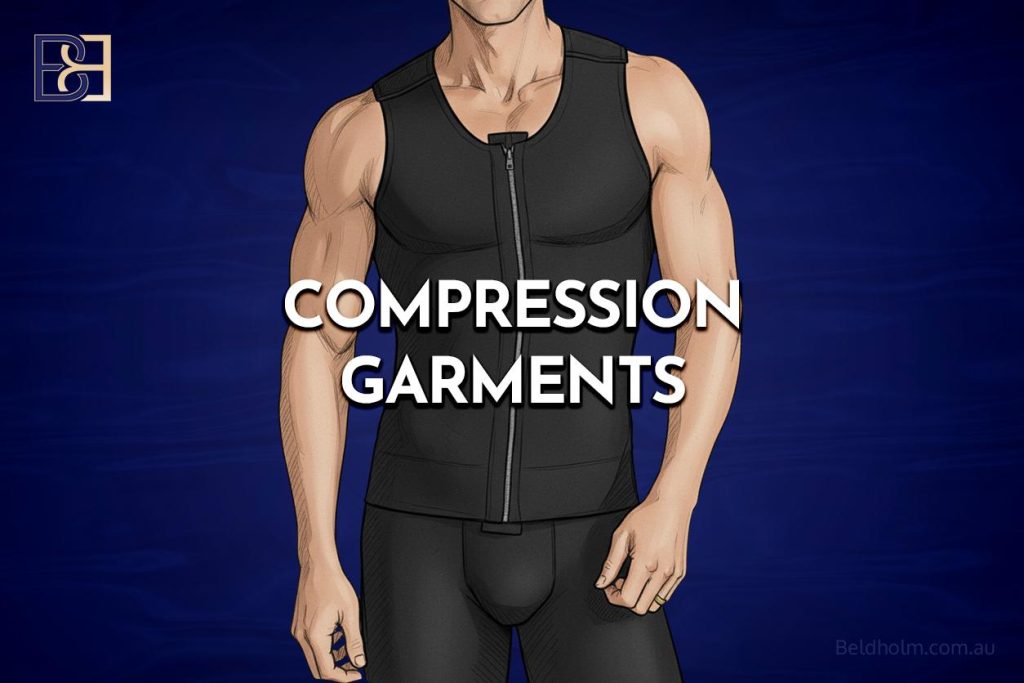
Compression is staged:
- Overnight. A compression bandage is applied over the chest in theatre and removed the following day.
- Weeks 1 and 2. A compression garment, worn full time.
- Weeks 3 and 4. The same garment, worn half time.
Compression holds the tissues together over the cavity left after the gland is removed, so there is less room for blood or fluid to collect there. That cavity is the source of the main risk of this operation, so wearing the garment as directed matters.
The first days and weeks
- Expect swelling, bruising and discomfort in the first week, usually manageable with the pain relief you are given.
- Plan a settled first week at home. Have someone with you to begin with.
- Numbness or altered sensation around the nipple is common early on. It usually resolves over the following months, though it can occasionally be longer lasting.
- Light walking early is encouraged. Avoid straining, heavy lifting, and anything that sharply raises your blood pressure or heart rate in the early period, because that can contribute to bleeding into the healing cavity.
Getting back to normal
- Desk-based work is often possible within a week or so, depending on how you feel and what your job involves.
- Return to the gym and to heavier training is staged, and left until later in recovery. The chest needs time to heal before it is loaded, so chest and upper-body work is reintroduced last.
- I review you after surgery and tell you when you can step your activity back up. Do not rush this on your own.
Follow-up
The scar at the areolar border is usually pink and firm for the first few months before it fades and softens, and it goes on maturing for a year or more.
I follow patients up over the first year, with reviews at four weeks, three months, six months and twelve months. That lets healing be assessed as it happens, and lets the settled result be judged once the swelling has fully resolved, which takes months rather than weeks.
Care is formally handed back to your GP at the four-week review, and your GP stays involved in your longer-term management.
Risks and complications
Gland excision is surgery, and it carries risk. Most male patients get through it without a serious problem, and a large multi-centre analysis of gynaecomastia surgery covering more than 1,500 adult cases found that serious postoperative complications within the first 30 days were uncommon (5). Uncommon is not the same as none. Healing differs from man to man, and you should go into this understanding what can go wrong.
Haematoma
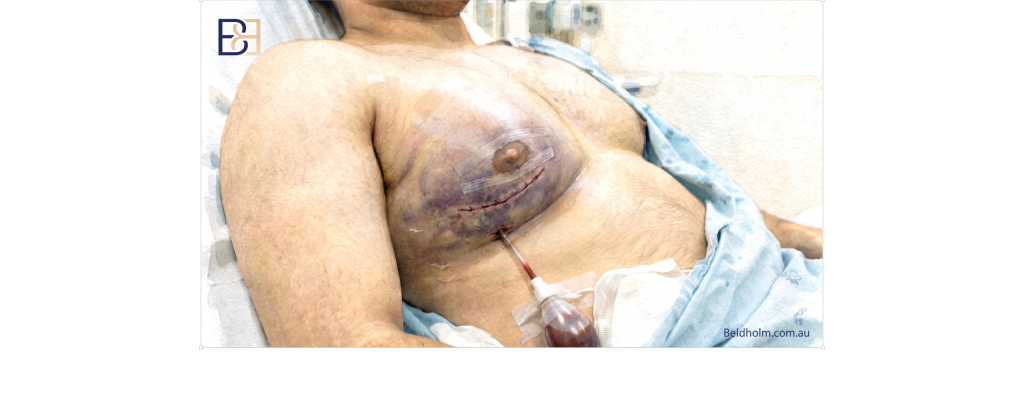
The complication to understand most clearly is haematoma, which is a collection of blood in the space left after the gland is removed.
Here is why it stands out for this particular operation. Excising the gland leaves a cavity. Raw tissue surfaces can ooze, and a cavity gives blood somewhere to collect. The operation is also carried out through a small incision, which is a narrow window to control bleeding through, and the surgical literature has recognised since this technique was first described that this makes control of bleeding demanding (1). In a published series of patients who underwent subcutaneous mastectomy for gynaecomastia, haematoma occurred in around 5% of cases (4). Because most men have the operation on both sides, a bilateral subcutaneous mastectomy means two cavities rather than one, and each carries its own risk of bleeding.
A haematoma usually shows itself in the first day or two as increasing swelling, firmness, pain, or spreading bruising, often on one side. A small one may settle on its own. A significant one needs a return to theatre to evacuate the blood and stop the bleeding.
This is why so much of the plan is built around preventing it:
- Control of bleeding during the operation itself.
- The compression bandage overnight, then the compression garment.
- The restrictions on straining and heavy lifting in the early weeks.
- Planned management of blood-thinning medications before surgery.
I give haematoma this much attention because it is the early complication most likely to need a further procedure.
Other risks
- Changed nipple sensation. Numbness or altered feeling around the nipple is common early and usually resolves, but the change can occasionally be lasting (4).
- Seroma. A collection of clear fluid in the healing cavity, distinct from blood. It sometimes needs draining (4).
- Contour irregularity, including a dished nipple. Removing too much tissue directly under the nipple can leave it sitting in a saucer-shaped depression, which is the reason a measured layer of tissue is left behind (1). Uneven healing can also leave the contour irregular.
- Asymmetry. The two sides may not match exactly, as they can heal differently (4).
- Scarring. The scar is permanent. It is placed at the areolar border to be discreet, but some people scar more than others, including thickened or keloid scars (4).
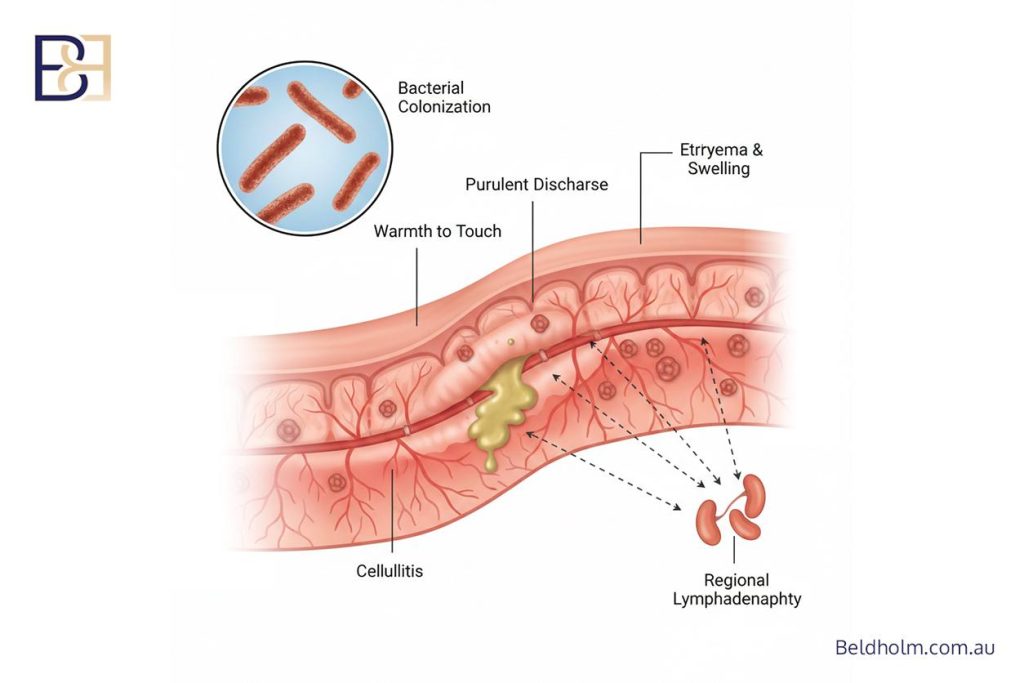
- Infection. Uncommon, and usually managed with antibiotics.
- Recurrence. Covered in the next section, because it is tied to the underlying cause.
- Anaesthetic risks, and risks related to blood clots. I assess your clot risk individually and decide on any preventive measures myself, rather than leaving it to the day of surgery.
One published series of subcutaneous mastectomy reported that when every complication is counted, including the minor and short-lived ones such as temporary numbness and bruising, the overall rate reaches almost half of all cases (4). That figure sounds alarming until you look at what sits inside it: the great majority were minor and settled without further treatment. I include it because you should have the whole picture rather than a curated one.
Recurrence and the underlying cause
Surgery removes the glandular tissue that is present now. It does not change whatever caused that tissue to develop. That distinction decides whether the result lasts.
Glandular tissue that has been excised does not grow back, and a published series of subcutaneous mastectomy for gynaecomastia reported no recurrences among the patients followed (4). Where the disc has been removed thoroughly and nothing is driving new tissue to form, the result tends to hold.
Where a driver is still active, the picture changes. If the cause remains in play, whether that is continued use of anabolic androgenic steroids or a hormonal driver that has not been investigated and managed, glandular tissue can develop again. Research in men who use anabolic agents reports a higher rate of revision surgery in that group, which fits both with an ongoing driver and with the difficulty of removing fibrous tissue completely at the first operation (2).
There is a second route to recurrence, and it is a technical one. If the glandular disc is incompletely excised, the tissue left behind can remain palpable, or become noticeable again as swelling settles. This is not the same as new tissue forming. It is tissue that was never removed.
Two practical conclusions follow from all of this.
- Work out the cause before operating, not after. This is why I want the workup done first, and why an active driver is managed before surgery rather than alongside it.
- Do not expect surgery to override an ongoing cause. Where a driver continues, the changes can return, and I would rather you knew that before you decided than after.
Medicare, private health insurance and cost

Cost, and whether Medicare contributes anything, is one of the questions I am asked most often. Here is how it works.
The Medicare item numbers for gynaecomastia surgery
There are specific Medicare Benefits Schedule item numbers for gynaecomastia surgery:
- 31525. Mastectomy for gynaecomastia, one side.
- 31526. Mastectomy for gynaecomastia, both sides.
Both items cover mastectomy for gynaecomastia with or without liposuction (suction assisted lipectomy), so a gland-only BB grade 1 operation falls within their scope.
These items are not automatic. The descriptors require that the breast enlargement is not caused by obesity and is not in proportion to your overall body build, and that photographic evidence of clinical need is recorded in your notes. The criteria are aimed at true glandular gynaecomastia rather than a chest that is enlarged because of body fat.
This is one more reason the gland versus fat distinction matters so much. A firm glandular BB grade 1 disc is the presentation that may meet these criteria. A purely fatty chest, which is pseudogynaecomastia, generally would not.
Whether you meet the criteria is a clinical determination. I assess it at consultation and, where it is met, I document the evidence that supports the item number. It is not something that can be decided from a photograph or confirmed before I examine you, and eligibility is not assured.
How this changes what you pay

There are three separate fees involved in an operation like this: a surgeon fee, an anaesthetist fee, and a hospital fee.
Where a Medicare item number applies:
- Medicare pays a set benefit toward the medical services, meaning the surgeon and anaesthetist fees. This is a contribution rather than the full amount, so an out-of-pocket gap normally remains.
- Medicare does not pay the private hospital fee.
Where no item number applies, because the criteria are not met, the operation is treated as cosmetic. Medicare does not contribute, and neither does a private health fund.
The distinction that decides this is whether the operation counts as reconstructive surgery, performed for a recognised clinical condition, or as cosmetic surgery. Gynaecomastia surgery can fall on either side of that line depending on what is actually there. Removing a true glandular disc is surgical treatment of a clinical condition. Reducing a fatty chest in a man whose weight explains it is not, on the Medicare criteria.
Where private health insurance fits

If a Medicare item number applies, and you hold private hospital cover at a level that includes this category of surgery, your fund may cover the private hospital fee, which is usually the largest single component. Whether it does depends on your policy, your level of cover, any waiting period, and your excess.
Once eligibility is confirmed, check two points directly with your fund, quoting the item number: whether the procedure is included at your level of cover, and whether any waiting period still applies to you. Health funds do not generally contribute to surgeon or anaesthetist gap fees.
After your consultation you are given an itemised written quote covering the surgeon, anaesthetist and hospital fees, the expected Medicare benefit where an item number applies, and the out-of-pocket amount you can expect, so you can make the decision with your own numbers in front of you.
Preparing for surgery
Most men I operate on for BB grade 1 gynaecomastia are young, fit and otherwise well. Preparation is correspondingly short.
Referral

A GP referral is required before your consultation. Your GP also has a part to play in investigating a cause of gynaecomastia where one is suspected, is copied in on your pre-operative blood results, and takes over your care again at the four-week review after surgery.
Blood tests
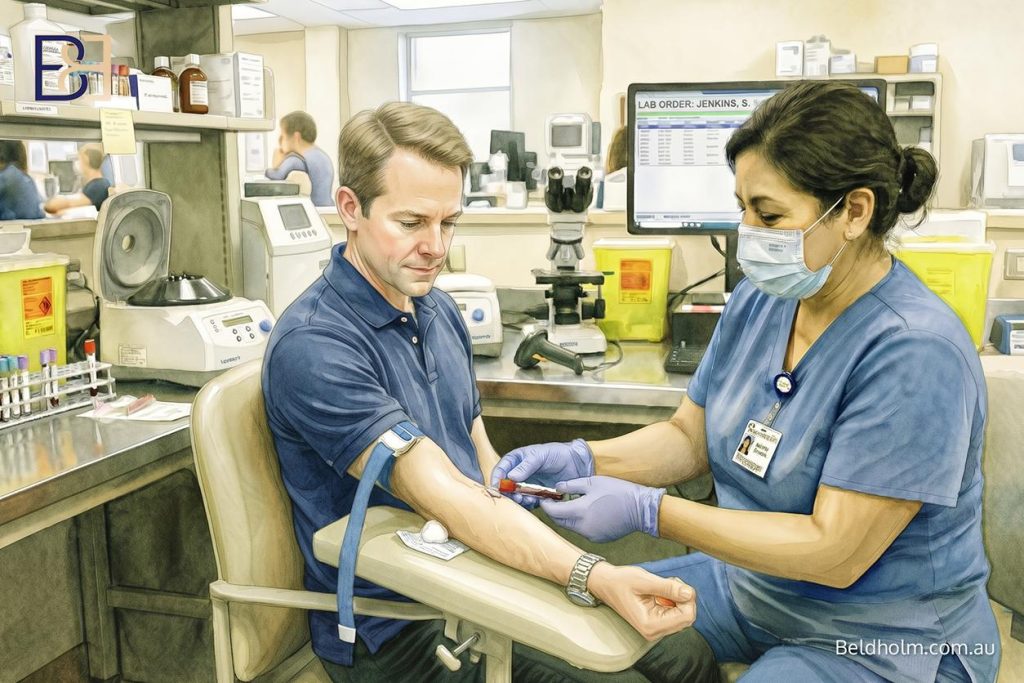
You will have a standard pre-operative blood panel to confirm you are fit for an anaesthetic. Where the cause of the gynaecomastia is still being worked out, hormone tests such as testosterone, oestradiol and related levels are ordered alongside it.
Medications that affect bleeding

Bleeding is the risk that matters most in this operation, so anything that thins the blood is dealt with in advance.
- Aspirin and other blood-thinning medications are usually stopped about a week before surgery. This is planned ahead, not decided on the day.
- Some patients need to continue them through surgery. Where that applies, it is arranged deliberately and well beforehand.
- I assess your risk of blood clots myself and decide what preventive measures are needed, rather than leaving that to the anaesthetist on the day.
Do not stop any prescribed medication on your own. Any change is made with medical guidance, and you will be given written instructions.
A note for those who train
Many men presenting with a glandular disc train seriously, and the question of when heavy chest work can resume comes up early. It is covered in the recovery section above. The other point that matters for this group is set out in the section on anabolic androgenic steroids: where an agent is still being used, it remains an active driver, and that bears on both the timing of surgery and the chance of recurrence.
About Dr Bernard Beldholm

I have been performing gynaecomastia surgery for more than 15 years, and male chest surgery is a significant part of what I do. The BB grade 1 patient is a familiar one in my rooms: a fit young man, often someone who trains seriously, with a firm disc under the areola and a puffy nipple areola that will not flatten no matter what he does in the gym.
Two things decide the result in this operation:
The first is recognising that the disc is glandular. Suction removes fat. It does not remove a firm, fibrous disc. If the tissue under the nipple is gland and the operation is planned around fat, the disc is still there when the swelling settles, and nothing has changed. This is the whole reason BB grade 1 is excision and not liposuction (suction assisted lipectomy).
The second is knowing how much to take. All of the glandular disc comes out, but a measured layer of tissue is left directly beneath the nipple. Strip that layer away and the nipple sinks into a dished, hollow depression. Leave too much and the disc is still palpable. That judgement, made through a small incision at the areolar border, is what the operation actually consists of.
I developed the BB grading system because the published classifications did not map cleanly onto the operation I needed to perform. BB grade 1 sits at the start of it: gland alone, contained within the areola, no fatty component to suction and no skin to remove. It is the one presentation where excision on its own is the whole operation.
Cause assessment is part of the same discipline. In this group that includes asking about anabolic androgenic steroid use, which I raise clinically and without judgement, because it bears on whether surgery makes sense now and on the chance the tissue comes back afterwards.
I teach other surgeons. I am a Specialist Surgeon in the Hunter Valley, with rooms in Lorn, and I operate at Maitland Private Hospital, which has an intensive care unit.
Common questions
How do I know whether my chest is gland or fat? By examination. A firm disc under the areola that stays put no matter how lean you get is glandular. A soft, fatty chest with no disc points to pseudogynaecomastia. The two call for different operations, which is why the distinction is settled before anything is planned.
Can liposuction (suction assisted lipectomy) alone flatten a puffy nipple areola? Not reliably. In BB grade 1 the puffiness is caused by a firm glandular disc, and suction removes fat rather than fibrous glandular tissue. That is why excision is the operation for a glandular presentation (1).
Will I have a drain? Usually not. BB grade 1 is a localised excision and the cavity left behind is small, so I do not routinely use a drain for this operation. Drains tend to be reserved for larger resections (4).
What compression do I wear, and for how long? A compression bandage goes on in theatre and comes off the next day. After that, a compression garment full time for two weeks, then half time for another two weeks.
How long until I can lift again? Return to training is staged, and chest and upper-body work is reintroduced last, because the chest needs to heal before it is loaded. I tell you when to progress at your reviews. Pushing this early risks bleeding into the healing cavity, which is the complication most likely to send you back to theatre.
Will the scar be obvious? The incision sits at the lower border of the areola (1). It is still a permanent scar, and how any scar matures differs from person to person.
Will it come back? An excised gland does not grow back, and where the cause is no longer active, the result tends to hold (4). Where a driver is still running, including continued use of anabolic androgenic steroids, glandular tissue can develop again (2).
If I go back to using anabolic agents after surgery, what happens? The same driver that produced the glandular tissue the first time can produce it again. That is the clinical position, and it is the reason I raise the question before surgery rather than after.
Does Medicare cover this? There are specific item numbers for gynaecomastia surgery, but they apply only where the criteria are met, including that the enlargement is glandular and not caused by obesity. Whether you qualify is determined at examination and documented. See the Medicare section above.
Is it done under general anaesthetic, and do I stay overnight? General anaesthetic, and for most patients it is a day procedure, confirmed for your circumstances beforehand.
Do I need a referral? Yes. A GP referral is required before your consultation.
References
- Webster JP. Mastectomy for gynaecomastia through a semicircular intra-areolar incision. Ann Surg. 1946;124(3):557-575.
- Vojvodic M, Xu FZ, Cai R, Roy M, Fielding JC. Anabolic-androgenic steroid use among gynecomastia patients: prevalence and relevance to surgical management. Ann Plast Surg. 2019;83(3):258-263.
- Nydick M, Bustos J, Dale JH, Rawson RW. Gynecomastia in adolescent boys. JAMA. 1961;178(5):449-454.
- Steele SR, Martin MJ, Place RJ. Gynecomastia: complications of the subcutaneous mastectomy. Am Surg. 2002;68(2):210-213.
- Zavlin D, Jubbal KT, Friedman JD, Echo A. Complications and outcomes after gynecomastia surgery: analysis of 204 pediatric and 1583 adult cases from a national multi-center database. Aesthetic Plast Surg. 2017;41(4):761-767.