


Newcastle, Maitland and the Hunter Valley
Get the 4 options guideIf the weight of your breasts gives you persistent neck, shoulder or back pain, grooves where your bra straps sit, or a rash in the fold beneath the breast, a breast reduction (reduction mammoplasty) may be an option. The operation removes breast tissue, fat and skin, and moves the nipple and areola higher on a smaller, lighter breast.
There are 4 ways to do it. The scar pattern, the amount of tissue removed, and the way the nipple and areola keep their blood supply differ between them, and each has limits. I perform this operation at Maitland Private Hospital in the Hunter Valley, for patients from Newcastle, Lake Macquarie, Maitland, Port Stephens, the Central Coast and regional NSW.
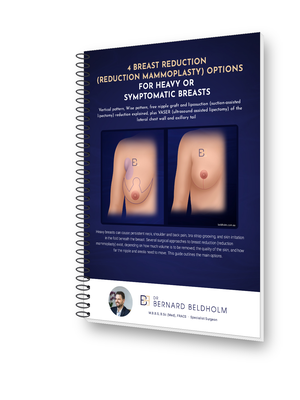
The 4 options guide
My guide sets out the vertical pattern, Wise pattern, free nipple graft and liposuction (suction-assisted lipectomy) approaches to breast reduction (reduction mammoplasty): what is done in each, the scar it leaves and what it cannot do. It explains how a reduction differs from a breast lift (mastopexy), and covers VASER (ultrasound assisted lipectomy) of the side of the chest at the same operation. The guide is emailed, usually within a few minutes.
Is breast reduction (reduction mammoplasty) right for me?
The patients I see for this operation come with physical symptoms from the weight of their breasts:
- neck, shoulder or upper back pain that builds through the day
- grooves in the shoulders where the bra straps sit
- rash, irritation or broken skin in the fold beneath the breast
- difficulty with exercise, and trouble finding bras and clothing that fit
- a size difference between the 2 breasts that causes practical difficulty
At consultation I look at your breast size in relation to your frame, the quality of the breast tissue and skin, where the nipple and areola sit, your general health, and the symptoms themselves. Those findings decide which of the 4 approaches fits, and whether a reduction or a breast lift (mastopexy) is the right operation.
When I would wait
- Weight that is still changing. Surgery is planned once it has settled, because breast size and shape change with it.
- A recent pregnancy or breastfeeding. Surgery waits until breastfeeding has finished and the breasts have settled, with no set number of months that applies to everyone. Future pregnancy and breastfeeding can change the result, and a reduction can affect your ability to breastfeed later.
- Nicotine in any form, including vaping and patches. I require 6 weeks nicotine-free before surgery and 6 weeks after, because nicotine affects wound healing and the blood supply to the nipple.
- A medical condition that is not yet well managed, such as diabetes, high blood pressure or anaemia.
The 4 approaches to breast reduction (reduction mammoplasty)
Every reduction repositions the nipple and areola, so a lift is built into the operation. A breast lift (mastopexy) on its own moves the nipple and areola higher and tightens the skin without the aim of reducing volume, and a breast lift (mastopexy) with auto-augmentation keeps the lower breast tissue and moves it higher rather than removing it. Which of these operations fits you is decided at consultation.
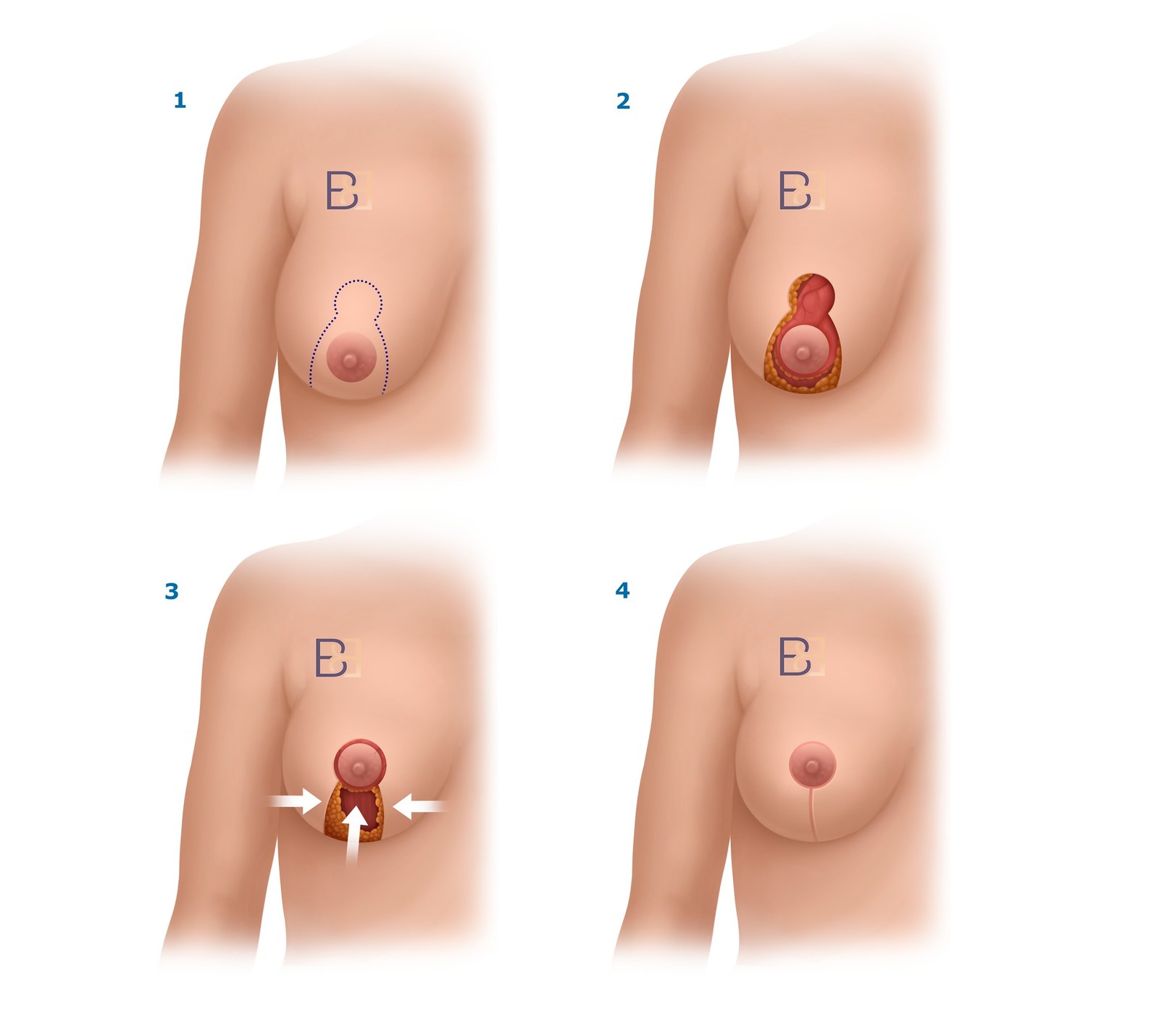
1. Vertical pattern reduction
May suit small to moderate reductions where the skin has good elasticity and the nipple and areola do not need to move far. The scar runs around the areola and vertically to the fold, with no scar along the fold.

2. Wise pattern (inverted-T) reduction
May suit moderate to large reductions, a large amount of skin laxity, or a nipple and areola that need to move a long way. It removes the most skin and tissue. The scar runs around the areola, vertically to the fold, and along the fold beneath the breast.
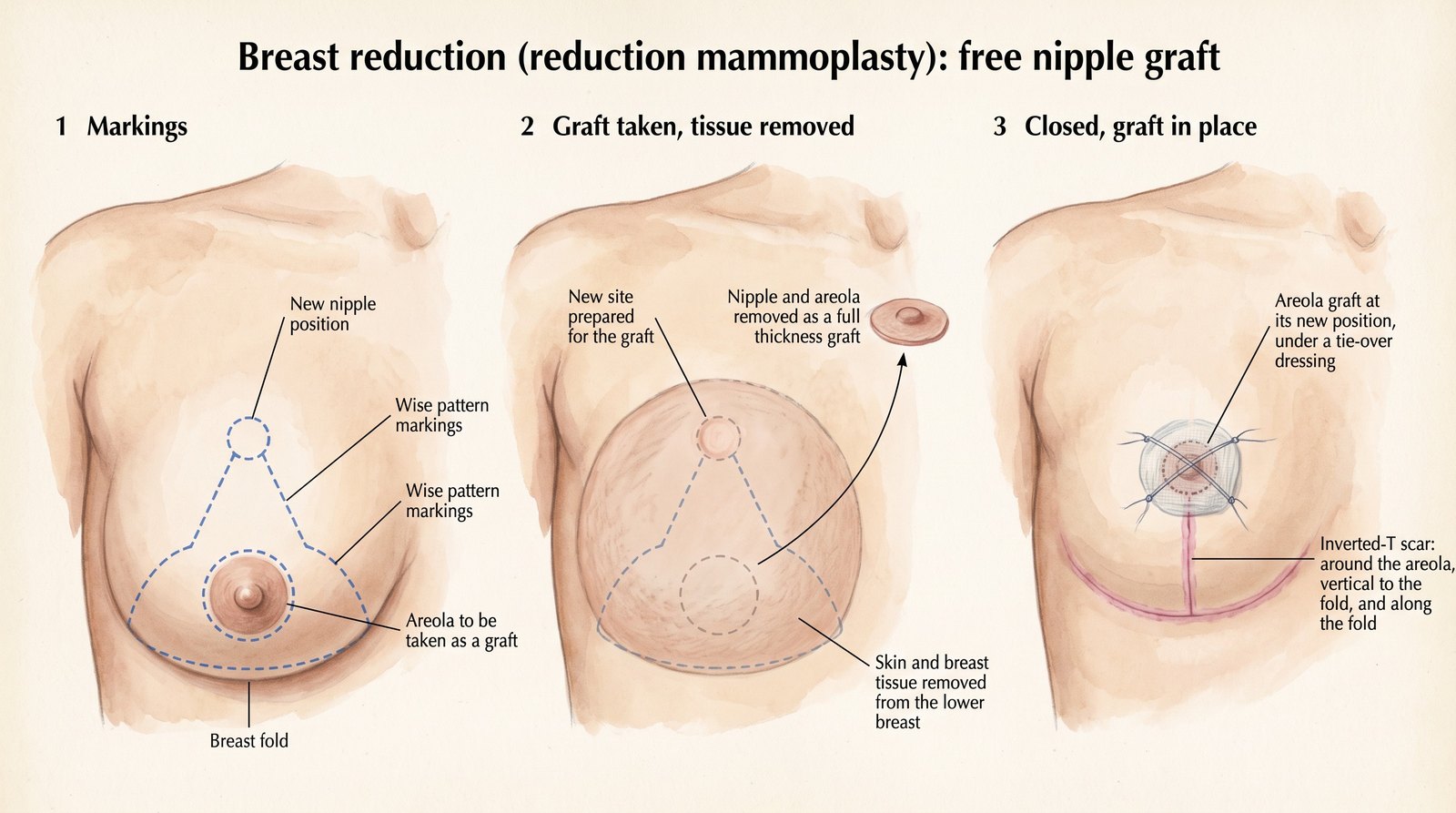
3. Free nipple graft reduction
Rarely used. I consider it only where keeping the nipple on a pedicle of breast tissue would carry a high risk of losing it, or where a shorter operation is needed for medical reasons. The nipple and areola are removed and replaced as a graft, so nipple sensation is usually lost, breastfeeding is not possible afterwards, and part or all of the graft can fail to take. The scars follow the Wise pattern.
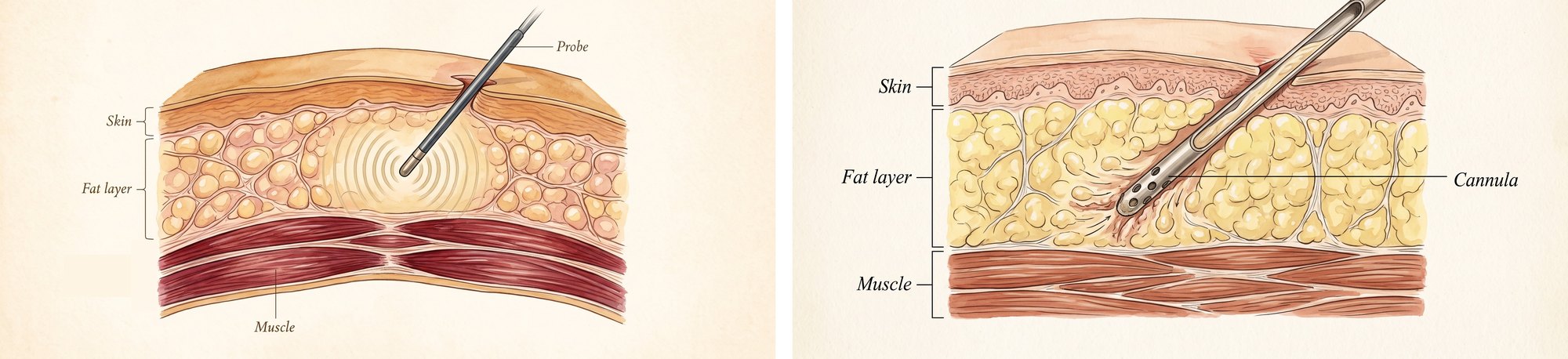
4. Liposuction (suction-assisted lipectomy) reduction using VASER (ultrasound assisted lipectomy)
May suit a narrower group: breasts made up mostly of fat rather than glandular tissue, good skin elasticity, a nipple and areola already at a good height, and a modest reduction. Only fat is removed, so skin laxity is not treated and the nipple is not repositioned. The scars are a few millimetres, at the access points only.
VASER (ultrasound assisted lipectomy) of the side of the chest
The reduction itself does not remove the fat at the side of the breast or in the axillary tail, the extension of breast tissue towards the armpit. Where it is appropriate, I treat this area with VASER (ultrasound assisted lipectomy) through a small incision at the side, during the same operation as options 1 to 3. Whether this applies to you depends on what I find at examination.
Each approach, with what is done step by step, the scar it leaves and its limits, is set out in the guide above.
Your pathway
- GP referral. A referral is needed before a consultation can be booked. Your GP is copied on your pre-operative blood results, receives a formal handover at the 4-week visit after surgery, and looks after your long-term care.
-
First consultation. About 1 hour with me, in person at my rooms in Lorn or by video if you are travelling. I take your history, examine the breasts, and tell you whether surgery is reasonable for you now and which approach fits. Clinical photographs are taken for planning and form part of your record. At this consultation I use Crisalix 3D imaging as a planning aid, so we can talk through size and shape options together. It is a simulation, not a prediction or a guarantee of your result, and results vary between patients.
3D imaging is a visualisation aid used during the consultation. It is a general guide only. It does not predict or guarantee your surgical result, and results vary between patients.
- Second consultation. Included at no cost, with written information to take away. No consent is signed at the first visit, at least 1 consultation is in person before surgery, and at least 7 days pass between consent and booking or paying a deposit. Standard pre-operative blood tests are arranged, with breast imaging where it is indicated for your age and your operation, and you have a pre-operative consultation with the anaesthetist, by phone in most cases.
-
Surgery. At Maitland Private Hospital, under general anaesthetic. Most patients go home the same day, with drains. Staying 1 night is an option, and some patients with hospital cover prefer it.

- Follow-up. In the first 2 weeks you are seen often, with reviews by me and my nurse and LED light treatment with the Healite II device. I then review you at 4 weeks, when your GP receives the handover, and at 3, 6 and 12 months. After hours, you call Maitland Private Hospital, where the nurses triage by phone.
Recovery and risks
Breast reduction (reduction mammoplasty) is an invasive operation under general anaesthetic, and recovery takes time. What follows is the usual course. Yours will depend on the approach used, the amount of tissue removed and how you heal.
- Dressings are Comfeel, which is water-resistant, so you shower from the day after surgery.
- A surgical bra is worn full time for 4 weeks, then in the daytime for a further 2 weeks, after which an underwire bra is permitted.
- Most patients drive again at 5 to 7 days, once off strong pain relief, and return to desk work at 7 to 14 days. Heavy lifting and upper-body exercise wait 2 to 3 weeks, then build up gradually.
- Swelling settles over the first 6 to 12 weeks, the breasts settle into their shape over several months, and scars take 12 to 18 months to mature.
The risks I go through with every patient include bleeding and haematoma, infection, delayed wound healing (most often where the scars meet beneath the areola in a Wise pattern), a change in or loss of nipple sensation, loss of part or all of the nipple and areola from a poor blood supply, which is uncommon, an effect on breastfeeding, a difference between the 2 sides, firm areas of fat necrosis, scars that thicken or widen, deep vein thrombosis and pulmonary embolism, and the need for revision surgery. The full list, and the risks that apply to you, are discussed at consultation before you decide anything.
Read more: recovery after breast reduction (reduction mammoplasty) and complications of breast reduction (reduction mammoplasty).
Cost and Medicare
Breast reduction (reduction mammoplasty) may attract a Medicare item number where the clinical criteria are met, and private hospital cover then applies to the hospital stay. Where the criteria are not met it is a cosmetic operation, and GST applies to the fees.
My surgical fee, the hospital and anaesthetist components that are billed separately, what the fee includes, and the Medicare position are set out on the breast reduction (reduction mammoplasty) cost page. A written quote follows your consultation.
Why patients choose me
I am a Specialist Surgeon (FRACS) with more than 15 years of surgical experience, and my practice covers breast surgery, body contouring and facial surgery. I see you at every consultation, I perform the operation myself, and I review you through recovery until the result has settled, with my nurse alongside me in the first 2 weeks.
My rooms are at 30 Belmore Road, Lorn, near Maitland, and I operate at Maitland Private Hospital, which has 24-hour medical cover and an on-site intensive care unit. Video consultations are available if you are travelling.

The 4 options guide
Vertical pattern, Wise pattern, free nipple graft and liposuction (suction-assisted lipectomy) reduction using VASER (ultrasound assisted lipectomy), with the scar each leaves and its limits, plus VASER (ultrasound assisted lipectomy) of the side of the chest at the same operation. Emailed, usually within a few minutes.
Questions patients ask
Is breast reduction (reduction mammoplasty) covered by Medicare or private health insurance?
Where the clinical criteria for the Medicare item are met, Medicare contributes to the surgeon and anaesthetist fees and private hospital cover applies to the hospital stay. Where they are not met, it is a cosmetic operation, the full cost is out of pocket and GST applies. Eligibility is assessed at consultation, and the detail is on the cost page.
Will I be able to breastfeed afterwards?
Some patients can and some cannot. It depends on the approach, the amount of tissue removed and your anatomy, and with a free nipple graft it is not possible. If more children are a possibility, tell me at consultation, because it affects the choice of approach and the timing of surgery.
What will the scars be like?
The scars are permanent, and their position depends on the approach: around the areola and a vertical line to the fold for the vertical pattern, with a further line along the fold for the Wise pattern and the free nipple graft. They fade and flatten over 12 to 18 months. Some patients form thicker or wider scars, and skin type and individual healing influence this.