


Deep Neck Lift (Cervicoplasty) in Newcastle NSW
A deep neck lift (cervicoplasty) is a neck lift (cervicoplasty) that works below the platysma muscle, not just above it. The platysma is the thin sheet of muscle that sits just under the skin of the neck. A standard neck lift (cervicoplasty) manages the skin, the fat above the platysma, and the muscle itself. A deep neck lift (cervicoplasty) goes one layer further. Through an incision hidden under the chin, I open the platysma and work on the structures beneath it: the subplatysmal fat pad and, where indicated, the anterior digastric muscles. The platysma is then repaired and tightened, and the skin is redraped.
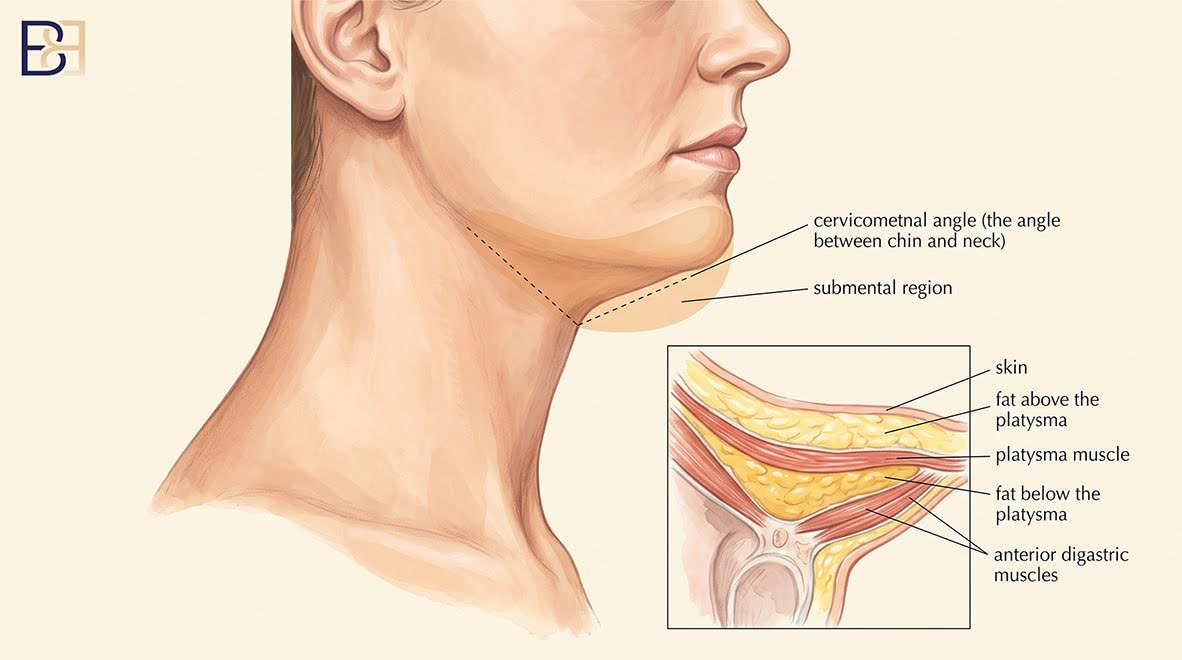
The distinction matters. In some necks, the fullness that shows on the outside does not come from the skin or the surface fat at all. It comes from deeper structures. Liposuction and skin tightening cannot reach that fullness, because it sits underneath the muscle. A deep neck lift (cervicoplasty) is designed for exactly that situation.
I should be clear about what this operation does not do. It does not change skin texture, fine lines, or sun damage. It does not treat the submandibular glands, which can also contribute to fullness in some necks; I assess this separately at consultation. And it does not stop the ageing process. Neck ageing is a normal part of life, the neck continues to age after surgery, and results are not permanent in that sense.
A deep neck lift (cervicoplasty) is often performed together with work on the lower face, and it builds on the same foundations as a standard neck lift (cervicoplasty). If you want more detail on the anatomy and what actually sits beneath the platysma, I cover it fully in my article on the deep neck lift (cervicoplasty) and what sits beneath the platysma.
Book your appointment online now
What a deep neck lift (cervicoplasty) is suited to
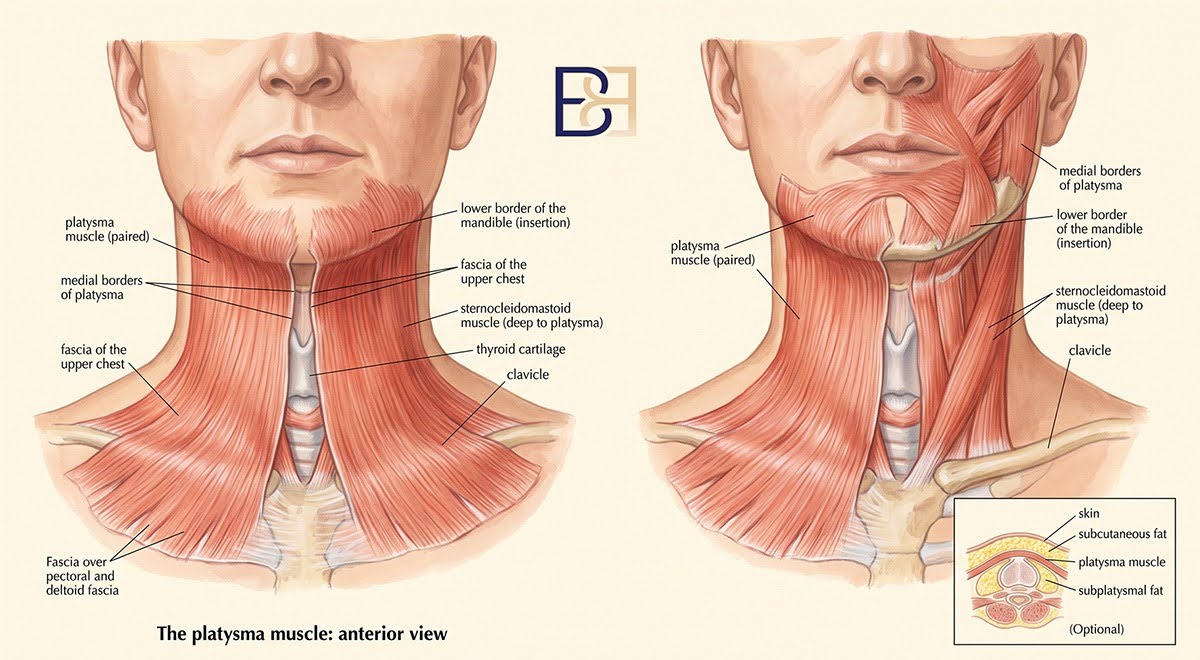
The deciding factor is where the fullness sits. At consultation, I work out which layer of the neck is responsible for what you are seeing. The possibilities include loose skin, fat above the platysma, laxity or banding of the platysma itself, and fullness below the muscle from the subplatysmal fat pad or prominent anterior digastric muscles. Prominent submandibular glands can also contribute in some necks, and I identify that at assessment, although this operation does not treat the glands.
A deep neck lift (cervicoplasty) is suited to necks where a meaningful part of the fullness sits below the platysma. This is often the case in patients who have had a full or heavy neck for most of their adult life, sometimes running in the family, rather than something that appeared with age. It also suits patients where the angle between the chin and the neck, the cervicomental angle, is blunted by deep fullness that surface work cannot reach.
Where the deeper layer is not the problem, I do not open it. If the changes are mainly in the skin, the surface fat, or the platysma, a standard neck lift (cervicoplasty), platysmaplasty, or VASER (ultrasound-assisted liposuction) may be the better-matched operation, and I explain that reasoning at consultation. Some concerns are better suited to non-surgical measures, and where that is the case I say so; which options are appropriate is something I discuss with you individually.
Where the lower face and the neck are both involved, a deep neck lift (cervicoplasty) may be combined with a facelift (rhytidectomy) in the one operation. This is only done where both are genuinely indicated for you, and it is a decision made together at consultation.
Techniques I use in a deep neck lift (cervicoplasty)
The operation is performed through an incision hidden in the crease under the chin. Depending on what is found at assessment, and confirmed during surgery, it involves some or all of the following steps.
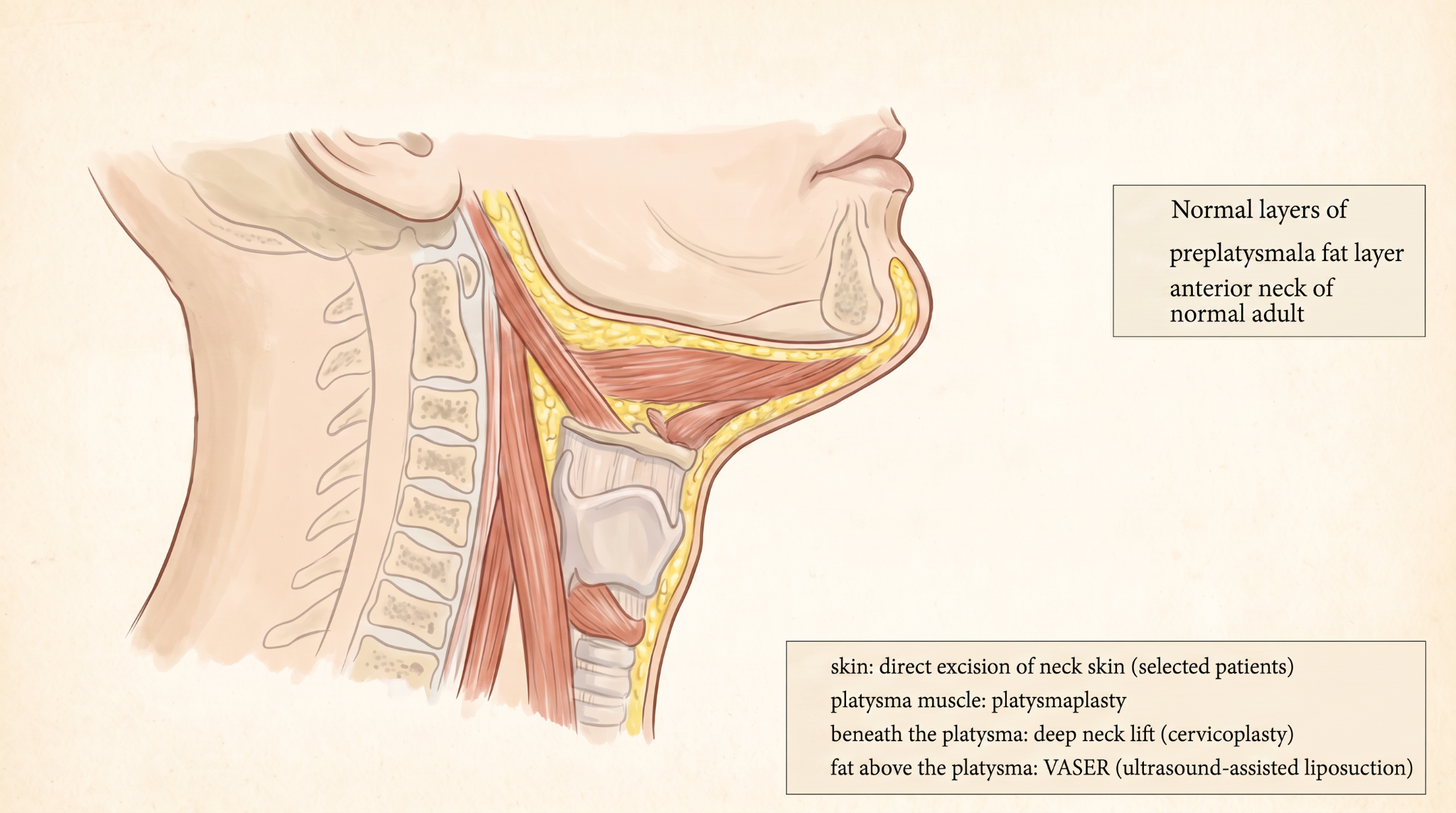
Subplatysmal fat management
The subplatysmal fat pad sits in the midline of the neck, underneath the platysma. Where it is contributing to fullness, I reduce it under direct vision. Taking too much fat from this layer can hollow the neck, so judgement matters more than volume.
Anterior digastric work
The anterior bellies of the digastric muscles run under the chin on each side of the midline. In some necks they are bulky enough to blunt the contour even after the fat has been managed. Where that is the case, I reduce or reshape them. This step is only performed where the muscles are genuinely contributing, which is a judgement made during the operation.
Platysmaplasty closure
Once the deep work is complete, the platysma is repaired and tightened in the midline. This platysmaplasty step closes the deeper layer, supports the new contour, and works on any muscle banding at the same time. I explain this component in more detail on my platysmaplasty page.
Skin redraping
The skin is then redraped over the new contour. In many cases the skin settles without a separate skin excision. Where there is marked loose skin, that is a different problem, and I discuss the options for it at consultation.
Which of these steps apply to you depends entirely on your anatomy. For the full picture of how I decide between a standard neck lift (cervicoplasty), platysmaplasty, and deeper work, see my article on the neck lift (cervicoplasty) and platysmaplasty.
My approach

Every deep neck lift (cervicoplasty) starts with working out what is actually causing the appearance of the neck. At consultation I examine the skin, the fat above and below the platysma, the muscle itself, the digastric muscles, the submandibular glands, and the position of the hyoid bone, because each of these changes what surgery can and cannot achieve. Standardised clinical photography is part of that assessment. I only recommend opening the deep layer where the deep layer is the problem.
Preparation matters as much as the operation. Blood pressure is reviewed and optimised before any neck surgery, because raised blood pressure increases the risk of bleeding and haematoma afterwards. If you smoke, cessation for an appropriate period before and after surgery is required, because smoking affects skin blood supply and healing. Both are checked before a date is confirmed.
Book your appointment online now
About Dr Beldholm

I have performed face and neck surgery for more than 15 years. I am a Fellow of the Royal Australasian College of Surgeons (FRACS), and my practice covers facial surgery alongside post-weight-loss and post-pregnancy body contouring and breast surgery.
Deep neck work is a specific interest of mine. It demands detailed knowledge of the anatomy beneath the platysma, where the marginal mandibular nerve, the facial vessels, and the floor of the mouth structures all sit close to the surgical field. That is why I assess each neck layer by layer before recommending it, and why I am equally comfortable telling you the deep layer is not your problem.
Where a concern is better suited to non-surgical measures, I say so, and we discuss the appropriate options at consultation. All of my neck surgery is performed at Maitland Private Hospital in the Hunter Valley, with 24-hour medical cover and my own daily rounds while you are admitted.
Your pathway
GP referral
A referral from your GP is required before any consultation.
Consultation
Your first consultation runs for around an hour. It covers your health history, examination of the neck layer by layer, standardised clinical photography, and a frank discussion of what a deep neck lift (cervicoplasty) can and cannot achieve for you, including risks and recovery. A second consultation, in person or by telehealth, is provided at no cost.
Quote
After consultation you receive a written quote for my surgical fee. Separate estimates from the hospital and the anaesthetist are organised for you by my patient coordinator, so you have the full picture of costs before deciding.
Surgery
The operation is performed under general anaesthesia at Maitland Private Hospital. Your anaesthetic consultation is usually by phone beforehand, with the physical assessment on the day of surgery. A supportive garment is provided by the practice.
Follow-up
Follow-up is intensive in the first two weeks, with two to three visits per week for nursing and dressing review. After that, I see you at 4 weeks, 3 months, 6 months, and 12 months. All follow-up is included at no additional cost.
Recovery in brief
Because a deep neck lift (cervicoplasty) works below the platysma, the early recovery involves more swelling than surface-level neck surgery, and the swelling takes longer to settle. Expect noticeable swelling and bruising under the chin and in the neck in the first one to two weeks, a feeling of tightness when turning the head or swallowing early on, and a supportive garment worn as directed. Most patients take one to two weeks off work depending on their role, and return to exercise is staged over several weeks. Numbness under the chin is common early and usually settles over weeks to months. The final contour takes months to fully declare itself as the deep swelling resolves.
Recovery varies between patients. I cover the week-by-week detail, and what is specific to recovery after deep neck surgery, in my article on recovery after a deep neck lift (cervicoplasty), which sits alongside my broader neck lift (cervicoplasty) recovery guide.
Risks of a deep neck lift (cervicoplasty)
A deep neck lift (cervicoplasty) is a significant operation, and working below the platysma means operating close to important structures. The risks include:
- Haematoma (a collection of blood requiring return to theatre), the most notable early risk in neck surgery, with raised blood pressure a contributing factor
- Injury to the marginal mandibular nerve, which can cause temporary or, rarely, permanent weakness of the lower lip
- Bleeding in the deeper plane of the neck
- Infection
- Contour irregularity, over-hollowing, or asymmetry of the neck
- Prolonged swelling and firmness under the chin
- Numbness of the skin under the chin and neck, usually temporary
- Scarring at the submental incision, including the small risk of a thickened scar
- Skin healing problems, with the risk higher in smokers
- Deep vein thrombosis (DVT), assessed and managed individually
- Anaesthetic risks
- The possibility of revision surgery
Results vary between patients, and no outcome can be guaranteed. I go through each of these risks with you at consultation, and I cover them in more depth in my article on the risks of neck surgery.
Is a deep neck lift (cervicoplasty) right for you?
That depends on one question: where does your neck fullness actually come from? If it sits below the platysma, a deep neck lift (cervicoplasty) is designed to reach what surface-level surgery cannot. If it sits in the skin, the surface fat, or the muscle, a different operation is likely the better match, and I will tell you so. Neck ageing is normal, surgery is one option among several, and the right answer is worked out for you individually at consultation, after a layer-by-layer assessment. Whatever the answer turns out to be, you will leave that consultation understanding what is driving the appearance of your neck and what can realistically change it.