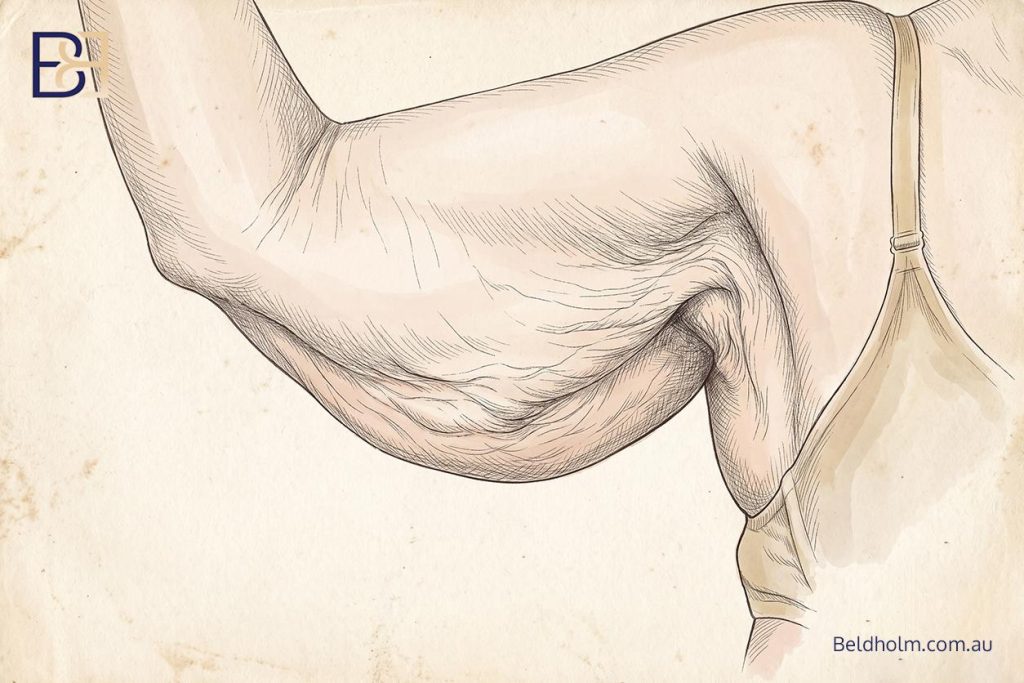
After a 40kg weight loss, the upper arm skin often cannot shrink back. Significant weight loss leaves reduced skin elasticity, so the skin no longer retracts. It hangs from the elbow to the armpit and frequently continues onto the lateral chest wall. This is different from the loose skin that comes with ageing. Ageing-related skin laxity tends to sit in the lower part of the upper arm. Skin laxity after massive weight loss is usually heavier, runs the full length of the arm, and wraps further around it and onto the chest wall.
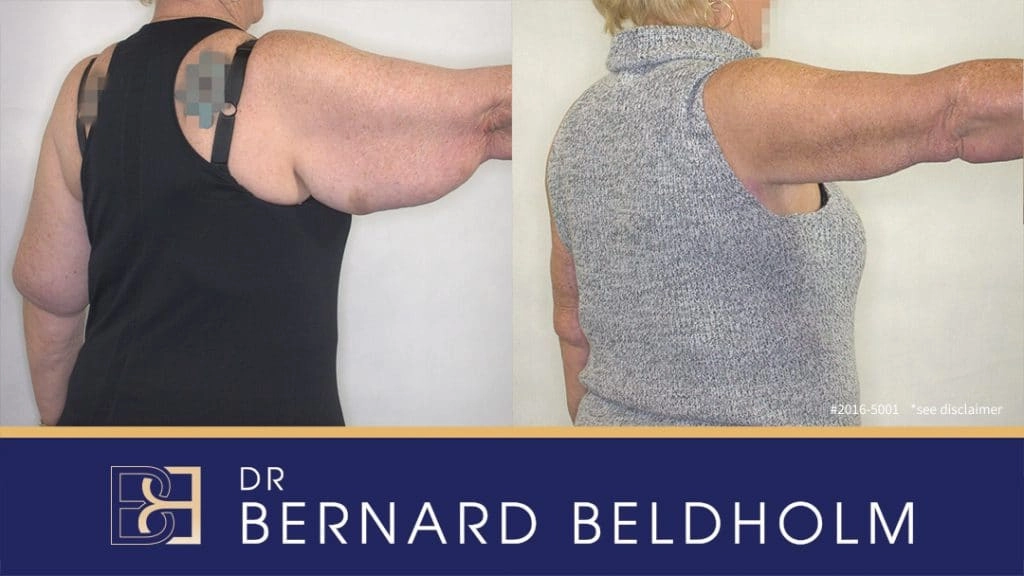
Disclaimer: Tattoo blurred on the upper back area. Not in the surgical area. Operation performed by Dr Bernard Beldholm. Adult content, surgery has risks; individual results vary, seek 2nd opinion. Please see the full disclaimer.
That pattern is the reason a standard arm lift (brachioplasty) is often not enough after major weight loss. The excess skin extends past the armpit, so the surgical incision needs to reach past it too. This is what makes the operation an extended brachioplasty (arm lift). An arm lift (brachioplasty) is a surgical procedure designed to remove excess skin, specifically excess upper arm skin.
This article walks through an extended brachioplasty (arm lift) on one of my patients who had lost 40kg. I have set it out step by step, from the markings before surgery through to closing the second arm, using photographs taken during the operation. The aim is to show what actually happens in theatre, so you can see what the procedure involves rather than read a general description of it.
A few things to keep in mind as you read:
- This is one patient’s operation. The skin pattern, the amount removed, and the surgical plan are worked out for each person individually. Results vary.
- Loose arm skin after weight loss is assessed at a consultation, and a GP referral is required before that consultation.
- This surgery carries risks, and a recovery period that should not be underestimated. I cover both later in this article.
Who an Extended Brachioplasty (Arm Lift) Suits After Weight Loss
Not everyone with excess arm skin is ready for surgery, and not everyone needs the extended version. Whether an extended brachioplasty (arm lift) is appropriate is something I work out with each patient at consultation.
Here is what I look at.
Stable weight
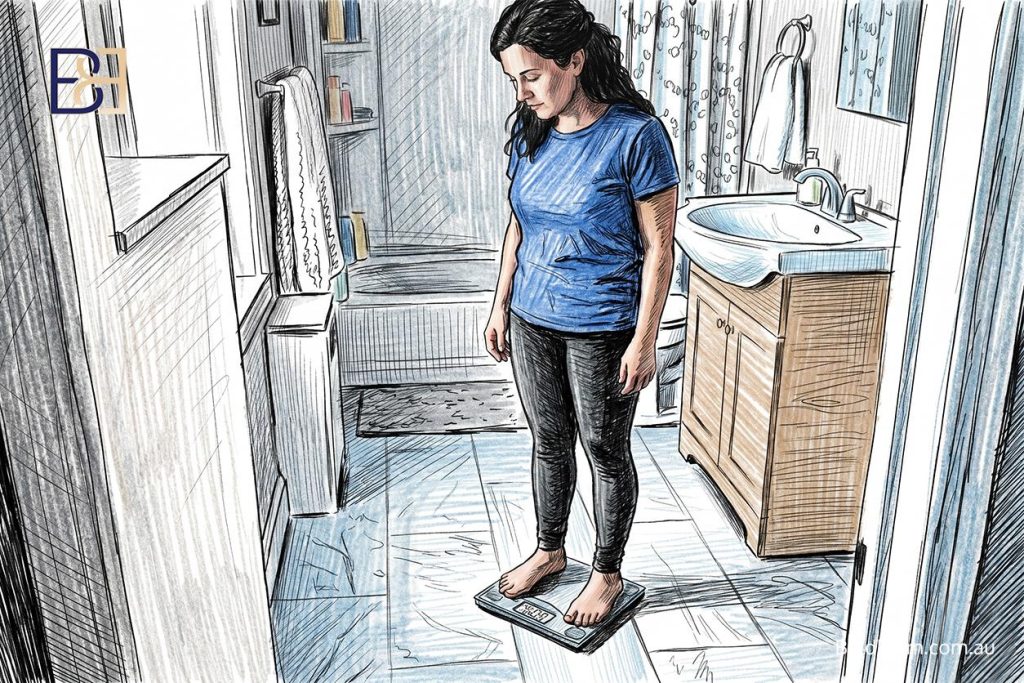
I look for a stable, healthy weight before operating, and a healthy lifestyle that supports recovery. Ongoing weight loss keeps changing the amount of loose skin, and operating in the middle of that can mean the result shifts later. If you are still losing, or still adjusting weight loss medications, it is usually better to wait until your weight has been steady for a few months.
The pattern and amount of loose skin
The extended part of the operation is for skin that reaches past the armpit and onto the side of the chest. If your skin laxity is mild and confined to the upper arm, a limited brachioplasty (mini arm lift) may be enough. If it carries on past the armpit, which is common after a large weight loss, the longer incision is what removes it. I assess this by hand at the consultation.
General health
A longer operation places more demand on the body than a short one. I review your medical history, any conditions you manage, your medications, and whether you smoke. Smoking in particular affects how an arm scar heals, and I will talk with you about stopping well before surgery.
Nutritional status

Most people who have lost weight through bariatric surgery or weight loss medications have some nutritional gaps, and these matter for wound healing. I check this with blood tests before surgery and correct what needs correcting. I go into this further down.
BMI as a rough guide, not a cut-off
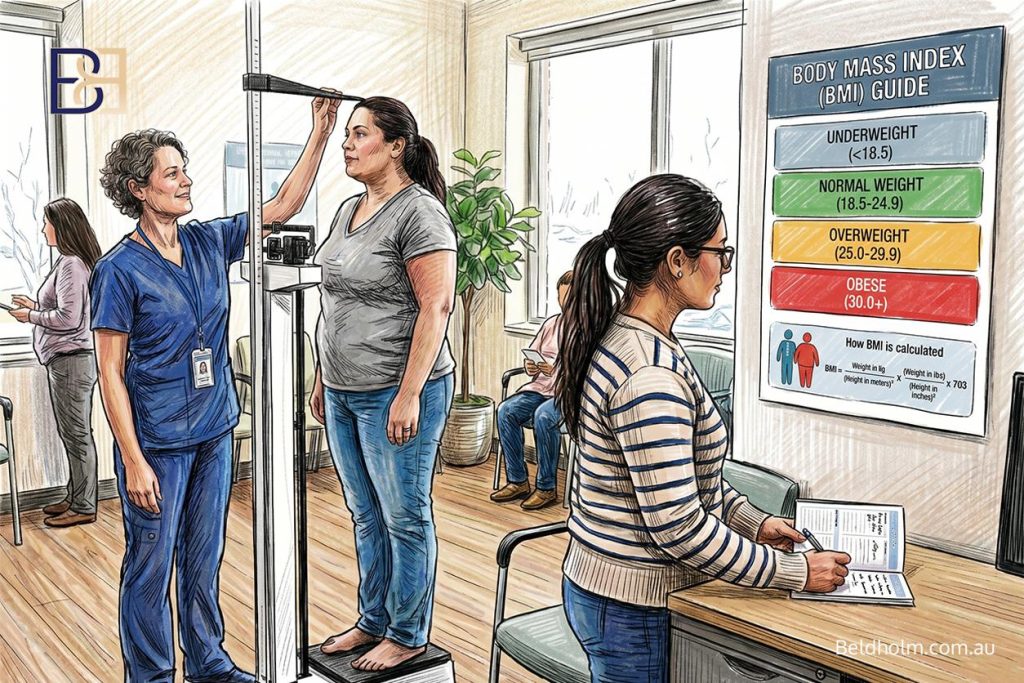
I use BMI as a rough guide only. It does not decide things on its own. Two people at the same BMI can carry very different amounts of loose arm skin. Clinical assessment at the consultation is what determines whether surgery is appropriate, not a single number. I do not use routine DEXA scans for this.
One thing to be clear about: an extended brachioplasty (arm lift) removes loose skin from the arm. It is not a weight loss procedure and it is not a substitute for one.
Why This Is an “Extended” Brachioplasty (Arm Lift)
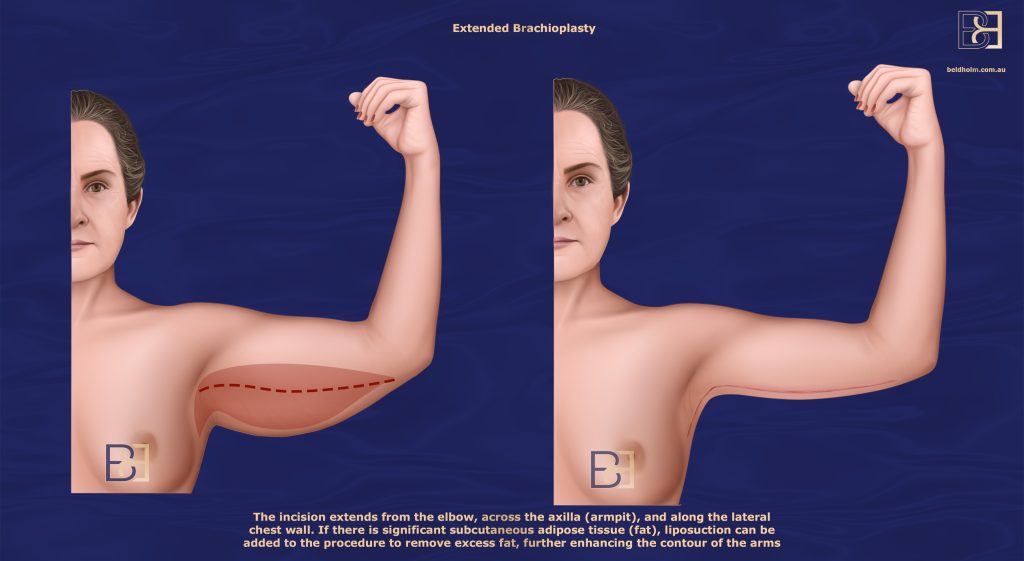
A standard arm lift (brachioplasty) deals with loose skin and the underlying supportive tissue in the upper arm area. It does not change underlying muscle tone. The scar runs along the inner arm, from near the elbow up towards the armpit. For a lot of people whose arm skin has loosened with ageing, that is all that is needed.
After a 40kg weight loss the picture is usually different.
The excess does not stop at the armpit
When someone has massive weight loss, the loose skin on the arm tends to continue past the armpit and onto the lateral chest wall. If the incision stopped at the armpit, that skin would be left behind, and it would often show as a fold at the end of the scar. To remove it, the incision has to continue past the armpit and along the chest wall. Extending the incision in this way is what the word “extended” refers to.
What that means for the scar
The trade-off is a longer scar. In an extended brachioplasty (arm lift) the scar follows that same long path, from the inner arm through the armpit and onto the chest. I plan the line so clothing can cover it, but it is a long scar and I make sure patients know that. I cover scars in more detail later.
Liposuction (suction assisted lipectomy) is usually part of it
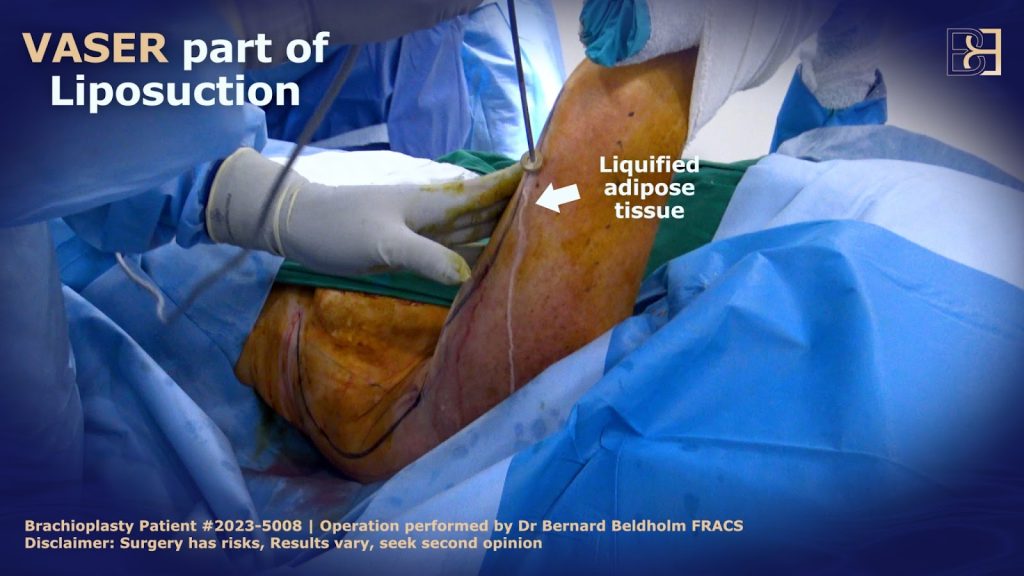
In this group of patients I almost always use liposuction (suction assisted lipectomy) as part of the operation. The aim is not fat removal, though some excess fat does come away as the tissue is loosened. It loosens and thins the underlying fatty tissue first, so I can lift the skin off without cutting as deeply, which means less trauma to the underlying tissues and less to recover from. Using liposuction (suction assisted lipectomy) alongside the skin excision has been linked to lower rates of some complications (1), and published research indicates it can be performed at the same time as the arm lift (brachioplasty) (2). I show that step in the walkthrough below.
Preparing for Surgery
An extended brachioplasty (arm lift) is a longer operation than a standard arm lift (brachioplasty), so the preparation matters. Most of it happens in the weeks before the day of surgery.
Nutrition and blood tests
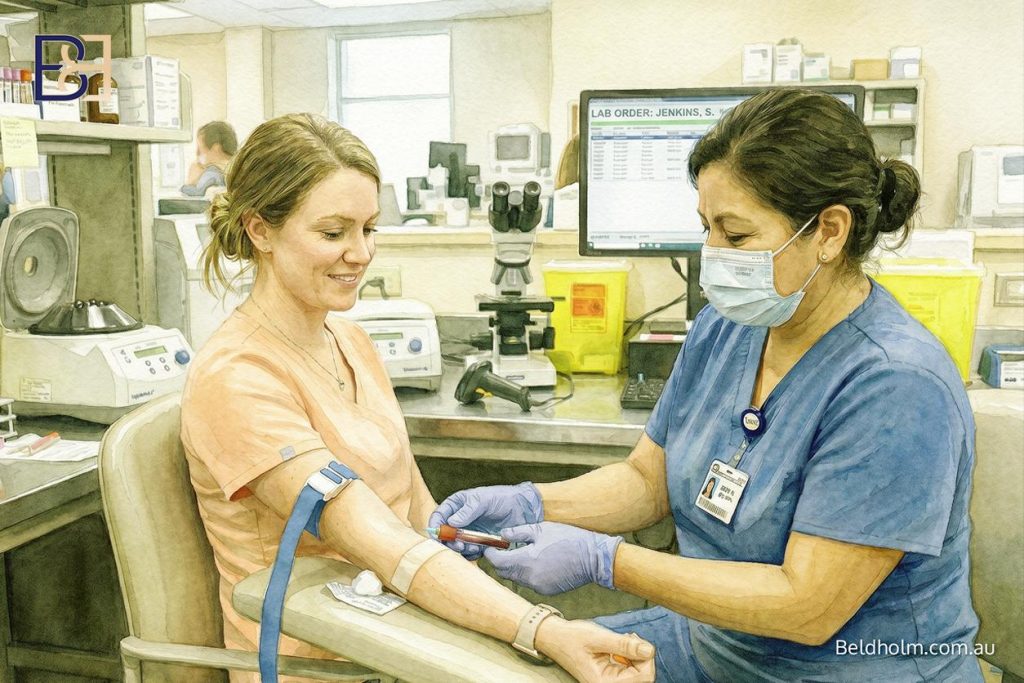
Most people who reach me after a large weight loss have nutritional gaps that built up while they were losing weight. Low iron, low protein stores, and low levels of certain vitamins are common, and all of them affect how a wound heals (3). Healing an arm scar that runs from the elbow to the chest wall depends on this more than people expect.
Before surgery I order a full pre-operative blood panel that covers what matters for body contouring patients, including iron studies, protein markers, and the vitamins most often low after weight loss. If something needs correcting, we sort it out before the operation rather than after. Your GP is kept in the loop on these results.
I do not repeat the detail of supplements and targets here. I have written separately about protein, iron, and the other nutrients that come up most often after weight loss, and those articles go through it properly.
Weight loss medications

If you are taking weight loss medications, do not stop or change them on your own before surgery. Current Australian guidance does not call for routinely stopping these before an operation, and I follow that. Occasionally I may discuss a temporary dose adjustment, for example if it is making it hard to reach your protein target before surgery, but that is a decision we make together as part of planning. It is not something to do by yourself.
Blood thinners and clot prevention
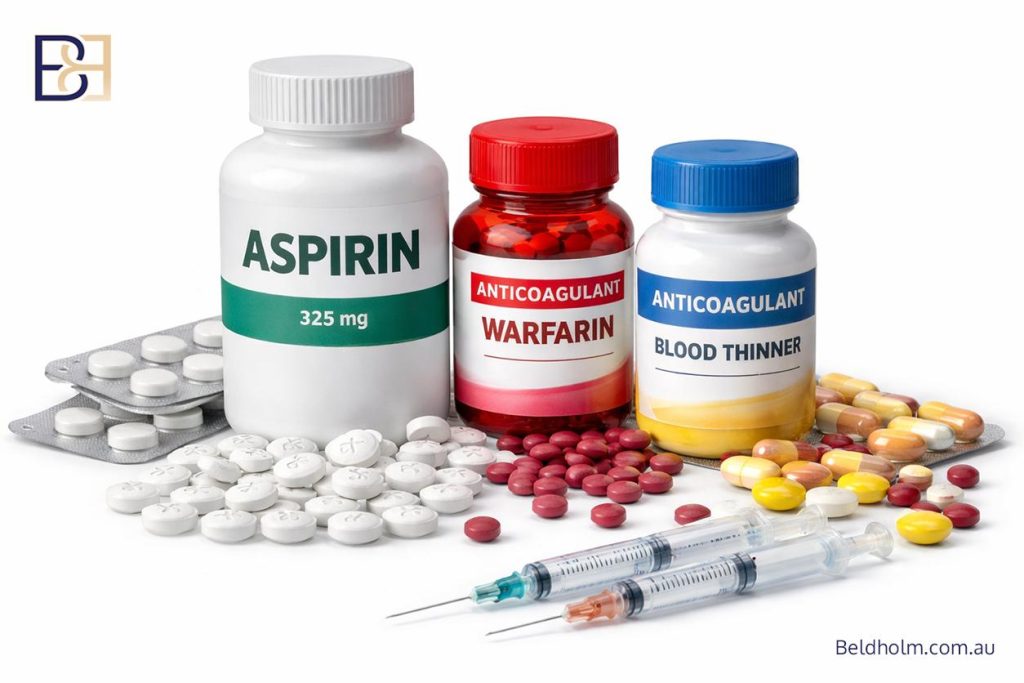
If you take aspirin or a blood thinner, we plan around it well ahead of time. Many are stopped about a week before surgery, though some patients need to stay on them through the operation. Either way, it is planned in advance. Do not stop a blood thinner on your own.
I am the one who assesses your risk of a blood clot (deep vein thrombosis) and decides what clot prevention you need around the operation (4). That is part of my planning, not something left to the anaesthetist or to the day. I have written about clot prevention in more detail separately.
The anaesthetic consultation

Book your appointment online now
Most patients have their anaesthetic consultation by phone before surgery. The physical check, including your airway, is done on the day of the operation. An in-person anaesthetic appointment beforehand is uncommon.
The Day of Surgery
Checking in
On the day, you arrive at the hospital and check in. A nurse takes your vitals and you change into a surgical gown. I come and see you before we start, to go over any last questions.
Markings
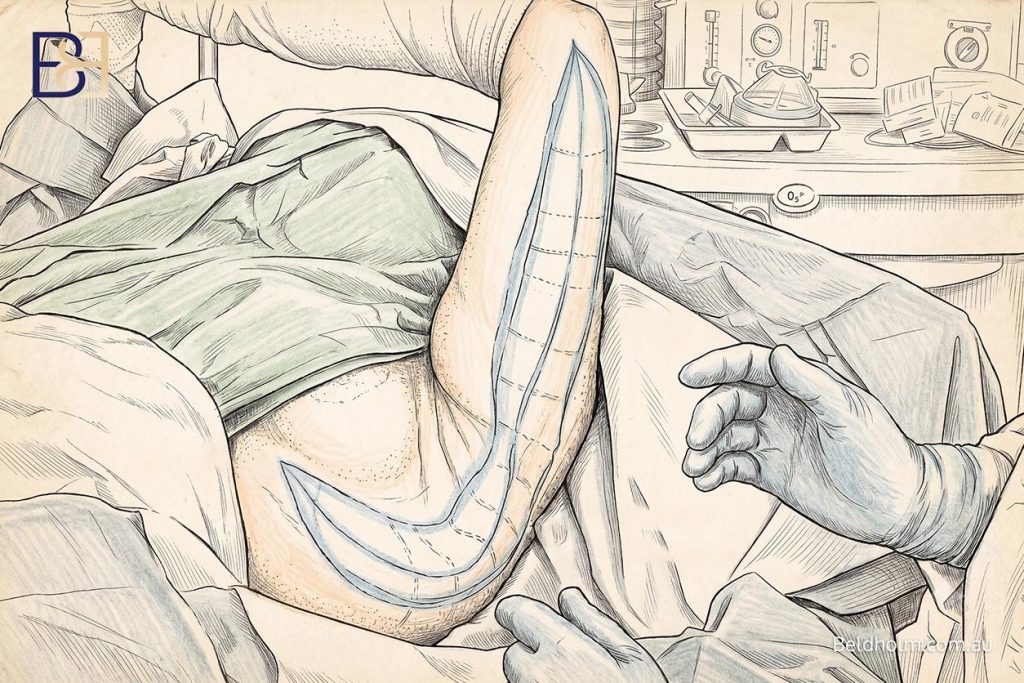
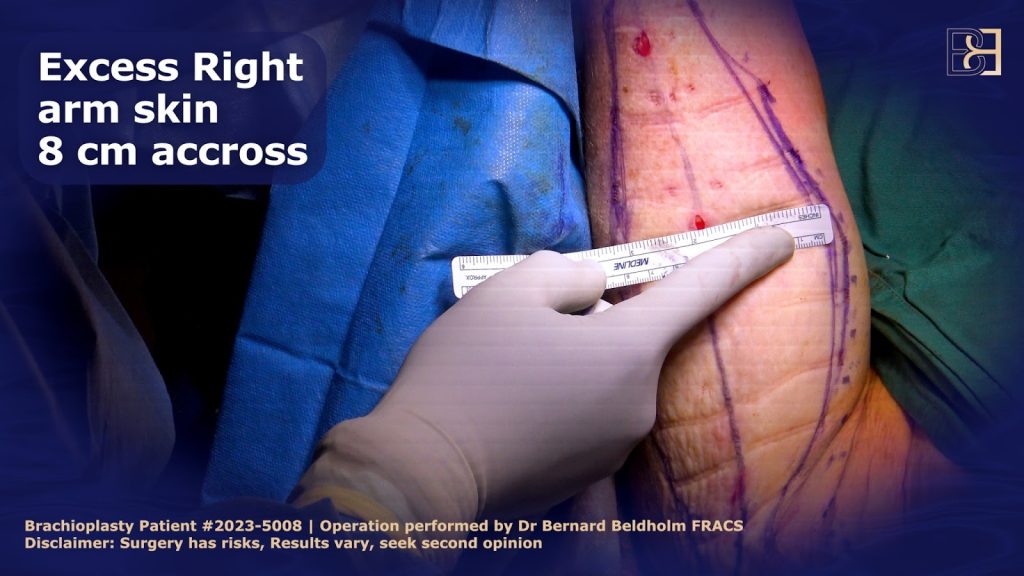
The skin markings are done while you are awake and standing up, before any anaesthetic. Standing matters here, because loose skin sits differently when you are upright than when you are lying down. I mark the line of the planned incision along the inner arm, through the armpit, and onto the side of the chest. These marks guide the operation once you are asleep.
Anaesthesia
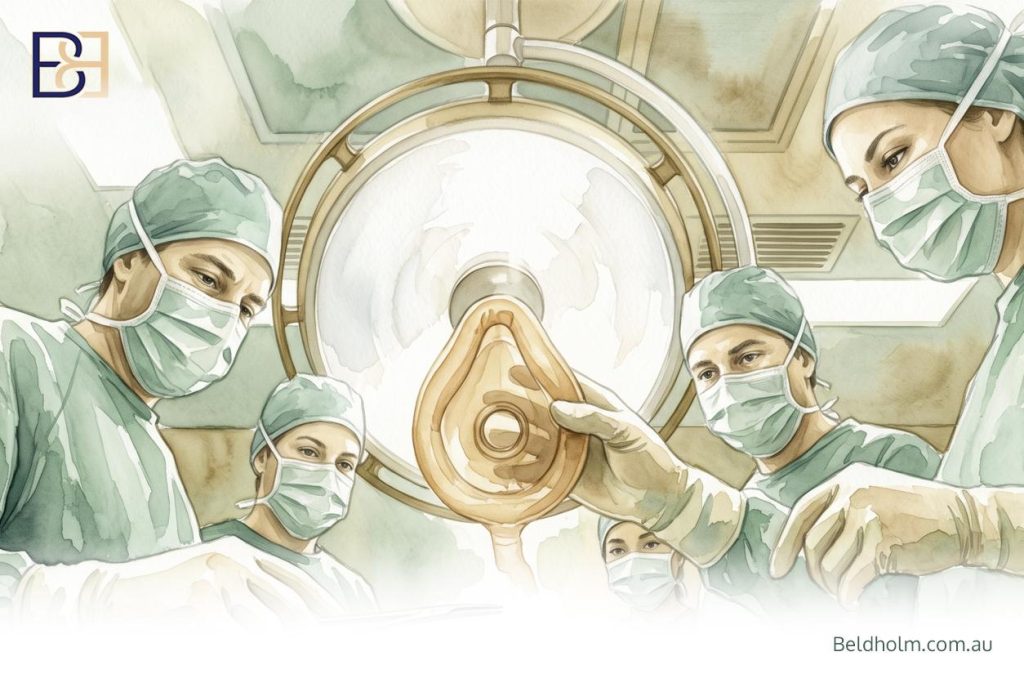
An extended brachioplasty (arm lift) is performed under general anaesthesia. Once you are on the operating table, the anaesthetist gives the anaesthetic through a drip, and you go to sleep. The anaesthetist stays with you for the whole operation, monitoring your breathing, heart rate, and blood pressure, and keeping you asleep and pain-free until the surgery is finished.
Inside the Operation
Here is how the surgical process runs, step by step, on this patient.
Positioning
I position patients for an arm lift (brachioplasty) in a particular way. A right-angle bar is fixed to the top of the operating table, and the arm is attached to that bar. This lets me reach the back of the arm and the side of the chest at the same time, which is where the work needs to happen in this operation. The arm is wrapped in sterile drapes so it can be moved freely during surgery, and each arm can be moved independently of the other. The arm and chest are cleaned with antiseptic before draping.
Liposuction (suction assisted lipectomy) first
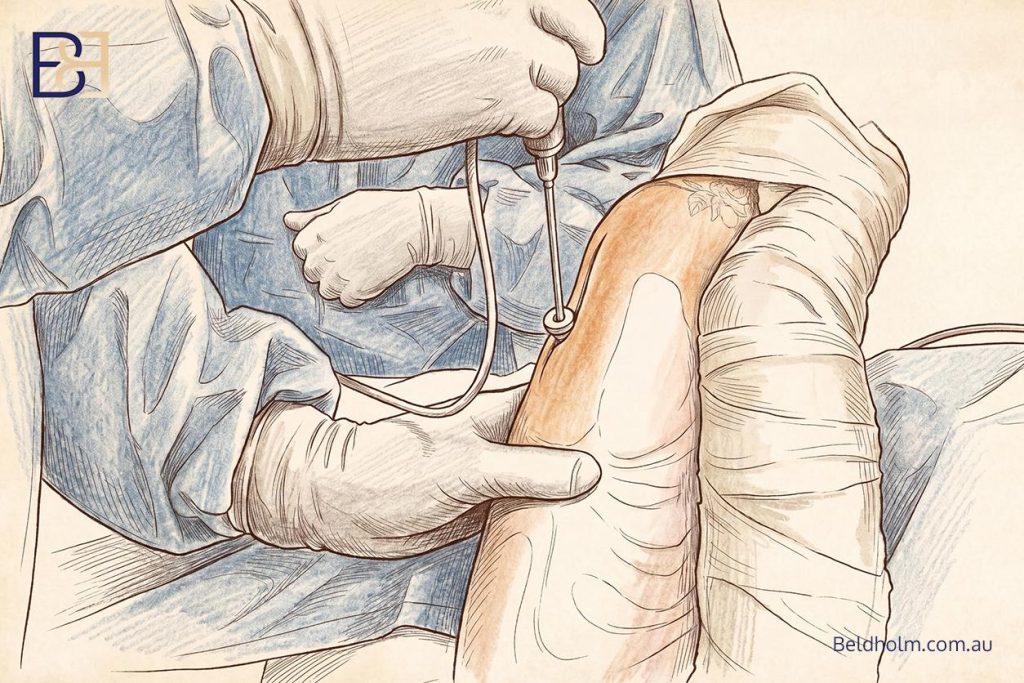
The procedure begins with liposuction (suction assisted lipectomy) along the marked area. As I said earlier, the point is to loosen the tissue, not to slim the arm. A fluid containing local anaesthetic is infiltrated first, then the suction loosens and thins the fatty tissue under the skin. This makes it easier to lift the skin away without cutting as deeply, and it tends to mean less bruising and less trauma to the small nerves and vessels in the area.
Confirming how much skin to remove
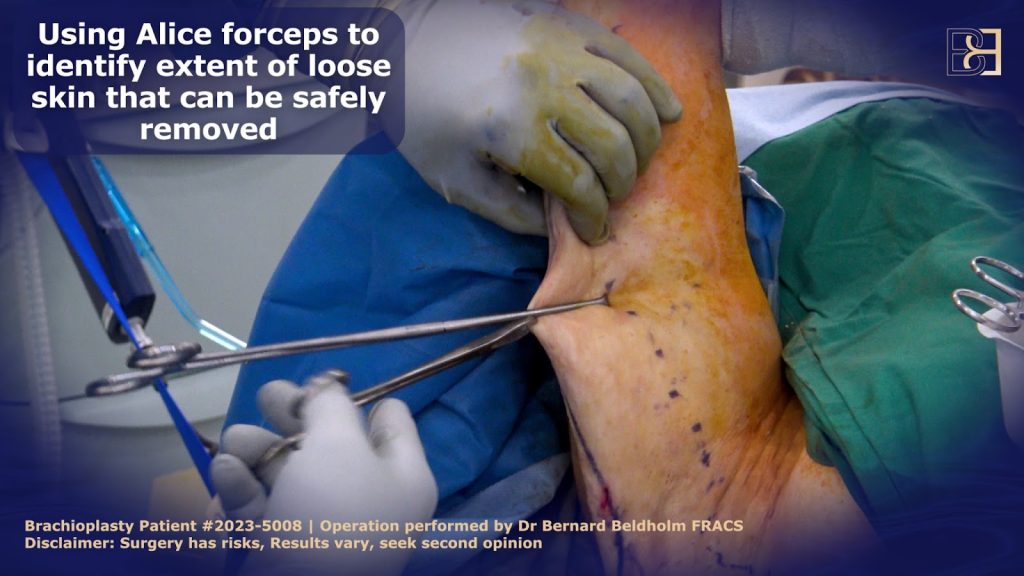
With the deeper layer loosened, I check the markings again and confirm how much excess tissue and skin can be taken. I pinch the skin together along the planned line to make sure the two edges will meet and close without pulling too tight. Taking too much is as much of a problem as taking too little, so this step is not rushed.
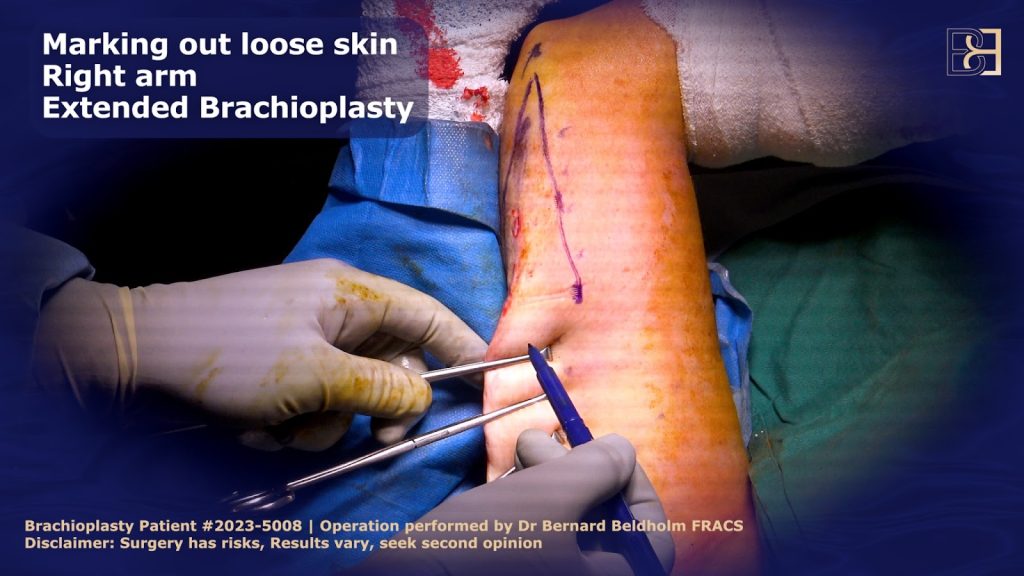
Removing the skin
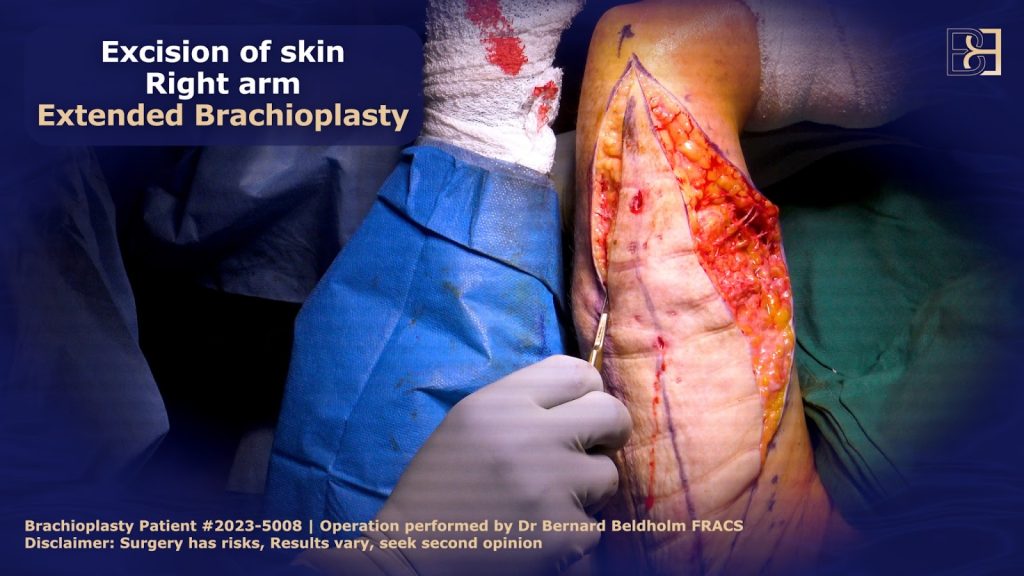
I then remove the marked strip of loose skin and the underlying fatty tissue, working from near the elbow, along the inner upper arm, through the armpit, and onto the lateral chest wall. This skin removal, together with the tissue removal beneath it, is the core of the operation, taking away the skin that was hanging and would not shrink back on its own.
Closing
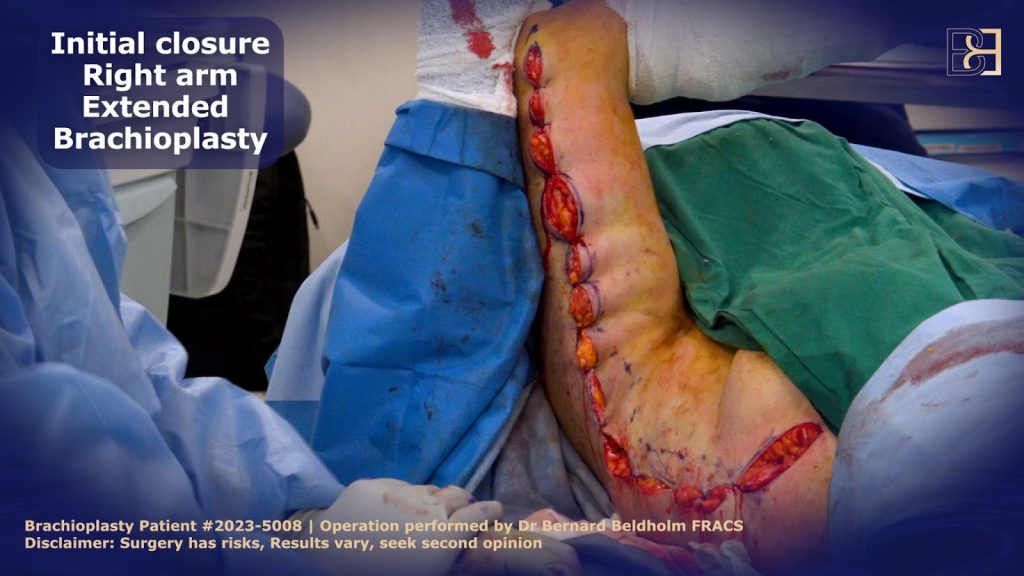
The wound is closed in layers. The deep layers are brought together with dissolving sutures that carry the tension, so the skin itself is not under strain as it heals. This matters for how the scar settles. The skin is then closed, and dressings and a compression garment go on.
The second arm
This is an operation done on both arms in the one sitting. Once the first arm is closed, the patient is repositioned and I repeat the same steps on the other arm: liposuction (suction assisted lipectomy), confirm the skin to remove, excise, and close.
How long it takes
This surgery is usually performed on both arms in one sitting. The brachioplasty (arm lift) surgery typically takes a few hours of operating time, and the exact time depends on how much work each arm needs.
Combining or Staging the Surgery
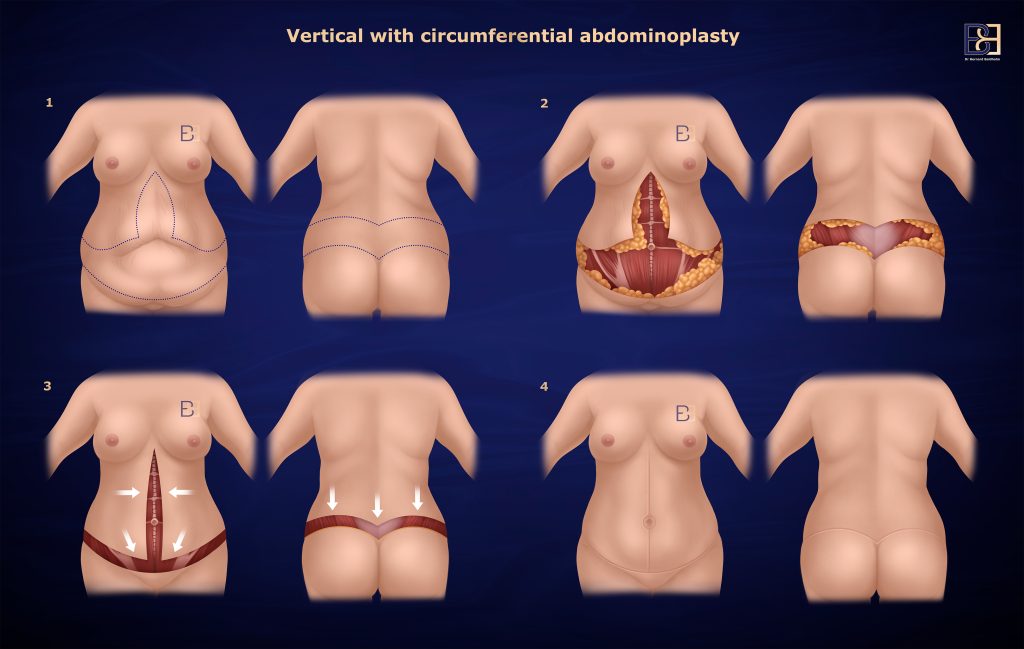
After significant weight loss, loose skin is often not limited to the arms, and some patients are considering other body contouring procedures such as a body lift (belt lipectomy). Some ask whether the arm lift (brachioplasty) can be done at the same time as other procedures, while others are better off having it on its own. Both can be reasonable. It depends on the person.
One operation versus several
Where a patient is suited to it, treating more than one area in a single operation can mean one anaesthetic and one recovery period rather than repeating those steps. For other patients, spreading the work across separate operations is the more appropriate path. This is assessed individually.
A larger combined operation is a bigger physiological event than an arm lift (brachioplasty) on its own. It places more demand on the body, takes longer under anaesthetic, and the recovery is more involved. Longer operating times have been associated with higher complication rates (5). That is the trade-off, and it is the reason preparation matters more when more is done in one sitting, not less.
How the decision is made
Whether to combine or stage is a clinical judgement I make with each patient at consultation. It depends on your medical history, your nutritional status, the pattern and extent of your loose skin, and what can be done well in one operating time. It is not decided in advance, and it is not settled on the basis of doing as much as possible in one go.
Staging is a legitimate choice, not a fallback. For some patients it is the more appropriate path, and I will say so if that is the case for you.
Recovery After an Extended Brachioplasty (Arm Lift)

Recovery from this brachioplasty (arm lift) procedure takes real time, and it helps to know what to expect before you commit to it. As with all surgical patients, the early weeks need care.
The first couple of weeks
Your upper arms will be swollen and bruised, and they will feel tight. Most people have pain in the first week that is managed with medication and settles over the days that follow. You will have dressings on the incisions. For arm lifts (brachioplasty) I use a Comfeel dressing rather than a negative pressure dressing. The negative pressure dressings did not perform well on arms, blistered at the edges, and made the compression garment hard to get on and off.
We keep a close eye on you early. There are several visits in the first two weeks, to my nurse and to me, to check the wounds and how you are healing.
Compression garments
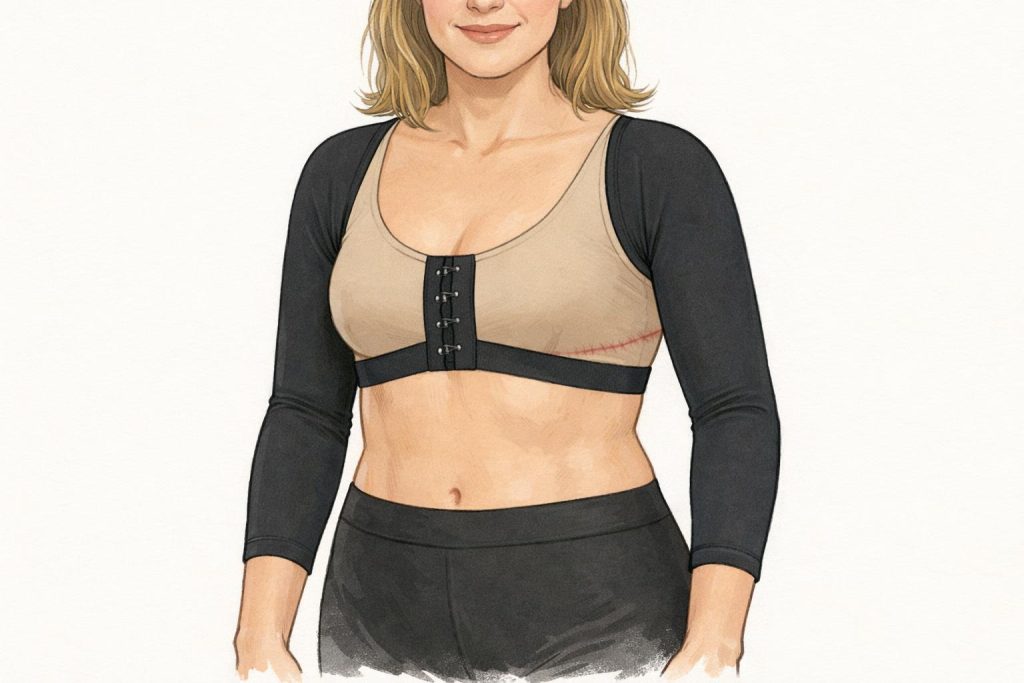
You are measured for a compression garment and the practice orders it for you. A compression sleeve helps minimise swelling and supports the arm while it heals. It can also cause some skin irritation, which we help you manage. The usual pattern is full-time wear for about four weeks, then part-time for a further two weeks. I give you the specifics for your situation.
Swelling and fluid
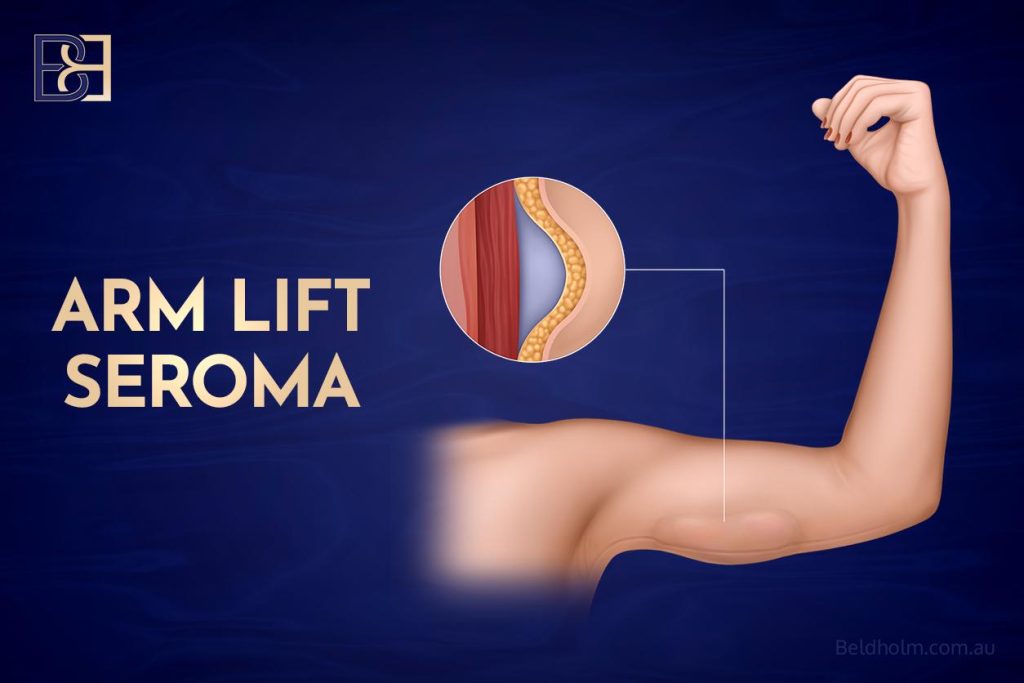
Swelling is expected and settles gradually over weeks to months. Fluid can sometimes collect under the skin, called a seroma, and if it does we manage it in the rooms. Small drains are sometimes used to reduce this.
Moving and lifting
I want you up and moving early, which helps lower the risk of a blood clot. What I ask you to hold off on is heavy lifting and strenuous use of the arms. A 10kg lifting limit applies for several weeks while the deep repair settles. Pushing this too early puts strain on the wound.
Getting back to normal
- Desk or sedentary work: most people are back at around four weeks.
- Manual or physical work: usually six to eight weeks, sometimes longer depending on how much the job uses your arms.
- Exercise: lower body activity can usually start earlier than upper body. I guide you on when you can return to strenuous exercise and load the arms again.
Follow-up
Your follow up appointments are at set points after surgery: the close reviews in the first fortnight, then again at four weeks, three months, six months, and twelve months. At the four-week visit I hand your ongoing care back to your GP.
After hours
During clinic hours, call the rooms. After hours, call Maitland Private Hospital, where a nurse will triage your call by phone. Severe pain, a fever, or a wound that opens are reasons to call. If something needs to be physically assessed after hours, that means going to your local emergency department, as Maitland Private is not an emergency department. For anything life-threatening, call 000.
Scars
An extended brachioplasty (arm lift) leaves a long scar, and the scar is permanent. The trade-off for removing the hanging skin is a line that runs from near the elbow, along the inner arm, through the armpit, and onto the side of the chest.
Where the scar sits
Scar placement matters. I plan the line so it sits along the inner arm, where it is less visible from the front and can be covered by clothing. The exact final position can shift a little as the tissues settle over the months after surgery.
How scars mature
A new scar looks its worst in the early months. It is usually raised, firm, and pink or red to begin with. Over the following twelve to eighteen months, it gradually flattens, softens, and fades to a paler line. This takes time, and the timeline varies from person to person.
Scar appearance varies. How a scar turns out depends on things I can influence and things I cannot. Surgical technique and taking tension off the wound help. Your own healing, your skin quality and type, and whether you smoke also play a part. Some people are prone to thicker or raised scars regardless of how the surgery is done. Hypertrophic scarring is among the most commonly reported issues after this operation (1).
What can help
- Keeping the wound clean and protected early, as we direct.
- Sun protection on the scar once it has healed, since UV can darken a new scar.
- Compression, which supports healing.
- Scar management such as silicone once the wound has healed, if I recommend it.
We also offer LED light therapy at the clinic, which can be used as part of post-operative care. Whether it has a role for you is something I discuss at your reviews.
If a scar heals thicker or wider than hoped, there are options to revise it later, once it has fully matured. I cover scar revision separately.
Risks and Complications
Every arm lift (brachioplasty) surgery carries risks, and a longer operation like this one carries more than a small procedure. I go through these with you in detail at consultation. Here are the possible complications and potential risks to be aware of (1).
General surgical risks
- Excessive bleeding and collection of blood under the skin (haematoma).
- Infection, which may need antibiotics or, less often, a return to theatre.
- Fluid collection under the skin (seroma).
- Risks related to the general anaesthetic.
- Blood clots in the legs (deep vein thrombosis) that can travel to the lungs. The risk is lower for arm surgery than for surgery on the trunk, but it is not zero, and it rises with longer or combined operations (5). This is why I assess your clot risk and plan prevention.
Risks more specific to arm surgery
- Wound healing problems. The incision is long and passes through the armpit, an area that moves and sweats, so wound breakdown and delayed healing are more common here than in many other operations.
- Numbness or altered sensation along the inner arm and forearm. Small sensory nerves run through the operative area and can be stretched or injured (6). This is usually temporary but can be permanent (1).
- Swelling of the arm or hand. The operation works near the lymphatic channels around the armpit, and this can cause ongoing swelling in some patients.
- Scars that heal thick, raised, or wider than hoped. The scar is long and permanent.
- Asymmetry between the two arms, since each arm is assessed and treated on its own.
- Residual skin or a fold at the end of the incision that may need revision.
Revision
Some patients need further surgery to settle a scar, a fold of residual skin, or asymmetry. Revision is not unusual after this operation (2), and it is part of weighing it up.
I cover the risks of arm surgery, including nerve injury and the rarer complications, in more detail in separate articles. The balance of benefit and risk is something we work through together before you decide.
References
- Aljerian A, Abi-Rafeh J, Ramirez-GarciaLuna J, Hemmerling T, Gilardino MS. Complications in brachioplasty: a systematic review and meta-analysis. Plast Reconstr Surg. 2022;149(1):83-95.
- Zomerlei TA, Neaman KC, Armstrong SD, Aitken ME, Cullen WT, Ford RD, et al. Brachioplasty outcomes: a review of a multipractice cohort. Plast Reconstr Surg. 2013;131(4):883-889.
- Agha-Mohammadi S, Hurwitz DJ. Nutritional deficiency of post-bariatric surgery body contouring patients: what every plastic surgeon should know. Plast Reconstr Surg. 2008;122(2):604-613.
- Hatef DA, Kenkel JM, Nguyen MQ, Farkas JP, Abtahi F, Rohrich RJ, et al. Thromboembolic risk assessment and the efficacy of enoxaparin prophylaxis in excisional body contouring surgery. Plast Reconstr Surg. 2008;122(1):269-279.
- Gusenoff JA, Coon D, Rubin JP. Brachioplasty and concomitant procedures after massive weight loss: a statistical analysis from a prospective registry. Plast Reconstr Surg. 2008;122(2):595-603.
- Knoetgen J 3rd, Moran SL. Long-term outcomes and complications associated with brachioplasty: a retrospective review and cadaveric study. Plast Reconstr Surg. 2006;117(7):2219-2223.