Reference summary
Calcium is a Tier 2 supplement in my pre-operative protocol. That means I do not start every patient on it at the first consultation. I check blood results first, then decide.
This is a deliberate position. It differs from a lot of general post-bariatric advice that tells patients to start the supplement from day one.
If a supplement is indicated, my usual regimen is calcium citrate 1200 to 1500 mg of elemental calcium per day. I split this into 2 or 3 doses, taken with meals.

Calcium citrate is preferred over calcium carbonate for this patient group because it absorbs without gastric acid. Post-bariatric patients often have reduced stomach acid. Many are also on proton pump inhibitors or H2 blockers, both of which block carbonate absorption.
Australian brands I discuss with patients include Citracal (calcium citrate), Caltrate Plus, and Swisse Calcium + Vitamin D. All are available at Chemist Warehouse, Pharmacy Direct, Priceline, or Amazon AU. Any product providing citrate at the target dose is acceptable.
Calcium is always paired with vitamin D3 (3000 to 6000 IU per day) and vitamin K2 MK-7 (100 micrograms per day). Both of these are Tier 1 in my protocol, meaning they are started at the first consultation for every post-weight-loss patient, regardless of blood results.
The reason for pairing is simple. Calcium without vitamin D is not effectively absorbed. Calcium without vitamin K2 risks depositing in the wrong places.
A few practical rules:
- Calcium should not be taken within 2 hours of iron supplements.
- The maximum single elemental dose is 500 mg. The gut saturates above that level.
- long-term monitoring is managed by the GP, not by me. My responsibility is pre-operative optimisation.
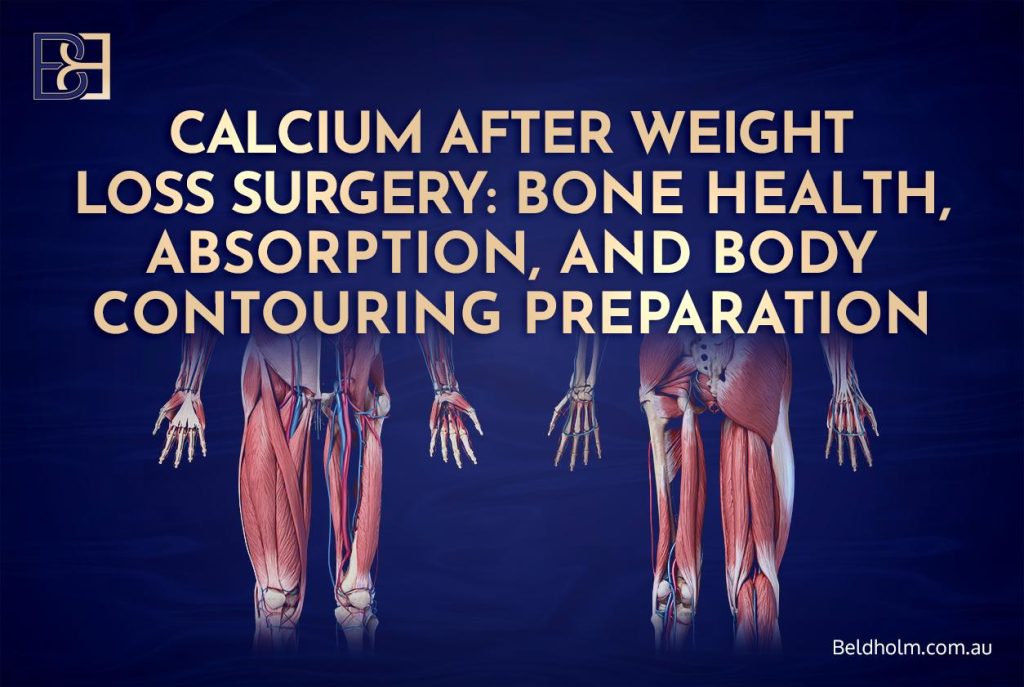
Table of Contents
Why I’m writing this article
Most of my post weight loss patients have been told about protein before they see me. Many have also been told something about vitamin D.
It, by contrast, is rarely discussed with any depth before the body contouring consultation. When it does come up, the advice is often wrong, outdated, or based on a general population that has not undergone weight-loss surgery.
That gap matters. Deficiency after bariatric surgery is slow, silent, and often not identified until bone loss is well established.
Patients can have a normal blood level and significant bone density loss at the same time. The blood test looks reassuring. The skeleton is quietly depleting.
I see this pattern often.
A patient arrives for a body-contouring consultation 5 or more years after their bariatric surgery. They feel well. They have never had their parathyroid hormone or vitamin D checked.
When I run a full pre-operative blood panel, the results tell a different story. Vitamin D is low. Levels are sometimes borderline, sometimes normal with a rising PTH. The absorption machinery has been quietly failing for years. The amount of weight lost is part of the picture: patients with significant weight loss have often gone through years of altered nutrition before they ever reach the body contouring consultation.
What this article covers
This article is designed to help patients who are considering post weight loss body contouring surgery understand three things:
- Why calcium matters specifically in this population, and not just in general terms.
- How calcium actually works in the body. The physiology tells you why so much of the standard advice is wrong for someone who has had bariatric surgery.
- How I approach calcium in my own patients. When I start it, what form I use, how I dose it, and what I hand over to the GP for long-term management.
A note on scope

This article covers the topic across all the post-weight-loss body contouring procedures I perform. That includes:
- Abdominoplasty (tummy tuck), including circumferential hybrid abdominoplasty and dual vector abdominoplasty
- Body lift (belt lipectomy)
- Thighplasty (thigh lift)
- Brachioplasty
- Mastopexy
The approach is uniform across all of them. Procedure-specific detail on incisions, recovery, and operative planning lives in the dedicated articles for each procedure.
Results from body contouring surgery vary between patients. Surgery carries risks. Nothing in this article should be taken as a substitute for an individual consultation, and nutritional decisions must always be made in the clinical context of the whole patient.
How calcium actually works in the body
Most people think of it as a bone mineral and leave it there. That is accurate but incomplete.
The incomplete part is where a lot of the clinical problems live. Understanding how this mineral moves through the body is essential for understanding two things: why deficiency is so easy to miss, and why the form of the supplement matters more for my patients than for the general population.
The skeleton is the bank, not just the building
98% of Calcium is stored in your skeleton.
Bones are not static scaffolding. They are a dynamic reservoir. The body constantly draws from and deposits into that reservoir, minute by minute, to keep circulating levels within a very narrow range.
That constant turnover is the key clinical point.
Bone is being broken down and rebuilt every day of your life. When dietary intake is adequate and absorption is working, deposition roughly balances withdrawal, and the skeleton is preserved.
When intake is low or absorption fails, withdrawal outpaces deposition. Bone quietly depletes. This is not a slow process you notice day to day. It is a silent ledger entry.
The range matters because the other 2% of circulating in the blood and inside cells runs some of the most critical processes in the body. The body will sacrifice skeletal stores indefinitely to keep that 2% stable.
What the circulating 2% actually does
It is a signalling ion. It is one of the most versatile messengers in human physiology.
A short list of what depends on it:
- Nerve conduction. Calcium helps maintain the electrical potential across nerve cell membranes and triggers neurotransmitter release at synapses. When a nerve fires, it moves.
- Muscle contraction. Every heartbeat, every skeletal muscle movement, and every smooth muscle contraction in the gut and blood vessels depends on it moving in and out of cells. This includes the diaphragm and the heart.
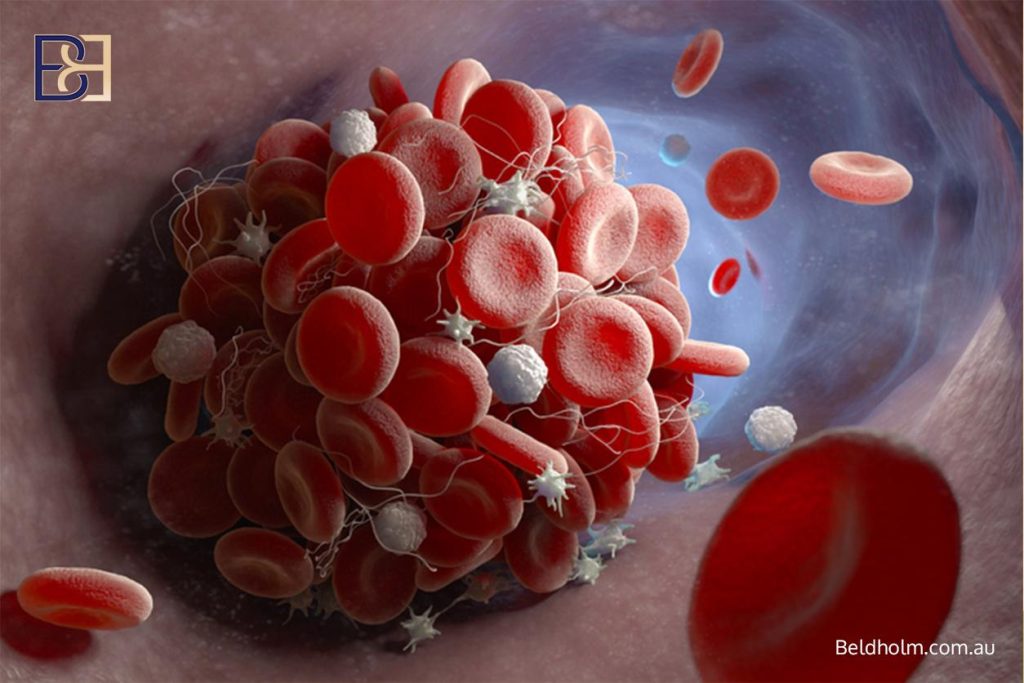
- Blood clotting. It is a required cofactor in multiple steps of the coagulation cascade. This is directly relevant to surgical planning. Patients with adequate levels clot normally. Patients with a low level clot poorly.
- Hormone and enzyme signalling. It acts as a second messenger inside cells, switching enzymes on and off in response to hormonal signals.
- Cell division and fertilisation. Sudden spikes are involved in both.
All of these processes are essential and intolerant of variation. The body prioritises keeping circulating levels stable above almost everything else, including bone preservation.
The three-hormone regulatory loop,
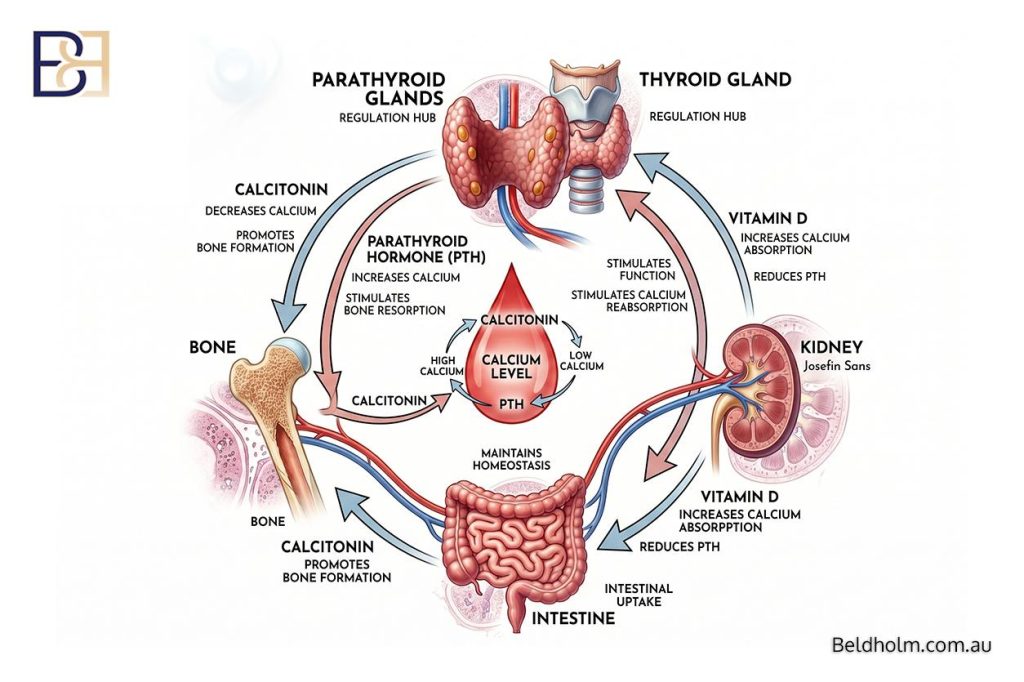
circulating levels is controlled by three hormones working together.
Parathyroid hormone (PTH) rises when circulating levels fall. PTH pulls the mineral out of bone, increases reabsorption in the kidney, and activates vitamin D to boost gut absorption.
It is the body’s first response to any drop in circulating levels.
Vitamin D (specifically calcitriol, the active form) drives active calcium absorption from the small intestine, mostly in the duodenum.
Without adequate vitamin D, absorption drops dramatically, regardless of how much is in the diet. This is why vitamin D deficiency and low levels often go together.
Calcitonin opposes PTH and helps deposit it back into bone. It is the counterweight in the system.
The loop matters because it explains what I see on blood results.
A patient with chronically low intake or poor absorption will often have a normal serum level on paper but a rising PTH. The PTH is the early warning signal. It tells me the body is compensating by drawing down the skeletal reservoir.
Why circulating levels stays normal while bone depletes

This is the single most important point in this article.
The body does not tolerate a drop in serum level. If dietary intake is inadequate, or if absorption fails, it will not let the level drop.
It will pull from bone indefinitely to maintain circulating levels. Serum levels stay normal. Bone density falls.
A basic blood test, taken in isolation, will look completely reassuring for years while significant bone loss is occurring underneath.
This is why “the test is normal” is not the same as “the bone status is fine”. It is one of the reasons standard primary care testing frequently misses this problem until a fracture or clinical deficiency finally breaks through.
How I actually assess calcium status
I do not rely on total level alone. The pattern that tells me what is actually happening combines several results:
- total level, measured directly.
- Albumin, because low albumin (common after bariatric surgery) artificially lowers the total level. I calculate an adjusted value using the formula: adjusted = measured + 0.02 × (40 minus albumin in g/L).
- ionised level, which reflects the biologically active fraction and is not affected by albumin.
- 25-hydroxyvitamin D, which indicates whether the absorption machinery has what it needs to function.
- Parathyroid hormone, where indicated. A rising PTH with a normal level is the red flag that the compensation is in progress.
- Phosphate is part of the bone mineral picture.
A single reassuring total level result in a post-bariatric patient is not enough information. It takes a detailed panel and some clinical interpretation to see what is really happening.
Absorption is where things fail first
It is absorbed from the small intestine by two mechanisms.
Active, vitamin D-dependent absorption happens mostly in the duodenum and upper jejunum. This is the efficient, regulated pathway.
The duodenum expresses the highest concentration of vitamin D receptors and active transport proteins. When higher demand develops, this pathway is upregulated.
Passive diffusion can happen throughout the small intestine, but only when the concentration in the gut is high enough to drive movement across the intestinal wall.
Passive absorption is less efficient and less regulated.
Two things happen after weight-loss surgery that directly affect this machinery.
After gastric bypass
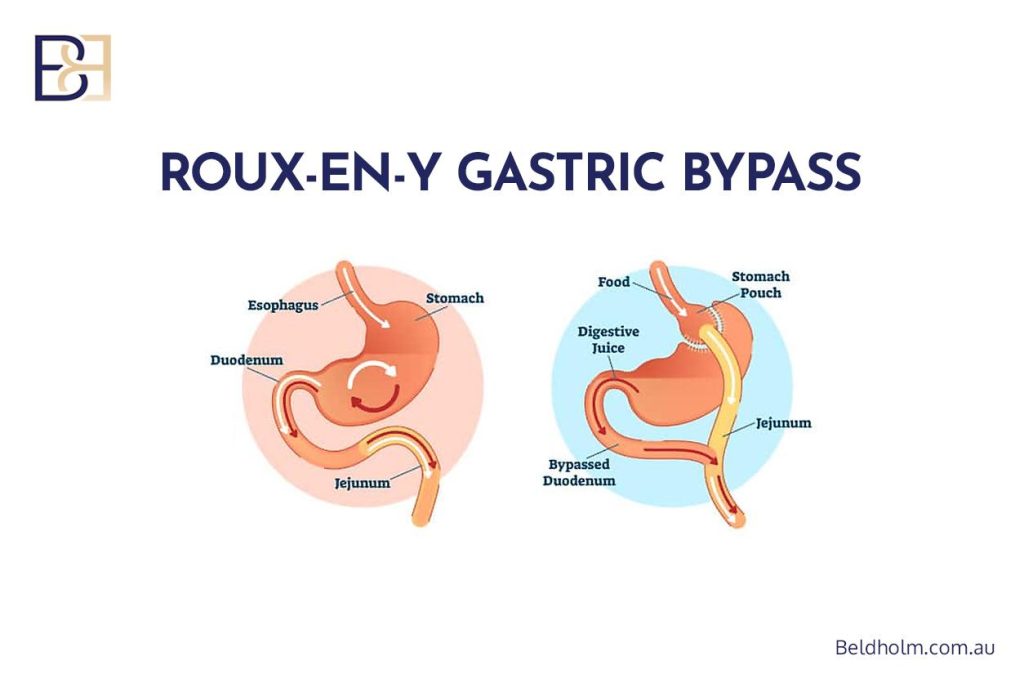
The duodenum is anatomically bypassed. The most efficient absorption site is no longer connected to the path food takes.
Intake still has to be absorbed, but it relies on passive diffusion further down the intestine. This is less efficient and less responsive to the body’s signals.
After sleeve gastrectomy
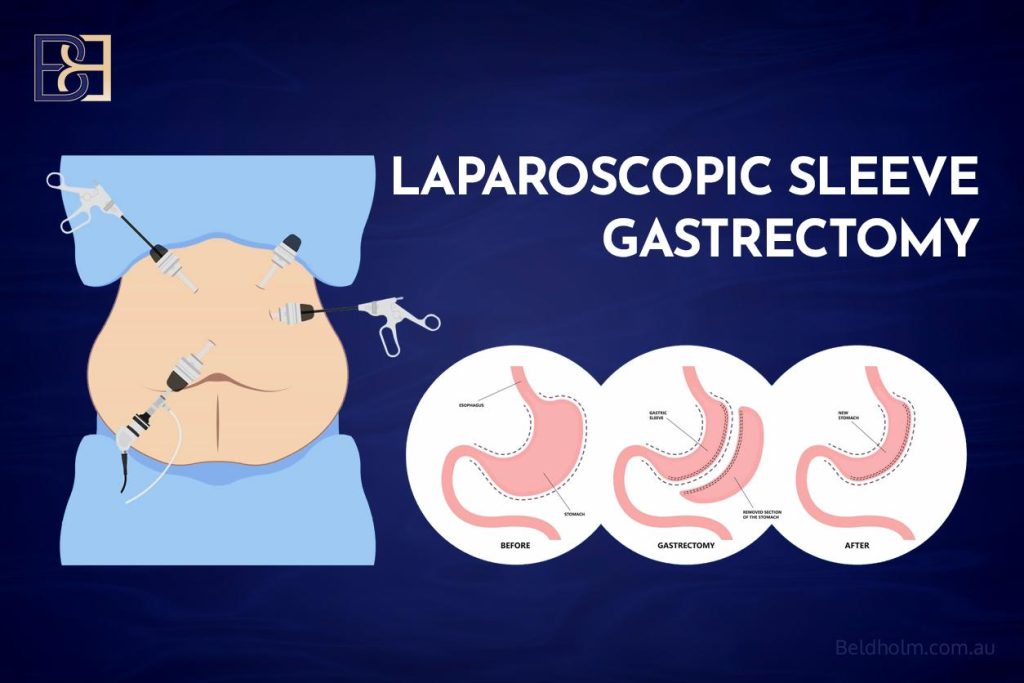
The anatomy of the small intestine is preserved, but gastric acid production is reduced.
Calcium carbonate requires an acidic stomach environment to dissolve and become available for absorption. In a patient with reduced stomach acid, carbonate passes through largely undissolved. Calcium citrate, which does not require gastric acid, remains absorbable.
What this adds up to
Both surgical effects compound with other factors common in this patient group:
- Low dietary intake
- Dairy intolerance after surgery
- Weight-loss medications that further suppress appetite
- Routine use of proton pump inhibitors or H2 blockers for reflux
All of these push in the same direction. Less reaches the bloodstream. More is pulled from the bone to compensate.
This is why absorption fails long before intake does. It is also why the physiology matters more for my patients than for the general population.
It is the foundation of everything that follows in this article: the choice between citrate and carbonate, the dosing strategy, the drug interactions, and the long-term plan with the GP.
Why weight loss surgery creates a long-term calcium problem
The previous section covered the physiology in the general sense: how it is absorbed, regulated, and stored.
This section covers what changes for the patient who has experienced significant weight loss. It is about why my approach is different from standard population nutrition advice.
There are four distinct pressures on status after bariatric surgery. Each one on its own is manageable. The problem is that they all occur together, and they compound over the years.
Pressure 1: dietary intake drops and often stays low
The first issue is how much comes in through the diet.
After bariatric surgery, portion sizes are smaller by design. Patients often eat one-third to one-half of what they ate before. For someone with significant weight loss behind them, this can mean years of reduced calcium intake before the body contouring consultation even happens.
That reduction alone substantially cuts daily calcium intake. Most dietary sources come from a few foods eaten in meaningful quantities: dairy products, fortified cereals, certain leafy greens, and fish with bones.
Dairy tolerance often changes

Some patients who were fine with milk and yoghurt before surgery find that dairy triggers nausea, dumping symptoms, or reflux afterwards.
Yoghurt and hard cheese tend to be better tolerated than milk. Many patients avoid dairy altogether.
Plant-based milks vary widely in content. Some are well fortified. Some are not. Patients rarely read the labels closely enough to know which is which.
Weight-loss medications add another pressure

Patients on GLP-1 medications experience an additional reduction in food intake beyond any surgical changes.
Published data on GLP-1 patients show consistent reductions in total energy intake and in intake of specific nutrients, including calcium, iron, and vitamin C.(7)
In my practice, I see patients who have been on these medications for one to three years and whose overall nutritional status is clearly worse than their weight alone would suggest.
The result
Many post-weight-loss patients take 400 to 600 mg per day, sometimes less.
The recommended intake is 1000 to 1200 mg.
Pressure 2: absorption is reduced by the surgery itself
The physiological mechanisms were covered in the previous section. The practical consequences for the two most common procedures are straightforward.
After Roux-en-Y
The duodenum is anatomically bypassed. This is the site of active, vitamin D-mediated absorption.
What remains is passive absorption further down the small intestine. This is less efficient and requires higher concentrations to work.
After sleeve gastrectomy
The duodenum is still in the food path, but gastric acid production drops.
Calcium carbonate, the most common and cheapest supplement form, requires stomach acid to dissolve. In a patient with reduced gastric acid, carbonate often passes through largely unabsorbed.
Calcium citrate does not depend on stomach acid. It remains a reliable option.
Why this matters clinically
The standard recommendation for the general population is 1000 mg per day, often as carbonate with food. That advice does not translate directly to the post-bariatric patient.
The same dose delivers substantially less when absorbed in someone who has had weight-loss surgery.
The research on this is reasonably well-established. Bone turnover increases and bone mass decreases within 3 to 9 months after gastric bypass, even when patients appear to be taking adequate supplementation on paper.(1)
Pressure 3: Gastric acid suppression medications are common
Many of my patients are on a proton pump inhibitor such as omeprazole, esomeprazole, or pantoprazole.
These medications are prescribed for reflux, which is common both before and after bariatric surgery, particularly after sleeve gastrectomy.
Why PPIs affect calcium

Proton pump inhibitors work by suppressing gastric acid production. That has two relevant effects on calcium:
- Carbonate absorption drops because there is no acid to dissolve the tablet.
- Long-term acid suppression is itself independently associated with reduced bone mineral density and an increased risk of fracture in published research.
H2 blockers such as famotidine and ranitidine have a similar but less profound effect.

The practical rule
If a patient is on any form of acid suppression medication, I will not use carbonate. Citrate is the only reliable option.
Pressure 4: Rapid weight loss changes mechanical loading on the skeleton
This pressure is often overlooked.
Bone responds to the load placed on it. This is a well-understood principle in orthopaedics and bone physiology. Bones under load are stimulated to remodel and maintain density. Bones under reduced load lose density.
What happens when a patient loses 30 to 70 kilograms
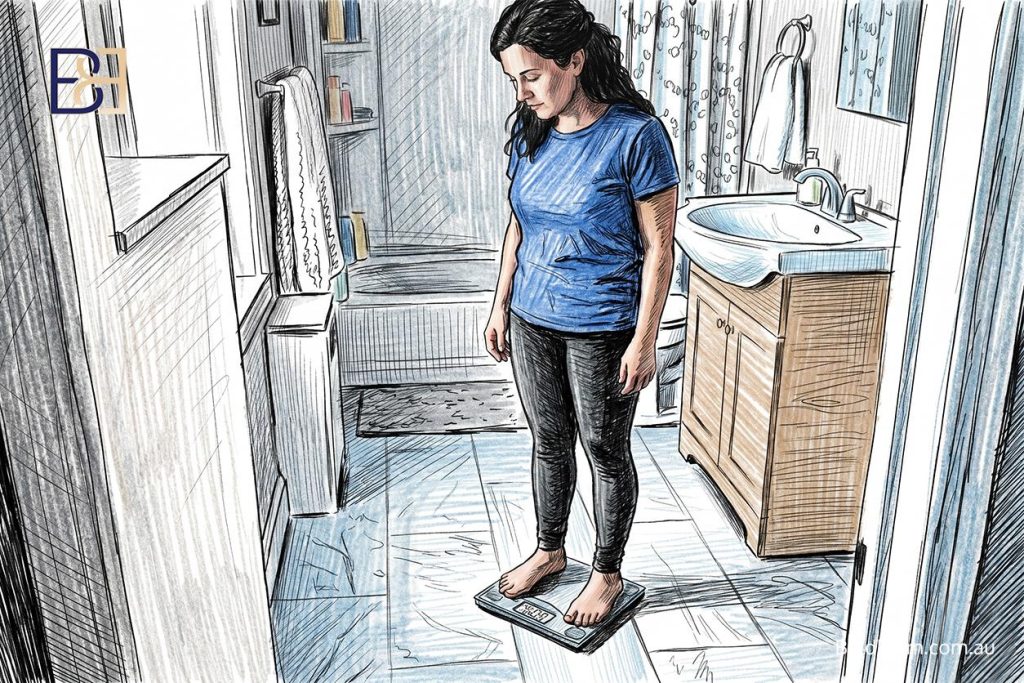
The mechanical load on the skeleton drops sharply and quickly.
The skeleton responds by losing density. The load signal has dropped, and the bone remodels accordingly.
This effect is independent of intake and absorption. It is additive to everything else.
A patient who has lost a large amount of weight has simultaneously reduced mechanical loading on their skeleton and reduced availability. Both pressures push bone density down at the same time. The greater the amount of weight lost, the more pronounced the effect.
The compounding effect over years
None of these four pressures cause clinical problems on day one. That is part of what makes deficiency in this population so easy to miss.
What happens instead is that bone density falls slowly over years.
A patient feels well. Blood tests stay normal. PTH may be rising, but unless someone is specifically looking, it is not being measured. Vitamin D is often low but not being treated.
The patient is functioning fine. Meanwhile, bone density is dropping year on year.
What I see in the clinic
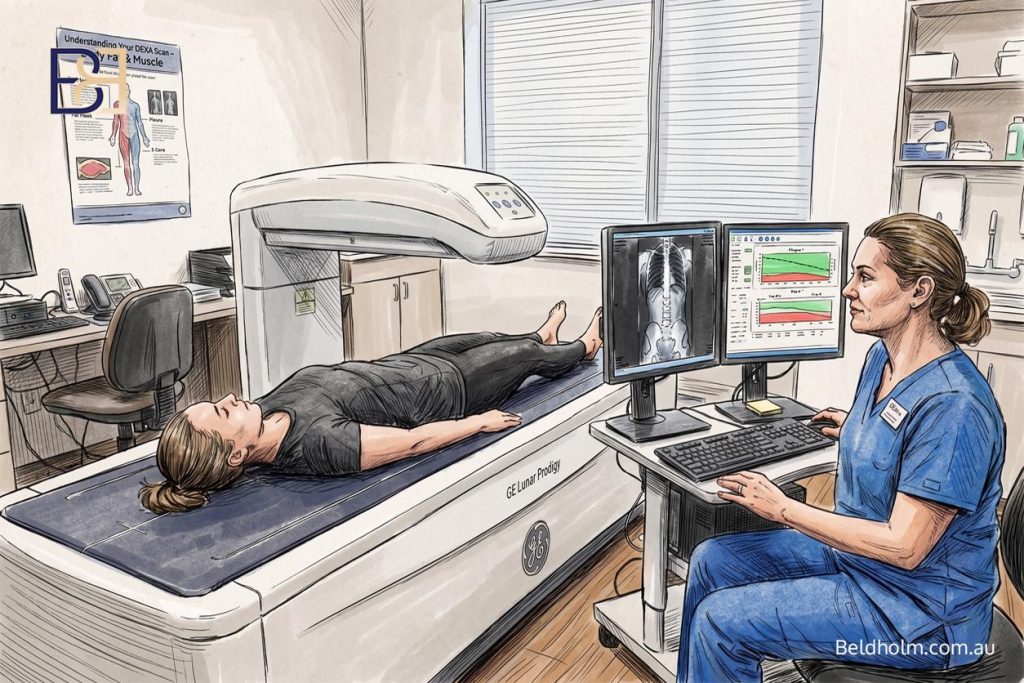
By the time a patient arrives at my practice five or more years after their bariatric surgery, the cumulative effect can be substantial.
Some have already had fragility fractures. Many have never been asked about bone health. Almost none have had a DEXA scan.
What this means for pre-operative assessment
This context shapes how I run the pre-operative blood panel.
I am not just asking whether a patient has enough calcium for wound healing in the immediate perioperative period. I am also asking whether this patient has an underlying bone health problem that has been building for years, and whether it needs to be treated before adding the surgical stress of body contouring to the picture.
Patients tend to do better going into surgery when their nutrition is optimised. That is well-established.
Less well discussed is that patients are also healthier in the long term, beyond the recovery window, when pre-operative assessment catches problems that would otherwise continue to compound.
For many of my patients, the pre-operative blood panel is the first real look anyone has taken at their nutritional status since their bariatric surgery.
Why calcium deficiency is missed until late
The previous sections explained why this deficiency develops after weight loss surgery. This section is about why it so often goes undetected until damage is done.
Three things are happening in parallel. The patient feels well. The standard tests look reassuring. And the person ordering those tests is usually not looking for this specific problem.
The clinical presentation is nearly silent for years
Early-stage deficiency has almost no symptoms. Bone density loss is not painful until it reaches the point of fracture or advanced osteoporosis.
The symptoms patients might notice are easy to miss or attribute to something else:
- Mild muscle cramps, often at night
- Tingling around the lips or fingertips
- Brittle nails or hair changes
- Dental problems
- Gradually worsening posture
None of these sends a patient to the GP saying “check my levels”. They get attributed to stress, ageing, dehydration, or the lingering effects of rapid weight loss itself.
By the time more obvious signs appear (bone pain, height loss, a fragility fracture, or persistent tetany), the problem has usually been developing for years.
Standard GP testing does not catch it early

A routine blood test typically includes the total level as part of an electrolyte panel. Total level on its own is a late-stage marker. It stays normal until compensation fails.
What is usually not ordered unless specifically requested:
- ionised level
- Albumin (to calculate adjusted calcium)
- 25-hydroxyvitamin D
- Parathyroid hormone
- Phosphate
Without these additional tests, the body’s compensation is invisible. A patient with rising PTH, falling vitamin D, and early bone loss will typically come back with a “normal level” result and no further action taken.
The Medicare problem

Some of these tests are not routinely bulk-billed without specific clinical indications listed on the request form.
Vitamin D requires a qualifying risk factor, such as obesity, malabsorption, or post-bariatric surgery, to be eligible for Medicare reimbursement. Bone health testing is often not triggered in a primary care setting unless the patient is already postmenopausal or has had a fracture.
A post-bariatric patient in their thirties or forties can easily fall through these testing criteria for years.
The stages of compensation on blood results
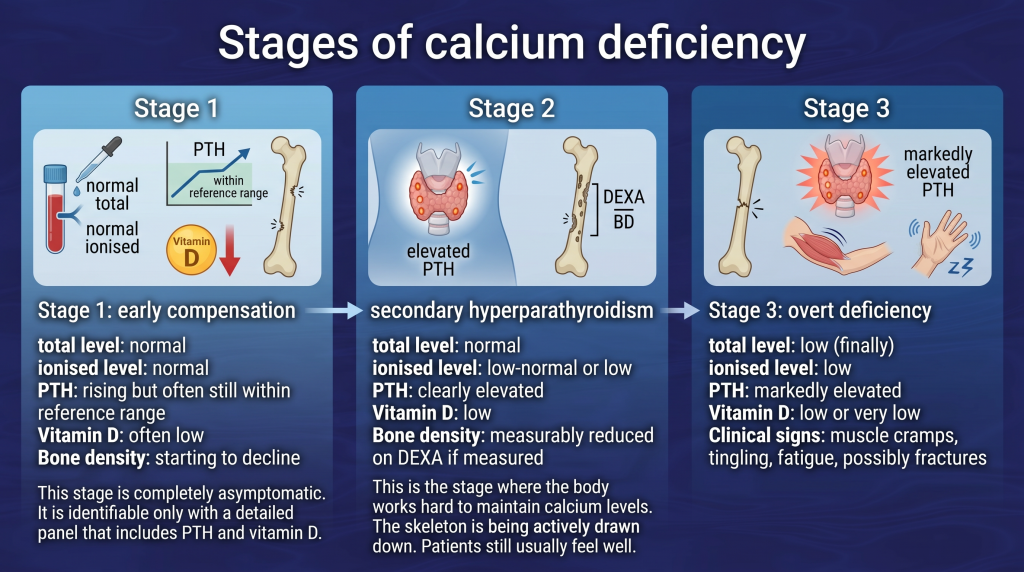
Deficiency does not appear on blood tests as a single moment. It appears in stages, and each stage is visible on a properly structured panel.
Stage 1: early compensation
- total level: normal
- ionised level: normal
- PTH: rising but often still within reference range
- Vitamin D: often low
- Bone density: starting to decline
This stage is completely asymptomatic. It is identifiable only with a detailed panel that includes PTH and vitamin D.
Stage 2: secondary hyperparathyroidism
- total level: normal
- ionised level: low-normal or low
- PTH: clearly elevated
- Vitamin D: low
- Bone density: measurably reduced on DEXA if measured
This is the stage where the body works hard to maintain calcium levels. The skeleton is being actively drawn down. Patients still usually feel well.
Stage 3: overt deficiency
- total level: low (finally)
- ionised level: low
- PTH: markedly elevated
- Vitamin D: low or very low
- Clinical signs: muscle cramps, tingling, fatigue, possibly fractures
At this point, the compensation has failed. The patient is symptomatic. The damage to bone has usually been substantial.
Many post-bariatric patients live in Stage 1 or Stage 2 for years before anything is picked up.
Why this pattern reaches my clinic so often

The patients I see for post-weight-loss body contouring are, by definition, patients who have lost a lot of weight. Many are several years out from their bariatric surgery.
They are coming to me for surgery on their skin and soft tissue. They are not coming to me for bone health. But my pre-operative blood panel includes exactly the tests that identify this problem.
A typical scenario
A patient in their early forties comes in for consideration of abdominoplasty. She had a sleeve gastrectomy six years ago, lost 45 kilograms, and has maintained her weight.
She feels well. She takes a generic multivitamin. She has had routine blood tests over the years and has been told everything is normal.
On my panel, her total level is 2.25 mmol/L (normal). Her ionised level is 1.12 mmol/L (low-normal). Her 25-hydroxyvitamin D is 38 nmol/L (deficient). Her PTH is 8.4 pmol/L (elevated).
This is textbook Stage 2. Her bone health has been quietly deteriorating for years. No one has looked at this combination of tests together before.
What I do with that information

I start her on vitamin D3 at 6000 IU per day with vitamin K2. I add it citrate 1200 mg per day, split across two doses. I recheck in six to eight weeks.
I write to her GP with the full results, my interpretation, and my plan. I flag that ongoing bone health monitoring is appropriate for this patient, and that decisions about further investigations such as DEXA sit with the GP as part of her long-term post-bariatric care.
The body contouring surgery is still the reason she came in. But the pre-operative work-up has produced a separate clinical finding that matters for her long-term health, not just her recovery from surgery.
The broader point
Calcium deficiency in post weight loss patients is not rare. It is common. It is under-diagnosed because the standard tests used by standard testing protocols are not designed to catch early compensation.
By the time it is obvious on a routine panel, the problem has usually been present for years.
This is why I run a detailed pre-operative blood panel on every post weight loss body contouring patient. And it is why the handover to the GP at the 4-week post-operative review provides a full nutritional and bone health picture that would otherwise go unexamined.
The D3 + K2 + calcium trio

Calcium supplementation is often treated as a standalone decision. It is not. Calcium only works properly when two other things are working alongside it.
The three together are what I call the trio: vitamin D3, vitamin K2, and the mineral itself. Each one does something the other two cannot. Missing any of them weakens the whole system.
This is why I start every post-weight-loss patient on vitamin D3 and vitamin K2 at the first consultation, before I even have blood results back. These are Tier 1 in my protocol. Calcium is Tier 2 because I wait for blood results before adding it. The D3 and K2 do not wait.
What each nutrient actually does
The chain runs in three steps: absorption, direction, and deposition. Each step needs a different nutrient.
Vitamin D3: the absorption step
Vitamin D3 (cholecalciferol) is converted in the body to calcitriol, the active form that drives active absorption of calcium across the intestinal wall.
Without adequate vitamin D, the body cannot pull calcium out of food or supplements efficiently. Calcium intake can look fine on paper and still not reach the bloodstream.
In my patient group, vitamin D deficiency is present in 60 to 90% of people with obesity, and it stays low after weight loss surgery unless specifically corrected.(5,9)
For this reason, vitamin D3 supplementation at 3000 to 6000 IU per day is Tier 1 for every post weight loss patient, before any blood results are in.
For a full walk-through of vitamin D supplementation, dosing, and blood testing, see the vitamin D article in this series.
Vitamin K2: the direction step
Once calcium is absorbed and circulating, it needs to be directed to the right places. That means bones and teeth.
The wrong places are soft tissue and blood vessels. Calcium deposits in arterial walls contribute to arterial stiffening. Calcium deposits in kidneys contribute to stones. Calcium deposits in soft tissue are generally not useful.
Vitamin K2 (specifically the MK-7 form) activates two proteins that do this directing work:
- Osteocalcin pulls the mineral into bone matrix.
- Matrix Gla protein keeps calcium out of arterial walls.
Both of these proteins require K2 to be activated. Without K2, they do not work.
In practical terms, this means that supplementing calcium or vitamin D without K2 can direct the mineral in the wrong direction. This is not a small point. It is a key reason why supplementation in the general population has had mixed results in cardiovascular safety studies. The studies that showed concerns did not include K2.(4)
My standard dose is 100 micrograms of vitamin K2 MK-7 per day. This is given in combination with D3, often in a single product.
The mineral itself: the deposition step
Calcium is the raw material. D3 gets into the bloodstream. K2 directs it into the bone. The mineral itself is what actually gets built into the skeleton.
Without enough calcium intake and absorption, the other two nutrients are working with empty stock. The system still compensates by pulling from existing bone, which is the problem the trio is designed to prevent.
That is the reason it becomes a separate Tier 2 decision once blood results are available. If intake and absorption are adequate, supplementation may not be needed. If it is, it is added alongside D3 and K2, not instead of them.
Why I do not supplement it without D3 and K2
Some patients come to me already taking a supplement. Often it is a standalone product or a calcium-plus-vitamin-D combination without K2.
This is incomplete. In a patient with low vitamin D (which is most post-bariatric patients), a straight calcium supplement contributes little because absorption is poor. Without K2, whatever does absorb is not being reliably directed.
My position is that supplementation in this population should not happen in isolation. If it is needed, D3 and K2 need to be in place first.
Sequencing matters
The sequence I follow is:
- Start D3 and K2 at first consultation, for every patient.
- Run the pre-operative blood panel.
- Review results at 2 to 4 weeks.
- Add calcium if blood results indicate it.
By the time it is added, the absorption and direction machinery has had a head start. This is different from the common pattern of starting the supplement on day one and hoping it finds its way.
Choosing the right form of each
Vitamin D3, not D2
Cholecalciferol (D3) is more effective at raising and maintaining serum 25-hydroxyvitamin D than ergocalciferol (D2). D3 is what I use in every case.
Vitamin K2 MK-7, not MK-4
Menaquinone-7 (MK-7) has a much longer half-life than menaquinone-4 (MK-4), so once-daily dosing is reliable. MK-4 needs multiple doses throughout the day to maintain blood levels.
MK-7 is the form I recommend.
Calcium citrate, not carbonate
Covered in detail in the next section. The short version: citrate absorbs without gastric acid. Carbonate does not.
How the trio gets delivered in practice

Patients often ask whether they need three separate supplements. The answer depends on what is available.
Many products combine D3 with K2 in a single capsule. NOW Foods D3+K2 5000 IU is one example I mention. Ostelin makes a vitamin D3 1000 IU product that can be paired with a separate K2 supplement to reach the target dose.
Calcium is almost always a separate product. It would need to be taken at a different time of day anyway because calcium can interfere with iron absorption and because the dose is usually split across two or three takes.
A typical daily schedule for a patient on the full trio
- Morning, with breakfast: Vitamin D3 + K2 combination (one or two capsules to reach 3000-6000 IU D3 + 100 micrograms K2 MK-7). Multivitamin. Whey protein isolate throughout the morning.
- Midday, with lunch: Calcium citrate 600 mg (one dose).
- Evening, with dinner: Calcium citrate 600 mg (second dose). Iron, if prescribed, should be separated from calcium by at least 2 hours, so either earlier in the afternoon or later in the evening.
This kind of routine takes a few days to establish. I walk patients through it at the consultation or during the blood results review.
Why the trio matters
The trio is not a marketing concept. It is how the physiology actually works.
Vitamin D gets calcium into the bloodstream. Vitamin K2 directs it to the skeleton instead of the arteries. The mineral itself is what the skeleton is built from.
In my patients, D3 and K2 are started universally. Calcium is started when the blood panel shows it is needed.
Getting these three nutrients to work together is the foundation of pre-operative bone health optimisation and long-term bone health after body contouring surgery.
Calcium citrate versus calcium carbonate
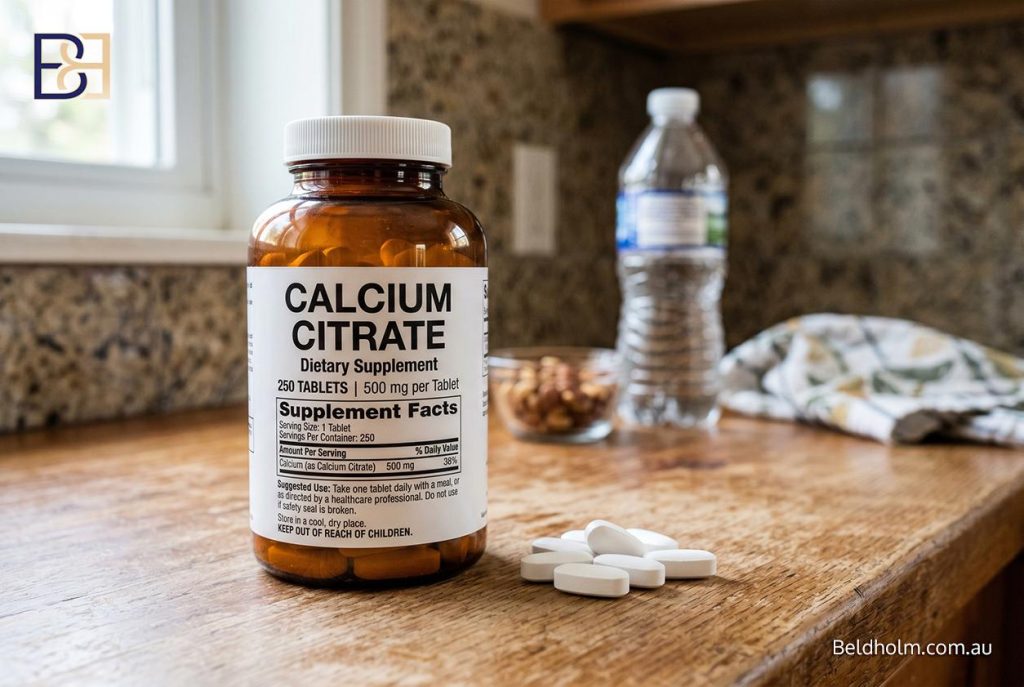
The form matters. For the general population, this is a relatively minor decision. For my patients, it is one of the most important practical choices in the whole pre-operative nutrition plan.
Most calcium supplements on the shelf are carbonate. That is not by accident. Carbonate is cheap to manufacture, easy to compress into tablets, and contains more elemental dose per gram than any other common form. It is the default product in most of the big supplement aisles.
For a patient with normal stomach acid and no gastric bypass, carbonate works well. For a patient who has had bariatric surgery, it often does not work at all.
The two forms, side by side
Calcium carbonate
- Contains 40% elemental dose by weight (so a 1250 mg tablet provides 500 mg of elemental)
- Requires stomach acid to dissolve
- Should be taken with meals to trigger acid release
- Cheaper per dose than citrate
- More commonly associated with bloating, constipation, and gas
Calcium citrate
- Contains 21% elemental dose by weight (so more tablets are needed to reach the same dose)
- Does not require stomach acid to dissolve
- Can be taken with or without food
- More expensive per dose
- Generally better tolerated for gastrointestinal side effects
The key clinical difference is not cost or tablet size. It is the gastric acid requirement.
Why gastric acid matters
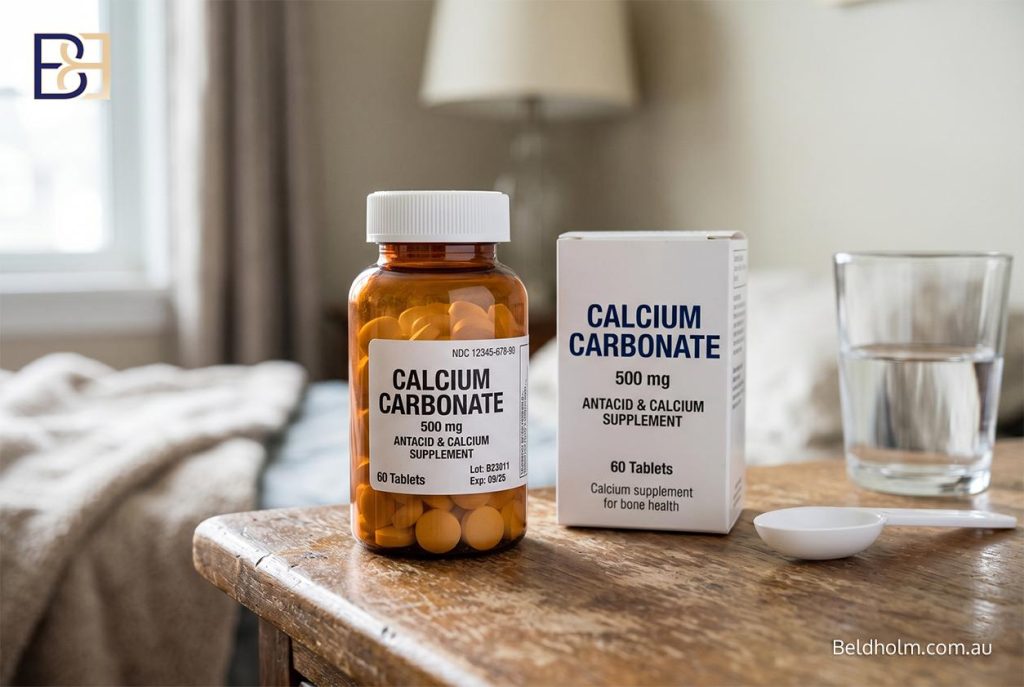
Calcium carbonate is a calcium-carbon compound. For the mineral to be absorbed, the compound has to dissolve into an ionised form in solution. That dissolution requires acid.
In a patient with normal stomach function, this happens automatically during digestion. Stomach acid is plentiful, especially during meals. The tablet dissolves, releasing ions that move into the small intestine for absorption.
In a patient with reduced stomach acid, the tablet does not dissolve efficiently. It passes through the stomach largely intact, enters the small intestine as an undissolved carbonate, and fails to deliver its load.
Calcium citrate is already in an ionised form. It does not need acid to become absorbable. This is why it is the supplement of choice in patients with achlorhydria or hypochlorhydria.
Who has reduced gastric acid?
This is where the decision becomes specific to my patient group.
In Roux-en-Y patients
Not only is the duodenum bypassed (as covered earlier in this article), but the small remaining gastric pouch produces significantly less acid than the original stomach. Gastric acid output is dramatically reduced by the anatomy itself.
Carbonate in this setting is close to useless.
After sleeve gastrectomy
The anatomy is different, but the effect on acid is similar. The portion of the stomach with the highest concentration of acid-producing cells (the fundus) is removed during sleeve surgery.
What remains produces less acid than a pre-surgical stomach. This varies between patients, but the trend is consistent.
On proton pump inhibitors or H2 blockers
A large proportion of my patients are on one of these medications for reflux.
Proton pump inhibitors (omeprazole, esomeprazole, pantoprazole, rabeprazole, lansoprazole) suppress gastric acid almost completely when taken regularly. H2 blockers (famotidine) reduce it substantially.
Any patient on one of these medications should be using citrate, not carbonate, regardless of whether they have had bariatric surgery.
Over the age of 60
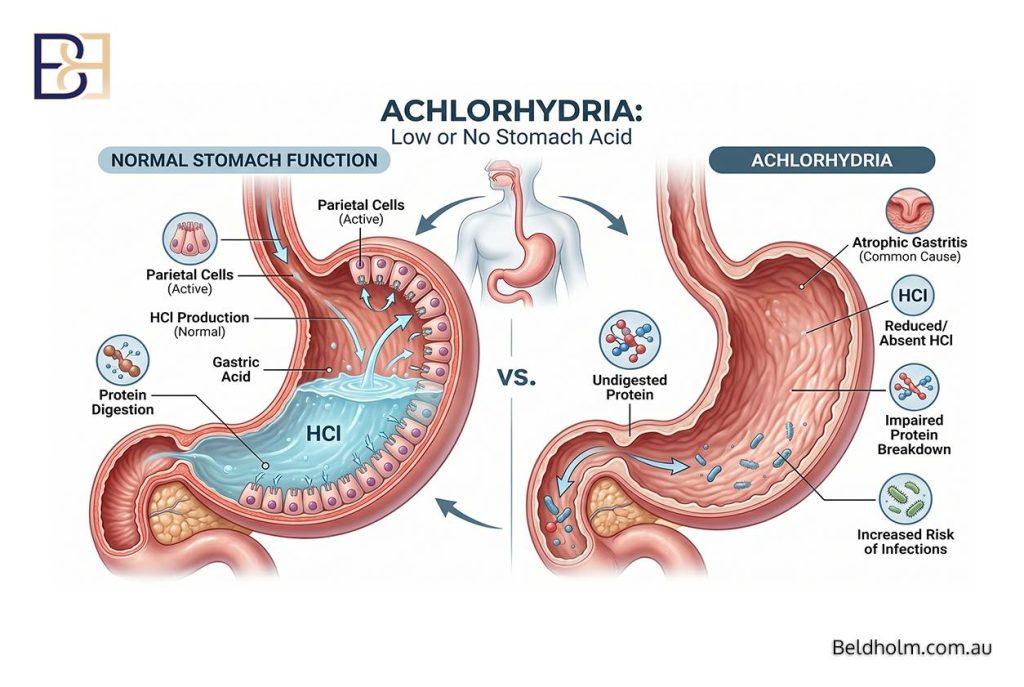
Gastric acid production declines with age. Achlorhydria (complete absence of gastric acid) is present in a meaningful proportion of people over 60. This is relevant to some of my post-weight-loss patients, even without surgical or medication factors.
What the evidence shows
The evidence on citrate versus carbonate in general populations is mixed. Some studies show equivalent absorption when both are taken with meals. Others show that citrate is absorbed better, particularly in older subjects or those with reduced gastric acid (3,4).
For the specific population of patients with achlorhydria, the evidence is clear. Calcium carbonate is poorly absorbed under fasting conditions in achlorhydric patients. Calcium citrate absorbs reliably regardless of gastric acid status (3,13).
For post-bariatric patients specifically, major bariatric surgical societies recommend calcium citrate as the preferred form of supplementation (5,8). This reflects the anatomical and physiological changes discussed above.
My position follows the evidence: for post-weight-loss patients, calcium citrate is the default. Carbonate is only used when I have specific confirmation that gastric acid is intact and there is no concurrent acid suppression medication.
The practical consequences of choosing the wrong form
If a patient is taking carbonate and their body is not dissolving it efficiently, a few things happen:
- The calcium is not absorbed. The supplement is effectively doing nothing.
- Blood tests do not change. If the ionised level was borderline before starting the supplement, it remains borderline.
- PTH continues to rise. The compensation the body was already doing continues unchanged.
- Bone density continues to fall. The patient believes they are being proactive. Their skeleton disagrees.
Worse, the patient often attributes the ongoing deficiency to the surgery itself, or to their body “not responding to supplements”. In reality, the supplement was never making it into their bloodstream in the first place.
This is why I am particular about the form. A patient doing everything right with the wrong product is still going to get the wrong result.
Tolerability

Beyond absorption, carbonate is more commonly associated with gastrointestinal side effects than citrate. Patients on carbonate report:
- Constipation
- Bloating
- Gas and flatulence
- Mild nausea
These symptoms are particularly unwelcome in a patient who is already managing post-bariatric gastrointestinal sensitivity. Switching to citrate often resolves them.
In clinical practice, if a patient complains of any of these symptoms on carbonate, I switch them to citrate. It is not a high bar. There is no good reason to persist with carbonate in this population.
Brands I mention to patients
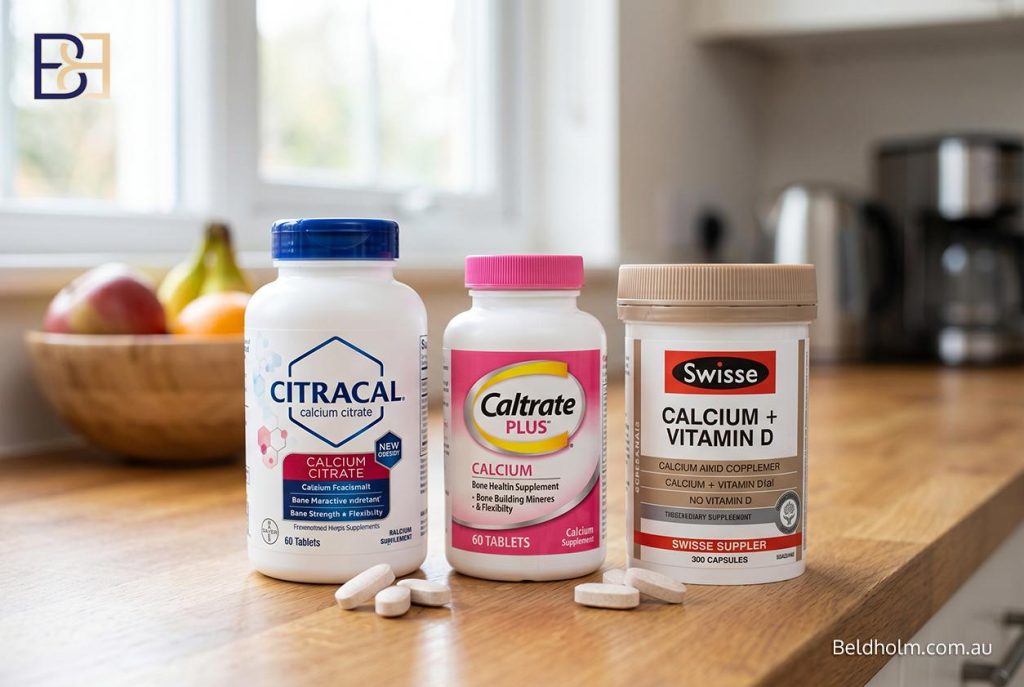
Australian supplement brands I routinely discuss with patients include:
- Citracal (calcium citrate): straightforward, well-labelled, widely available
- Caltrate Plus: contains calcium plus vitamin D; check the label for form
- Swisse Calcium + Vitamin D: check the product for the form
All of these are stocked at Chemist Warehouse, Pharmacy Direct, Priceline, and Amazon AU.
The criteria I apply are: calcium citrate as the form, 500 mg or less per tablet to respect the gut saturation ceiling, and a reputable Australian stockist so patients can obtain the product reliably.
Any product meeting those three criteria is acceptable. The brand name matters less than the form and the dose.
Why does the form matter this much
For my post-weight-loss patients, calcium citrate is the default. It absorbs without gastric acid, is better tolerated, and works reliably in a population with predictable gastric acid reduction.
Carbonate has a role in the general population, but not in patients who have had bariatric surgery or who are on acid suppression medications.
Getting the form right is not a minor detail. It is the difference between supplementation that actually reaches the bloodstream and supplementation that does not.
Who I actually start on calcium, and when
This is the section where the protocol gets specific. Calcium is not a blanket supplement in my practice. It is a clinical decision based on blood results, surgical history, and the overall pattern of a patient’s bone health.
The framework I use is a two-tier system. Understanding the tier structure is important because it explains why I do not give every patient calcium on day one, even though it is genuinely important in this population.
The two-tier structure
Tier 1: started at the first consultation, for every patient

These supplements go to every post-weight-loss patient as soon as they book for surgery. I do not wait for blood results.
- Whey protein isolate
- Complete multivitamin (bariatric-specific where possible)
- Vitamin D3 (3000 to 6000 IU per day)
- Vitamin K2 MK-7 (100 micrograms per day)
- Vitamin C (1000 mg per day)
- Zinc (maintenance dose)
The reason these are universal is that deficiency or sub-optimal status for all of these is common enough in the post-weight-loss population that the benefit of starting immediately outweighs any need to confirm deficiency first.
Tier 2: started only after blood results confirm the need

These supplements are added after the pre-operative blood panel comes back, at the blood results consultation 2 to 4 weeks after the first visit.
- Iron
- Vitamin B12
- Folate
- Vitamin A
- Thiamine (B1) and Vitamin B6
- Calcium
- Magnesium
- Selenium
Tier 2 supplementation is based on the principle of demonstrated need. These nutrients can be dosed too high, and they interact with each other and with other supplements. Starting them without blood confirmation risks over-supplementation or missing a drug interaction that should have been caught.
Calcium sits in Tier 2. It is not added blindly.
Why calcium is Tier 2 and not Tier 1
Three reasons.
First, the dose can be too high. Excessive intake has its own set of concerns, including kidney stones in susceptible patients and cardiovascular concerns raised in large population studies (covered in a later section). Supplementing 1200 to 1500 mg per day on top of a diet that already meets requirements is not a small decision.
Second, absorption needs to be set up first. Vitamin D and K2 are the prerequisites for calcium to do its job. Starting the supplement before D3 has had a chance to raise 25-hydroxyvitamin D is putting the cart before the horse.
Third, the blood results often change the plan. A patient with normal ionised level, normal PTH, and adequate vitamin D stores may not need supplementation at all. A patient with a clearly elevated PTH and low ionised levels needs it promptly and at the full dose. The panel tells me which is which.
The specific triggers for starting supplementation
At the blood results consultation, I start the patient on calcium if any of the following are present:
Low serum level
- total level below 2.10 mmol/L, or
- Albumin-adjusted calcium below 2.10 mmol/L, or
- ionised level below 1.10 mmol/L
Any of these is a clear indication. Calcium starts at the results consultation.
Elevated PTH with low or low-a normal level
- PTH above the upper reference range
- Paired with low, low-normal, or adjusted calcium in the lower third of the reference range
- Almost always with a low 25-hydroxyvitamin D
This is the Stage 2 secondary hyperparathyroidism pattern described earlier in this article. The body is compensating. Calcium supplementation is part of the response, alongside correcting the vitamin D deficiency.
High-risk post-bariatric patient with documented bone loss
- Post-bariatric surgery more than 3 years ago, and
- Previous fragility fracture, or
- DEXA scan showing osteopenia or osteoporosis, or
- Strong clinical suspicion of advanced bone loss based on history
In this group, I start the supplement even if current blood results look relatively reassuring, because the bone loss is already established and the compensation is ongoing.
Post-bariatric patient with confirmed absorption issues
- Roux-en-Y gastric bypass, particularly long-limb variants
- Known achlorhydria
- Malabsorption on clinical grounds (weight loss continuing past target, persistent deficiencies despite supplementation)
In this group, even normal blood results can be misleading. The body is still compensating. I usually start the supplement prophylactically in this subgroup, at a slightly lower dose initially.
Who I do not start on calcium
Not every post-weight-loss patient needs supplementation.
A patient who presents with all of the following typically does not go on calcium:
- Adequate dietary intake (reliably above 1000 mg per day)
- Normal total, adjusted, and ionised level
- Normal PTH
- Adequate 25-hydroxyvitamin D (above 75 nmol/L on my panel)
- No history of fracture or low bone density
- Weight loss surgery more than 2 years ago with stable weight
This is the minority of my patients, but it does happen. In this group, the Tier 1 D3 and K2 supplementation is sufficient, and adding the supplement would be unnecessary.
The most common version of this scenario is a patient who had a sleeve gastrectomy, maintains an active diet with dairy and leafy greens, and has had consistent follow-up with a dietitian since their surgery. Their bone health machinery is intact. They do not need it added.
Albumin adjustment matters here
One practical detail. Post-bariatric patients often have a low serum albumin. Low albumin artificially lowers total level on standard lab reports.
This matters because a total level of 2.05 mmol/L in a patient with a low albumin of 32 g/L is not the same as 2.05 mmol/L in a patient with a normal albumin of 42 g/L. The first patient has a normal adjusted calcium. The second does not.
The formula I use:
Adjusted = measured calcium + 0.02 × (40 − albumin in g/L)
So for the first patient above: 2.05 + 0.02 × (40 − 32) = 2.05 + 0.16 = 2.21 mmol/L (normal).
For the second: 2.05 + 0.02 × (40 − 42) = 2.05 − 0.04 = 2.01 mmol/L (low).
Without the adjustment, I would start the supplement on the wrong patient. This is why I request albumin alongside calcium on every pre-operative panel.
The role split: me, the dietitian, the GP

Calcium management is not something I handle alone in the long term.
Pre-operative phase (my responsibility): I assess nutritional status, run the blood panel, start Tier 1 at first consultation, add it (and any other Tier 2 supplements) after results are in, and aim to have the patient in the best possible state for surgery by the time they arrive at hospital.
Peri-operative phase (shared with dietitian): Maitland Private Hospital has an on-ward dietitian service. I frequently arrange dietitian review during admission, particularly for patients with ongoing nutritional concerns. Calcium and the rest of the supplement plan continue through the hospital stay.
Long-term phase (GP takes over): At the 4-week post-operative review, assuming the patient is healing well and there are no surgical issues, I hand over formally to the patient’s GP. For post-bariatric patients, lifelong supplementation and bone monitoring are often needed, and those decisions sit with the GP as part of the patient’s long-term primary care.
The detail of what the handover includes, and how long-term monitoring is managed, is covered later in this article.
I do not keep post-bariatric patients on my books indefinitely for nutritional management. The GP is better placed for long-term, whole-person care.
What patients should take away from this section

The question “should I be taking the supplement?” does not have a universal answer for post weight loss patients. It depends on:
- What your blood results actually show
- What your bariatric surgical history is
- What medications you are on
- What your bone density looks like
- What your dietary intake actually is
The right answer for one patient is wrong for another. For that reason I do not give a blanket “everyone should take it” recommendation, and I do not trust protocols that do.
If you are considering body contouring surgery with me and you are already on a calcium supplement, bring the product to your consultation. If you are not on one and are wondering whether you should be, the pre-operative blood panel will give us the answer.
Either way, the decision is made on data, not on defaults.
Dosing, timing, and how I explain it to patients
Once a patient and I have decided calcium is indicated, the next question is how to actually take it. This is where a lot of supplementation falls over.
A patient can be on the right form, at the right daily total, and still end up with poor absorption because of how the doses are spaced or what else is being taken alongside. The difference between “taking the supplement” and “absorbing it” comes down to practical scheduling.
This section is the one I find myself walking patients through most often in consultation. Getting it right takes five minutes of explanation. Getting it wrong wastes months of supplementation.
The daily dose
My standard prescription for a patient who needs supplementation is:
1200 to 1500 mg of elemental per day, divided into 2 or 3 doses.
The dose is based on published guidance from major bariatric surgical societies and reflects the reality that absorption in this population is reduced (5,6,8). A general-population dose of 1000 mg per day is usually insufficient for a post-bariatric patient.
“Elemental” refers to the actual content, as opposed to the compound’s total weight in the tablet. This distinction matters when reading labels.
For calcium citrate, a 1250 mg tablet typically contains around 250 to 315 mg of elemental calcium. Labels on reputable Australian products usually display both numbers. If they do not, the elemental dose figure is the one that counts.
Where the dose range comes from
I choose between 1200 and 1500 mg based on the individual patient:
- Lower end (1200 mg): Patient with mild deficiency, normal weight, adequate dietary intake that needs topping up.
- Middle (1350 mg): Most patients.
- Upper end (1500 mg): Patient with confirmed malabsorption, elevated PTH, or documented bone loss.
I do not go above 1500 mg from supplements alone without a specific reason. Higher total daily doses have diminishing returns and rising risks, and the gut has a hard absorption ceiling per dose that makes additional supplementation largely wasted. I cover this next.
The 500 mg ceiling per dose
This is one of the most important and least-known facts about supplementation in this patient group.
The absorption mechanism in the small intestine saturates at around 500 mg of elemental in a single dose. Anything above that passes through without being absorbed, regardless of how much is in the tablet (2,4).
What this means practically: a single 1000 mg tablet taken once a day does not deliver 1000 mg of absorbed elemental. It delivers roughly 500 mg, with the rest wasted.
The only way to actually deliver 1200 to 1500 mg per day is to split the dose. This is why every regimen I prescribe is taken in 2 or 3 separate doses rather than as a single daily tablet.
Dose splitting: how I actually prescribe it
My default is 2 doses per day for simpler regimens, 3 doses for patients who need the higher total.
Two-dose regimen
- Morning with breakfast: 600 mg elemental dose
- Evening with dinner: 600 mg elemental dose
- Total: 1200 mg per day
Three-dose regimen
- Morning with breakfast: 500 mg
- Midday with lunch: 500 mg
- Evening with dinner: 500 mg
- Total: 1500 mg per day
Most patients find the two-dose regimen easier to stick to. The three-dose regimen is more work but gives better absorption at the higher total dose.
Timing in the day
With meals or without meals?
- Calcium citrate: Can be taken with or without food. I usually suggest meals because they anchor the routine, but they are not required.
- Carbonate (if used): Must be taken with a meal to trigger stomach acid release for dissolution.
Morning versus evening
There is some evidence that evening dosing results in slightly better overnight PTH control. Bone turnover has a circadian rhythm, and the body’s calcium demand rises overnight.
That said, it is a minor effect, and compliance matters more. The best dose schedule is the one the patient will consistently follow.
Separation from iron

This is the interaction patients most often get wrong.
Calcium interferes with iron absorption when taken at the same time. For most patients with adequate iron stores, this does not have clinical significance. For my patients, many of whom are iron-deficient post-bariatric, it matters significantly.
Rule: calcium and iron must be separated by at least 2 hours.
How this plays out in practice
If a patient is on both calcium and iron, I usually structure it like this:
- Morning with breakfast: Iron + vitamin C (vitamin C improves iron absorption)
- Midday or with lunch: First dose
- Evening with dinner: Second dose
The iron sits 4 to 6 hours away from either dose, well clear of the 2-hour minimum.
If that does not work for a patient’s routine
The 2-hour minimum is the hard floor. Longer is better. If a patient’s schedule does not allow morning iron plus midday and evening doses, I will flip it: evening iron (separated by 3+ hours from the second dose) and morning plus midday calcium.
The principle is separation. The specific clock times can adapt to the patient’s life.
Other interactions to know about
Zinc

Calcium can reduce zinc absorption at high doses. Most of my patients are on maintenance-dose zinc (Tier 1), which is not clinically significant. For patients on repletion-dose zinc (Tier 2) for confirmed deficiency, I suggest separating zinc from calcium by at least 2 hours, similar to iron.
Magnesium
Similar pattern. Calcium and magnesium compete for absorption at high doses. For patients receiving magnesium supplementation, a 2-hour separation is reasonable.
Thyroid medication
This one patient must know about.
Levothyroxine (thyroxine) absorption is reduced significantly when taken with calcium. The interaction is well-documented and clinically meaningful.
Rule: calcium and thyroxine must be separated by at least 4 hours.
Thyroxine is almost always taken first thing in the morning on an empty stomach. Patients on thyroxine should take their morning thyroxine at least 4 hours before any dose. That usually means thyroxine on waking, breakfast an hour later, then the first dose at midday or later.
Bisphosphonates
If a patient is already on a bisphosphonate, such as alendronate or risedronate, for bone protection, these medications have strict timing requirements.
Bisphosphonates need to be taken first thing in the morning on an empty stomach with plain water, and the patient must remain upright for at least 30 minutes afterwards. Calcium must be separated from the bisphosphonate by at least 30 minutes, and ideally by several hours.
That usually means bisphosphonate on waking, upright for 30 minutes, then breakfast, and calcium no earlier than the midday dose.
Antibiotics
Quinolone antibiotics (ciprofloxacin, norfloxacin) and tetracyclines (doxycycline) both have reduced absorption when taken with calcium. Separation by at least 2 hours is standard.
If a patient is prescribed one of these antibiotics during the peri-operative period, I review the calcium schedule temporarily to ensure separation.
The sample daily schedule
For a patient on the full Tier 1 and Tier 2 regimen, including calcium, a realistic day looks like this:
On waking (if on thyroxine): Thyroxine with plain water. Remain upright for 30 minutes.
Breakfast: Multivitamin. Vitamin D3 + K2 combination. Whey protein isolate shake or meal. Iron + vitamin C (if prescribed).
Mid-morning: Water.
Lunch: First calcium citrate dose (500 to 600 mg elemental). Zinc (if on maintenance dose, taken separately from iron).
Afternoon: Water.
Dinner: Second calcium citrate dose (500 to 600 mg elemental). Whey protein isolate if the protein target is not yet met.
Evening: Additional protein if needed. Water. Fish oil (if taking, during the permitted window).
I walk patients through this schedule at the blood results consultation. Most find it manageable within a couple of days of starting. I also provide a written version of the daily plan so they have something to refer back to.
When patients struggle with compliance
Some patients find the schedule difficult. The most common issues are:
Remembering the midday dose at work. Solution: set a phone reminder, keep a second bottle in the workplace, or shift to a 2-dose regimen at a lower total if the midday dose is unreliable.
Forgetting the separation from iron. Solution: simplify the schedule. Iron morning, calcium midday and evening. Do not get creative.
Nausea or GI upset. Solution: switch from carbonate to citrate (as covered in the citrate-versus-carbonate section), or reduce the dose per take to 300 or 400 mg and split across 3 or 4 doses instead of 2.
Pill burden. Solution: consider a combined calcium citrate plus vitamin D3 plus K2 product if one is available at the right dose. This reduces the number of separate tablets.
The regimen has to fit the patient’s life. A theoretically optimal plan that the patient cannot sustain is worse than a simpler plan that actually gets followed.
The three rules that matter most
Dosing is not complicated, but it is specific. Three rules cover most of the practical decisions:
- Split the total daily dose so no single take exceeds 500 mg of elemental.
- Separate calcium from iron by at least 2 hours, and from thyroxine by at least 4 hours.
- Use citrate in this patient group, and take it with meals where possible.
Get those three right and absorption follows. Get them wrong and the supplement does not deliver what it is supposed to.
This is the level of detail I take patients through in the blood results consultation. It is not information most post-bariatric patients have been given before.
Medications that affect bone status
The earlier dosing section covered the timing rules for supplements alongside common medications. This is a different question: which medications independently affect calcium status or bone health, whether or not a patient is on supplements at all.
These are the items I work through in the medication history at every consultation. Some of them change my decision. Some of them flag a need for closer monitoring. Some of them require a conversation with the GP before surgery proceeds.
Long-term acid suppression medications
Proton pump inhibitors and H2 blockers were covered earlier in this article from an absorption standpoint. They also have an independent effect on bone that deserves flagging.
The evidence on fracture risk
Long-term PPI use has been associated with reduced bone mineral density and increased fracture risk in large population studies (4). The effect is dose-dependent and duration-dependent. Short courses are not the concern. Years of daily use are.
Many of my patients have been on a PPI for reflux since before their bariatric surgery, continued through the bariatric period, and are still on it years later. Total exposure can be substantial.
What I actually do about it
I do not generally recommend that patients stop their PPI. Reflux after bariatric surgery, particularly after sleeve gastrectomy, is often genuine and well-managed by the medication.
What I do:
- Confirm with the GP that the PPI is still clinically indicated, not just continued by habit.
- Use citrate rather than carbonate (as covered in the citrate-versus-carbonate section)
- Set a lower threshold for starting supplementation in the blood results consultation.
- Flag in the GP handover letter that this patient is on long-term acid suppression and should have bone health monitored accordingly.
If the PPI can be safely stepped down or switched to on-demand use, that conversation happens between the patient and their GP, not with me.
Corticosteroids

Oral corticosteroids have a well-documented negative effect on bone, even at relatively modest doses.
Prednisolone at 7.5 mg per day or more over sustained periods is associated with significant bone loss (4). The mechanism is multiple: corticosteroids reduce gut absorption, increase excretion in urine, and directly inhibit bone formation by osteoblasts.
Patients this affects
- Autoimmune conditions (rheumatoid arthritis, systemic lupus, inflammatory bowel disease, polymyalgia rheumatica)
- Severe asthma or COPD on oral steroid courses
- Recent high-dose courses for other indications
For patients on chronic oral corticosteroids, I have a more specific conversation. These patients typically need:
- Confirmed calcium supplementation (usually at the upper end of the range, 1500 mg)
- Confirmed vitamin D supplementation at the full 6000 IU dose
- Consideration of a DEXA scan through their GP or treating specialist if not done recently
- Close collaboration with the specialist managing their underlying condition
Inhaled corticosteroids at standard doses do not carry the same bone risk. Topical steroids are not an issue. Short courses (under two weeks) for acute problems are not the concern.
Anticonvulsants

Several anticonvulsant medications reduce absorption of calcium by increasing the metabolism of vitamin D. The list includes:
- Phenytoin
- Phenobarbital
- Carbamazepine
- Primidone
Patients on these medications can develop secondary hypocalcaemia and osteomalacia if calcium and vitamin D are not actively managed.
Most patients on long-term anticonvulsants are already under neurology care and often already on supplementation. What I do is confirm this is happening, review doses, and coordinate with the treating neurologist if anything needs adjustment before surgery.
Newer anticonvulsants (lamotrigine, levetiracetam, topiramate) have less clear effects on bone metabolism and are managed case by case.
Thiazide diuretics

Thiazide diuretics (hydrochlorothiazide, indapamide, chlorthalidone) reduce urinary excretion. This sounds beneficial and sometimes is, but it creates a specific risk.
A patient on thiazide diuretics plus supplementation can develop hypercalcaemia. This is uncommon at standard doses but worth monitoring.
For patients on a thiazide diuretic, I:
- Check baseline total and ionised level carefully
- Start at a lower dose if supplementation is indicated
- Recheck the level at the 4-week post-operative review if clinically indicated
- Flag in the GP handover that this interaction requires ongoing monitoring
Loop diuretics
Loop diuretics (frusemide, bumetanide) have the opposite effect. They increase urinary excretion.
A patient on long-term loop diuretic therapy may have a chronic negative calcium status from urinary losses alone. This is more common in older patients on medication for heart failure.
Calcium supplementation in this group is often appropriate but needs coordination with the cardiologist or GP managing the underlying condition.
Weight loss medications (GLP-1 receptor agonists)

GLP-1 medications affect bone health indirectly, through reduced overall eating.
Patients on these medications consume less total food and often less mineral-rich food specifically. Published data shows consistent reductions in the intake of this nutrient, alongside reductions in vitamin C, iron, and total energy.
The medication itself does not block absorption directly. The issue is dietary intake.
What I actually do
For patients on GLP-1 medications who are also candidates for body contouring surgery:
- Assess calcium intake carefully in the dietary history
- Expect blood results to show below-average intake markers
- Set a lower threshold for adding Tier 2 calcium supplementation
- Coordinate with the treating team on protein intake, which is a larger concern in this group
Current guidelines do not recommend routine cessation of GLP-1 medications before surgery (7). I follow that position. If a patient cannot meet pre-operative nutritional targets due to appetite suppression, dose adjustment is a matter for discussion between the patient and their prescribing doctor, not a blanket recommendation.
Bisphosphonates

Bisphosphonates are the most commonly prescribed medication specifically for bone density protection.
If a patient is already on a bisphosphonate (alendronate, risedronate, zoledronic acid), it usually means their bone density has already been assessed and found to be reduced. This changes my calcium approach in two ways:
First, adequate calcium and vitamin D are prerequisites for bisphosphonates to work. The medication relies on the mineral being available to be deposited into bone matrix. If intake or absorption is low, the bisphosphonate cannot do its job.
Second, supplementation becomes more likely, not less. Almost all patients on bisphosphonates should also be on these two. I confirm this is in place at consultation.
Timing
Bisphosphonates must be taken on waking, on an empty stomach, with plain water, with the patient remaining upright for 30 minutes. Calcium must be separated from the bisphosphonate by at least 30 minutes.
Perioperative considerations

Oral bisphosphonates are usually continued through the perioperative period. I do not routinely ask patients to stop them before surgery.
Intravenous bisphosphonates (zoledronic acid) are given infrequently (once a year for osteoporosis). If a patient has a scheduled infusion in the perioperative period, we discuss timing with their prescriber.
Thyroid medication

Thyroxine (levothyroxine) absorption is reduced by calcium taken at the same time. The timing rule of 4-hour separation was covered in the dosing section earlier.
A separate point. Untreated or poorly controlled thyroid disease can affect bone turnover. Hyperthyroidism increases bone resorption. Severe hypothyroidism can also affect bone metabolism through other pathways.
For patients on thyroid medication, I usually request recent TSH and free T4 results alongside the calcium panel. If thyroid control is suboptimal, that is a conversation with the GP or endocrinologist before we consider the supplement question settled.
Medications I routinely ask about at consultation
At the initial consultation, I work through a specific medication history that includes:
- All prescribed medications, with doses and durations
- Over-the-counter medications used regularly (particularly reflux medications and NSAIDs)
- All supplements currently taken, including brands and doses
- Recent antibiotic courses
- Recent steroid courses
- Hormonal contraceptives and hormone replacement therapy
- Traditional or complementary medicines
The last category matters more than patients sometimes expect. Several herbal supplements (St John’s wort, ginkgo, high-dose fish oil) have relevant interactions or perioperative considerations independent of calcium.
The coordination principle
None of these medication issues are mine to manage alone. The model I follow is coordination, not takeover.
If a medication is relevant to calcium or bone health, my role is to:
- Identify the issue at consultation
- Adjust the supplement plan where appropriate
- Flag it to the GP or treating specialist
- Confirm a monitoring plan for after the perioperative period
I do not step into other clinicians’ prescribing. A patient’s endocrinologist, rheumatologist, or cardiologist is better placed to decide on their medications than I am. My job is to make sure the body contouring surgery does not proceed in a patient whose medication-related bone issues have been missed.
A medication list is a clinical review, not a checklist
Medications that affect bone status are common in the post weight loss population. Acid suppression, corticosteroids, thiazides, loop diuretics, GLP-1 medications, and bisphosphonates all come up regularly in my consultations.
Each one changes the conversation. Some lower the threshold for supplementation. Some raise it. Some require coordination with another treating doctor before the plan is finalised.
The principle is always the same: a patient’s medication list has to be reviewed properly before treatment decisions are made. This is not a protocol-driven exercise. It is a clinical review, case by case.
Dietary sources: what I actually suggest
Supplements are only part of the picture. Diet is the other part, and in a post-weight-loss patient, it is often the part that has quietly fallen behind.
This section covers the practical food advice I give at consultations. It is not a dietitian-level nutritional plan. That is not my role. My role is to give patients enough working knowledge to understand which foods matter, which foods are not what they appear to be on the label, and how to build calcium-rich meals around the dietary limitations that come with bariatric surgery.
Dietary sources targets
The recommended daily intake for adults is approximately 1000 to 1200 mg, based on dietary reference intakes published in major nutrition guidelines. For post-menopausal women and men over 70, the recommendation rises to 1300 mg.
These targets are for total daily intake, combining food and any supplements. The dietary reference intakes are designed for the general population, and the aim is for a patient to meet the target without over-relying on supplementation.
Most of my post weight loss patients are well below the target from food alone, often in the 400 to 600 mg range. This is why supplementation is added for many of them. A patient hitting 800 to 1000 mg from food may only need a modest supplement, or none at all. A patient hitting 400 mg from food needs the supplement plan in full.
The foods that actually move the needle

Calcium is not evenly distributed across foods. Some foods contain a lot in a reasonable serving. Most do not.
Foods that matter
Dairy products. Milk, yoghurt, and hard cheese are the highest-density dietary sources for most people. A cup of milk has around 300 mg. A small pot of yoghurt has 150 to 250 mg. A slice of hard cheese has 150 to 200 mg.
Canned fish with bones. Sardines, salmon, and mackerel, eaten with the soft bones, are among the best non-dairy sources. A small tin of sardines (100 g) contains about 350-400 mg of calcium.
Tofu (calcium-set). Tofu made with calcium sulphate or chloride as the coagulant contains around 150 to 350 mg per 100 g, depending on the product. Check the label for “sulphate” in the ingredients.
Fortified plant-based milks. Fortified soy, almond, oat, and rice milks typically contain around 300 mg per cup, similar to dairy milk. The keyword is fortified. Unfortified versions contain very little.
Fortified breakfast cereals. Many breakfast cereals are fortified with calcium at 200 to 500 mg per serve. Check the nutrition panel, not the marketing claims on the front of the box.
Leafy greens: some yes, some no
Leafy greens are often promoted as a source of calcium. The picture is more complicated.
Good options:
- Kale (around 100 mg per cup, cooked)
- Bok choy (around 150 mg per cup, cooked)
- Collard greens (around 260 mg per cup, cooked)
- Chinese broccoli (similar to bok choy)
- Broccoli (around 60 mg per cup, cooked)
Poor options despite the reputation:
- Spinach (contains calcium, but oxalates bind it; only around 5% is actually absorbed)
- Rhubarb (similar issue to spinach)
- Swiss chard and beetroot greens (high in oxalates)
Patients are often surprised by the spinach point. On paper, a cup of cooked spinach contains around 250 mg of calcium, but in practice, only about 13 mg is actually absorbed. The oxalate content effectively locks the mineral in the food.
Foods with minor content

Nuts, seeds, legumes, and dried fruit contain modest amounts of calcium but not enough to be reliable daily contributors. They are fine as part of a varied diet but not the foundation of a supplement plan.
Eggs, meat, and poultry contain relatively little calcium. They matter for protein but not for this nutrient.
What actually works after bariatric surgery
The challenge is not identifying high-calcium foods. It is fitting them into the eating pattern of a post-bariatric patient.
After bariatric surgery, portion sizes are small. Meals are often split into three or four small meals rather than three larger ones. Some foods are well tolerated. Others cause nausea, dumping symptoms, or reflux.
Foods that usually work well
Greek yoghurt. high in this nutrient, high in protein, usually well tolerated. A 170 g pot contains around 200 mg and 15-20 g of protein.
Hard cheese. Smaller volume, more concentrated, less lactose than milk. Often tolerated where milk is not.
Fortified soy milk in smoothies. Can be combined with whey protein isolate for a mineral plus protein hit in a format that is easy to consume slowly.
Canned salmon or sardines. A small tin twice a week delivers meaningful nutrients plus protein and omega-3. The soft bones in canned fish are what provide the mineral. Removing them defeats the purpose.
Tofu in stir-fries or soups. Calcium-set tofu in small portions is well tolerated by most patients.
Foods that often do not work
Full glasses of milk. Volume alone can cause discomfort after a sleeve or bypass. Some patients also develop new lactose intolerance after surgery.
Large raw salads. The volume is difficult, and leafy greens in raw form are lower in calcium than cooked greens anyway (volume reduces significantly on cooking, concentrating the content per bite).
Cheese-heavy meals. Rich, dense cheese dishes can trigger reflux in post-bariatric patients.
Dumping syndrome and calcium
Some calcium-rich food (especially sweetened yoghurts, flavoured milks, and fortified cereals with added sugar) can trigger dumping symptoms in patients after Roux-en-Y. This is a sugar and osmolarity issue, not a mineral issue.
Switching to unsweetened yoghurt, plain milk, or cereals with lower sugar content usually resolves it. The content is what matters; the sugar is separate.
A realistic day of intake

Here is what a realistic post weight loss patient’s day looks like if they are active about dietary sources:
Breakfast: Small bowl of fortified cereal with fortified soy milk. Or Greek yoghurt with berries. (Around 350 to 450 mg)
Morning snack: Small piece of hard cheese with a few crackers. (Around 150 to 200 mg)
Lunch: Half a tin of sardines on wholegrain toast with a side of bok choy. (Around 400 to 500 mg)
Afternoon: Small smoothie with fortified almond milk, whey protein isolate, and a small banana. (Around 300 mg)
Dinner: Stir-fry with calcium-set tofu, kale, and brown rice. (Around 250 to 350 mg)
This day totals approximately 1450 to 1800 mg of calcium from food, which is above the daily target. A patient who consistently eats this way would need little or no supplementation.
The reality is that most patients do not eat this way consistently. That is not a criticism. It reflects real life. Supplements exist to close the gap between aspirational intake and actual intake.
Things that reduce absorption

Even when calcium is present in food or supplement form, several factors can reduce how much is actually absorbed.
Oxalates. Already covered. Spinach, rhubarb, and some other leafy greens bind calcium in the gut.
Phytates. Found in whole grains, legumes, nuts, and seeds. They reduce absorption modestly. Not enough to avoid these foods, but relevant to overall balance.
Caffeine. Coffee intake above 300 mg per day (roughly three to four cups) increases urinary excretion. Moderate coffee intake is fine. Heavy intake shifts the balance.
High sodium intake. Salt increases urinary excretion. A high-sodium diet works against calcium status.
Alcohol. Heavy alcohol intake reduces absorption and independently affects bone metabolism. Moderate intake is less of a concern.
Excessive protein. High protein intake increases urinary loss to a mild degree. This is rarely clinically relevant and should not be used to argue against adequate protein intake, which is essential for wound healing and recovery.
What I do not do
A few things I deliberately avoid in dietary advice:
I do not tell patients to avoid dairy. Dairy is the single most efficient source for most people. Unless a patient has confirmed intolerance or an ethical reason to avoid dairy, it should be included in the diet.
I do not tell patients to avoid oxalate-containing foods entirely. Spinach, almonds, and beetroot have other nutritional values. Patients just need to know that they are not reliable sources of calcium.
I do not prescribe specific meal plans. That is the dietitian’s role. I give patients the framework and the key facts, and if they need detailed menu planning, I refer them to an Accredited Practising Dietitian.
I do not over-complicate the advice. The pattern is simple: prioritise dairy, calcium-set tofu, or canned fish with bones as the main contributors; fill in with fortified plant milks and suitable greens; avoid over-reliance on spinach; and be aware that caffeine and salt work against you.
Food first, supplements to close the gap
dietary sources matter. In the ideal scenario, food contributes the majority of a patient’s daily target, and supplements exist only to close a specific gap.
In the post weight loss population, the reality is that diet often falls short. Smaller portions, changed tolerances, and sometimes new food aversions after surgery mean that many patients simply cannot hit 1000 to 1200 mg through food alone.
Supplements are how that gap gets closed. But the goal is always to have food doing as much of the work as the patient’s situation allows.
A patient with a structured calcium-aware diet and a modest supplement plan is in a better position than a patient relying entirely on supplements with a low-mineral diet. The absorption is more reliable, the nutrient context is better, and the long-term bone health picture is stronger.
Safety considerations
Calcium is often discussed as if it is unambiguously beneficial. In most patients at standard doses, it is. But supplementation has a safety profile that matters, and in a population already managing multiple supplements and medications, it needs to be understood.
This section covers what can go wrong and how I manage it. The goal is not to alarm patients. It is important to make clear that calcium is a clinical decision with real considerations on both sides, which is why I prescribe it selectively rather than universally.
The overall picture
For most patients at the doses I prescribe, calcium is safe. Side effects are uncommon. The main concerns are:
- Excess intake effects (kidney stones, hypercalcaemia)
- Cardiovascular safety questions raised in some large studies
- The prostate cancer signal in men at higher intakes
- Gastrointestinal side effects
- Interactions with medications (covered earlier in this article)
Understanding each of these helps explain why I set the dose where I do and why I do not go above 1500 mg per day from supplementation.
Kidney stones

Kidney stones are probably the safety concern patients ask about most often.
The picture is more complicated than most patients think. For many years, kidney stone prevention meant a low-calcium diet. The current evidence tells a different story.
Dietary sources reduce stone risk
Dietary sources, taken with food, actually reduces the risk of kidney stones in most patients (4,12). The mechanism is that dietary sources binds to oxalate in the gut, preventing oxalate absorption, which is what forms oxalate stones (the most common type).
A low-calcium diet paradoxically increases stone risk by allowing more oxalate to be absorbed.
Supplemental calcium has a small risk signal
Supplemental calcium, particularly at high doses or when taken without food, has been associated with a modest increase in stone risk in some studies (4). The effect is smaller than once thought, and the risk is concentrated among people with a history of stones.
What I actually do
For a patient with no history of kidney stones, standard calcium supplementation of 1200 to 1500 mg per day, split and taken with meals, is low risk.
For a patient with a personal or strong family history of oxalate stones, I am more cautious. This involves:
- Keeping supplemental calcium at the lower end of the range (1200 mg total, rarely more)
- Emphasising calcium from food where possible
- Encouraging generous fluid intake
- Often coordinating with the patient’s GP or urologist, particularly if they have had recent stones
I do not routinely avoid supplementation in patients with a history of stones if they genuinely need it for bone protection. The balance of risks usually still favours supplementation, just at a lower dose and with closer monitoring.
Hypercalcaemia
Hypercalcaemia (elevated blood level) is rare at the doses I prescribe, but it can occur.
The patients most at risk are:
- Those on thiazide diuretics (as discussed in the medications section earlier)
- Those taking very high-dose vitamin D without monitoring
- Those with undiagnosed primary hyperparathyroidism
- Those with certain cancers that release PTH-related peptide
Symptoms

Early hypercalcaemia can be subtle: fatigue, nausea, loss of appetite, constipation, excessive thirst, or confusion. More severe hypercalcaemia can cause muscle weakness, kidney dysfunction, or cardiac arrhythmias.
Any patient who develops unexplained new symptoms on a supplementation regimen should have their levels checked promptly.
What I actually do
I monitor the level at the pre-operative panel and again at the post-operative review if there is any clinical reason. I also flag to the GP at handover that ongoing supplementation requires periodic monitoring, particularly if the patient is on a thiazide diuretic or high-dose vitamin D.
Cardiovascular safety

This is the topic with the most mixed evidence and the most internet speculation.
Some large population studies raised concerns about an association between supplementation and cardiovascular events (4). The signal was not present in every study, and meta-analyses have reached conflicting conclusions.
What the evidence actually says
The concerning studies had two features that shape how I read them:
First, they were observational. They showed association, not causation. Patients who take high-dose calcium supplements differ from those who do not in ways that are hard to control for.
Second, they did not include vitamin K2. K2 directs calcium into bone rather than into arterial walls, which is the whole point of pairing them in the trio approach described earlier in this article. Studies of supplementation without K2 showed some signals that have not been replicated in studies that included K2.
What I do about it
I do not prescribe it in isolation. Every patient on calcium is also on vitamin D3 and vitamin K2 MK-7. This is not primarily about cardiovascular safety. It is about how the physiology actually works. But the K2 component does treat the most plausible mechanism of any cardiovascular effect.
I also do not exceed 1500 mg of supplemental calcium per day. Keeping the dose within the range that meets physiological needs, without pushing into excess territory, is reasonable clinical practice regardless of how the cardiovascular debate resolves.
For patients with existing cardiovascular disease, I coordinate with their cardiologist before finalising the supplement plan.
The prostate cancer signal in men
This is a specific concern I discuss with male patients considering supplementation.
Published research has found an association between calcium intake above 1500 mg per day (from diet plus supplements combined) and an increased risk of advanced and fatal prostate cancer in men (4,11). The effect becomes more pronounced at intakes above 2000 mg per day.
The mechanism is not fully established. One leading theory is that high calcium intake suppresses circulating vitamin D levels and that vitamin D may have a protective effect against advanced prostate cancer.
What this means for my practice
For male patients, the 1500 mg per day ceiling for supplements is strictly applied. I also factor in dietary intake when determining the supplement dose.
A male patient with a high-dairy diet, contributing 1000 mg from food plus 1000 mg from supplements, has a total intake of 2000 mg. This is outside the range I would recommend.
Practically, this means that for male patients I:
- Assess dietary intake carefully
- Aim for a total intake (diet plus supplements) of 1000 to 1500 mg per day
- Use supplements to fill the gap rather than to add on top of adequate dietary intake
- Do not push supplementation above 1200 mg per day unless there is a specific clinical reason
This is not a blanket recommendation to avoid calcium in men. Men also have bone health needs, and men with confirmed low levels of bone loss still need supplementation. It is about calibrating the dose with this specific concern in mind.
The same signal has not been observed in women, so the standard dose range applies to female patients.
Gastrointestinal side effects

This is the most common practical issue patients encounter.
Calcium supplements, particularly carbonate, can cause:
- Constipation
- Bloating
- Gas and flatulence
- Mild nausea
The good news is that these effects are usually manageable.
Switching to citrate
As covered earlier in the citrate-versus-carbonate section, calcium citrate is generally better tolerated than carbonate. For patients experiencing GI side effects from carbonate, switching to citrate often resolves the problem entirely.
Dose splitting
Even on citrate, some patients find a 600 mg dose causes mild discomfort. Splitting the dose further (to 300 to 400 mg per take, three or four times per day) usually solves this.
Fluid and fibre

Constipation related to calcium often responds to increased fluid intake and dietary fibre. Most of my post-weight-loss patients are already working on hydration and fibre intake for other reasons, so this is not a major additional ask.
When to stop and reassess
If a patient has persistent GI symptoms despite switching to citrate and splitting doses, I will step back and reconsider whether calcium is essential at the current dose. Sometimes a lower dose plus a stronger focus on dietary sources is the right answer.
Allergic reactions
True allergic reactions to calcium supplements are uncommon but possible. More often, what patients describe as an “allergy” is actually a reaction to a tablet ingredient: binders, colourings, coatings, or preservatives.
If a patient has had a reaction to one product, switching brands usually resolves it. Calcium citrate from different manufacturers uses different inactive ingredients.
Genuine anaphylaxis to the mineral itself is extremely rare. Any patient with a history of allergic reaction to supplements should still let me know, and we will manage it on a case-by-case basis.
Excessive vitamin D alongside calcium
This is worth a specific mention because it is a pattern I sometimes see in patients who have been self-supplementing.
Very high-dose vitamin D (10,000 IU per day or more, taken for months) can, when combined with supplementation, cause hypercalcaemia. Vitamin D drives absorption beyond what the body can clear, thereby raising serum levels.
At the doses I prescribe (3000 to 6000 IU D3, plus 1200 to 1500 mg calcium), this is not a concern. The problem arises when patients self-prescribe high-dose vitamin D on top of a regimen.
If a patient is already taking a higher dose of vitamin D than I would prescribe, we adjust downward before adding the supplement.
What I monitor and when
For any patient on supplementation, my standard monitoring is:
- Pre-operative blood panel including total level, ionised level, albumin, vitamin D, PTH, and phosphate
- Post-operative blood panel at the 4-week post-operative review, including vitamin D, iron studies, B12, and folate (calcium is not routinely rechecked post-operatively unless there is a clinical reason)
- GP handover at the 4-week post-operative visit, provided the patient is healed, and there are no surgical issues requiring ongoing management
Long-term monitoring sits with the GP. My handover letter provides the pre-operative and post-operative results, the supplement record, and the clinical reasoning behind my decisions. How often the GP repeats bloods, whether and when to organise a DEXA scan, and how to adjust doses over time are decisions that live with them.
For patients with ongoing bone health concerns, coordination with an endocrinologist or the original bariatric team is sometimes appropriate. That referral pathway also sits with the GP.
The balance
Calcium supplementation in the right patient at the right dose is safe and beneficial. The safety considerations in this section are real, but they are manageable.
Sensible practice is to supplement based on need rather than habit, at a dose that meets physiological requirements without pushing into excess, and with the context of other supplements and medications factored in.
This is why the pre-operative assessment matters. A one-size-fits-all approach to calcium would be wrong for some patients in either direction: too much for some, too little for others. Clinical judgement based on data is what makes the difference.
Relevance across body contouring procedures
A question that sometimes comes up in consultation is whether calcium matters more or less for specific procedures. Does it matter more for a longer operation? Less for a smaller one?
The answer is that the approach is uniform across all the post-weight-loss body contouring procedures I perform.
The procedures covered
The nutrition plan in this article applies equally to:
- Abdominoplasty (tummy tuck), including circumferential hybrid abdominoplasty and dual vector abdominoplasty
- Body lift (belt lipectomy)
- Thighplasty (thigh lift)
- Brachioplasty
- Mastopexy
Whether a patient is having a single procedure or staged operations, the calcium principles are the same. The same is true of whether the procedure is focused on the upper body, the lower body, or the torso.
Why the approach is uniform
Calcium status is a systemic issue, not a procedure-specific one.
Bone health, wound healing, and supporting physiological status do not differ depending on which part of the body the incision is made. The surgical stress of a brachioplasty triggers the same healing processes as that of an abdominoplasty. The nutrient requirements for recovery are the same.
Calcium supplementation is about treating an underlying deficiency and protecting long-term bone health. Neither of those depends on the surgical site.
What does vary by procedure?
The pieces that do change between procedures are covered in the dedicated articles for each operation. These include:
- Incision design and placement
- Operative time and anaesthetic considerations
- Specific recovery timelines
- Drain management
- Per-procedure risk profiles, including DVT risk stratification
- Compression garment requirements
- Return-to-activity guidance
None of these belong in a nutrition article. They are properly covered in the procedure-specific content, where they have the space and context they deserve.
If you are considering a specific procedure, the abdominoplasty, body lift (belt lipectomy), thighplasty (thigh lift), brachioplasty, and mastopexy articles each cover the procedure-specific details.
For patients having staged procedures
Many post weight loss patients end up having more than one body contouring procedure, usually staged over time. A common pattern is an abdominoplasty first, followed by a thighplasty or a brachioplasty months later.
The supplement plan runs continuously through the staged sequence. It does not reset or restart between operations. Tier 1 supplements continue throughout. Calcium, if started as Tier 2 after the first set of blood results, usually continues through subsequent procedures.
Blood tests are repeated before each operation to confirm the plan is still appropriate. Dose adjustments happen based on results, not on which procedure is being planned.
Calcium is a systemic issue, not a procedure issue
it does not care which procedure is being done. What it cares about is whether the patient’s intake, absorption, and bone health are in good shape for the surgical stress and recovery period ahead.
The supplement plan in this article applies across the full range of post-weight-loss body contouring procedures. Procedure-specific detail lives elsewhere.
The long-term view: what happens after my role ends
Calcium is not a short-term problem for post-bariatric patients. It is a lifelong one.
My role is specific and bounded. I optimise the patient for body contouring surgery, manage their nutritional status through the pre-operative and peri-operative period, see them through their routine post-operative follow-ups, and hand over to the GP for ongoing long-term care.
This section covers where my responsibility ends, where the GP’s begins, and what patients should expect in the years after body contouring surgery.
Why long-term bone health matters for this population
The pressures that drove a low level before surgery do not disappear after body contouring. The patient still has the same bariatric anatomy. The same reduced stomach acid. The same medication picture. The same mechanical changes to their skeleton from the weight loss.
Body contouring surgery does not correct any of this. It treats the skin and soft tissue consequences of weight loss. The underlying metabolic and nutritional picture carries on.
What this means practically is that a patient who is optimised for body contouring surgery still needs ongoing management. The supplements I start do not end after the operation. For most post-bariatric patients, they continue for life.
Bone density and fracture risk after bariatric surgery
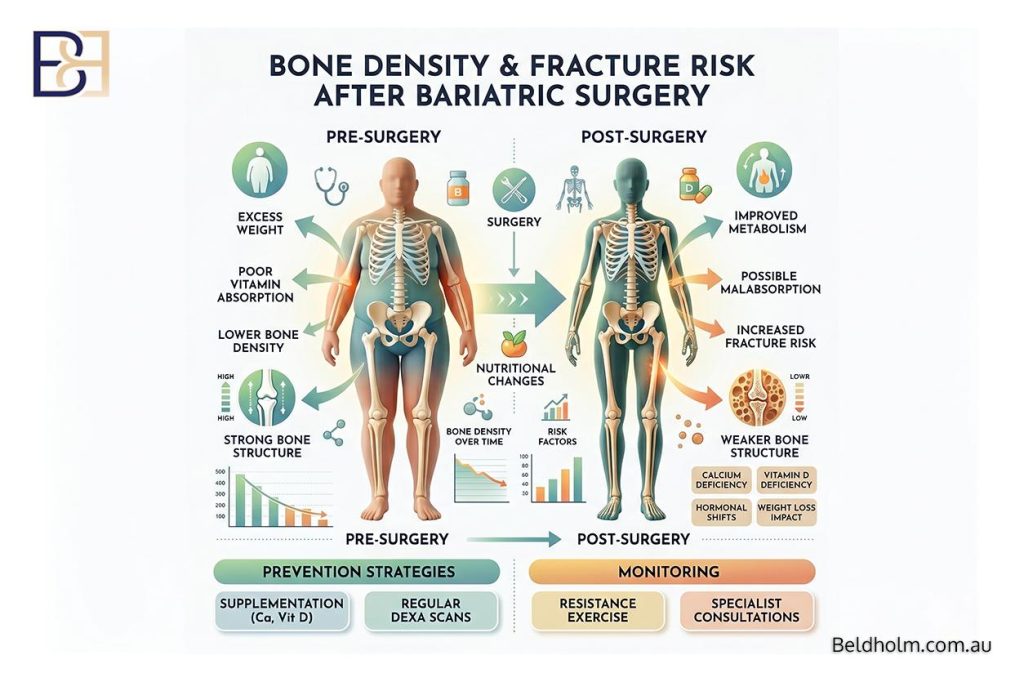
Post-bariatric bone loss is a well-documented long-term issue.
Published research has consistently shown that patients who have had gastric bypass or sleeve gastrectomy are at elevated risk of reduced bone mineral density and fractures in the years and decades after their bariatric surgery(1,5,10).
The reduction in bone density typically starts in the first 6 to 12 months after bariatric surgery and continues at a slower rate over subsequent years (1,9,10). The cumulative effect can be substantial, particularly in patients who have been post-bariatric for more than 5 years without any bone-directed supplementation.
Post-bariatric patients have a higher risk of fragility fractures compared with the general population. Fractures most commonly occur at the wrist, hip, and spine. Risk is highest in older patients, post-menopausal women, and patients on chronic corticosteroids or other bone-affecting medications.
This is the context that shapes my pre-operative assessment. It is also the reason why long-term bone monitoring is important for this population, and why that monitoring needs to be built into the patient’s relationship with their GP rather than left to chance.
DEXA scanning sits with the GP
Dual-energy X-ray absorptiometry (DEXA) is the standard test for measuring bone mineral density. It is not a test I order as part of my pre-operative work-up.
DEXA scanning is a long-term tool for bone health. Decisions about when to scan, how often to repeat, and how to interpret results in the context of ongoing care belong with the doctor managing the patient’s long-term health, not with me.
If a patient arrives for a body-contouring consultation with DEXA results already in hand (through their GP, bariatric surgeon, or endocrinologist), I factor them into my pre-operative assessment. Reduced bone density may change my supplementation plan, may prompt coordination with the treating doctor, and may affect how I think about perioperative bone health.
If a patient has never had a DEXA scan and the pre-operative blood panel raises concerns about bone health, I communicate this to the GP during handover. The GP then decides whether a DEXA scan is warranted and when to organise it.
I do not step into that decision. It is not my territory, and I do not have the ongoing clinical context to make it well.
My post-operative follow-up schedule
I see all post-weight-loss body contouring patients at four set time points after their surgery:
- 4 weeks post-operative
- 3 months post-operative
- 6 months post-operative
- 12 months post-operative
These reviews are about the surgery itself: wound healing, scar maturation, compression garment use, return to activity, and anything else related to the body contouring operation.
At each visit I also review how the patient is going nutritionally. Are they taking their supplements? Are they tolerating them? Has anything changed in their medication list? For most patients these questions take a few minutes at each review.
The 4-week post-operative review and GP handover
The 4-week post-operative review is an important point in my care of the patient.
By 4 weeks, most body-contouring patients are well into the acute recovery phase. Wounds are substantially healed. The patient is resuming normal activities with the guidance I have given them. If the surgery has gone straightforwardly and there are no ongoing surgical concerns, this visit is where I organise the formal handover to the GP.
Blood tests are timed around this review. The post-operative panel includes vitamin D, iron studies, vitamin B12, and folate. Calcium is not routinely rechecked at this point because supplementation at standard doses does not produce rapid serum changes that need early monitoring.
When the handover happens
The handover happens at the 4-week review if the patient is healing well and there are no surgical issues requiring ongoing management by me.
If there are complications, slow wound healing, or other surgical matters that need continued specialist attention, the handover is delayed until those issues are resolved. The patient continues under my care until the surgical picture is stable.
This is not common. Most post weight loss body contouring patients are well enough for handover at the 4-week mark.
What the handover package contains
The formal handover is a package of documents sent directly from my clinic to the GP surgery. It includes:
- A formal handover letter summarising the patient’s history, the surgery performed, the peri-operative course, and relevant clinical findings
- The pre-operative blood results with my clinical interpretation
- The post-operative blood results at 4 weeks
- The operation report documenting the surgical procedure in detail
- A complete supplement record listing every supplement the patient is on, including doses, brands where relevant, and durations
For patients who are on supplementation, the handover specifies the current dose and form, the paired vitamin D3 and K2 doses, and the clinical reason the calcium was started.
What the handover does not do
The handover communicates what I have done and what I have found. It does not prescribe what the GP should do next.
Decisions about monitoring frequency, when to repeat blood tests, whether to organise a DEXA scan, how to adjust doses over time, and whether to refer to an endocrinologist or bariatric specialist all sit with the GP.
My handover gives the GP the information they need to make those decisions. It does not replace their judgement.
Continued follow-up after the handover
The handover to the GP does not end my relationship with the patient. I still see them at their 3-month, 6-month, and 12-month reviews.
At these later reviews, the focus is on the body contouring outcome: scar maturation, skin quality, any revisions or adjustments that might be discussed, and long-term surgical result. Nutritional management by this point is the GP’s responsibility, but I still ask at each visit whether the patient is engaged with their GP and whether long-term supplementation is on track.
If something has fallen through the cracks, I flag it back to the GP. If the patient has stopped their level or vitamin D without discussion, we talk about why. The goal is to keep the long-term plan coherent, even though the day-to-day management is no longer mine.
The CC to the GP during the pre-operative phase
The GP is not only involved at the 4-week handover. I also CC the GP on the initial pre-operative blood results when they come back from pathology.
This gives the GP early sight of the nutritional picture and allows them to flag anything they want treated before surgery. It also opens a line of communication for GPs who have not been closely involved in the patient’s post-bariatric care.
For patients whose GP is actively involved in their long-term care, this early contact often leads to useful coordination. For patients whose GP has not seen them regularly since their bariatric surgery, it re-establishes that relationship around a specific clinical trigger.
Why the GP is the right person for long-term management

I do not keep post-bariatric patients on my books indefinitely for nutritional management. That is not the right model for several reasons.
The GP sees the whole patient. They have the full picture of other medications, other medical issues, family dynamics, and the patient’s life context in a way that a specialist does not.
Continuity of care is better in primary care. Patients move, change insurance, or lose contact with specialists over time. A good GP relationship is often the most stable healthcare connection in a patient’s life.
Specialist care works best when it is specialist. My role is body contouring surgery and pre-operative optimisation. Long-term primary care is a different discipline.
The goal is for the patient to have a strong nutritional foundation coming out of my care, and then a clear plan that their GP can execute in the years that follow.
Red flags patients should raise with their GP
At the handover, I give patients a specific list of symptoms that should prompt them to see their GP sooner rather than waiting for routine review:
- New bone pain, particularly in the back, hips, or ribs
- A fall resulting in a fracture
- Height loss noticed over time
- Persistent muscle cramps despite adequate supplementation
- Tingling in hands or feet
- Unexplained fatigue or new weakness
These symptoms are not specific to a calcium problem, but any of them can signal a bone or nutritional issue that needs the GP to look more closely.
The long-term view in one paragraph

A patient who has had body contouring surgery with me, after significant weight loss, is set up with an evidence-based nutritional plan at the start and a clean handover to their GP at the 4-week post-operative review. The pre-operative period is intensive. The perioperative period is focused. The surgical follow-up continues at 3, 6, and 12 months. Long-term management is provided by the GP as part of the patient’s ongoing primary care relationship.
Calcium supplementation is often part of that long-term plan. Whether it continues, at what dose, and for how long is a decision that lives with the GP. My job is to make sure the handover gives them everything they need to make that call well.
The best outcomes come from continuity. My role is to hand off cleanly to the person best placed to provide it.
Practical summary: what I want patients to leave with
This is a long article. Most patients will not remember every detail. What matters is that a few key ideas stick.
This section is the summary I give at the end of consultations when calcium has come up. It is deliberately brief. The earlier sections contain the detail. These are the principles.
Principle 1: calcium is tested first, then started
I do not give every post weight loss patient calcium on day one. The blood panel tells me who needs it.
Some patients have adequate bone health going into surgery. Starting them on a supplement they do not need is not helpful.
Other patients are silently deficient and need it added urgently. Missing them is also not helpful.
The difference between these two situations is what the pre-operative blood panel is for.
Principle 2: D3 and K2 come first, calcium comes second
Vitamin D3 and vitamin K2 are Tier 1 in my protocol. Every post weight loss patient starts these at the first consultation, before blood results are available.
Calcium is Tier 2. It is added later, only when blood results indicate need.
The sequence matters. Vitamin D3 drives the gut absorption of the mineral. Vitamin K2 directs absorbed calcium into bone rather than into the wrong places. Without those two in place, supplementation does not work properly.
Principle 3: calcium citrate, not carbonate
For post-bariatric patients, calcium citrate is the default.
Carbonate requires stomach acid to dissolve. Most of my patients have reduced stomach acid, either from the surgery itself or from medications they take for reflux. Carbonate in these patients often passes through without being absorbed.
Citrate does not have this problem. It absorbs without gastric acid.
Principle 4: The dose has to be split
The gut cannot absorb more than about 500 mg of elemental at one time. Anything above that is wasted.
My standard prescription is 1200 to 1500 mg per day, split into 2 or 3 doses, with meals. A single large tablet once a day does not deliver what the label suggests.
Principle 5: separation from iron is not optional

Calcium interferes with iron absorption when taken at the same time. For my iron-deficient post-bariatric patients, this matters significantly.
The rule is 2 hours minimum separation. Longer is better. Iron in the morning, calcium at midday and evening, is the simplest workable pattern.
For patients on thyroxine, the separation is 4 hours.
Principle 6: My role ends, the GP’s begins
The supplement plan I start is not meant to end with the 4-week post-operative review.
For most post-bariatric patients, supplementation continues for life. Monitoring, dose adjustments, and any decisions about DEXA scanning or referral for specialist bone care sit with the GP, as part of the patient’s ongoing primary care.
My handover gives the GP everything they need to take that forward. What they do with it is their clinical decision.
Principle 7: results vary, and data drives decisions
There is no single answer that works for every post weight loss patient. What the blood results show, what medications a patient is on, what their bariatric history looks like, and what their diet actually contains all feed into the decision.
This is why I do not prescribe by default and why I am sceptical of protocols that do. Clinical judgement based on data is what makes the difference between supplementation that works and supplementation that does not.
What to do with this information
If you are considering body contouring surgery with me and calcium is already on your mind, bring your current supplements to the consultation. I will review them with you.
If you are not taking anything and are wondering whether you should be, the pre-operative blood panel will answer that question. The decision is made from data, not from defaults.
Between now and your first consultation, the Tier 1 supplements (vitamin D3, vitamin K2, whey protein isolate, a complete multivitamin, vitamin C, and zinc at maintenance dose) are reasonable to start if you wish. These are universal in my protocol and do not require blood results.
Calcium can wait until we have the panel back.
A final word

Bone health is not glamorous. It does not show up in before-and-after photos. It does not feature in the social media version of body contouring surgery.
But for a post-weight-loss patient, it is one of the most important long-term health considerations throughout the entire weight-loss journey. The amount of weight lost, the speed at which it came off, and whether bariatric surgery was involved all shape how the bones have weathered the journey. Getting it right before body contouring surgery is an opportunity to identify and correct a problem that might otherwise continue compounding for years.
For patients with significant weight loss behind them, the weight-loss journey is rarely just about the body-contouring outcome. It is about the long-term health that comes with it. Significant weight loss represents a real metabolic shift, and the skeleton quietly bears the long-term consequences.
The goal is not perfect supplementation. The goal is for a patient to enter body contouring surgery with their nutritional status properly assessed, their deficiencies treated, and a clear plan handed over to the GP for the long term.
Everything in this article is designed to support that goal. Consultation is where the individual decisions get made.
References
- Coates PS, Fernstrom JD, Fernstrom MH, Schauer PR, Greenspan SL. Gastric bypass surgery for morbid obesity leads to an increase in bone turnover and a decrease in bone mass. J Clin Endocrinol Metab. 2004;89(3):1061-5.
- Institute of Medicine (US) Committee to Review Dietary Reference Intakes for Vitamin D and Calcium. Dietary Reference Intakes for Calcium and Vitamin D. Ross AC, Taylor CL, Yaktine AL, Del Valle HB, editors. Washington (DC): National Academies Press; 2011.
- Sakhaee K, Bhuket T, Adams-Huet B, Rao DS. Meta-analysis of calcium bioavailability: a comparison of calcium citrate with calcium carbonate. Am J Ther. 1999;6(6):313-21.
- Straub DA. Calcium supplementation in clinical practice: a review of forms, doses, and indications. Nutr Clin Pract. 2007;22(3):286-96.
- Mechanick JI, Apovian C, Brethauer S, Garvey WT, Joffe AM, Kim J, et al. Clinical practice guidelines for the perioperative nutrition, metabolic, and nonsurgical support of patients undergoing bariatric procedures – 2019 update. Surg Obes Relat Dis. 2020;16(2):175-247.
- Agha-Mohammadi S, Hurwitz DJ. Nutritional deficiency of post-bariatric surgery body contouring patients: what every plastic surgeon should know. Plast Reconstr Surg. 2008;122(2):604-13.
- Gusenoff JA, Rubin JP. Nutritional challenges in post-massive weight loss body contouring: guidance for plastic surgeons on GLP-1 agonists and sleeve gastrectomy. Plast Reconstr Surg. 2025.
- Parrott J, Frank L, Rabena R, Craggs-Dino L, Isom KA, Greiman L. American Society for Metabolic and Bariatric Surgery Integrated Health Nutritional Guidelines for the Surgical Weight Loss Patient 2016 Update: Micronutrients. Surg Obes Relat Dis. 2017;13(5):727-41.
- Slater GH, Ren CJ, Siegel N, Williams T, Barr D, Wolfe B, et al. Serum fat-soluble vitamin deficiency and abnormal calcium metabolism after malabsorptive bariatric surgery. J Gastrointest Surg. 2004;8(1):48-55.
- Goode LR, Brolin RE, Chowdhury HA, Shapses SA. Bone and gastric bypass surgery: effects of dietary sources and vitamin D. Obes Res. 2004;12(1):40-7.
- Giovannucci E, Liu Y, Stampfer MJ, Willett WC. A prospective study of calcium intake and incident and fatal prostate cancer. Cancer Epidemiol Biomarkers Prev. 2006;15(2):203-10.
- Curhan GC, Willett WC, Rimm EB, Stampfer MJ. A prospective study of dietary sources and other nutrients and the risk of symptomatic kidney stones. N Engl J Med. 1993;328(12):833-8.
- Recker RR. Calcium absorption and achlorhydria. N Engl J Med. 1985;313(2):70-3.