Many people who have experienced significant weight loss are left with loose or excess skin and stretched soft tissue around the midsection. Skin folds in these areas can cause ongoing skin irritation. A question I often hear in my clinic is whether a belt lipectomy (body lift) or an abdominoplasty (tummy tuck) is the right procedure to remove it.
The two operations overlap, but they treat different areas and suit different patients. Below, I set out what each one does, how they differ, and how I work through that decision with a patient at consultation.
The short answer
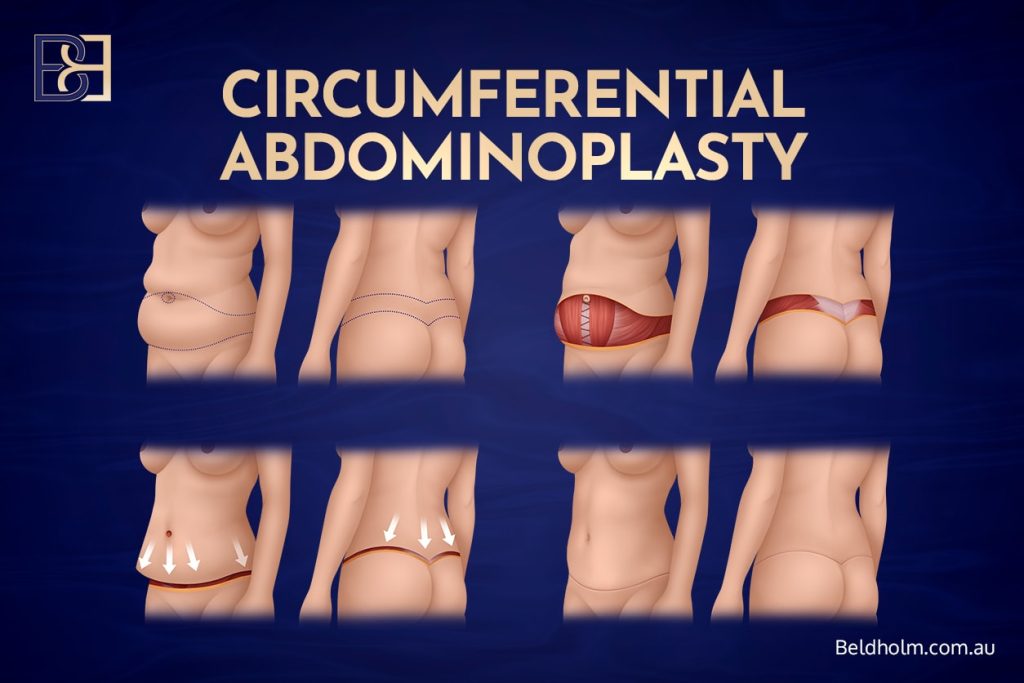

The main difference is how far around the body the operation goes.
- An abdominoplasty (tummy tuck) treats the front of the abdomen. It removes loose skin and fat from the upper and lower abdomen and, where indicated, repairs separated abdominal muscles. It does not treat the back, the buttocks, or the outer hips.
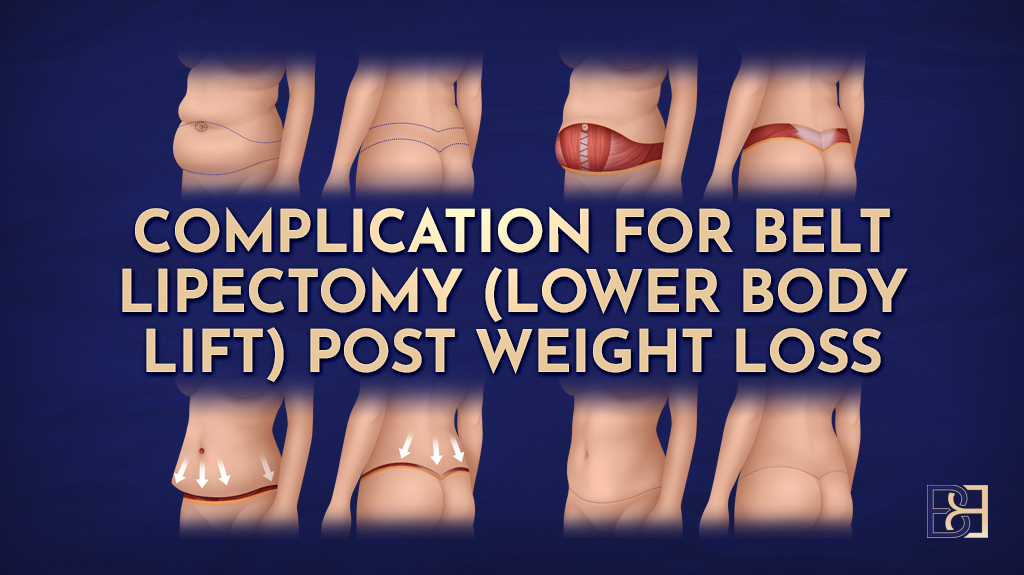
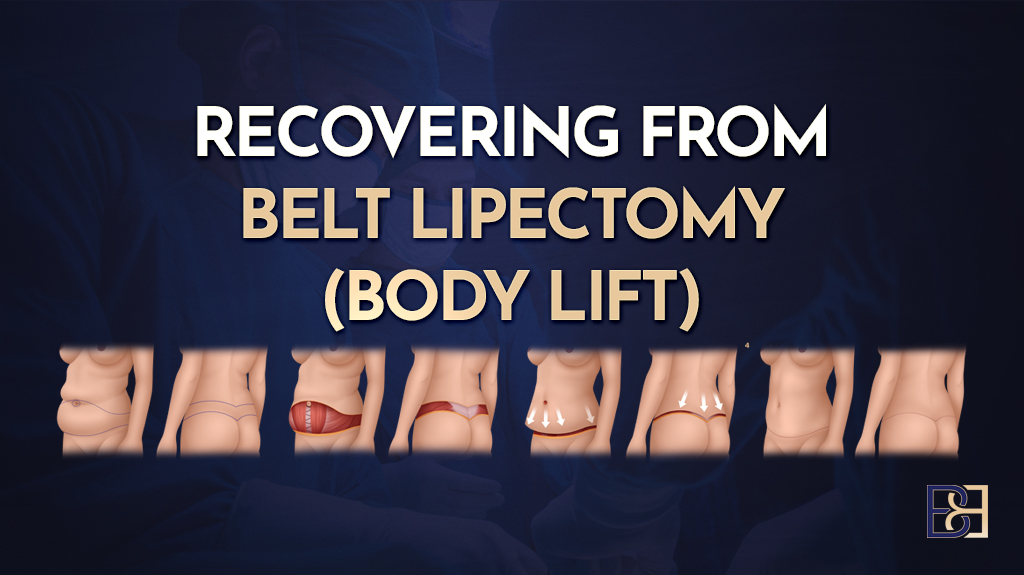
- A belt lipectomy (body lift) treats the full circumference of the lower trunk. It removes loose skin and fat from the front, sides, and back in a single operation and lifts the outer thigh and buttock via the back component.
In post weight loss patients, the choice usually comes down to one thing: whether the loose skin sits mainly across the front, or whether it continues right around the waistline. That pattern is assessed individually, and a belt lipectomy (body lift) is the larger of the two operations.
Abdominoplasty (tummy tuck) after weight loss
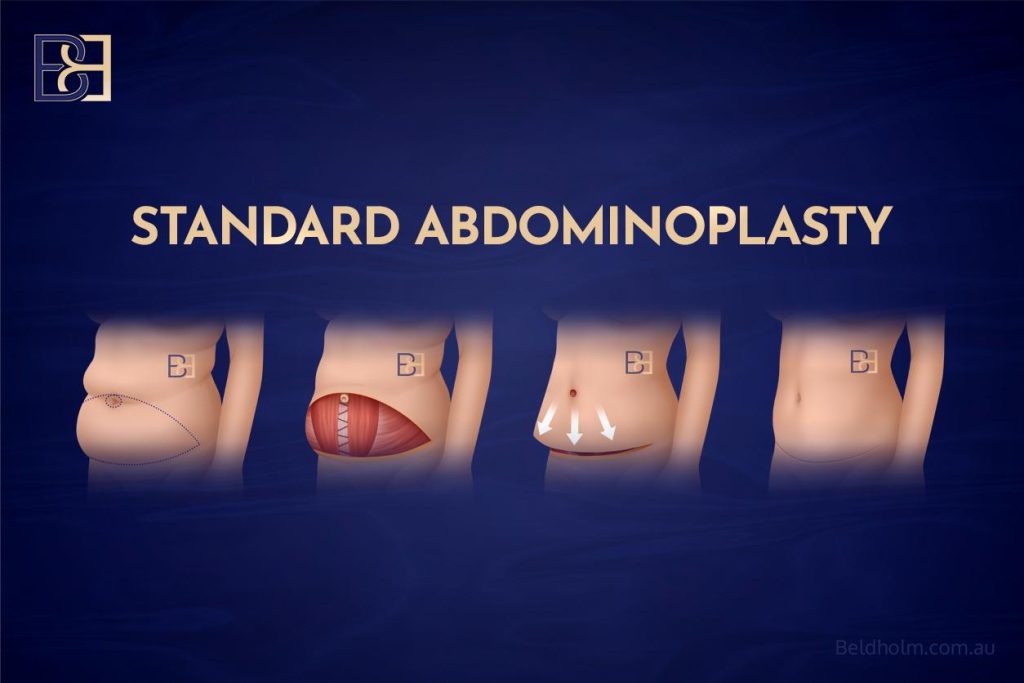
An abdominoplasty (tummy tuck) treats the front of the abdomen. It removes excess abdominal skin and fat that sit across the stomach after weight loss, and it tightens the remaining skin downward. I treat horizontal skin excess across the lower abdomen first. Where it is indicated, I also repair the separation of the abdominal wall muscles. This abdominal wall tightening is done only when there is true separation. In post weight loss patients the belly button (umbilicus) is usually stretched and pulled downward, so I free it and reposition it through the new skin.
I use liposuction (suction-assisted lipectomy) during most of these operations to remove excess fat, refine the contour, and make the tissue easier to lift and move.
Extended abdominoplasty is the usual starting point after weight loss
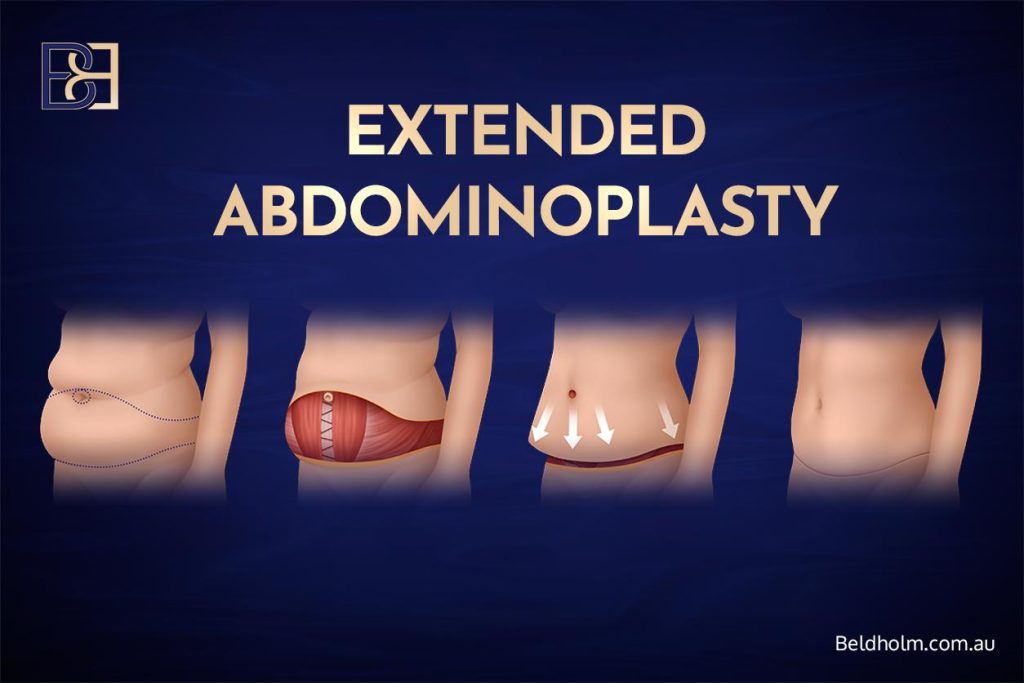
The version of the operation matters more for post weight loss patients than it does after pregnancy.
- A full abdominoplasty is the common post pregnancy operation. It treats the front of the abdomen between the hips.
- An extended abdominoplasty carries the incision farther around toward the flanks, so it also includes the loose skin along the sides. For most patients who have lost a large amount of weight, this is the version I am working with, because the laxity rarely stops neatly at the front.
When more than a horizontal excision is needed
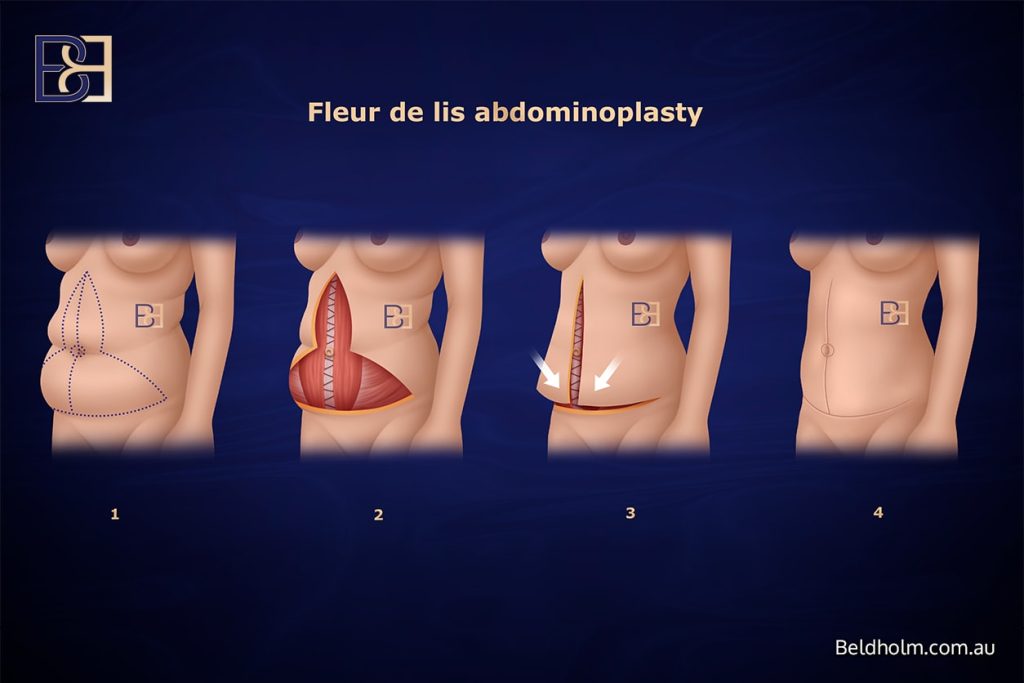
Some post weight loss patients have vertical excess skin running down the abdomen as well as horizontally. A standard horizontal excision alone does not take that up.
- A Fleur de Lis abdominoplasty uses a vertical incision in addition to the horizontal one. This lets me remove redundant skin in two directions and bring in the waistline. I cover this in detail in a separate article.
- For a patient whose main problem is a heavy overhang of skin and who is not suited to a longer operation, an apronectomy removes the overhanging apron of skin without the full muscle and contouring work. I cover this separately as well.
A limited abdominoplasty (mini abdominoplasty) treats only the skin below the belly button. It is rarely the right operation after significant weight loss, because the loose skin almost always extends above the belly button.
Muscle repair is assessed, not assumed
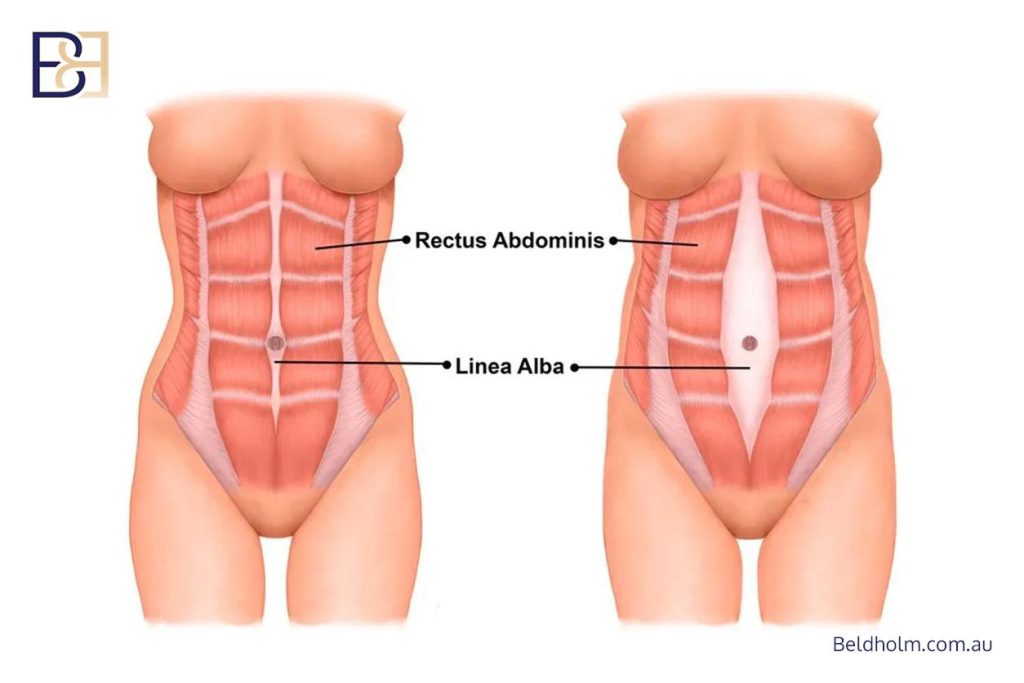
Separation of the abdominal muscles, called muscle separation (diastasis recti), is mainly a finding after pregnancy. It is not a given in post weight loss patients. I check for it on examination and repair the muscle only when the separation is actually present. I do not treat muscle repair as a routine part of every post weight loss abdominoplasty.
The mons (the pubic area) often drops after weight loss as well, and an abdominoplasty can lift it as part of the same operation when that is needed.
Belt lipectomy (body lift) after weight loss
A belt lipectomy (body lift) treats loose or excess skin that runs around the entire lower trunk. The circumferential incision passes around the body like a belt, which is where the name comes from, and it leaves a circumferential scar. In the literature, you will also see this operation referred to as a circumferential abdominoplasty, a lower body lift, or a circumferential body lift. They are the same procedure. It is a comprehensive surgical procedure designed to treat the entire lower trunk in a single operation, a form of circumferential body contouring.
This is the operation I reach for when the loose skin does not stop at the front. After major weight loss, the laxity often continues around the flanks, across the lower back, and down toward the buttocks and outer thighs. An abdominoplasty (tummy tuck) cannot reach that tissue because it only works on the front.
What it treats that an abdominoplasty does not
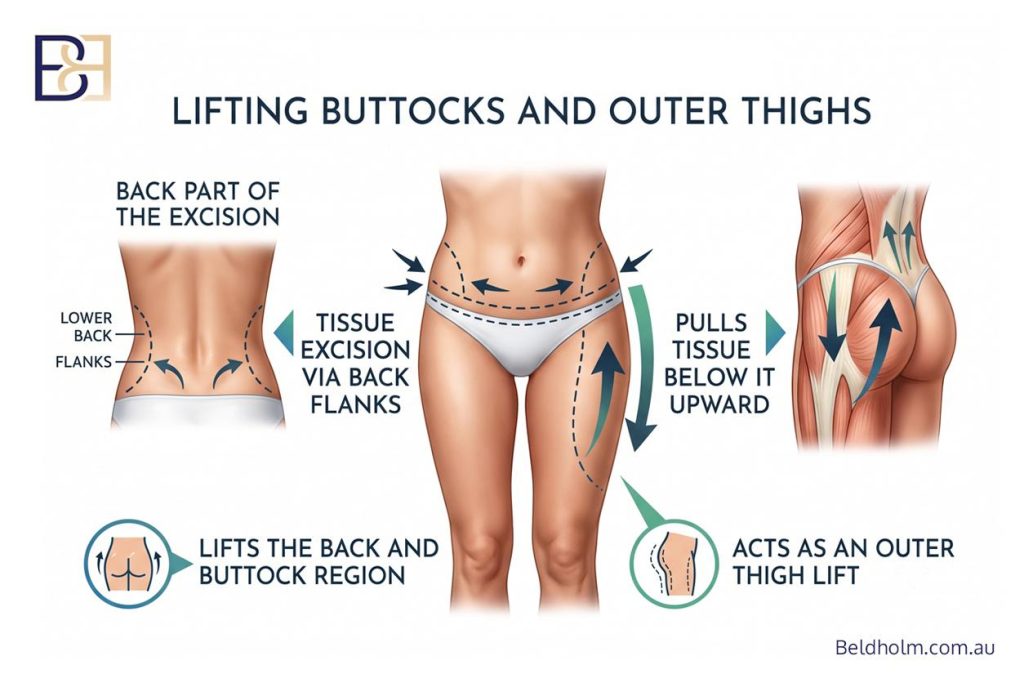
Working all the way around lets me do several things in one operation.
- Remove excess skin and fat from the front of the abdominal region, the same as an abdominoplasty.
- Remove the loose skin and fat at the sides and across the lower back.
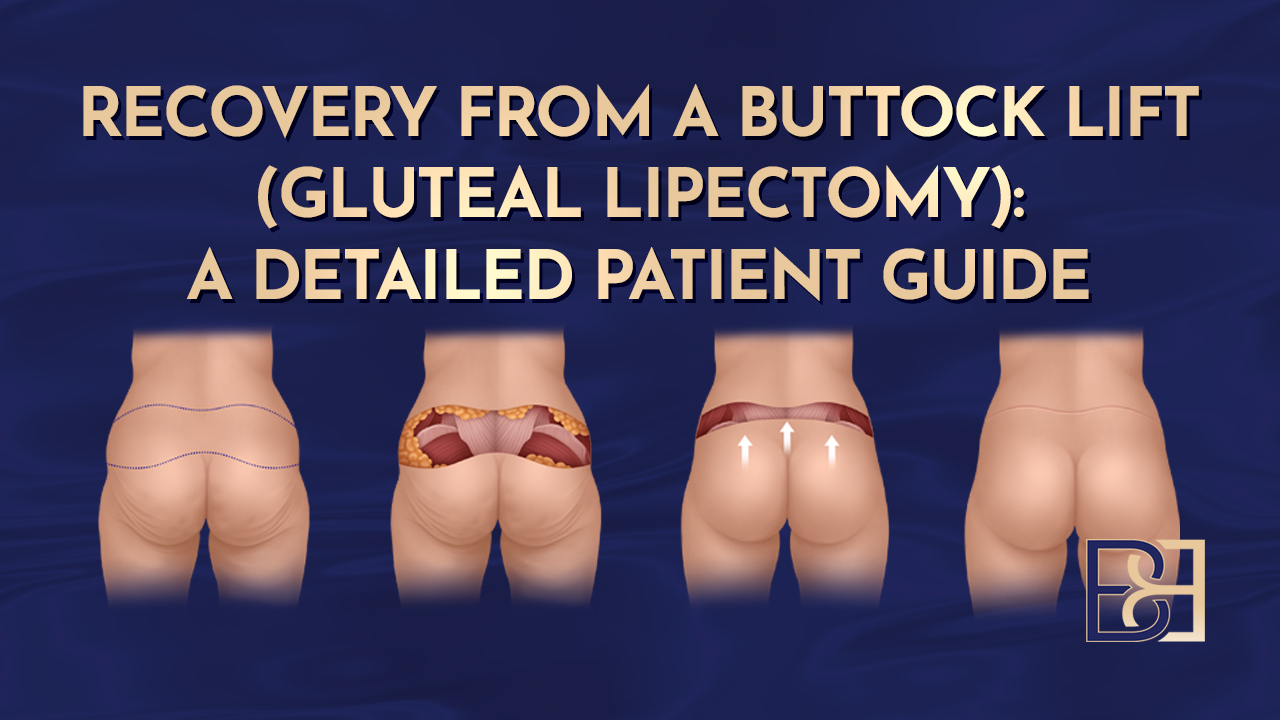
- Lift the buttocks and the outer thighs. This happens through the back part of the excision, which pulls the tissue below it upward, lifting the back and buttock region and acting as an outer thigh lift.
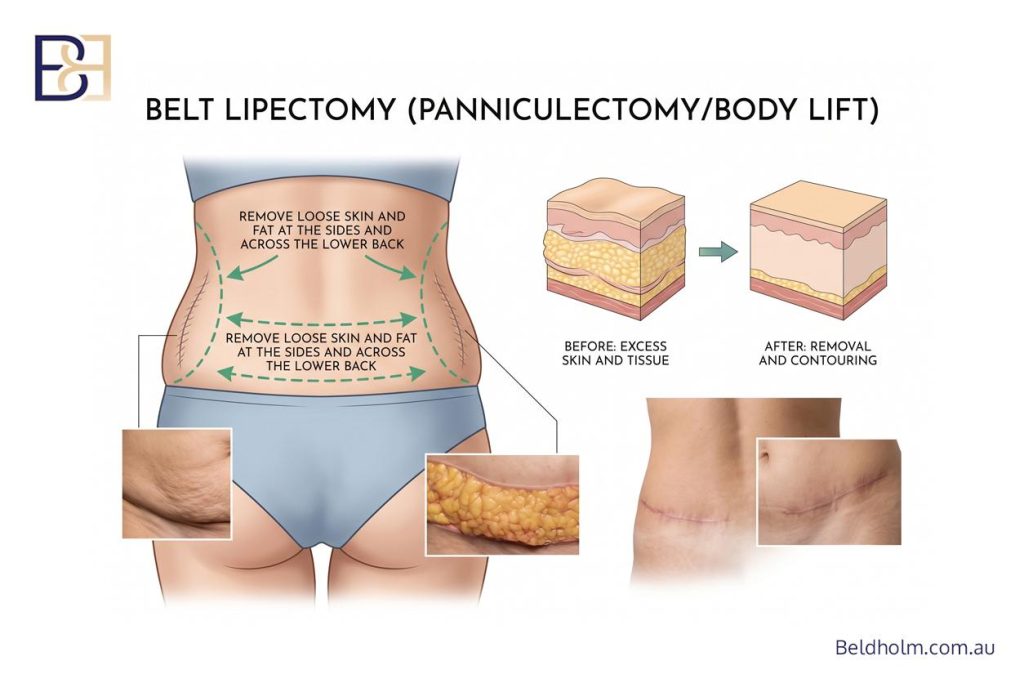
So a belt lipectomy (body lift) is not just a longer abdominoplasty. The back component changes what the operation can do for the buttock and outer thigh, and that is often the deciding factor for a patient whose laxity is truly circumferential (1). Loose skin higher up the back is treated by a separate operation, an upper body lift, not by belt lipectomy surgery.
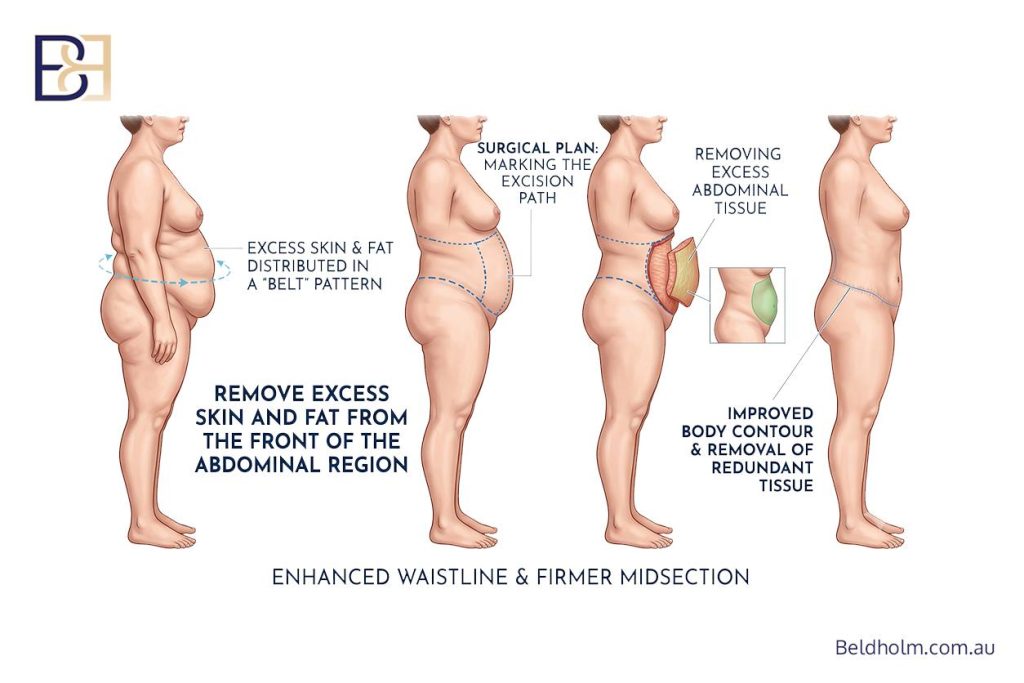
It is the larger of the two operations
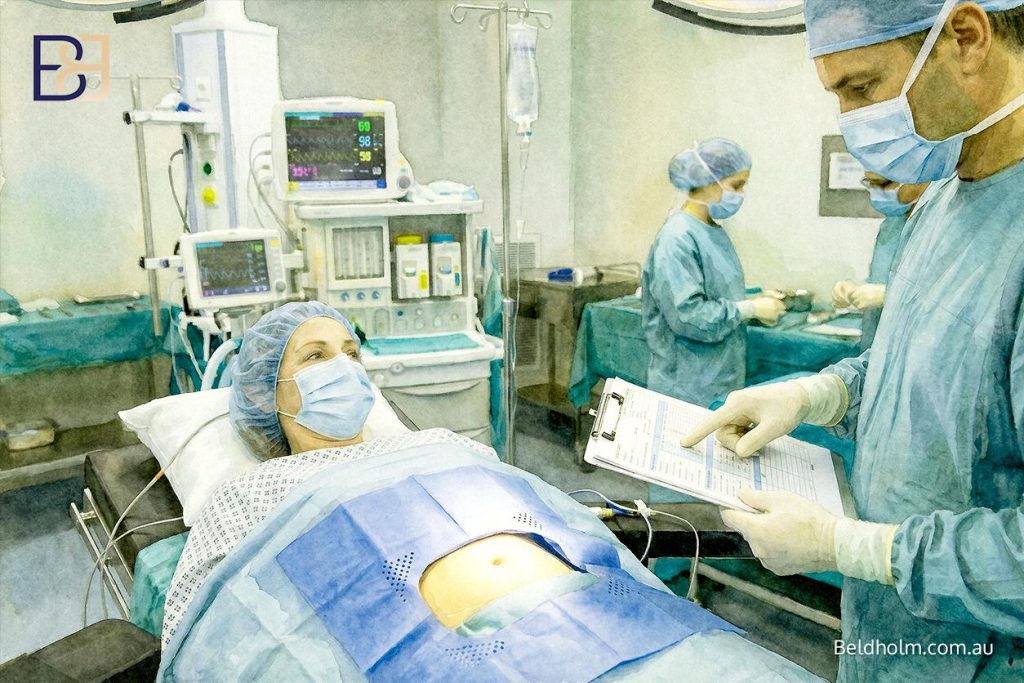
Body lift (belt lipectomy) surgery involves a longer incision, more tissue moved, and more time on the operating table than an abdominoplasty. Because the patient is repositioned during surgery to reach the back, the repositioning is a more significant physiological event. That has real consequences for preparation and recovery, which I cover further down.
I place two closed suction drains in post weight loss body contouring of this size, one on each side, to manage the fluid that collects under such a large area of lifted tissue.
Book your appointment online now
How I decide between them
There is no single answer that fits every patient. The choice between an abdominoplasty (tummy tuck) and a belt lipectomy (body lift) is a clinical judgement I make with each patient at consultation.
These are the things I weigh up.
The pattern of loose skin

This is the main one. I look at where the laxity actually sits.
- If the skin laxity is primarily along the front of the abdomen, an abdominoplasty usually treats it.
- If the loose skin continues around the flanks and across the back, and the buttock and outer thigh have dropped, then a front-only operation leaves a large part of the problem untreated. That is when a belt lipectomy (body lift) is considered.
I assess this with the patient standing because loose skin behaves differently under gravity than it does lying down.
Medical history and general health
A belt lipectomy (body lift) asks more of the body than an abdominoplasty. I go through a patient’s medical history, their other health conditions, and how well they would tolerate a longer operation and a longer recovery. For some patients the larger operation is reasonable. For others it is not, and that shapes the plan.
Weight should be stable first
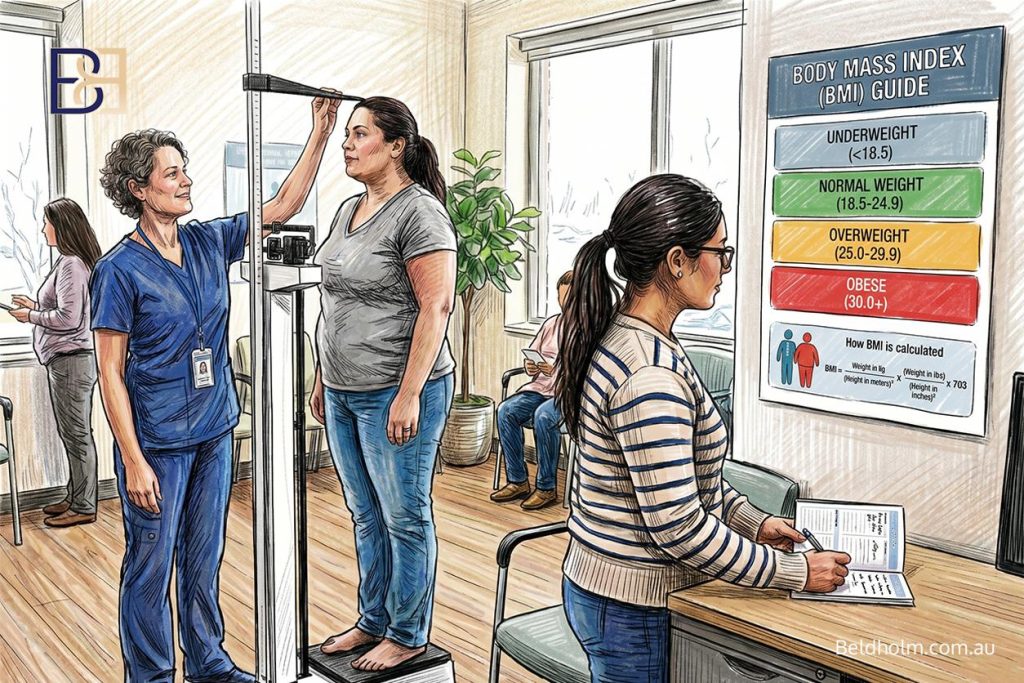
I want a patient at a stable weight before surgery, whether their weight loss came from weight loss surgery, weight loss medications, or diet and exercise. Operating while the weight is still moving works against healing and against the contour. I ask that patients maintain a stable weight and a healthy lifestyle for several months first. This matters for all massive weight loss patients, especially after significant weight reduction.
Nutritional status

Most people who have lost a large amount of weight have nutritional gaps, and these matter more before a bigger operation (2). This is common after bariatric surgery in particular. I check this with blood tests before surgery and correct what needs correcting. I cover the details of pre-operative nutrition separately.
What can be done well in one operating time
There is a limit to how much can be completed properly in a single operation. The extent of the loose skin, the patient’s build, and how long the anaesthetic can reasonably last all feed into whether the work fits into one operation or is better divided. That question, one operation or several, is the next thing I weigh up with the patient.
The point I make to every patient is that this is decided individually at consultation.
One comprehensive operation or staged surgery

When the loose skin is extensive, a related question comes up: should the work be done in one larger operation, or divided across two or more separate operations.
Where a patient is suited to it, I prefer treating excess skin in a single comprehensive operation rather than dividing it across several body contouring procedures. The reason is practical. One operation means one anaesthetic, one hospital admission, and one recovery to work through, rather than repeating each of those steps two or three times.
This is a preference, not a rule.
Staging is the right path for some patients
For some patients, doing everything at once places more demand on the body than is sensible. In that situation, staging the work across separate operations is the more appropriate. Staging is a legitimate clinical choice. It is not a lesser option or a compromise, and for some patients, it is exactly what I recommend.
Which path suits a particular patient depends on their medical history, their nutritional status, the extent and pattern of their loose skin, and how much can be completed well in a single operating time. That is assessed at consultation with the patient after a GP referral. It is not decided in advance.
A larger operation is a bigger event, not a shortcut
A single comprehensive operation is a larger physiological event than a smaller one. The benefit of consolidating the work is balanced against the greater demand a longer operation places on the body.
That is exactly why pre-operative preparation matters more when a single comprehensive operation is planned, not less. Most post weight loss patients have nutritional gaps that developed during weight loss, and correcting these before surgery supports healing (2). Getting that preparation right is part of what makes a larger operation a reasonable choice in the first place. I cover pre-operative nutrition in detail separately.
None of this is about doing more surgery than a patient needs. The aim is to treat what is there in the way that is appropriate for the individual, and whether that is one operation or several is a decision I make with each patient at consultation.
Risks and recovery for each operation

Both operations are major surgeries, and both carry risk. A belt lipectomy (body lift) carries more than an abdominoplasty (tummy tuck), because the incision is longer and far more tissue is moved.
Risks to understand
For both operations, the possible complications include bleeding, infection, fluid collection under the skin (seroma), delayed wound healing, and wound separation along the incision (3). Some loss of skin sensation is common and may be lasting. Scars are permanent. Asymmetry and contour irregularities can occur, and some patients need a revision operation later. The extent of skin removal and how the underlying tissues heal both affect the final contour.
A clot in the leg (deep vein thrombosis) that can travel to the lungs is a recognised risk of any large body-contouring operation, and the risk is higher with the longer procedure (4). Blood clots are taken seriously, and the risk with belt lipectomy is higher than with many other body contouring procedures. I assess this risk for each patient and decide on clot prevention myself. I have written about clot prevention separately.
These risks are not reasons to avoid surgery. They are the reasons I assess each patient carefully and prepare them properly first.
Time in hospital

How many nights a patient stays is a clinical decision I make day by day, based on how they are recovering. A belt lipectomy (body lift) generally requires a longer hospital stay than an abdominoplasty because it is a larger operation. All patients receive blood-thinning injections in the hospital, and most continue them for about two weeks after going home. Patients can be discharged with drains still in place.
The first weeks at home

The recovery process is similar in shape for both operations, longer and more demanding after a belt lipectomy.
- Dressings: I use PICO dressings over the incisions until about day 7, then move to Hypafix tape.
- Compression garment: full-time for about 4 weeks, then part-time for a further 2 weeks. Daytime wear matters most because swelling tends to build over the course of the day.
- Drains: removed once the daily output drops sufficiently, usually after 2 to 7 days.
- The scars look their worst in the first few weeks. Some bunching, firmness, and minor wound discharge in this period is expected, not a sign something has gone wrong.
Getting back to activity

- Desk or sedentary work: around 4 weeks for most patients.
- Manual or physical work: 6 to 8 weeks.
- Lifting: nothing heavier than 10 kg in the early weeks.
When a patient can return to core exercise depends on what was done.
- If the operation removed skin and fat only, core work and squats can usually start from around 4 weeks.
- If I repaired the abdominal muscles, the wait is longer, 8 weeks or more, to protect that repair.
I review every patient at 4 weeks, then again at 3, 6, and 12 months. Scars keep maturing across that first year and beyond, and scar management over that period matters. Recovery times vary depending on the operation and the individual.
Realistic expectations
It helps to hold realistic expectations. These operations remove excess skin, but they leave permanent scars, sometimes visible and prominent scarring, and the result depends on the underlying tissues and how they heal. Results vary from one patient to the next.
Medicare and eligibility

Some post weight loss patients meet Medicare Benefits Schedule criteria for part of this surgery where there is a medical indication, such as recurrent skin irritation under an overhang of excess skin. A belt lipectomy (body lift) has its own item number where the criteria are met. Whether a patient qualifies depends on their individual circumstances and is checked as part of planning. Current fees and any rebate detail are set out on the pricelist page.
Consultation and referral

A GP referral is required before a consultation. At the consultation I assess the pattern and extent of the loose skin, go through the medical history and nutritional status, and talk through which operation, or which staged plan, suits the individual.
The decision between an abdominoplasty (tummy tuck) and a belt lipectomy (body lift) is not one to make from a website. It is made with the patient, after assessment, and results vary from one person to the next.
References
- Aly AS, Cram AE, Chao M, Pang J, McKeon M. Belt lipectomy for circumferential truncal excess: the University of Iowa experience. Plast Reconstr Surg. 2003;111(1):398-413.
- Makarawung DJS, Al Nawas M, Smelt HJM, Monpellier VM, Wehmeijer LM, van den Berg WB, et al. Complications in post-bariatric body contouring surgery using a practical treatment regime to optimise the nutritional state. JPRAS Open. 2022;34:91-102.
- Aly A, Mueller M. Circumferential truncal contouring: the belt lipectomy. Clin Plast Surg. 2014;41(4):765-774.
- Griffin M, Akhavani MA, Muirhead N, Fleming ANM, Soldin M. Risk of thromboembolism following body-contouring surgery after massive weight loss. Eplasty. 2015;15:e17.