Abdominoplasty (tummy tuck) surgery after major weight loss is more variable than post‑pregnancy abdominoplasty. In patients following significant or massive weight loss, the primary issue is excess skin rather than muscle tightening.
After substantial weight loss, reduced skin elasticity and stretched abdominal skin mean the tummy tuck (abdominoplasty) is primarily a surgical procedure to remove excess skin and address loose skin. Unlike post‑pregnancy cases, where separated abdominal muscles are often the main concern, post‑weight‑loss abdominoplasty surgery focuses on skin removal across a larger abdominal area.
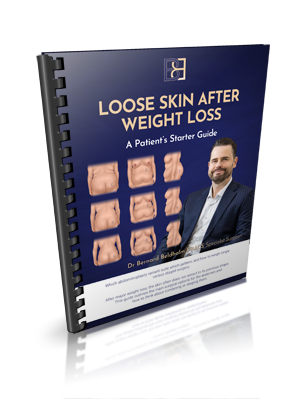
The extent and distribution of excess skin vary widely. Skin laxity may involve the lower abdomen only or extend to the flanks, hips, and back, requiring anything from a full abdominoplasty to extended or circumferential body contouring procedures.
Previous bariatric surgery or other abdominal operations can further increase complexity due to scars and changes to the abdominal wall. For these reasons, how long abdominoplasty takes after major weight loss depends on individual anatomy and surgical scope, rather than a fixed timeframe, and varies more than post‑pregnancy abdominoplasty.
Who This Article Is For and Why Surgery Time Matters
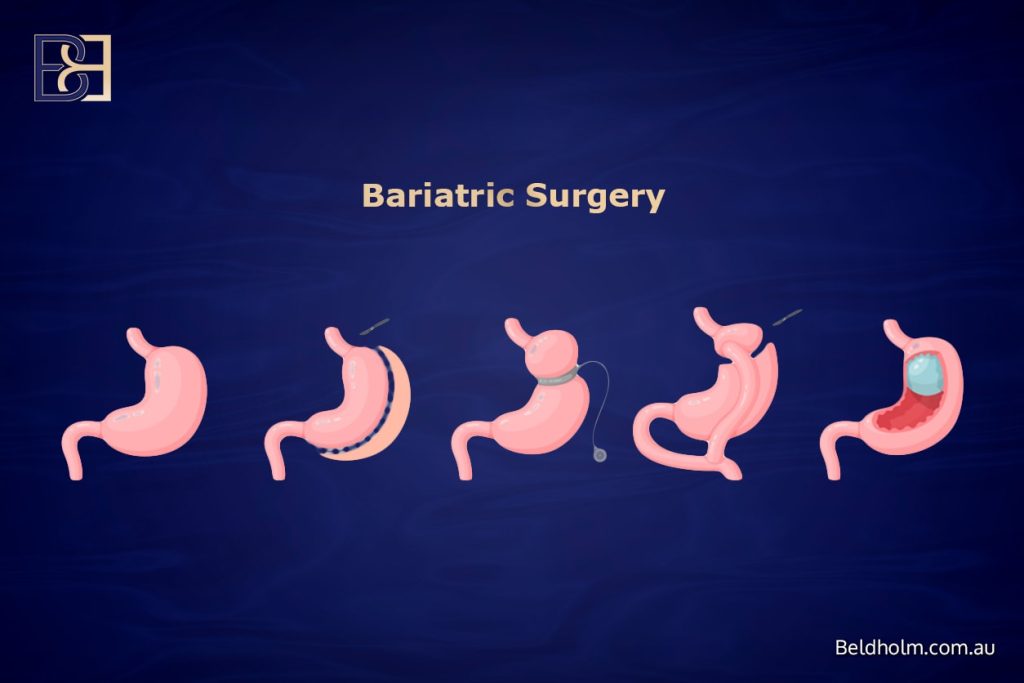
This article is written for patients who have experienced major weight loss and are considering abdominoplasty (tummy tuck) surgery to manage excess skin. Understanding how long an operation takes is important, as surgical duration has practical implications for cost, recovery, and overall surgical planning.
It is particularly relevant for:
- Patients following bariatric surgery as part of a weight loss procedure
- Patients who have achieved massive or significant weight loss through non‑surgical means
- Patients who have completed their weight loss journey and have reached a stable weight
In post‑weight‑loss patients, the tummy tuck (abdominoplasty) procedure is most commonly performed to remove excess skin rather than for muscle tightening alone. The amount and distribution of loose skin influence not only the type of abdominoplasty recommended but also the extent of the operation.
Longer and more comprehensive body contouring procedures generally involve treating a larger surface area and removing a greater volume of excess skin. While these operations take more time, they may reduce the need for further or staged surgery by treating the abdomen, flanks, and back in a single procedure. In contrast, smaller operations, such as a standard abdominoplasty, may be shorter but can leave residual loose skin in the flanks, back, or horizontally, which may require additional surgery at a later stage.
Surgical duration also affects postoperative recovery, anaesthetic exposure, and overall cost. For this reason, an individual assessment including a review of medical history is required to determine whether abdominoplasty is appropriate and which body-contouring procedure best balances operative time, recovery, and surgical goals.
Table of Contents
Overview of Abdominoplasty Surgery Time After Weight Loss

A common question after major weight loss is: How long does abdominoplasty take after major weight loss? In most post‑weight‑loss patients, abdominoplasty surgery takes between 3 and 8+ hours under general anaesthetic, depending on the type and extent of surgery performed.
Unlike a standard tummy tuck (abdominoplasty) performed for limited skin laxity, post‑weight‑loss tummy tuck (abdominoplasty) surgery often involves treating a much larger surface area. Operative time varies primarily with the extent of skin removal and the complexity of the procedure.
Key factors that influence surgery time include:
- Extent of excess skin – whether loose skin is limited to the anterior abdomen or extends to the flanks and back
- Type of abdominoplasty performed – full, extended, fleur‑de‑lis, or circumferential procedures all differ significantly in duration
- Presence of excess skin and fat, which may require liposuction (suction-assisted lipectomy), Circumferential Abdominoplasty (Lower Body Lift or belt lipectomy)
Smaller procedures, such as a full abdominoplasty limited to the front of the abdomen, are generally shorter. More extensive body contouring procedures remove more excess skin but require longer operating times and more complex surgical planning.
The sections below outline typical timeframes for the different abdominoplasty procedures commonly performed after significant weight loss, helping patients understand how operative time relates to the extent of skin removal and overall surgical decision‑making.
Full Abdominoplasty After Weight Loss
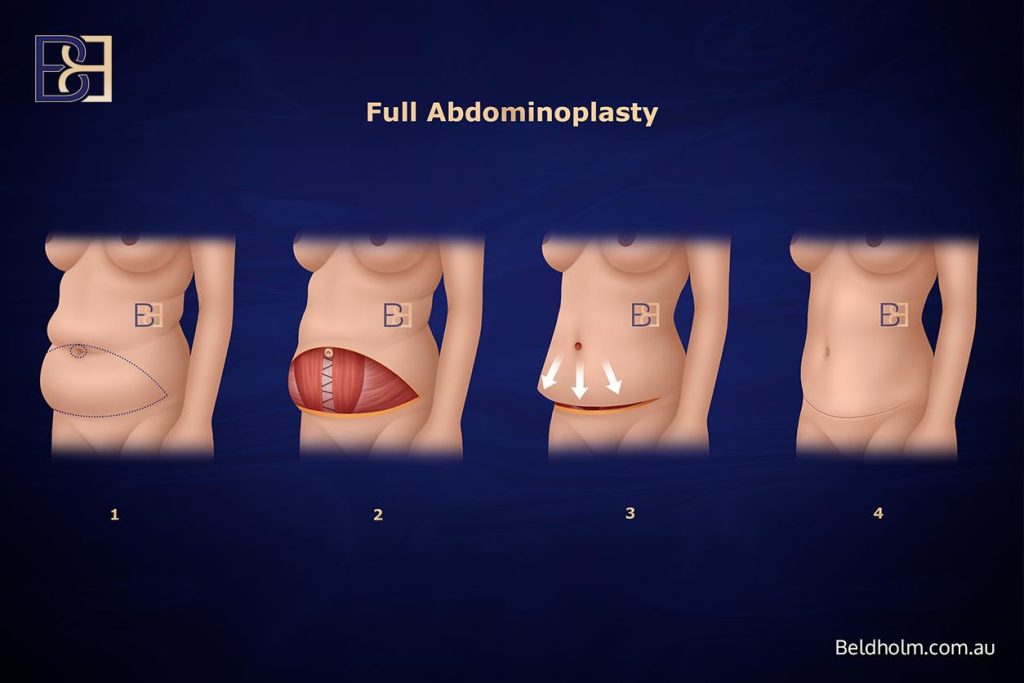
A full abdominoplasty (tummy tuck) is commonly used in post‑weight‑loss patients when excess skin is predominantly limited to the anterior abdominal area. In patients who have reached a stable weight, this abdominoplasty procedure is most often focused on skin removal rather than large‑volume fat reduction or muscle tightening.
This procedure is typically considered when loose skin affects the front of the abdomen but does not extend significantly into the flanks or back.
Full Abdominoplasty – Skin Removal Only
- Typical surgical time: approximately 3 hours under general anaesthetic
- Designed to remove excess abdominal skin from the front of the abdomen
- Includes repositioning of the belly button
- Limited tightening of the abdominal wall may be performed if clinically indicated
Full Abdominoplasty With Liposuction (suction-assisted lipectomy)
- Considered when excess skin and fat are both present
- Liposuction (suction-assisted lipectomy) is performed as part of a tummy tuck (abdominoplasty)
- Adds approximately 1.5 hours to the operation
- More commonly required when residual excess fat remains after major weight loss
Full Abdominoplasty With Abdominal Muscle Repair
- May include repair of abdominal muscle separation (diastasis recti)
- Less common after weight loss than in post‑pregnancy patients
- Adds approximately 30 minutes to the surgical procedure when required
Full Abdominoplasty With Hernia Repair
- Hernia repair may be performed during the same operation when indicated
- Hernia types may include ventral, incisional, umbilical, inguinal, femoral, or Spigelian hernias
- Adds approximately 1 hour, depending on the number and complexity of repairs
Limitations of a Full Abdominoplasty After Weight Loss
- Does not treat loose skin of the flanks, back, or circumferential waistline
- Horizontal or lateral skin excess may remain untreated
- Further or staged body contouring procedures may be required for more comprehensive skin removal
Extended Abdominoplasty After Significant Weight Loss
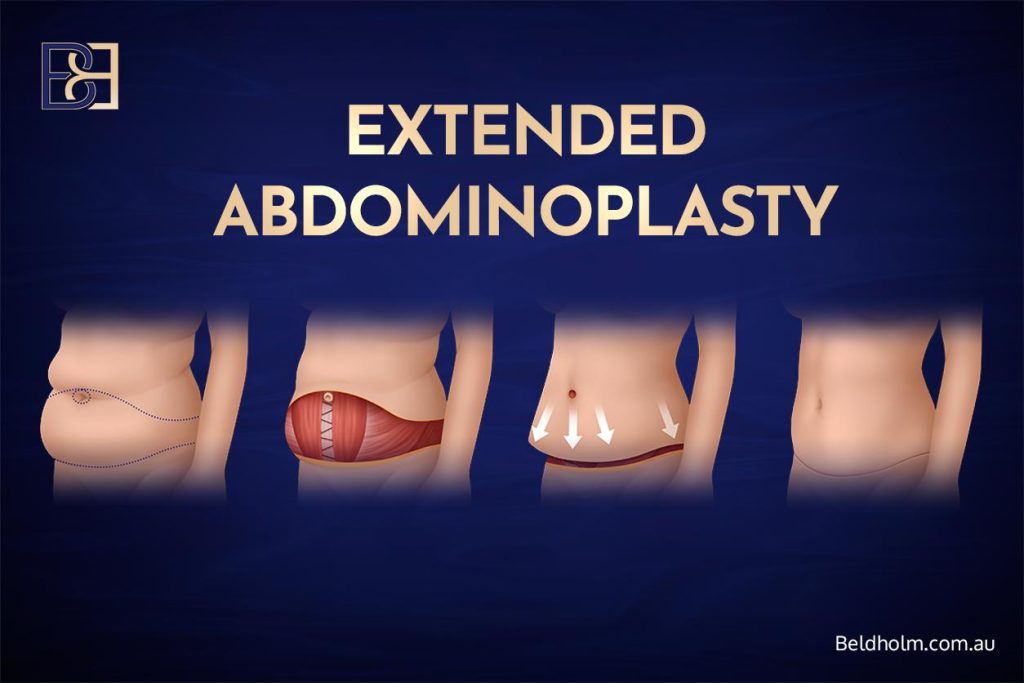
An extended abdominoplasty is commonly recommended for post‑weight‑loss patients when excess skin extends beyond the central abdomen to involve the flanks and lateral abdominal area. This procedure treats a larger surface area than a full abdominoplasty and is often indicated after significant or massive weight loss.
Compared with a standard abdominoplasty, an extended abdominoplasty allows more comprehensive skin removal along the waistline but does not treat the back or fully circumferential skin excess.
Extended Abdominoplasty – Skin Removal Only
- Typical surgical time: approximately 4 hours under general anaesthetic
- Treats loose skin of the anterior abdomen and flanks
- Allows removal of a greater amount of excess skin than a full abdominoplasty
- Liposuction (suction-assisted lipectomy) is not routinely required when loose skin is the primary issue
Extended Abdominoplasty With Liposuction (suction-assisted lipectomy)
- Considered when excess skin and fat are both present in the abdomen or flanks
- Liposuction (suction-assisted lipectomy) performed as part of an extended abdominoplasty (tummy tuck)
- Adds approximately 1.5 hours to the operation
- More commonly required when residual excess fat remains after weight loss
Extended Abdominoplasty With Abdominal Muscle Repair
- May include repair of abdominal muscle separation when clinically indicated
- Less common after weight loss than post‑pregnancy but may be appropriate in selected patients
- Adds approximately 30 minutes to the surgical procedure
Extended Abdominoplasty With Hernia Repair
- Hernia repair may be performed during the same operation when present
- Commonly includes ventral, incisional, or umbilical hernias
- Adds approximately 1 hour, depending on the number and complexity of repairs
Limitations of an Extended Abdominoplasty After Weight Loss
- Does not fully treat loose skin of the lower back or posterior waistline
- Circumferential or horizontal skin excess may remain untreated
- More extensive procedures, such as circumferential abdominoplasty, may be required to avoid staged surgery
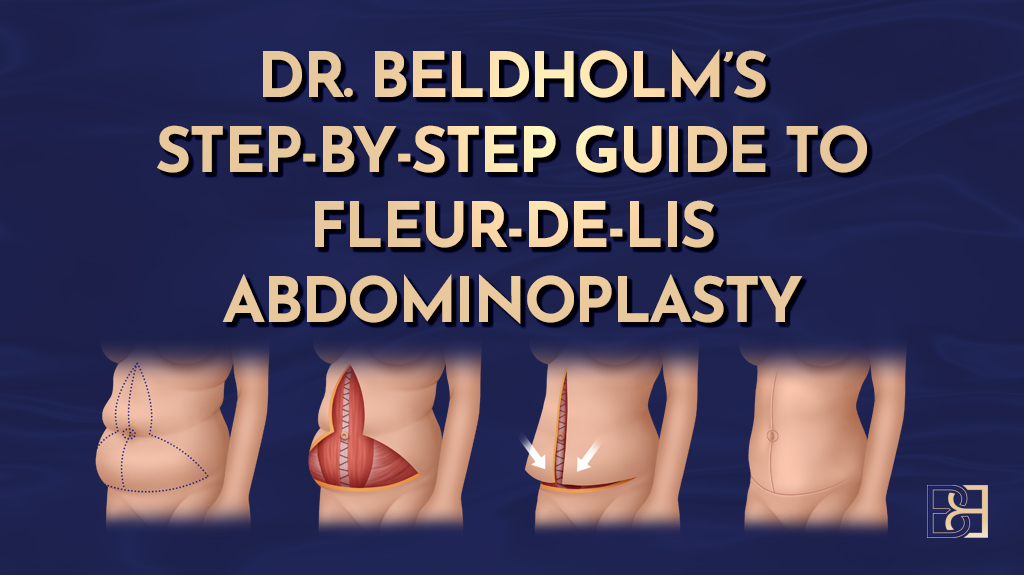
Fleur-de-Lis Abdominoplasty After Massive Weight Loss

A fleur-de-lis abdominoplasty is most commonly performed in patients who have experienced substantial weight loss and have excess skin in both vertical and horizontal directions. This pattern of skin laxity is frequently seen after bariatric surgery, where weight loss has stretched the abdominal skin, which cannot be adequately treated with a standard or extended abdominoplasty alone.
Unlike other abdominoplasty procedures, the fleur-de-lis approach allows removal of excess skin both from side to side and from top to bottom. This makes it particularly suitable for patients with significant central abdominal skin excess and reduced skin elasticity following major weight loss.
Fleur-de-Lis Abdominoplasty – Skin Removal Only
- Typical surgical time: approximately 4.5 hours under general anaesthetic
- Designed to remove excess abdominal skin in both vertical and horizontal planes
- Commonly indicated after massive weight loss or bariatric surgery
- Focuses primarily on skin removal rather than fat reduction
Fleur-de-Lis Abdominoplasty With Liposuction (suction-assisted lipectomy)
- Considered when excess skin and fat are both present
- Liposuction (suction-assisted lipectomy) performed as part of a tummy tuck (abdominoplasty)
- Adds approximately 1.5 hours to the operation
- Used selectively where residual excess fat remains after weight loss
Fleur-de-Lis Abdominoplasty With Abdominal Muscle Repair
- May include repair of abdominal muscle separation when clinically indicated
- Less common after weight loss than post-pregnancy but may still be required in selected patients
- Adds approximately 30 minutes to the surgical procedure
Fleur-de-Lis Abdominoplasty With Hernia Repair
- Hernia repair may be performed during the same operation when present
- Hernia types may include ventral, incisional, or umbilical hernias
- Adds approximately 1 hour, depending on the number and complexity of repairs
Limitations of a Fleur-de-Lis Abdominoplasty After Weight Loss
- Does not treat loose skin of the lower back or the circumferential waistline
- The scarring pattern is more extensive due to vertical and horizontal incisions
- Circumferential abdominoplasty may be required if back or flank skin excess is significant
Dual Vector Abdominoplasty
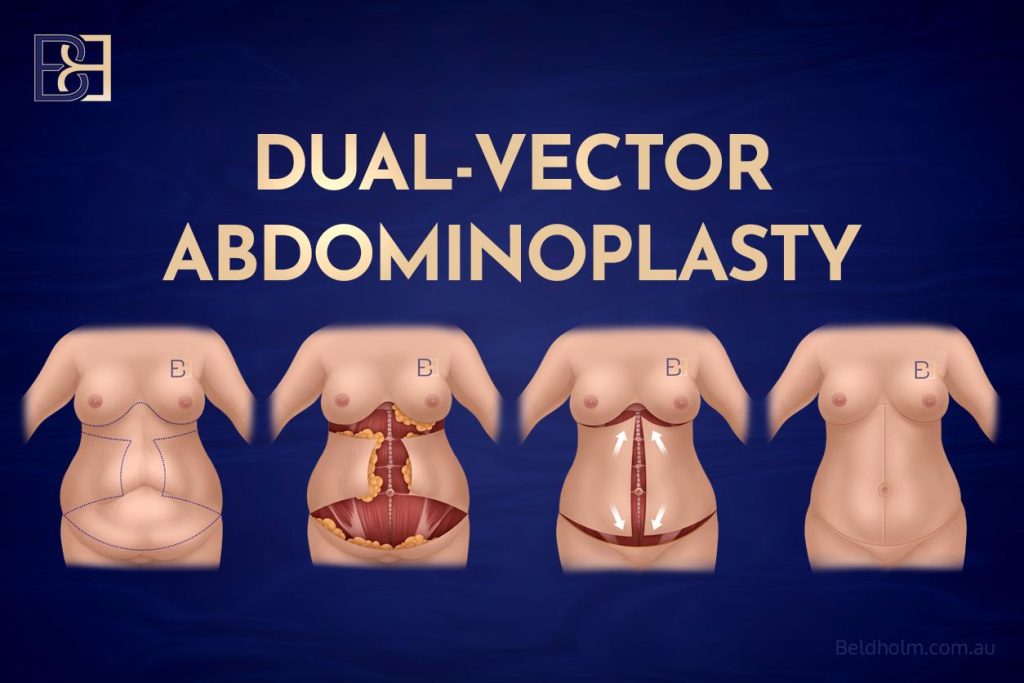
A dual vector abdominoplasty is used in selected post‑weight‑loss patients where excess skin is present in multiple directions and cannot be adequately treated by a standard, extended, or fleur‑de‑lis abdominoplasty alone. This approach is typically considered after significant or massive weight loss, particularly where skin laxity affects both the vertical and horizontal dimensions of the abdomen.
In post‑weight‑loss anatomy, skin redundancy may not follow a single pattern. A dual vector abdominoplasty allows skin removal and tightening along multiple axes, making it useful for patients with complex or uneven loose skin distribution after weight loss.
Dual Vector Abdominoplasty – Skin Removal Only
- Typical surgical time: approximately 5 hours under general anaesthetic
- Designed to treat multidirectional loose skin of the abdominal area
- Focuses primarily on skin removal rather than fat reduction
- Commonly considered where previous procedures would leave residual skin laxity
Dual Vector Abdominoplasty With Liposuction (suction-assisted lipectomy)
- Considered when excess skin and fat are both present
- Liposuction (suction-assisted lipectomy) performed as part of a tummy tuck (abdominoplasty)
- Adds approximately 1.5 hours to the operation
- Used selectively in post‑weight‑loss patients with residual excess fat
Dual Vector Abdominoplasty With Abdominal Muscle Repair
- May include repair of abdominal muscle separation when clinically indicated
- Less common after weight loss, but may be appropriate in selected cases
- Adds approximately 30 minutes to the surgical procedure
Dual Vector Abdominoplasty With Hernia Repair
- Hernia repair may be performed during the same operation when present
- May include ventral, incisional, or umbilical hernias
- Adds approximately 1 hour, depending on the number and complexity
Limitations of a Dual Vector Abdominoplasty After Weight Loss
- Does not treat loose skin of the lower back or the fully circumferential waistline
- The scarring pattern may be more complex than standard abdominoplasty techniques
- Circumferential abdominoplasty may be required when back or flank skin excess is significant
Circumferential Abdominoplasty (Lower Body Lift or belt lipectomy)
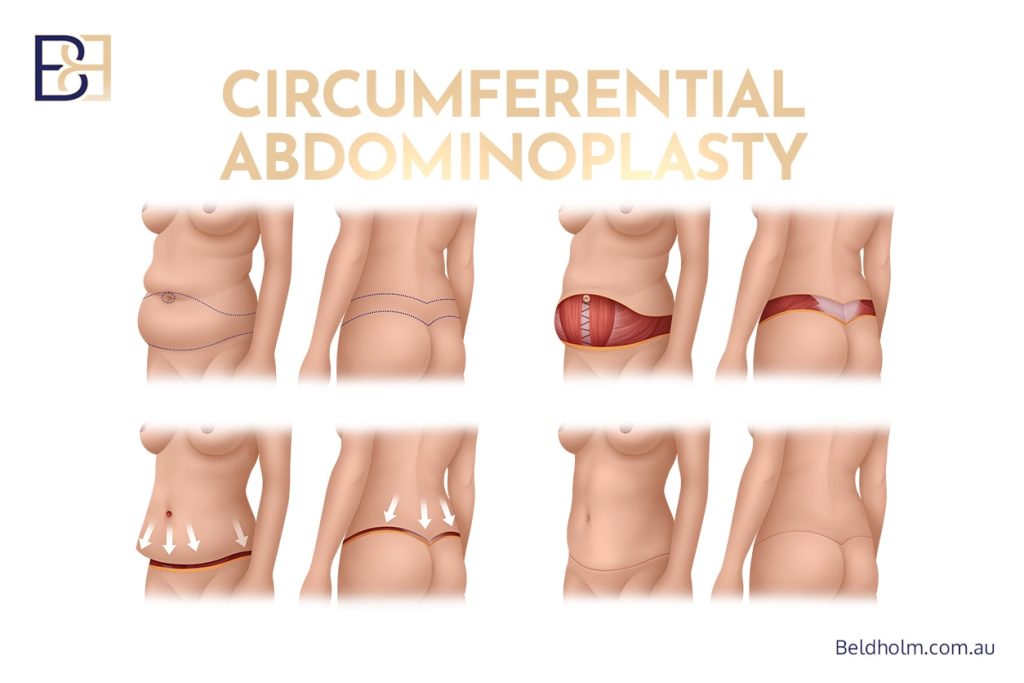
A circumferential abdominoplasty, also referred to as a lower body lift, is the most extensive abdominoplasty procedure commonly performed after major or massive weight loss. It is typically indicated when excess skin affects the abdomen, flanks, hips, and lower back, creating circumferential skin laxity that cannot be adequately treated with anterior procedures alone.
This operation is frequently considered in patients following bariatric surgery or extreme weight loss, where skin redundancy extends around the entire waistline. By treating the front and back in a single surgical plan, a circumferential abdominoplasty can remove a large volume of excess skin and reduce the likelihood of requiring multiple staged procedures.
Circumferential Abdominoplasty – Skin Removal Only
- Typical surgical time: approximately 6 hours under general anaesthetic
- Treats loose skin of the abdomen, flanks, hips, and lower back
- Focuses primarily on circumferential skin removal rather than fat reduction
- Often described clinically as a lower body lift (belt lipectomy or 360 degree lift)
Circumferential Abdominoplasty With Liposuction (Suction-assisted lipectomy)
- Considered when excess skin and fat are present around the waistline or back
- Liposuction (Suction-assisted lipectomy) performed as part of a tummy tuck (abdominoplasty)
- Adds approximately 2.5–3 hours to the operation
- Due to operative length, procedures are often staged
Circumferential Abdominoplasty With Muscle or Hernia Repair
- Abdominal muscle repair may be included when clinically indicated
- Hernia repair may be performed during the same operation if present
- Muscle repair typically adds ~30 minutes
- Hernia repair generally adds ~1 hour, depending on complexity
Limitations of a Circumferential Abdominoplasty After Weight Loss
- Longer operative time compared with anterior-only procedures
- Increased recovery demands due to the extent of skin removal
- Staged surgery may still be required in selected patients
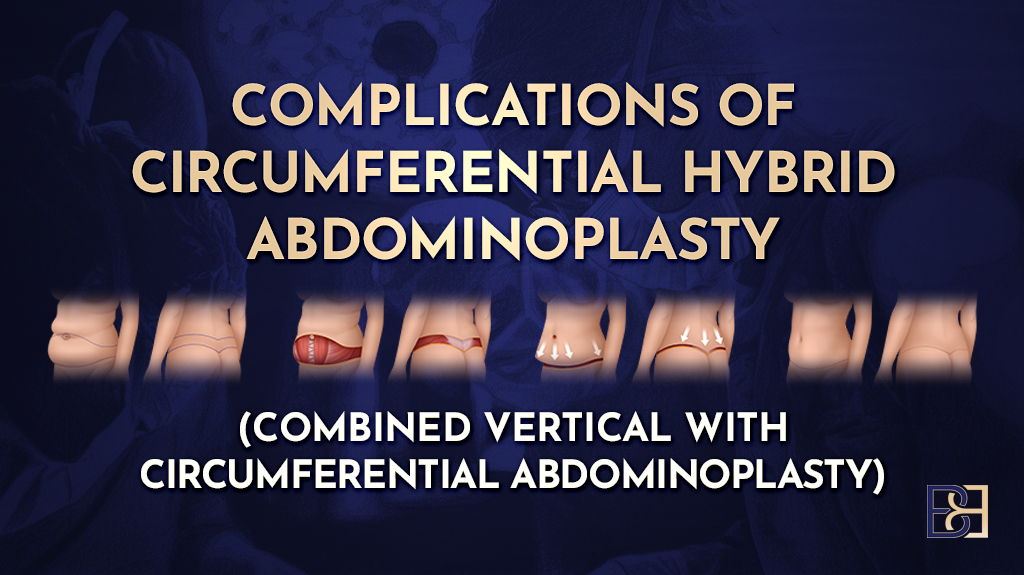
Circumferential Hybrid Abdominoplasty

A circumferential hybrid abdominoplasty is reserved for selected post‑weight‑loss patients with extreme or massive weight loss, in whom skin excess is extensive, complex, and involves the entire circumference of the trunk. This procedure combines elements of circumferential abdominoplasty with additional tailored skin excision to treat areas that cannot be adequately corrected with a standard lower-body lift (belt lipectomy). This approach is most commonly considered when patients have marked excess skin of the abdomen, flanks, hips, lower back, and upper buttocks, often following bariatric surgery. The aim is to maximise skin removal in a single surgical plan while recognising the increased complexity and operative time involved.
Circumferential Hybrid Abdominoplasty – Skin Removal Only
- Typical surgical time: approximately 7–8 hours under general anaesthetic
- Treats extensive circumferential loose skin of the abdomen, waistline, and back
- Allows more comprehensive skin removal than a standard circumferential abdominoplasty
- Focuses primarily on skin excision rather than fat reduction
Circumferential Hybrid Abdominoplasty With Liposuction (suction‑assisted lipectomy)
- Considered when excess skin and fat are present across multiple regions
- Liposuction (suction‑assisted lipectomy) performed as part of a tummy tuck (abdominoplasty)
- Adds approximately 2.5–3 hours to the operation
- Due to prolonged operative time, procedures are frequently staged for patient safety
Circumferential Hybrid Abdominoplasty With Adjunct Repairs
- Abdominal muscle repair may be included when clinically indicated
- Hernia repair may be performed during the same operation if present
- Muscle repair typically adds ~30 minutes
- Hernia repair generally adds ~1 hour, depending on the number and complexity
Limitations of a Circumferential Hybrid Abdominoplasty After Weight Loss
- Longest operative time of all abdominoplasty procedures
- Increased recovery demands and postoperative support requirements
- Staged surgery may still be required despite the extensive nature of the procedure
Book your appointment online now
Why Longer Surgery Time Matters in Post-Weight-Loss Patients

Understanding the length of abdominoplasty surgery after major weight loss is important because operative time has direct implications for recovery, and overall surgical planning. Longer procedures are not inherently better or worse, but they do carry different considerations that should be discussed as part of informed consent.
Anaesthetic Considerations
Abdominoplasty procedures are performed under general anaesthesia. As operative time increases, so does the duration of anaesthetic exposure. In post-weight-loss patients—many of whom have a history of bariatric surgery or complex medical backgrounds—this is an important factor in preoperative assessment and risk management.
Risk of Blood Clots and Medical Complications
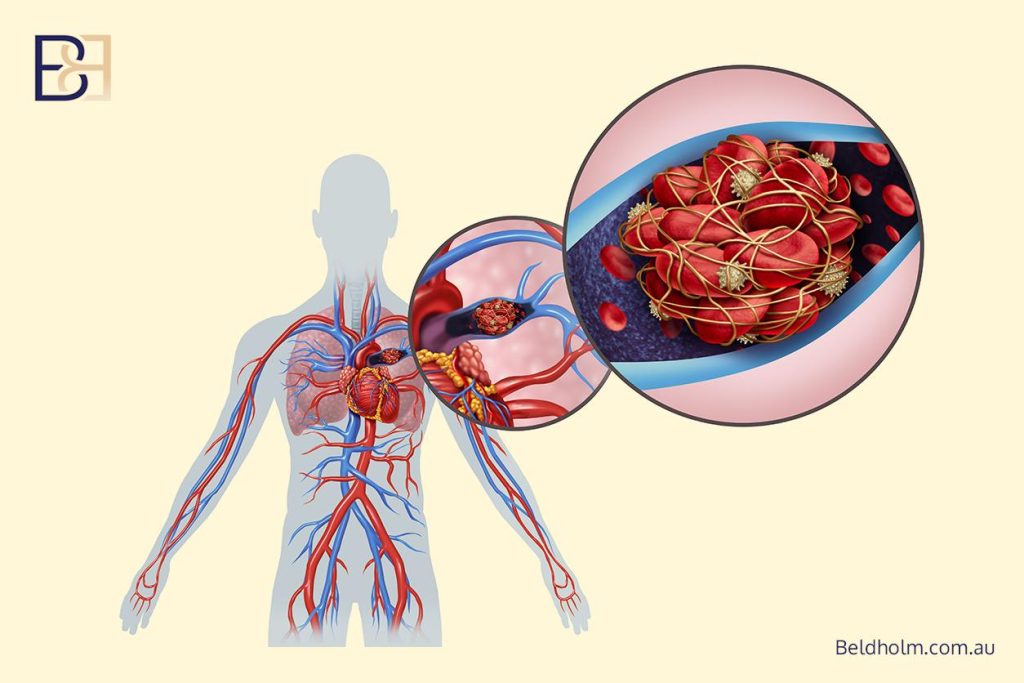
Longer operations are associated with an increased risk of complications such as deep vein thrombosis and blood clots. Preventative measures, including compression devices, early mobilisation, and appropriate perioperative care, are routinely used, but operative duration remains a relevant consideration when planning extensive body contouring surgery.
Impact on Recovery and the Healing Process

The length and extent of surgery influence postoperative recovery. Larger procedures that remove significant amounts of excess skin often involve:
- Longer hospital stays
- Increased need for postoperative support
- A more prolonged healing process
While more extensive abdominoplasty procedures may reduce the need for further surgery, recovery demands are typically greater than with shorter, anterior-only operations.
Balancing the Extent of Surgery and Staging
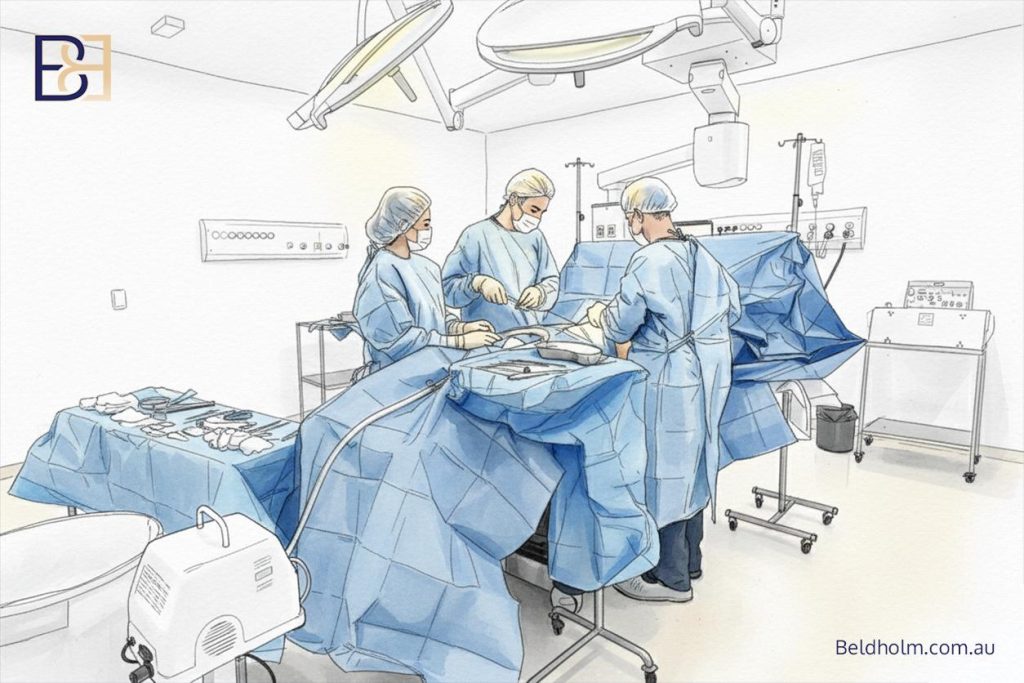
In some post-weight-loss patients, performing a larger single-stage operation can remove more excess skin and reduce the likelihood of additional procedures. In others, staging surgery into separate operations may be more appropriate, particularly when operative time becomes prolonged.
For this reason, decisions about surgical duration are individualised and based on anatomy, medical history, and overall risk profile, rather than a one-size-fits-all approach.
Common Questions About Abdominoplasty After Weight Loss
How long after weight loss can you have an abdominoplasty?
Most patients are considered for abdominoplasty after completing their weight-loss journey and maintaining a stable weight for at least 12 months. This is particularly important following bariatric surgery or major weight loss, as ongoing weight fluctuations can affect surgical planning, recovery, and long-term results. The exact timing is determined during an initial consultation and depends on overall physical health, nutritional status, and medical history.
What factors may disqualify a patient after weight loss?
Not all patients are suitable for abdominoplasty surgery immediately. Factors that may delay or exclude surgery include:
- Ongoing weight loss or significant weight fluctuations
- Poor nutritional status after bariatric surgery
- Uncontrolled medical conditions identified in the medical history
- Smoking or inability to comply with postoperative care requirements
These factors are carefully assessed to reduce the risk of complications.
Does Medicare provide rebates for abdominoplasty after weight loss?
In selected cases, Medicare may rebate abdominoplasty when performed for medical indications, such as functional problems related to excess skin. Eligibility is determined by specific clinical criteria and item numbers and is assessed individually during consultation. Private health insurance may also be relevant in some cases, depending on the indication and level of cover.
Why does post-weight-loss abdominoplasty often take longer than post-pregnancy surgery?
After major or massive weight loss, excess skin is often more extensive, involving multiple regions of the abdomen, flanks, and back. Reduced skin elasticity, previous bariatric surgery, and the need for larger surface-area skin removal contribute to longer operative times compared with post-pregnancy abdominoplasty, where muscle separation (diastasis recti) is often the primary issue.
Final Considerations

Abdominoplasty after major weight loss is not a single procedure but a spectrum of operations tailored to the amount and distribution of excess skin, underlying anatomy, and individual health factors. Understanding how long abdominoplasty surgery may take helps patients make informed decisions about the type and extent of surgery that may be appropriate for their circumstances.
Surgical planning is based on a detailed assessment of anatomy, medical history, previous bariatric or abdominal surgery, and overall physical health. In post‑weight‑loss patients, this often involves balancing the benefits of more comprehensive skin removal against operative time, recovery demands, and the potential need for staged procedures.
All abdominoplasty procedures carry risks, and individual outcomes vary. A consultation with a qualified specialist surgeon is required to determine suitability, discuss operative options, outline expected recovery, and potential complications.